BACIS OF COMMUNICATION
MK : TELEKOMUNIKASI-DIGITAL
ANANG ARIS WIDODO - SKI 2
Magister Teknik Elektro - Universitas Brawijaya
BASIC OF COMMUNICATION
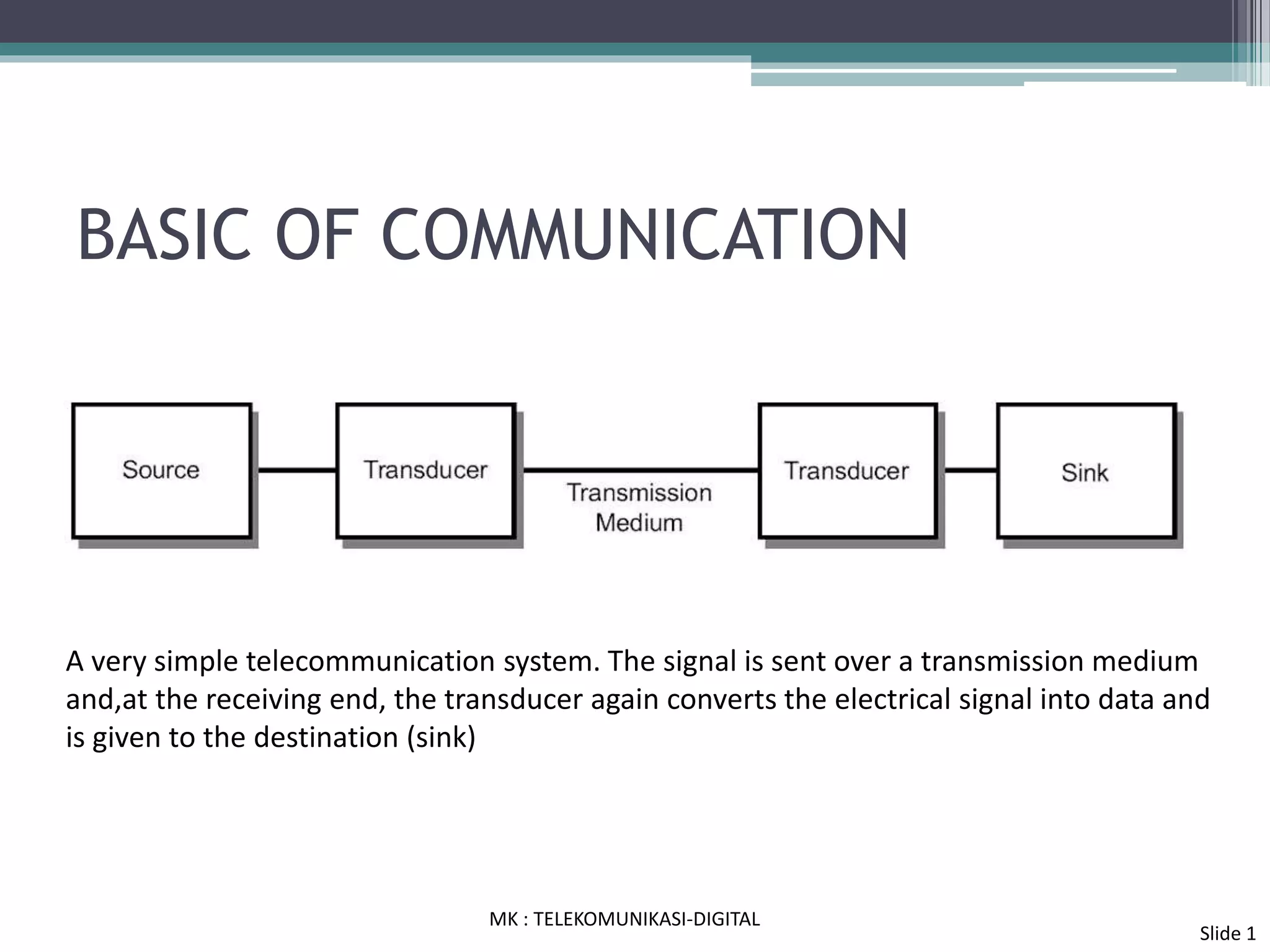
A very simple telecommunication system. The signal is sent over a transmission medium
and,at the receiving end, the transducer again converts the electrical signal into data and
is given to the destination (sink)
Slide 1
MK : TELEKOMUNIKASI-DIGITAL
5 Basic Component
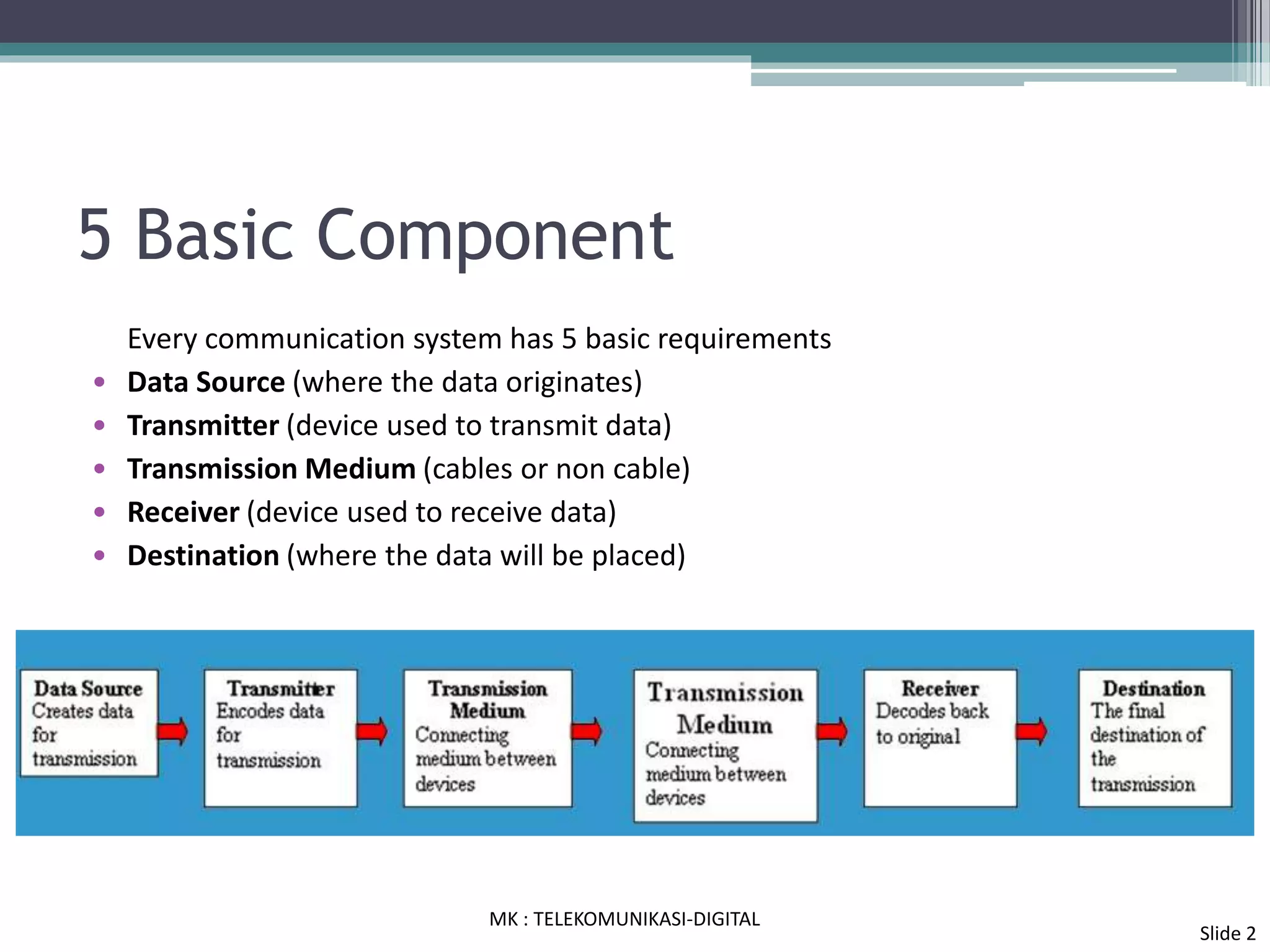
Every communication system has 5 basic requirements
• Data Source (where the data originates)
• Transmitter (device used to transmit data)
• Transmission Medium (cables or non cable)
• Receiver (device used to receive data)
• Destination (where the data will be placed)
Slide 2
MK : TELEKOMUNIKASI-DIGITAL
5 Basic Components
Slide 3
MK : TELEKOMUNIKASI-DIGITAL
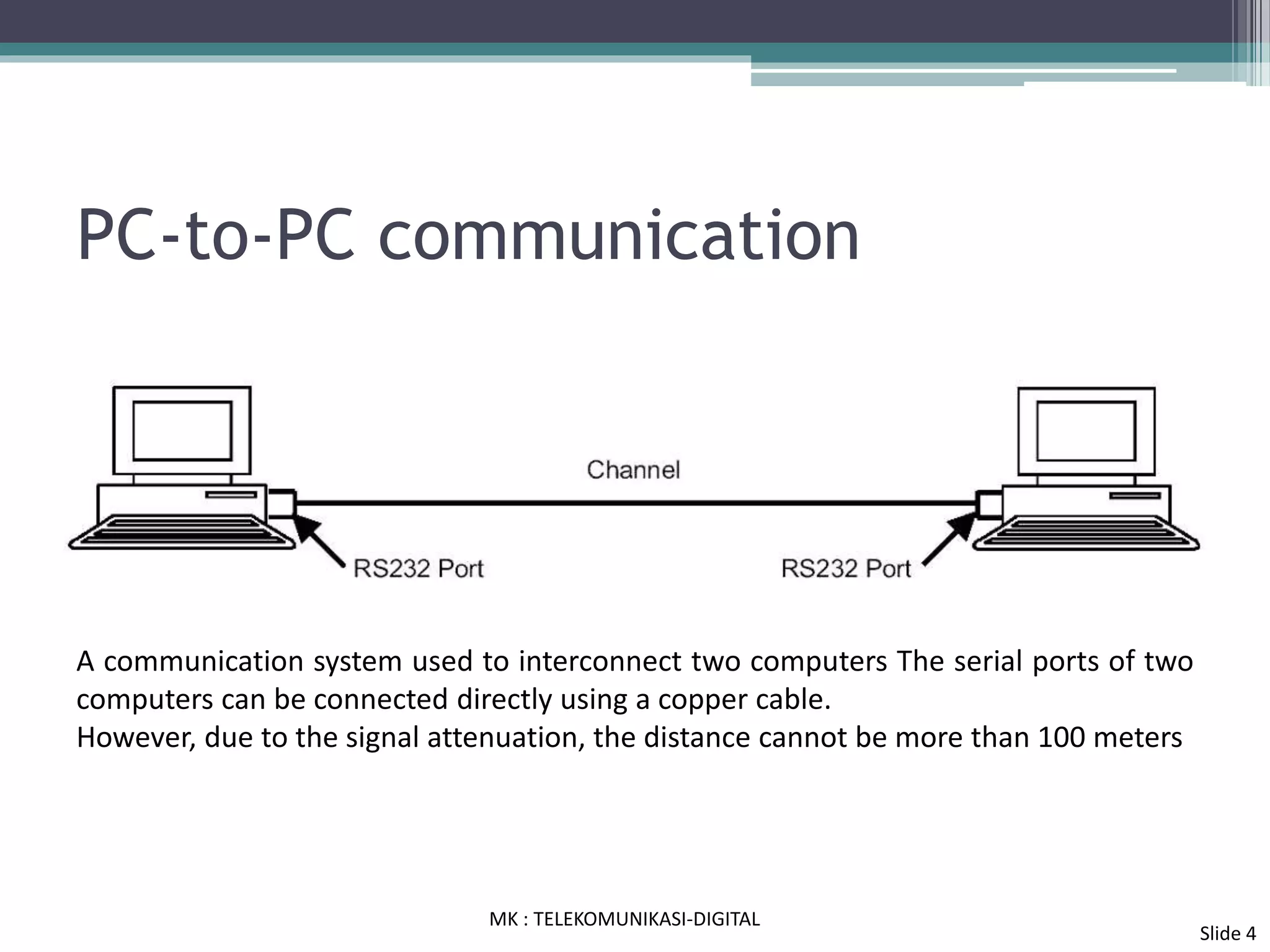
PC-to-PC communication
A communication system used to interconnect two computers The serial ports of two
computers can be connected directly using a copper cable.
However, due to the signal attenuation, the distance cannot be more than 100 meters
MK : TELEKOMUNIKASI-DIGITAL
Slide 4
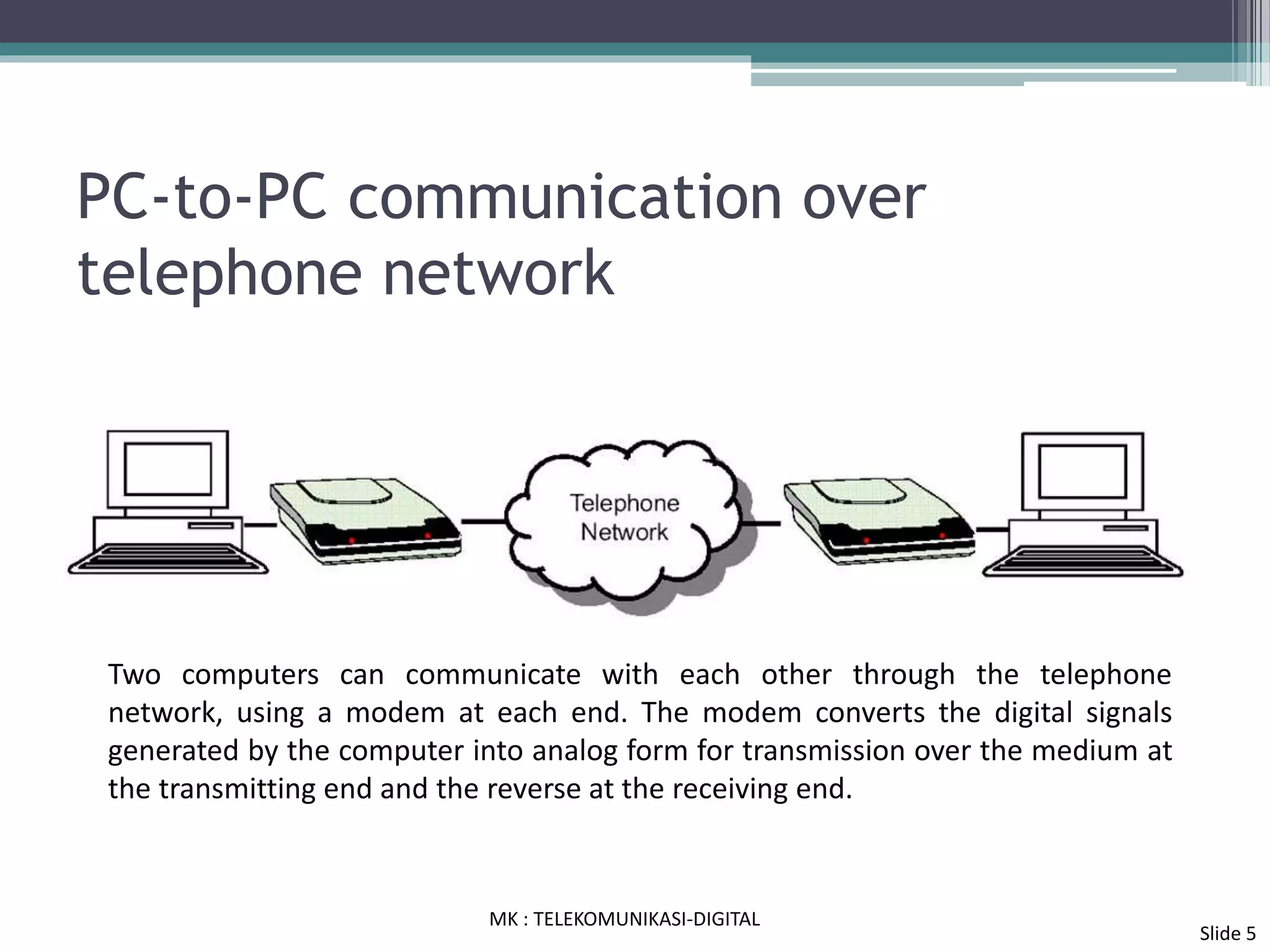
PC-to-PC communication over
telephone network
Two computers can communicate with each other through the telephone
network, using a modem at each end. The modem converts the digital signals
generated by the computer into analog form for transmission over the medium at
the transmitting end and the reverse at the receiving end.
MK : TELEKOMUNIKASI-DIGITAL
Slide 5
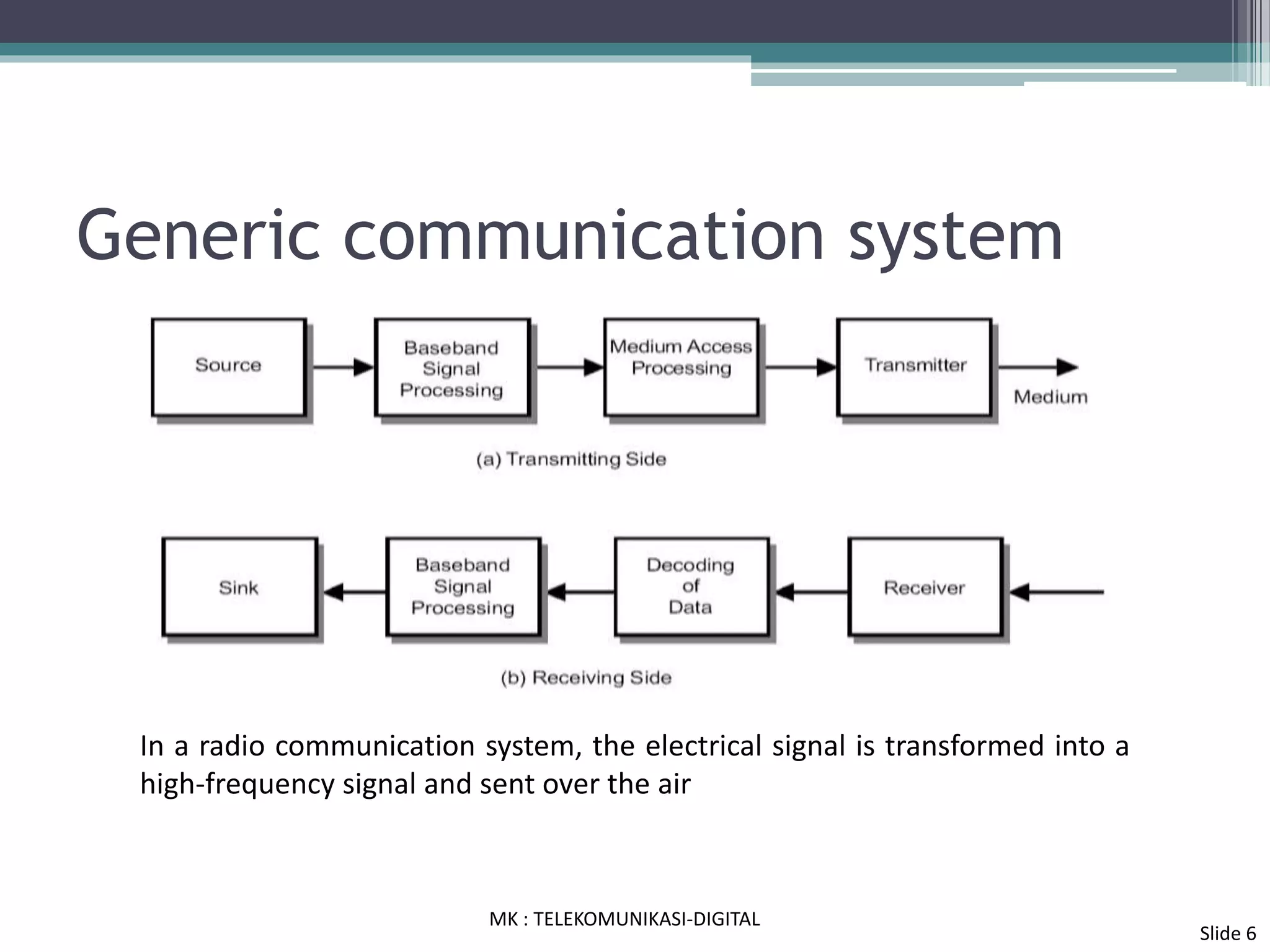
Generic communication system
In a radio communication system, the electrical signal is transformed into a
high-frequency signal and sent over the air
MK : TELEKOMUNIKASI-DIGITAL
Slide 6
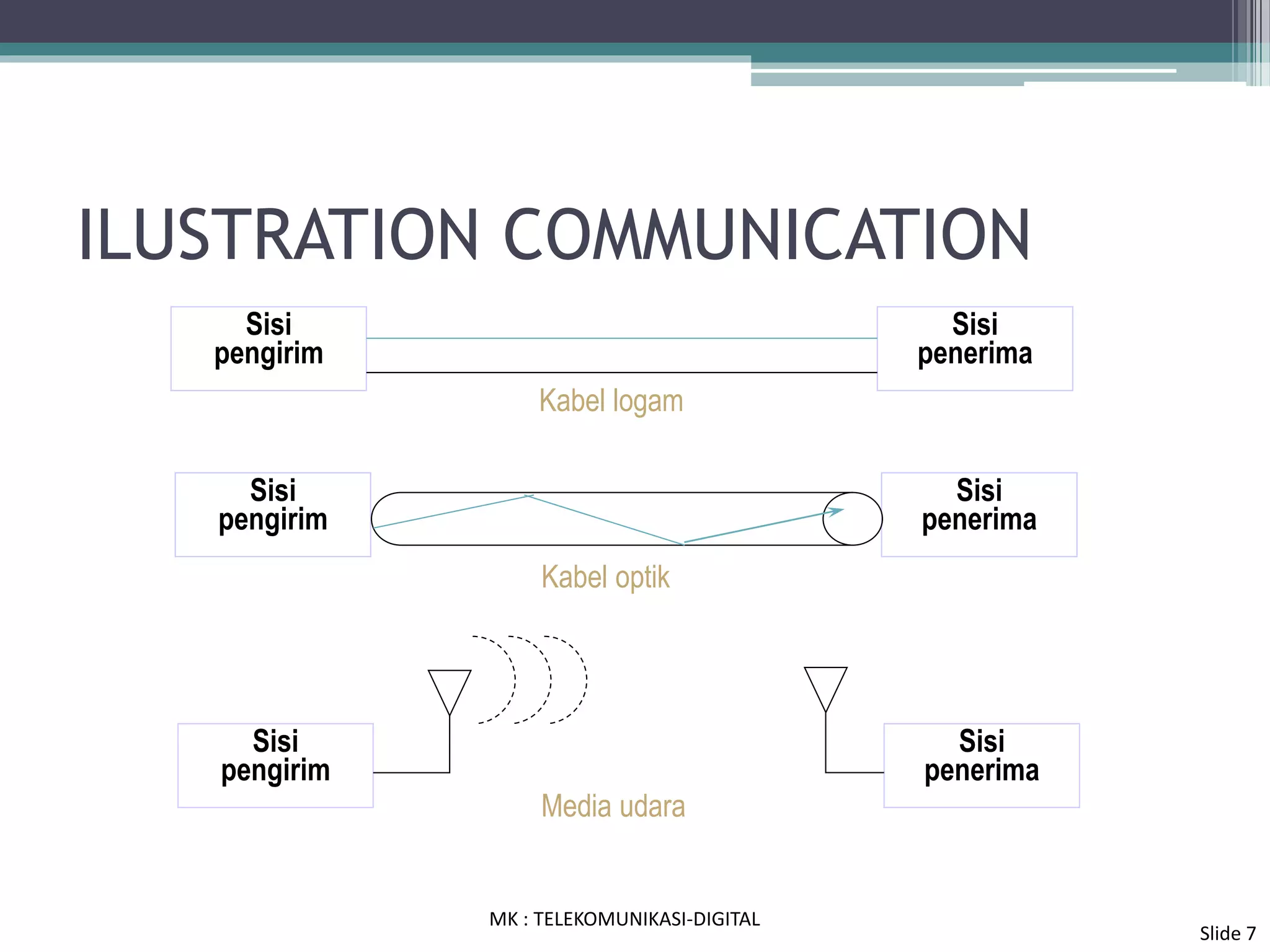
ILUSTRATION COMMUNICATION
Kabel logam
Sisi
pengirim
Sisi
penerima
Media udara
Sisi
pengirim
Sisi
penerima
Sisi
pengirim
Sisi
penerima
Kabel optik
MK : TELEKOMUNIKASI-DIGITAL
Slide 7
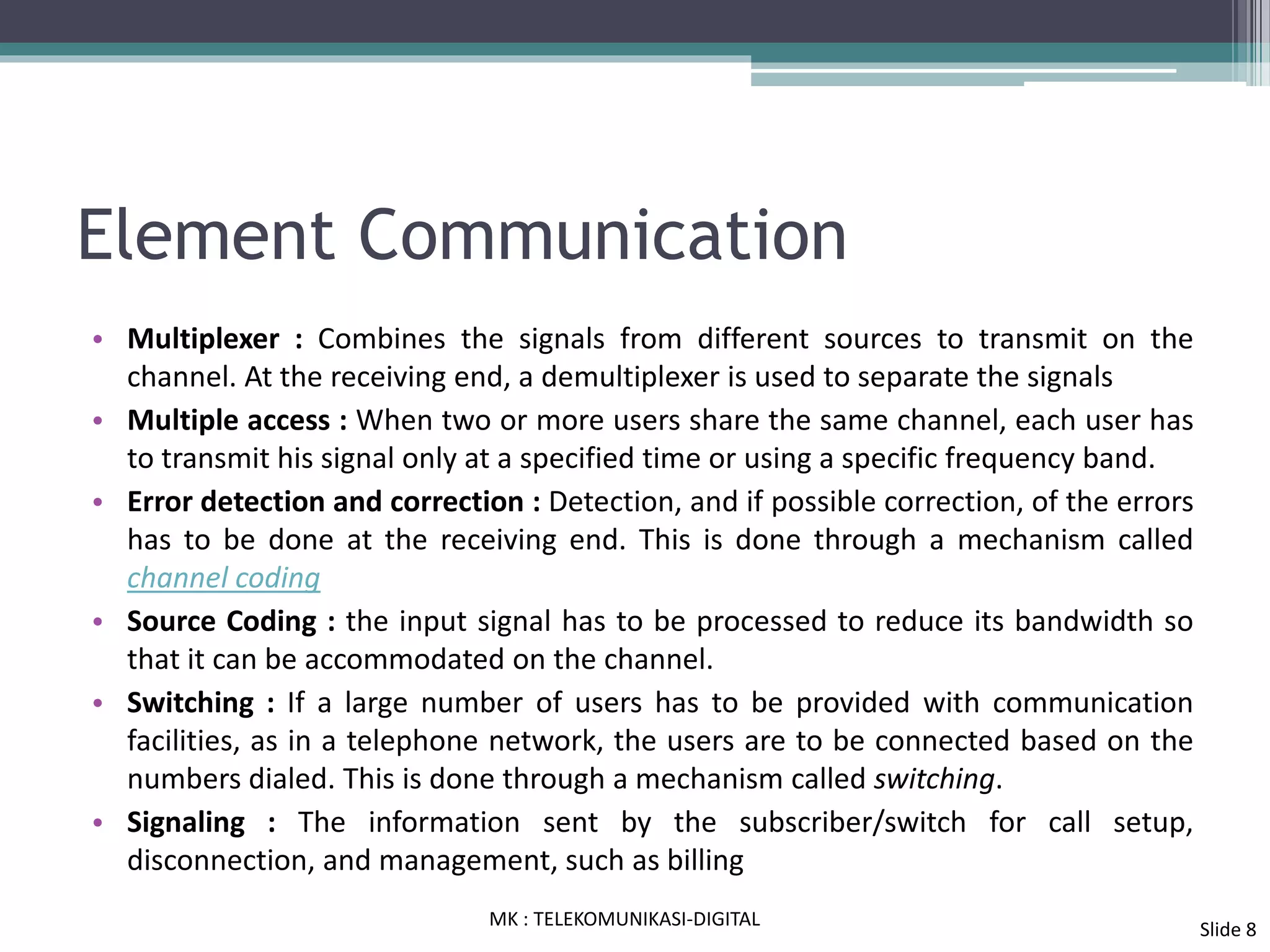
Element Communication
• Multiplexer : Combines the signals from different sources to transmit on the
channel. At the receiving end, a demultiplexer is used to separate the signals
• Multiple access : When two or more users share the same channel, each user has
to transmit his signal only at a specified time or using a specific frequency band.
• Error detection and correction : Detection, and if possible correction, of the errors
has to be done at the receiving end. This is done through a mechanism called
channel coding
• Source Coding : the input signal has to be processed to reduce its bandwidth so
that it can be accommodated on the channel.
• Switching : If a large number of users has to be provided with communication
facilities, as in a telephone network, the users are to be connected based on the
numbers dialed. This is done through a mechanism called switching.
• Signaling : The information sent by the subscriber/switch for call setup,
disconnection, and management, such as billing
MK : TELEKOMUNIKASI-DIGITAL
Slide 8
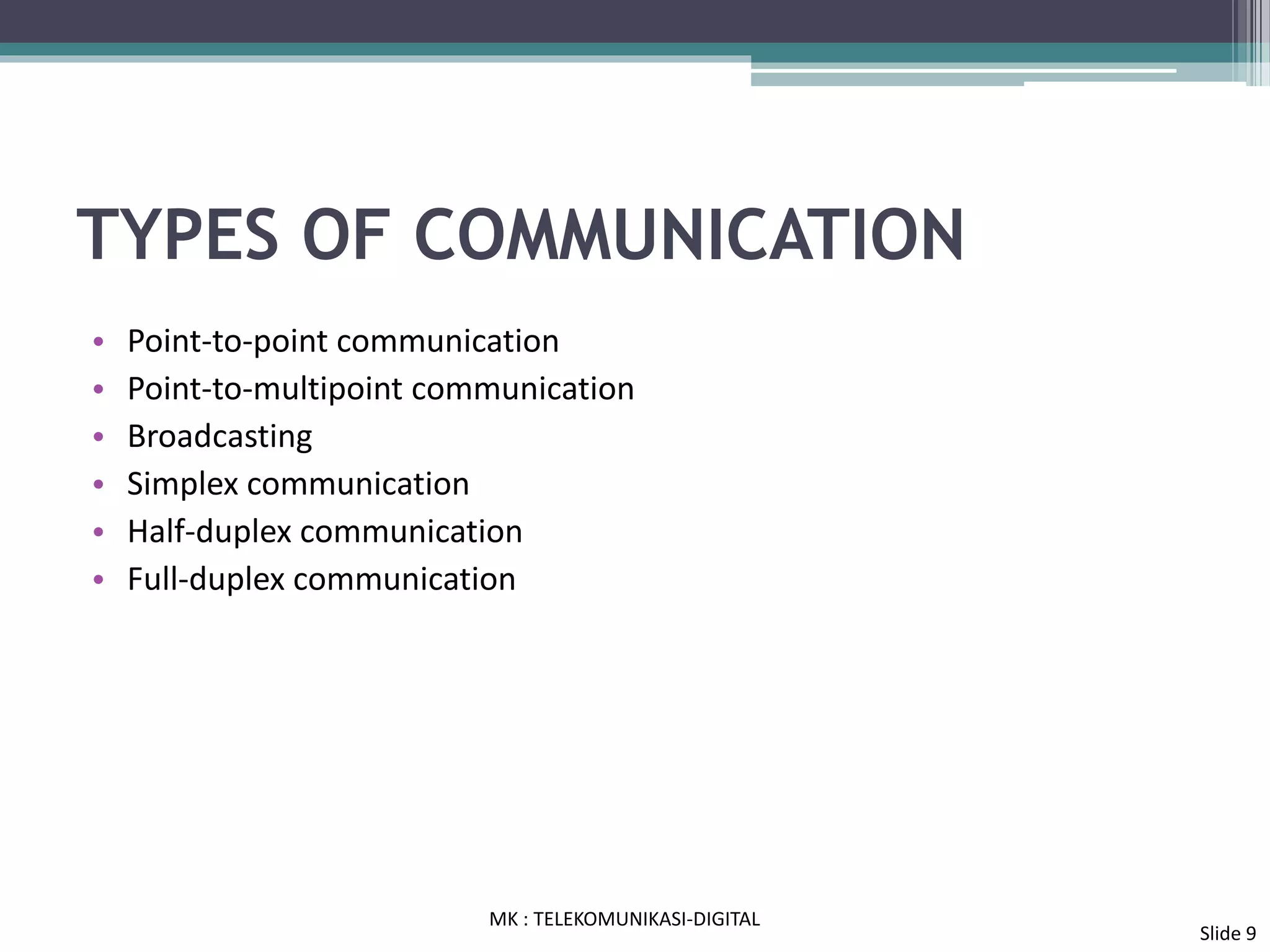
TYPES OF COMMUNICATION
• Point-to-point communication
• Point-to-multipoint communication
• Broadcasting
• Simplex communication
• Half-duplex communication
• Full-duplex communication
MK : TELEKOMUNIKASI-DIGITAL
Slide 9
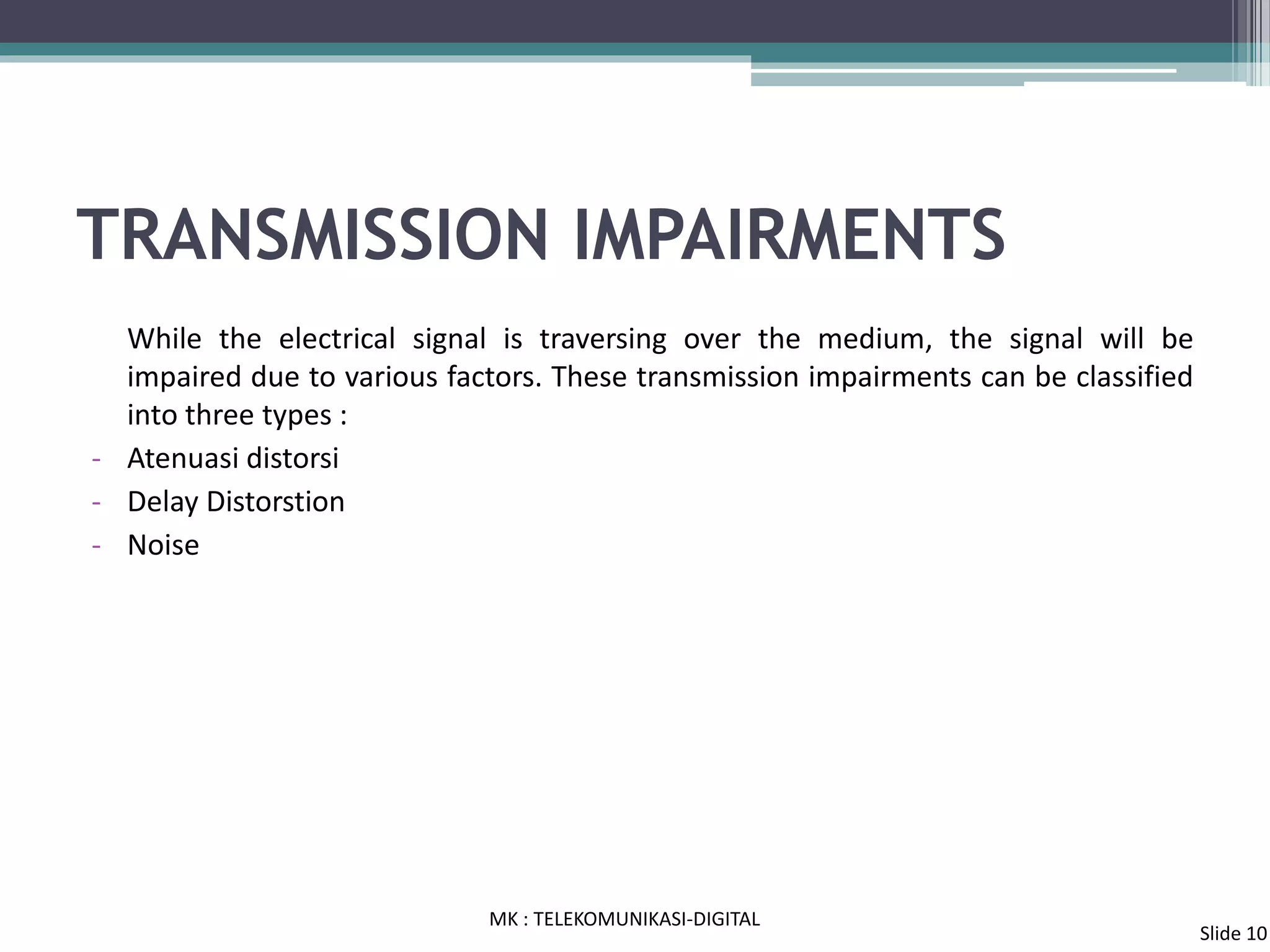
TRANSMISSION IMPAIRMENTS
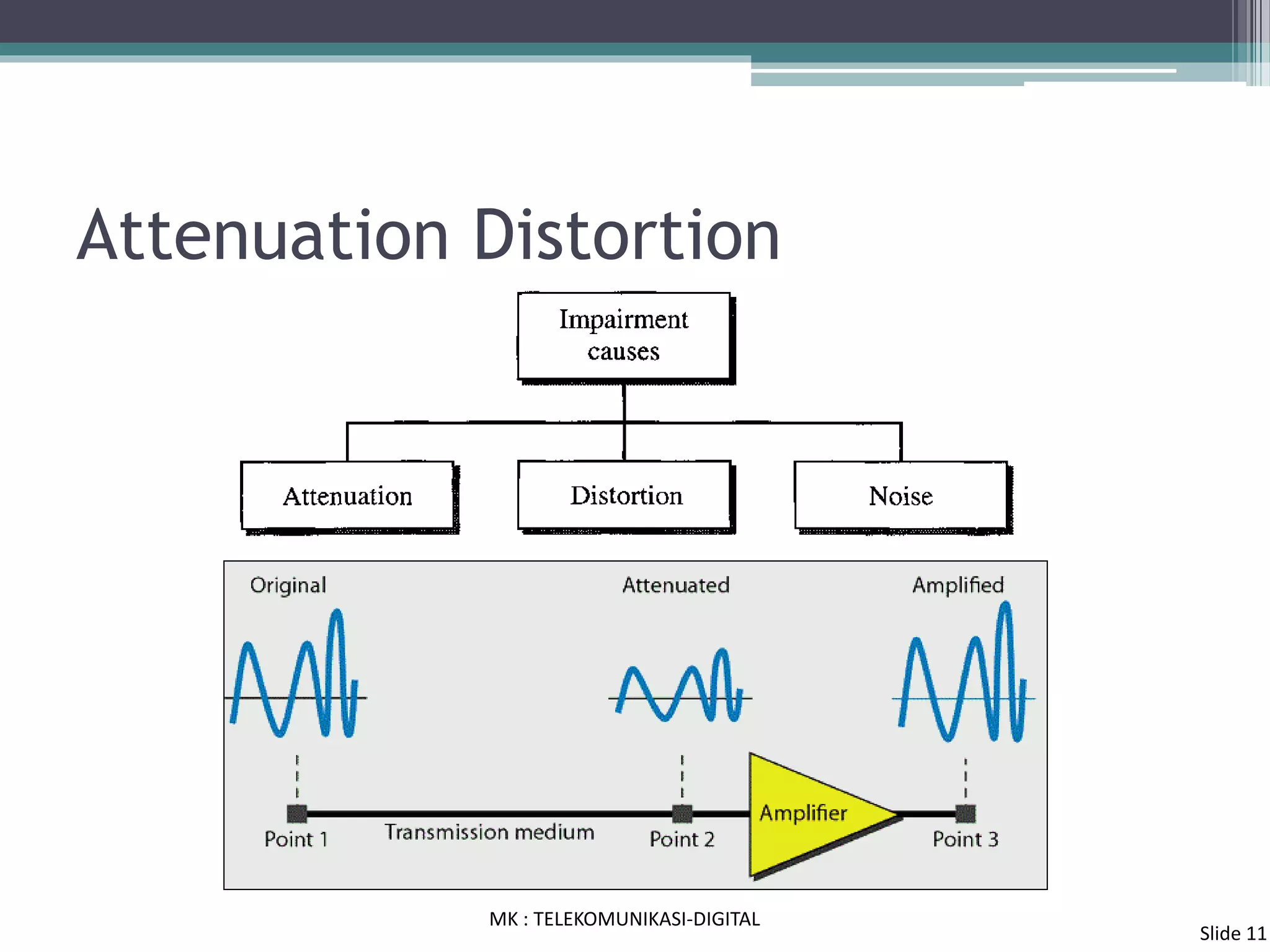
While the electrical signal is traversing over the medium, the signal will be
impaired due to various factors. These transmission impairments can be classified
into three types :
- Atenuasi distorsi
- Delay Distorstion
- Noise
MK : TELEKOMUNIKASI-DIGITAL
Slide 10
Attenuation Distortion
MK : TELEKOMUNIKASI-DIGITAL
Slide 11
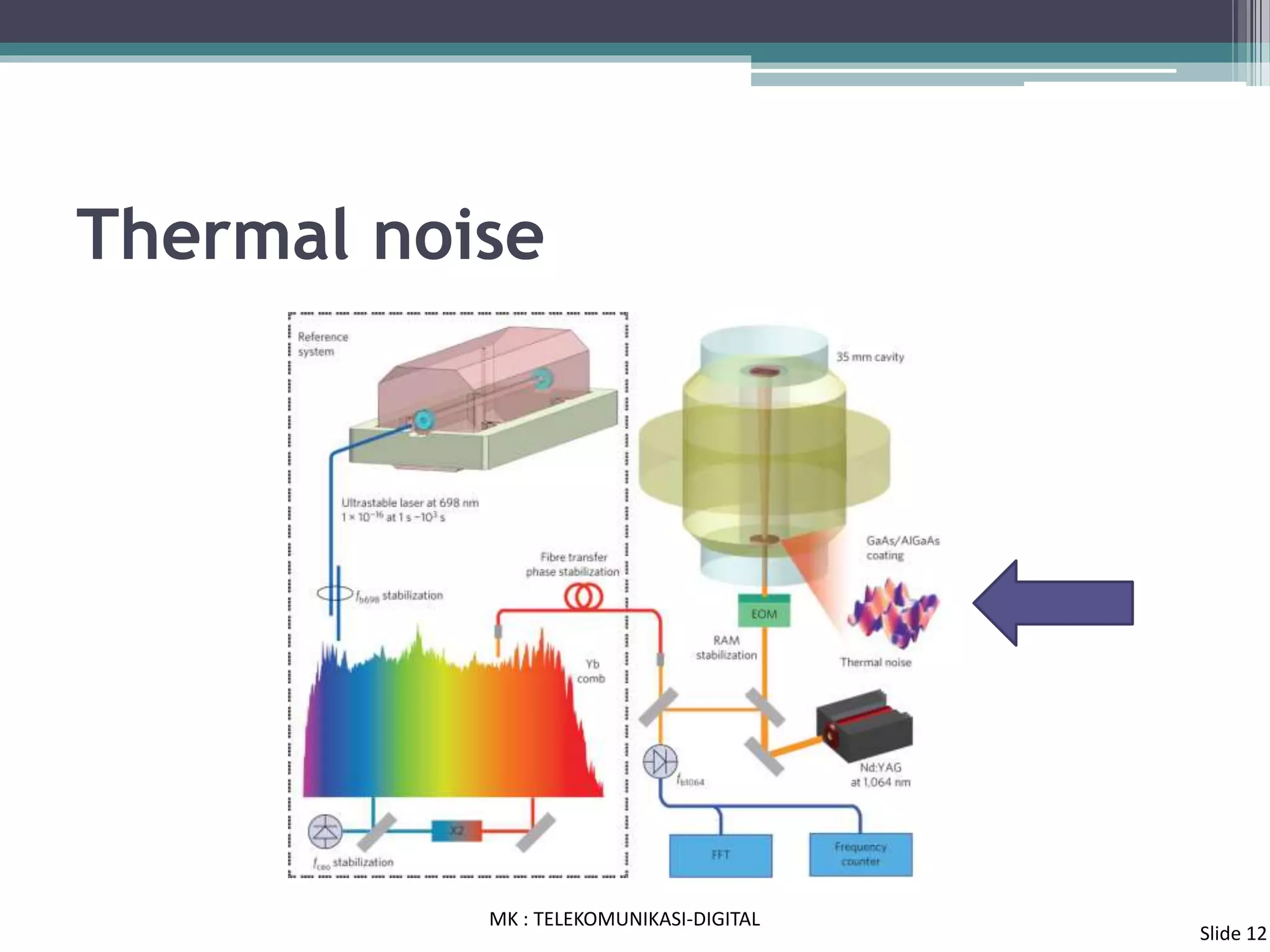
Thermal noise
MK : TELEKOMUNIKASI-DIGITAL
Slide 12
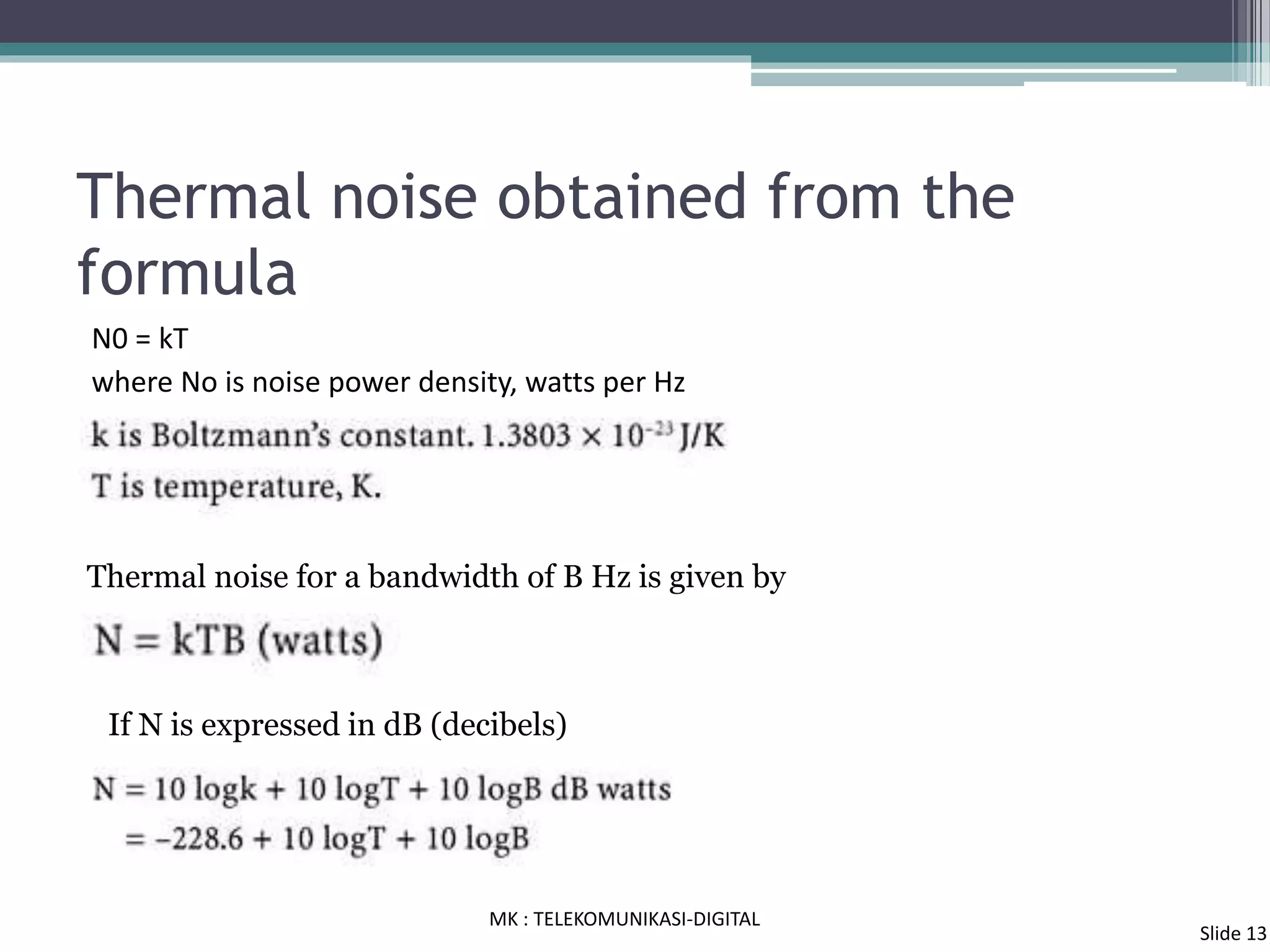
Thermal noise obtained from the
formula
N0 = kT
where No is noise power density, watts per Hz
Thermal noise for a bandwidth of B Hz is given by
If N is expressed in dB (decibels)
MK : TELEKOMUNIKASI-DIGITAL
Slide 13
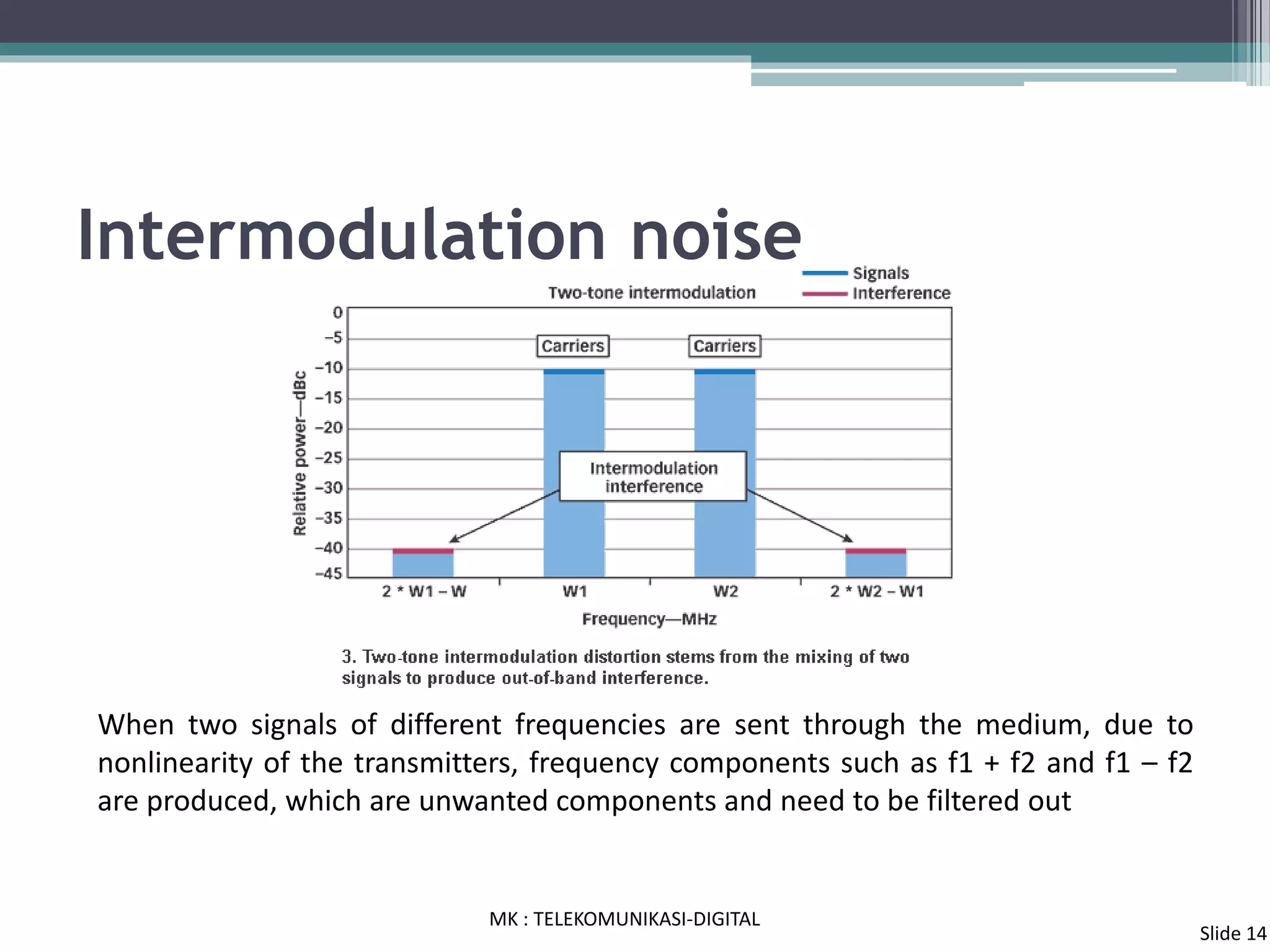
Intermodulation noise
When two signals of different frequencies are sent through the medium, due to
nonlinearity of the transmitters, frequency components such as f1 + f2 and f1 – f2
are produced, which are unwanted components and need to be filtered out
MK : TELEKOMUNIKASI-DIGITAL
Slide 14
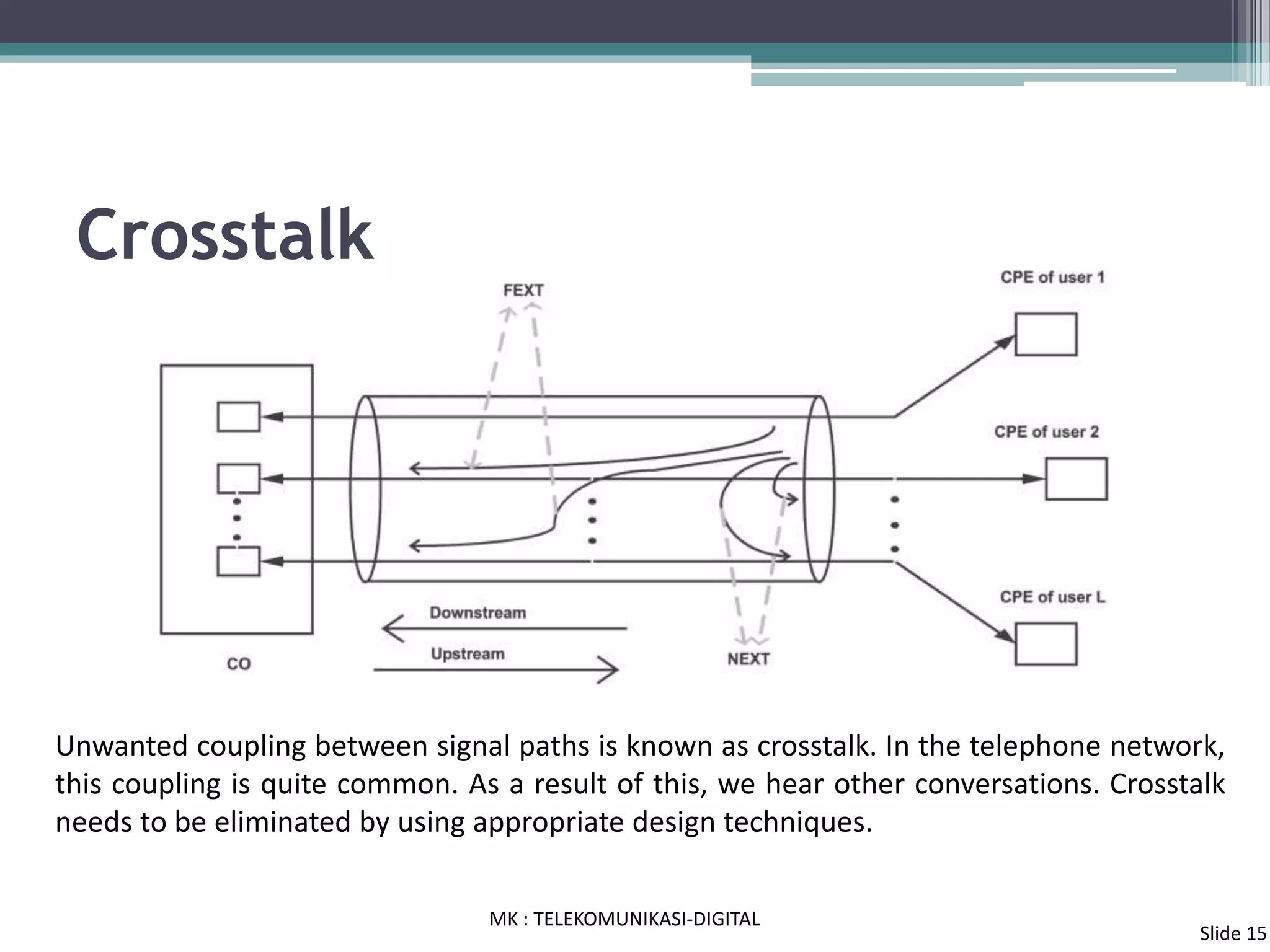
Crosstalk
Unwanted coupling between signal paths is known as crosstalk. In the telephone network,
this coupling is quite common. As a result of this, we hear other conversations. Crosstalk
needs to be eliminated by using appropriate design techniques.
MK : TELEKOMUNIKASI-DIGITAL
Slide 15
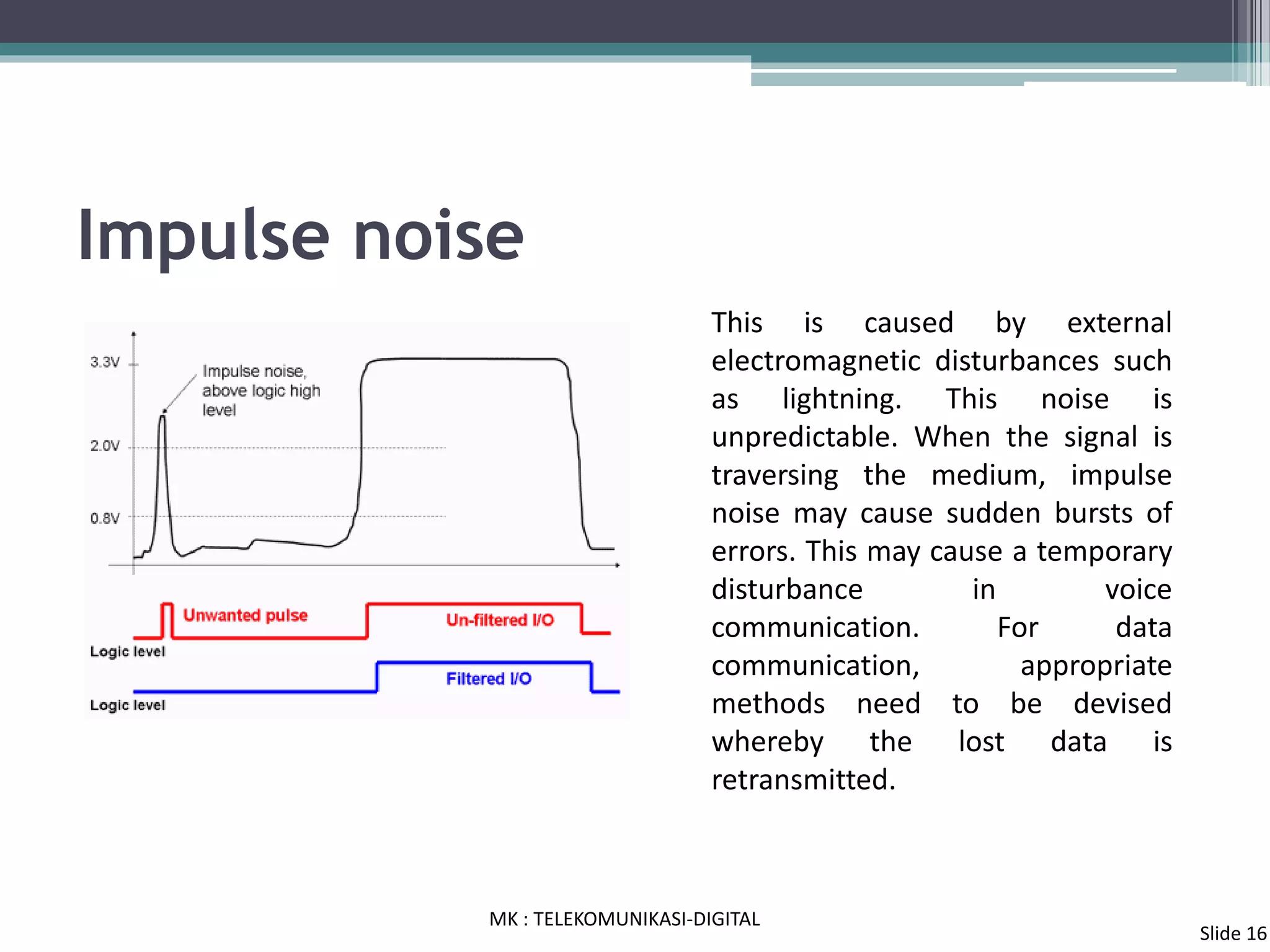
Impulse noise
This is caused by external
electromagnetic disturbances such
as lightning. This noise is
unpredictable. When the signal is
traversing the medium, impulse
noise may cause sudden bursts of
errors. This may cause a temporary
disturbance in voice
communication. For data
communication, appropriate
methods need to be devised
whereby the lost data is
retransmitted.
MK : TELEKOMUNIKASI-DIGITAL
Slide 16
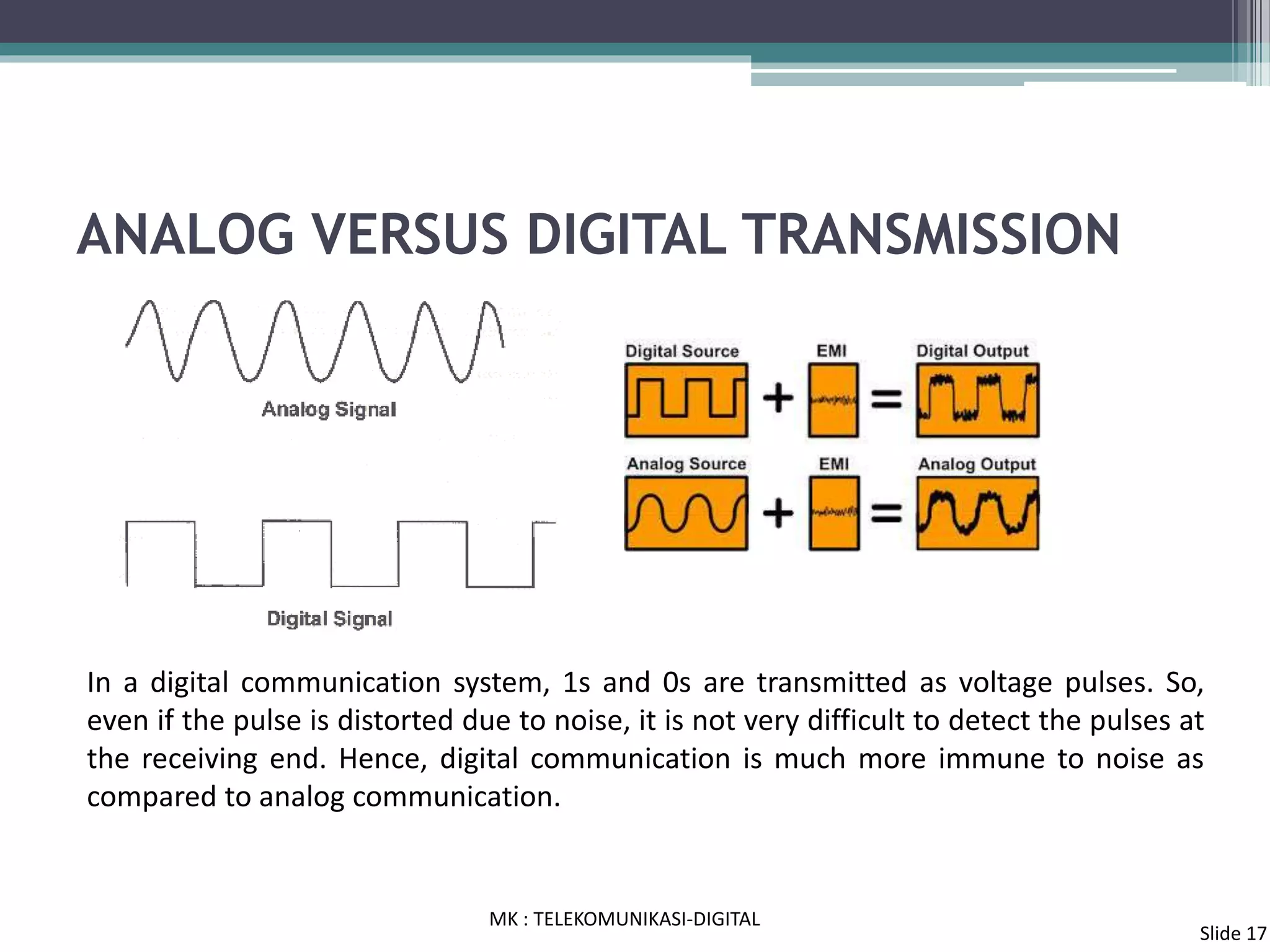
ANALOG VERSUS DIGITAL TRANSMISSION
In a digital communication system, 1s and 0s are transmitted as voltage pulses. So,
even if the pulse is distorted due to noise, it is not very difficult to detect the pulses at
the receiving end. Hence, digital communication is much more immune to noise as
compared to analog communication.
MK : TELEKOMUNIKASI-DIGITAL
Slide 17
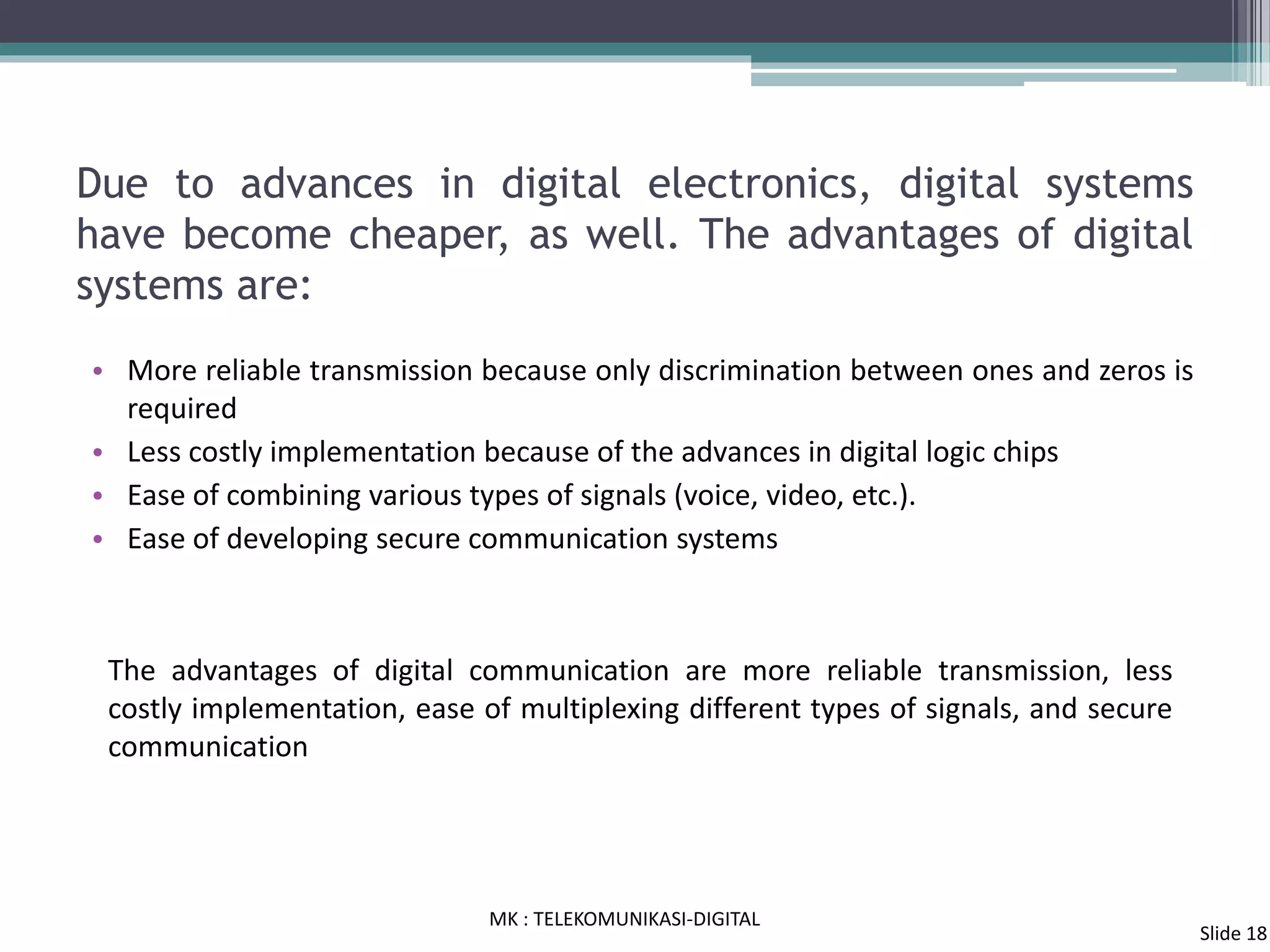
Due to advances in digital electronics, digital systems
have become cheaper, as well. The advantages of digital
systems are:
• More reliable transmission because only discrimination between ones and zeros is
required
• Less costly implementation because of the advances in digital logic chips
• Ease of combining various types of signals (voice, video, etc.).
• Ease of developing secure communication systems
The advantages of digital communication are more reliable transmission, less
costly implementation, ease of multiplexing different types of signals, and secure
communication
MK : TELEKOMUNIKASI-DIGITAL
Slide 18
Questions
• What are the advantages of digital communication over analog communication?
• Explain the different types of communication systems.
• What are the different types of transmission impairments?
• What is multiplexing?
• What is multiple access?
• What is signaling?
MK : TELEKOMUNIKASI-DIGITAL
Slide 19
References
• G. Kennedy and B. Davis. Electronic Communication Systems. Tata McGraw-Hill
Publishing Company Limited, 1993.
• R. Horak. Communication Systems and Networks. Wiley-Dreamtech India Pvt. Ltd.,
2002.
CP : anangariswidodo@gmail.com
MK : TELEKOMUNIKASI-DIGITAL
Slide 20

Chapter 1 - Digital Telecommunication

  • 1.
    BACIS OF COMMUNICATION MK: TELEKOMUNIKASI-DIGITAL ANANG ARIS WIDODO - SKI 2 Magister Teknik Elektro - Universitas Brawijaya
  • 2.
    BASIC OF COMMUNICATION Avery simple telecommunication system. The signal is sent over a transmission medium and,at the receiving end, the transducer again converts the electrical signal into data and is given to the destination (sink) Slide 1 MK : TELEKOMUNIKASI-DIGITAL
  • 3.
    5 Basic Component Everycommunication system has 5 basic requirements • Data Source (where the data originates) • Transmitter (device used to transmit data) • Transmission Medium (cables or non cable) • Receiver (device used to receive data) • Destination (where the data will be placed) Slide 2 MK : TELEKOMUNIKASI-DIGITAL
  • 4.
    5 Basic Components Slide3 MK : TELEKOMUNIKASI-DIGITAL
  • 5.
    PC-to-PC communication A communicationsystem used to interconnect two computers The serial ports of two computers can be connected directly using a copper cable. However, due to the signal attenuation, the distance cannot be more than 100 meters MK : TELEKOMUNIKASI-DIGITAL Slide 4
  • 6.
    PC-to-PC communication over telephonenetwork Two computers can communicate with each other through the telephone network, using a modem at each end. The modem converts the digital signals generated by the computer into analog form for transmission over the medium at the transmitting end and the reverse at the receiving end. MK : TELEKOMUNIKASI-DIGITAL Slide 5
  • 7.
    Generic communication system Ina radio communication system, the electrical signal is transformed into a high-frequency signal and sent over the air MK : TELEKOMUNIKASI-DIGITAL Slide 6
  • 8.
    ILUSTRATION COMMUNICATION Kabel logam Sisi pengirim Sisi penerima Mediaudara Sisi pengirim Sisi penerima Sisi pengirim Sisi penerima Kabel optik MK : TELEKOMUNIKASI-DIGITAL Slide 7
  • 9.
    Element Communication • Multiplexer: Combines the signals from different sources to transmit on the channel. At the receiving end, a demultiplexer is used to separate the signals • Multiple access : When two or more users share the same channel, each user has to transmit his signal only at a specified time or using a specific frequency band. • Error detection and correction : Detection, and if possible correction, of the errors has to be done at the receiving end. This is done through a mechanism called channel coding • Source Coding : the input signal has to be processed to reduce its bandwidth so that it can be accommodated on the channel. • Switching : If a large number of users has to be provided with communication facilities, as in a telephone network, the users are to be connected based on the numbers dialed. This is done through a mechanism called switching. • Signaling : The information sent by the subscriber/switch for call setup, disconnection, and management, such as billing MK : TELEKOMUNIKASI-DIGITAL Slide 8
  • 10.
    TYPES OF COMMUNICATION •Point-to-point communication • Point-to-multipoint communication • Broadcasting • Simplex communication • Half-duplex communication • Full-duplex communication MK : TELEKOMUNIKASI-DIGITAL Slide 9
  • 11.
    TRANSMISSION IMPAIRMENTS While theelectrical signal is traversing over the medium, the signal will be impaired due to various factors. These transmission impairments can be classified into three types : - Atenuasi distorsi - Delay Distorstion - Noise MK : TELEKOMUNIKASI-DIGITAL Slide 10
  • 12.
    Attenuation Distortion MK :TELEKOMUNIKASI-DIGITAL Slide 11
  • 13.
    Thermal noise MK :TELEKOMUNIKASI-DIGITAL Slide 12
  • 14.
    Thermal noise obtainedfrom the formula N0 = kT where No is noise power density, watts per Hz Thermal noise for a bandwidth of B Hz is given by If N is expressed in dB (decibels) MK : TELEKOMUNIKASI-DIGITAL Slide 13
  • 15.
    Intermodulation noise When twosignals of different frequencies are sent through the medium, due to nonlinearity of the transmitters, frequency components such as f1 + f2 and f1 – f2 are produced, which are unwanted components and need to be filtered out MK : TELEKOMUNIKASI-DIGITAL Slide 14
  • 16.
    Crosstalk Unwanted coupling betweensignal paths is known as crosstalk. In the telephone network, this coupling is quite common. As a result of this, we hear other conversations. Crosstalk needs to be eliminated by using appropriate design techniques. MK : TELEKOMUNIKASI-DIGITAL Slide 15
  • 17.
    Impulse noise This iscaused by external electromagnetic disturbances such as lightning. This noise is unpredictable. When the signal is traversing the medium, impulse noise may cause sudden bursts of errors. This may cause a temporary disturbance in voice communication. For data communication, appropriate methods need to be devised whereby the lost data is retransmitted. MK : TELEKOMUNIKASI-DIGITAL Slide 16
  • 18.
    ANALOG VERSUS DIGITALTRANSMISSION In a digital communication system, 1s and 0s are transmitted as voltage pulses. So, even if the pulse is distorted due to noise, it is not very difficult to detect the pulses at the receiving end. Hence, digital communication is much more immune to noise as compared to analog communication. MK : TELEKOMUNIKASI-DIGITAL Slide 17
  • 19.
    Due to advancesin digital electronics, digital systems have become cheaper, as well. The advantages of digital systems are: • More reliable transmission because only discrimination between ones and zeros is required • Less costly implementation because of the advances in digital logic chips • Ease of combining various types of signals (voice, video, etc.). • Ease of developing secure communication systems The advantages of digital communication are more reliable transmission, less costly implementation, ease of multiplexing different types of signals, and secure communication MK : TELEKOMUNIKASI-DIGITAL Slide 18
  • 20.
    Questions • What arethe advantages of digital communication over analog communication? • Explain the different types of communication systems. • What are the different types of transmission impairments? • What is multiplexing? • What is multiple access? • What is signaling? MK : TELEKOMUNIKASI-DIGITAL Slide 19
  • 21.
    References • G. Kennedyand B. Davis. Electronic Communication Systems. Tata McGraw-Hill Publishing Company Limited, 1993. • R. Horak. Communication Systems and Networks. Wiley-Dreamtech India Pvt. Ltd., 2002. CP : anangariswidodo@gmail.com MK : TELEKOMUNIKASI-DIGITAL Slide 20