Distributed DBMS


By :-Bharat P. Patil   Bihag Mehta
     Ronak Thakkar     Prashant Jaiswal
DISTRIBUTED DBMS
 Database:- Logical interrelated
  collection of shared data, along with
  description of data, physically
  distributed over a computer network.
 DBMS:- The software system that
  permits the management of the
  distributed database and makes the
  distribution transparent to users
DISTRIBUTED DBMS
CONCEPTS

TWO types of Applications

• Local application : Application that do not required
data from other sites.

• Global application : Application that required data
from other sites.
CONCEPTS
Characteristics DDBMS

• A collection of logically related shared data.


• Data is split into a number of fragments.


• Fragments are replicated.


•Fragments/ replicas are allocated to sites.
CONCEPTS
Characteristics Of DDBMS

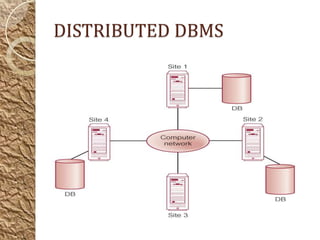
• Sites are linked by a communication network.


• Data at each site is in the control of a DBMS.


•DBMS at each site can handle local
 applications

• Each DBMS participates in at least one global
application
Concepts
Properties of DDBMS

• Distributed Data Independence : Users should
not have to know where data is located (extends
Physical and Logical Data Independence
principles).

•Distributed Transaction Atomicity : Users should
be able to write Xacts accessing multiple sites just
like local Xacts.
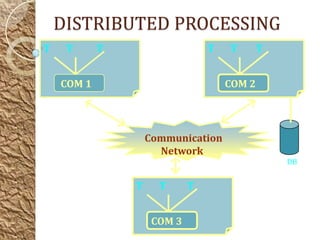
DISTRIBUTED PROCESSING
T    T      T                    T   T       T


    COM 1                            COM 2


                    Communication
                      Network
                                                 DB


                T     T      T


                     COM 3
ADVANTAGES
•Reflects organizational structure

•Improved shareability and local autonomy

•Improved availability

•Improved reliability

•Improved performance

•Economics

•Modular growth
DISADVANTAGES
•Complexity

•Cost

•Security

•Integrity control more difficult

•Lack of standards

•Lack of experience

•Database design more complex
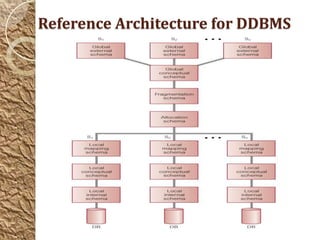
Reference Architecture for DDBMS
 Due to diversity, no accepted architecture
  equivalent     to     ANSI/SPARC      3-level
  architecture.
 A reference architecture consists of:
    ◦   Set of global external schemas.
    ◦   Global conceptual schema (GCS).
    ◦   Fragmentation schema and allocation schema.
    ◦   Set of schemas for each local DBMS conforming to 3-level
        ANSI/SPARC .
 Some levels may be missing, depending on
  levels of transparency supported.
 Can be homogeneous or heterogeneous
Reference Architecture for DDBMS
TYPE OF DDBMS
• Homogeneous   DDBMS

• All sites use same DBMS product.


• Heterogeneous DDBMS


• All sites use different DBMS product.
COMPONENET ARCHITECTURE
FOR DDBMS
•   Local DBMS

•   Data Communication Component

•   Global System Catalog

•   Distributed DBMS component
DISTRIBUTED DATABASE DESIGN
AND TECHNIQUE
•   Fragmentation: that are used to break up
    the database into logical units,called
    fragments.

•   Replication: which permits certain data to
    be stored in more than one site.

•   Allocation: process of allocating fragments
    or replicas of fragments for storage at the
    various site.
TYPES OF FRAGMENTATION
• Horizontal fragment of a relation is a subset of the
  tuples in that relation.

• Vertical fragment of a relation keeps only
  certain attributes of a relation.

• Mixed – both horizontal and vertical.
• Derived – natural join first to get additional
information required then fragment.

• Must be able to reconstruct original table.
• Can query and update through fragment.
FRAGMENTATION
• Strategize to achieve:
 •   Locality of Reference
 •   Improved Reliability and Availability
 •   Improved Performance
 •   Balanced Storage Capacities and Costs
 •   Minimal Communication Costs.


• Quantitative and quantitative information

• Correctness of Fragmentation
  • Completeness
  • Reconstruction
  • Disjointness.
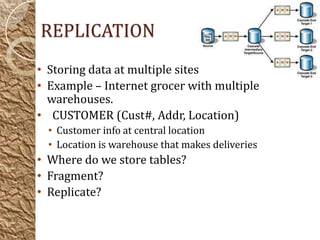
REPLICATION
• Storing data at multiple sites
• Example – Internet grocer with multiple
  warehouses.
• CUSTOMER (Cust#, Addr, Location)
  • Customer info at central location
  • Location is warehouse that makes deliveries
• Where do we store tables?
• Fragment?
• Replicate?
TRANSPERENCIES IN DDBMS
•   Transparencies hide implementation details
    from the user

•   Example in Centralized databases : Data
    independence

•   Main types of transparencies in

•   DDBMS:Distributed Transparency

•   Transaction Transparency
DISTRIBUTED TRANSPARENCY
Allows the user to see the database as a
single, logical entity.

If this transparency is exhibited then the
user does not need to know that

1. The data are partitioned.
2. Data can be replicated at several sites.
3. Data location.
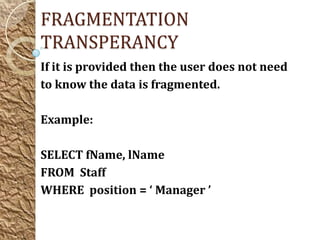
FRAGMENTATION
TRANSPERANCY
If it is provided then the user does not need
to know the data is fragmented.

Example:

SELECT fName, lName
FROM Staff
WHERE position = ‘ Manager ’
TRANSACTION TRANSPARENCY

•   It maintains distributed database’s integrity
    and consistency.
PARALLEL DBMS

A DBMS running across multiple processors
and disks that has been designed to execute
operations in parallel, whenever possible, in
order to improve performance.
Date’s 12 Rules for a DDBMS
Fundamental Principle
To the user, a distributed system should look
  exactly like a non distributed system.
1.        Local Autonomy
2.        No Reliance on a Central Site
3.        Continuous Operation
4.        Location Independence
5.        Fragmentation Independence
6.        Replication Independence
Date’s 12 Rules for a DDBMS
7. Distributed Query Processing
8. Distributed Transaction Processing
9. Hardware Independence
10. Operating System Independence
11. Network Independence
12. Database Independence

   Last four rules are ideals.
Distributed dbms

Distributed dbms

  • 1.
    Distributed DBMS By :-BharatP. Patil Bihag Mehta Ronak Thakkar Prashant Jaiswal
  • 2.
    DISTRIBUTED DBMS  Database:-Logical interrelated collection of shared data, along with description of data, physically distributed over a computer network.  DBMS:- The software system that permits the management of the distributed database and makes the distribution transparent to users
  • 3.
  • 4.
    CONCEPTS TWO types ofApplications • Local application : Application that do not required data from other sites. • Global application : Application that required data from other sites.
  • 5.
    CONCEPTS Characteristics DDBMS • Acollection of logically related shared data. • Data is split into a number of fragments. • Fragments are replicated. •Fragments/ replicas are allocated to sites.
  • 6.
    CONCEPTS Characteristics Of DDBMS •Sites are linked by a communication network. • Data at each site is in the control of a DBMS. •DBMS at each site can handle local applications • Each DBMS participates in at least one global application
  • 7.
    Concepts Properties of DDBMS •Distributed Data Independence : Users should not have to know where data is located (extends Physical and Logical Data Independence principles). •Distributed Transaction Atomicity : Users should be able to write Xacts accessing multiple sites just like local Xacts.
  • 8.
    DISTRIBUTED PROCESSING T T T T T T COM 1 COM 2 Communication Network DB T T T COM 3
  • 9.
    ADVANTAGES •Reflects organizational structure •Improvedshareability and local autonomy •Improved availability •Improved reliability •Improved performance •Economics •Modular growth
  • 10.
    DISADVANTAGES •Complexity •Cost •Security •Integrity control moredifficult •Lack of standards •Lack of experience •Database design more complex
  • 11.
    Reference Architecture forDDBMS  Due to diversity, no accepted architecture equivalent to ANSI/SPARC 3-level architecture.  A reference architecture consists of: ◦ Set of global external schemas. ◦ Global conceptual schema (GCS). ◦ Fragmentation schema and allocation schema. ◦ Set of schemas for each local DBMS conforming to 3-level ANSI/SPARC .  Some levels may be missing, depending on levels of transparency supported.  Can be homogeneous or heterogeneous
  • 12.
  • 13.
    TYPE OF DDBMS •Homogeneous DDBMS • All sites use same DBMS product. • Heterogeneous DDBMS • All sites use different DBMS product.
  • 14.
    COMPONENET ARCHITECTURE FOR DDBMS • Local DBMS • Data Communication Component • Global System Catalog • Distributed DBMS component
  • 15.
    DISTRIBUTED DATABASE DESIGN ANDTECHNIQUE • Fragmentation: that are used to break up the database into logical units,called fragments. • Replication: which permits certain data to be stored in more than one site. • Allocation: process of allocating fragments or replicas of fragments for storage at the various site.
  • 16.
    TYPES OF FRAGMENTATION •Horizontal fragment of a relation is a subset of the tuples in that relation. • Vertical fragment of a relation keeps only certain attributes of a relation. • Mixed – both horizontal and vertical. • Derived – natural join first to get additional information required then fragment. • Must be able to reconstruct original table. • Can query and update through fragment.
  • 17.
    FRAGMENTATION • Strategize toachieve: • Locality of Reference • Improved Reliability and Availability • Improved Performance • Balanced Storage Capacities and Costs • Minimal Communication Costs. • Quantitative and quantitative information • Correctness of Fragmentation • Completeness • Reconstruction • Disjointness.
  • 18.
    REPLICATION • Storing dataat multiple sites • Example – Internet grocer with multiple warehouses. • CUSTOMER (Cust#, Addr, Location) • Customer info at central location • Location is warehouse that makes deliveries • Where do we store tables? • Fragment? • Replicate?
  • 20.
    TRANSPERENCIES IN DDBMS • Transparencies hide implementation details from the user • Example in Centralized databases : Data independence • Main types of transparencies in • DDBMS:Distributed Transparency • Transaction Transparency
  • 21.
    DISTRIBUTED TRANSPARENCY Allows theuser to see the database as a single, logical entity. If this transparency is exhibited then the user does not need to know that 1. The data are partitioned. 2. Data can be replicated at several sites. 3. Data location.
  • 22.
    FRAGMENTATION TRANSPERANCY If it isprovided then the user does not need to know the data is fragmented. Example: SELECT fName, lName FROM Staff WHERE position = ‘ Manager ’
  • 23.
    TRANSACTION TRANSPARENCY • It maintains distributed database’s integrity and consistency.
  • 24.
    PARALLEL DBMS A DBMSrunning across multiple processors and disks that has been designed to execute operations in parallel, whenever possible, in order to improve performance.
  • 25.
    Date’s 12 Rulesfor a DDBMS Fundamental Principle To the user, a distributed system should look exactly like a non distributed system. 1. Local Autonomy 2. No Reliance on a Central Site 3. Continuous Operation 4. Location Independence 5. Fragmentation Independence 6. Replication Independence
  • 26.
    Date’s 12 Rulesfor a DDBMS 7. Distributed Query Processing 8. Distributed Transaction Processing 9. Hardware Independence 10. Operating System Independence 11. Network Independence 12. Database Independence  Last four rules are ideals.