B.Abinaya bharathi
I-M.Sc[Cs&IT]
Nadar Saraswathi college of Arts and Science,
Theni
* An operating system is a program that acts as an
interface between the user and the computer hardware and
controls the execution of all kinds of programs.
* OS is a layer of software whose job is to manage all
devices and provide user programs with a simpler interface to
the hardware.
Objectives of OS
* Convenience
* Efficiency
* Ability to evolve
Convenience: OS makes a computer more convenient to use.
Efficiency: OS allows the computer system resources to be used
in an efficient manner.
Ability to evolve: OS should be constructed in such a way as to
permit the effective development, testing, and introduction of
new system functions without interfering with service.
Functions of OS
* Program development
* Program execution
* Access to I/O devices
* System access
* Controlled access to files
* Error detection and response
* Accounting
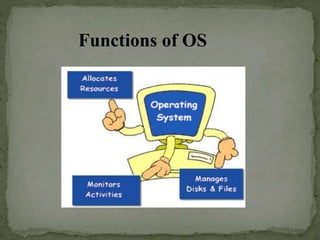
Functions of OS
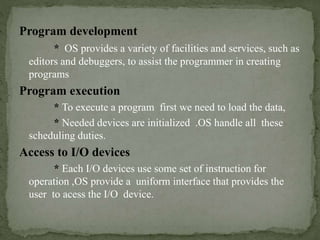
Program development
* OS provides a variety of facilities and services, such as
editors and debuggers, to assist the programmer in creating
programs
Program execution
* To execute a program first we need to load the data,
* Needed devices are initialized .OS handle all these
scheduling duties.
Access to I/O devices
* Each I/O devices use some set of instruction for
operation ,OS provide a uniform interface that provides the
user to acess the I/O device.
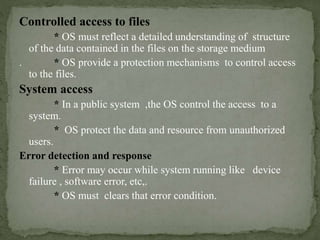
Controlled access to files
* OS must reflect a detailed understanding of structure
of the data contained in the files on the storage medium
. * OS provide a protection mechanisms to control access
to the files.
System access
* In a public system ,the OS control the access to a
system.
* OS protect the data and resource from unauthorized
users.
Error detection and response
* Error may occur while system running like device
failure , software error, etc,.
* OS must clears that error condition.
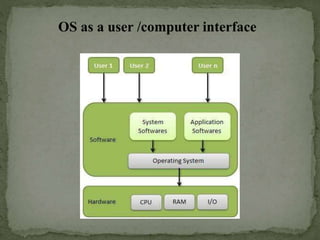
OS as a user /computer interface
* user view of the computer refers to the interface being
used
* The goal of the Operating System is to maximize the
work and minimize the effort of the user.
* Most of the systems are designed to be operated by
single user, however in some systems multiple users can share
resources, memory.
* In these cases Operating System is designed to handle
available resources among multiple users and CPU efficiently.
* Operating System must be designed by taking both
usability and efficient resource utilization into view.
OS as a user /computer interface
OS as a Resource manager
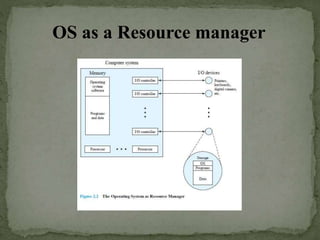
* Operating System is allocator, which allocate
memory, resources among various processes.It controls the
sharing of resources among programs.
* It prevents improper usage, error and handle
deadlock conditions.
* It is a program that runs all the time in the system in
the form of Kernel.
* It controls application programs that are not part of
Kernel.
* It mamages the resources efficiently.
OS as a Resource manager
THANK YOU

Basic topic on os

  • 1.
    B.Abinaya bharathi I-M.Sc[Cs&IT] Nadar Saraswathicollege of Arts and Science, Theni
  • 2.
    * An operatingsystem is a program that acts as an interface between the user and the computer hardware and controls the execution of all kinds of programs. * OS is a layer of software whose job is to manage all devices and provide user programs with a simpler interface to the hardware.
  • 3.
    Objectives of OS *Convenience * Efficiency * Ability to evolve Convenience: OS makes a computer more convenient to use. Efficiency: OS allows the computer system resources to be used in an efficient manner. Ability to evolve: OS should be constructed in such a way as to permit the effective development, testing, and introduction of new system functions without interfering with service.
  • 4.
    Functions of OS *Program development * Program execution * Access to I/O devices * System access * Controlled access to files * Error detection and response * Accounting
  • 5.
  • 6.
    Program development * OSprovides a variety of facilities and services, such as editors and debuggers, to assist the programmer in creating programs Program execution * To execute a program first we need to load the data, * Needed devices are initialized .OS handle all these scheduling duties. Access to I/O devices * Each I/O devices use some set of instruction for operation ,OS provide a uniform interface that provides the user to acess the I/O device.
  • 7.
    Controlled access tofiles * OS must reflect a detailed understanding of structure of the data contained in the files on the storage medium . * OS provide a protection mechanisms to control access to the files. System access * In a public system ,the OS control the access to a system. * OS protect the data and resource from unauthorized users. Error detection and response * Error may occur while system running like device failure , software error, etc,. * OS must clears that error condition.
  • 8.
    OS as auser /computer interface * user view of the computer refers to the interface being used * The goal of the Operating System is to maximize the work and minimize the effort of the user. * Most of the systems are designed to be operated by single user, however in some systems multiple users can share resources, memory. * In these cases Operating System is designed to handle available resources among multiple users and CPU efficiently. * Operating System must be designed by taking both usability and efficient resource utilization into view.
  • 9.
    OS as auser /computer interface
  • 10.
    OS as aResource manager * Operating System is allocator, which allocate memory, resources among various processes.It controls the sharing of resources among programs. * It prevents improper usage, error and handle deadlock conditions. * It is a program that runs all the time in the system in the form of Kernel. * It controls application programs that are not part of Kernel. * It mamages the resources efficiently.
  • 11.
    OS as aResource manager
  • 12.