•5.2 Linear block codes, generation, capabilities, and syndrome
calculation
•5.3 Binary cyclic codes, Convolution codes, Code tree, and Trellis
• Linear block code is a type of error-correcting code in which the actual
information bits are linearly combined with the parity check bits so as
to generate a linear codeword that is transmitted through the channel.
Another major type of error-correcting code is convolution code.
• In the linear block code technique, the complete message is divided
into blocks and these blocks are combined with redundant bits so as to
deal with error detection and correction.
• What is Error Correcting Code?
• While discussing interleaving, we have mentioned that the bursts of errors are
redistributed over codewords (the process is named as interleaving) after
which error-correcting codes can be applied in order to correct the errors.
• Now, the question arises of what exactly error correction refers to and why it
is needed.
• Whenever we deal with data communication, then one of the major concerns
associated with the transmission of the data is the introduction of errors.
These errors must be removed as the presence of errors changes the actual
information content. The sole purpose of applying error correction codes is to
facilitate the detection and even correction of the data which is transmitted
over communication channel by introducing redundancies within the actual
message bits.
• The error-correcting codes are nothing but the addition of redundancies
(unnecessary bits) to the actual message bits so that the receiver must properly
decode the actual message signal from the encoded one.
• It is to be noted here that the error-correcting codes are applicable to digital
signals and not analog ones. More simply, the signals that are in the form of 1s
and 0s i.e., the binary form.
• There are two techniques for error control coding, namely
• Linear Block Coding
• Convolution Coding
• This presentation deals with linear block coding.
• We already know that encoding enables the addition of coding bits to the data
stream, done at the transmitter side. While decoding is the recovery of the actual
data stream from the coded one, done at the receiver end. However, the codec
performs the action of both coding and decoding.
Linear Block Coding
• In block coding, the complete message bits are divided into blocks where
each block holds the same number of bits. Suppose each block contains k
bits, and each k bits of a block defines a data word. Hence, the overall
datawords will be 2k. At this particular point, we have not considered any
redundancies, thus, we only have the actual message bitstream converted
into datawords.
• Now, in order to perform encoding, the data words are encoded as
codewords having n number of bits. We have recently discussed that a block
has k bits and after encoding there will be n bits in each block (of course,
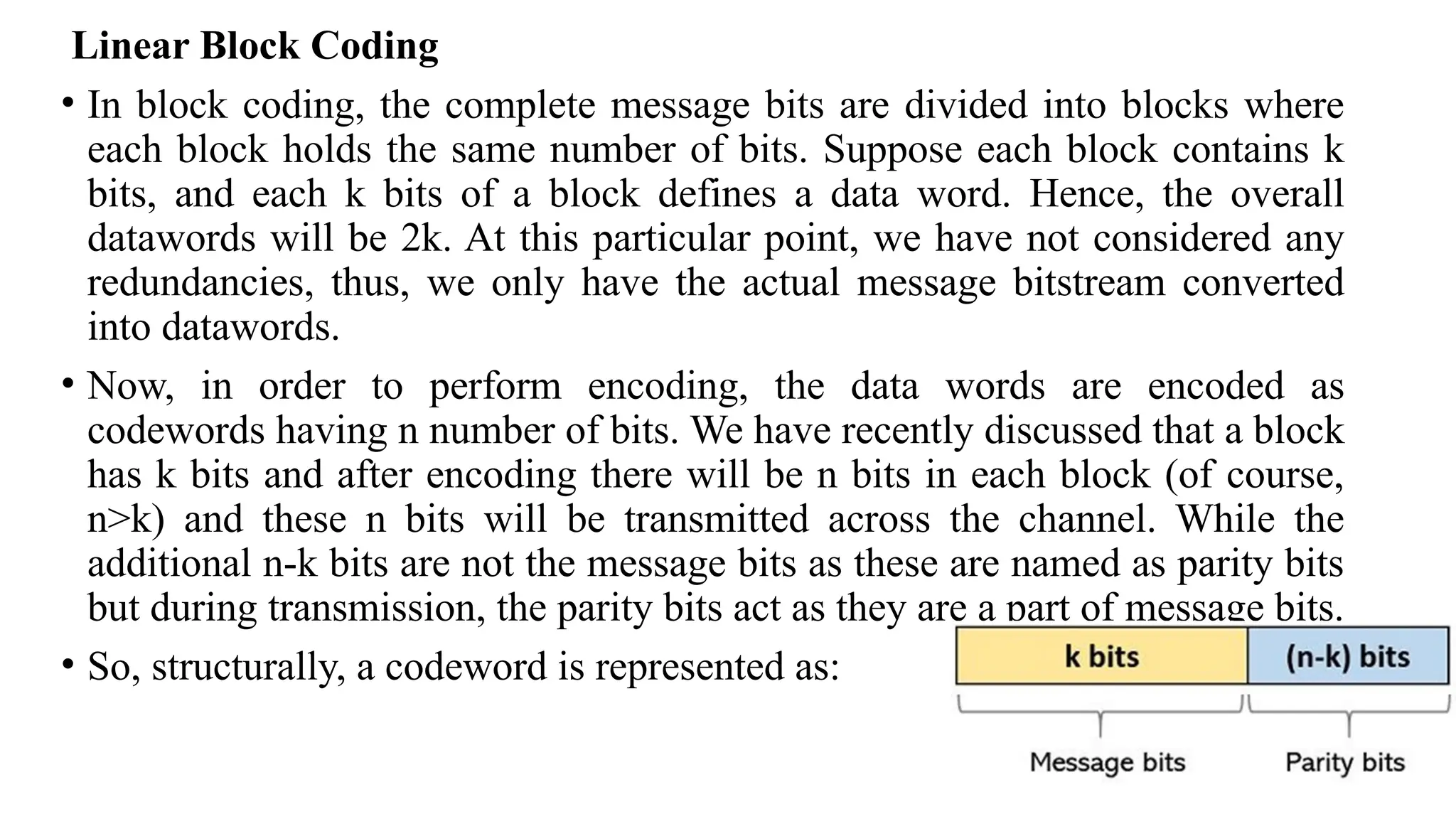
n>k) and these n bits will be transmitted across the channel. While the
additional n-k bits are not the message bits as these are named as parity bits
but during transmission, the parity bits act as they are a part of message bits.
• So, structurally, a codeword is represented as:
• Hence, the possible codewords will be 2n out of which 2k contains
datawords. During transmission, if errors are introduced then most
probably, the permissible codewords will be changed into redundant words
which can be detected as an error by the receiver.
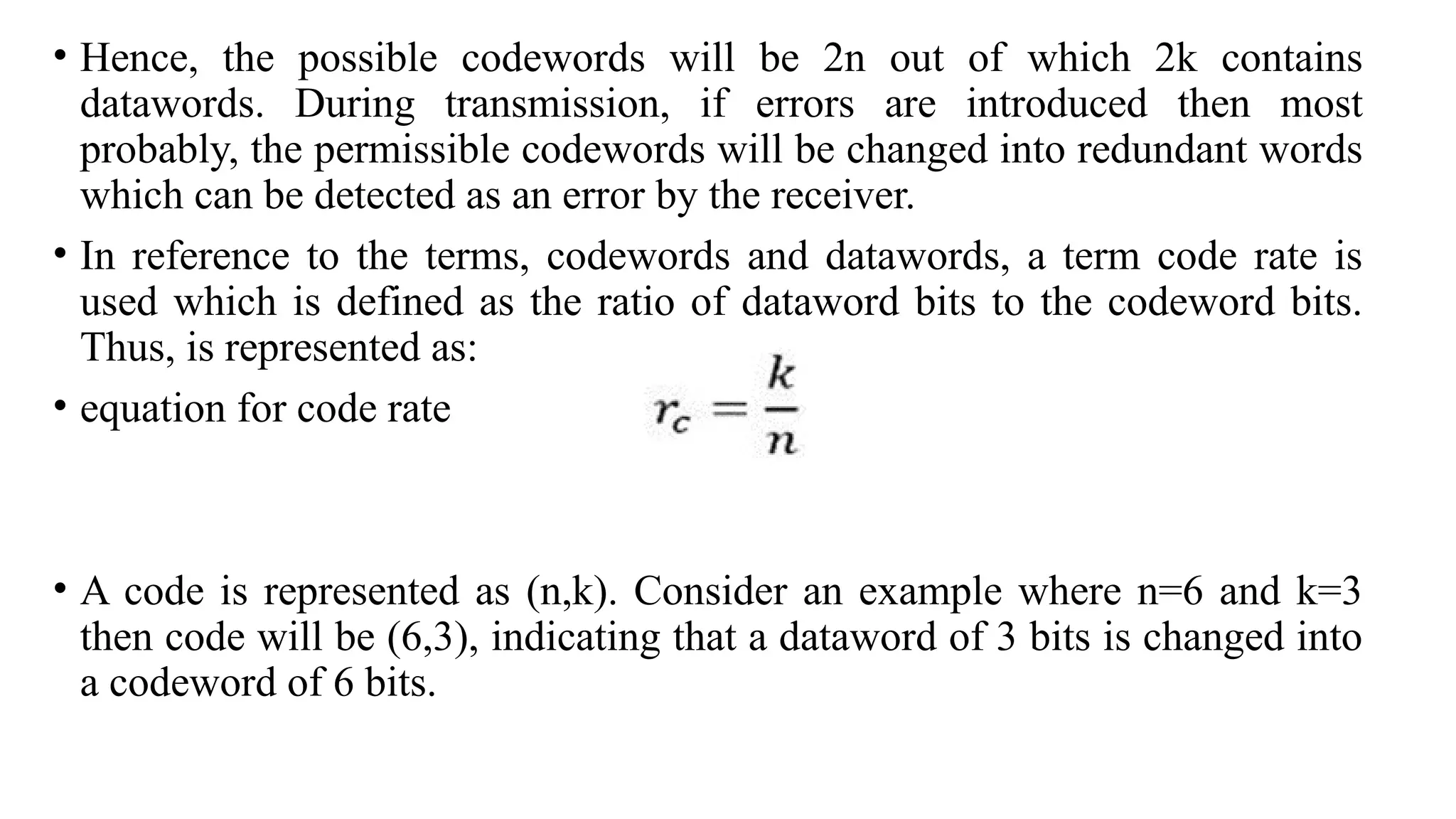
• In reference to the terms, codewords and datawords, a term code rate is
used which is defined as the ratio of dataword bits to the codeword bits.
Thus, is represented as:
• equation for code rate
• A code is represented as (n,k). Consider an example where n=6 and k=3
then code will be (6,3), indicating that a dataword of 3 bits is changed into
a codeword of 6 bits.
Explanation with Example
• Consider a repetition code, to understand the general properties of block code
• In a repetition code, each individual bit acts as a dataword.
• Thus, k = 1 and n-redundancy encoding will provide n-bits at the output of the encoder.
• If n = 3, then for binary value 1 at the input of encoder, the output codeword will be 111. While for binary value 0,
the output codeword will be 000.
• The logic circuit within the decoder decodes codeword 111 as 1 while codeword 000 as 0.
• This is achieved through proper synchronization between the encoder and the decoder.
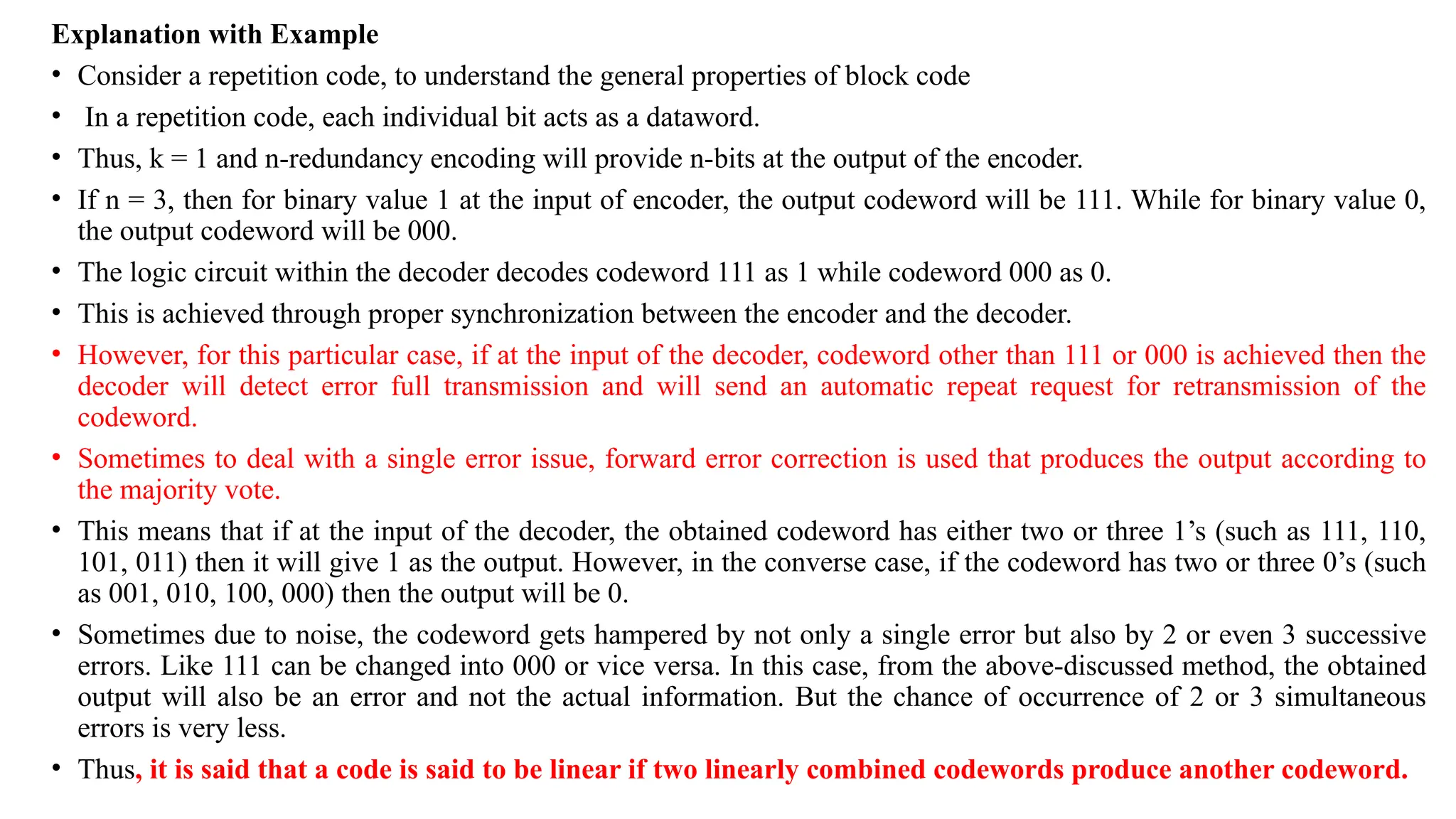
• However, for this particular case, if at the input of the decoder, codeword other than 111 or 000 is achieved then the
decoder will detect error full transmission and will send an automatic repeat request for retransmission of the
codeword.
• Sometimes to deal with a single error issue, forward error correction is used that produces the output according to
the majority vote.
• This means that if at the input of the decoder, the obtained codeword has either two or three 1’s (such as 111, 110,
101, 011) then it will give 1 as the output. However, in the converse case, if the codeword has two or three 0’s (such
as 001, 010, 100, 000) then the output will be 0.
• Sometimes due to noise, the codeword gets hampered by not only a single error but also by 2 or even 3 successive
errors. Like 111 can be changed into 000 or vice versa. In this case, from the above-discussed method, the obtained
output will also be an error and not the actual information. But the chance of occurrence of 2 or 3 simultaneous
errors is very less.
• Thus, it is said that a code is said to be linear if two linearly combined codewords produce another codeword.
Datawor
d
Parity Bit Codeword
000 0 0000
001 1 0011
010 1 0101
011 0 0110
100 1 1001
101 0 1010
110 0 1100
111 1 1111
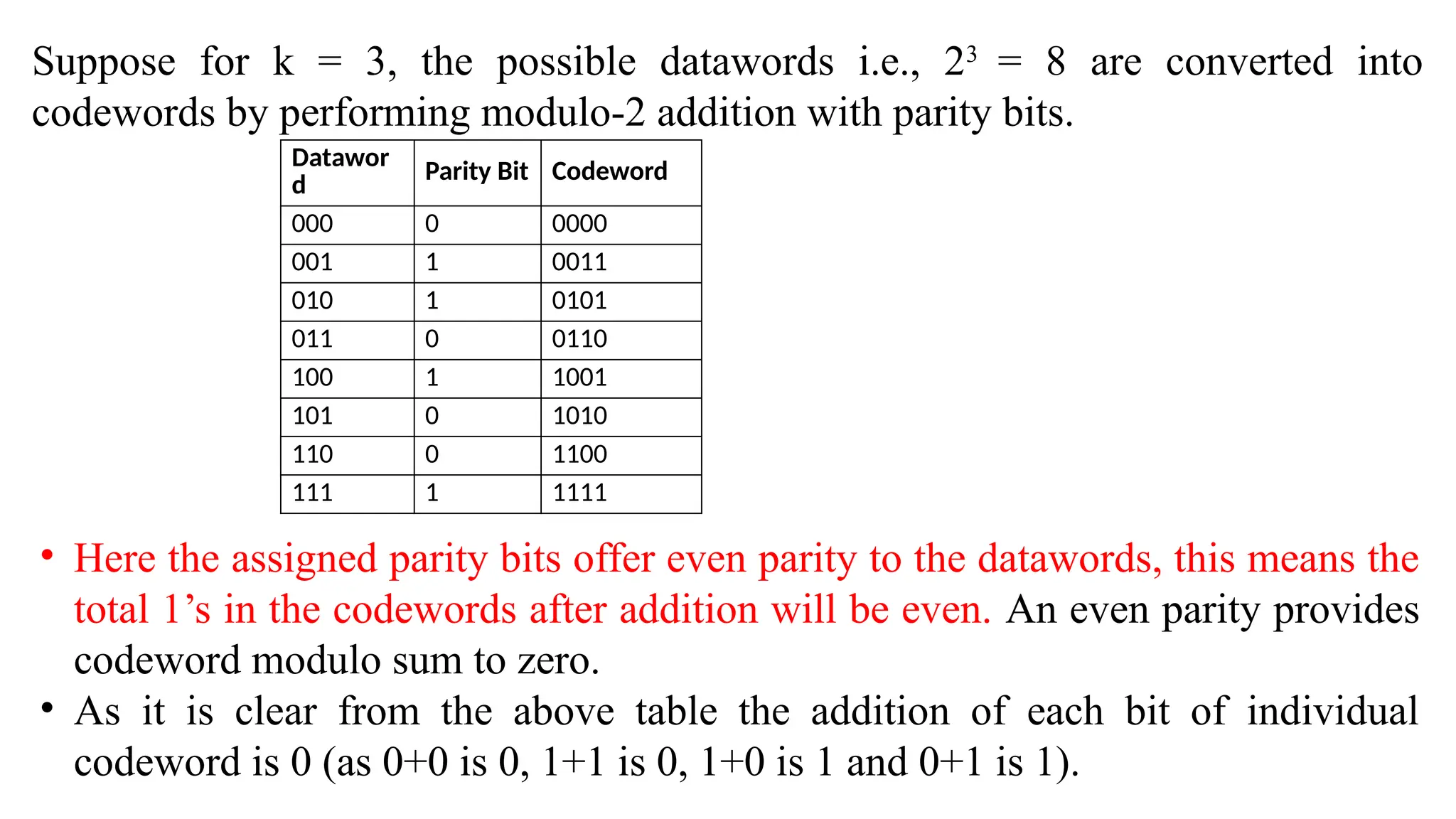
Suppose for k = 3, the possible datawords i.e., 23
= 8 are converted into
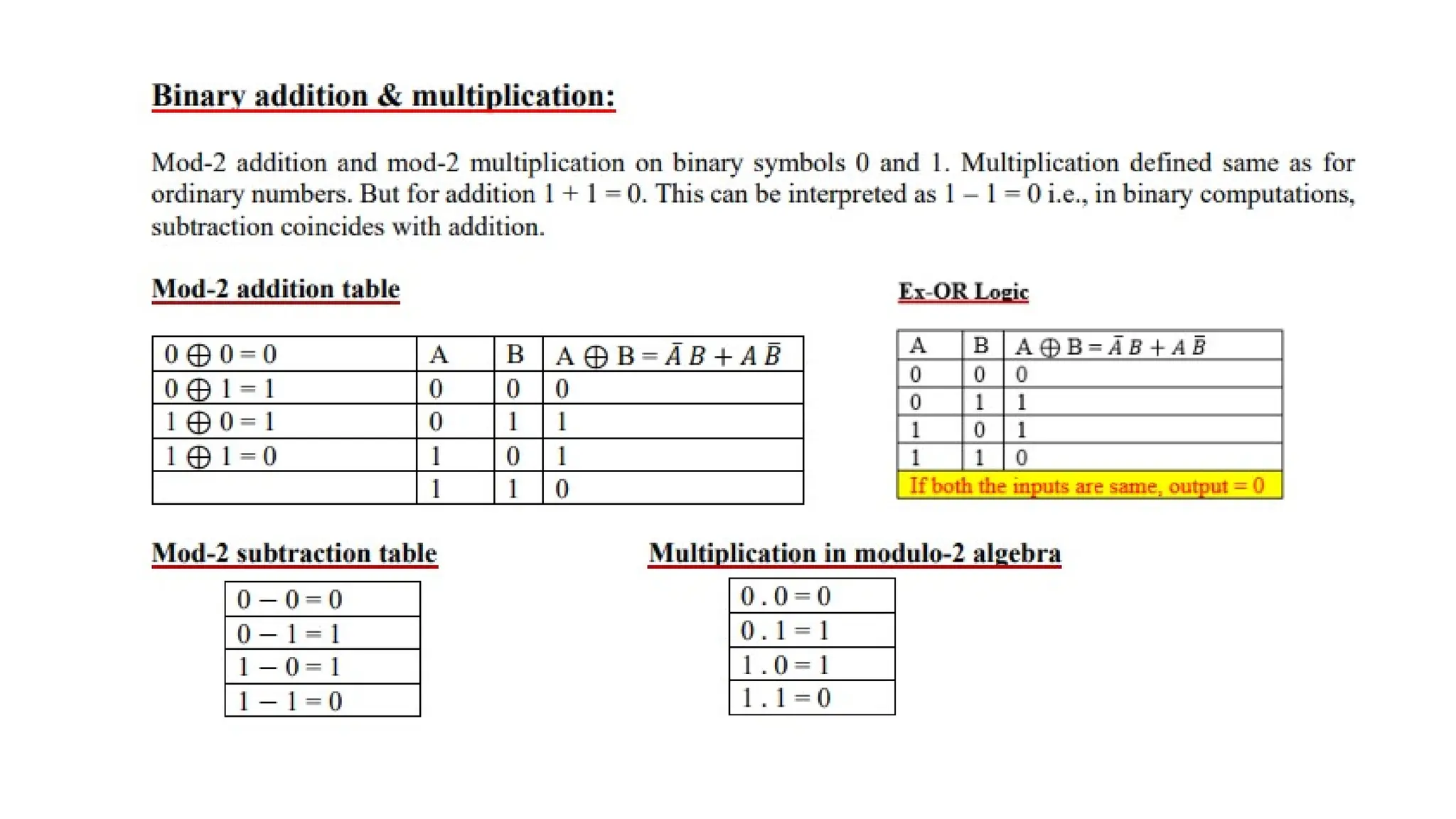
codewords by performing modulo-2 addition with parity bits.
• Here the assigned parity bits offer even parity to the datawords, this means the
total 1’s in the codewords after addition will be even. An even parity provides
codeword modulo sum to zero.
• As it is clear from the above table the addition of each bit of individual
codeword is 0 (as 0+0 is 0, 1+1 is 0, 1+0 is 1 and 0+1 is 1).
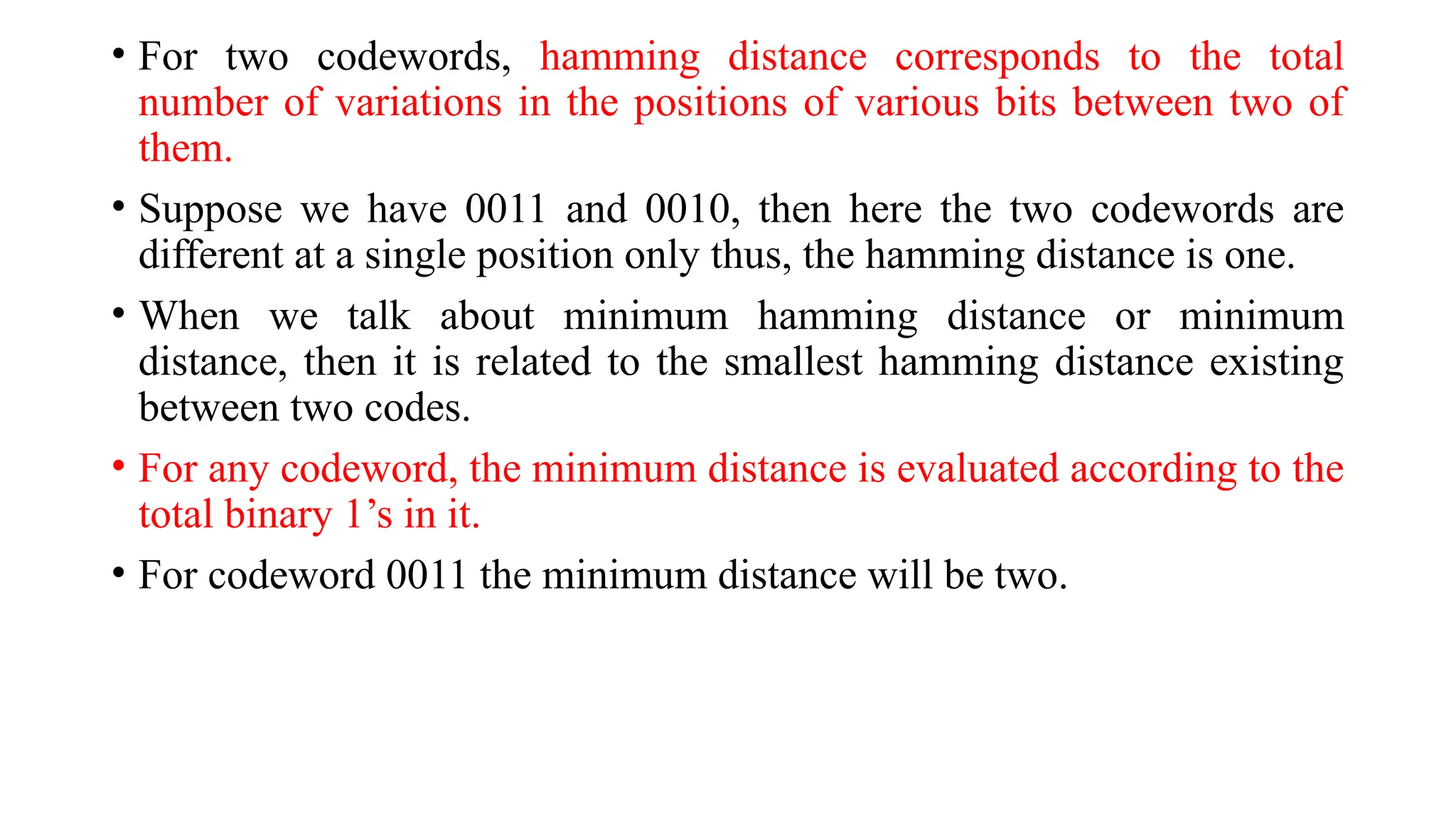
• For two codewords, hamming distance corresponds to the total
number of variations in the positions of various bits between two of
them.
• Suppose we have 0011 and 0010, then here the two codewords are
different at a single position only thus, the hamming distance is one.
• When we talk about minimum hamming distance or minimum
distance, then it is related to the smallest hamming distance existing
between two codes.
• For any codeword, the minimum distance is evaluated according to the
total binary 1’s in it.
• For codeword 0011 the minimum distance will be two.
Linear Encoding of Block Codes
• Now, consider matrices to understand more about linear block codes.
• Suppose, we have a dataword, 101, represented by row vector d. d = [101]
• The codeword for this with the even parity approach discussed above will be 1010, given by row
vector c. c = [1010]
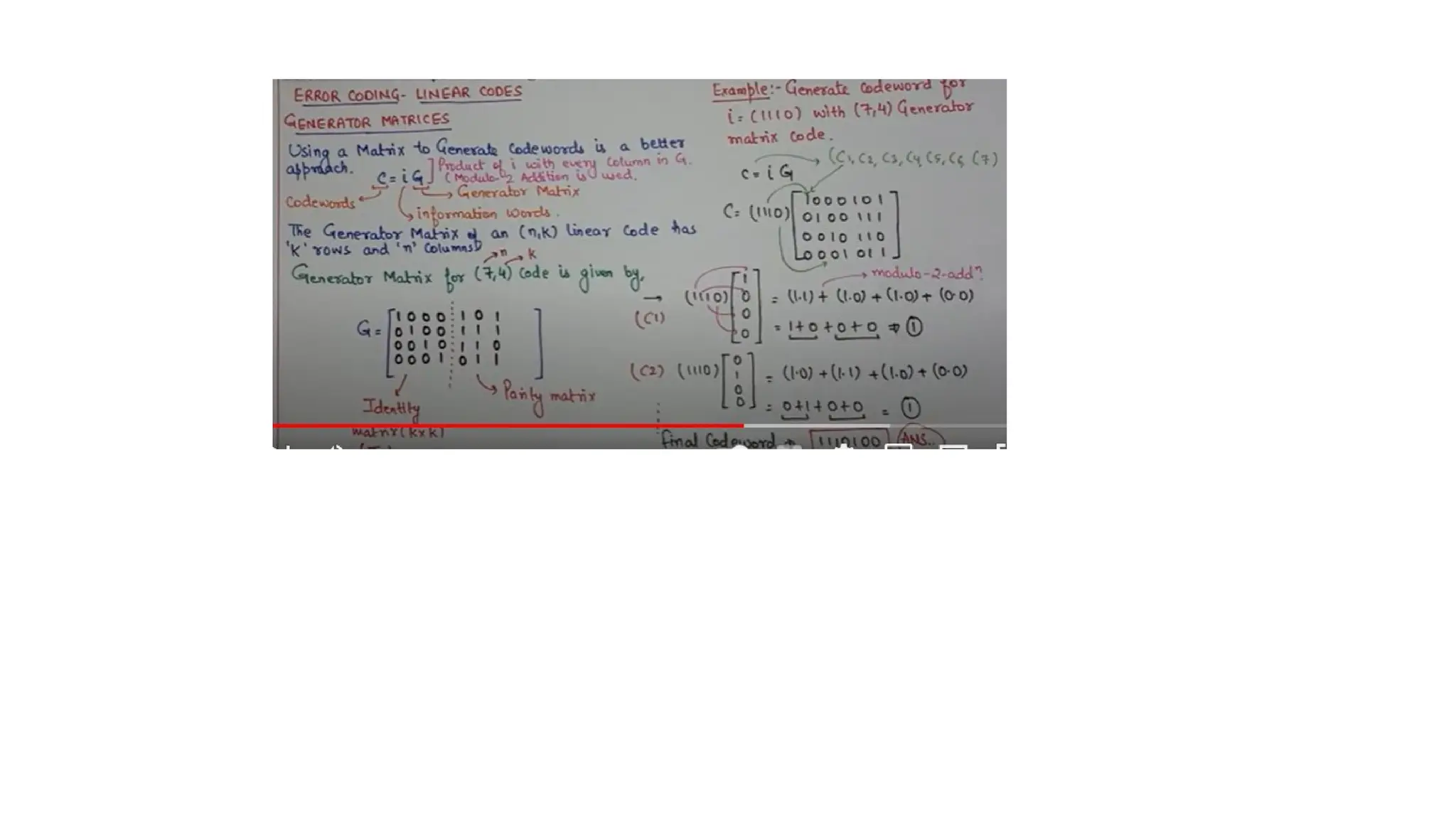
• Generally, generator matrix, G is used to produce codeword from dataword. The relation between c, d
and G is given as: c = dG
• For a code (6,3), there will be 6 bits in codeword and 3 in the dataword.
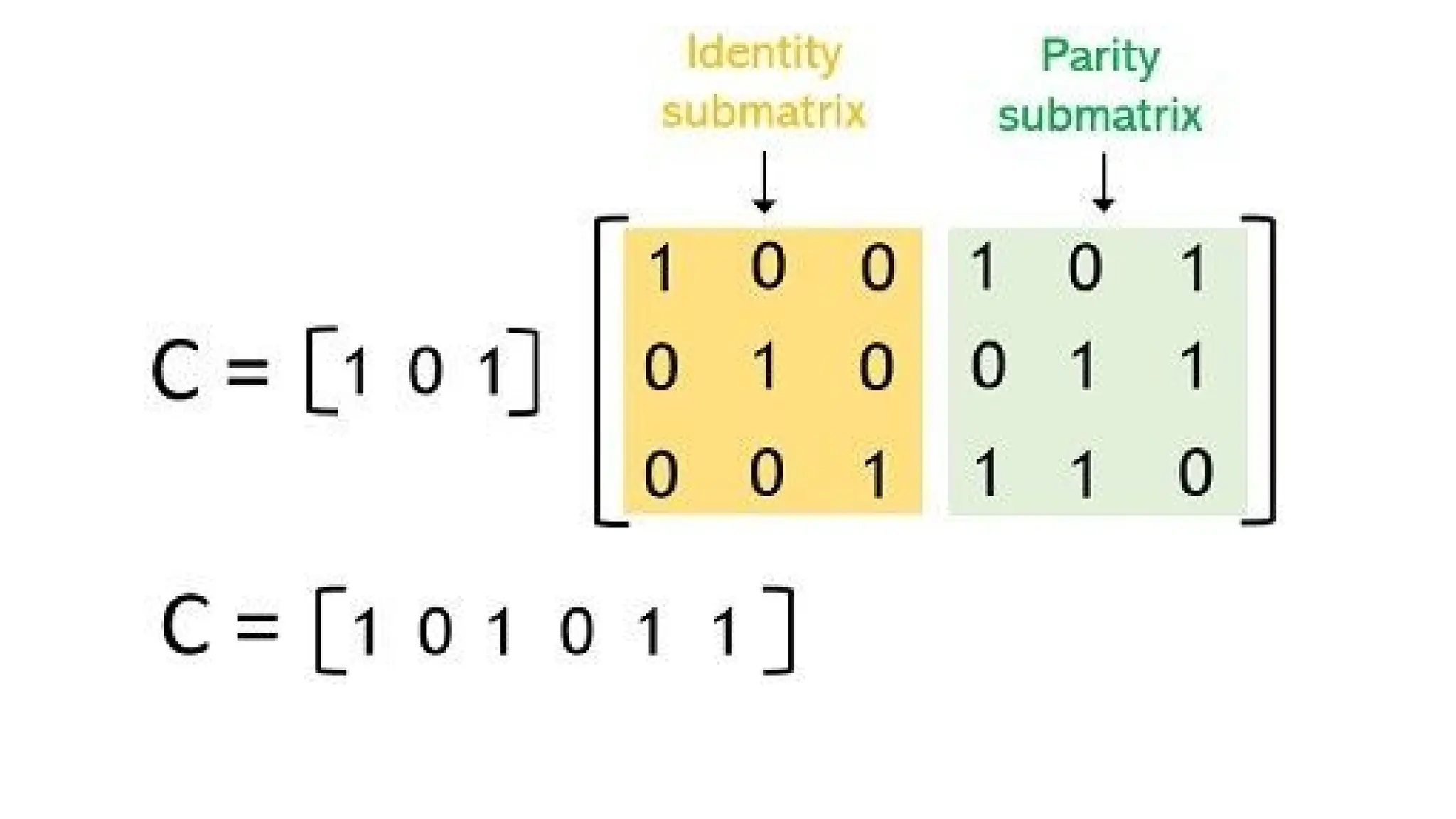
• In a systematic code, the most common arrangement has dataword at the beginning of the
codeword. To get this, identity submatrix is used in conjunction with parity submatrix and
using the relation d.G, we can have
• It is clearly shown that
dataword is present as the
first 3 bits of the obtained
codeword while the rest 3 are
the parity bits.
Linear Decoding of Block Codes
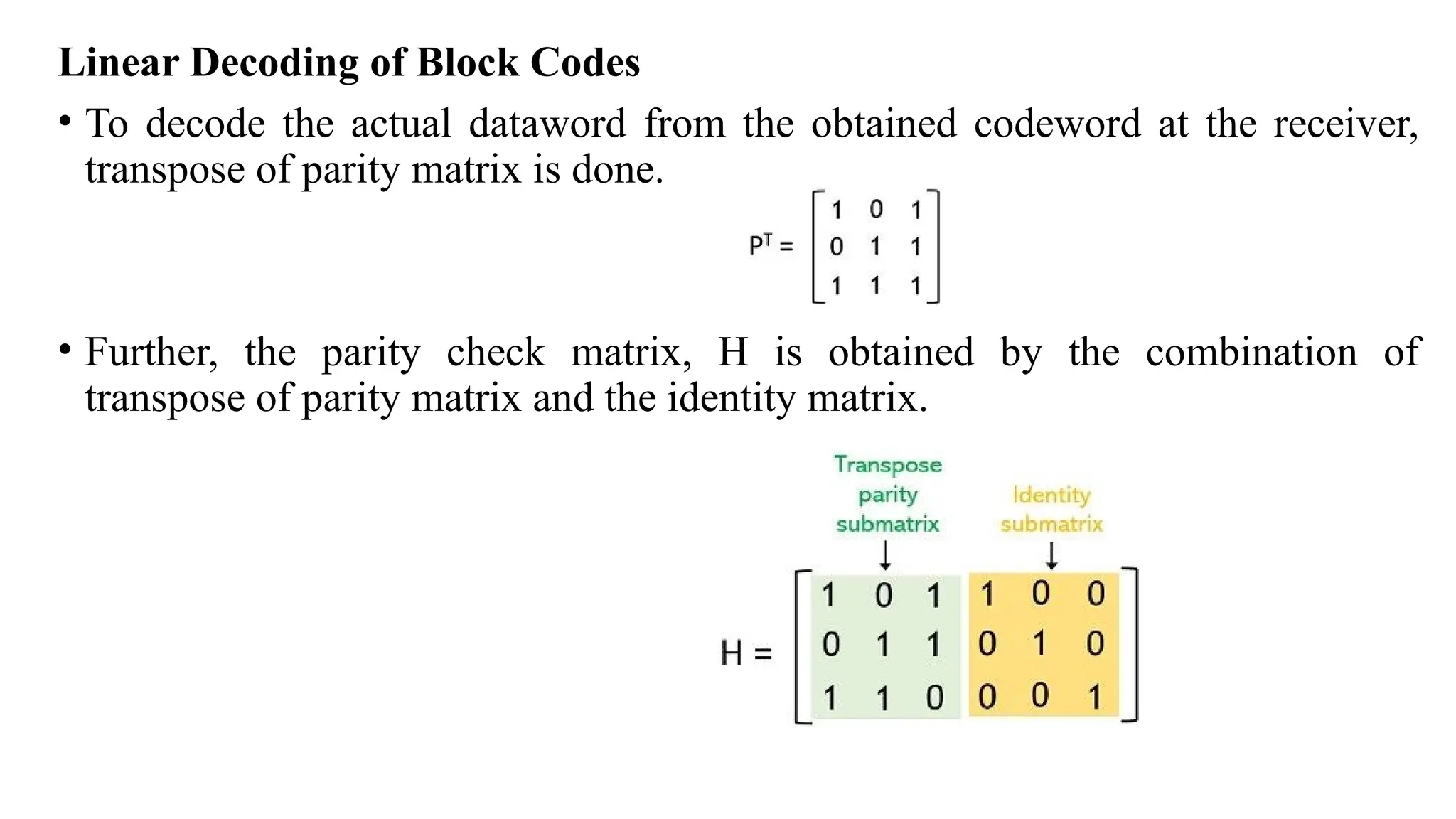
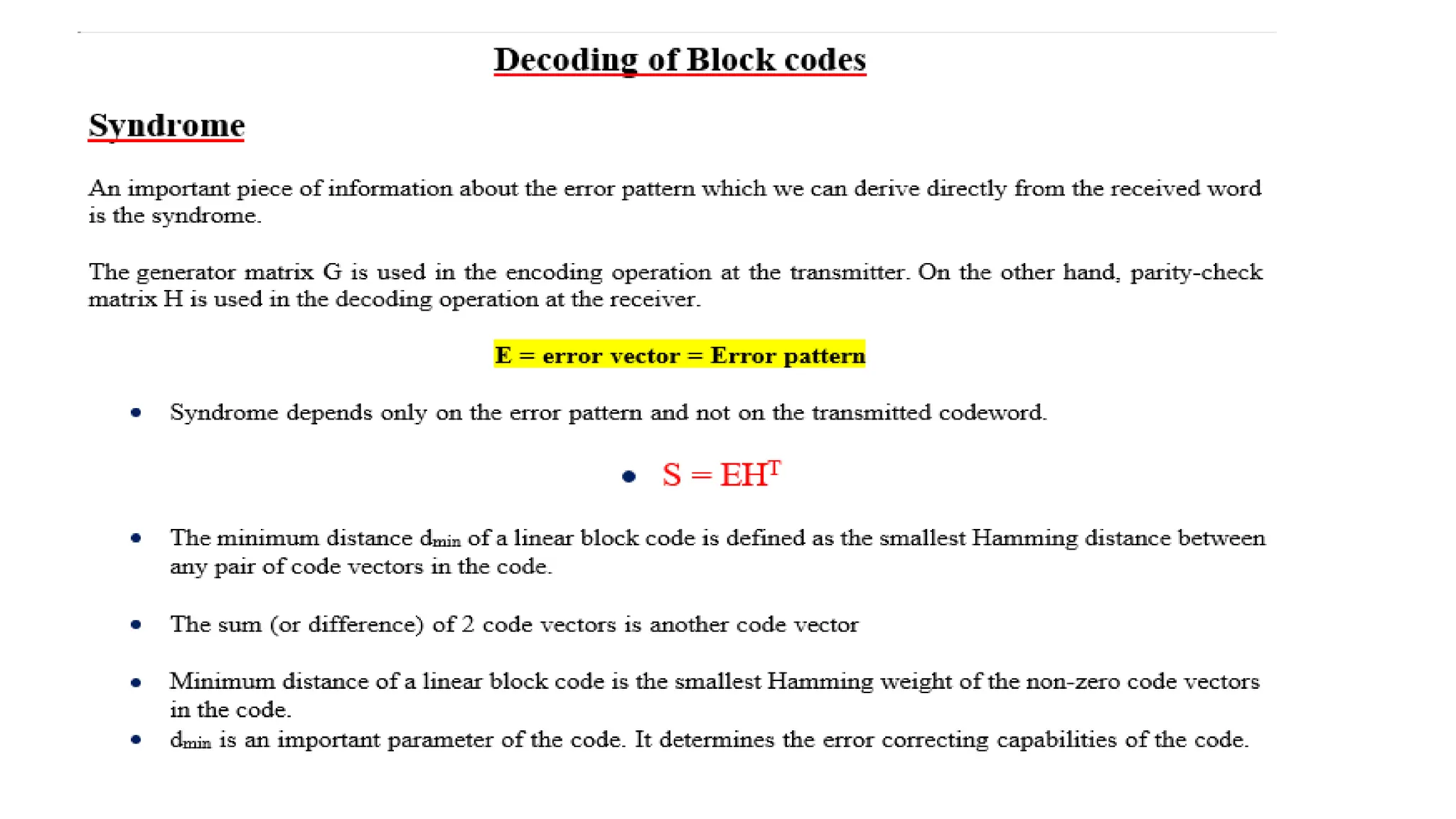
• To decode the actual dataword from the obtained codeword at the receiver,
transpose of parity matrix is done.
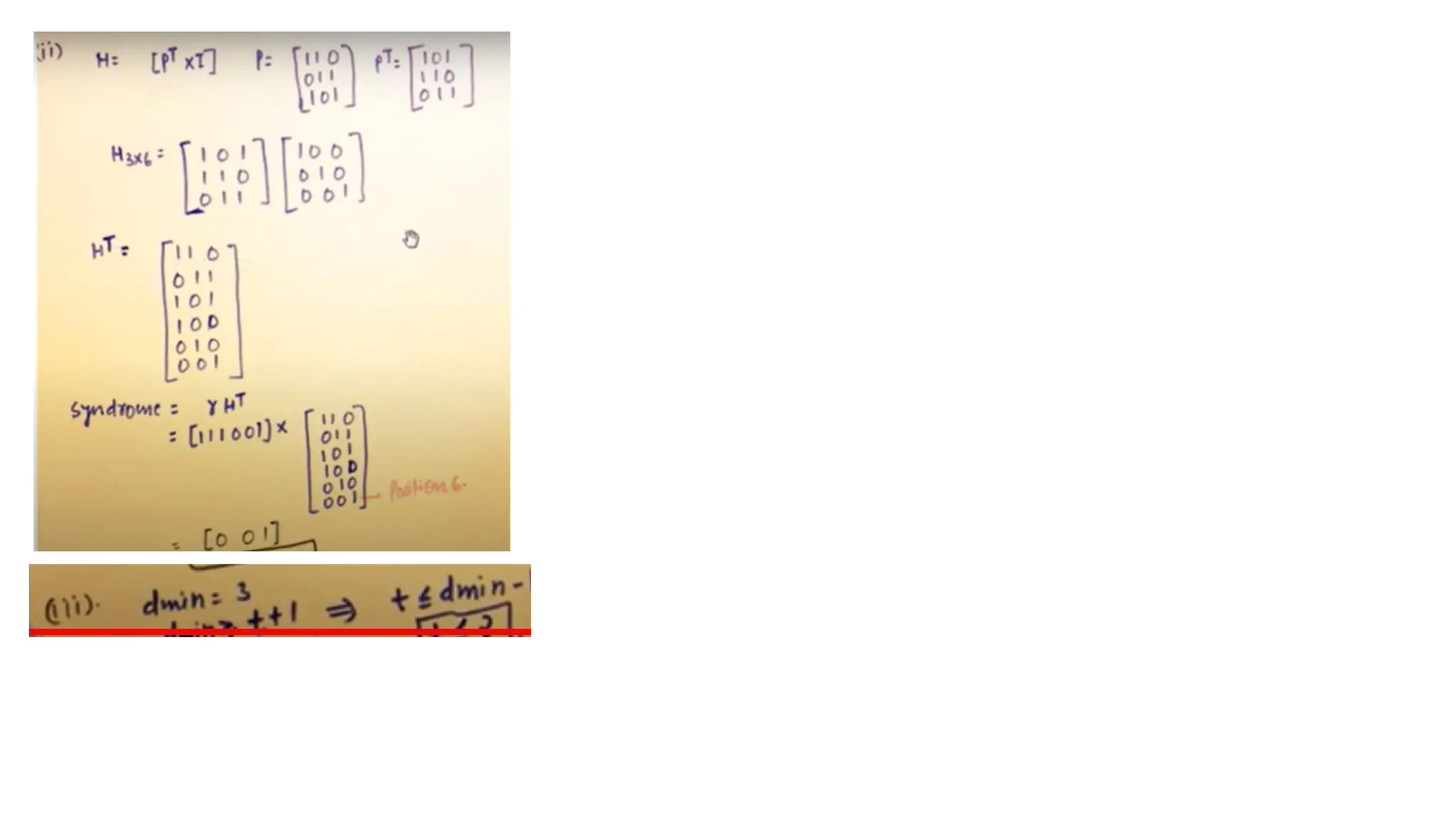
• Further, the parity check matrix, H is obtained by the combination of
transpose of parity matrix and the identity matrix.
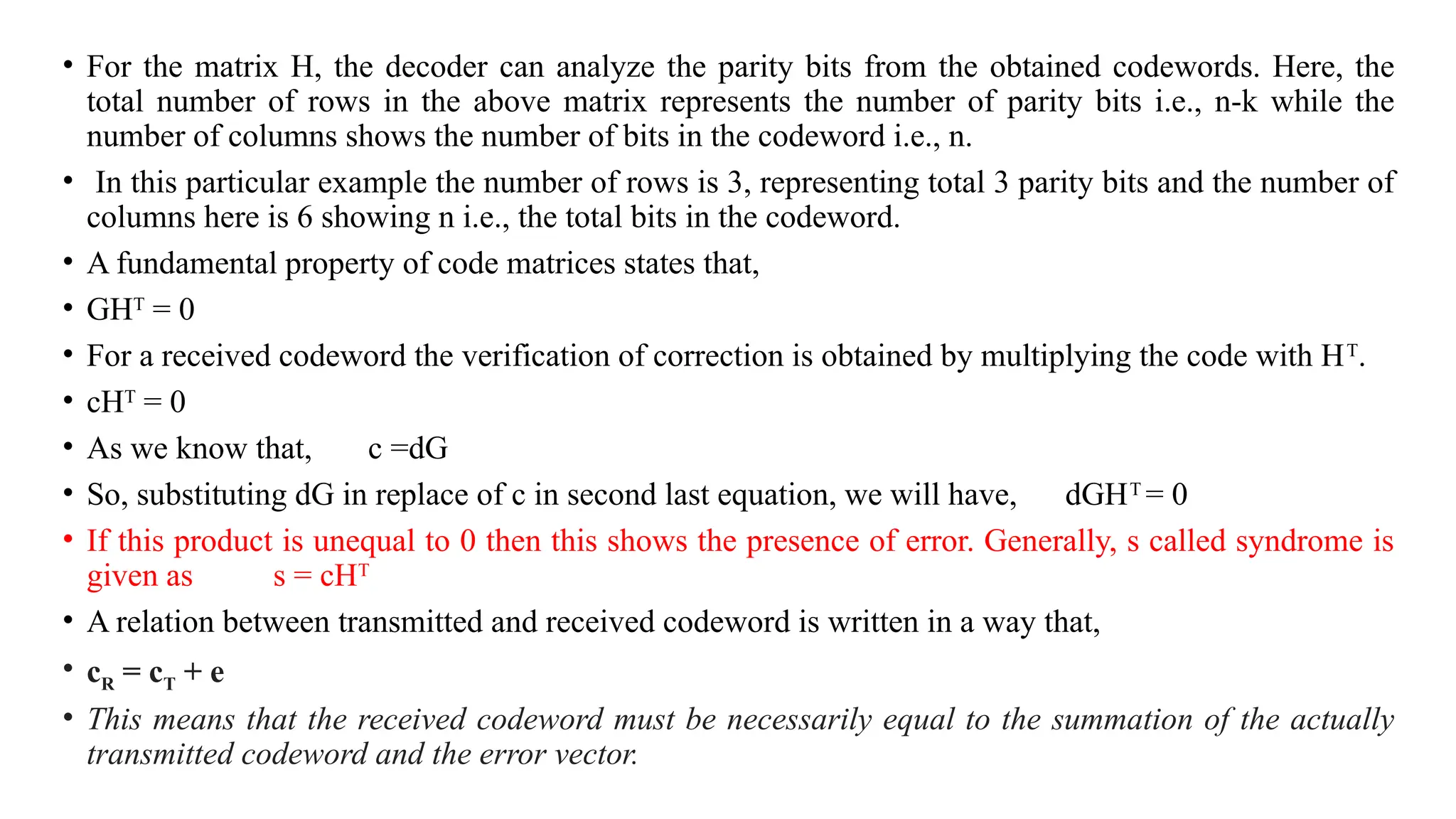
• For the matrix H, the decoder can analyze the parity bits from the obtained codewords. Here, the
total number of rows in the above matrix represents the number of parity bits i.e., n-k while the
number of columns shows the number of bits in the codeword i.e., n.
• In this particular example the number of rows is 3, representing total 3 parity bits and the number of
columns here is 6 showing n i.e., the total bits in the codeword.
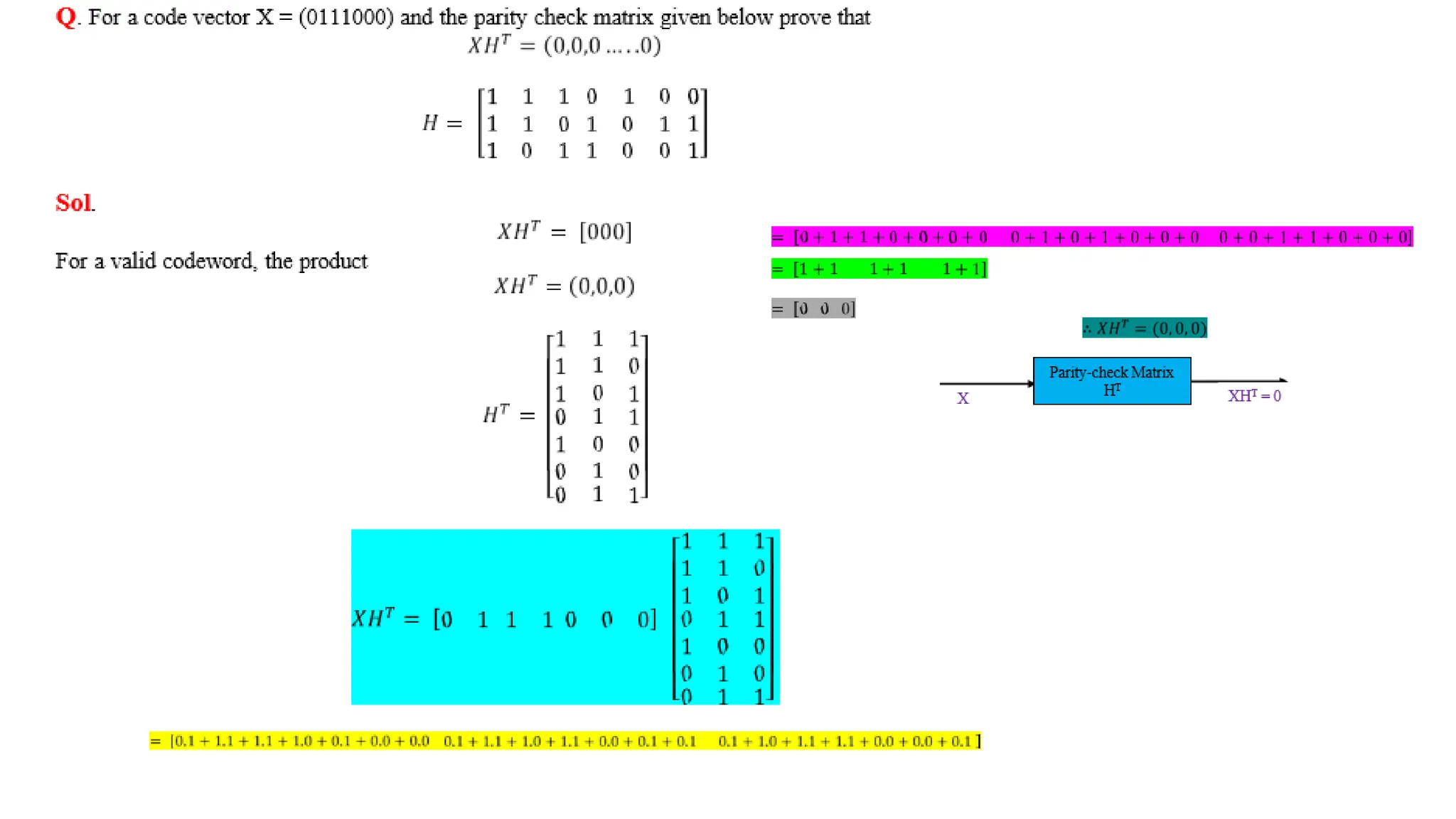
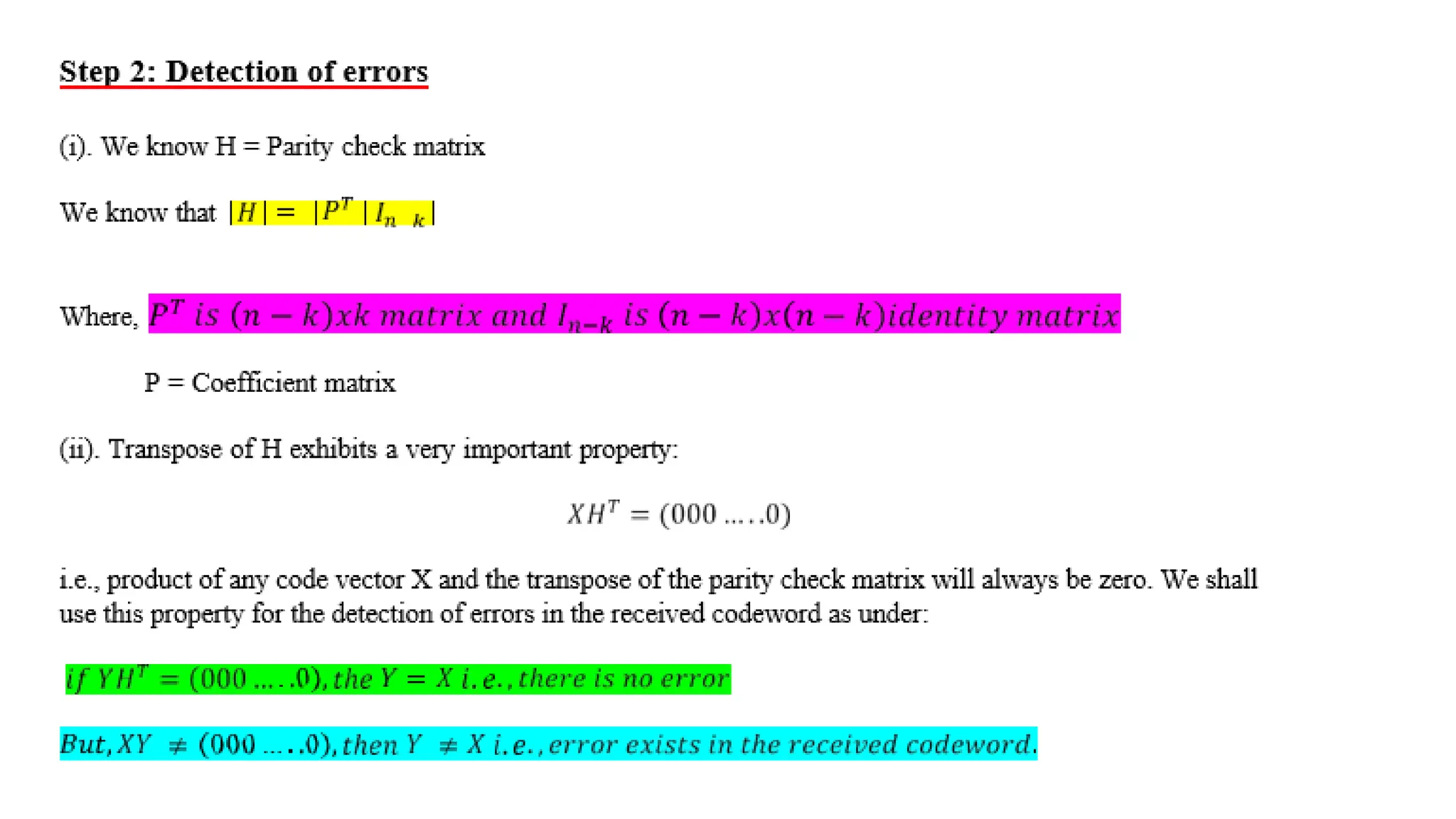
• A fundamental property of code matrices states that,
• GHT
= 0
• For a received codeword the verification of correction is obtained by multiplying the code with HT
.
• cHT
= 0
• As we know that, c =dG
• So, substituting dG in replace of c in second last equation, we will have, dGHT
= 0
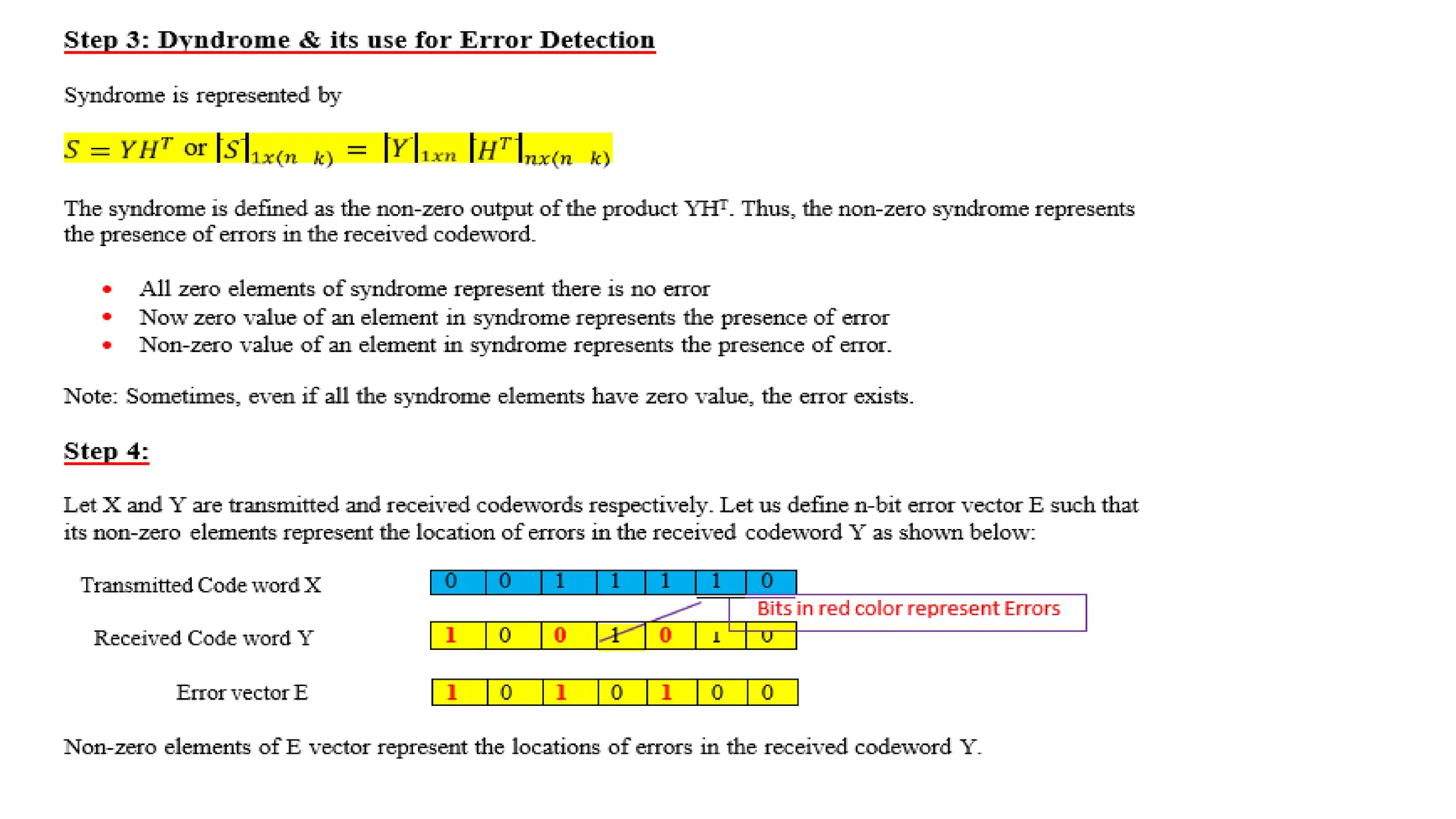
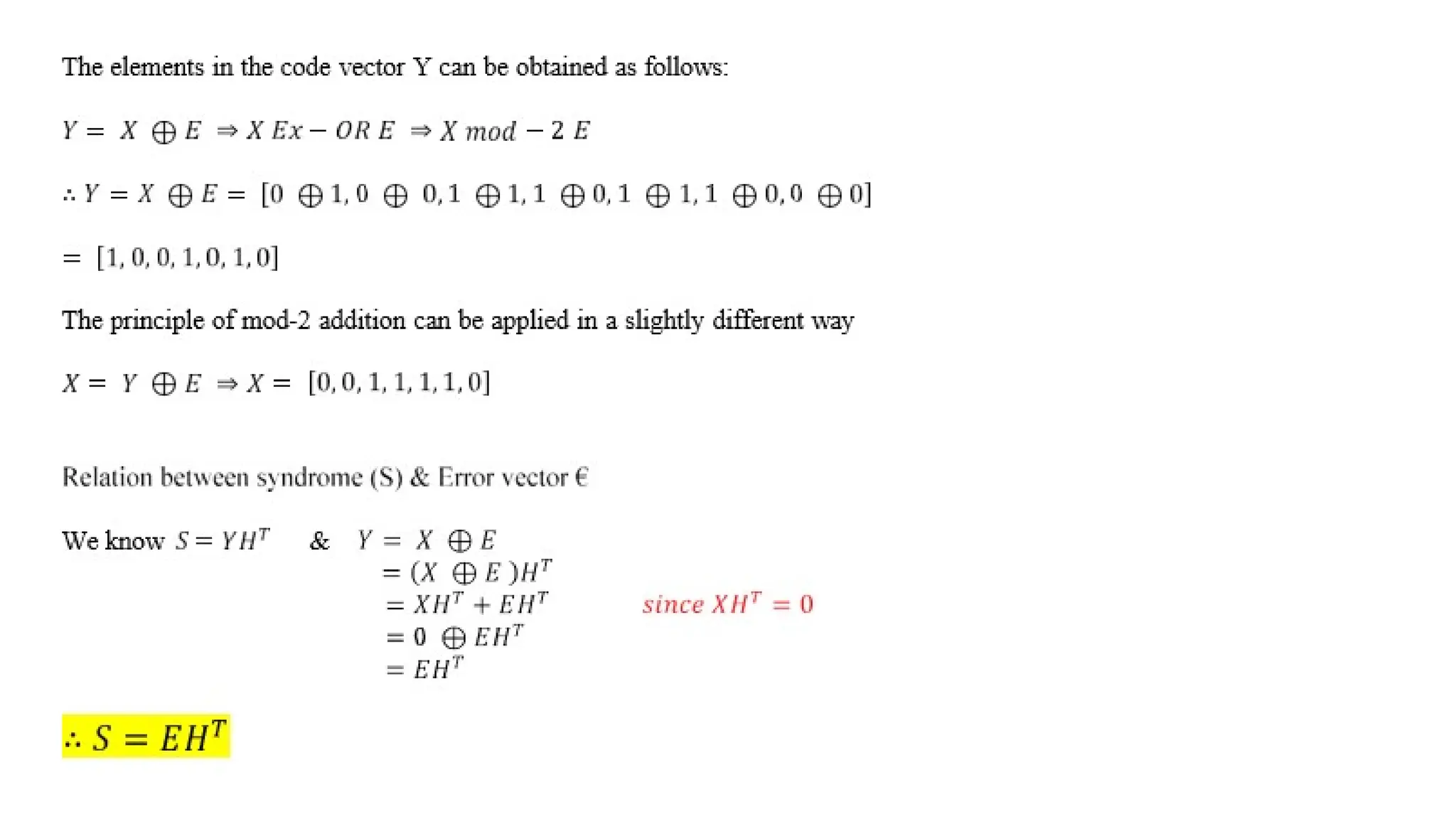
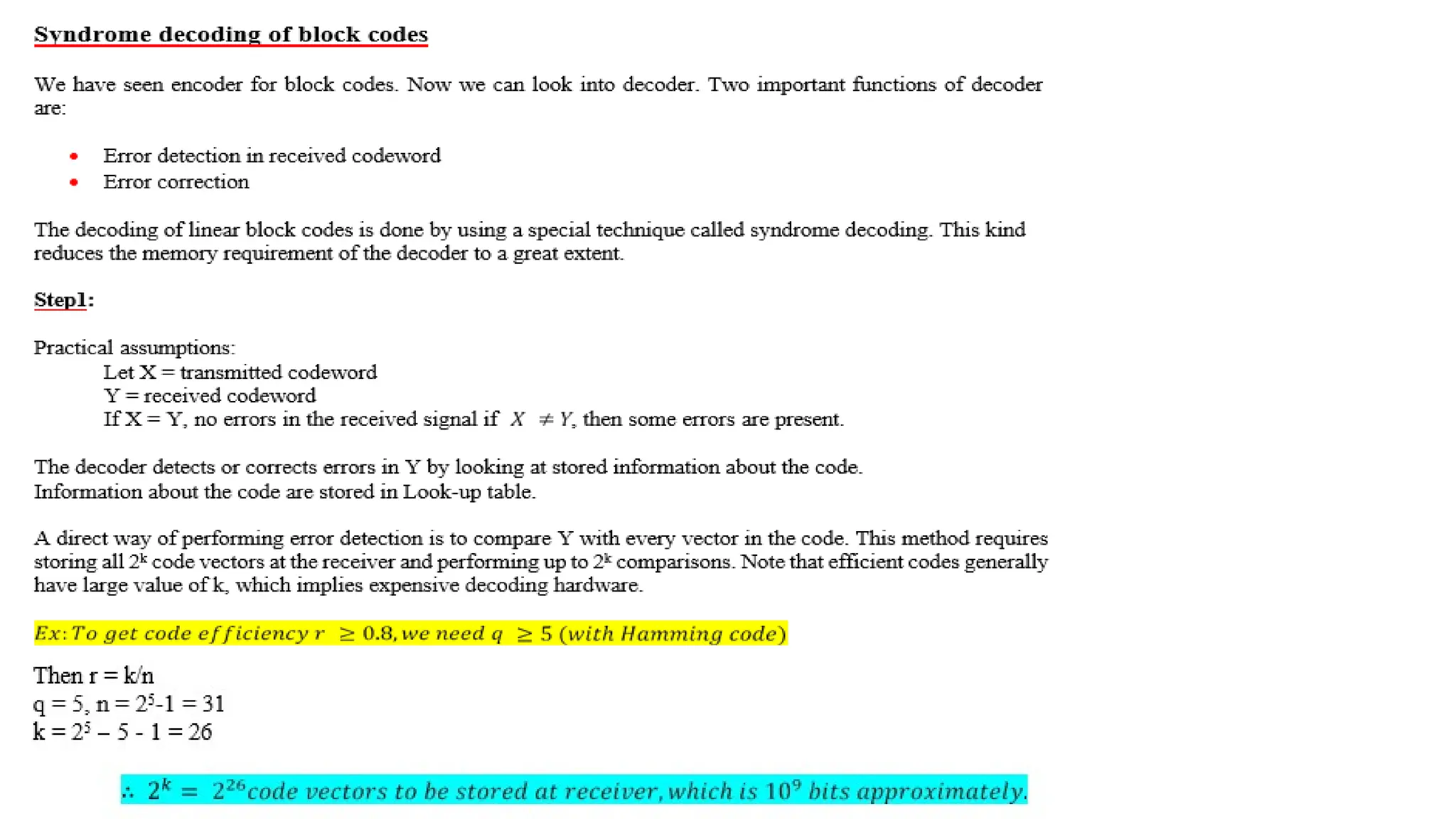
• If this product is unequal to 0 then this shows the presence of error. Generally, s called syndrome is
given as s = cHT
• A relation between transmitted and received codeword is written in a way that,
• cR = cT + e
• This means that the received codeword must be necessarily equal to the summation of the actually
transmitted codeword and the error vector.
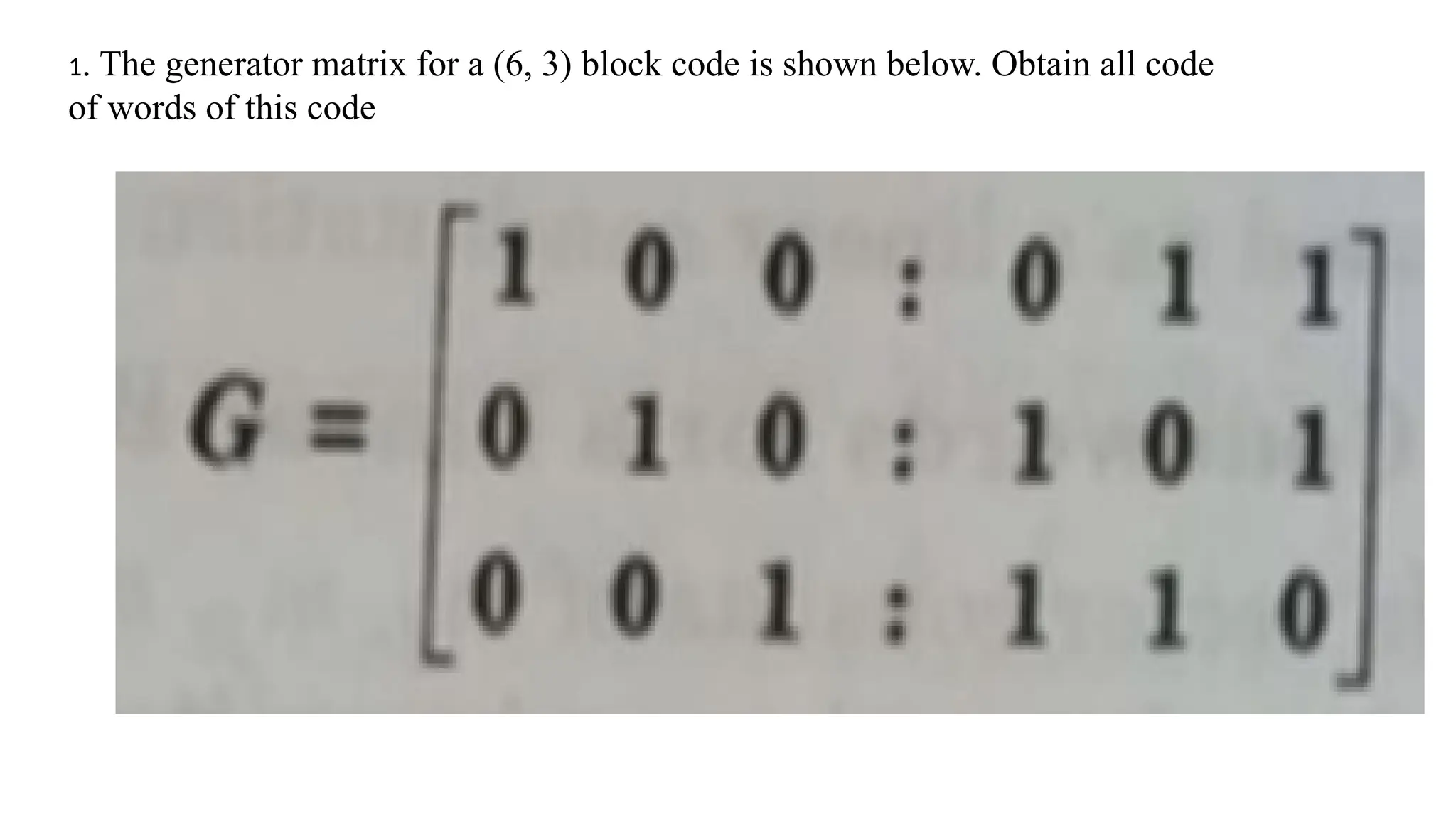
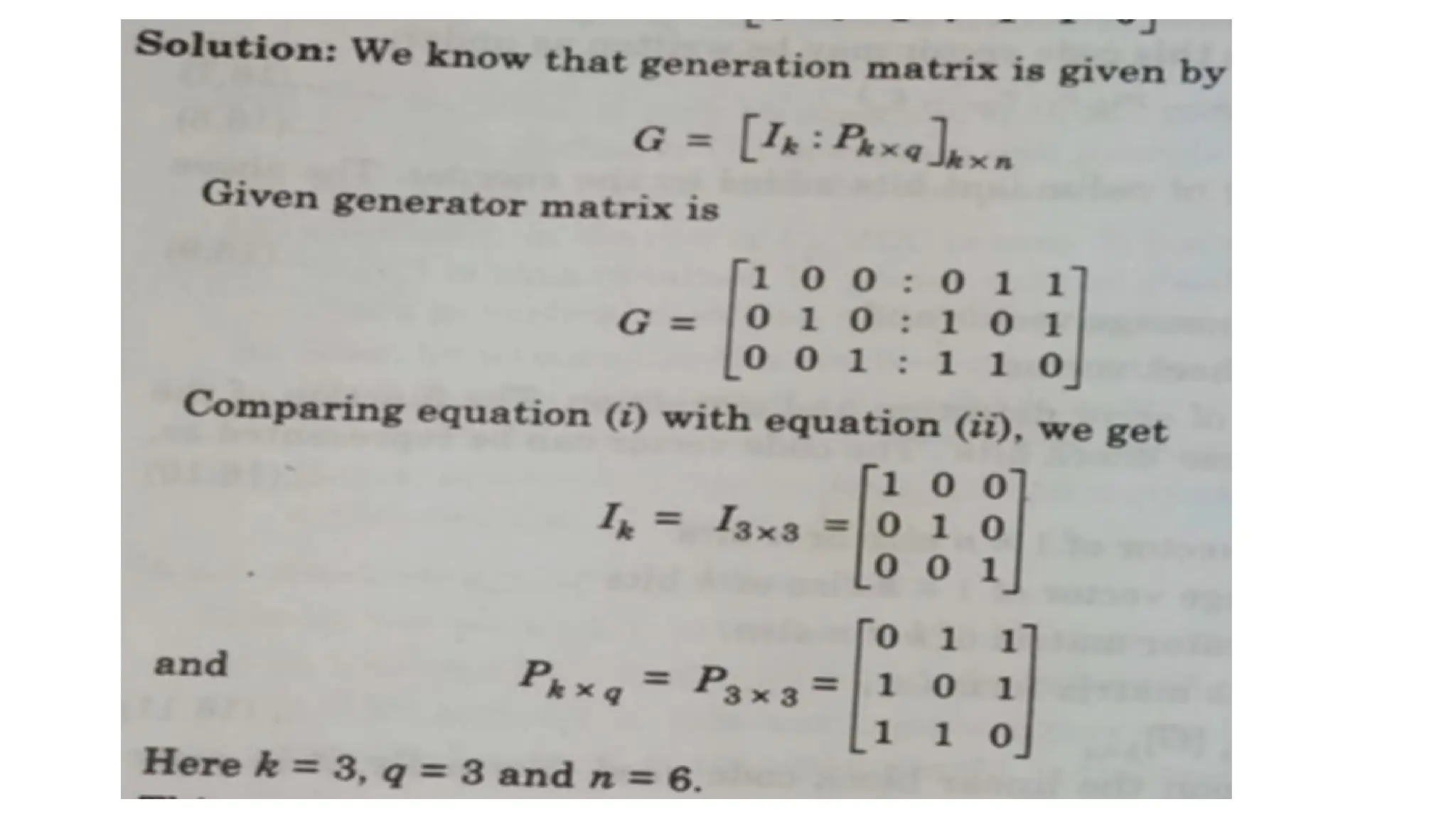
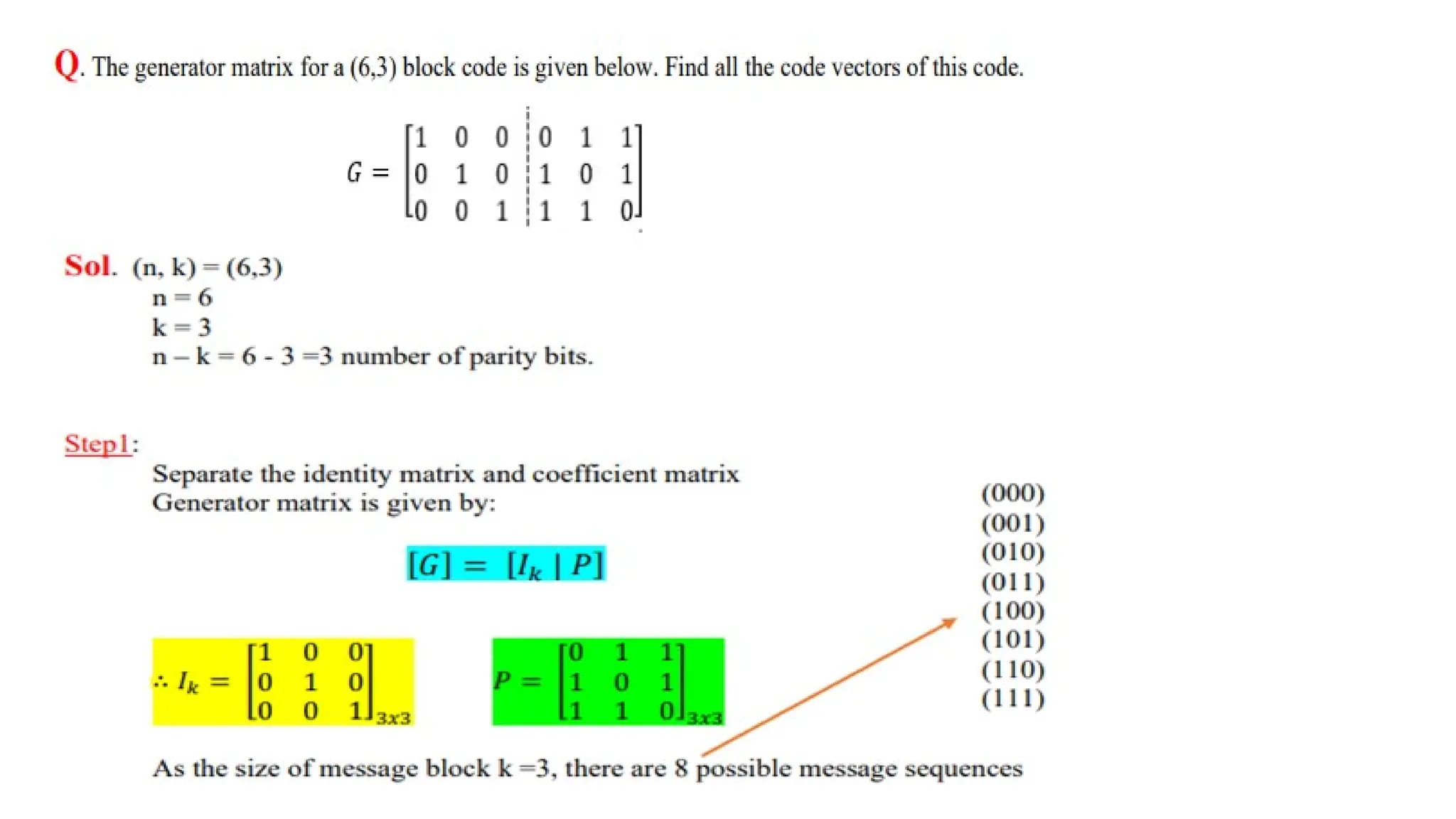
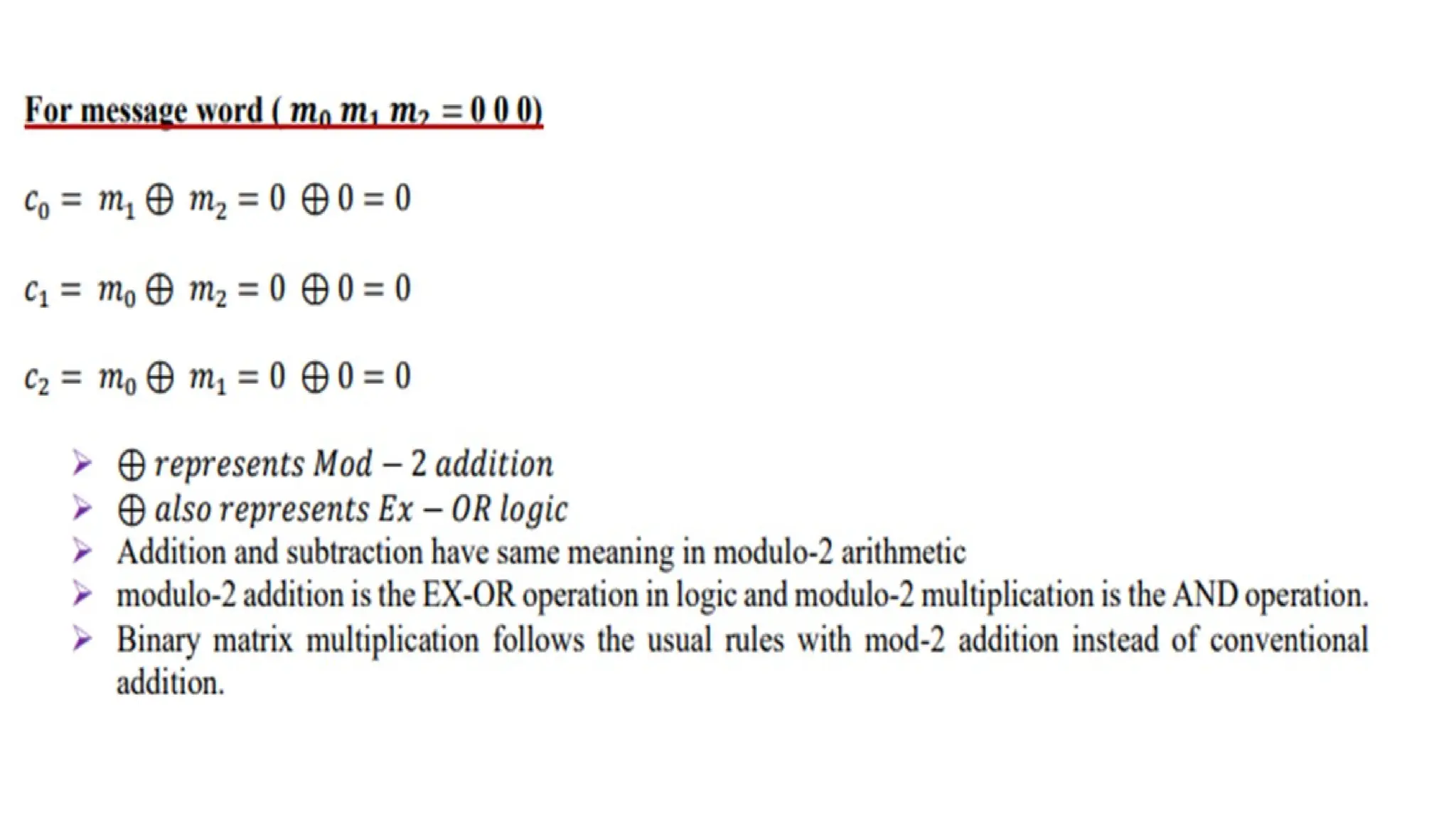
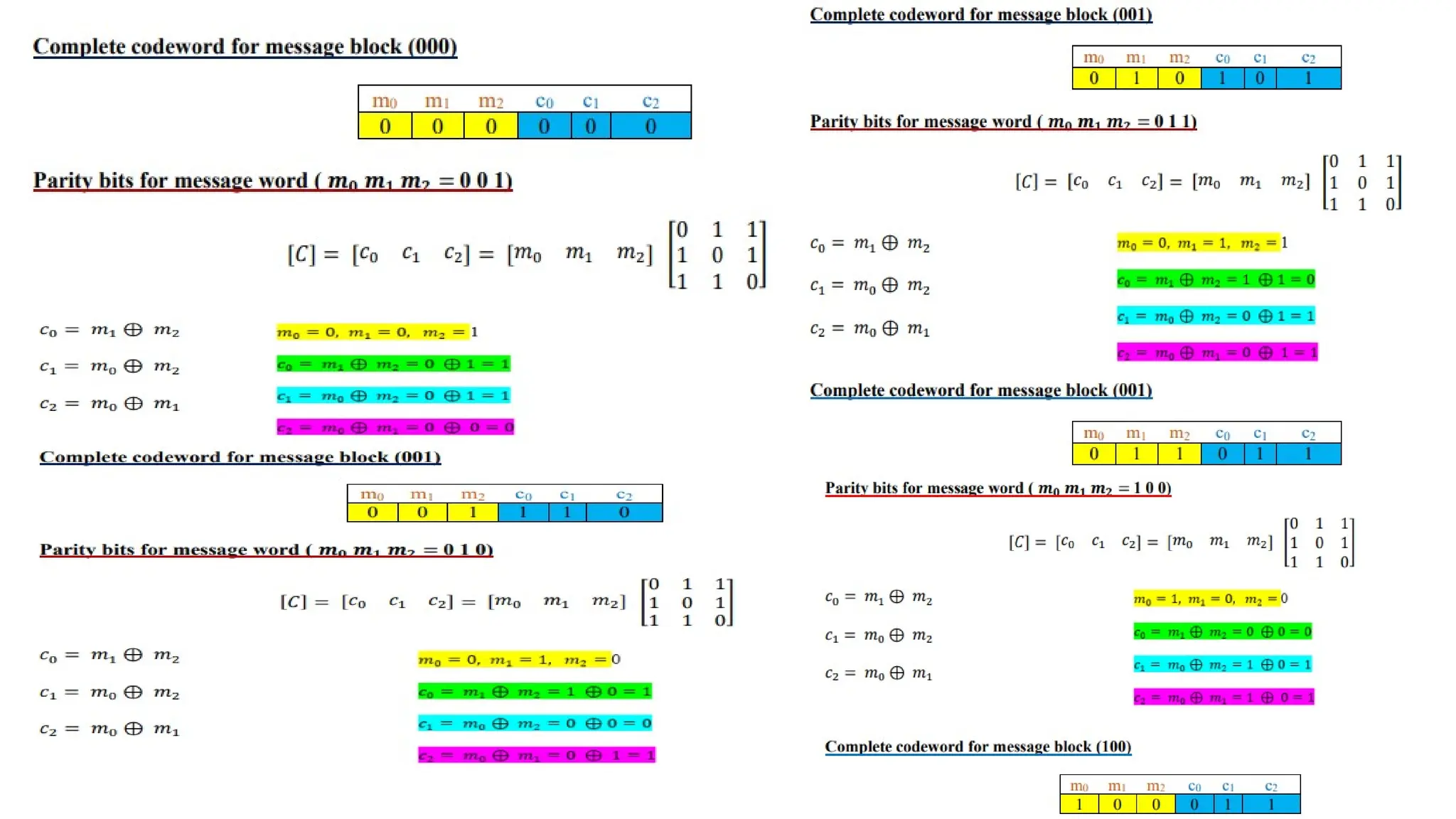
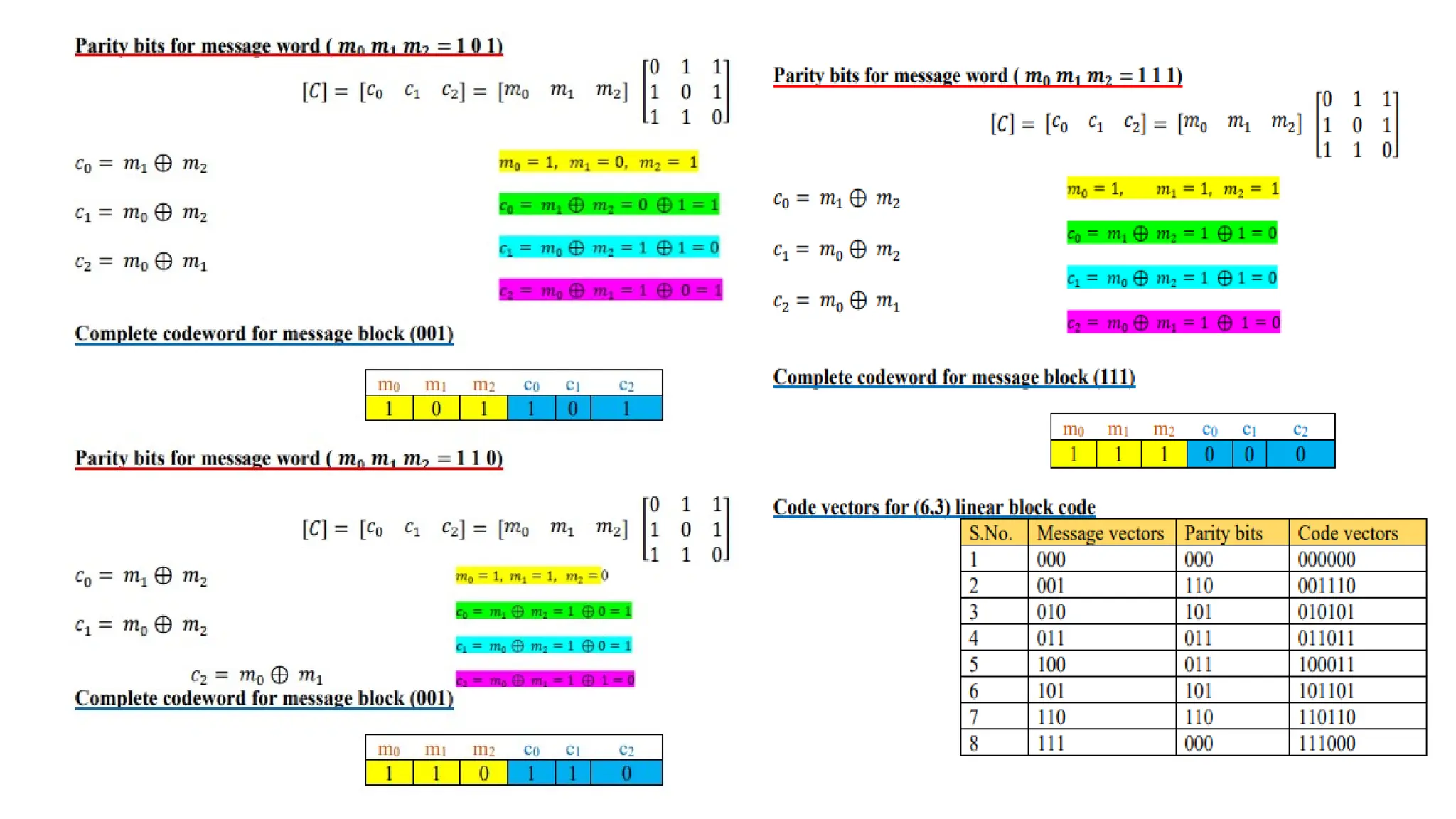
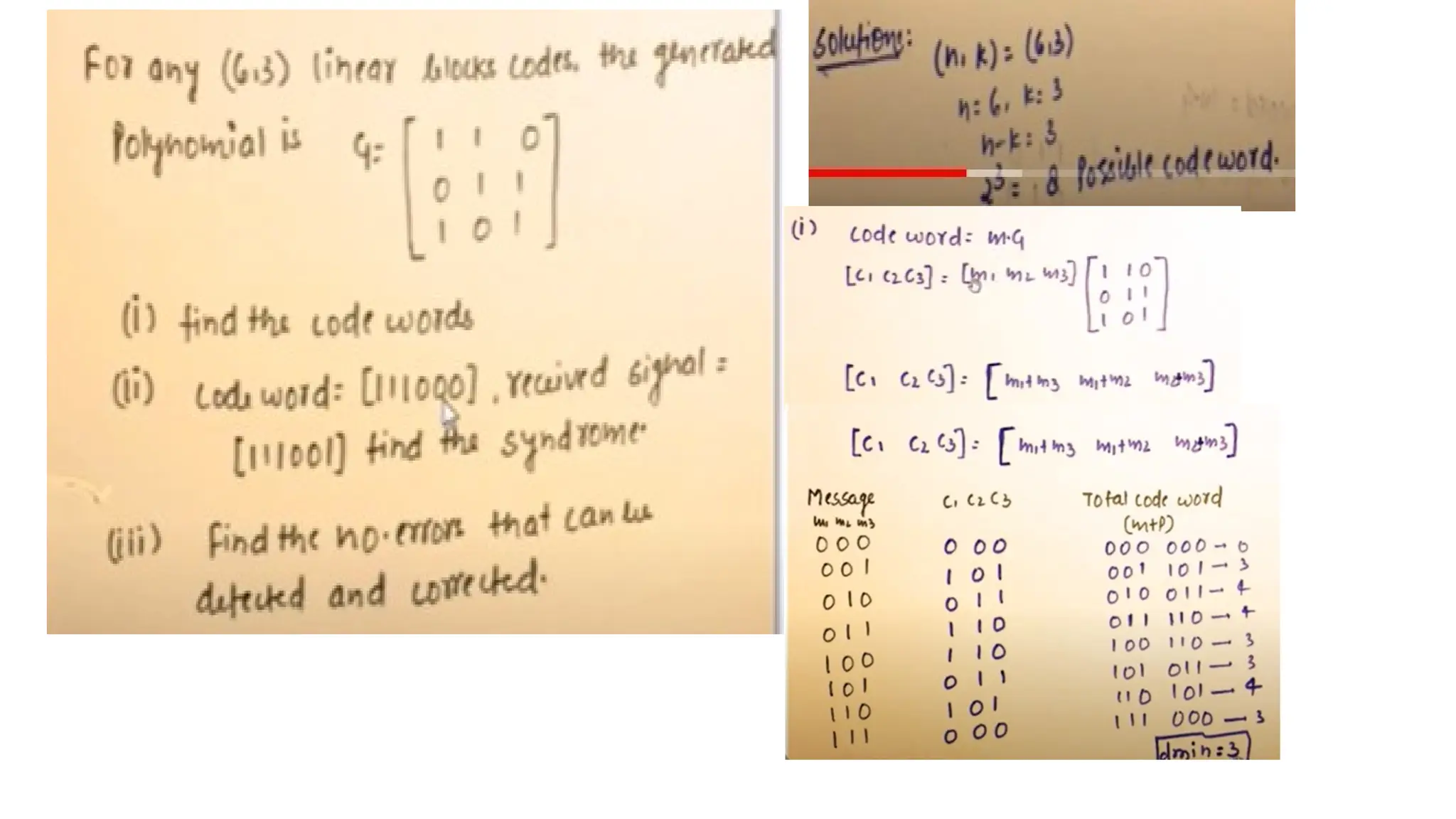
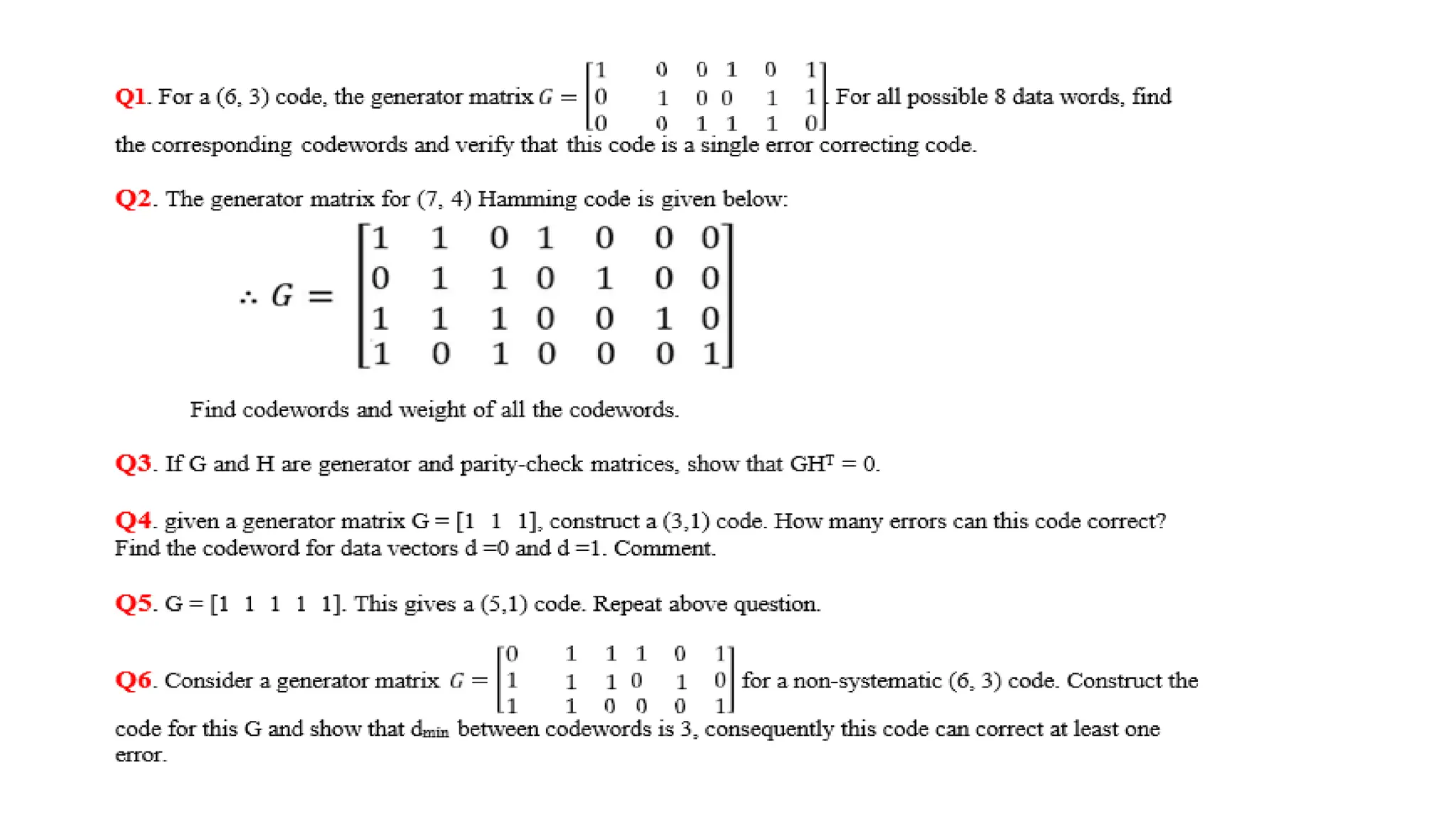
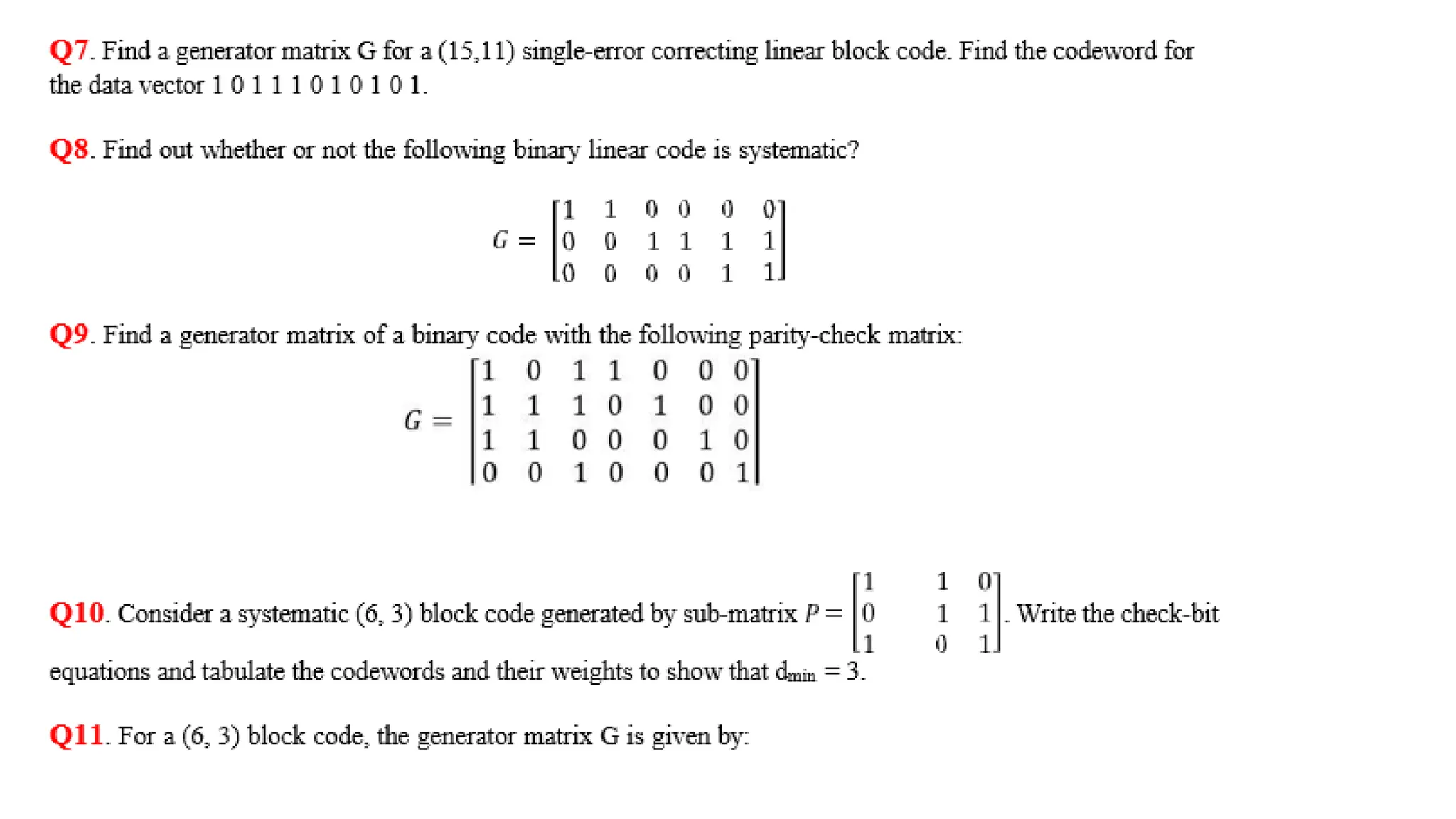
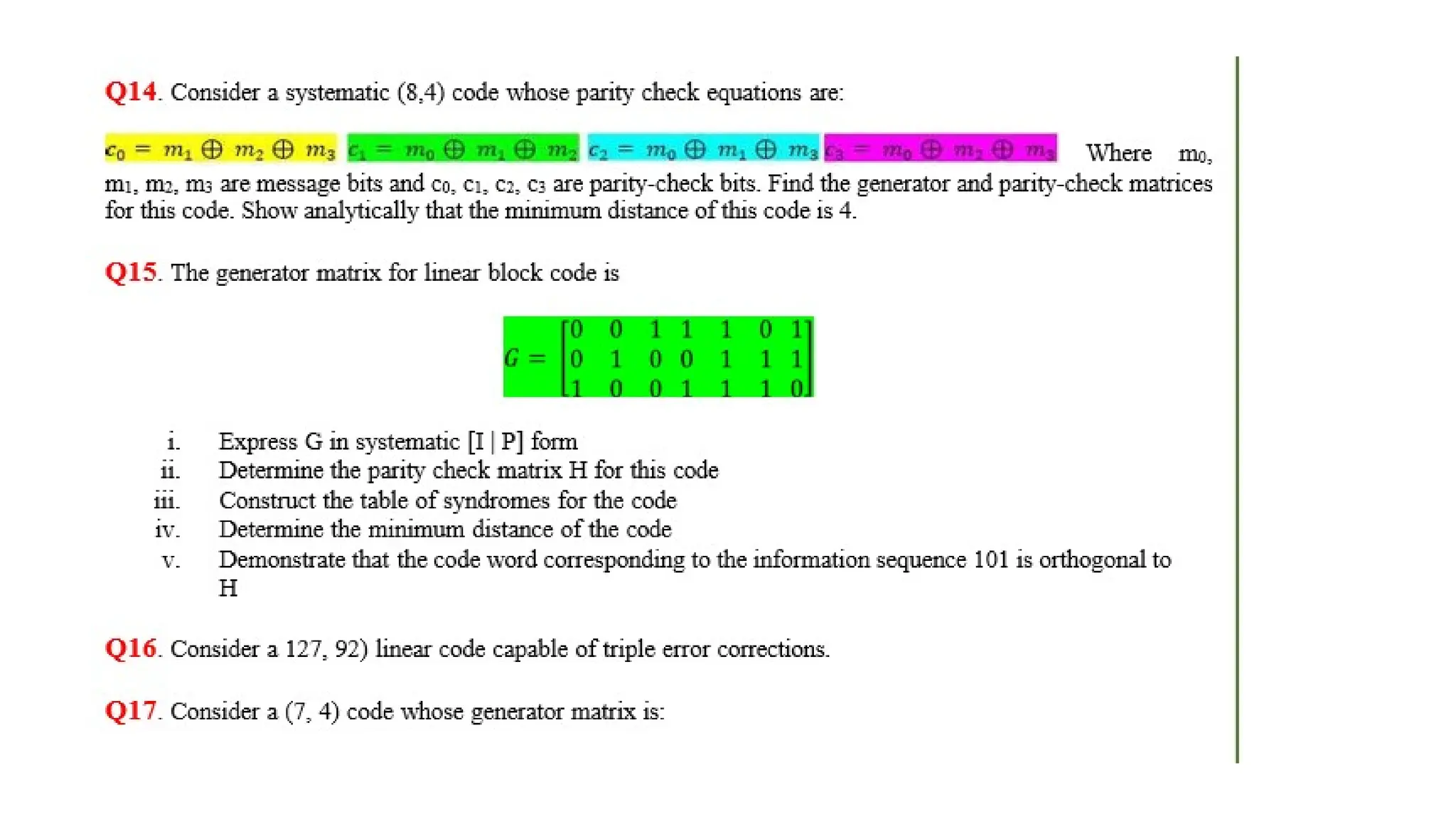
1. The generator matrix for a (6, 3) block code is shown below. Obtain all code
of words of this code
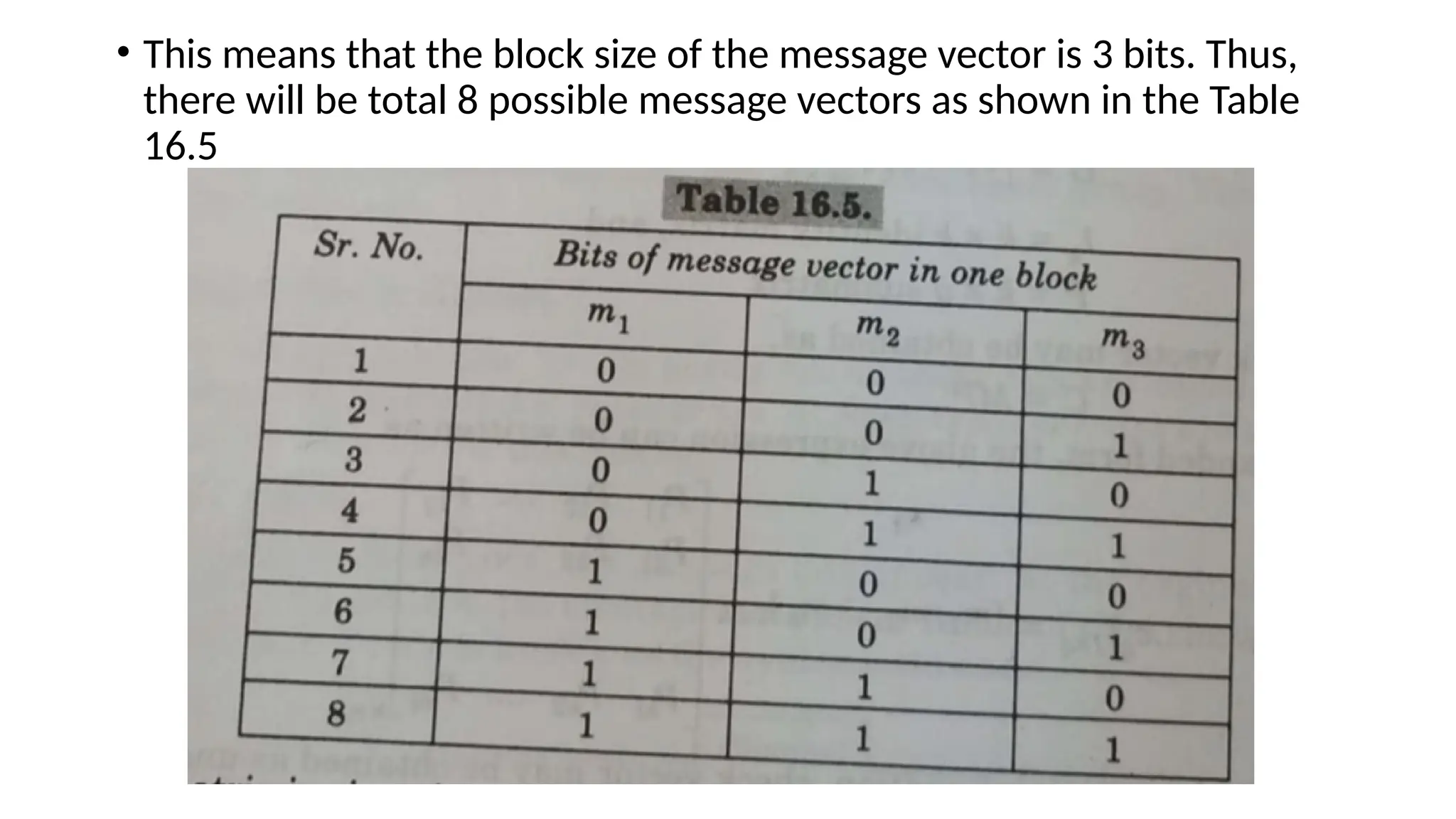
• This means that the block size of the message vector is 3 bits. Thus,
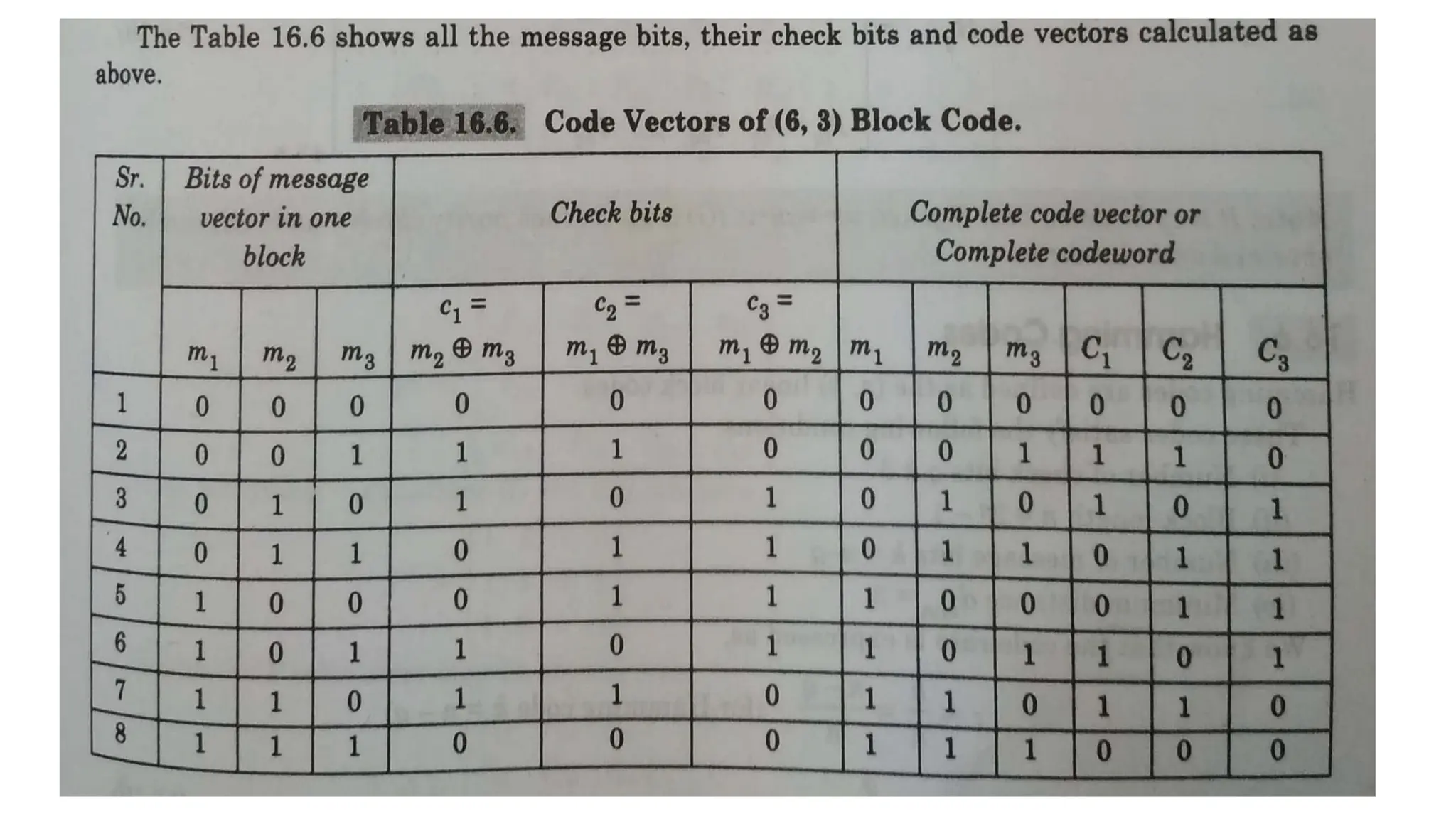
there will be total 8 possible message vectors as shown in the Table
16.5
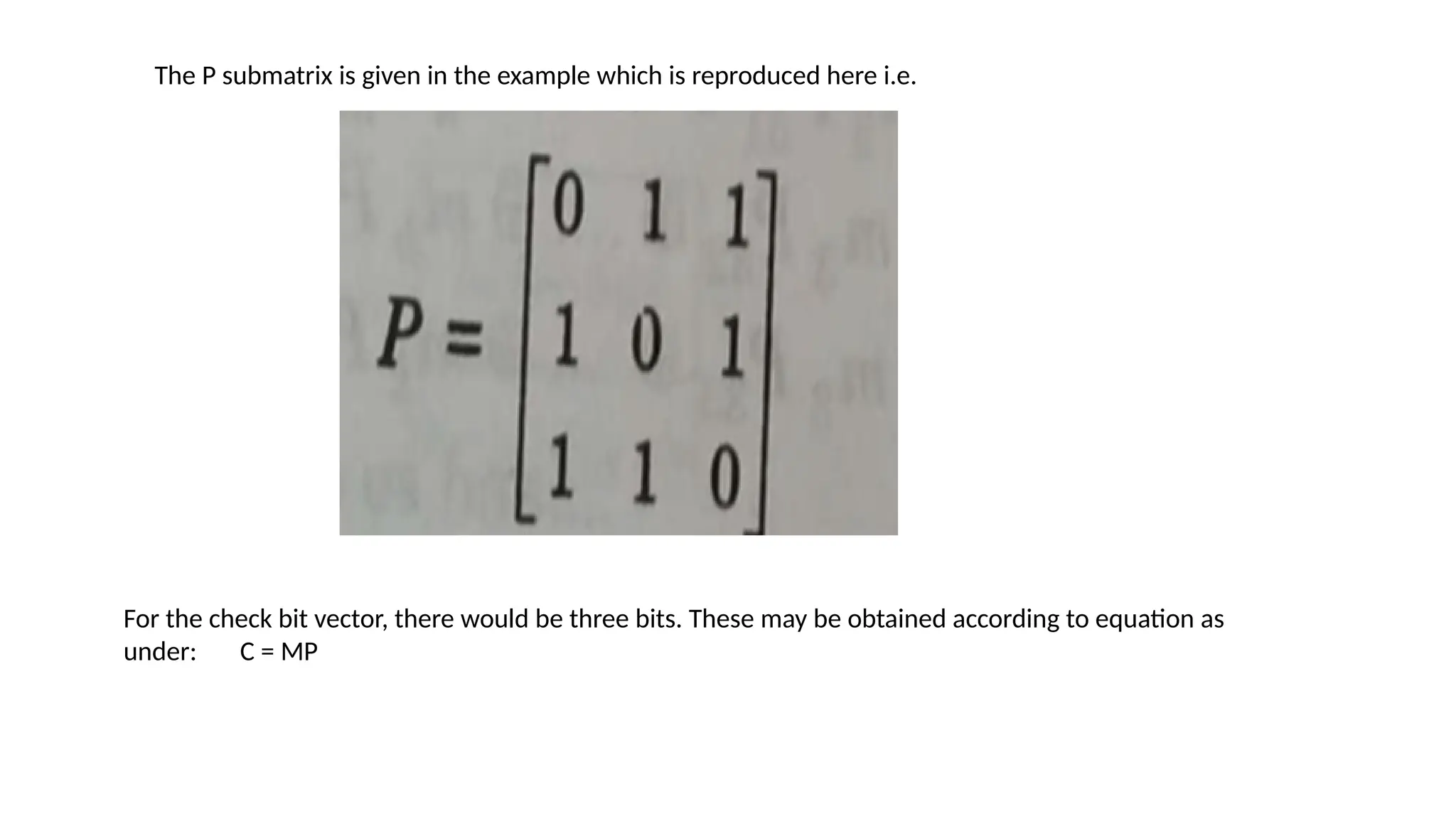
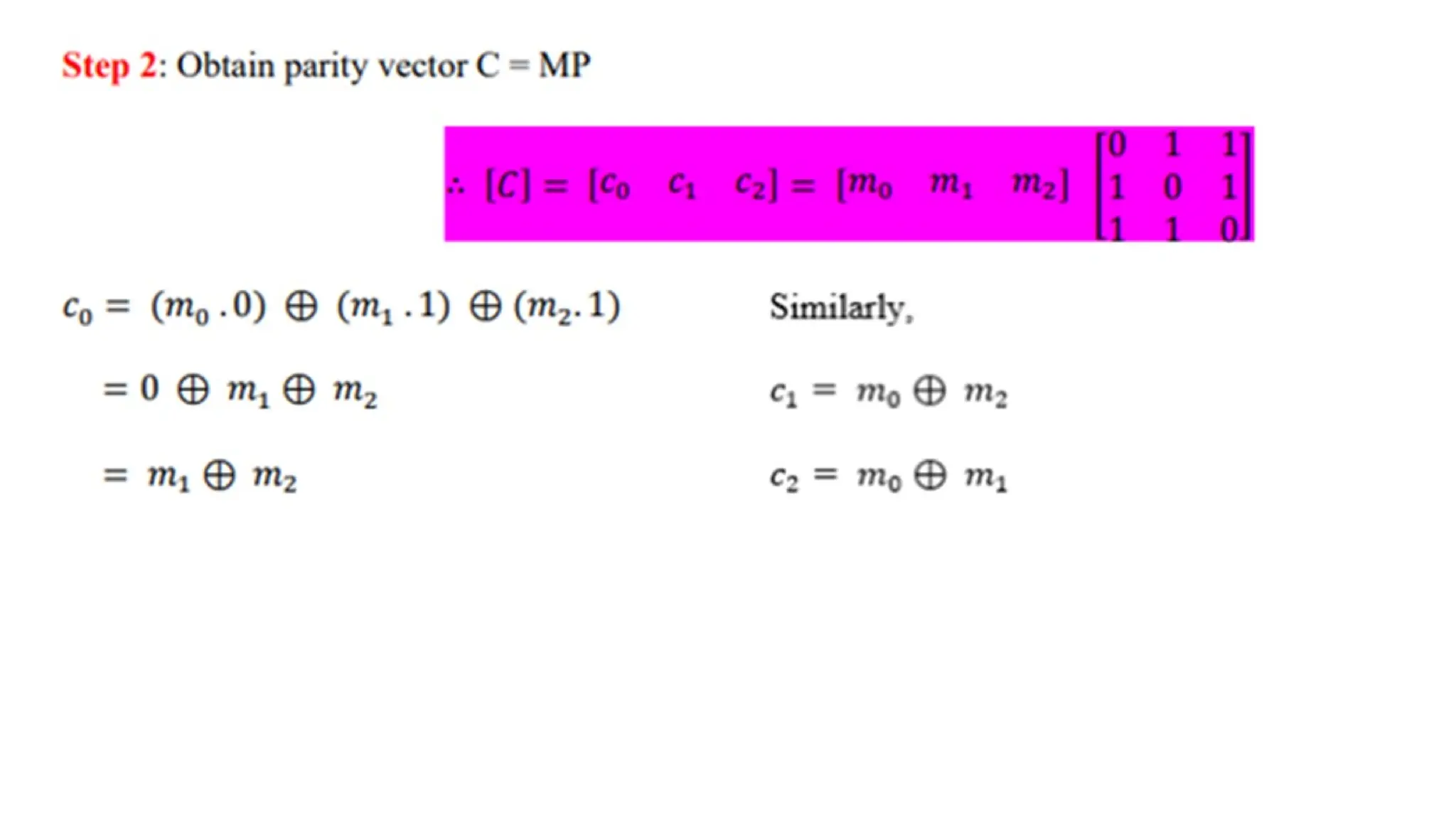
The P submatrix is given in the example which is reproduced here i.e.
For the check bit vector, there would be three bits. These may be obtained according to equation as
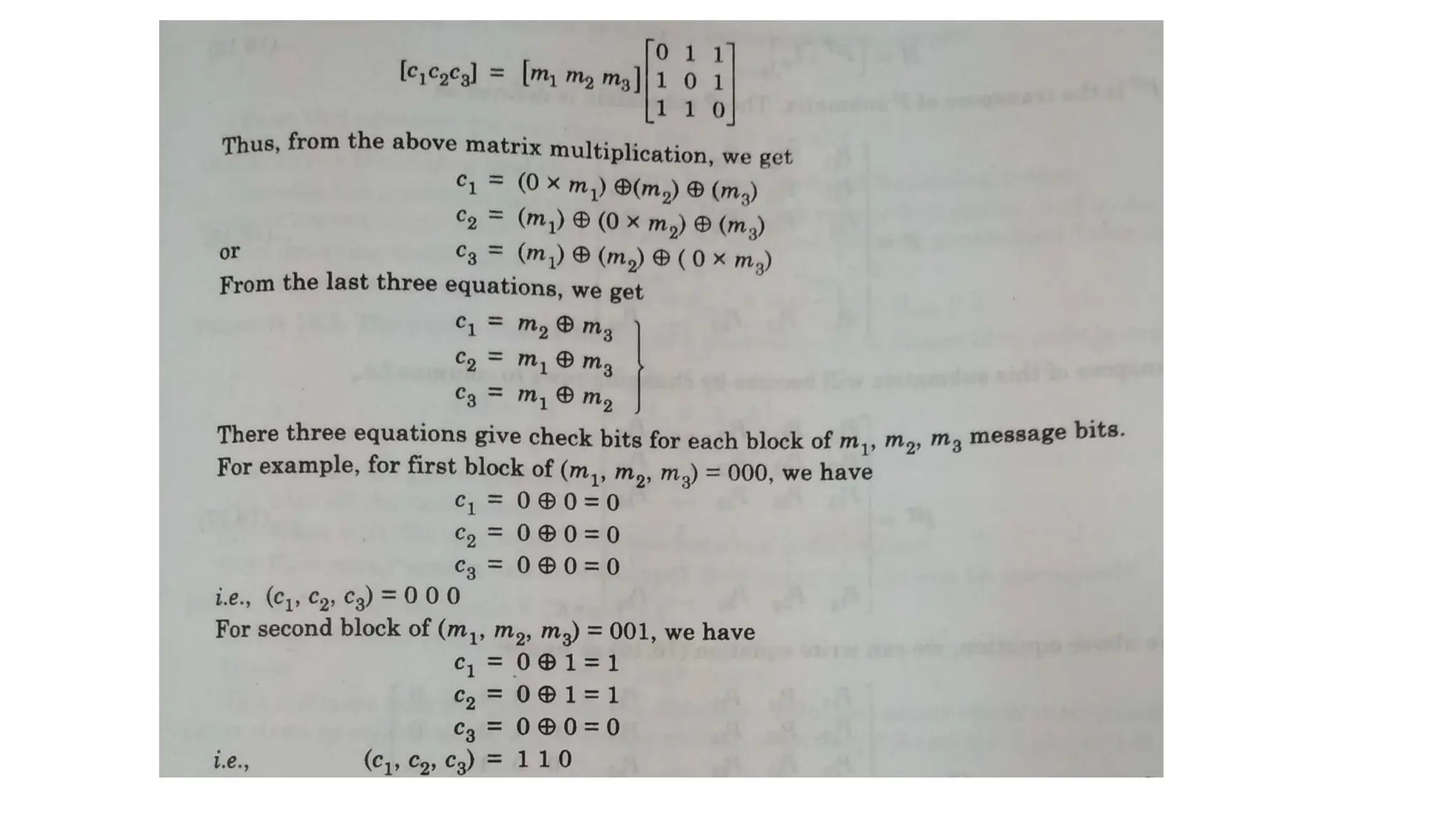
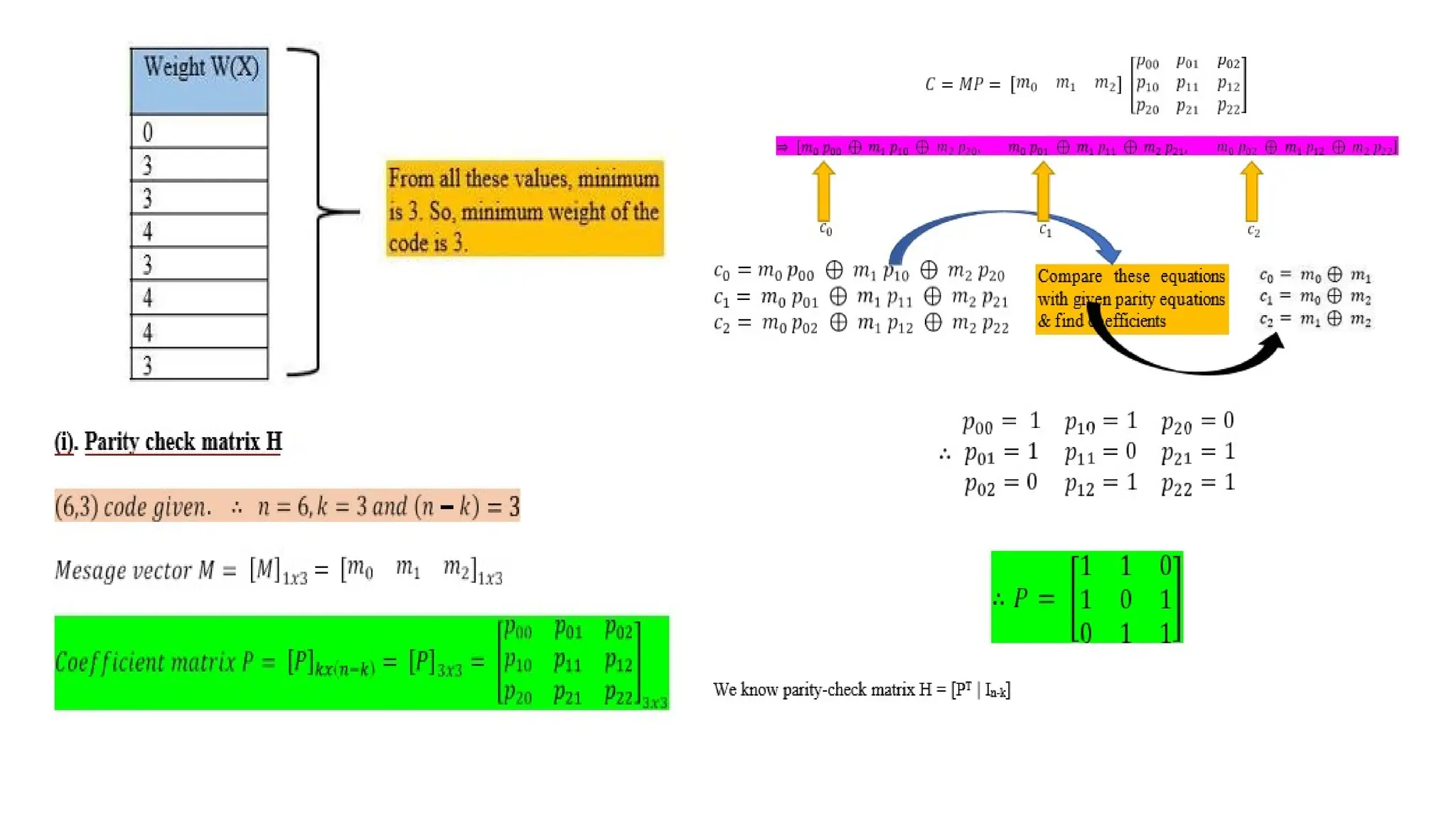
under: C = MP
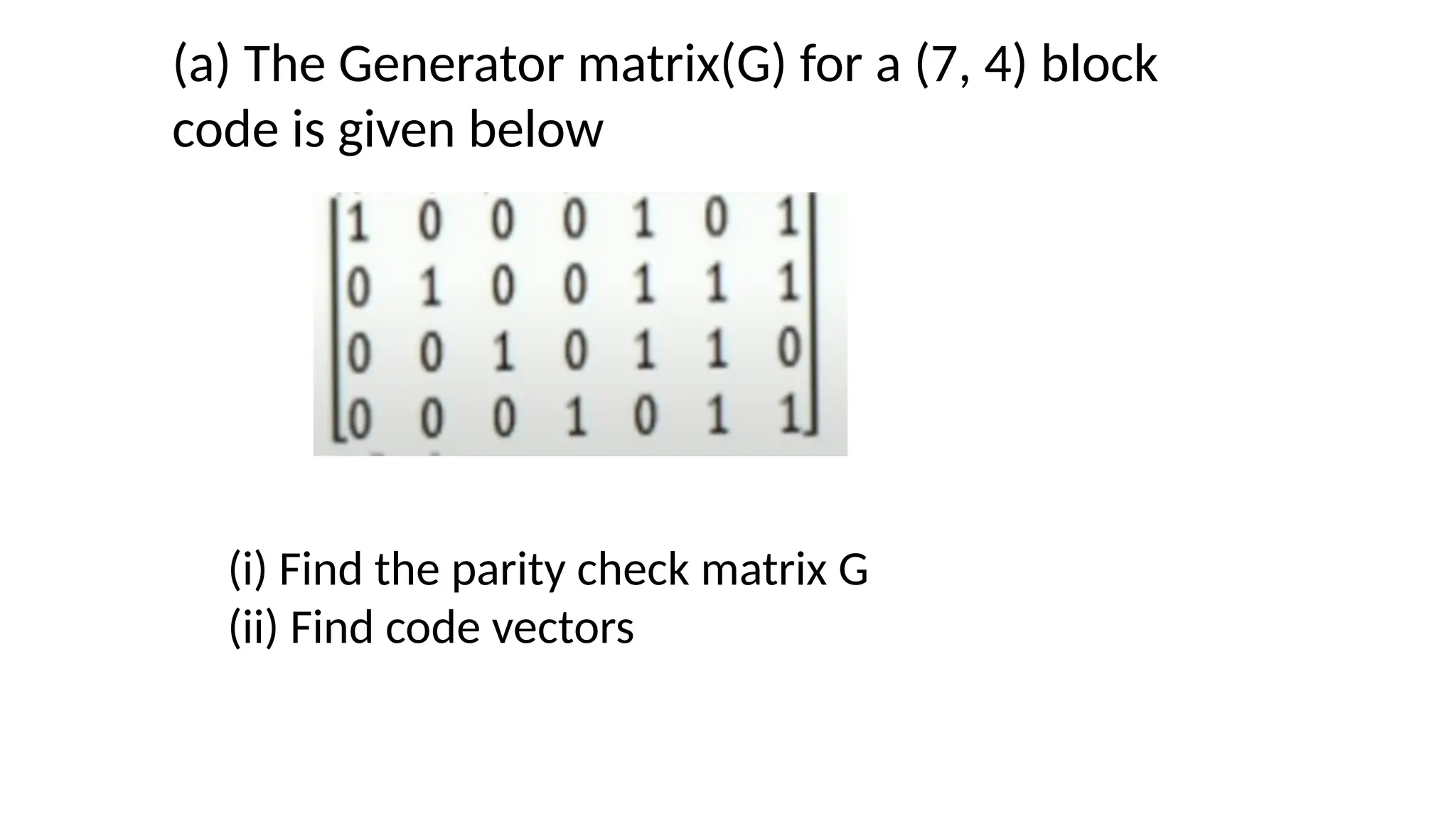
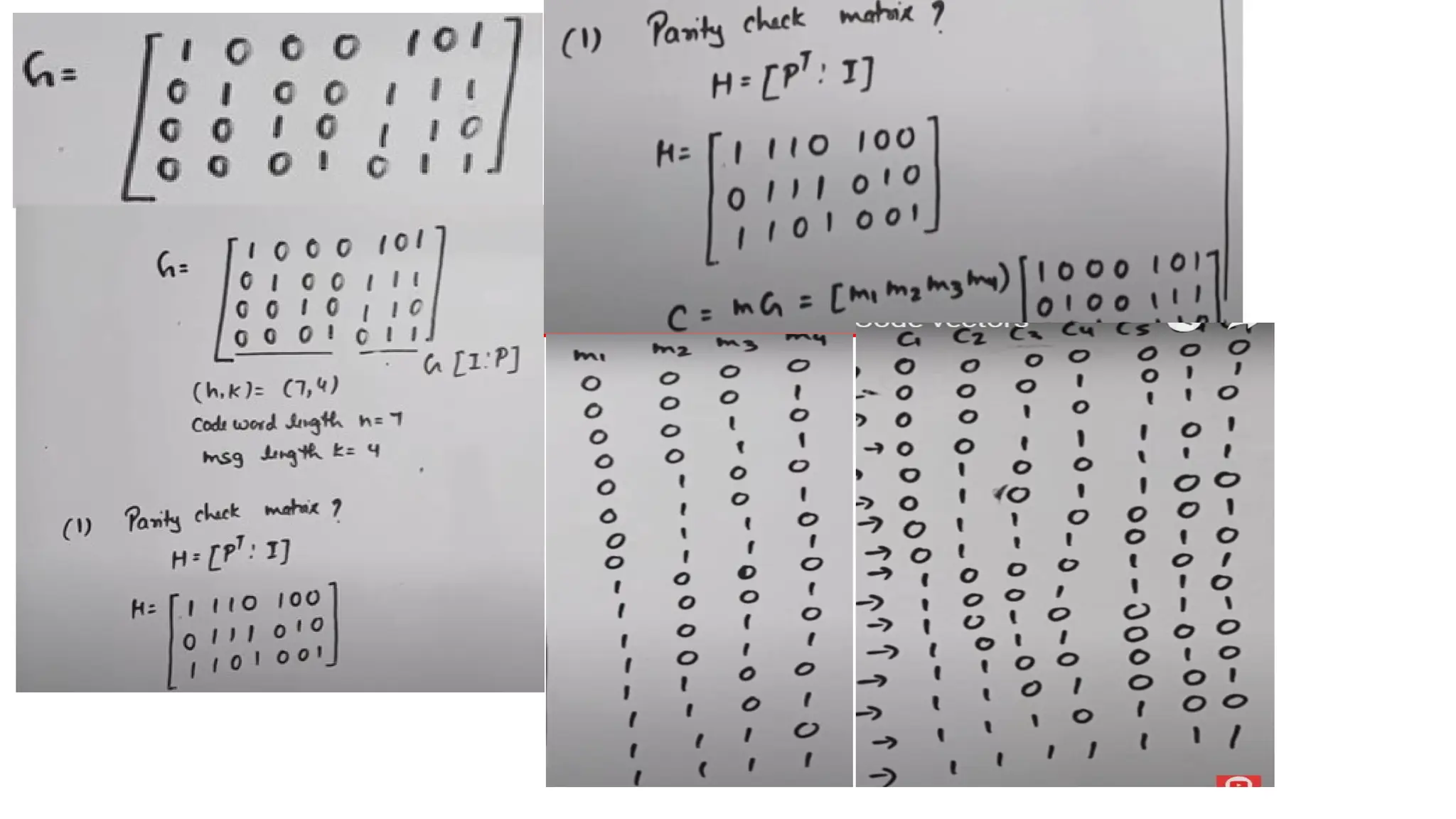
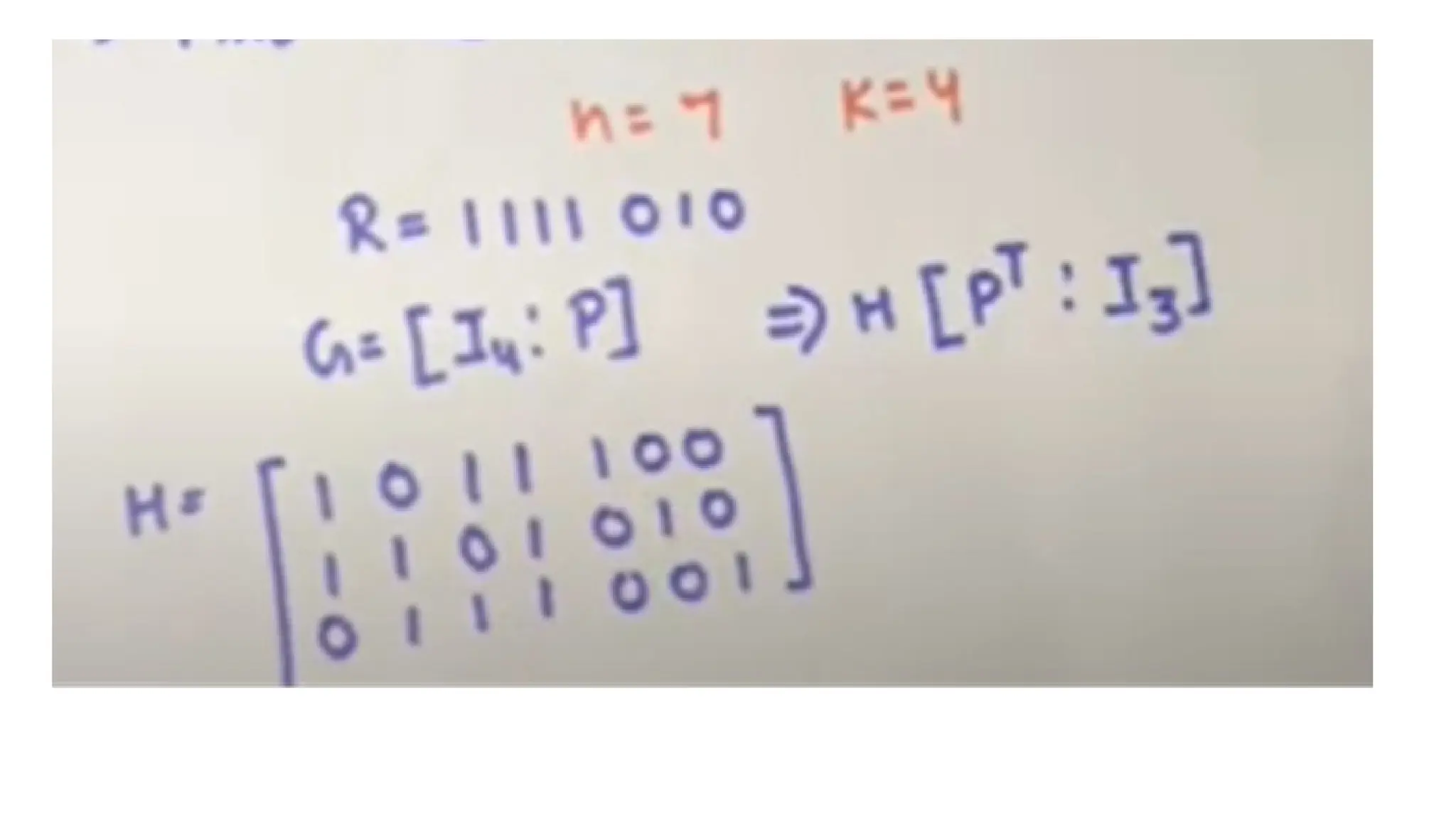
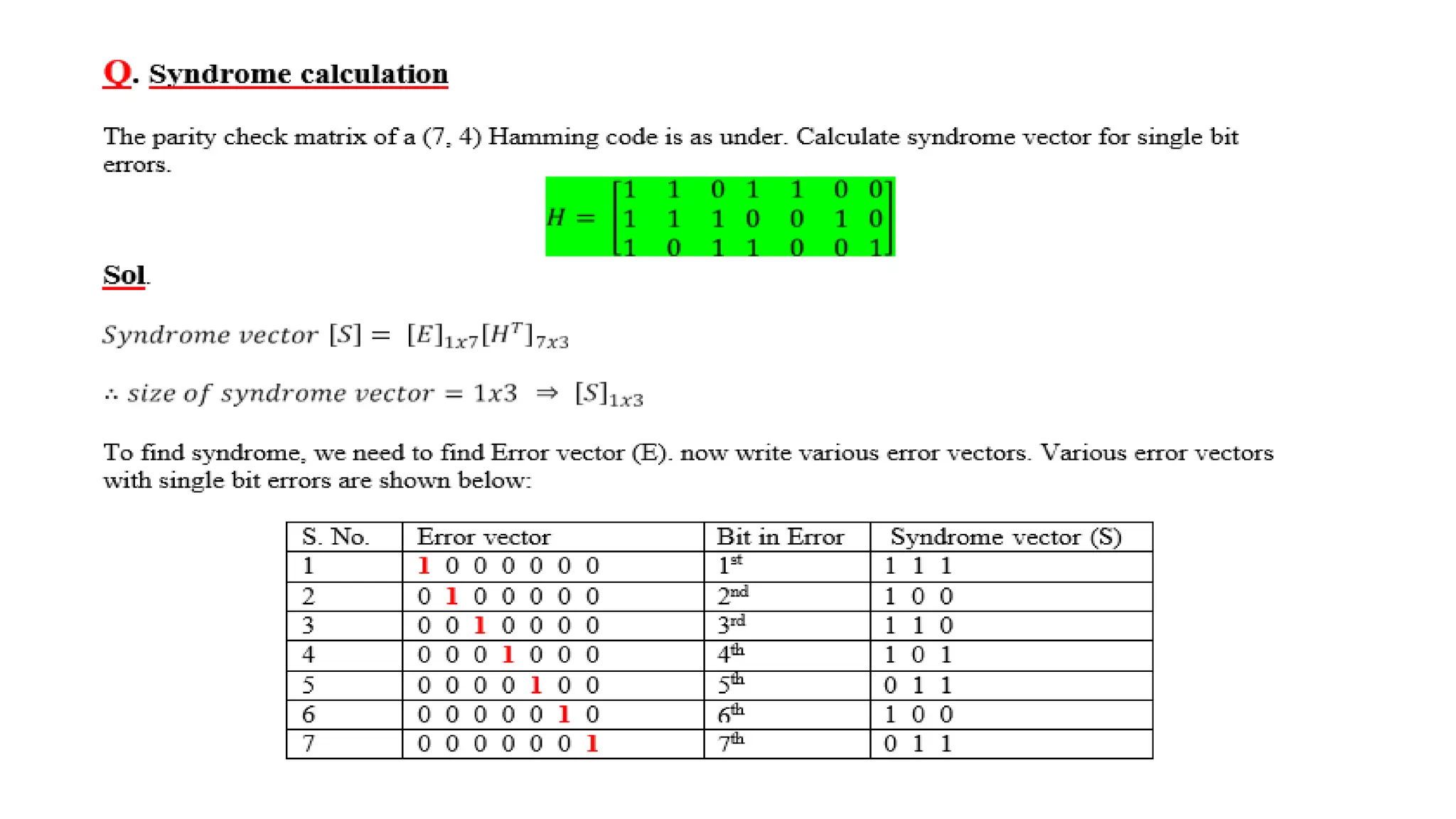
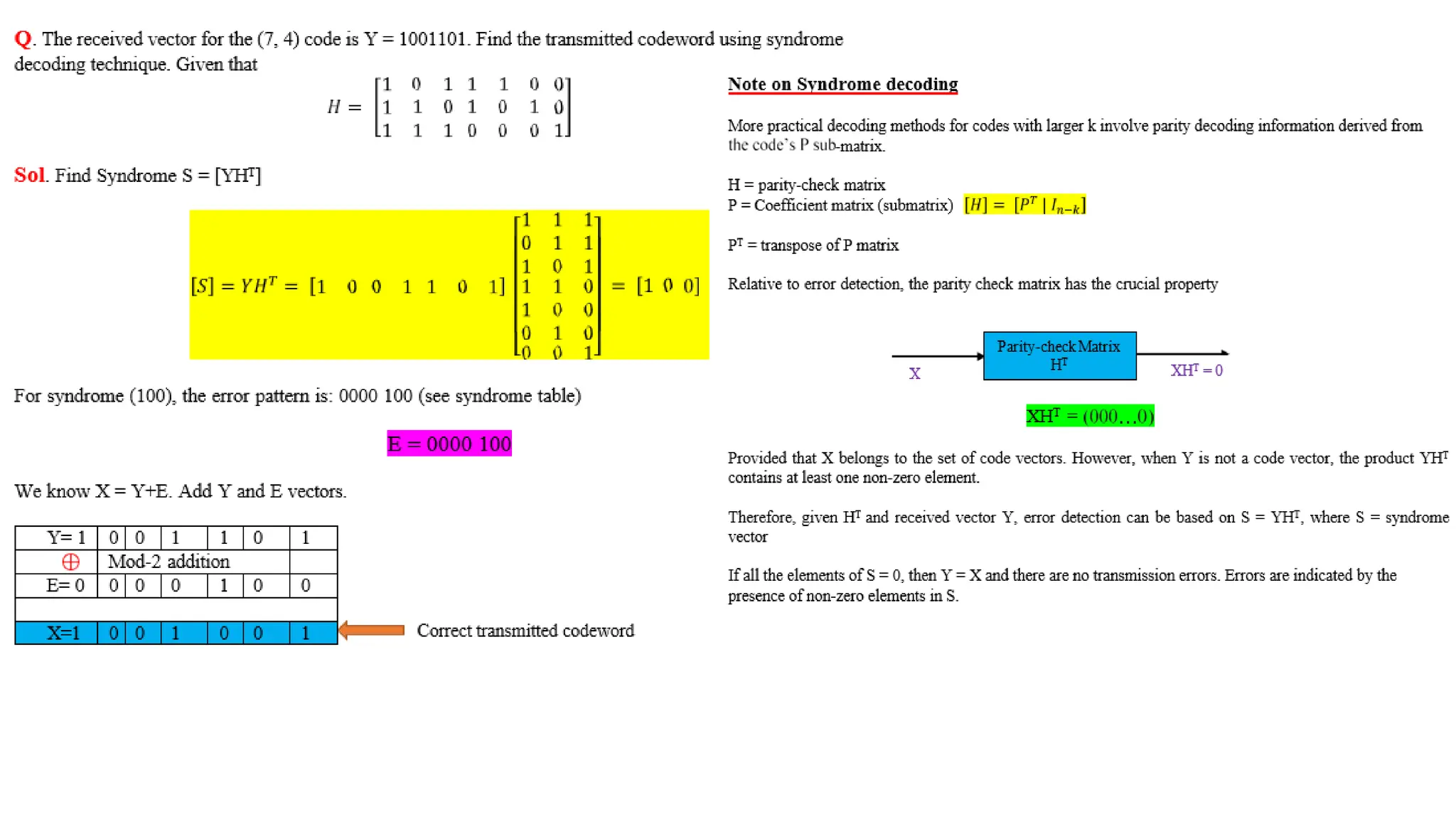
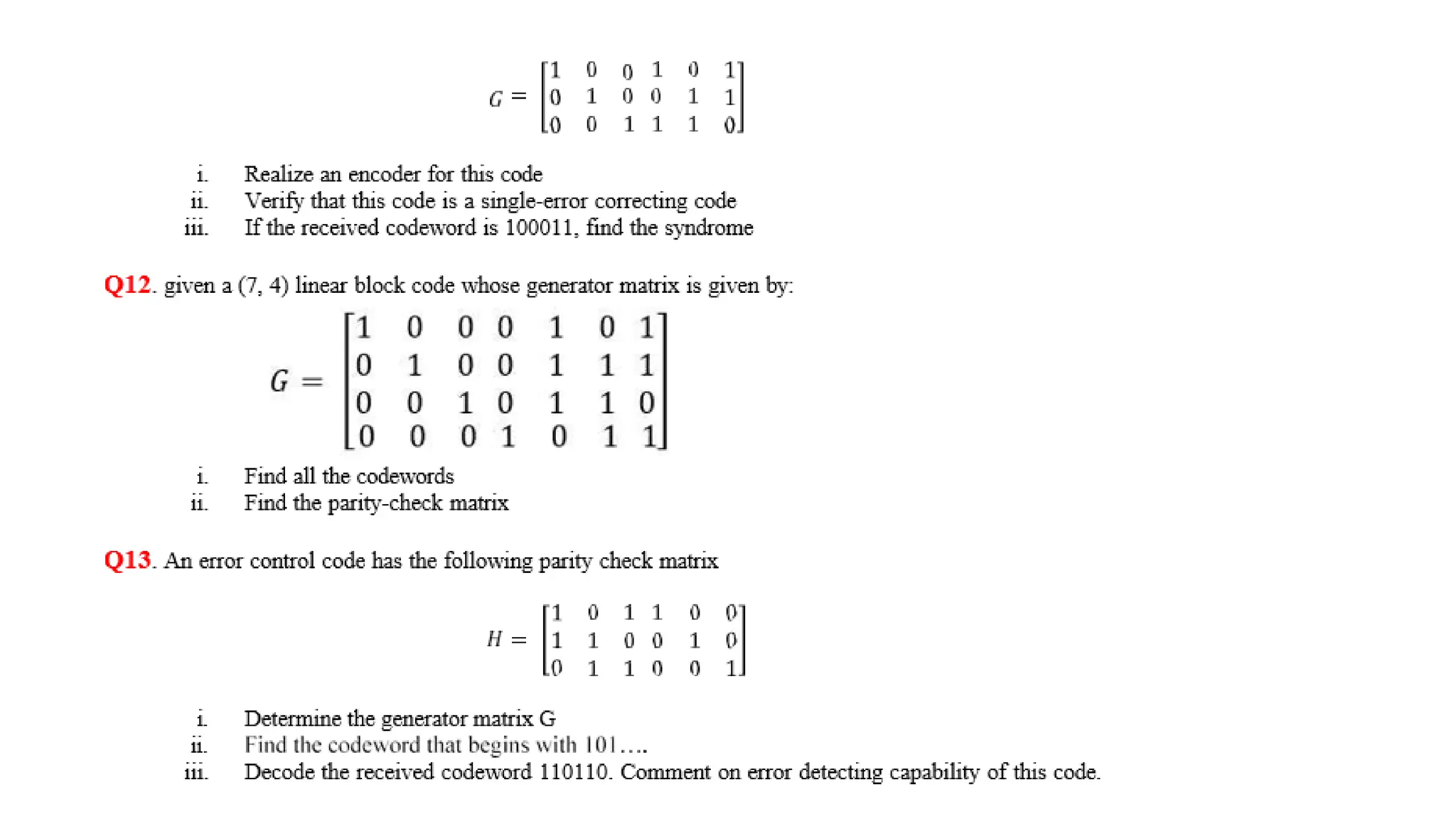
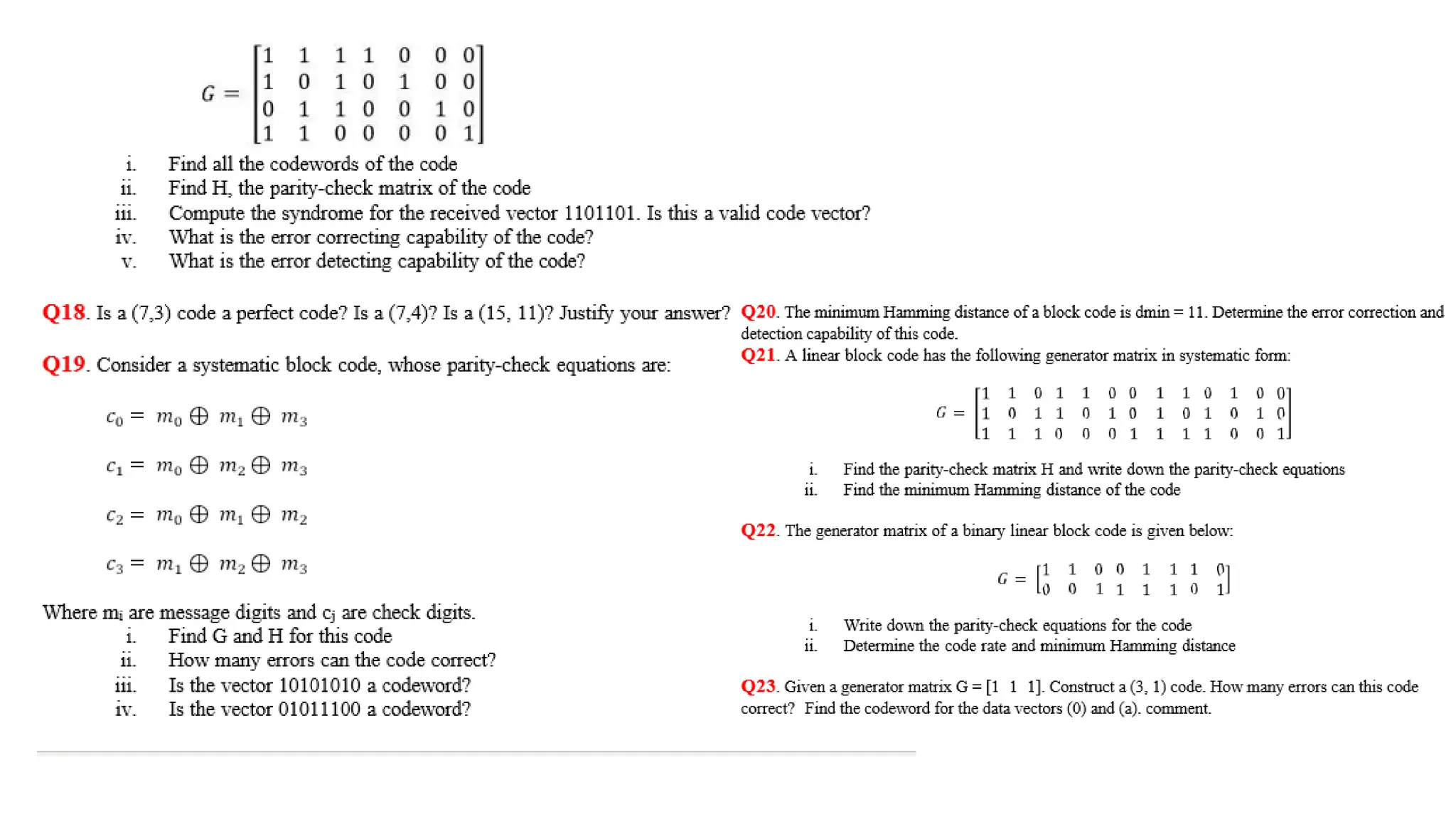
(a) The Generator matrix(G) for a (7, 4) block
code is given below
(i) Find the parity check matrix G
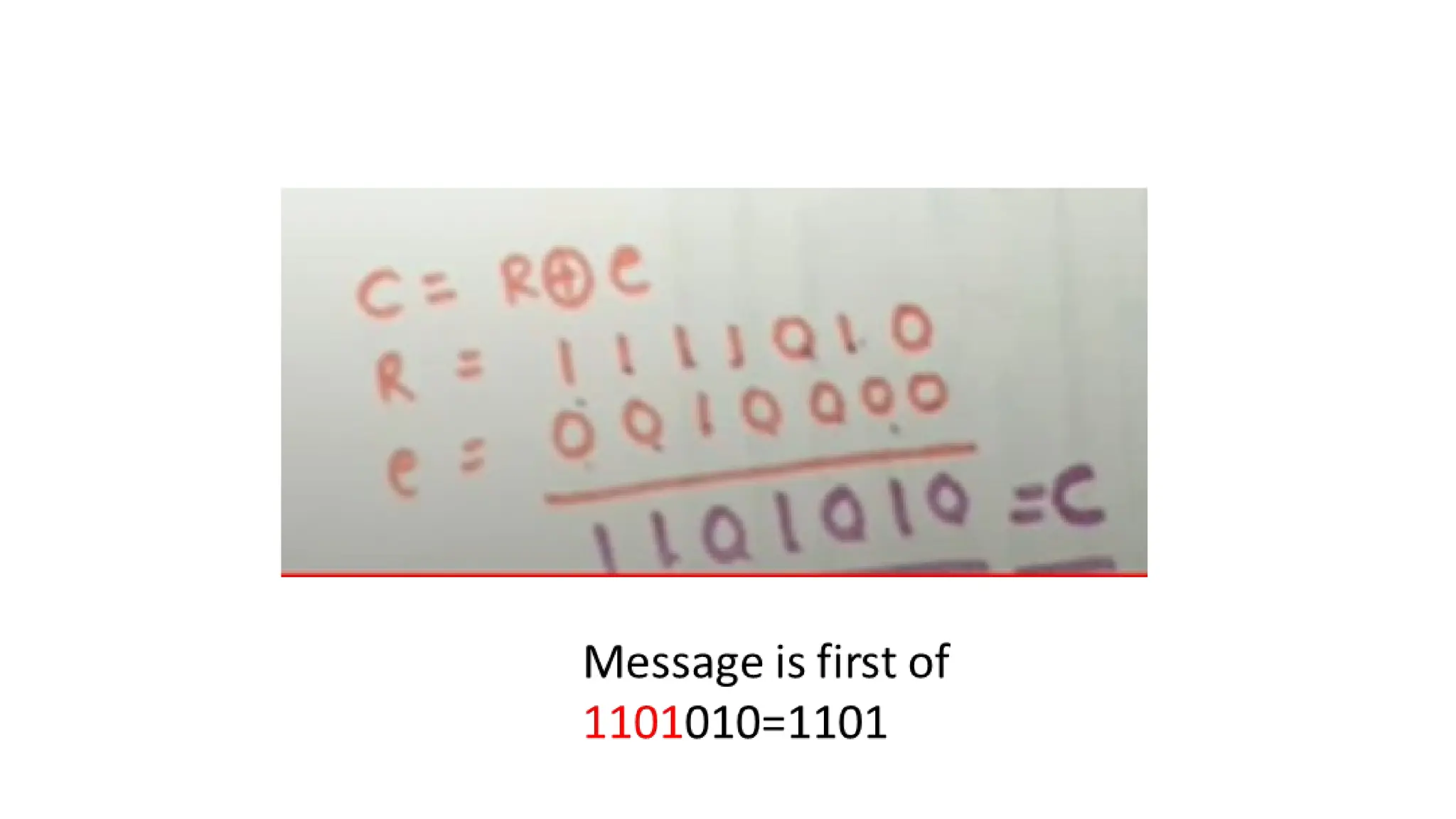
(ii) Find code vectors
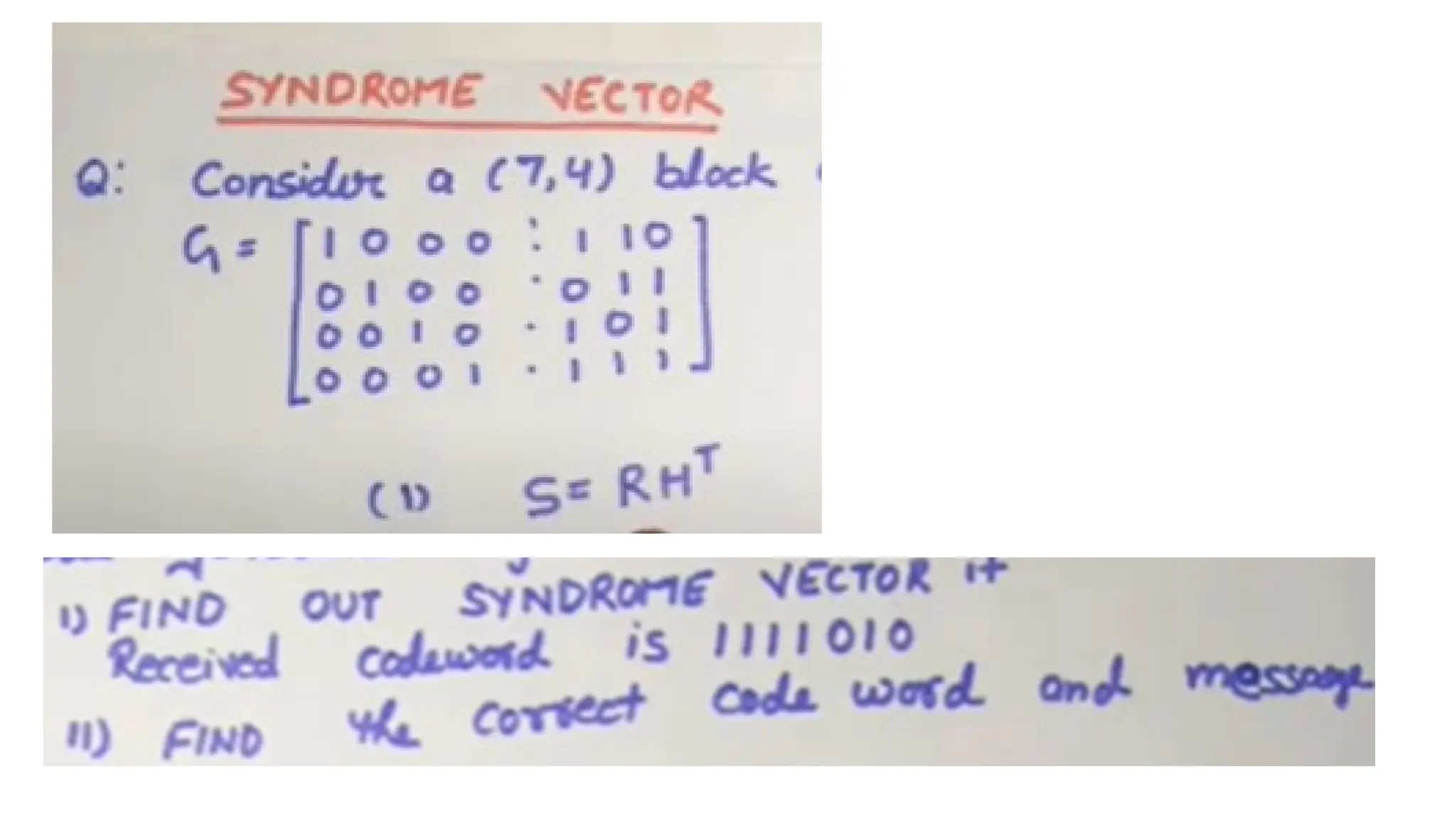
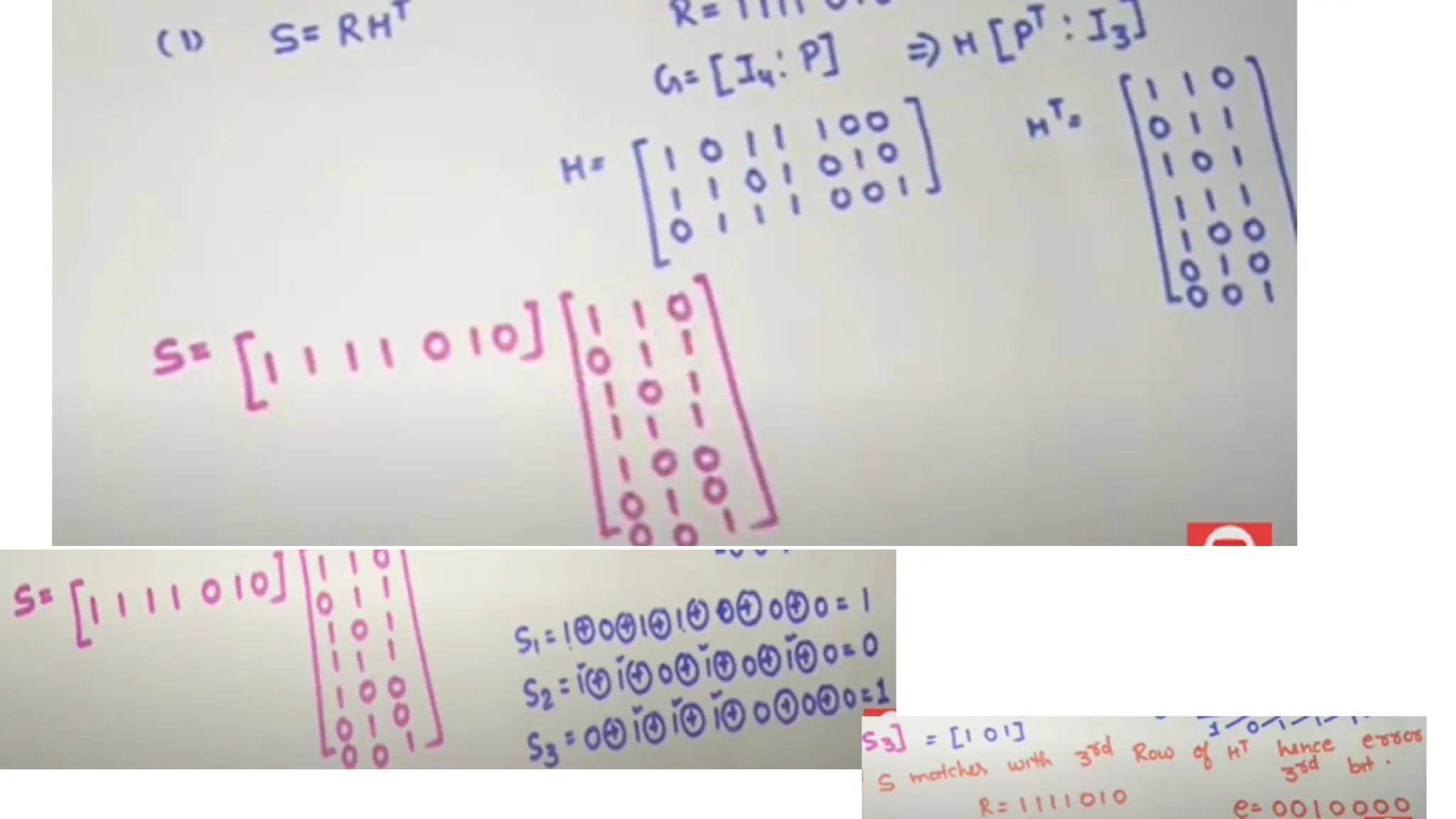
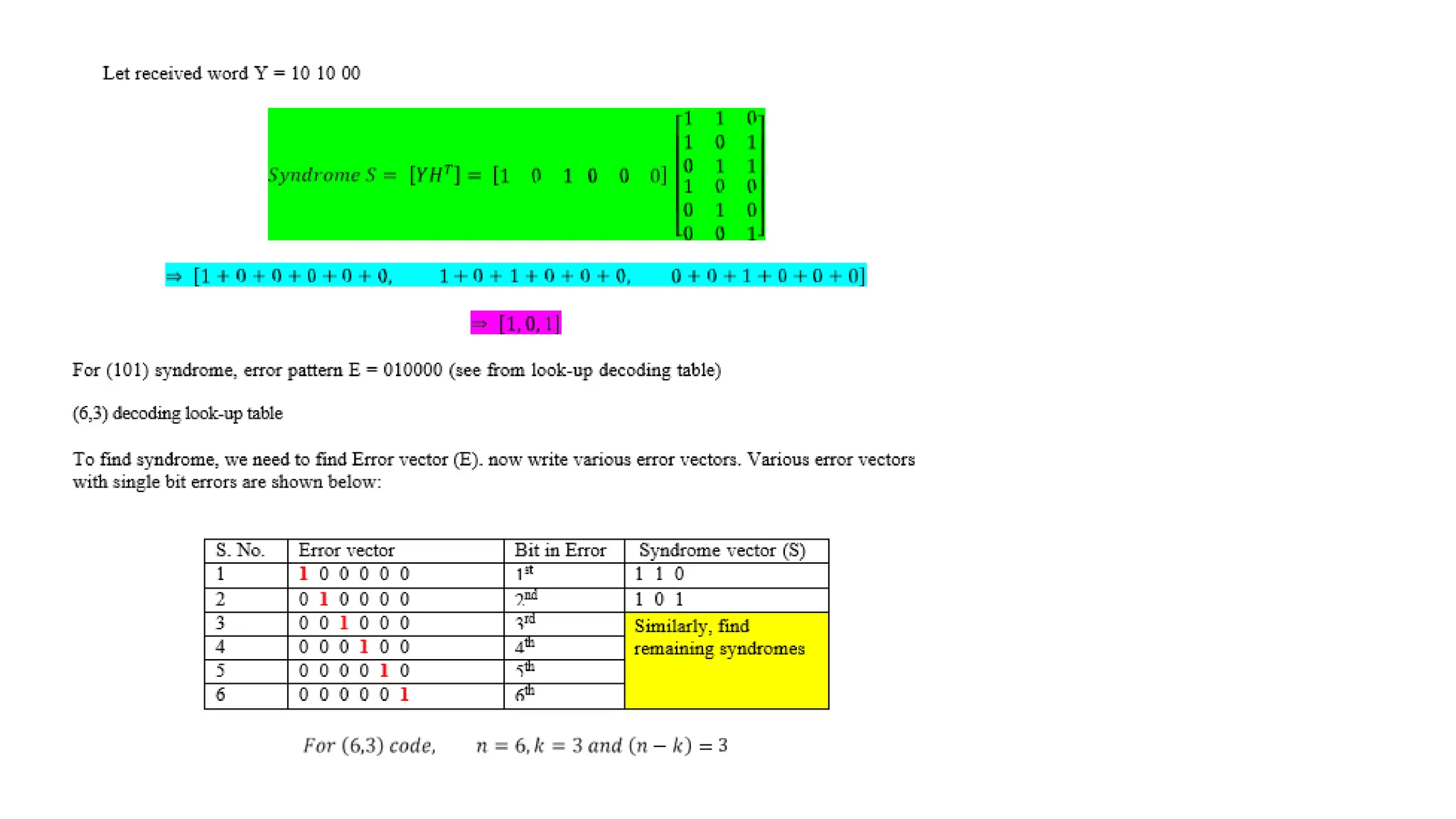
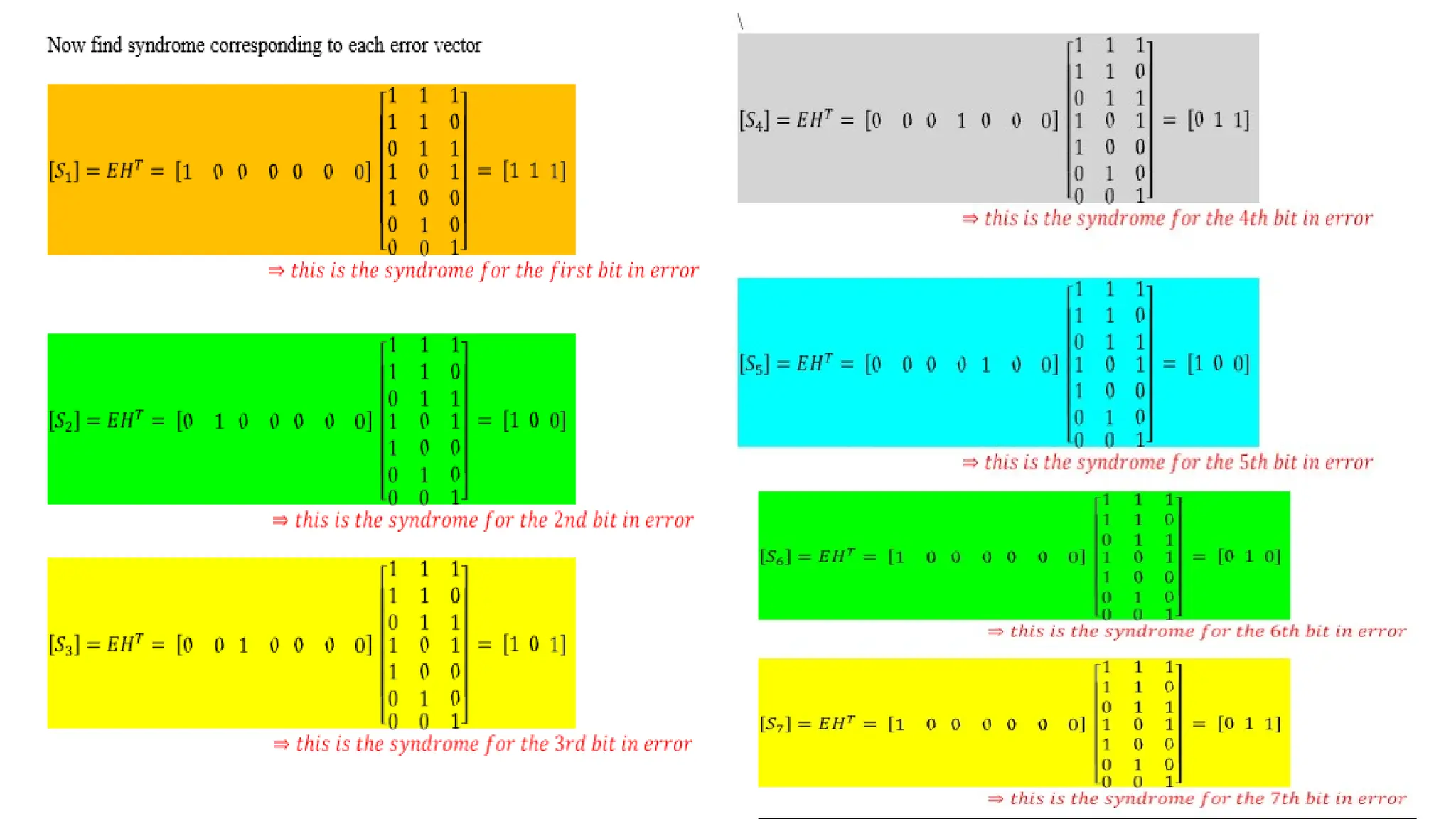
syndrome vector
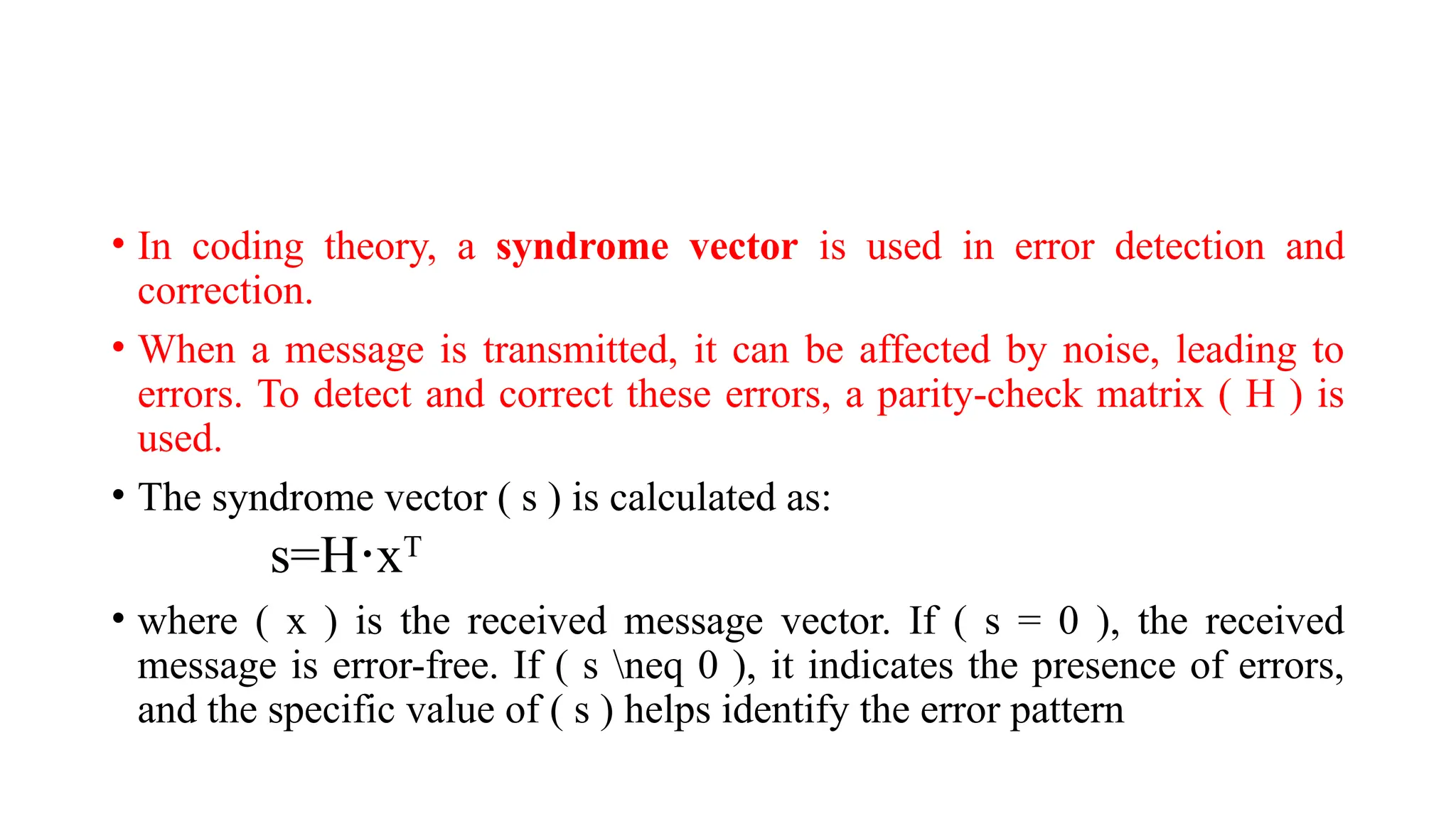
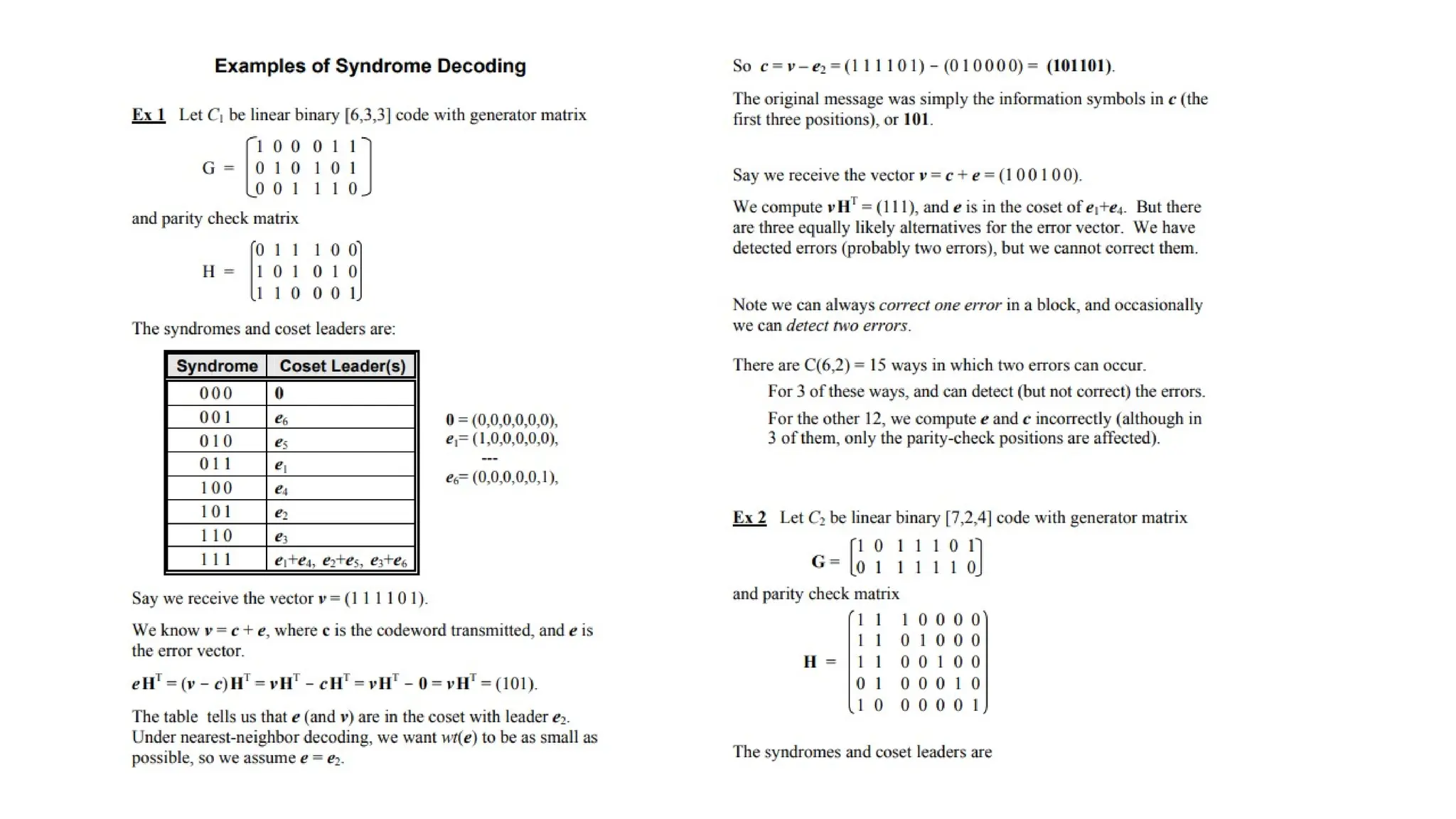
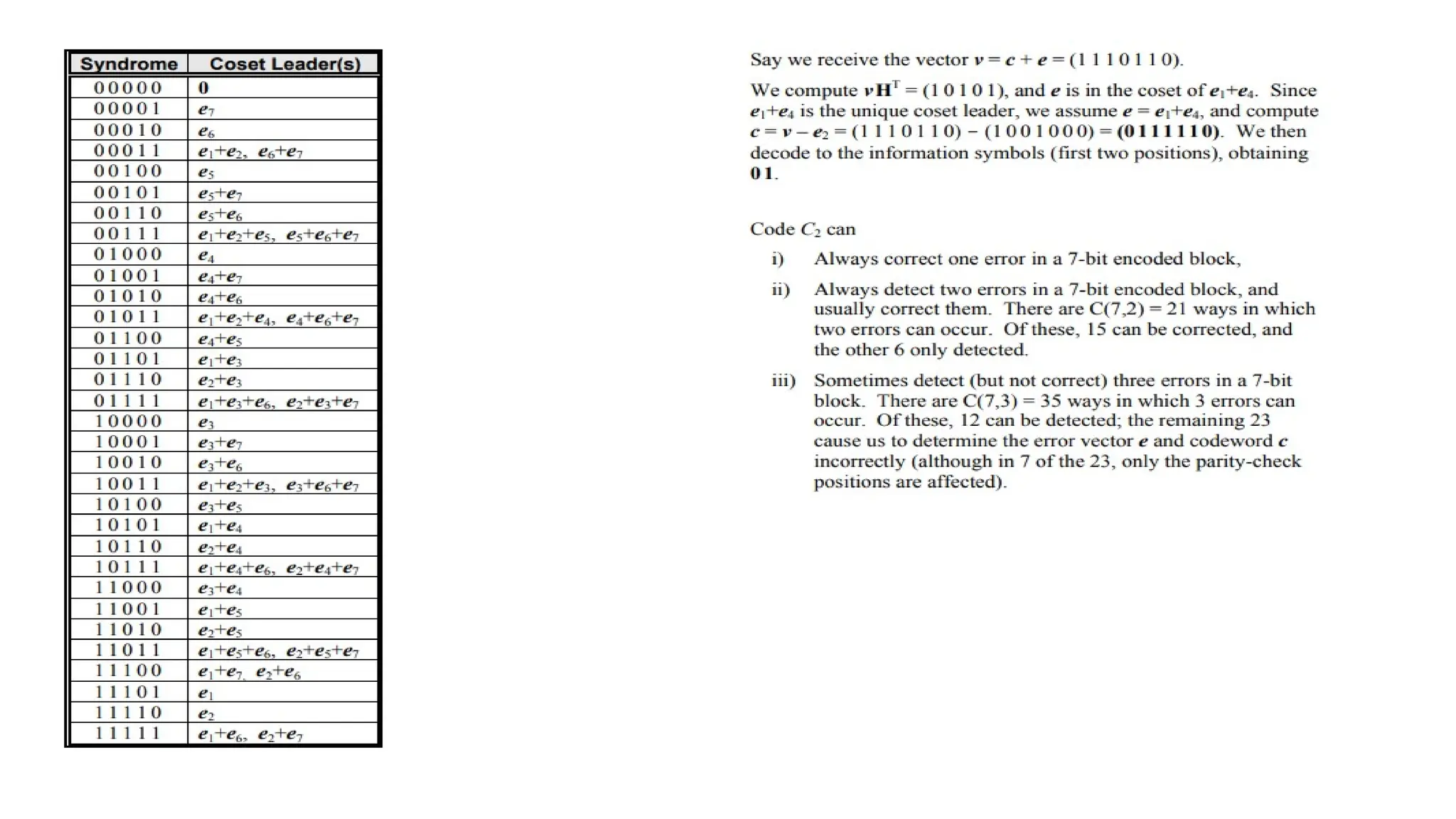
• In coding theory, a syndrome vector is used in error detection and
correction.
• When a message is transmitted, it can be affected by noise, leading to
errors. To detect and correct these errors, a parity-check matrix ( H ) is
used.
• The syndrome vector ( s ) is calculated as:
s=H x
⋅ T
• where ( x ) is the received message vector. If ( s = 0 ), the received
message is error-free. If ( s neq 0 ), it indicates the presence of errors,
and the specific value of ( s ) helps identify the error pattern
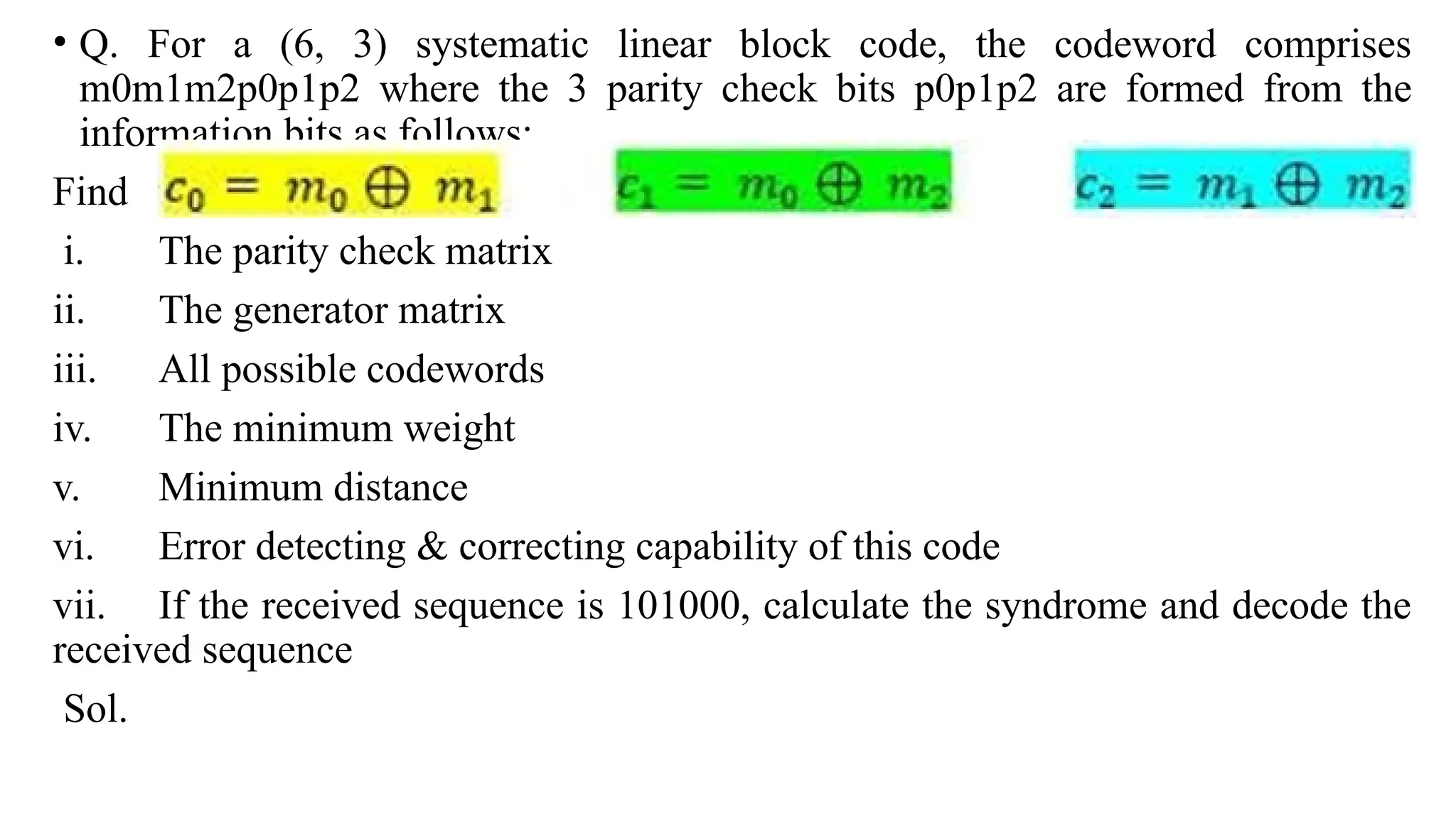
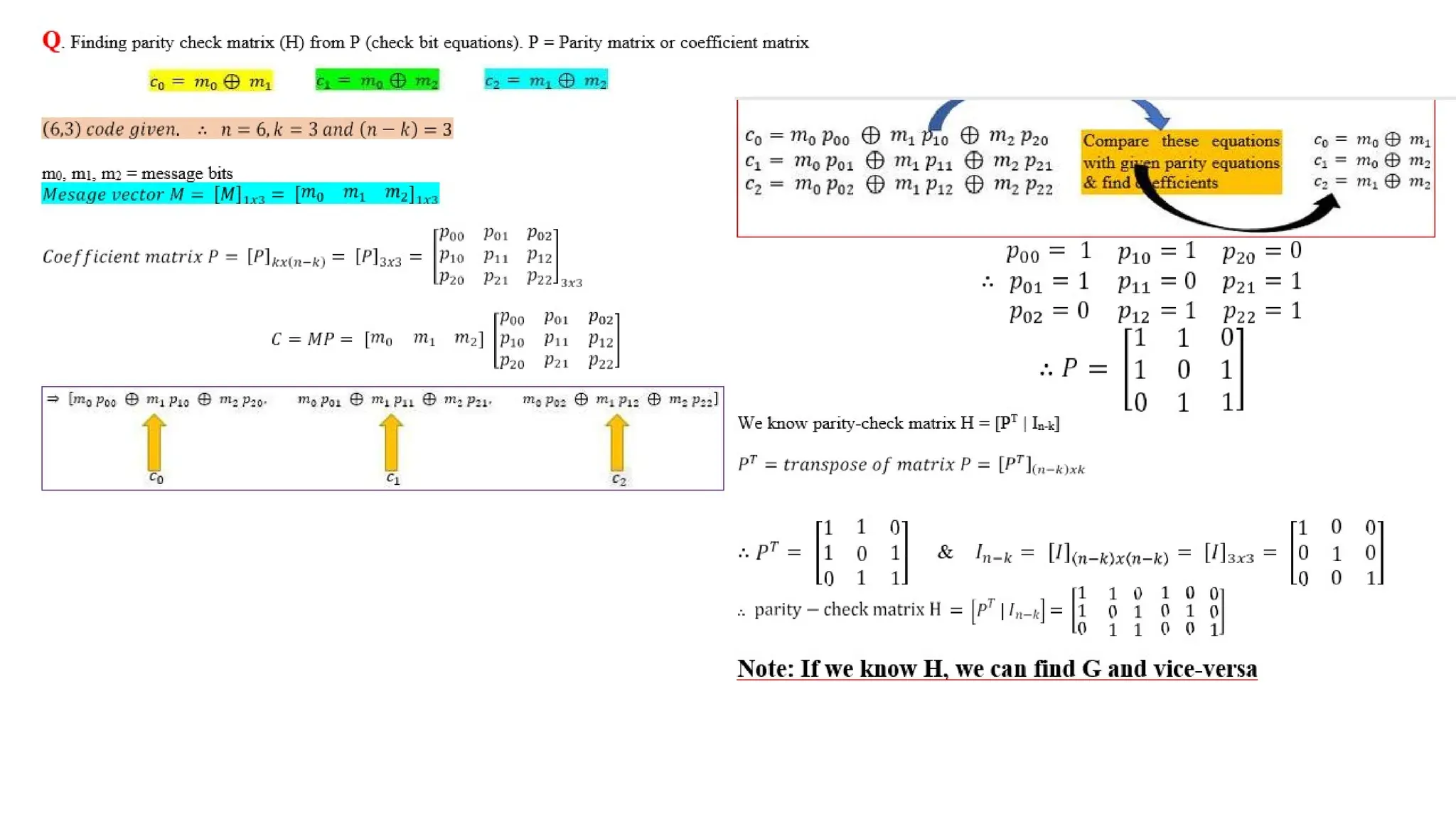
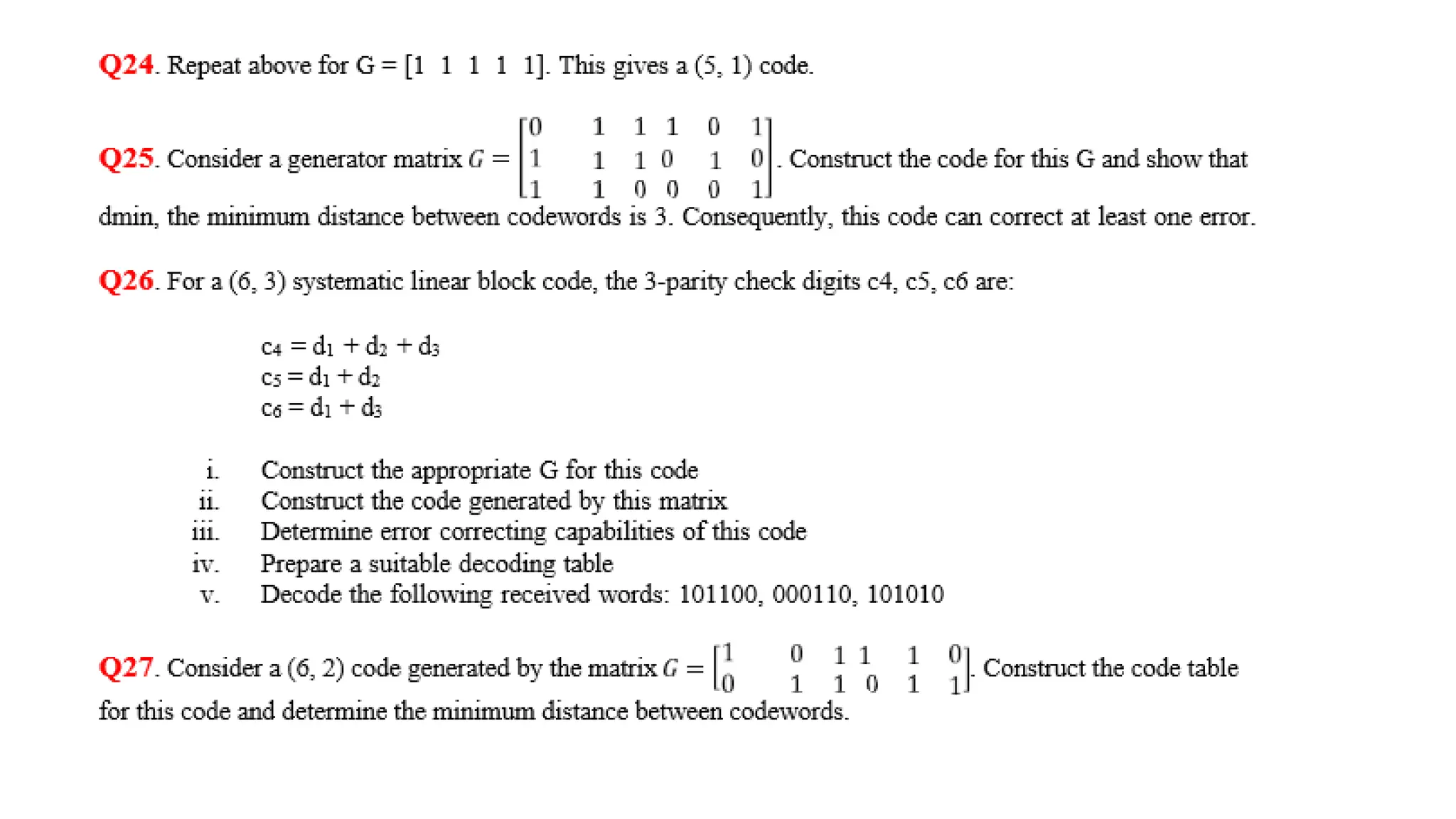
• Q. For a (6, 3) systematic linear block code, the codeword comprises
m0m1m2p0p1p2 where the 3 parity check bits p0p1p2 are formed from the
information bits as follows:
Find
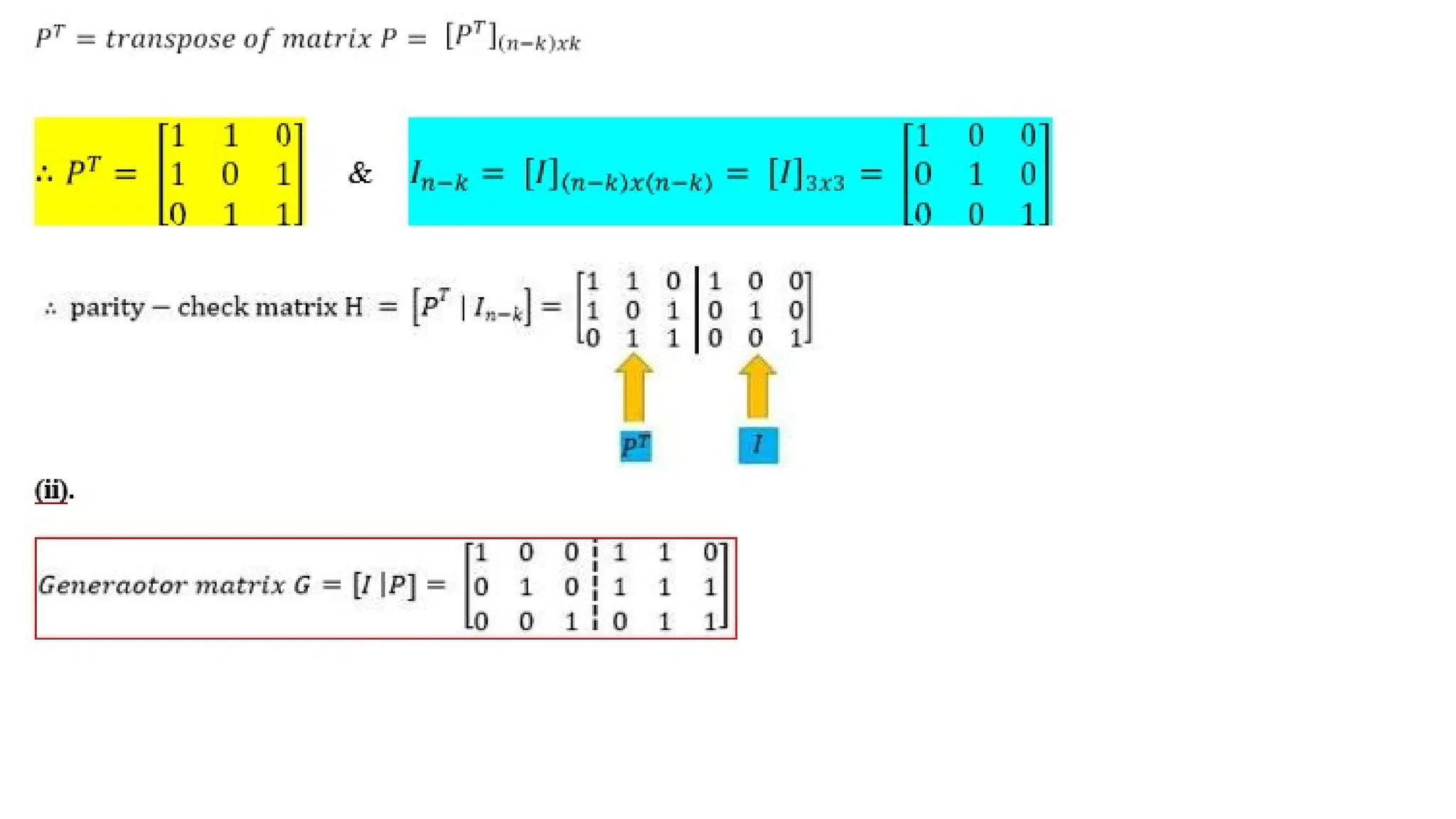
i. The parity check matrix
ii. The generator matrix
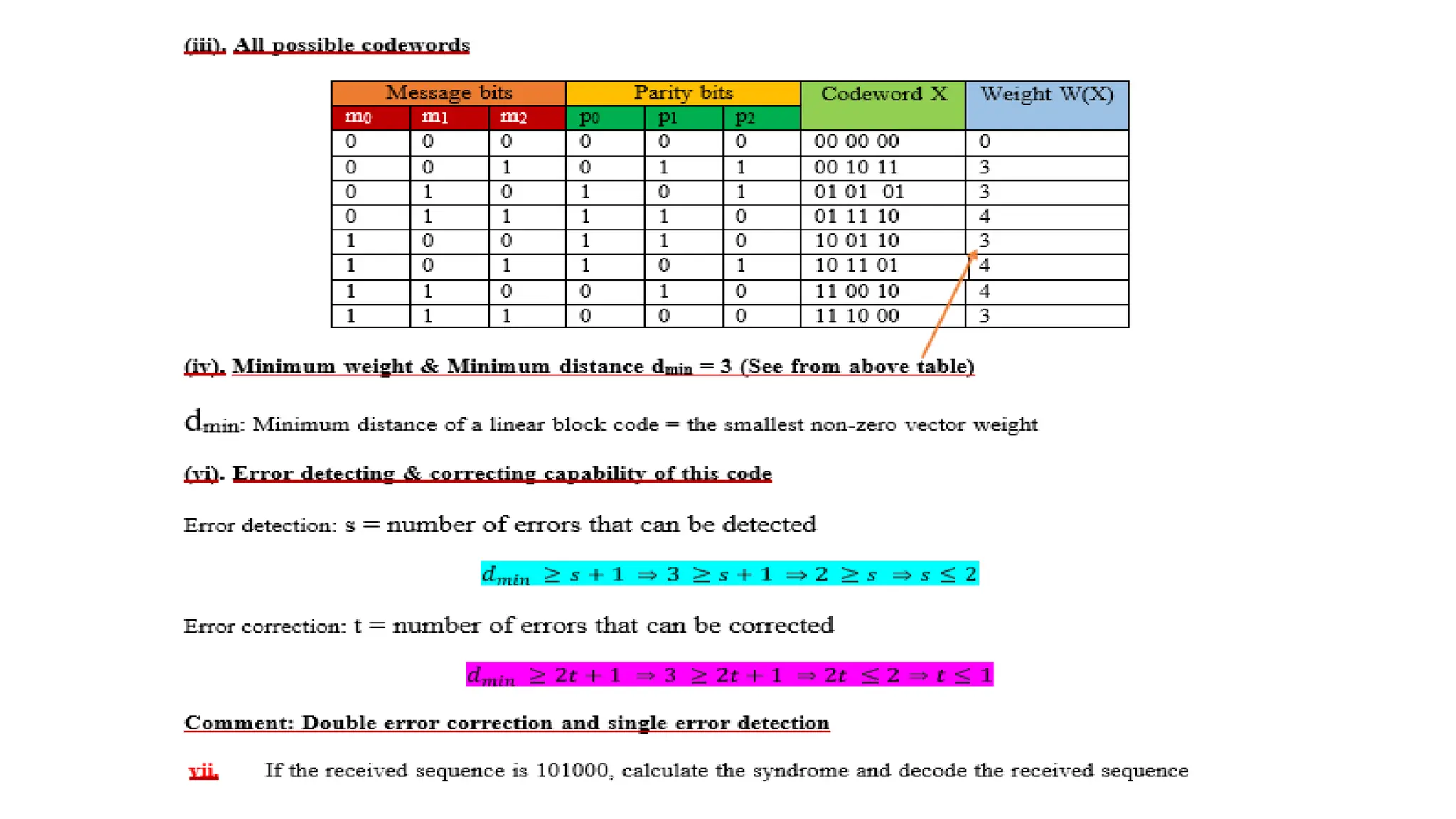
iii. All possible codewords
iv. The minimum weight
v. Minimum distance
vi. Error detecting & correcting capability of this code
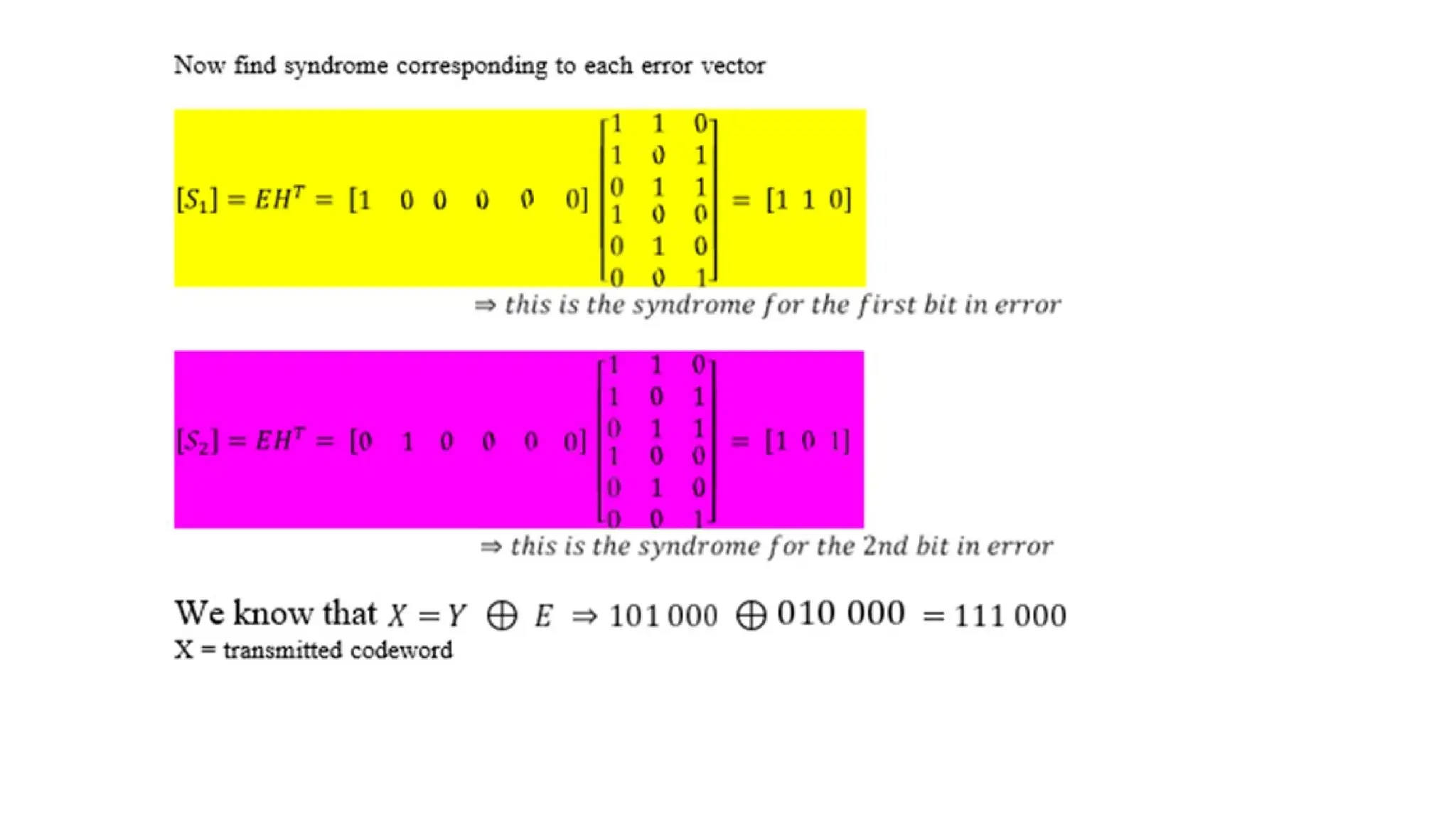
vii. If the received sequence is 101000, calculate the syndrome and decode the
received sequence
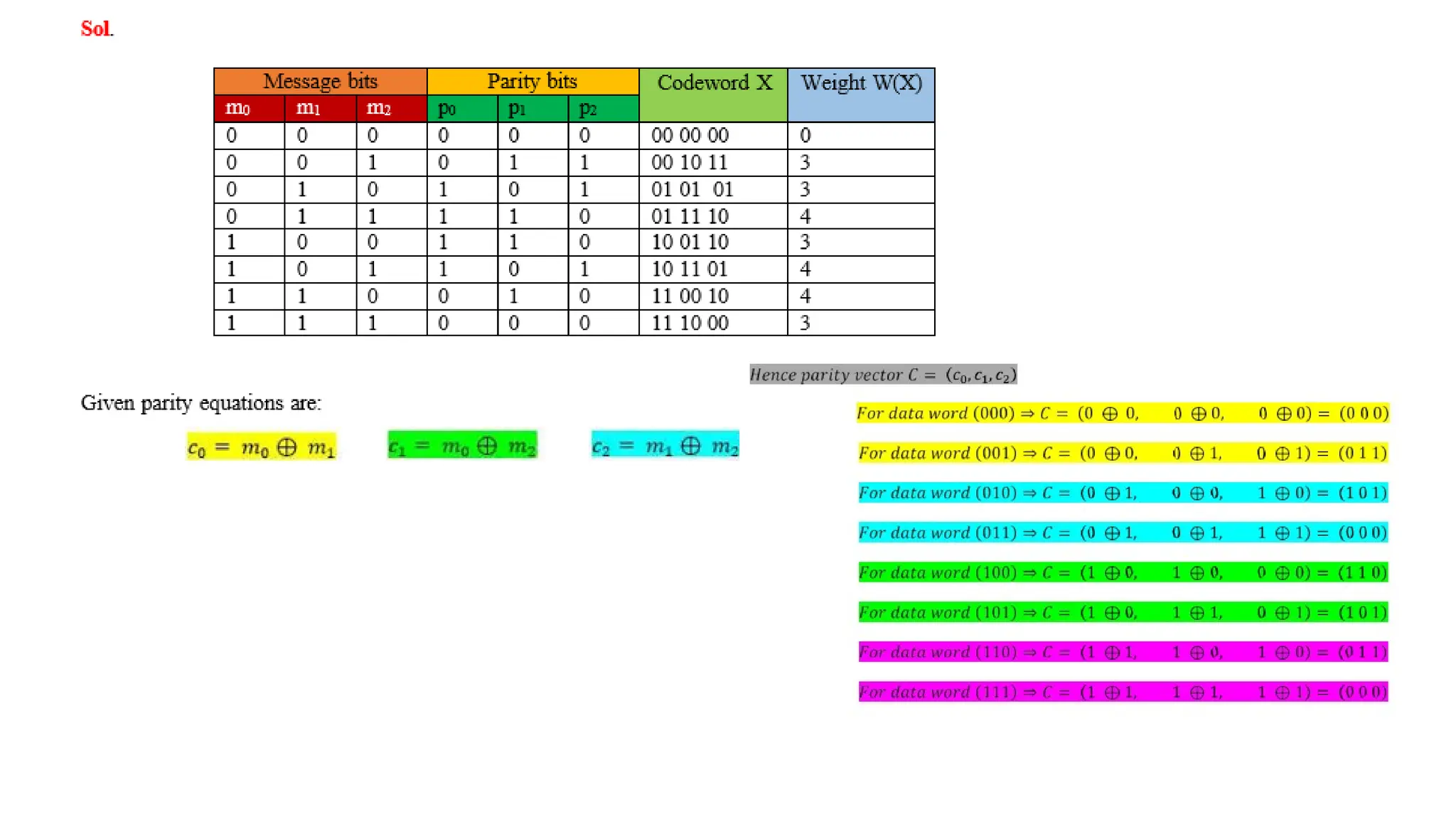
Sol.
linear block code.pptxjdkdidjdjdkdkidndndjdj

linear block code.pptxjdkdidjdjdkdkidndndjdj

  • 2.
    •5.2 Linear blockcodes, generation, capabilities, and syndrome calculation •5.3 Binary cyclic codes, Convolution codes, Code tree, and Trellis
  • 3.
    • Linear blockcode is a type of error-correcting code in which the actual information bits are linearly combined with the parity check bits so as to generate a linear codeword that is transmitted through the channel. Another major type of error-correcting code is convolution code. • In the linear block code technique, the complete message is divided into blocks and these blocks are combined with redundant bits so as to deal with error detection and correction.
  • 4.
    • What isError Correcting Code? • While discussing interleaving, we have mentioned that the bursts of errors are redistributed over codewords (the process is named as interleaving) after which error-correcting codes can be applied in order to correct the errors. • Now, the question arises of what exactly error correction refers to and why it is needed. • Whenever we deal with data communication, then one of the major concerns associated with the transmission of the data is the introduction of errors. These errors must be removed as the presence of errors changes the actual information content. The sole purpose of applying error correction codes is to facilitate the detection and even correction of the data which is transmitted over communication channel by introducing redundancies within the actual message bits.
  • 5.
    • The error-correctingcodes are nothing but the addition of redundancies (unnecessary bits) to the actual message bits so that the receiver must properly decode the actual message signal from the encoded one. • It is to be noted here that the error-correcting codes are applicable to digital signals and not analog ones. More simply, the signals that are in the form of 1s and 0s i.e., the binary form. • There are two techniques for error control coding, namely • Linear Block Coding • Convolution Coding • This presentation deals with linear block coding. • We already know that encoding enables the addition of coding bits to the data stream, done at the transmitter side. While decoding is the recovery of the actual data stream from the coded one, done at the receiver end. However, the codec performs the action of both coding and decoding.
  • 6.
    Linear Block Coding •In block coding, the complete message bits are divided into blocks where each block holds the same number of bits. Suppose each block contains k bits, and each k bits of a block defines a data word. Hence, the overall datawords will be 2k. At this particular point, we have not considered any redundancies, thus, we only have the actual message bitstream converted into datawords. • Now, in order to perform encoding, the data words are encoded as codewords having n number of bits. We have recently discussed that a block has k bits and after encoding there will be n bits in each block (of course, n>k) and these n bits will be transmitted across the channel. While the additional n-k bits are not the message bits as these are named as parity bits but during transmission, the parity bits act as they are a part of message bits. • So, structurally, a codeword is represented as:
  • 7.
    • Hence, thepossible codewords will be 2n out of which 2k contains datawords. During transmission, if errors are introduced then most probably, the permissible codewords will be changed into redundant words which can be detected as an error by the receiver. • In reference to the terms, codewords and datawords, a term code rate is used which is defined as the ratio of dataword bits to the codeword bits. Thus, is represented as: • equation for code rate • A code is represented as (n,k). Consider an example where n=6 and k=3 then code will be (6,3), indicating that a dataword of 3 bits is changed into a codeword of 6 bits.
  • 8.
    Explanation with Example •Consider a repetition code, to understand the general properties of block code • In a repetition code, each individual bit acts as a dataword. • Thus, k = 1 and n-redundancy encoding will provide n-bits at the output of the encoder. • If n = 3, then for binary value 1 at the input of encoder, the output codeword will be 111. While for binary value 0, the output codeword will be 000. • The logic circuit within the decoder decodes codeword 111 as 1 while codeword 000 as 0. • This is achieved through proper synchronization between the encoder and the decoder. • However, for this particular case, if at the input of the decoder, codeword other than 111 or 000 is achieved then the decoder will detect error full transmission and will send an automatic repeat request for retransmission of the codeword. • Sometimes to deal with a single error issue, forward error correction is used that produces the output according to the majority vote. • This means that if at the input of the decoder, the obtained codeword has either two or three 1’s (such as 111, 110, 101, 011) then it will give 1 as the output. However, in the converse case, if the codeword has two or three 0’s (such as 001, 010, 100, 000) then the output will be 0. • Sometimes due to noise, the codeword gets hampered by not only a single error but also by 2 or even 3 successive errors. Like 111 can be changed into 000 or vice versa. In this case, from the above-discussed method, the obtained output will also be an error and not the actual information. But the chance of occurrence of 2 or 3 simultaneous errors is very less. • Thus, it is said that a code is said to be linear if two linearly combined codewords produce another codeword.
  • 9.
    Datawor d Parity Bit Codeword 0000 0000 001 1 0011 010 1 0101 011 0 0110 100 1 1001 101 0 1010 110 0 1100 111 1 1111 Suppose for k = 3, the possible datawords i.e., 23 = 8 are converted into codewords by performing modulo-2 addition with parity bits. • Here the assigned parity bits offer even parity to the datawords, this means the total 1’s in the codewords after addition will be even. An even parity provides codeword modulo sum to zero. • As it is clear from the above table the addition of each bit of individual codeword is 0 (as 0+0 is 0, 1+1 is 0, 1+0 is 1 and 0+1 is 1).
  • 10.
    • For twocodewords, hamming distance corresponds to the total number of variations in the positions of various bits between two of them. • Suppose we have 0011 and 0010, then here the two codewords are different at a single position only thus, the hamming distance is one. • When we talk about minimum hamming distance or minimum distance, then it is related to the smallest hamming distance existing between two codes. • For any codeword, the minimum distance is evaluated according to the total binary 1’s in it. • For codeword 0011 the minimum distance will be two.
  • 11.
    Linear Encoding ofBlock Codes • Now, consider matrices to understand more about linear block codes. • Suppose, we have a dataword, 101, represented by row vector d. d = [101] • The codeword for this with the even parity approach discussed above will be 1010, given by row vector c. c = [1010] • Generally, generator matrix, G is used to produce codeword from dataword. The relation between c, d and G is given as: c = dG • For a code (6,3), there will be 6 bits in codeword and 3 in the dataword. • In a systematic code, the most common arrangement has dataword at the beginning of the codeword. To get this, identity submatrix is used in conjunction with parity submatrix and using the relation d.G, we can have • It is clearly shown that dataword is present as the first 3 bits of the obtained codeword while the rest 3 are the parity bits.
  • 13.
    Linear Decoding ofBlock Codes • To decode the actual dataword from the obtained codeword at the receiver, transpose of parity matrix is done. • Further, the parity check matrix, H is obtained by the combination of transpose of parity matrix and the identity matrix.
  • 14.
    • For thematrix H, the decoder can analyze the parity bits from the obtained codewords. Here, the total number of rows in the above matrix represents the number of parity bits i.e., n-k while the number of columns shows the number of bits in the codeword i.e., n. • In this particular example the number of rows is 3, representing total 3 parity bits and the number of columns here is 6 showing n i.e., the total bits in the codeword. • A fundamental property of code matrices states that, • GHT = 0 • For a received codeword the verification of correction is obtained by multiplying the code with HT . • cHT = 0 • As we know that, c =dG • So, substituting dG in replace of c in second last equation, we will have, dGHT = 0 • If this product is unequal to 0 then this shows the presence of error. Generally, s called syndrome is given as s = cHT • A relation between transmitted and received codeword is written in a way that, • cR = cT + e • This means that the received codeword must be necessarily equal to the summation of the actually transmitted codeword and the error vector.
  • 15.
    1. The generatormatrix for a (6, 3) block code is shown below. Obtain all code of words of this code
  • 17.
    • This meansthat the block size of the message vector is 3 bits. Thus, there will be total 8 possible message vectors as shown in the Table 16.5
  • 18.
    The P submatrixis given in the example which is reproduced here i.e. For the check bit vector, there would be three bits. These may be obtained according to equation as under: C = MP
  • 27.
    (a) The Generatormatrix(G) for a (7, 4) block code is given below (i) Find the parity check matrix G (ii) Find code vectors
  • 29.
  • 30.
    • In codingtheory, a syndrome vector is used in error detection and correction. • When a message is transmitted, it can be affected by noise, leading to errors. To detect and correct these errors, a parity-check matrix ( H ) is used. • The syndrome vector ( s ) is calculated as: s=H x ⋅ T • where ( x ) is the received message vector. If ( s = 0 ), the received message is error-free. If ( s neq 0 ), it indicates the presence of errors, and the specific value of ( s ) helps identify the error pattern
  • 38.
    • Q. Fora (6, 3) systematic linear block code, the codeword comprises m0m1m2p0p1p2 where the 3 parity check bits p0p1p2 are formed from the information bits as follows: Find i. The parity check matrix ii. The generator matrix iii. All possible codewords iv. The minimum weight v. Minimum distance vi. Error detecting & correcting capability of this code vii. If the received sequence is 101000, calculate the syndrome and decode the received sequence Sol.