Definitions
• A wordis a sequence of symbols.
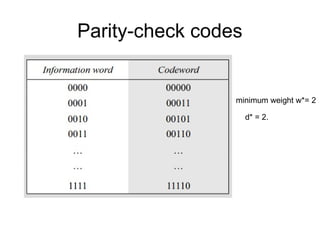
• A code is a set of vectors called codewords.
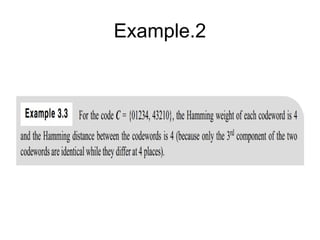
• The Hamming weight (w(c)) of a codeword
(or any vector) is equal to the number of non-
zero elements in the codeword.
• Hamming distance between two codewords
is the number of places by which the
codewords differ. d(c1,c2)
• d(c1, c2) = w (c1 – c2).
Example
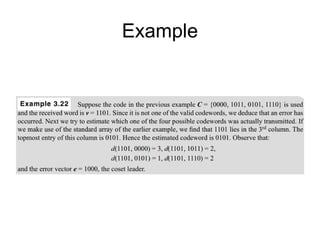
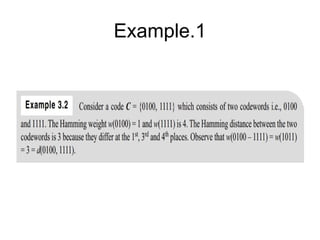
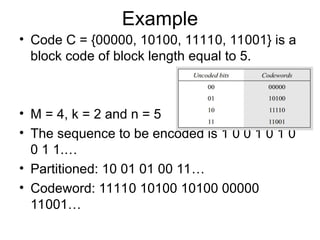
• Code C= {00000, 10100, 11110, 11001} is a
block code of block length equal to 5.
• M = 4, k = 2 and n = 5
• The sequence to be encoded is 1 0 0 1 0 1 0
0 1 1.…
• Partitioned: 10 01 01 00 11…
• Codeword: 11110 10100 10100 00000
11001…
Error control techniques
•Automatic Repeat reQuest (ARQ)
– Full-duplex connection, error detection codes
– The receiver sends a feedback to the transmitter, saying that
if any error is detected in the received packet or not (Not-
Acknowledgement (NACK) and Acknowledgement (ACK),
respectively).
– The transmitter retransmits the previously sent packet if it
receives NACK.
• Forward Error Correction (FEC)
– Simplex connection, error correction codes
– The receiver tries to correct some errors
• Hybrid ARQ (ARQ+FEC)
– Full-duplex, error detection and correction codes
26.
Linear block codes
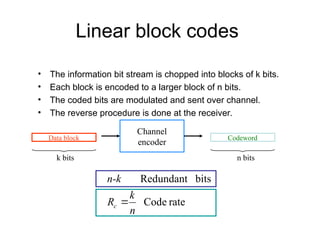
•The information bit stream is chopped into blocks of k bits.
• Each block is encoded to a larger block of n bits.
• The coded bits are modulated and sent over channel.
• The reverse procedure is done at the receiver.
Data block
Channel
encoder
Codeword
k bits n bits
rate
Code
bits
Redundant
n
k
R
n-k
c
27.
Linear block codes– cont’d
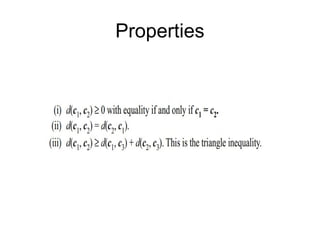
• The Hamming weight of vector U, denoted by w(U),
is the number of non-zero elements in U.
• The Hamming distance between two vectors U and
V, is the number of elements in which they differ.
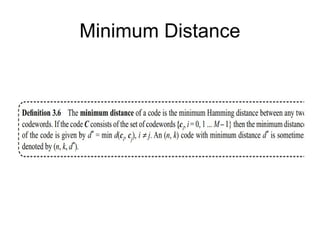
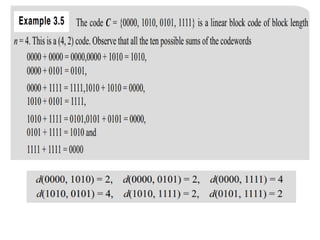
• The minimum distance of a block code is
)
(
)
( V
U
V
U,
w
d
)
(
min
)
,
(
min
min i
i
j
i
j
i
w
d
d U
U
U
28.
Linear block codes– cont’d
• Error detection capability is given by
• Error correcting-capability t of a code, which is defined
as the maximum number of guaranteed correctable
errors per codeword, is
2
1
min
d
t
1
min
d
e
29.
Linear block codes– cont’d
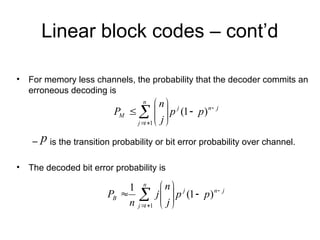
• For memory less channels, the probability that the decoder commits an
erroneous decoding is
– is the transition probability or bit error probability over channel.
• The decoded bit error probability is
j
n
j
n
t
j
M p
p
j
n
P
)
1
(
1
j
n
j
n
t
j
B p
p
j
n
j
n
P
)
1
(
1
1
p
30.
Linear block codes– cont’d
• Encoding in (n,k) block code
– The rows of G, are linearly independent.
– The sum of any two codewords is also a codeword.
mG
U
k
n
k
k
n
m
m
m
u
u
u
m
m
m
u
u
u
V
V
V
V
V
V
2
2
2
1
1
2
1
2
1
2
1
2
1
)
,
,
,
(
)
,
,
,
(
)
,
,
,
(
Linear block codes– cont’d
• Systematic block code (n,k)
– For a systematic code, the first (or last) k elements in
the codeword are information bits.
matrix
)
(
matrix
identity
]
[
k
n
k
k
k
k
k
k
P
I
I
P
G
)
,...,
,
,
,...,
,
(
)
,...,
,
(
bits
message
2
1
bits
parity
2
1
2
1 k
k
n
n m
m
m
p
p
p
u
u
u
U
Coefficient
Matrix gives
dependency of
parity bits on the
message bits
34.
Linear block codes– cont’d
• For any linear code we can find an matrix ,
whose rows are orthogonal to rows of :
• H is called the parity check matrix and its rows are
linearly independent.
• For systematic linear block codes:
n
k
n
)
(
H
G
0
GH
T
]
[ T
k
n P
I
H
Linear block codes– cont’d
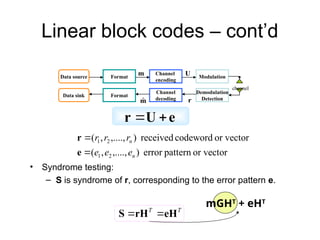
• Syndrome testing:
– S is syndrome of r, corresponding to the error pattern e.
Format
Channel
encoding
Modulation
Channel
decoding
Format
Demodulation
Detection
Data source
Data sink
U
r
m
m̂
channel
or vector
pattern
error
)
,....,
,
(
or vector
codeword
received
)
,....,
,
(
2
1
2
1
n
n
e
e
e
r
r
r
e
r
e
U
r
T
T
eH
rH
S
mGHT
+ eHT
41.
Linear block codes– cont’d
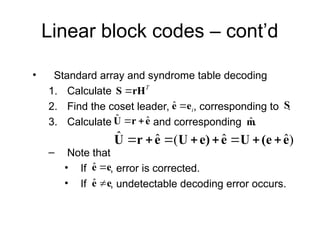
• Standard array and syndrome table decoding
1. Calculate
2. Find the coset leader, , corresponding to .
3. Calculate and corresponding .
– Note that
• If , error is corrected.
• If , undetectable decoding error occurs.
T
rH
S
i
e
e
ˆ S
e
r
U ˆ
ˆ
m̂
)
ˆ
ˆ
(
ˆ
ˆ e
(e
U
e
e)
U
e
r
U
e
e
ˆ
e
e
ˆ
42.
Linear block codes– cont’d
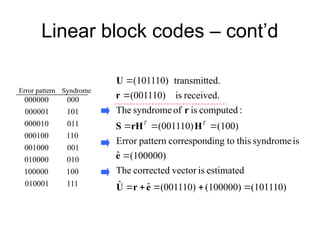
(101110)
(100000)
(001110)
ˆ
ˆ
estimated
is
vector
corrected
The
(100000)
ˆ
is
syndrome
this
to
ing
correspond
pattern
Error
(100)
(001110)
:
computed
is
of
syndrome
The
received.
is
(001110)
ted.
transmit
(101110)
e
r
U
e
H
rH
S
r
r
U
T
T
111
010001
100
100000
010
010000
001
001000
110
000100
011
000010
101
000001
000
000000
Error pattern Syndrome
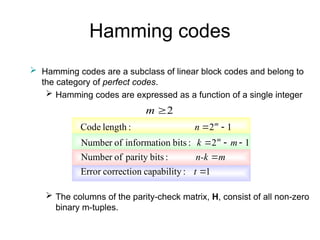
Hamming codesare a subclass of linear block codes and belong to
the category of perfect codes.
Hamming codes are expressed as a function of a single integer
The columns of the parity-check matrix, H, consist of all non-zero
binary m-tuples.
Hamming codes
2
m
t
m
n-k
m
k
n
m
m
1
:
capability
correction
Error
:
bits
parity
of
Number
1
2
:
bits
n
informatio
of
Number
1
2
:
length
Code
Cyclic block codes
•Cyclic codes are a subclass of linear block
codes.
• Encoding and syndrome calculation are easily
performed using feedback shift-registers.
– Hence, relatively long block codes can be
implemented with reasonable complexity.
• BCH and Reed-Solomon codes are cyclic codes.
47.
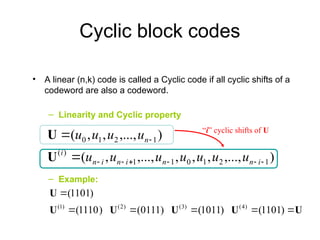
Cyclic block codes
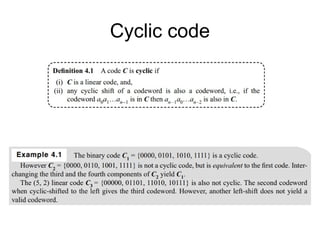
•A linear (n,k) code is called a Cyclic code if all cyclic shifts of a
codeword are also a codeword.
– Linearity and Cyclic property
– Example:
)
,...,
,
,
,
,...,
,
(
)
,...,
,
,
(
1
2
1
0
1
1
)
(
1
2
1
0
i
n
n
i
n
i
n
i
n
u
u
u
u
u
u
u
u
u
u
u
U
U “i” cyclic shifts of U
U
U
U
U
U
U
)
1101
(
)
1011
(
)
0111
(
)
1110
(
)
1101
(
)
4
(
)
3
(
)
2
(
)
1
(
48.
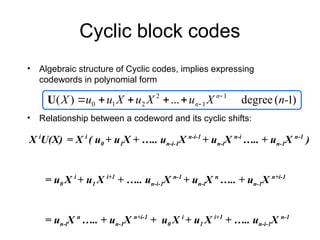
Cyclic block codes
•Algebraic structure of Cyclic codes, implies expressing
codewords in polynomial form
• Relationship between a codeword and its cyclic shifts:
)
1
(
degree
...
)
( 1
1
2
2
1
0 n-
X
u
X
u
X
u
u
X n
n
U
X i
U(X) = X i
( u0 + u1X + ….. un-i-1X n-i-1
+ un-iX n-i
….. + un-1X n-1
)
= u0 X i
+ u1 X i+1
+ ….. un-i-1X n-1
+ un-iX n
….. + un-1X n+i-1
= un-iX n
….. + un-1X n+i-1
+ u0 X i
+ u1 X i+1
+ ….. un-i-1X n-1
50.
Cyclic block codes
Xi
U(X) = un-iX n
….. + un-1X n+i-1
+ u0 X i
+ u1 X i+1
+ ….. un-i-1X n-1
= un-i +un-i + un-iX n
….. + un-1 X i-1
+ un-1 X i-1
+ un-1 X n+i-1
+ u0 X i
+ u1 X i+1
+ ….. un-i-1X n-1
= un-i +un-i (Xn
+ 1)….. + un-1 X i-1
+ un-1 X i-1
(Xn
+ 1)
+ u0 X i
+ u1 X i+1
+ ….. un-i-1X n-1
= un-i +….. + un-1 X i-1
+ u0 X i
+ u1 X i+1
+ ….. un-i-1X n-1
51.
Cyclic block codes
Let,
U(i)
(X) = un-i +….. + un-1 X i-1
+ u0 X i
+ u1 X i+1
+ ….. un-i-1X n-1
q(X) = un-i + un-i-1 X + ………+ un-1 X i-1
X i
U(X) = q(X) (Xn
+ 1)+ U(i)
(X)
)
1
(
modulo
)
(
)
(
)
(
n
i
i
X
X
X
X U
U
By extension
)
1
(
modulo
)
(
)
(
)
1
(
n
X
X
X
X U
U
52.
Cyclic block codes
LetC be a binary (n,k) linear cyclic code
Within the set of code polynomials in C, there is a
unique monic polynomial g(X) with minimal degree r, called as the
generator polynomial.
g(X) is a polynomial of degree n-k and is a factor of (Xn
+ 1)
Every code polynomial U(X) in C, can be expressed uniquely as
r
r X
g
X
g
g
X
...
)
( 1
0
g
U(X) = m(X) g(X)
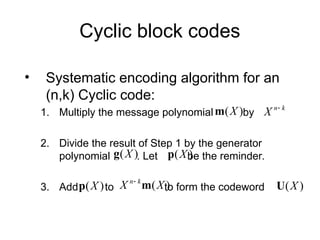
Cyclic block codes
•Systematic encoding algorithm for an
(n,k) Cyclic code:
1. Multiply the message polynomial by
2. Divide the result of Step 1 by the generator
polynomial . Let be the reminder.
3. Add to to form the codeword
)
(X
m k
n
X
)
(X
g )
(X
p
)
(X
p )
(X
X k
n
m
)
(X
U
55.
Cyclic block codes
The orthogonality of G and H in polynomial form is
expressed as
This means is also a factor of
The row , of generator matrix is formed by the
coefficients of the cyclic shift of the generator
polynomial.
r
r
r
r
k
g
g
g
g
g
g
g
g
g
g
g
g
X
X
X
X
X
1
0
1
0
1
0
1
0
1
)
(
)
(
)
(
0
0
g
g
g
G
1
)
(
)
(
n
X
X
X h
g
1
n
X
)
(X
h
k
i
i ,...,
1
,
"
1 "
k
56.
Cyclic block codes
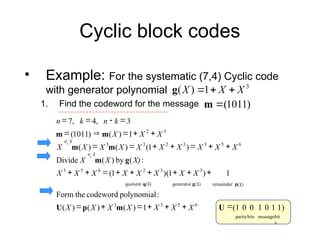
•Example: For the systematic (7,4) Cyclic code
with generator polynomial
1. Find the codeword for the message )
1011
(
m
3
1
)
( X
X
X
g
1
)
(
)
(
)
(
:
polynomial
codeword
the
Form
1
)
1
(
)
1
(
:
(
by
)
(
Divide
)
1
(
)
(
)
(
1
)
(
)
1011
(
3
,
4
,
7
6
5
3
3
remainder
generator
3
quotient
3
2
6
5
3
6
5
3
3
2
3
3
3
2
)
1
1
0
1
0
0
1
(
bit
s
message
bits
parity
U
m
p
U
g
m
m
m
m
m
p
g
q
X
X
X
X
X
X
X
X
X
X
X
X
X
X
X
X)
X
X
X
X
X
X
X
X
X
X
X
X
X
X
X
k
n
k
n
(X)
(X)
(X)
k
n
k
n
57.
Cyclic block codes
2.Find the generator and parity check matrices, G and H,
respectively.
1
0
1
1
0
0
0
0
1
0
1
1
0
0
0
0
1
0
1
1
0
0
0
0
1
0
1
1
)
1101
(
)
,
,
,
(
1
0
1
1
)
( 3
2
1
0
3
2
G
g g
g
g
g
X
X
X
X
Not in systematic form.
We do the following:
row(4)
row(4)
row(2)
row(1)
row(3)
row(3)
row(1)
1
0
0
0
1
0
1
0
1
0
0
1
1
1
0
0
1
0
1
1
0
0
0
0
1
0
1
1
G
1
1
1
0
1
0
0
0
1
1
1
0
1
0
1
1
0
1
0
0
1
H
4
4
I
3
3
I T
P
P
58.
Cyclic block codes
•Syndrome decoding for Cyclic codes:
– Received codeword in polynomial form is given by
– The syndrome is the reminder obtained by dividing the
received polynomial by the generator polynomial.
– With syndrome and Standard array, error is estimated.
• In Cyclic codes, the size of standard array is considerably reduced.
)
(
)
(
)
( X
X
X e
U
r
Received
codeword
Error
pattern
)
(
)
(
)
(
)
( X
X
X
X S
g
q
r
Syndrome
59.
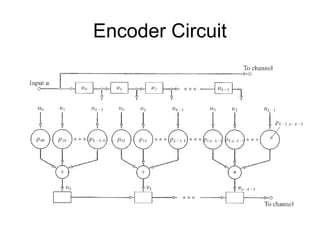
Circuit for encodingsystematic cyclic codes
• In the circuit, first the message flows to the shift register, and
feedback switch is set to ‘1’, where after check-bit-switch is
turned on, and the feedback switch to ‘0’, enabling the check
bits to be outputted .
1
0
( )mod ( )/ ( )
s x r x g x
Table 16.6
Decoding cyclic codes: error
correction
62.
Decoding circuit for(7,4) code
syndrome computation
• To start with, the switch is at “0” position
• Then shift register is stepped until all the received code bits
have entered the register
• This results is a 3-bit syndrome (n - k = 3 ):
that is then left to the register
• Then the switch is turned to the position “1” that drives the
syndrome out of the register.
received code syndrome
( ) mod ( )/ ( )
p p p
S R G
3
( ) 1
p p p
G
1
0
received code syndrome
x0 x1
xn-1
63.
Some block codesthat can be
realized by cyclic codes
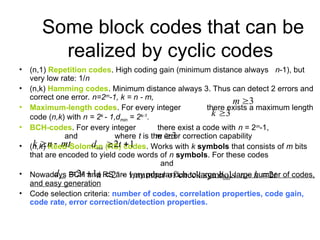
• (n,1) Repetition codes. High coding gain (minimum distance always n-1), but
very low rate: 1/n
• (n,k) Hamming codes. Minimum distance always 3. Thus can detect 2 errors and
correct one error. n=2m
-1, k = n - m,
• Maximum-length codes. For every integer there exists a maximum length
code (n,k) with n = 2k
- 1,dmin = 2k-1
.
• BCH-codes. For every integer there exist a code with n = 2m-1,
and where t is the error correction capability
• (n,k) Reed-Solomon (RS) codes. Works with k symbols that consists of m bits
that are encoded to yield code words of n symbols. For these codes
and
• Nowadays BCH and RS are very popular due to large dmin, large number of codes,
and easy generation
• Code selection criteria: number of codes, correlation properties, code gain,
code rate, error correction/detection properties.
3
k
3
m
k n mt min
2 1
d t
2 1,number of check symbols 2
m
n n k t
min
2 1
d t
1: Task: find out from literature what is meant by dual codes!
3
m














![Linear block codes – cont’d
• Systematic block code (n,k)
– For a systematic code, the first (or last) k elements in
the codeword are information bits.
matrix
)
(
matrix
identity
]
[
k
n
k
k
k
k
k
k
P
I
I
P
G
)
,...,
,
,
,...,
,
(
)
,...,
,
(
bits
message
2
1
bits
parity
2
1
2
1 k
k
n
n m
m
m
p
p
p
u
u
u
U
Coefficient
Matrix gives
dependency of
parity bits on the
message bits](https://image.slidesharecdn.com/unit2-260107110539-dd873a36/85/unit2-ppt-Information-Theory-and-Coding-PPT-32-320.jpg)

![Linear block codes – cont’d
• For any linear code we can find an matrix ,
whose rows are orthogonal to rows of :
• H is called the parity check matrix and its rows are
linearly independent.
• For systematic linear block codes:
n
k
n
)
(
H
G
0
GH
T
]
[ T
k
n P
I
H
](https://image.slidesharecdn.com/unit2-260107110539-dd873a36/85/unit2-ppt-Information-Theory-and-Coding-PPT-34-320.jpg)



![Repetition Codes
• (n,1) code, eg. (5,1)
• G = [ 1 1 1 1 1 ]
• H = 1 0 0 0 1
0 1 0 0 1
0 0 1 0 1
0 0 0 1 1](https://image.slidesharecdn.com/unit2-260107110539-dd873a36/85/unit2-ppt-Information-Theory-and-Coding-PPT-43-320.jpg)
![Hamming codes
• Example: Systematic Hamming code (7,4)
]
[
1
0
1
1
1
0
0
1
1
0
1
0
1
0
1
1
1
0
0
0
1
3
3
T
P
I
H
]
[
1
0
0
0
1
1
1
0
1
0
0
0
1
1
0
0
1
0
1
0
1
0
0
0
1
1
1
0
4
4
I
P
G](https://image.slidesharecdn.com/unit2-260107110539-dd873a36/85/unit2-ppt-Information-Theory-and-Coding-PPT-45-320.jpg)