Electronic Devices & Circuits
1
Dr. S. M. Gulhane, PREC, Loni
Field Effect Transistor
Drain and Transfer Characteristics of FET
Dr. S. M. Gulhane
2
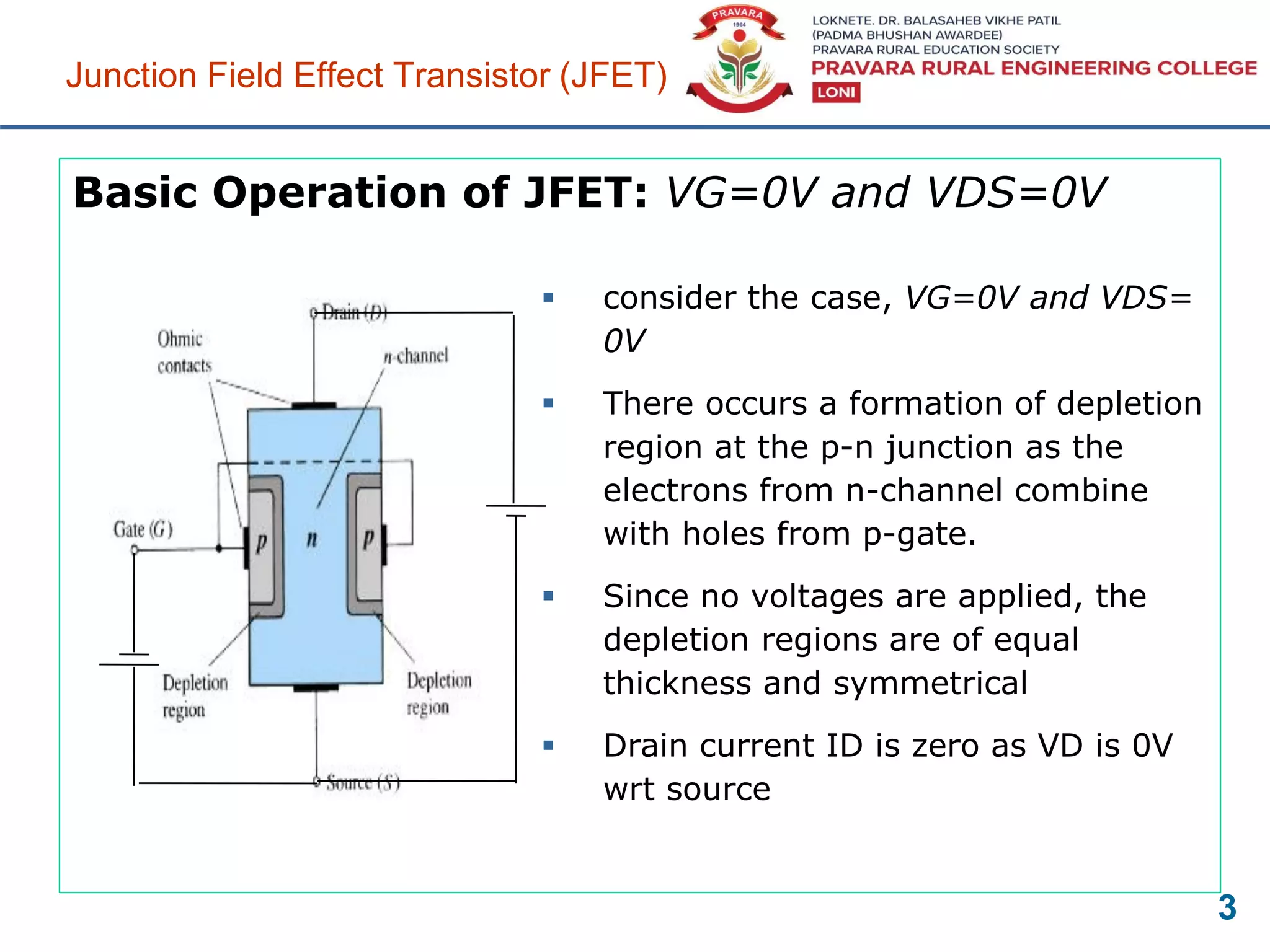
Basic Operation of JFET: VG=0V and VDS=0V
▪ consider the case, VG=0V and VDS=
0V
▪ There occurs a formation of depletion
region at the p-n junction as the
electrons from n-channel combine
with holes from p-gate.
▪ Since no voltages are applied, the
depletion regions are of equal
thickness and symmetrical
▪ Drain current ID is zero as VD is 0V
wrt source
Junction Field Effect Transistor (JFET)
3
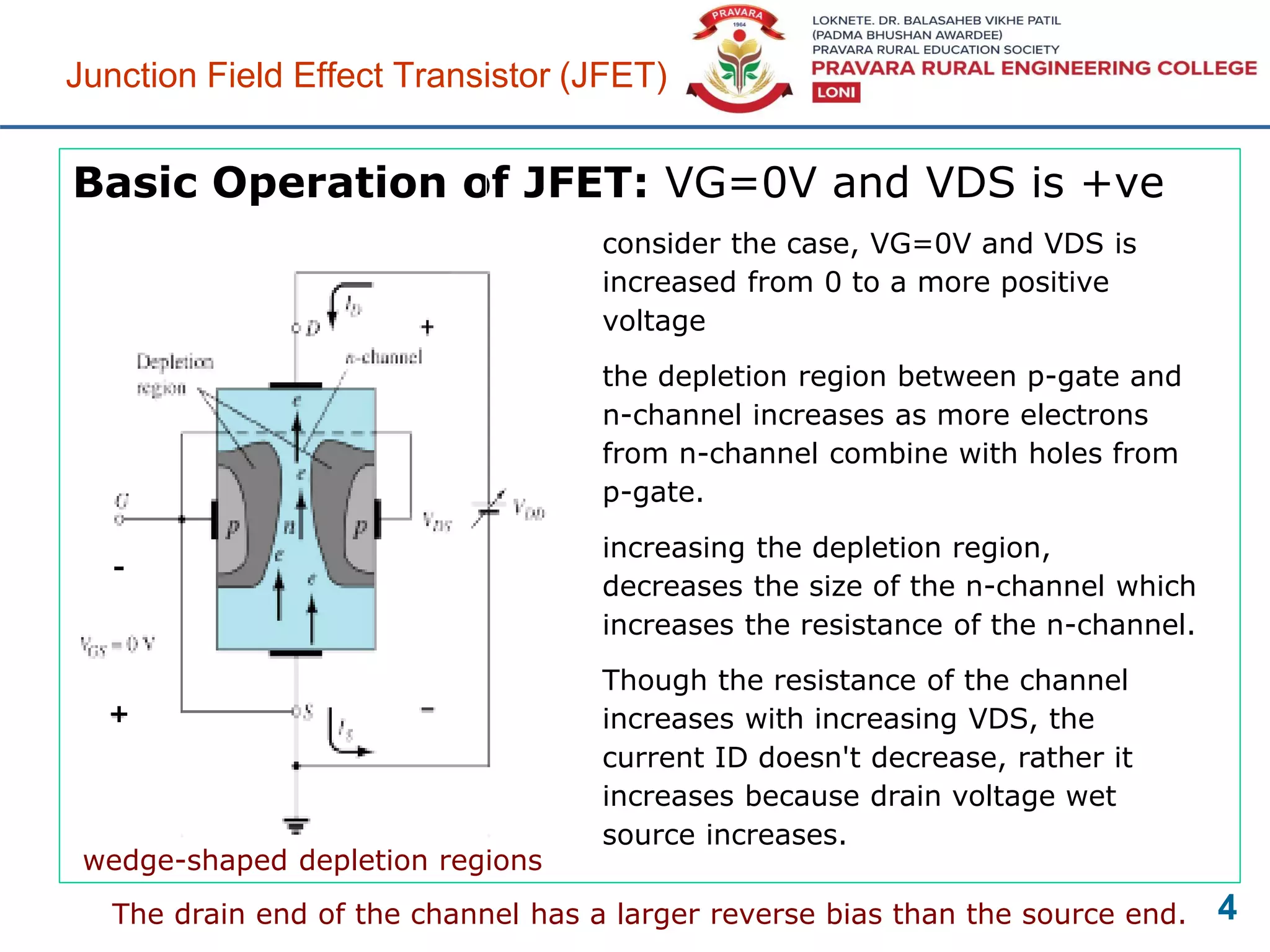
Basic Operation of JFET: VG=0V and VDS is +ve
▪ consider the case, VG=0V and VDS is
increased from 0 to a more positive
voltage
▪ the depletion region between p-gate and
n-channel increases as more electrons
from n-channel combine with holes from
p-gate.
▪ increasing the depletion region,
decreases the size of the n-channel which
increases the resistance of the n-channel.
▪ Though the resistance of the channel
increases with increasing VDS, the
current ID doesn't decrease, rather it
increases because drain voltage wet
source increases.
4The drain end of the channel has a larger reverse bias than the source end.
wedge-shaped depletion regions
+
-
Junction Field Effect Transistor (JFET)
Basic Operation of JFET: Pinch-off
+
-
▪ If VGS = 0 and VDS is further increased to a
more positive voltage, then the depletion
zone gets so large that it reaches near to
pinch off the n-channel.
▪ The channel width becomes very narrow and
remain constant and the current ID doesn't
vary irrespective of variation in VDS
At the pinch-off point:
▪ any further increase in VDS does not produce
any increase in ID.
▪ ID is at saturation or maximum. It is referred
to as IDSS and the value of VDS at which
saturation starts is referred to as Vp
▪ Also the resistance of the channel is at
maximum
5
0V
Junction Field Effect Transistor (JFET)
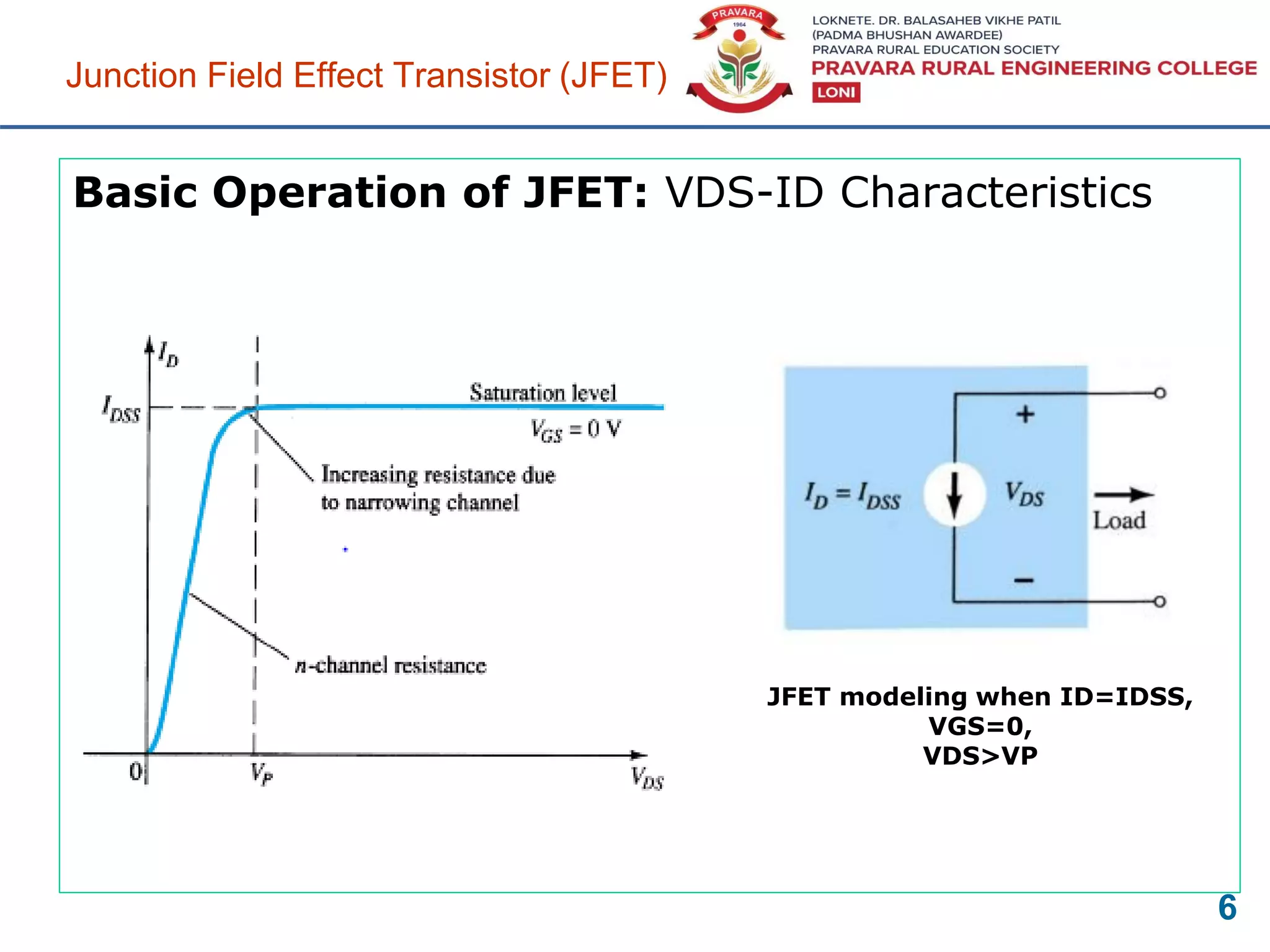
Basic Operation of JFET: VDS-ID Characteristics
6
JFET modeling when ID=IDSS,
VGS=0,
VDS>VP
Junction Field Effect Transistor (JFET)
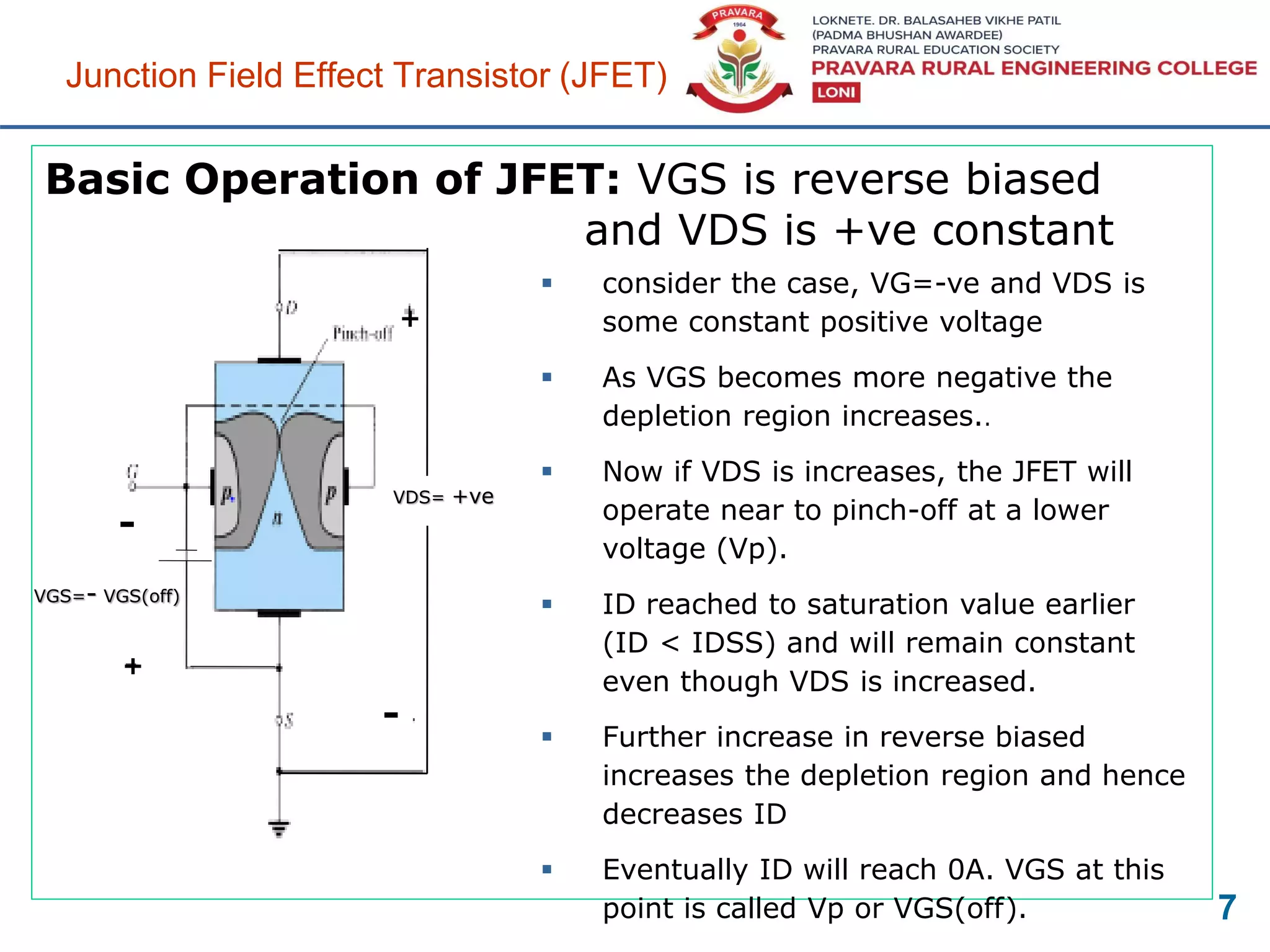
Basic Operation of JFET: VGS is reverse biased
and VDS is +ve constant
▪ consider the case, VG=-ve and VDS is
some constant positive voltage
▪ As VGS becomes more negative the
depletion region increases..
▪ Now if VDS is increases, the JFET will
operate near to pinch-off at a lower
voltage (Vp).
▪ ID reached to saturation value earlier
(ID < IDSS) and will remain constant
even though VDS is increased.
▪ Further increase in reverse biased
increases the depletion region and hence
decreases ID
▪ Eventually ID will reach 0A. VGS at this
point is called Vp or VGS(off). 7
+
-
-
+
+
-
VDS= +ve
VGS=- VGS(off)
Junction Field Effect Transistor (JFET)
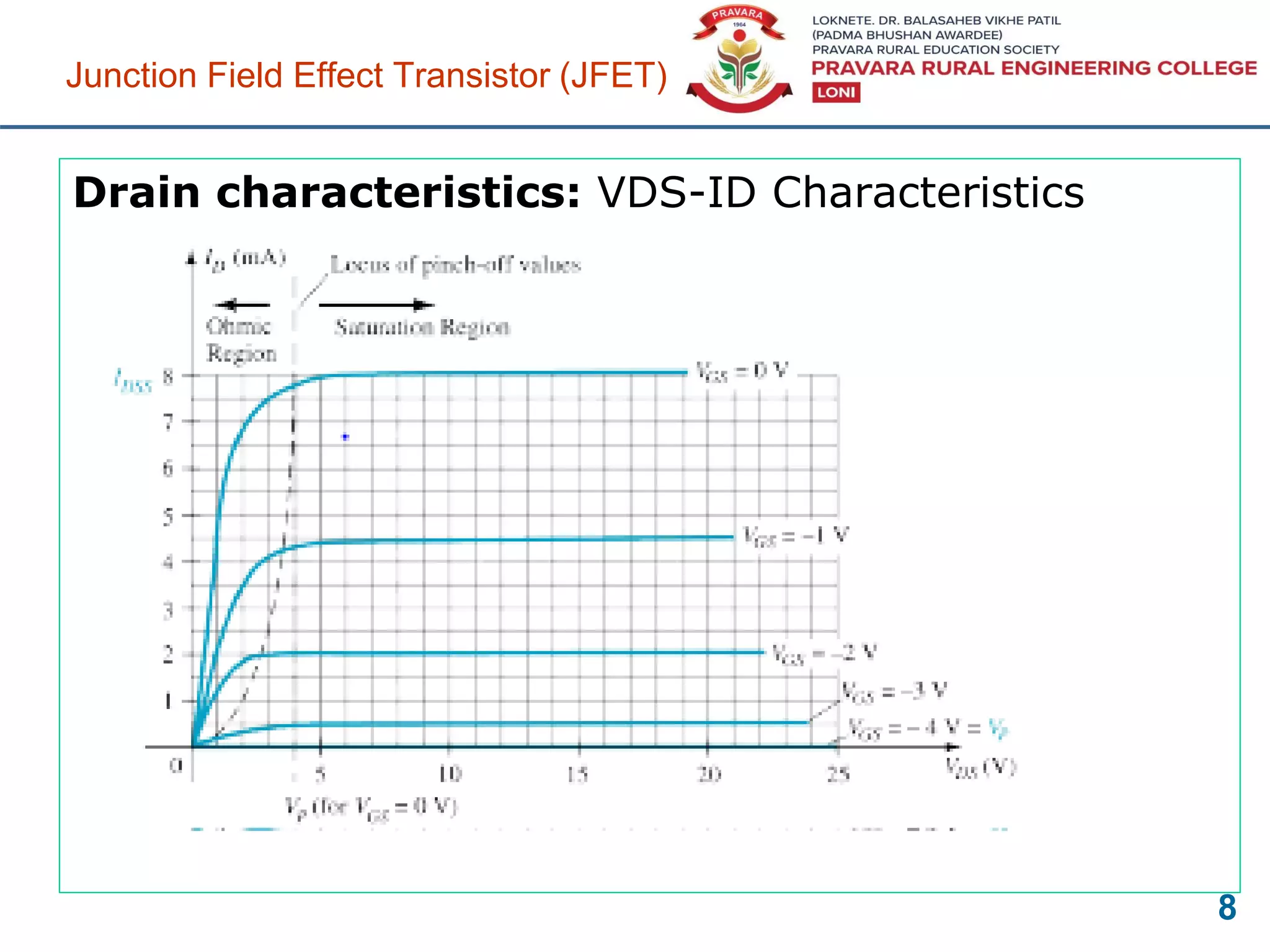
Drain characteristics: VDS-ID Characteristics
8
Junction Field Effect Transistor (JFET)
Drain characteristics : VDS-ID Characteristics
9
▪ Also note that at high
levels of VDS the JFET
reaches a breakdown
situation.
▪ if VDS > VDSmax, ID
will increases
uncontrollably
Junction Field Effect Transistor (JFET)
Ohmic
region
Saturation region
Cut-off region
VGS=-1V
VGS=0V
VGS=-1V
VGS=-5V
=-2V
=-3V
=-4V
5 10 15 20 25
Drain characteristics : VDS-ID for p-chanel FET
10
▪ In p-channel FET,
substrate is p-type and
gate is n type
▪ To make Drain to source
forward bias a negative
voltage is applied
between Drain and
source
▪ To make Gate-Source
voltage reverse bias a p
ositive voltage is applied
between Gate to Source
Ohmic
region
Saturation region
Cut-off region
Junction Field Effect Transistor (JFET)
Transfer Characteristics : VGS-ID Characteristics
11
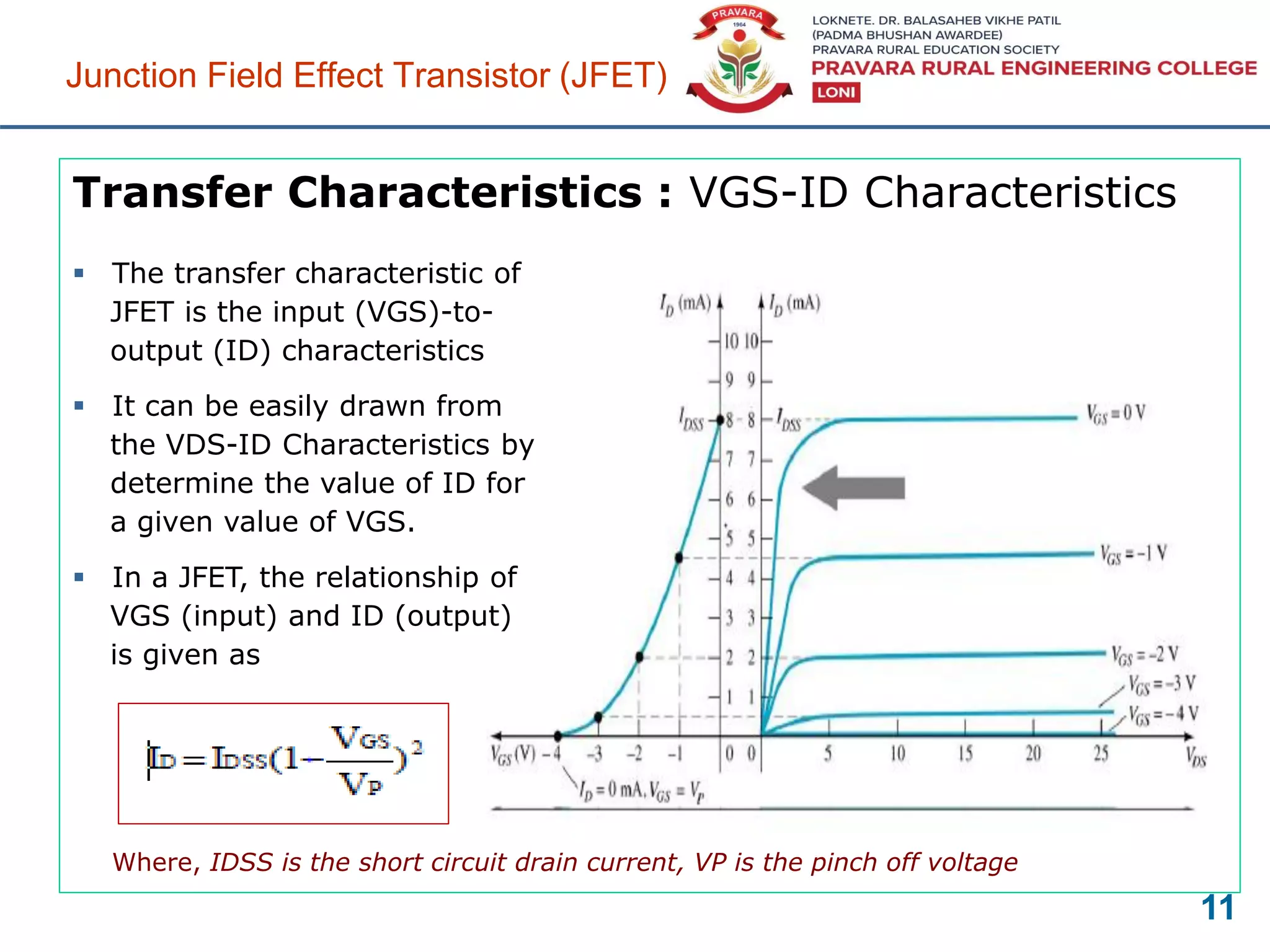
▪ The transfer characteristic of
JFET is the input (VGS)-to-
output (ID) characteristics
▪ It can be easily drawn from
the VDS-ID Characteristics by
determine the value of ID for
a given value of VGS.
▪ In a JFET, the relationship of
VGS (input) and ID (output)
is given as
Where, IDSS is the short circuit drain current, VP is the pinch off voltage
Junction Field Effect Transistor (JFET)
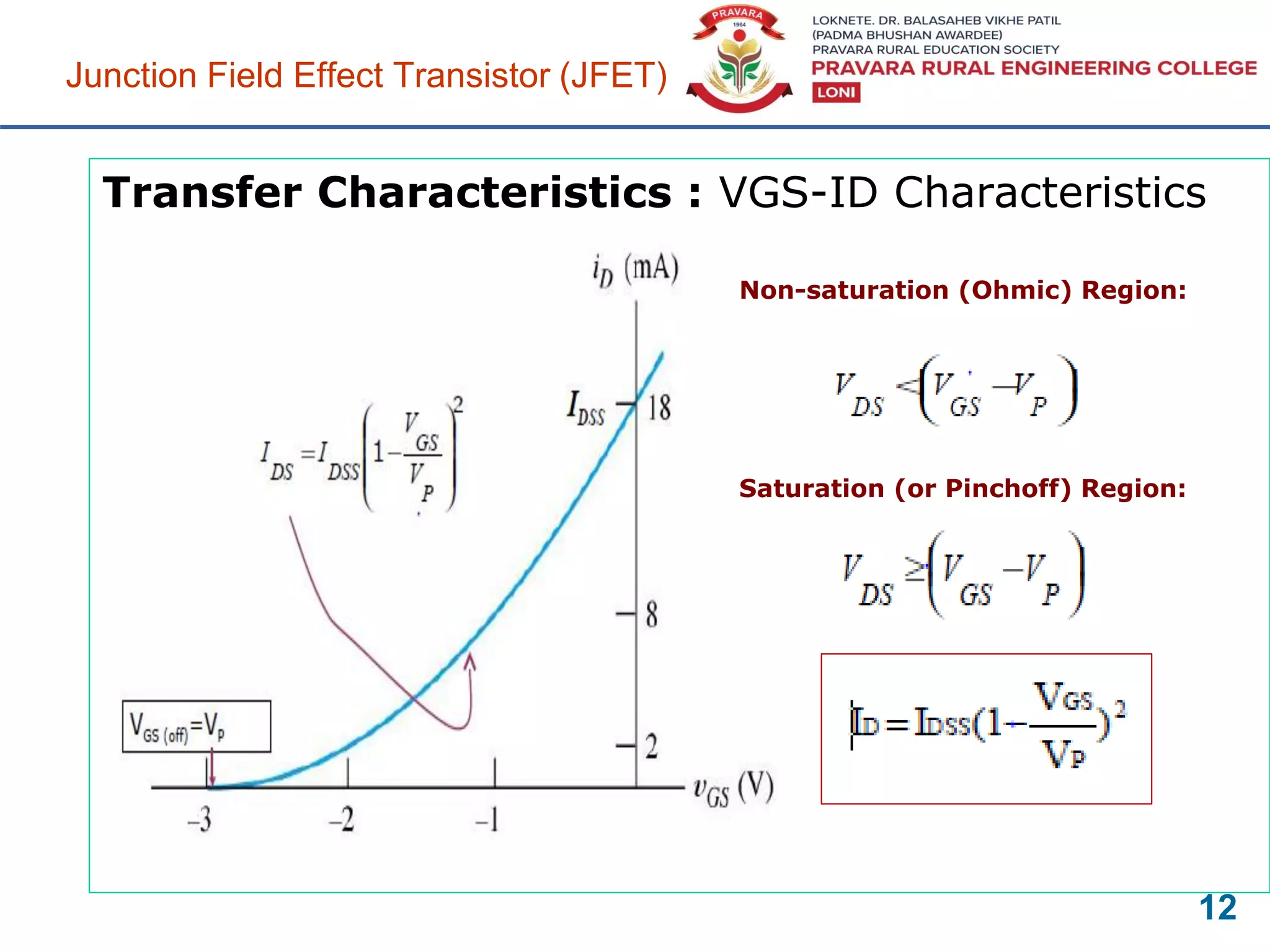
Transfer Characteristics : VGS-ID Characteristics
12
Non-saturation (Ohmic) Region:
Saturation (or Pinchoff) Region:
Junction Field Effect Transistor (JFET)
REGIONS OF JFET ACTION :
• Ohmic Region
▪ linear region
▪ JFET behaves like an ordinary resistor
• Pinch Off Region
▪ Saturation Region
▪ JFET operates as a constant current device
▪ The JFET is used as an amplifier in this region
• Breakdown Region
▪ If VDS is increased beyond its avalanche breakdown voltage
▪ Id increases to an excessive value.
• Cut Off Region
▪ Two depletion regions touch each other, channel width is zero, ID
is zero
▪ VGS (off) = -Vp 13
Junction Field Effect Transistor (JFET)

Field Effect Transistor

  • 1.
    Electronic Devices &Circuits 1 Dr. S. M. Gulhane, PREC, Loni
  • 2.
    Field Effect Transistor Drainand Transfer Characteristics of FET Dr. S. M. Gulhane 2
  • 3.
    Basic Operation ofJFET: VG=0V and VDS=0V ▪ consider the case, VG=0V and VDS= 0V ▪ There occurs a formation of depletion region at the p-n junction as the electrons from n-channel combine with holes from p-gate. ▪ Since no voltages are applied, the depletion regions are of equal thickness and symmetrical ▪ Drain current ID is zero as VD is 0V wrt source Junction Field Effect Transistor (JFET) 3
  • 4.
    Basic Operation ofJFET: VG=0V and VDS is +ve ▪ consider the case, VG=0V and VDS is increased from 0 to a more positive voltage ▪ the depletion region between p-gate and n-channel increases as more electrons from n-channel combine with holes from p-gate. ▪ increasing the depletion region, decreases the size of the n-channel which increases the resistance of the n-channel. ▪ Though the resistance of the channel increases with increasing VDS, the current ID doesn't decrease, rather it increases because drain voltage wet source increases. 4The drain end of the channel has a larger reverse bias than the source end. wedge-shaped depletion regions + - Junction Field Effect Transistor (JFET)
  • 5.
    Basic Operation ofJFET: Pinch-off + - ▪ If VGS = 0 and VDS is further increased to a more positive voltage, then the depletion zone gets so large that it reaches near to pinch off the n-channel. ▪ The channel width becomes very narrow and remain constant and the current ID doesn't vary irrespective of variation in VDS At the pinch-off point: ▪ any further increase in VDS does not produce any increase in ID. ▪ ID is at saturation or maximum. It is referred to as IDSS and the value of VDS at which saturation starts is referred to as Vp ▪ Also the resistance of the channel is at maximum 5 0V Junction Field Effect Transistor (JFET)
  • 6.
    Basic Operation ofJFET: VDS-ID Characteristics 6 JFET modeling when ID=IDSS, VGS=0, VDS>VP Junction Field Effect Transistor (JFET)
  • 7.
    Basic Operation ofJFET: VGS is reverse biased and VDS is +ve constant ▪ consider the case, VG=-ve and VDS is some constant positive voltage ▪ As VGS becomes more negative the depletion region increases.. ▪ Now if VDS is increases, the JFET will operate near to pinch-off at a lower voltage (Vp). ▪ ID reached to saturation value earlier (ID < IDSS) and will remain constant even though VDS is increased. ▪ Further increase in reverse biased increases the depletion region and hence decreases ID ▪ Eventually ID will reach 0A. VGS at this point is called Vp or VGS(off). 7 + - - + + - VDS= +ve VGS=- VGS(off) Junction Field Effect Transistor (JFET)
  • 8.
    Drain characteristics: VDS-IDCharacteristics 8 Junction Field Effect Transistor (JFET)
  • 9.
    Drain characteristics :VDS-ID Characteristics 9 ▪ Also note that at high levels of VDS the JFET reaches a breakdown situation. ▪ if VDS > VDSmax, ID will increases uncontrollably Junction Field Effect Transistor (JFET) Ohmic region Saturation region Cut-off region VGS=-1V VGS=0V VGS=-1V VGS=-5V =-2V =-3V =-4V 5 10 15 20 25
  • 10.
    Drain characteristics :VDS-ID for p-chanel FET 10 ▪ In p-channel FET, substrate is p-type and gate is n type ▪ To make Drain to source forward bias a negative voltage is applied between Drain and source ▪ To make Gate-Source voltage reverse bias a p ositive voltage is applied between Gate to Source Ohmic region Saturation region Cut-off region Junction Field Effect Transistor (JFET)
  • 11.
    Transfer Characteristics :VGS-ID Characteristics 11 ▪ The transfer characteristic of JFET is the input (VGS)-to- output (ID) characteristics ▪ It can be easily drawn from the VDS-ID Characteristics by determine the value of ID for a given value of VGS. ▪ In a JFET, the relationship of VGS (input) and ID (output) is given as Where, IDSS is the short circuit drain current, VP is the pinch off voltage Junction Field Effect Transistor (JFET)
  • 12.
    Transfer Characteristics :VGS-ID Characteristics 12 Non-saturation (Ohmic) Region: Saturation (or Pinchoff) Region: Junction Field Effect Transistor (JFET)
  • 13.
    REGIONS OF JFETACTION : • Ohmic Region ▪ linear region ▪ JFET behaves like an ordinary resistor • Pinch Off Region ▪ Saturation Region ▪ JFET operates as a constant current device ▪ The JFET is used as an amplifier in this region • Breakdown Region ▪ If VDS is increased beyond its avalanche breakdown voltage ▪ Id increases to an excessive value. • Cut Off Region ▪ Two depletion regions touch each other, channel width is zero, ID is zero ▪ VGS (off) = -Vp 13 Junction Field Effect Transistor (JFET)