Digital Architecture – The Missing Link in Digital Transformation Success
The document discusses the importance of digital architecture in enabling successful digital transformation. It defines digital architecture as the design of digital solutions through applying and integrating digital technologies to transform companies and deliver value to customers. A well-designed digital architecture guides an enterprise's gradual development of digital solutions that empower customer experiences, integrations, and insights. It also links an enterprise's digital strategy to execution by aligning business and technology capabilities. The document provides a framework for digital architecture and highlights characteristics like customer centricity, collaborative design, and an evolutionary approach that allows for an integrated roadmap and agility.
Digital Architecture – The Missing Link in Digital Transformation Success
1.
Digital Architecture –The Missing
Link in Digital Transformation
Success
Tan Eng Tsze
Principal Lecturer & Consultant, Digital Strategy and Leadership Practice
[ 33 slides]
1#ISSLearningFest
2.
Learning Outcome
Upon completionof this session, you will be able to understand:
Digital Architecture
Digital Architecture Linking Digital Strategy to Execution
Digital Architecture Framework
Importance of Architecture Thinking and Mindset
2#ISSLearningFest
3.
3
77 million customer
detailsstolen
Service down for X days
Costed USD $250
million
Why are some Internet retailers able to make crucial changes to their ecommerce
websites in hours while it takes brick-and-mortar retailers three months or more to
do the same?
How come just a few car manufacturers can rapidly make online updates to their
products in the field, be they to their infotainment systems or to fuel and engine
performance—a practice that is becoming crucial in a world of servitization,
where manufactured products come with digital services attached to them?
And how is the new wave of cloud-based enterprise software vendors able to
make software updates to their products in days or weeks, rather than the months it
takes traditional enterprise software vendors to do so?
In this Digital Age…
#ISSLearningFest
4.
Architecture Practices ofthe Past and
Current?
4
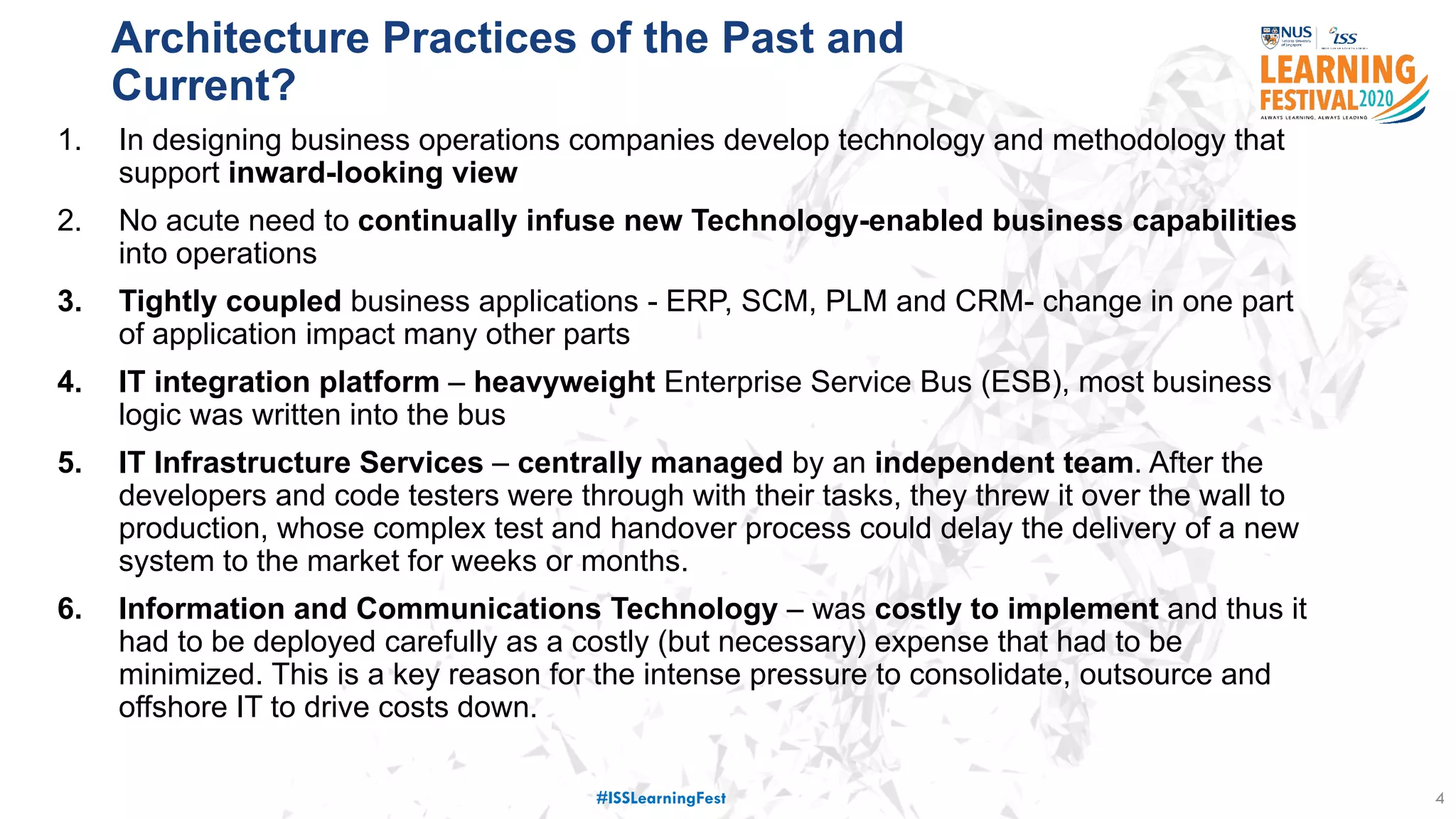
1. In designing business operations companies develop technology and methodology that
support inward-looking view
2. No acute need to continually infuse new Technology-enabled business capabilities
into operations
3. Tightly coupled business applications - ERP, SCM, PLM and CRM- change in one part
of application impact many other parts
4. IT integration platform – heavyweight Enterprise Service Bus (ESB), most business
logic was written into the bus
5. IT Infrastructure Services – centrally managed by an independent team. After the
developers and code testers were through with their tasks, they threw it over the wall to
production, whose complex test and handover process could delay the delivery of a new
system to the market for weeks or months.
6. Information and Communications Technology – was costly to implement and thus it
had to be deployed carefully as a costly (but necessary) expense that had to be
minimized. This is a key reason for the intense pressure to consolidate, outsource and
offshore IT to drive costs down.
#ISSLearningFest
5.
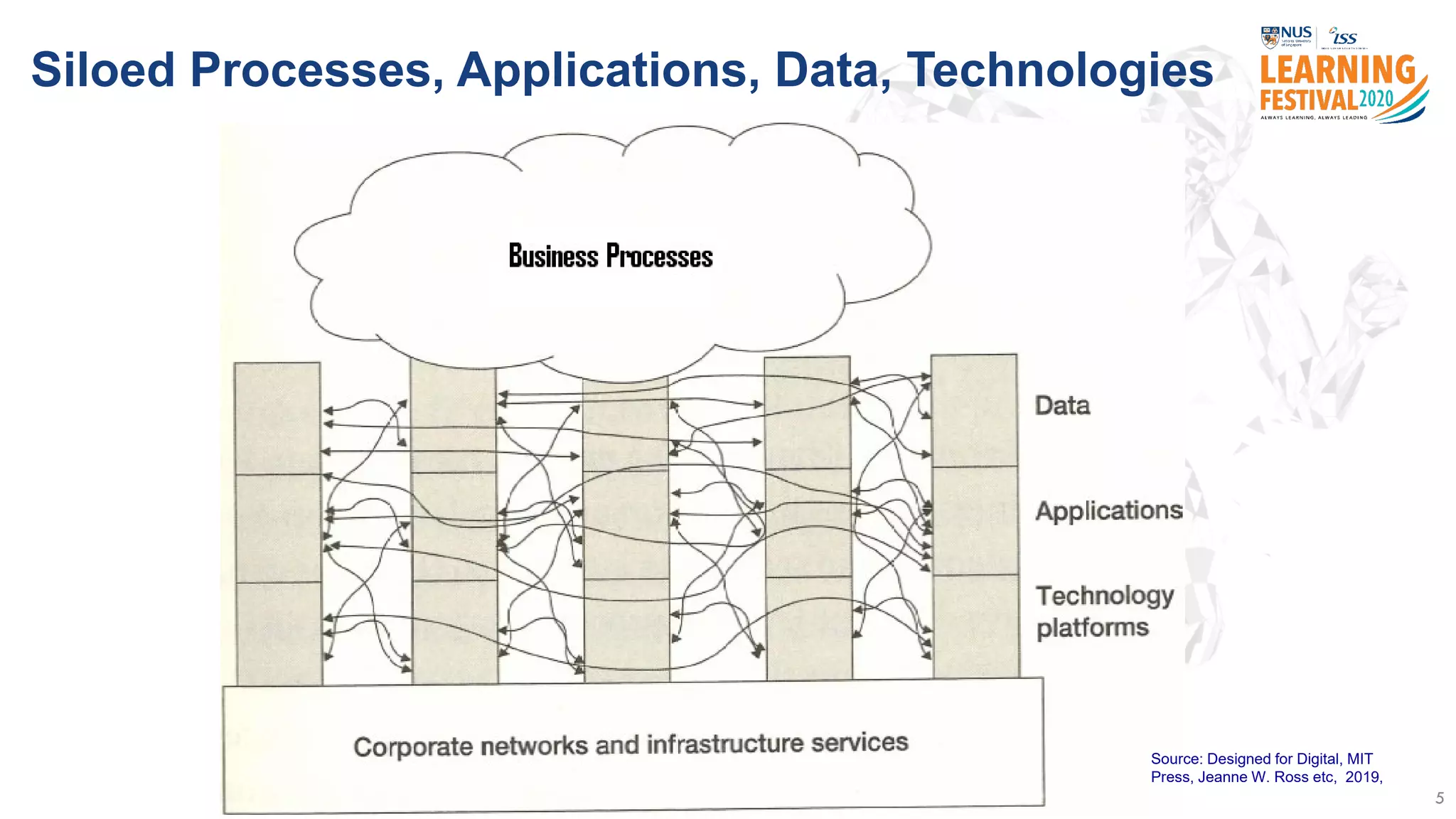
Siloed Processes, Applications,Data, Technologies
5
77 million
customer details
stolen
Service down for
X days
Costed USD $250
million
Source: Designed for Digital, MIT
Press, Jeanne W. Ross etc, 2019,
6.
6
77 million
customer details
stolen
Servicedown for
X days
Costed USD $250
million
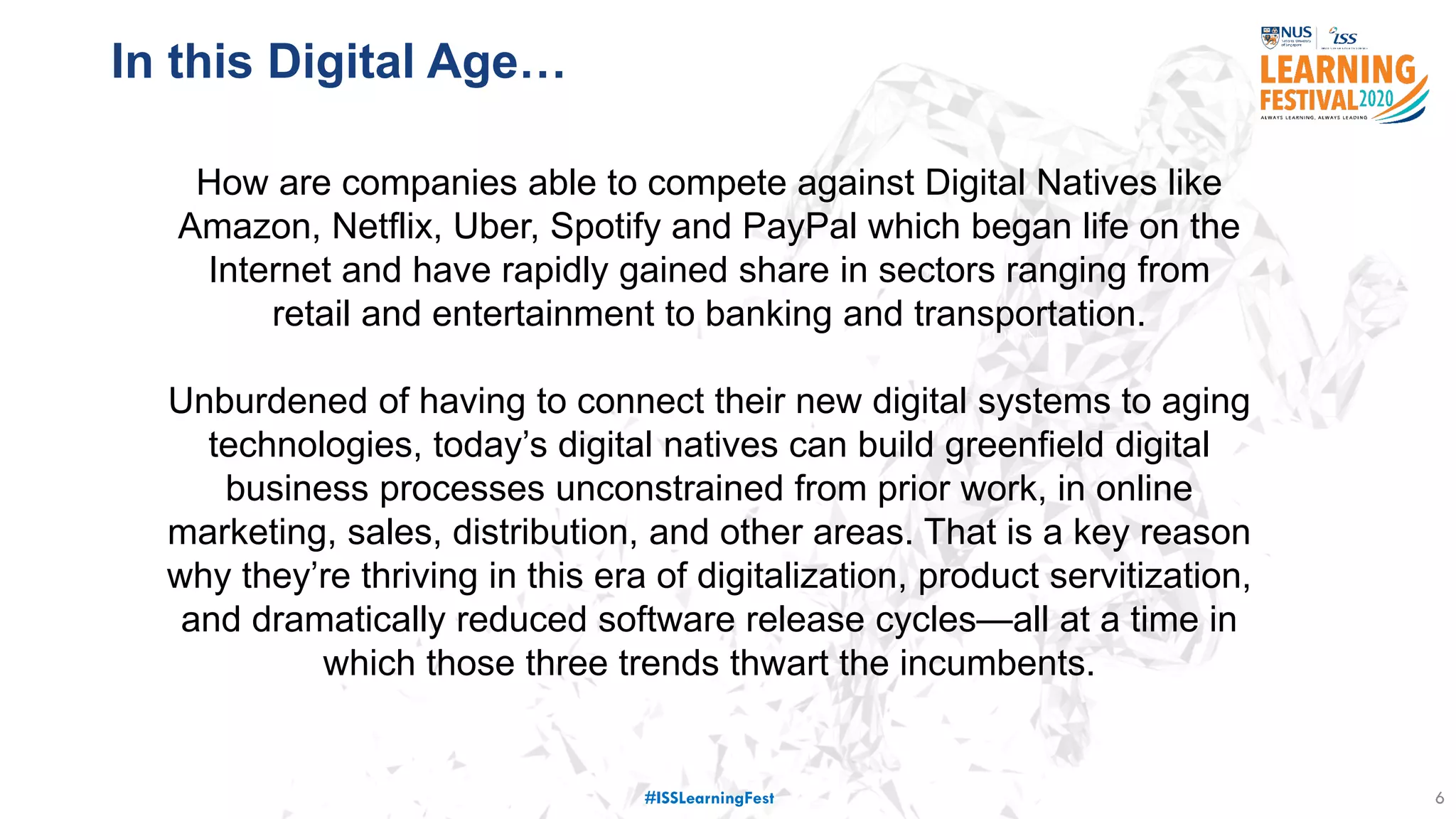
How are companies able to compete against Digital Natives like
Amazon, Netflix, Uber, Spotify and PayPal which began life on the
Internet and have rapidly gained share in sectors ranging from
retail and entertainment to banking and transportation.
Unburdened of having to connect their new digital systems to aging
technologies, today’s digital natives can build greenfield digital
business processes unconstrained from prior work, in online
marketing, sales, distribution, and other areas. That is a key reason
why they’re thriving in this era of digitalization, product servitization,
and dramatically reduced software release cycles—all at a time in
which those three trends thwart the incumbents.
In this Digital Age…
#ISSLearningFest
7.
Digital Enterprise
7
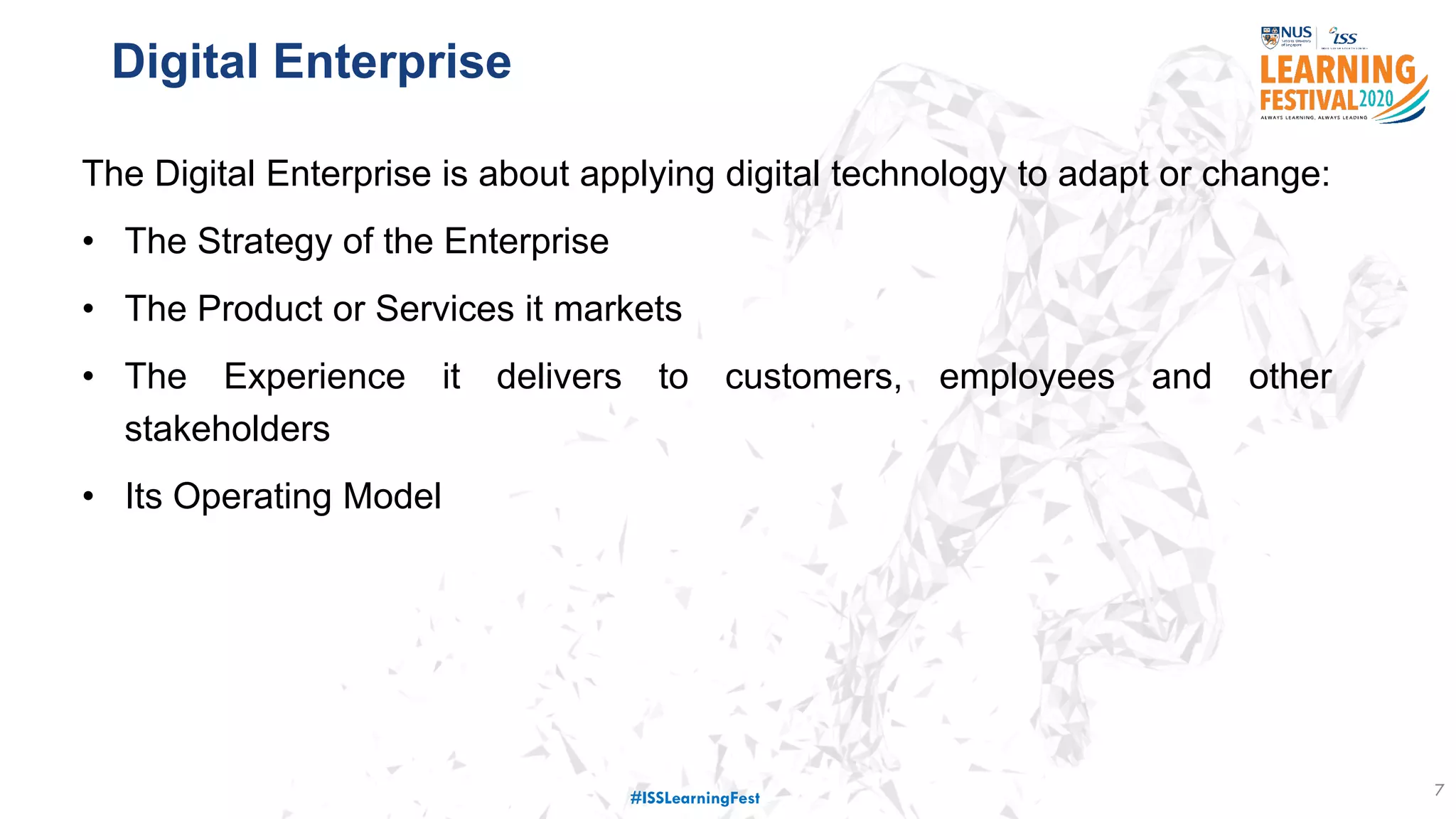
The DigitalEnterprise is about applying digital technology to adapt or change:
• The Strategy of the Enterprise
• The Product or Services it markets
• The Experience it delivers to customers, employees and other
stakeholders
• Its Operating Model
#ISSLearningFest
8.
8
77 million
customer details
stolen
Servicedown for
X days
Costed USD $250
million
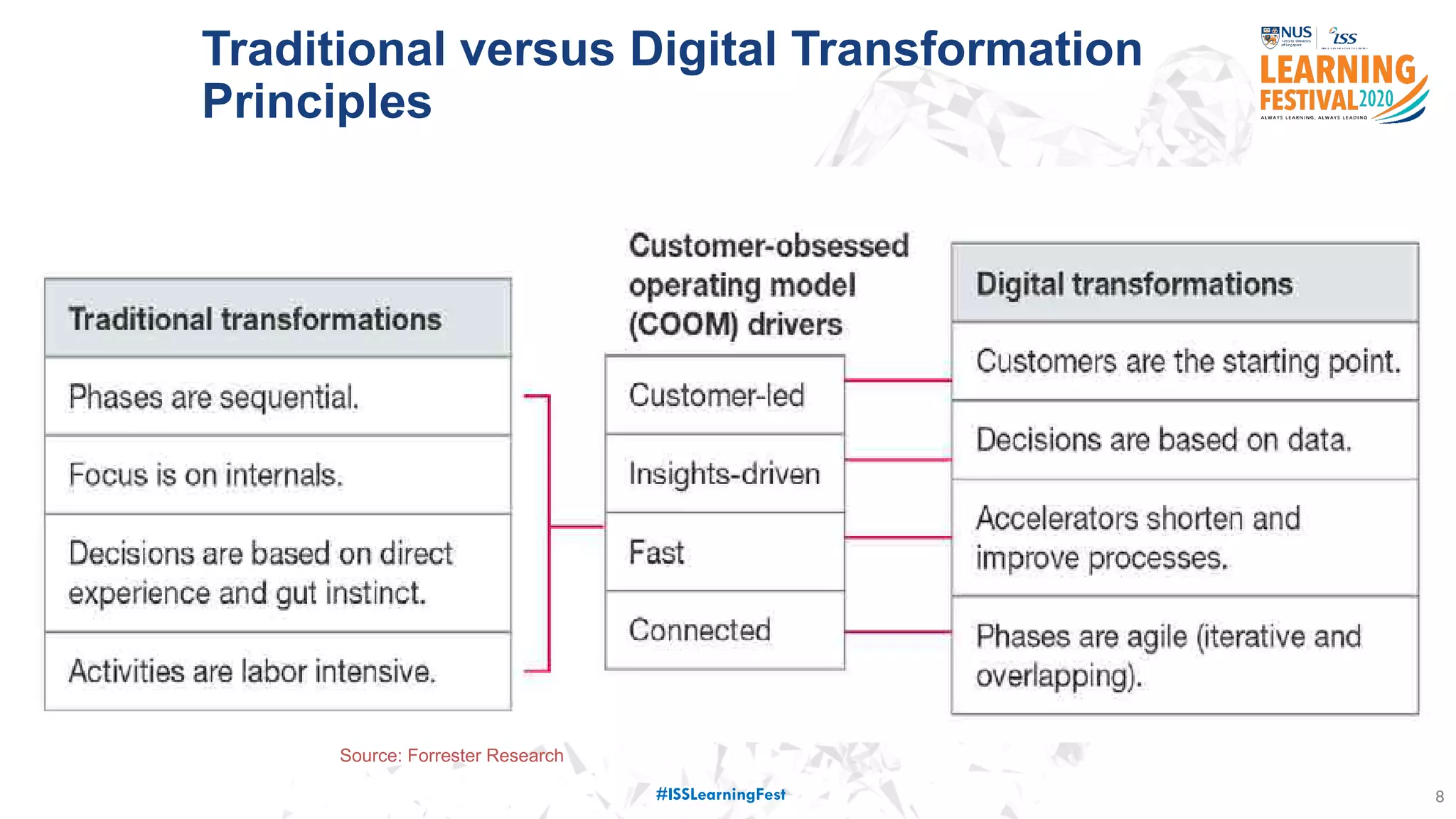
Traditional versus Digital Transformation
Principles
Source: Forrester Research
#ISSLearningFest
9.
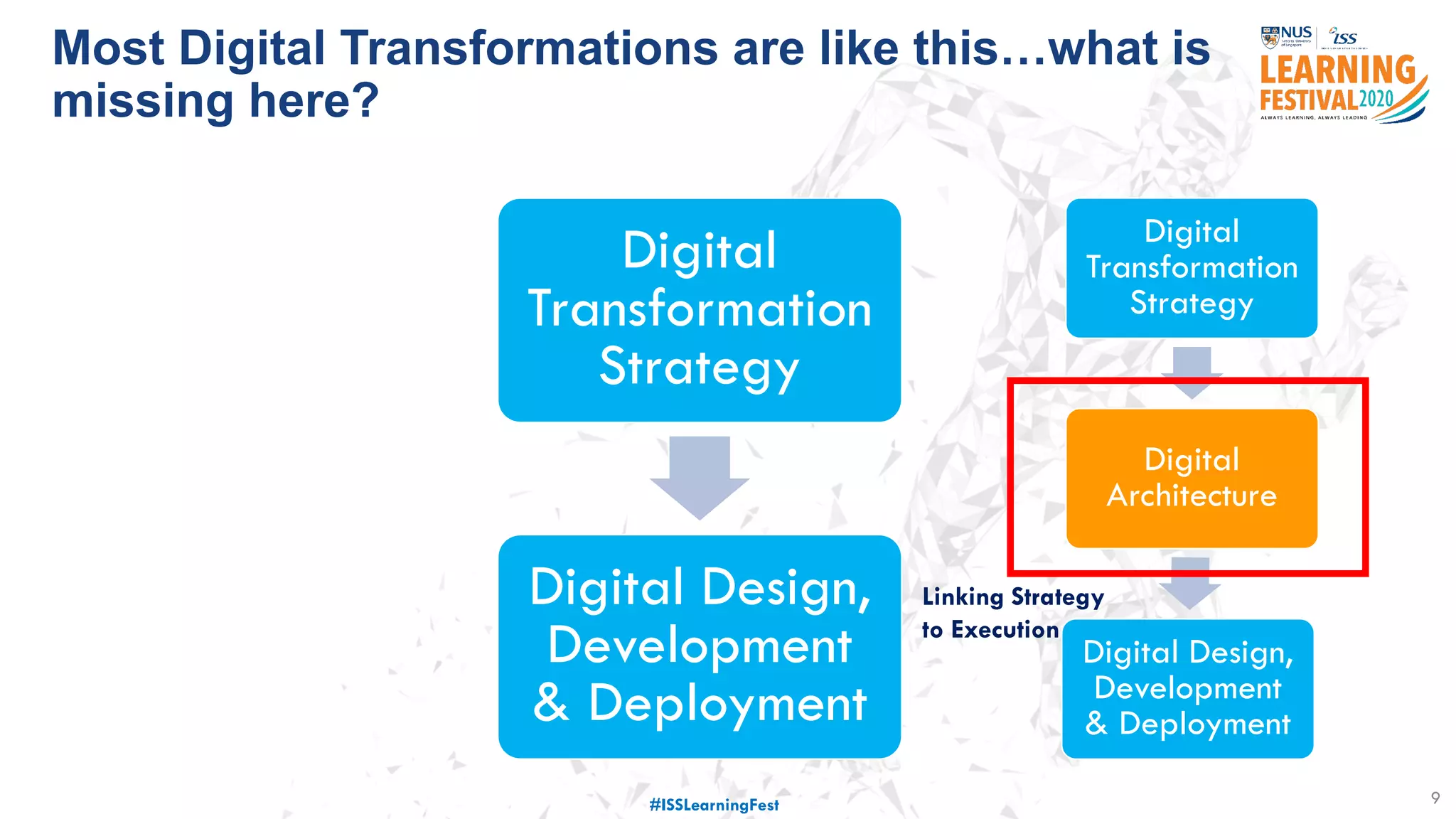
Most Digital Transformationsare like this…what is
missing here?
9
Digital
Transformation
Strategy
Digital Design,
Development
& Deployment
Digital
Transformation
Strategy
Digital
Architecture
Digital Design,
Development
& Deployment
Linking Strategy
to Execution
#ISSLearningFest
10.
Defining Digital Architecture
10
•Digital Architecture is the design of Digital Solutions through the
application and integration of Digital Technologies to enable the Digital
Transformation of the company and deliver value to the customers.
• The real essence of digital architecture lies in the way it approaches to
problems; it redefines the solutions design process and shifts the focus
from the problem to the customer experience.
• In addition, a well-thought-out digital architecture guides an enterprise’s
gradual maturation in delivering digital solutions that empower
customer experiences, integrations, and insights
#ISSLearningFest
11.
11
77 million
customer details
stolen
Servicedown for
X days
Costed USD $250
million
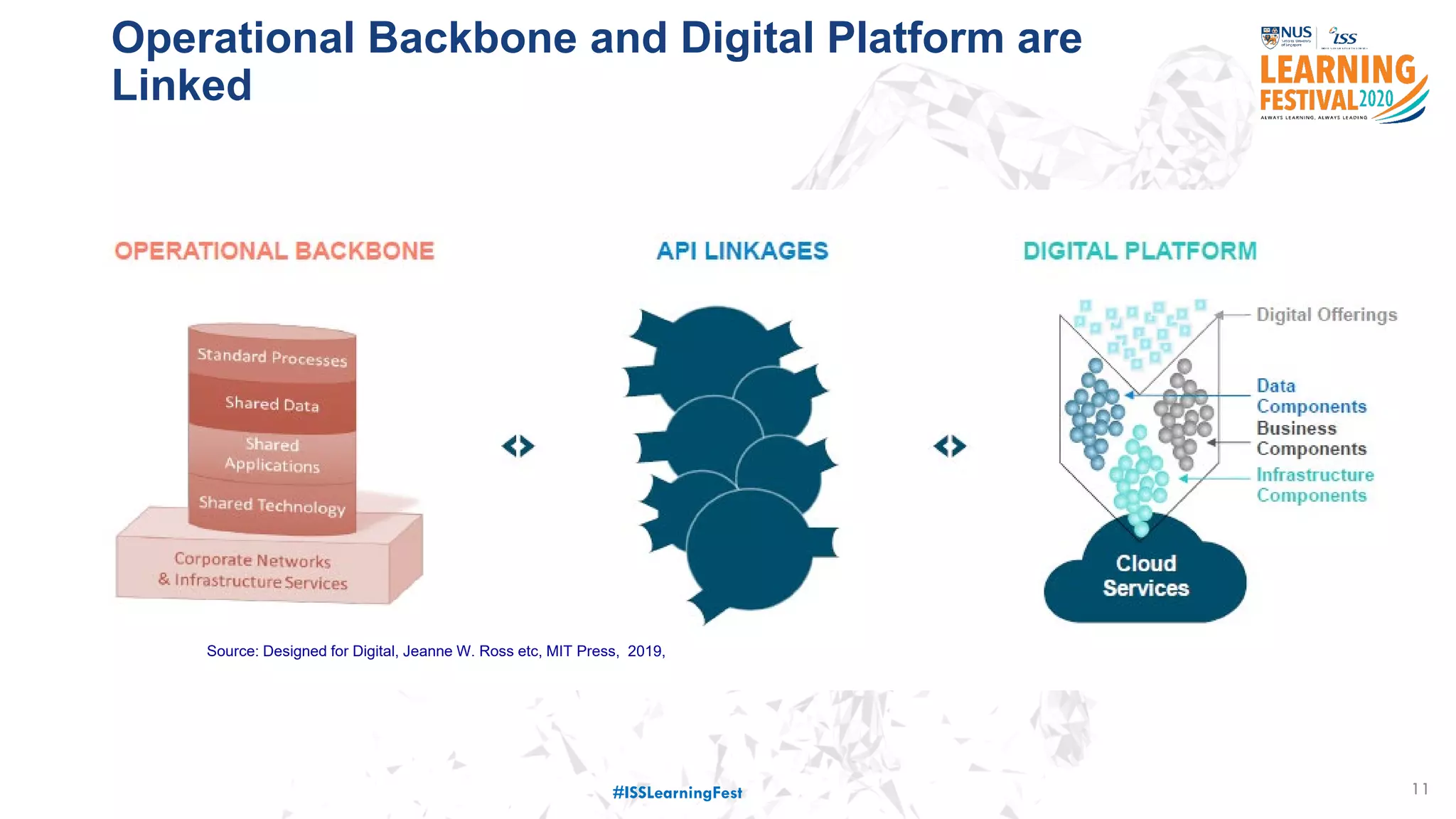
Operational Backbone and Digital Platform are
Linked
Source: Designed for Digital, Jeanne W. Ross etc, MIT Press, 2019,
#ISSLearningFest
12.
12
77 million
customer details
stolen
Servicedown for
X days
Costed USD $250
million
#ISSLearningFest
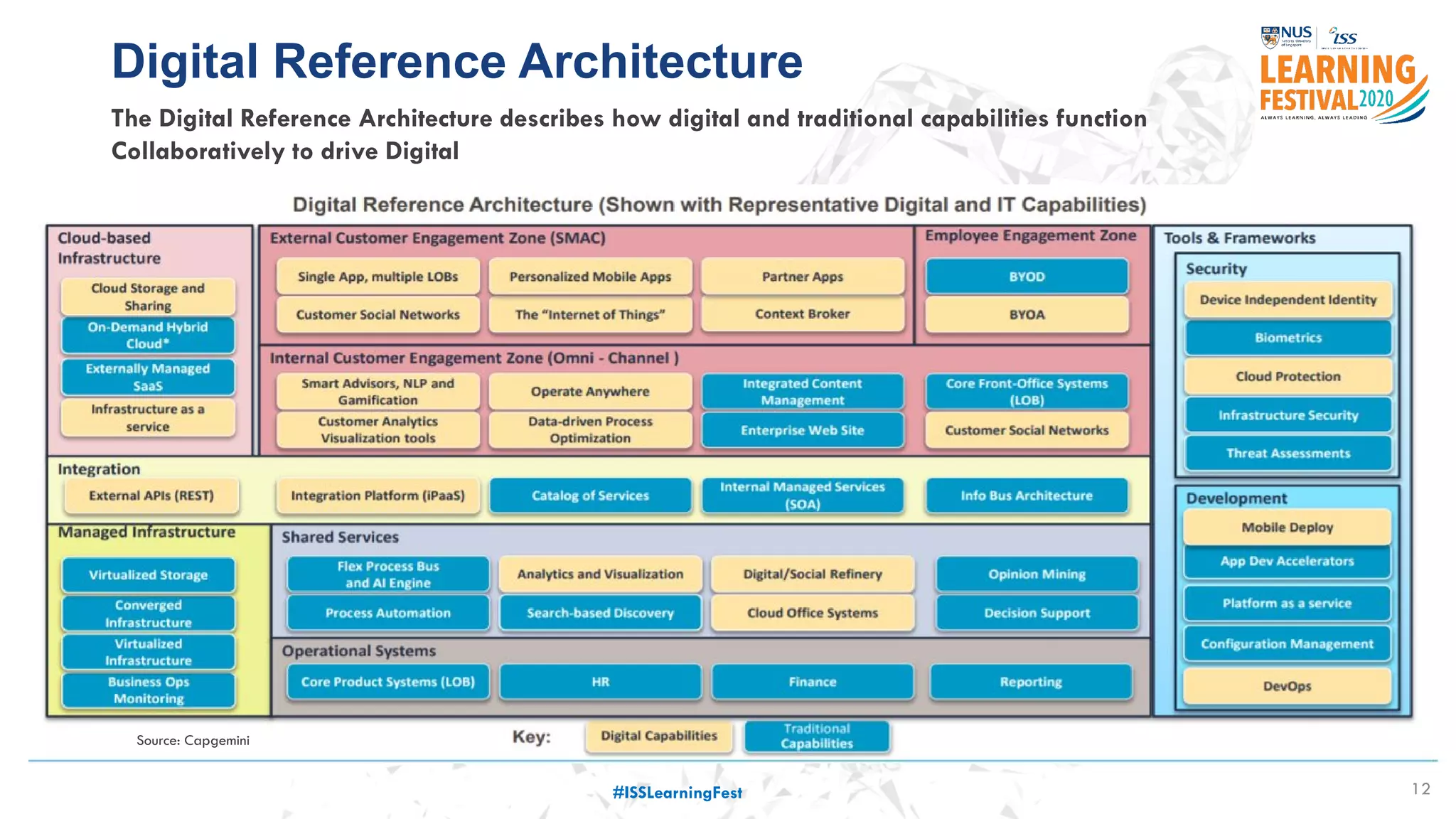
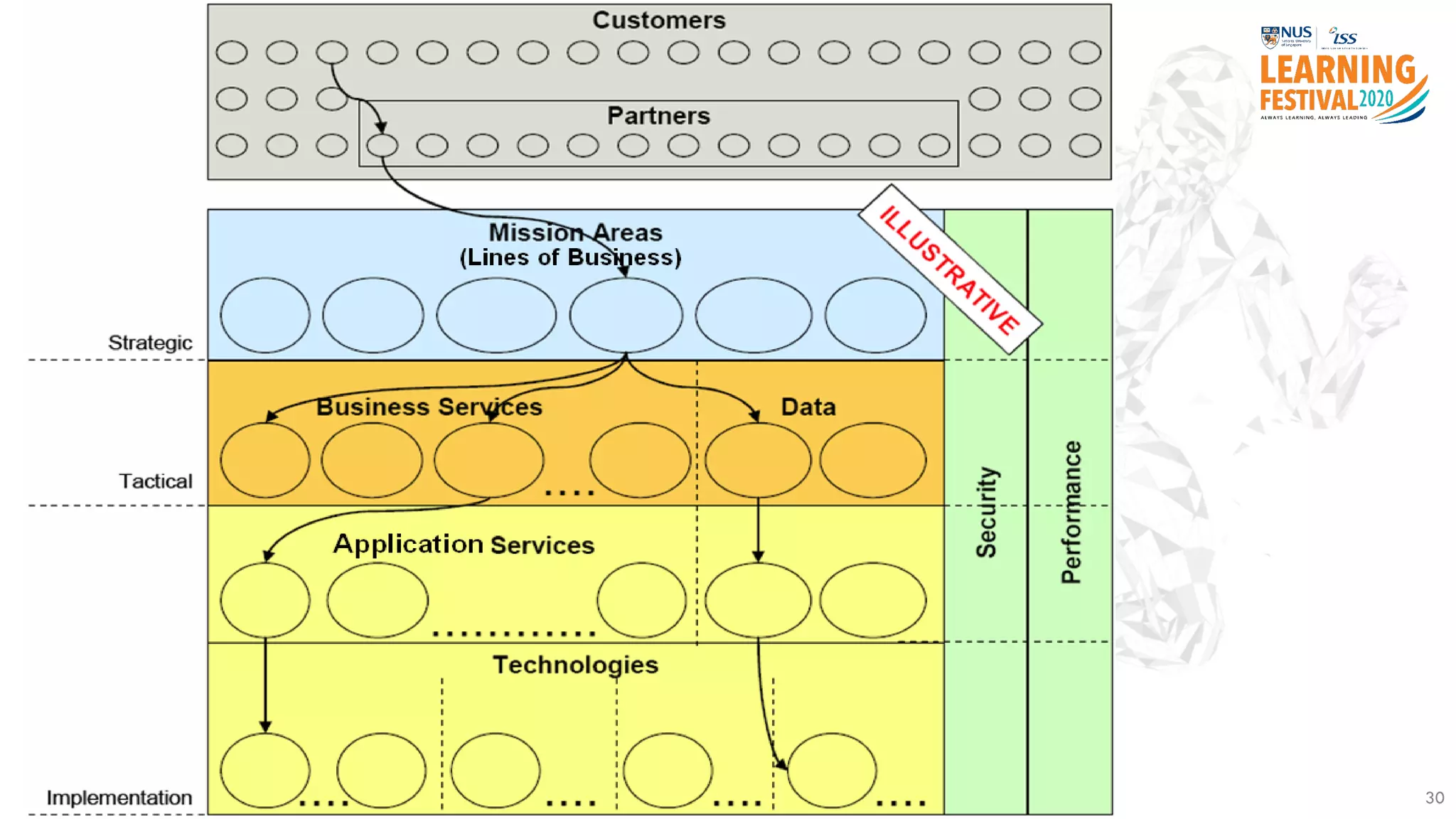
Digital Reference Architecture
The Digital Reference Architecture describes how digital and traditional capabilities function
Collaboratively to drive Digital
Source: Capgemini
13.
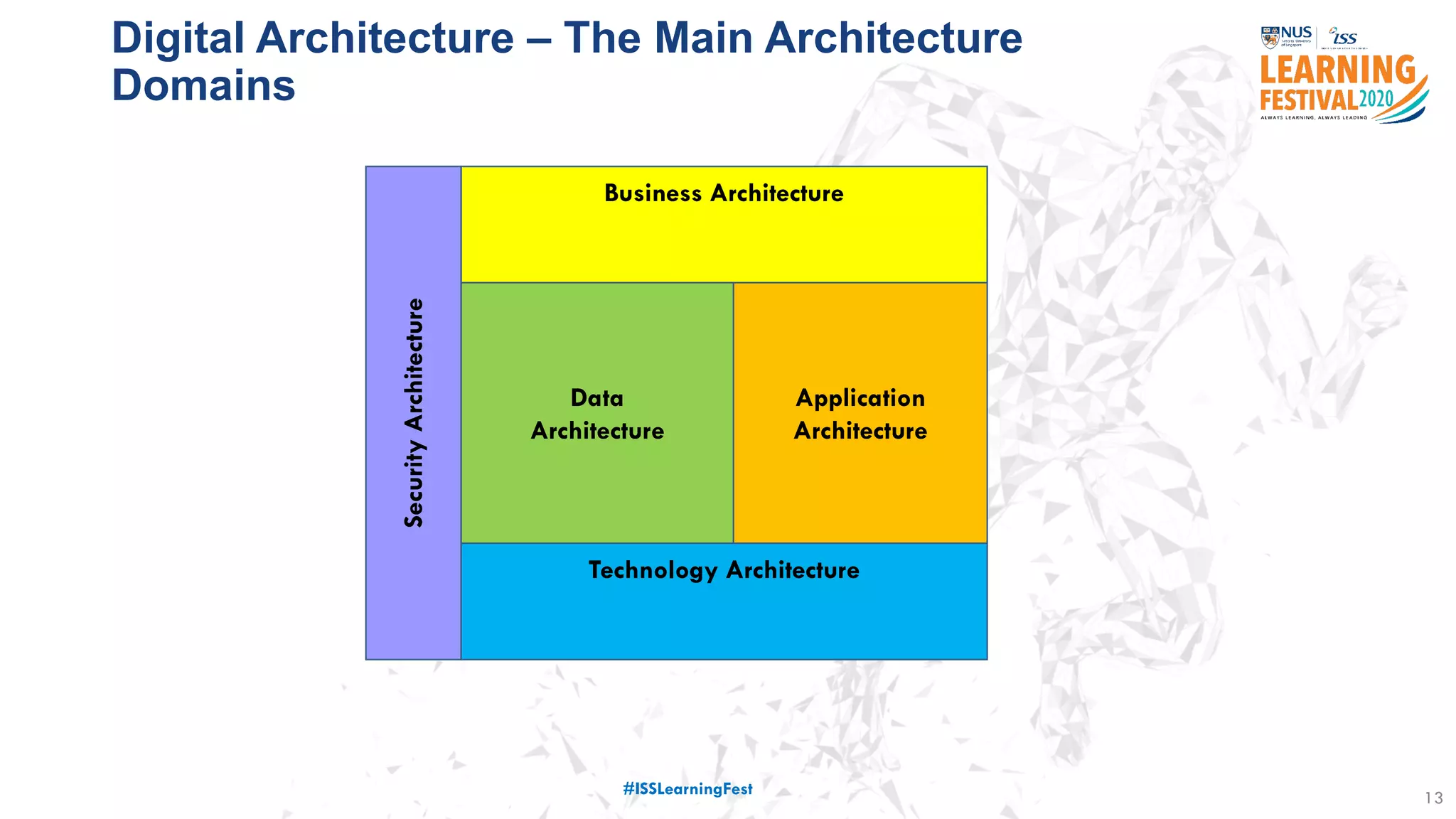
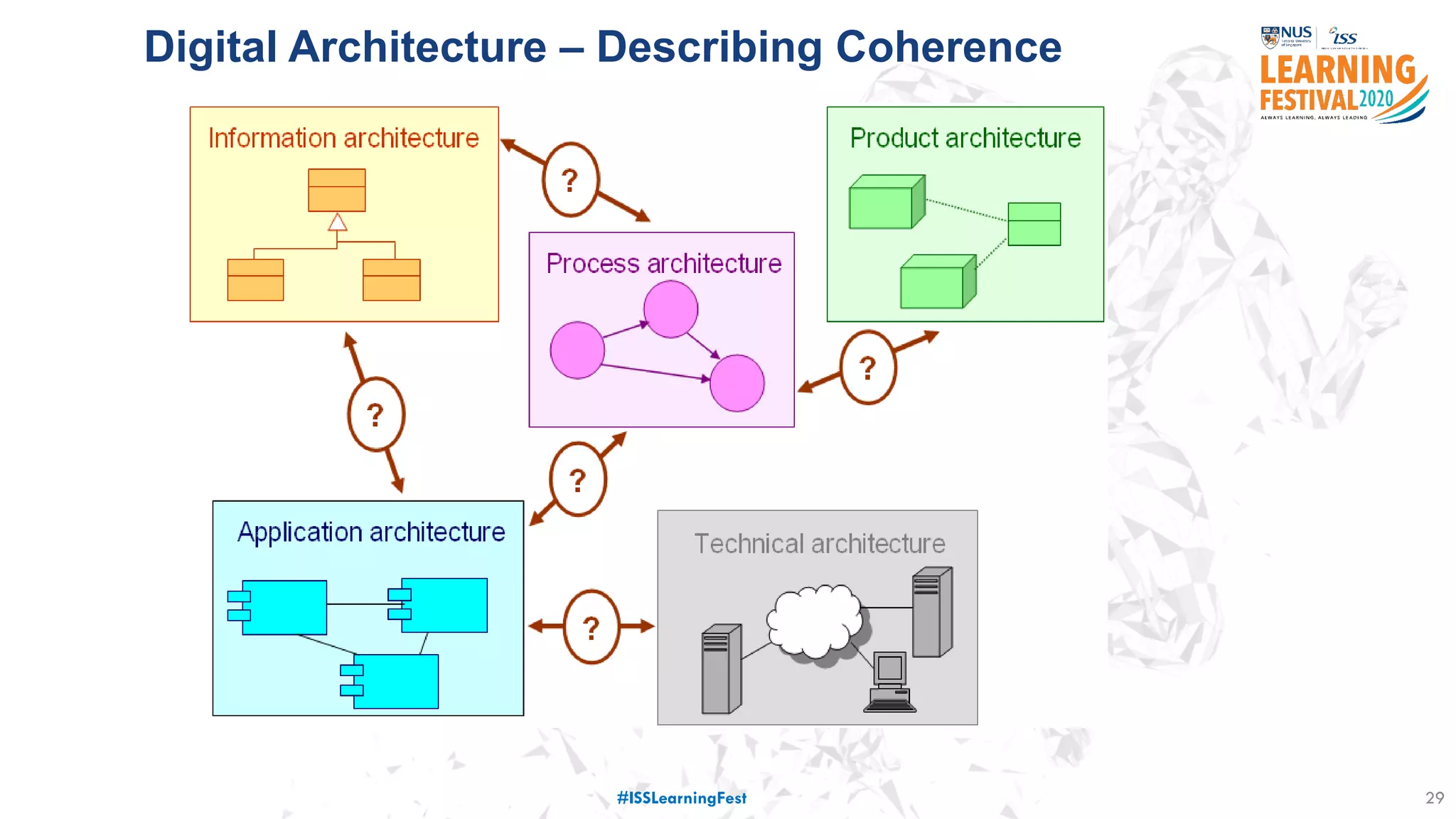
Digital Architecture –The Main Architecture
Domains
13
Business Architecture
Data
Architecture
Application
Architecture
Technology Architecture
SecurityArchitecture
#ISSLearningFest
14.
14
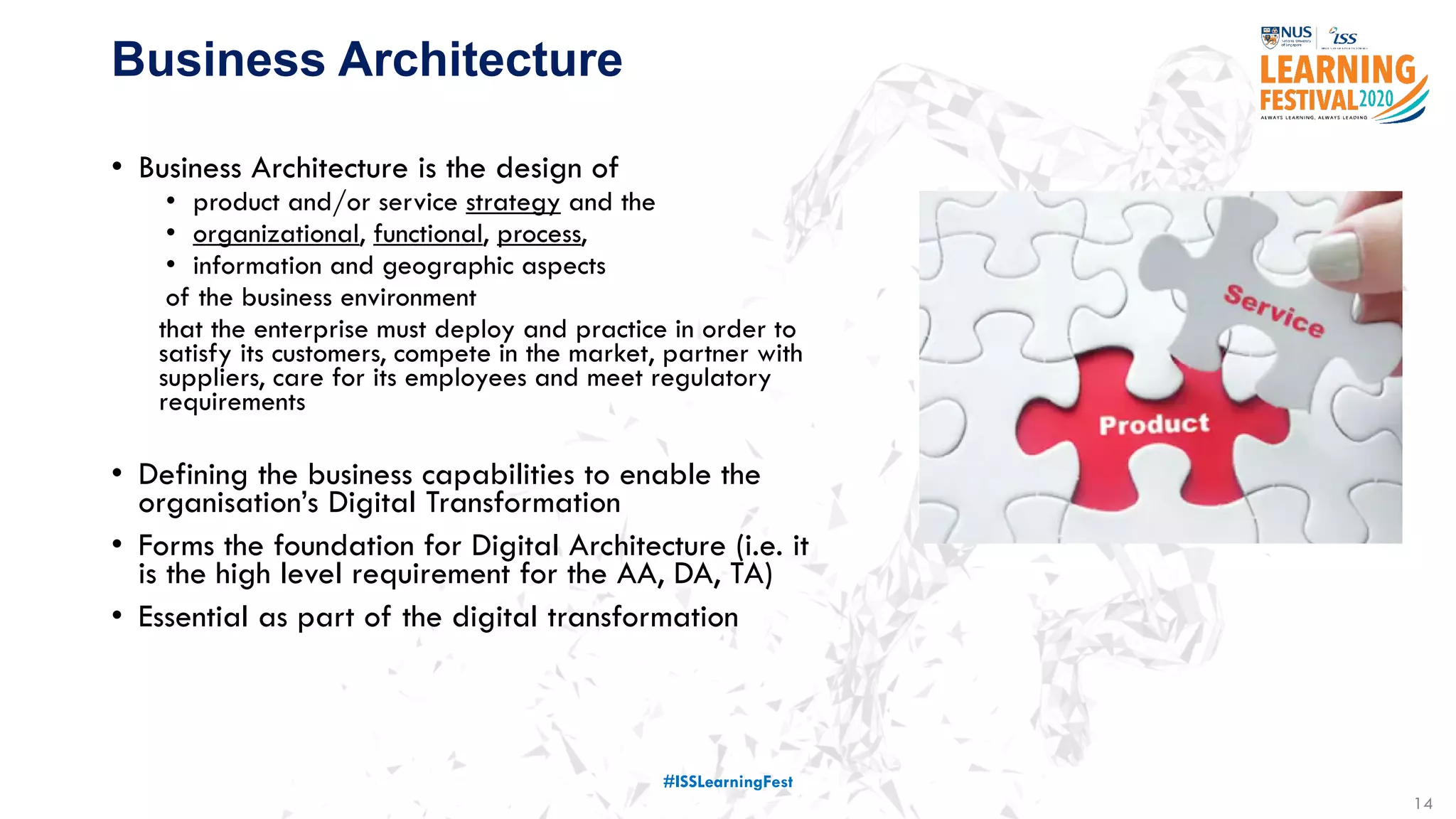
Business Architecture
• BusinessArchitecture is the design of
• product and/or service strategy and the
• organizational, functional, process,
• information and geographic aspects
of the business environment
that the enterprise must deploy and practice in order to
satisfy its customers, compete in the market, partner with
suppliers, care for its employees and meet regulatory
requirements
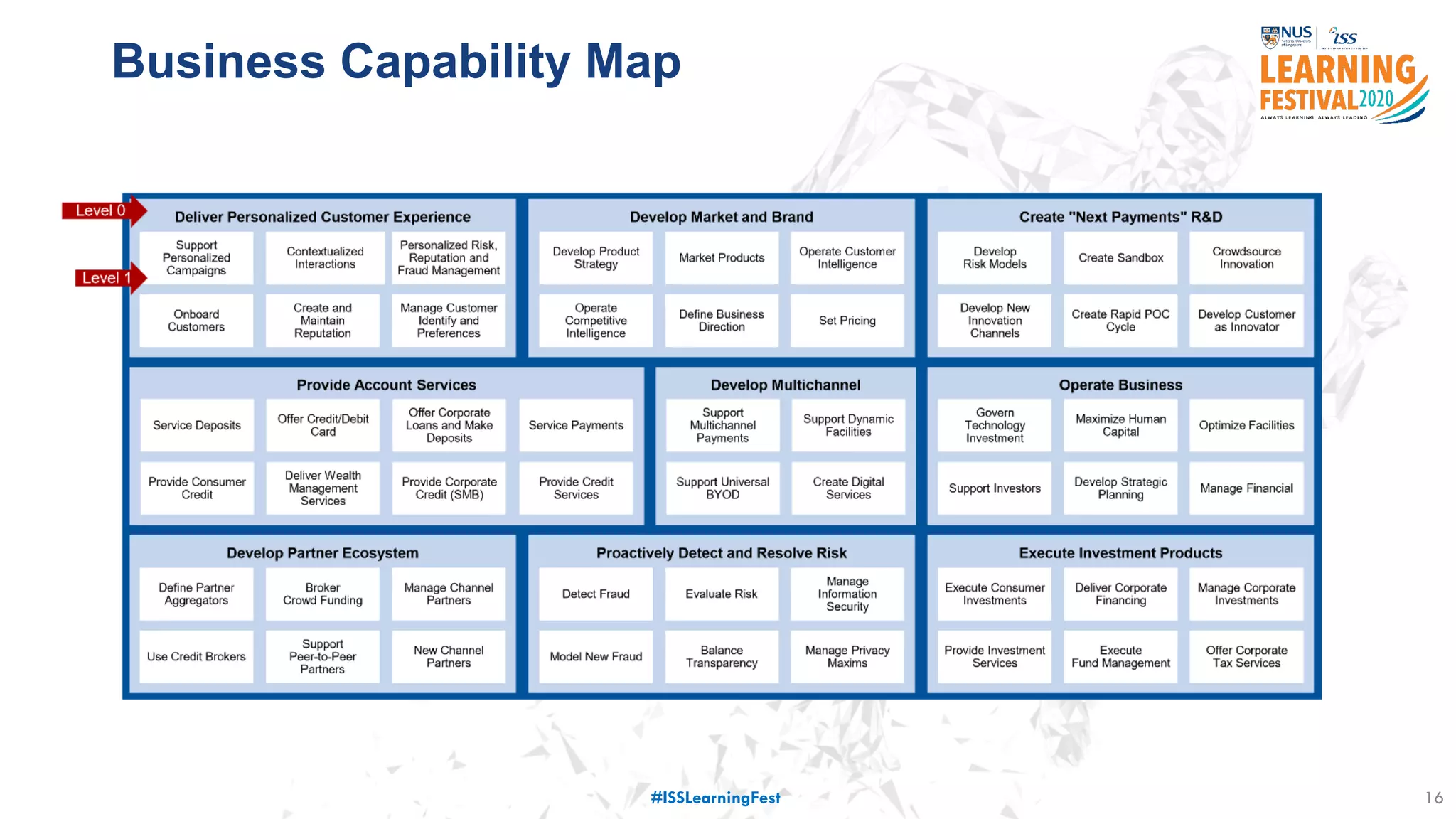
• Defining the business capabilities to enable the
organisation’s Digital Transformation
• Forms the foundation for Digital Architecture (i.e. it
is the high level requirement for the AA, DA, TA)
• Essential as part of the digital transformation
#ISSLearningFest
15.
15
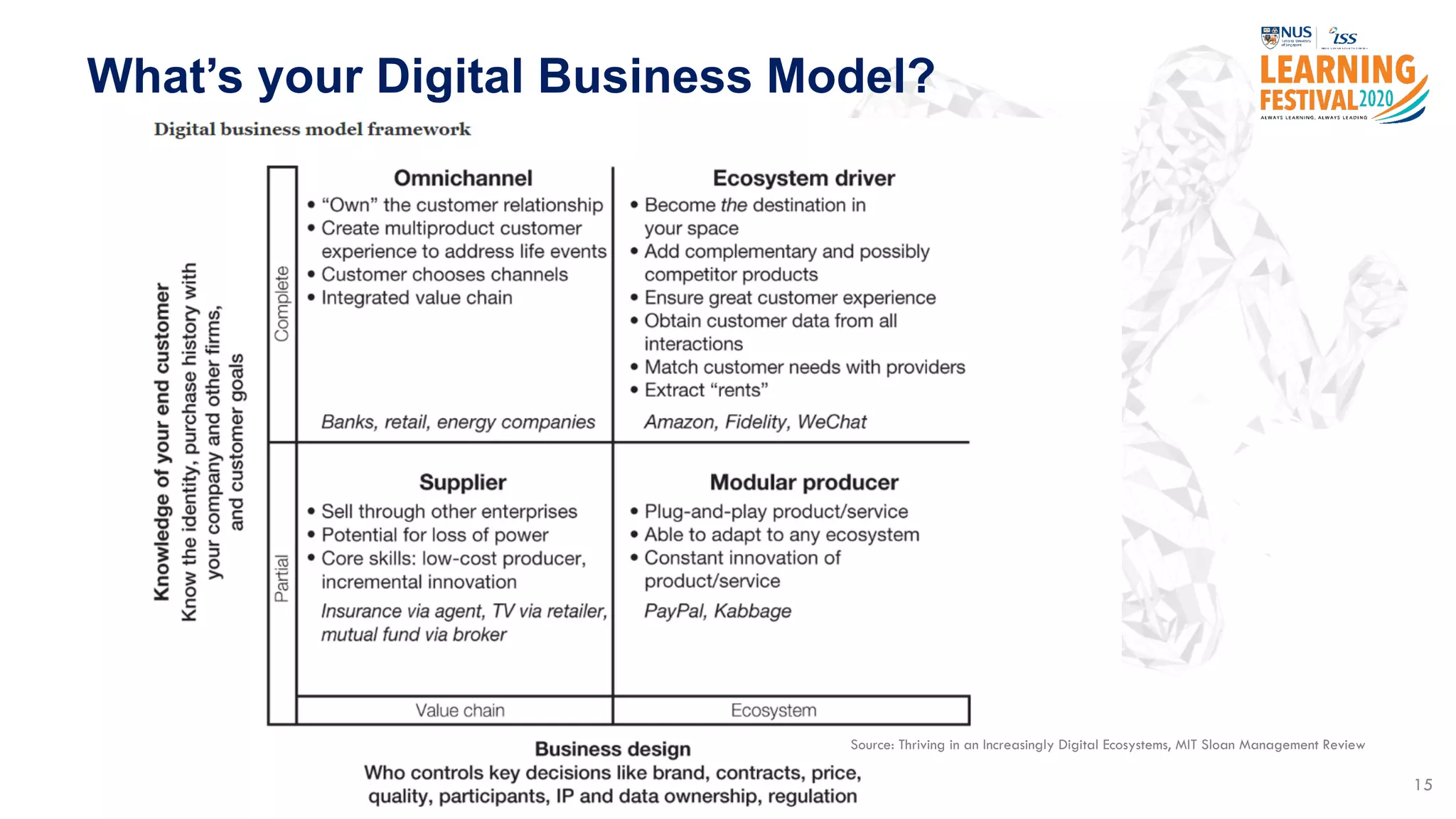
What’s your DigitalBusiness Model?
Source: Thriving in an Increasingly Digital Ecosystems, MIT Sloan Management Review
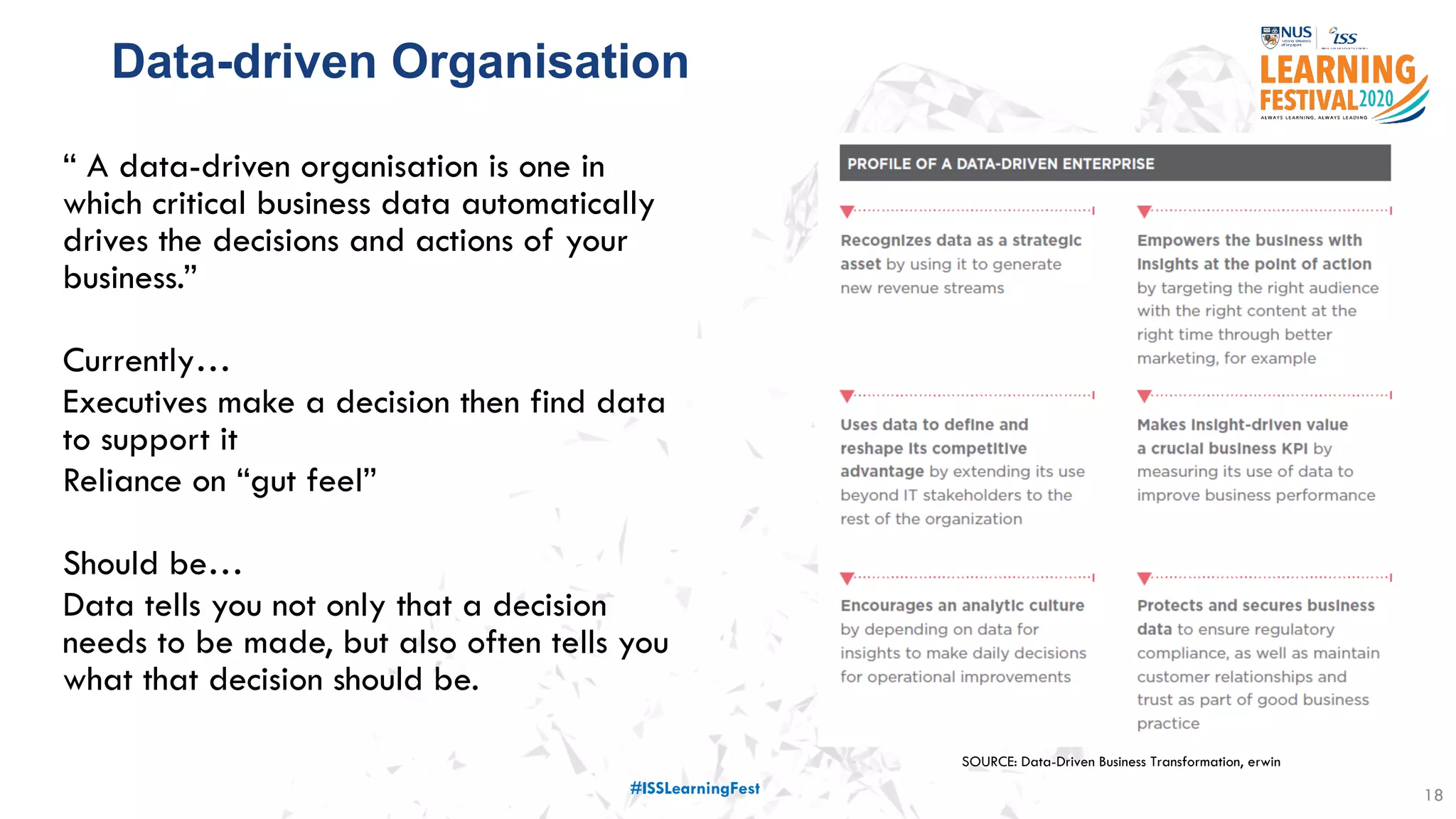
Data-driven Organisation
18
“ Adata-driven organisation is one in
which critical business data automatically
drives the decisions and actions of your
business.”
Currently…
Executives make a decision then find data
to support it
Reliance on “gut feel”
Should be…
Data tells you not only that a decision
needs to be made, but also often tells you
what that decision should be.
SOURCE: Data-Driven Business Transformation, erwin
#ISSLearningFest
19.
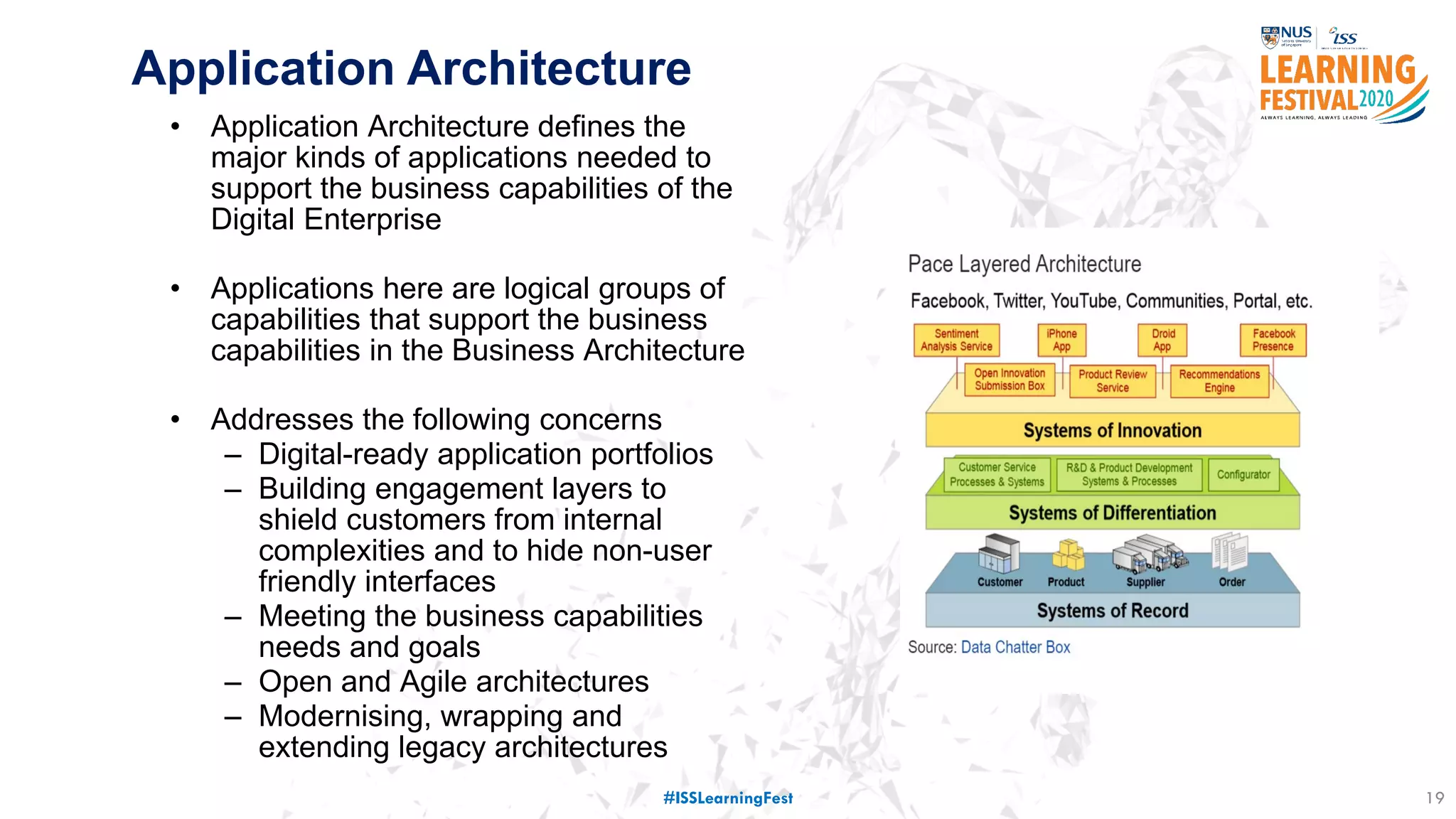
Application Architecture
• ApplicationArchitecture defines the
major kinds of applications needed to
support the business capabilities of the
Digital Enterprise
• Applications here are logical groups of
capabilities that support the business
capabilities in the Business Architecture
• Addresses the following concerns
– Digital-ready application portfolios
– Building engagement layers to
shield customers from internal
complexities and to hide non-user
friendly interfaces
– Meeting the business capabilities
needs and goals
– Open and Agile architectures
– Modernising, wrapping and
extending legacy architectures
19#ISSLearningFest
20.
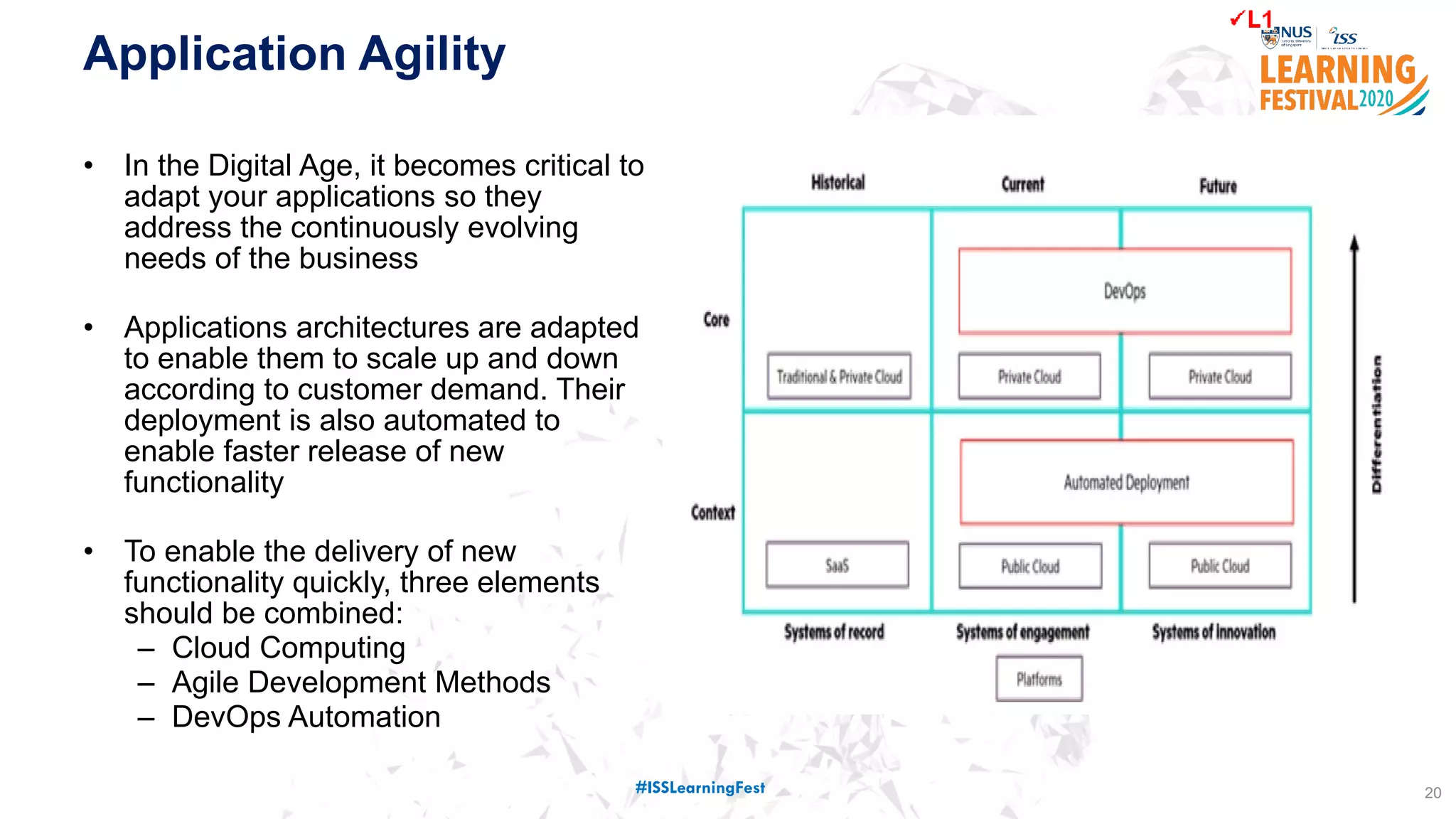
Application Agility
• Inthe Digital Age, it becomes critical to
adapt your applications so they
address the continuously evolving
needs of the business
• Applications architectures are adapted
to enable them to scale up and down
according to customer demand. Their
deployment is also automated to
enable faster release of new
functionality
• To enable the delivery of new
functionality quickly, three elements
should be combined:
– Cloud Computing
– Agile Development Methods
– DevOps Automation
20#ISSLearningFest
21.
• Cloud Firstrefers to software solutions designed
specifically to utilize modern cloud computing
functionality
• These solutions leverage modern cloud hosting
providers (Azure, Amazon, and Google) to
maximize investment
• A cloud first service or application was not
updated and migrated to the cloud. Instead, the
design of the application is from scratch i.e.
Cloud Native
• Cloud first applications and services are better
performing and in many cases more stable than
traditional application models.
21
Technology Architecture - Cloud First
Strategy
#ISSLearningFest
22.
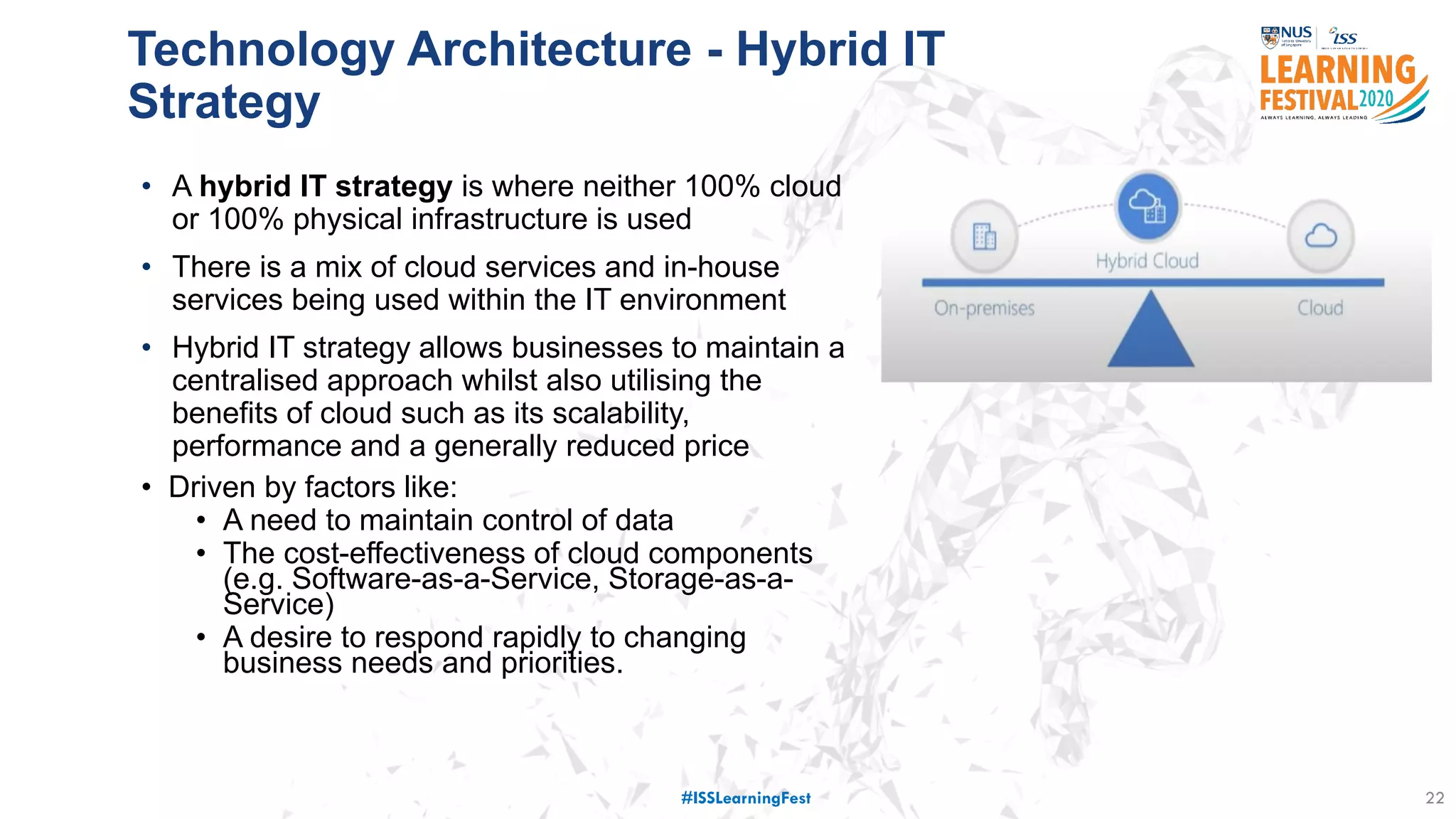
• A hybridIT strategy is where neither 100% cloud
or 100% physical infrastructure is used
• There is a mix of cloud services and in-house
services being used within the IT environment
• Hybrid IT strategy allows businesses to maintain a
centralised approach whilst also utilising the
benefits of cloud such as its scalability,
performance and a generally reduced price
• Driven by factors like:
• A need to maintain control of data
• The cost-effectiveness of cloud components
(e.g. Software-as-a-Service, Storage-as-a-
Service)
• A desire to respond rapidly to changing
business needs and priorities.
22
Technology Architecture - Hybrid IT
Strategy
#ISSLearningFest
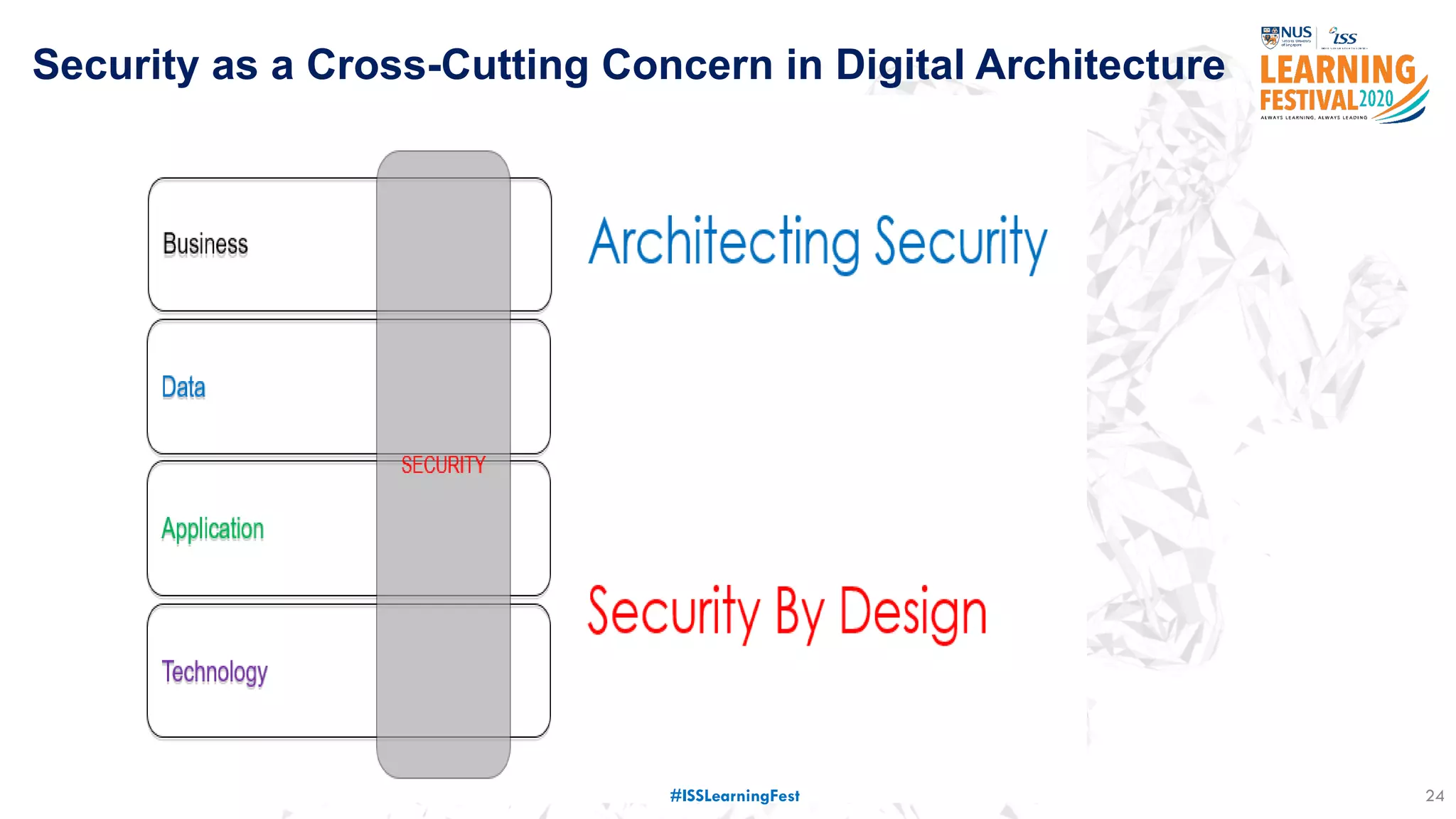
Security as aCross-Cutting Concern in Digital Architecture
24#ISSLearningFest
25.
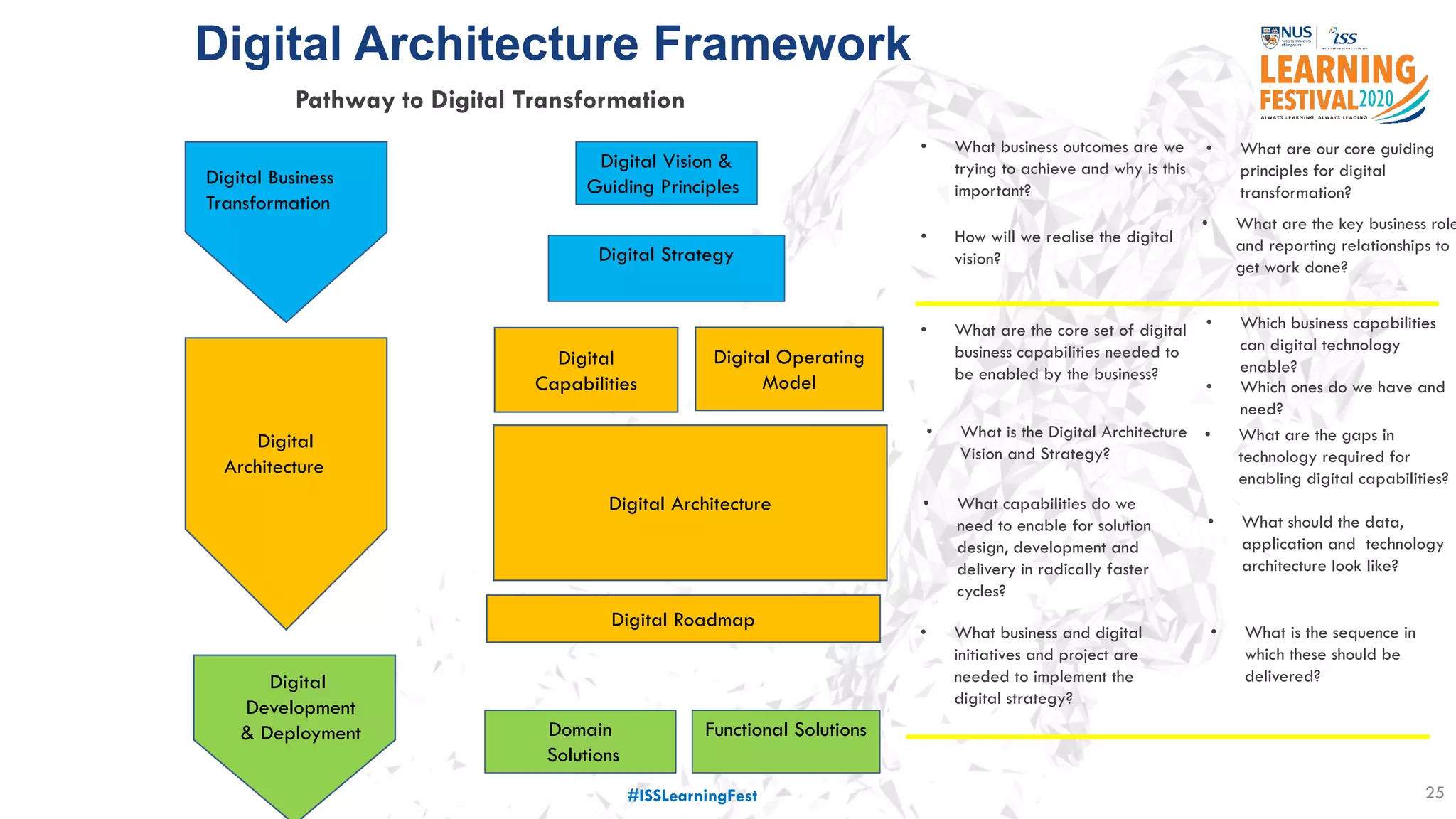
Digital Architecture Framework
25
Pathwayto Digital Transformation
Digital Vision &
Guiding Principles
Domain
Solutions
Digital Strategy
• What business outcomes are we
trying to achieve and why is this
important?
• What are our core guiding
principles for digital
transformation?
Functional Solutions
Digital Operating
Model
Digital
Capabilities
Digital Architecture
Digital Roadmap
• What capabilities do we
need to enable for solution
design, development and
delivery in radically faster
cycles?
• What are the gaps in
technology required for
enabling digital capabilities?
• What is the Digital Architecture
Vision and Strategy?
• What should the data,
application and technology
architecture look like?
• What are the core set of digital
business capabilities needed to
be enabled by the business?
• Which business capabilities
can digital technology
enable?
• Which ones do we have and
need?
• What are the key business role
and reporting relationships to
get work done?
• What business and digital
initiatives and project are
needed to implement the
digital strategy?
• What is the sequence in
which these should be
delivered?
• How will we realise the digital
vision?
Digital Business
Transformation
Digital
Architecture
Digital
Development
& Deployment
#ISSLearningFest
26.
Digital Architecture DesignObjectives
26
77 million
customer details
stolen
Service down for
X days
Costed USD $250
million
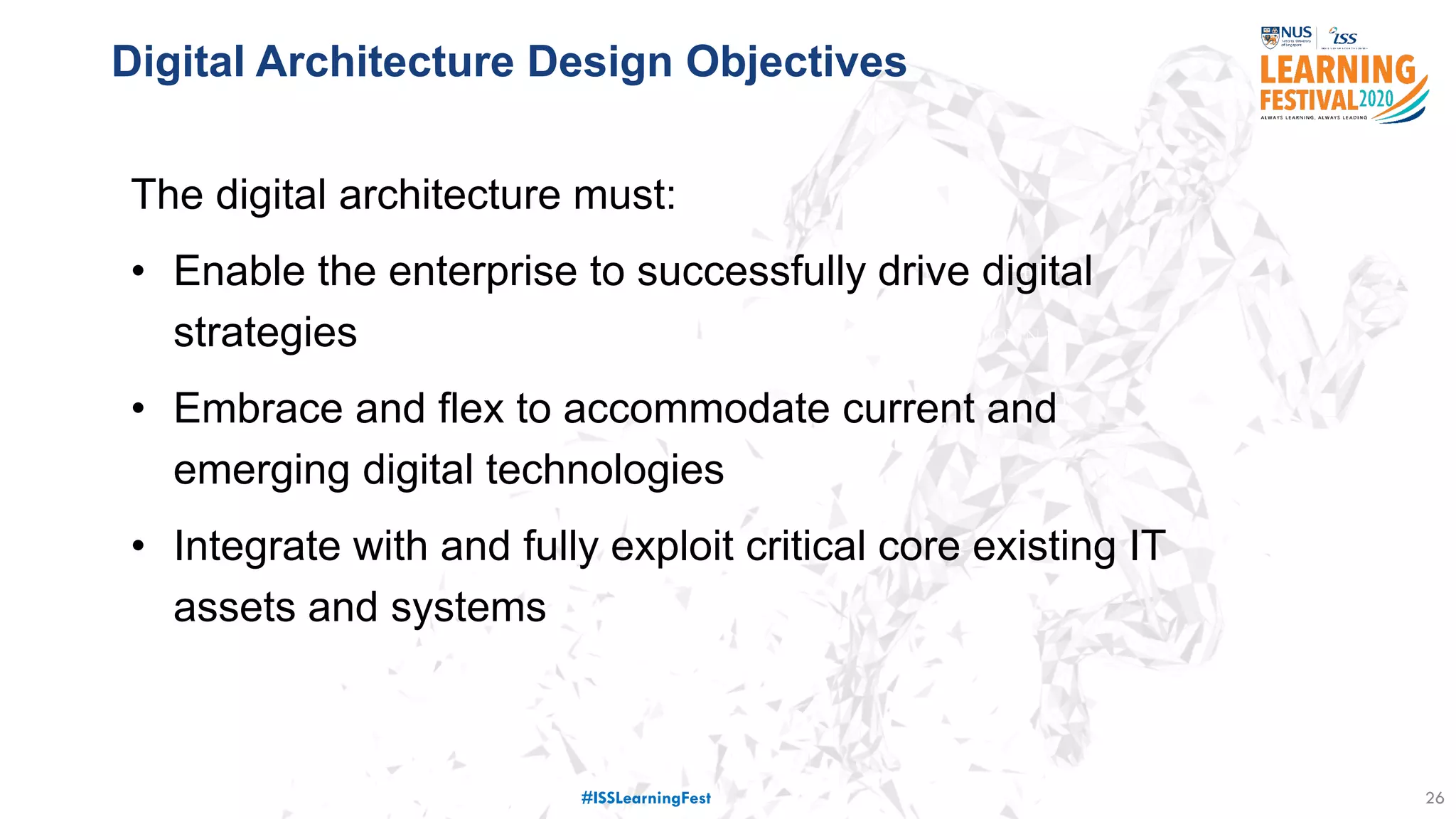
The digital architecture must:
• Enable the enterprise to successfully drive digital
strategies
• Embrace and flex to accommodate current and
emerging digital technologies
• Integrate with and fully exploit critical core existing IT
assets and systems
#ISSLearningFest
27.
27
77 million
customer details
stolen
Servicedown for
X days
Costed USD $250
million
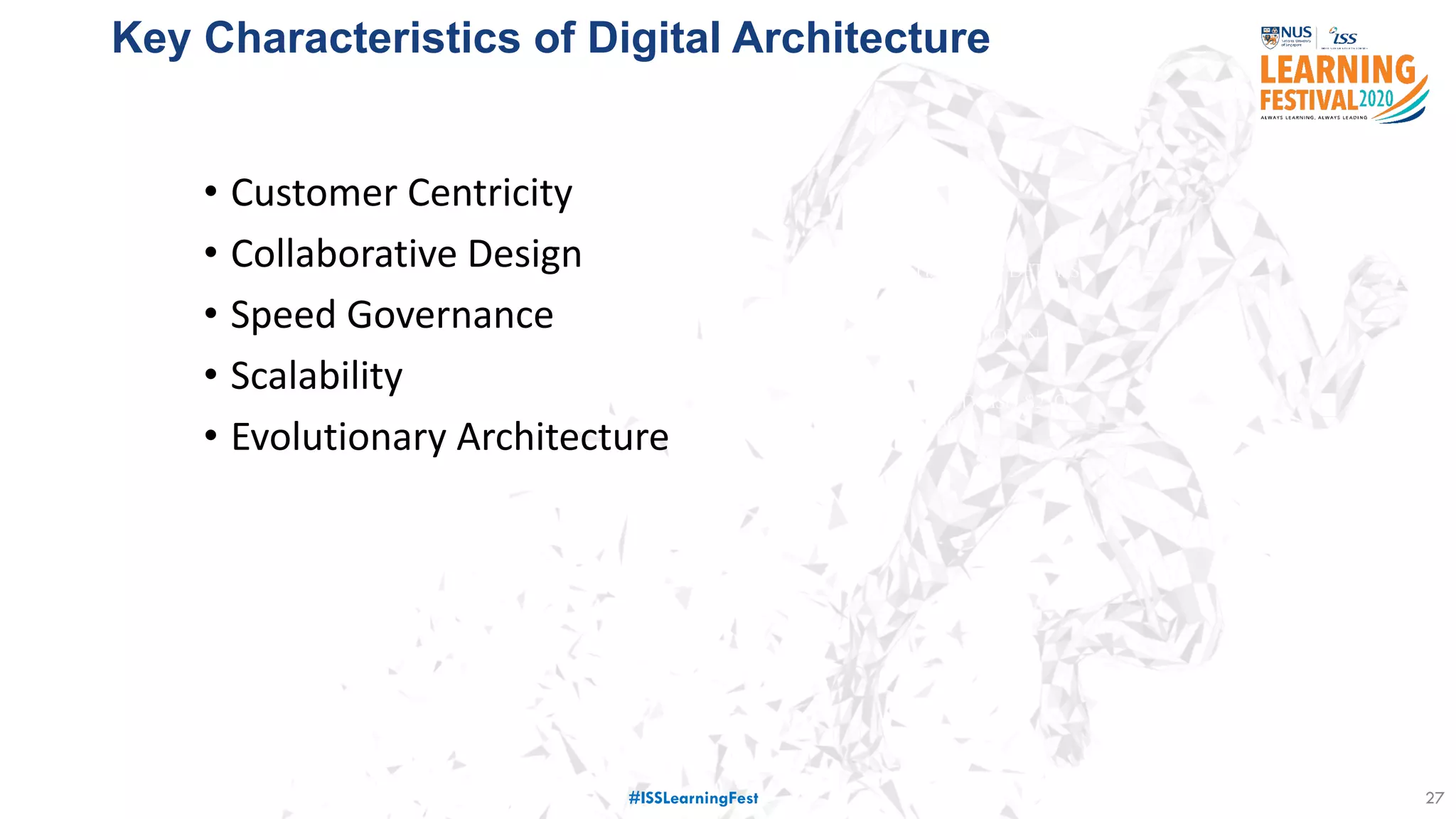
Key Characteristics of Digital Architecture
• Customer Centricity
• Collaborative Design
• Speed Governance
• Scalability
• Evolutionary Architecture
#ISSLearningFest
28.
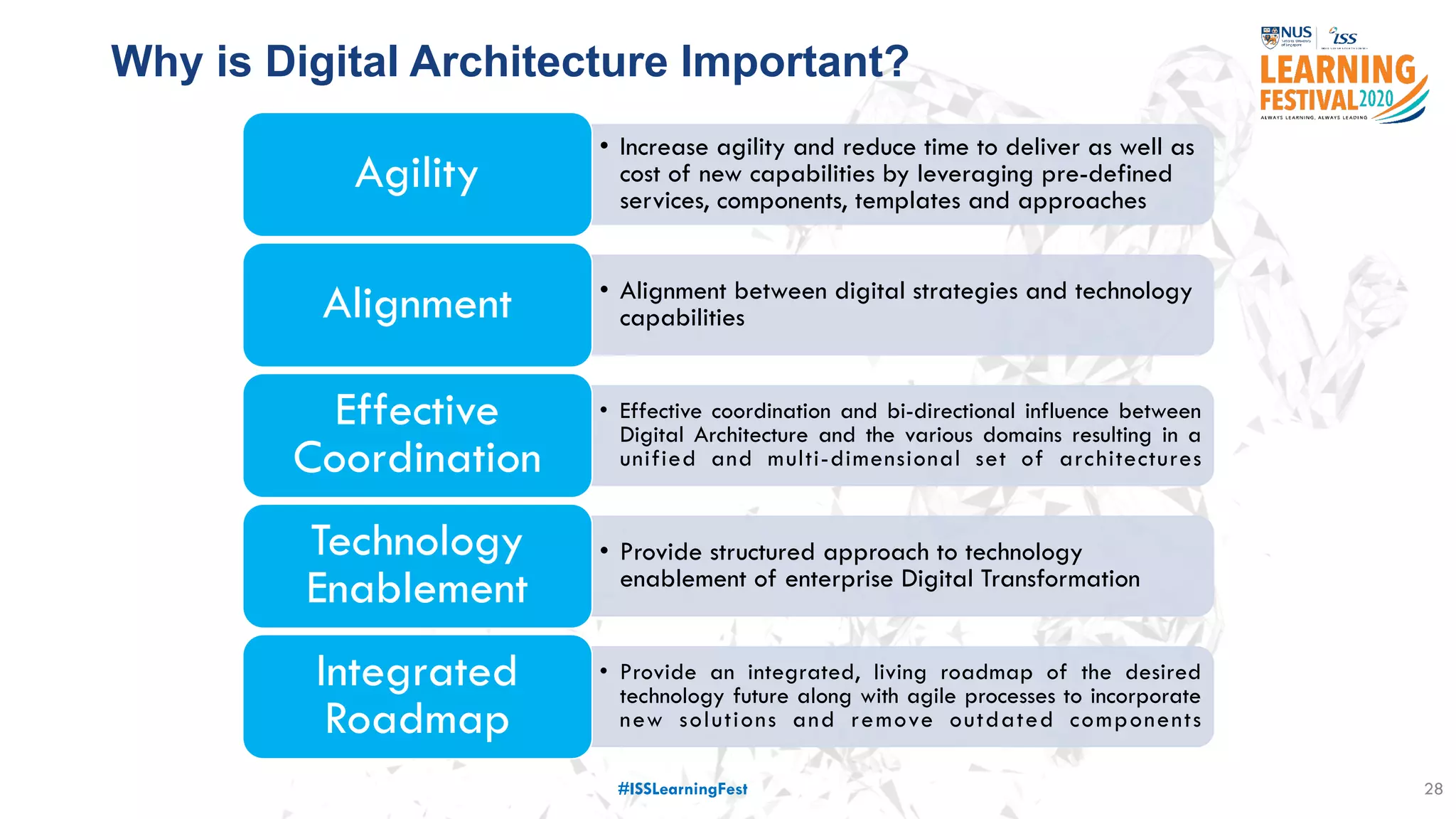
Why is DigitalArchitecture Important?
28
• Increase agility and reduce time to deliver as well as
cost of new capabilities by leveraging pre-defined
services, components, templates and approaches
Agility
• Alignment between digital strategies and technology
capabilitiesAlignment
• Effective coordination and bi-directional influence between
Digital Architecture and the various domains resulting in a
unified and multi-dimensional set of architectures
Effective
Coordination
• Provide structured approach to technology
enablement of enterprise Digital Transformation
Technology
Enablement
• Provide an integrated, living roadmap of the desired
technology future along with agile processes to incorporate
new solutions and remove outdated components
Integrated
Roadmap
#ISSLearningFest
Summary
Important tohave Architecture Thinking and Mindset
Digital Architecture and its importance linking successful
Digital Strategy and Transformation to execution
The Digital Architecture Design Objectives and Characteristics
Digital Architecture Framework to enable Digital
Transformation
31#ISSLearningFest
![Digital Architecture – The Missing
Link in Digital Transformation
Success
Tan Eng Tsze
Principal Lecturer & Consultant, Digital Strategy and Leadership Practice
[ 33 slides]
1#ISSLearningFest](https://image.slidesharecdn.com/digitalarchitecture-themissinglinkindigitaltransformationsuccess-200825094521/75/Digital-Architecture-The-Missing-Link-in-Digital-Transformation-Success-1-2048.jpg)