DIGITAL
TRANSFORMATION
Digital transformation is evolving at a rate faster than ever
before. SMAC (Social, Mobile, Analytics & Cloud) and Internet
of Things (IoT) are some of the trends that are here to stay
and revolutionize digital processes. The customer
expectations have reached unprecedented heights and
organizations strive to offer digital products and services to
stay relevant and competitive. This calls for a very innovative
approach in the development and deployment of IT to support
new applications and business models.
Copyright 2017. www.saksoft.com
INTRODUCTION ON
DIGITAL TRANSFORMATION
Organizations of this generation try to sell smart solutions and user experience than a mere
product or service. For this, they leverage new and advanced digital solutions that are now at
their disposal. The expected outcomes of these investments are increased process
efficiency and business capabilities. But often organizations miss out on the most profitable
business opportunities. This happens because in most cases, organizations sign up for the
trending technology/tool of the time without understanding its full potential or relevance to
their existing infrastructure.
One way to look at Digital Transformation is from the POV of a customer. Modern-age
customers are unlike anything before. They have access to resources that makes their life
easier and simpler. What is their expectation of a good product or service? For this, a good
understanding of customers and their behavioural patterns are important. Let’s analyse a
few examples of how industries are transforming.
This whitepaper explains where the world stands in terms of digital transformation and the
best solution approach to drive digital transformation to leverage maximum results.
Physical visit to banks and tedious manual work significantly dwindled as banks
introduced mobile banking to offer services to customers.
Retailers complimented their physical presence with online business offerings to
counter the likes of Amazon, Flipkart etc.
Logistics companies up their game by going digital and giving real-time data to
customers on goods in transit and end-to-end tracking.
Government introduced various digital channels to review citizen grievances and
offer quick fix to public issues such as safety, transportation etc.
Copyright 2017. www.saksoft.com
THE RISE OF
DIGITAL TRANSFORMATION
Digital transformation is not a new term and has been used since 30 years. It’s the context
that has changed over the years. We began the journey by creating digital channels to
connect organizations to customers. The website was one of the initial by-products of
digitization. From ordinary brochure-like websites it went on to become richer and thicker.
Slowly new processes were added to support this online interaction with customers, often
disintegrated and applied on legacy processes.
The introduction of ERP in the early 90’s
truly marked the turning point of the digital
transformation. IT was a milestone that has
paved the way for digital transformation to
reach where it is now. Many tech giants
developed huge applications with a
consistent architecture and promised data
integrity and process integration, and a
single system with customizations.
Point-to-point connections bound these
ERPs and applications together.
Over the course of time, on-premise
applications become obsolete and digital
enthusiasts started moving applications to
cloud. This further extended the digital
spectrum as there needed a connection
between on-premise and cloud applications.
As the interaction chain expanded with
more and more arena’s started to join the
digital spectrum. Organizations started to
digitize the internal processes and
interactions. Gateways and portals needed
to be built in order to facilitate customer
interactions and various external links.
As applications and processes became
connected, it generated huge amounts of
multi-level data. Organizations then added
another dimension to the digital arena in the
form of data storage and business
intelligence to make use of big data to
further increase the competency. And now,
the introduction of Internet of Things (IoT)
and mobile revolution caused the digital
spectrum to explode. Organizations are
trying to find out new approaches to overall
integration and leverage maximum benefits
from it. Some of the adopted strategies to
tackle this complex and loosely integrated
digital network implementing a
service-oriented architecture (SOA) and
Enterprise service bus (ESB). Did that solve
the issues and created a truly digital
environment? It is a different question to
answer.
“Product improvement and technology are the biggest rising
priorities for CEOs in 2017 and 42 per cent of them have
begun digital business transformation”
- Gartner
Copyright 2017. www.saksoft.com
IS THERE A
PERFECT STRATEGY?
There is no doubt that digital business is growing
beyond imaginations. According to Gartner’s survey,
Digital transformation and business growth are top
priorities for CEOs in 2017. It is noticed that 22% of the
CEOs take the “digital to the core” stance where the
product, service and business model should change
according to the digital growth and the technologies
that support those become their core competency.
This clearly points to a direction where organizations
are 100% digitally empowered. But this change
doesn’t come without certain pain points.
One of the biggest challenges organizations face is
how to leverage their existing architecture to full
potential while creating a new digital path. No
organization can afford to start from scratch by
decimating their existing infrastructure and throwing
away the investments made so far. Many of the newly
developed technologies are little compatible with
legacy systems in terms of coding, security
compliances, standards, scalability, to name a few.
This results in rewriting some or all of the applications
which adds up to the total work and ends up in silos.
In the end, CIOs are handed with a complex challenge:
How to be digitally innovative and promote business
growth while optimizing the cost?
“According to
Forrester, only
27% of today’s
businesses
have a
coherent
digital
strategy that
sets out how
the firm will
create
customer
value as a
digital
business.”
Copyright 2017. www.saksoft.com
THE BIG
SOLUTION
Faster Product
Transformation
Operation
Cost Optimization
Employee
Sentiment Analytics
Efficient
Asset Utilization
Customer Experience
CollaborationCloud
Machine Learning
Virtual Reality
Applied AI
Intelligent Business
Ecosystems
Flexible, Secure & Scalable
Information Systems
BI & Analytics Everything
on Demand Humanized
Big Data
Personalization
Device Independence
IoT
Mobility
Google Machine Learning
Machine Learning
DIGITAL TRANSFORMATION PLATFORM
Copyright 2017. www.saksoft.com
THE BIG
SOLUTION
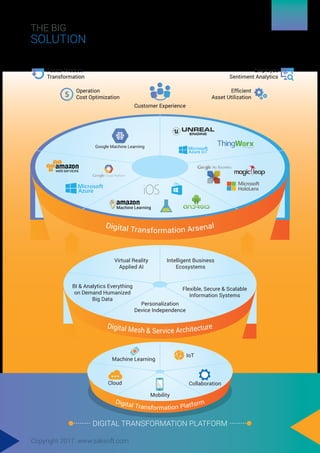
Monolithic architecture no longer serves the modern-day applications that are flexible, fast
and agile and needs a strong and dynamic operating environment. To cater to the needs of
today’s digitally competitive environments and operations, businesses need a strong
architecture that is inclusive of all the latest technological advancements.
Some of the fundamental features that can considerably boost the digital competency are:
Robust Architecture that can simultaneously process millions of requests from
IoT and mobile devices, handle application processes, identify patterns across
the data generated and combine them to form meaningful outputs.
Scalable Integration layer that provides integration across every system while
enabling APIs and gateways for internal processes and external stakeholders to
build a digital ecosystem to interact digitally.
Digital transformation revolves around two important aspects – Centralization
and Integration. Managing data and applications in an administered centralized
platform significantly boosts the operational efficiency and security.
Container – based application platform that can be packaged and scaled. This
ensures a future-proof environment against large scale changes.
Analytics and Business Intelligence to analyze, track, and monitor the
performance of set KPIs and understanding complex business processes.
“22% of the CEOs are taking a “digital to the core”
stance where the product, service, and business
model change with new digital capabilities and
the technology that supports those becomes a
core competency”
– Gartner Survey
Copyright 2017. www.saksoft.com
THE
CHECK-LIST
Apparently every organization is different and so are
their digital needs. Traditional companies are setting
for a major change when compared to companies that
grew up digital. Start-ups and SMEs may face budget
constraints when compared to giants but will have a
less complex transition strategy. However, when you
set on the journey to digital transformation, the
following parameters will help to deal with a major
percentage of your transition. Of course, these are not
“the” solution – there can be more or less. In the end
companies need to chart their own check-list.
Although from the past successful or failed journeys
of digital transformation, few aspects are worthy to
consider.
“57% CEOs
plan to build
in-house
technology
and digital
capabilities,
compared to
29% who plan
to outsource
it”
– Gartner
Process-centric and scalable applications
Changing all the apps that are in use can be
complex, time-consuming and expensive. By
adopting a Service-oriented-architecture (SOA) and
using APIs and gateways, you can minimize
changing individual applications but also reap
benefits such as eliminate data duplication, reduce
manual processes and increase operational
efficiency.
All these apps are powered with high-performance
in-memory data storage and are integrated to offer
maximum performance, speed and scalability. It
also eliminates data duplication and offers
meaningful insights that are crucial to business
growth.
Master Data Management
Data warehousing is an integral part of being a
digitally enabled organization. However, many still
don’t understand what a data warehouse actually
is. One of the common pictures is that of a common
repository to collect and store data from all the
Copyright 2017. www.saksoft.com
Analytics and visualization
Everybody these days talk about analytics and how
important it is for an organization. Rarely do people
talk about the significance of presenting the data.
Analytics play a crucial role in measuring an
organization’s success in terms of scalability,
achieving KPIs, and making crucial business
decisions. But often, what matters is how we
present the data to users in the simplest forms in
order for them to make optimum use of it. That’s
where different data visualization tools are highly
beneficial. It categorizes the mass amount of
analysed data into various graphical forms such as
graphs, real-time dashboards, etc.
business applications. But that is pretty old school
now and it has evolved beyond this definition. We have
a storage space – it might be physical or logical. But
does it covers things like ETL (Extract-Transfer-Load),
different data models, advanced servers and
algorithms? Probably not!
Renowned industry analyst Wayne Eckerson has
defined data warehouse in more abstract term
“A data warehouse is not a technology or tool. It is
primarily a business process that unites an
organization in electronic form (i.e., through data) so it
can function as a single entity, not a conglomeration
of loosely coupled fiefdom”
It is important for organizations to see data
warehousing as an integral part of their digital
transformation than a mere storage medium. It can be
classified as the foundation of digital transformation
as areas such as business intelligence, analytics,
data-driven decision making etc. are heavily
dependent on a good data warehousing solution.
“58% CEOs
say, growth is
their No.1
business
priority in
2017, while
product
improvement
and
technology
are also in
priority”
– Gartner
Copyright 2017. www.saksoft.com
“By 2018, 67%
of the CEOs of
Global 2000
enterprises will
have digital
transformation
at the center
of their
corporate
strategy.”
- Gartner
Comprehensive Testing
You have a strong data warehouse, scalable
applications that are highly compatible and well
integrated, a robust business intelligence solution
and analytics to support your big data. But what if
the system is vulnerable to threats – both internal
and external? What if your applications are not
optimized to leverage the full potential? What if you
are having frequent shut downs that are adversely
affecting the business efficiency?
Testing is a crucial aspect of digital transformation
that unfortunately a lot of companies take for
granted. Whether it is to reduce time-to-market,
production cost, or simply to avoid the additional
effort, organizations tend to overlook the
importance of testing.
Testing ensures that the architecture and individual
applications are highly resistant to any vulnerability.
It helps to maintain security, minimum downtime
and synchronization of the architecture. This is
especially vital in case of banking and financial
sector, government and other public sector, military,
healthcare etc. that deals with data that are highly
confidential and vulnerable to threats. An
end-to-end testing also provides longevity to
applications, increase performance and minimize
maintenance requirements.
Copyright 2017. www.saksoft.com
DIGITAL TRANSFORMATION
TAKE THE “BIG LEAP” OF
Whether or not organizations are ready, digital transformation is inevitable and essential for
today’s business. A forrester study found out that the key drivers of digital transformation
are profitability, customer satisfaction and increased speed-to-market; all of them are the
essentials of a business. Industries such as banking, e-commerce, retail, logistics and supply
chain etc. has made great progress while laggards such as manufacturing, consumer goods,
traditional pharmaceuticals are at a high risk. Business to Customers (B2C) are feeling the
heat more than Business to Business (B2B) as they are directly dealing with end users who
are equipped with high-end smart phones, advanced applications and high expectations like
never before. Having said all these, the good thing about digital transformation is, it is never
too late to start. With the help of a good digital transformation partner, organizations can
embrace the digital journey and obtain competitive advantage in the long run.
“By 2018, 35% of IT resources will be spent to support the
creation of new digital revenue streams and by 2020
almost 50% of IT budgets will be tied to digital
transformation initiatives.” - IDC
SAKSOFT LIMITED
SP INFOCITY, Block A, 2nd Floor, #40, Dr. MGR Salai,
Kandanchavadi, Perungudi, Chennai 600096.
Phone: +91 44 2454 3500 | Fax: +91 44 2454 3510
Copyright 2017. All rights reserved. Info@saksoft.com | www.saksoft.com
India • USA • UK • Singapore
Author
Marketing Team

Digital transformation - whitepaper

  • 1.
    DIGITAL TRANSFORMATION Digital transformation isevolving at a rate faster than ever before. SMAC (Social, Mobile, Analytics & Cloud) and Internet of Things (IoT) are some of the trends that are here to stay and revolutionize digital processes. The customer expectations have reached unprecedented heights and organizations strive to offer digital products and services to stay relevant and competitive. This calls for a very innovative approach in the development and deployment of IT to support new applications and business models. Copyright 2017. www.saksoft.com
  • 2.
    INTRODUCTION ON DIGITAL TRANSFORMATION Organizationsof this generation try to sell smart solutions and user experience than a mere product or service. For this, they leverage new and advanced digital solutions that are now at their disposal. The expected outcomes of these investments are increased process efficiency and business capabilities. But often organizations miss out on the most profitable business opportunities. This happens because in most cases, organizations sign up for the trending technology/tool of the time without understanding its full potential or relevance to their existing infrastructure. One way to look at Digital Transformation is from the POV of a customer. Modern-age customers are unlike anything before. They have access to resources that makes their life easier and simpler. What is their expectation of a good product or service? For this, a good understanding of customers and their behavioural patterns are important. Let’s analyse a few examples of how industries are transforming. This whitepaper explains where the world stands in terms of digital transformation and the best solution approach to drive digital transformation to leverage maximum results. Physical visit to banks and tedious manual work significantly dwindled as banks introduced mobile banking to offer services to customers. Retailers complimented their physical presence with online business offerings to counter the likes of Amazon, Flipkart etc. Logistics companies up their game by going digital and giving real-time data to customers on goods in transit and end-to-end tracking. Government introduced various digital channels to review citizen grievances and offer quick fix to public issues such as safety, transportation etc. Copyright 2017. www.saksoft.com
  • 3.
    THE RISE OF DIGITALTRANSFORMATION Digital transformation is not a new term and has been used since 30 years. It’s the context that has changed over the years. We began the journey by creating digital channels to connect organizations to customers. The website was one of the initial by-products of digitization. From ordinary brochure-like websites it went on to become richer and thicker. Slowly new processes were added to support this online interaction with customers, often disintegrated and applied on legacy processes. The introduction of ERP in the early 90’s truly marked the turning point of the digital transformation. IT was a milestone that has paved the way for digital transformation to reach where it is now. Many tech giants developed huge applications with a consistent architecture and promised data integrity and process integration, and a single system with customizations. Point-to-point connections bound these ERPs and applications together. Over the course of time, on-premise applications become obsolete and digital enthusiasts started moving applications to cloud. This further extended the digital spectrum as there needed a connection between on-premise and cloud applications. As the interaction chain expanded with more and more arena’s started to join the digital spectrum. Organizations started to digitize the internal processes and interactions. Gateways and portals needed to be built in order to facilitate customer interactions and various external links. As applications and processes became connected, it generated huge amounts of multi-level data. Organizations then added another dimension to the digital arena in the form of data storage and business intelligence to make use of big data to further increase the competency. And now, the introduction of Internet of Things (IoT) and mobile revolution caused the digital spectrum to explode. Organizations are trying to find out new approaches to overall integration and leverage maximum benefits from it. Some of the adopted strategies to tackle this complex and loosely integrated digital network implementing a service-oriented architecture (SOA) and Enterprise service bus (ESB). Did that solve the issues and created a truly digital environment? It is a different question to answer. “Product improvement and technology are the biggest rising priorities for CEOs in 2017 and 42 per cent of them have begun digital business transformation” - Gartner Copyright 2017. www.saksoft.com
  • 4.
    IS THERE A PERFECTSTRATEGY? There is no doubt that digital business is growing beyond imaginations. According to Gartner’s survey, Digital transformation and business growth are top priorities for CEOs in 2017. It is noticed that 22% of the CEOs take the “digital to the core” stance where the product, service and business model should change according to the digital growth and the technologies that support those become their core competency. This clearly points to a direction where organizations are 100% digitally empowered. But this change doesn’t come without certain pain points. One of the biggest challenges organizations face is how to leverage their existing architecture to full potential while creating a new digital path. No organization can afford to start from scratch by decimating their existing infrastructure and throwing away the investments made so far. Many of the newly developed technologies are little compatible with legacy systems in terms of coding, security compliances, standards, scalability, to name a few. This results in rewriting some or all of the applications which adds up to the total work and ends up in silos. In the end, CIOs are handed with a complex challenge: How to be digitally innovative and promote business growth while optimizing the cost? “According to Forrester, only 27% of today’s businesses have a coherent digital strategy that sets out how the firm will create customer value as a digital business.” Copyright 2017. www.saksoft.com
  • 5.
    THE BIG SOLUTION Faster Product Transformation Operation CostOptimization Employee Sentiment Analytics Efficient Asset Utilization Customer Experience CollaborationCloud Machine Learning Virtual Reality Applied AI Intelligent Business Ecosystems Flexible, Secure & Scalable Information Systems BI & Analytics Everything on Demand Humanized Big Data Personalization Device Independence IoT Mobility Google Machine Learning Machine Learning DIGITAL TRANSFORMATION PLATFORM Copyright 2017. www.saksoft.com
  • 6.
    THE BIG SOLUTION Monolithic architectureno longer serves the modern-day applications that are flexible, fast and agile and needs a strong and dynamic operating environment. To cater to the needs of today’s digitally competitive environments and operations, businesses need a strong architecture that is inclusive of all the latest technological advancements. Some of the fundamental features that can considerably boost the digital competency are: Robust Architecture that can simultaneously process millions of requests from IoT and mobile devices, handle application processes, identify patterns across the data generated and combine them to form meaningful outputs. Scalable Integration layer that provides integration across every system while enabling APIs and gateways for internal processes and external stakeholders to build a digital ecosystem to interact digitally. Digital transformation revolves around two important aspects – Centralization and Integration. Managing data and applications in an administered centralized platform significantly boosts the operational efficiency and security. Container – based application platform that can be packaged and scaled. This ensures a future-proof environment against large scale changes. Analytics and Business Intelligence to analyze, track, and monitor the performance of set KPIs and understanding complex business processes. “22% of the CEOs are taking a “digital to the core” stance where the product, service, and business model change with new digital capabilities and the technology that supports those becomes a core competency” – Gartner Survey Copyright 2017. www.saksoft.com
  • 7.
    THE CHECK-LIST Apparently every organizationis different and so are their digital needs. Traditional companies are setting for a major change when compared to companies that grew up digital. Start-ups and SMEs may face budget constraints when compared to giants but will have a less complex transition strategy. However, when you set on the journey to digital transformation, the following parameters will help to deal with a major percentage of your transition. Of course, these are not “the” solution – there can be more or less. In the end companies need to chart their own check-list. Although from the past successful or failed journeys of digital transformation, few aspects are worthy to consider. “57% CEOs plan to build in-house technology and digital capabilities, compared to 29% who plan to outsource it” – Gartner Process-centric and scalable applications Changing all the apps that are in use can be complex, time-consuming and expensive. By adopting a Service-oriented-architecture (SOA) and using APIs and gateways, you can minimize changing individual applications but also reap benefits such as eliminate data duplication, reduce manual processes and increase operational efficiency. All these apps are powered with high-performance in-memory data storage and are integrated to offer maximum performance, speed and scalability. It also eliminates data duplication and offers meaningful insights that are crucial to business growth. Master Data Management Data warehousing is an integral part of being a digitally enabled organization. However, many still don’t understand what a data warehouse actually is. One of the common pictures is that of a common repository to collect and store data from all the Copyright 2017. www.saksoft.com
  • 8.
    Analytics and visualization Everybodythese days talk about analytics and how important it is for an organization. Rarely do people talk about the significance of presenting the data. Analytics play a crucial role in measuring an organization’s success in terms of scalability, achieving KPIs, and making crucial business decisions. But often, what matters is how we present the data to users in the simplest forms in order for them to make optimum use of it. That’s where different data visualization tools are highly beneficial. It categorizes the mass amount of analysed data into various graphical forms such as graphs, real-time dashboards, etc. business applications. But that is pretty old school now and it has evolved beyond this definition. We have a storage space – it might be physical or logical. But does it covers things like ETL (Extract-Transfer-Load), different data models, advanced servers and algorithms? Probably not! Renowned industry analyst Wayne Eckerson has defined data warehouse in more abstract term “A data warehouse is not a technology or tool. It is primarily a business process that unites an organization in electronic form (i.e., through data) so it can function as a single entity, not a conglomeration of loosely coupled fiefdom” It is important for organizations to see data warehousing as an integral part of their digital transformation than a mere storage medium. It can be classified as the foundation of digital transformation as areas such as business intelligence, analytics, data-driven decision making etc. are heavily dependent on a good data warehousing solution. “58% CEOs say, growth is their No.1 business priority in 2017, while product improvement and technology are also in priority” – Gartner Copyright 2017. www.saksoft.com
  • 9.
    “By 2018, 67% ofthe CEOs of Global 2000 enterprises will have digital transformation at the center of their corporate strategy.” - Gartner Comprehensive Testing You have a strong data warehouse, scalable applications that are highly compatible and well integrated, a robust business intelligence solution and analytics to support your big data. But what if the system is vulnerable to threats – both internal and external? What if your applications are not optimized to leverage the full potential? What if you are having frequent shut downs that are adversely affecting the business efficiency? Testing is a crucial aspect of digital transformation that unfortunately a lot of companies take for granted. Whether it is to reduce time-to-market, production cost, or simply to avoid the additional effort, organizations tend to overlook the importance of testing. Testing ensures that the architecture and individual applications are highly resistant to any vulnerability. It helps to maintain security, minimum downtime and synchronization of the architecture. This is especially vital in case of banking and financial sector, government and other public sector, military, healthcare etc. that deals with data that are highly confidential and vulnerable to threats. An end-to-end testing also provides longevity to applications, increase performance and minimize maintenance requirements. Copyright 2017. www.saksoft.com
  • 10.
    DIGITAL TRANSFORMATION TAKE THE“BIG LEAP” OF Whether or not organizations are ready, digital transformation is inevitable and essential for today’s business. A forrester study found out that the key drivers of digital transformation are profitability, customer satisfaction and increased speed-to-market; all of them are the essentials of a business. Industries such as banking, e-commerce, retail, logistics and supply chain etc. has made great progress while laggards such as manufacturing, consumer goods, traditional pharmaceuticals are at a high risk. Business to Customers (B2C) are feeling the heat more than Business to Business (B2B) as they are directly dealing with end users who are equipped with high-end smart phones, advanced applications and high expectations like never before. Having said all these, the good thing about digital transformation is, it is never too late to start. With the help of a good digital transformation partner, organizations can embrace the digital journey and obtain competitive advantage in the long run. “By 2018, 35% of IT resources will be spent to support the creation of new digital revenue streams and by 2020 almost 50% of IT budgets will be tied to digital transformation initiatives.” - IDC SAKSOFT LIMITED SP INFOCITY, Block A, 2nd Floor, #40, Dr. MGR Salai, Kandanchavadi, Perungudi, Chennai 600096. Phone: +91 44 2454 3500 | Fax: +91 44 2454 3510 Copyright 2017. All rights reserved. Info@saksoft.com | www.saksoft.com India • USA • UK • Singapore Author Marketing Team