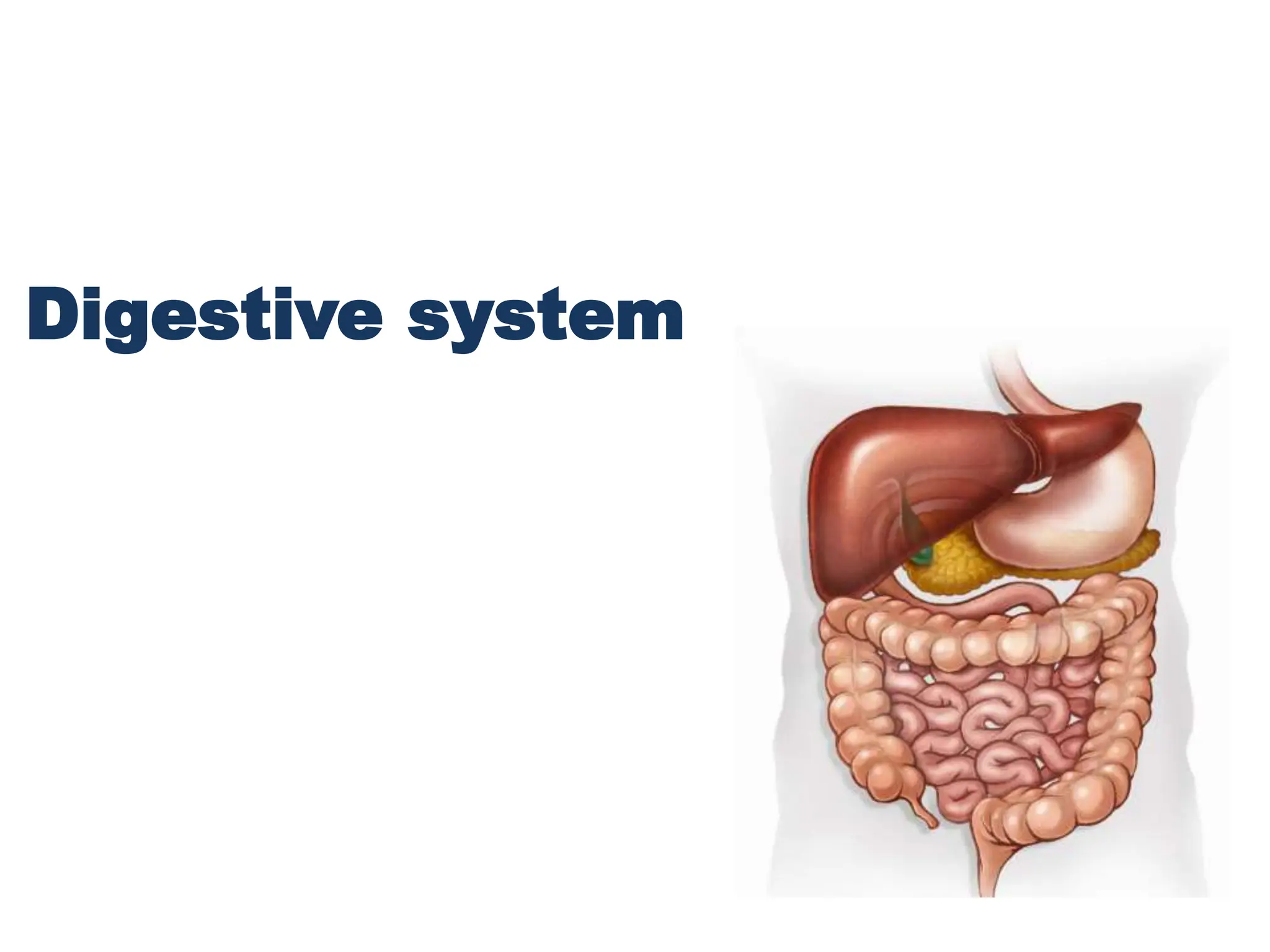
Digestive system
Digestion is the process by which food is broken
down into smaller pieces so that the body can use
them to build and nourish cells and to provide
energy.
The digestive system is made up of the digestive
tract. The digestive tract in an adult is about 30 feet
long.
1-Digestive canal:
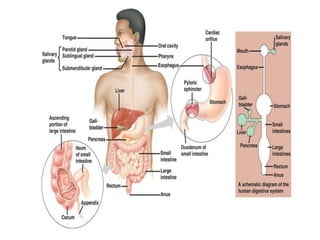
Which consist from { mouth, pharynx ,esophagus
,stomach ,small intestine (duodenum, jejunum ,ileum ),
large intestine (appendix , the cecum, colon ,3 parts:
ascending ,transverse ,descending which transforms
into the sigmoid colon) ,rectum and anal canal } .
2-Additional digestive parts:
 Salivary glands.
 Liver.
 Gall bladder
 Pancreas
Oral cavity (Mouth) is the upper opening of the
digestive tract, beginning with the lips and containing
the teeth, gums, and tongue. Foodstuffs are broken
down mechanically in the mouth by chewing and
saliva is added as a lubricant. Saliva contains
amylase, an enzyme that digests starch.
Pharynx is a muscular tube that plays a dual role of
the food pass into the esophagus and air to pass
larynx. It is situated at the back of the nose and oral
cavity.
Esophagus: Once food is swallowed, it enters the
esophagus, a muscular tube that is about 10
inches long. The esophagus is located between
the pharynx and the stomach. Muscular wavelike
contractions push the food down through the
esophagus to the stomach. A muscular ring (called
the cardiac orifice) at the end of the esophagus
allows food to enter the stomach.
The stomach is a J-shaped organ that lies between the
esophagus and the small intestine in the upper
abdomen.
The stomach has 3 main functions:
•to store the swallowed food and liquid
•to mix up the food, liquid and digestive juices produced
by the stomach.
•to slowly empty its contents into the pyloric sphincter, a
thickened muscular ring between the stomach and the
first part of the small intestine called the duodenum.
Small intestine: Most digestion and absorption of
food occurs in the small intestine. The small
intestine is a narrow, twisting tube that occupies
most of the lower abdomen between the stomach
and the beginning of the large intestine. It extends
about 20 feet in length. The small intestine
consists of 3 parts: the duodenum (the C-shaped
part), the jejunum (the coiled midsection), and the
ileum (the last section).
Duodenum: the first part of the small intestine.
The duodenum is a common site for the formation
of peptic ulcers.
Jejunum: Part of the small intestine. It is half-way
down the small intestine between its duodenum
and ileum sections.
Ileum: The lowest part of the small intestine,
located beyond the duodenum and jejunum, just
before the large intestine (the colon).
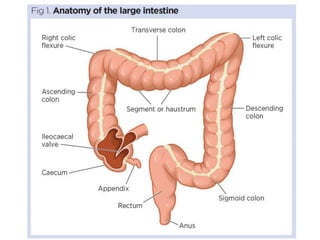
The large intestine forms an upside down U over the
coiled small intestine. It begins at the lower right-hand
side of the body and ends on the lower left-hand side.
The large intestine is about 5-6 feet long. It has three
parts: the cecum, the colon, and the rectum. The
cecum is a pouch at the beginning of the large intestine.
This area allows food to pass from the small intestine to
the large intestine.
The colon is where fluids and salts are absorbed and
extends from the cecum to the rectum. The last part of
the large intestine is the rectum, which is where feces
(waste material) is stored before leaving the body
through the anus.
The main job of the large intestine is to remove water
and salts (electrolytes) from the undigested material and
to form solid waste that can be excreted.
• Cecum: The cecum is the first portion of the
large bowel, situated in the lower right quadrant
of the abdomen.
The cecum receives fecal material from the small
bowel (ileum) which opens into it. The appendix is
attached to the cecum.
Colon: The part of the large intestine that runs
from the cecum to the rectum as a long hollow
tube that serves to remove water from digested
food and let the remaining material, solid waste
called stool, move through it to the rectum and
leave the body through the anus. .
The colon measures about 5 ft (1.5 m) in length.
It goes up (the ascending colon) on the right
side of the abdomen, across the abdomen (the
transverse colon) beneath the stomach, and
then down (the descending colon) on the left
side of the abdomen and makes a sharp turn in
the left lower portion (the sigmoid colon) to
merge with the rectum.
Rectum: The last 6 to 8 inches of the large intestine.
The rectum stores solid waste until it leaves the body
through the anus.
Anus: The opening of the rectum to the outside of the
body.
The functions of the digestive system are:
•Ingestion - eating food
•Digestion - breakdown of the food
•Absorption - extraction of nutrients from the food
•Defecation - removal of waste products
Digestion: it is the process of the hydrolysis that decrypt
of chemical bonds in the food..
The digestion can be divided into four stages:
1-Mechanical process: include chewing,
Swallowing, and moving of Stomach and intestine.
2- Secretion process: includes action of glands.
3- Chemical process: includes effects of
enzymes.
4- Microbiology process: include action the
bacteria and microvillus in large intestine.
Digestion begins in the mouth, where chemical and
mechanical digestion occurs. Saliva, produced by the
salivary glands, is released into the mouth. Saliva begins
to break down the food, moistening it and making it
easier to swallow. A digestive enzyme (called amylase)
in the saliva begins to break down the carbohydrates
(starches and sugars). The sensations of smell and taste
from the food sets up reflexes which stimulate the
salivary glands.
The Salivary glands (parotid, sublingual &
submandibular)
These glands located under the tongue and near
the lower jaw ,they increase their output of
secretions through three pairs of ducts into the oral
cavity, and begin the process of digestion.
Saliva lubricates the food enabling it to be
swallowed and contains the enzyme ptyalin which
serves to begin to break down starch.
The small intestine has two important functions.
First, the digestive process is completed here by
enzymes and other substances made by intestinal
cells, the pancreas, and the liver. Glands in the
intestine walls secrete enzymes that breakdown
starches and sugars.
Second, the small intestine absorbs the nutrients from
the digestive process. The inner wall of the small
intestine is covered by millions of microvilli. the
microvilli which increase the surface area of the small
intestine greatly, allowing absorption of nutrients to
occur. Undigested material travels next to the large
intestine.
Liver: An organ in the upper abdomen that aids in
digestion and removes waste products and worn-out
cells from the blood. The liver is the largest solid
organ in the body. It weighs about 3.5 pounds (1.6
kilogram).
The liver produces bile, which is stored in the
Gallbladder. Bile helps to make fat molecules
soluble, so they can be absorbed by the body.
Function of the liver :
1-Production and secretion of bile .
2-Metabolic processes (e.g. gluconeogenesis,
glycogenolysis)
3-Synthesis of plasma proteins (e.g. albumin and
clotting factors)
4-Removel some drugs and hormones and
poisoning .
5-Storages some vitamins (A,B12,D,E, K) and some
material like (ferrous , copper ) .
6- Activation of vitamin D
7- Removal the damaged RBC,WBC and some
bacteria .
8- Excretion of cholestrol
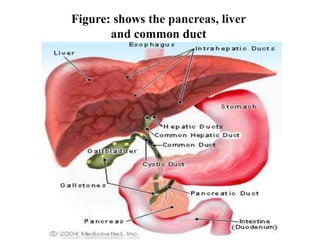
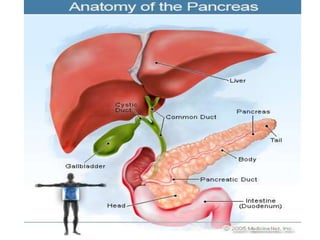
Figure: shows the pancreas, liver
and common duct
The Gall Bladder
Gallbladder: A pear-shaped organ just below the liver
that stores the bile secreted by the liver. During a fatty
meal, the gallbladder contracts, delivering the bile
through the bile ducts into the intestines to help with
digestion.
Bile: Bile is a yellow-green fluid that is made by the
liver, stored in the gallbladder and passes through the
common bile duct into the duodenum where it helps
digest fat.
Function of the gall bladder :
1-Storage of the bile .
2-Increase the concentration of the bile .
3-Execretion of the bile on need .
Pancreas: A fish-shaped spongy grayish-pink organ
about (15 cm) long that stretches across the back of the
abdomen, behind the stomach. The head of the
pancreas is on the right side of the abdomen and is
connected to the duodenum (the first section of the small
intestine). The narrow end of the pancreas, called the
tail, extends to the left side of the body.
• The Pancreas is connected to the duodenum via
two ducts and has two type of secretion:
a-Internal secretion : (insulin ,glucagon ,
somatostatine ).
b-External secretion: in the intestine for digestion
the food (peptidase, lipase, amylase) .
• Pancreas has two main functions:
1.To produce enzymes that aid the process of
digestion
2.To release insulin directly into the blood stream
for the purpose of controlling blood sugar levels.

Digestive system.pptx

  • 1.
  • 2.
    Digestion is theprocess by which food is broken down into smaller pieces so that the body can use them to build and nourish cells and to provide energy. The digestive system is made up of the digestive tract. The digestive tract in an adult is about 30 feet long.
  • 3.
    1-Digestive canal: Which consistfrom { mouth, pharynx ,esophagus ,stomach ,small intestine (duodenum, jejunum ,ileum ), large intestine (appendix , the cecum, colon ,3 parts: ascending ,transverse ,descending which transforms into the sigmoid colon) ,rectum and anal canal } . 2-Additional digestive parts:  Salivary glands.  Liver.  Gall bladder  Pancreas
  • 4.
    Oral cavity (Mouth)is the upper opening of the digestive tract, beginning with the lips and containing the teeth, gums, and tongue. Foodstuffs are broken down mechanically in the mouth by chewing and saliva is added as a lubricant. Saliva contains amylase, an enzyme that digests starch. Pharynx is a muscular tube that plays a dual role of the food pass into the esophagus and air to pass larynx. It is situated at the back of the nose and oral cavity.
  • 5.
    Esophagus: Once foodis swallowed, it enters the esophagus, a muscular tube that is about 10 inches long. The esophagus is located between the pharynx and the stomach. Muscular wavelike contractions push the food down through the esophagus to the stomach. A muscular ring (called the cardiac orifice) at the end of the esophagus allows food to enter the stomach.
  • 8.
    The stomach isa J-shaped organ that lies between the esophagus and the small intestine in the upper abdomen. The stomach has 3 main functions: •to store the swallowed food and liquid •to mix up the food, liquid and digestive juices produced by the stomach. •to slowly empty its contents into the pyloric sphincter, a thickened muscular ring between the stomach and the first part of the small intestine called the duodenum.
  • 9.
    Small intestine: Mostdigestion and absorption of food occurs in the small intestine. The small intestine is a narrow, twisting tube that occupies most of the lower abdomen between the stomach and the beginning of the large intestine. It extends about 20 feet in length. The small intestine consists of 3 parts: the duodenum (the C-shaped part), the jejunum (the coiled midsection), and the ileum (the last section).
  • 10.
    Duodenum: the firstpart of the small intestine. The duodenum is a common site for the formation of peptic ulcers. Jejunum: Part of the small intestine. It is half-way down the small intestine between its duodenum and ileum sections. Ileum: The lowest part of the small intestine, located beyond the duodenum and jejunum, just before the large intestine (the colon).
  • 11.
    The large intestineforms an upside down U over the coiled small intestine. It begins at the lower right-hand side of the body and ends on the lower left-hand side. The large intestine is about 5-6 feet long. It has three parts: the cecum, the colon, and the rectum. The cecum is a pouch at the beginning of the large intestine. This area allows food to pass from the small intestine to the large intestine.
  • 12.
    The colon iswhere fluids and salts are absorbed and extends from the cecum to the rectum. The last part of the large intestine is the rectum, which is where feces (waste material) is stored before leaving the body through the anus. The main job of the large intestine is to remove water and salts (electrolytes) from the undigested material and to form solid waste that can be excreted.
  • 13.
    • Cecum: Thececum is the first portion of the large bowel, situated in the lower right quadrant of the abdomen. The cecum receives fecal material from the small bowel (ileum) which opens into it. The appendix is attached to the cecum. Colon: The part of the large intestine that runs from the cecum to the rectum as a long hollow tube that serves to remove water from digested food and let the remaining material, solid waste called stool, move through it to the rectum and leave the body through the anus. .
  • 14.
    The colon measuresabout 5 ft (1.5 m) in length. It goes up (the ascending colon) on the right side of the abdomen, across the abdomen (the transverse colon) beneath the stomach, and then down (the descending colon) on the left side of the abdomen and makes a sharp turn in the left lower portion (the sigmoid colon) to merge with the rectum.
  • 15.
    Rectum: The last6 to 8 inches of the large intestine. The rectum stores solid waste until it leaves the body through the anus. Anus: The opening of the rectum to the outside of the body. The functions of the digestive system are: •Ingestion - eating food •Digestion - breakdown of the food •Absorption - extraction of nutrients from the food •Defecation - removal of waste products Digestion: it is the process of the hydrolysis that decrypt of chemical bonds in the food..
  • 16.
    The digestion canbe divided into four stages: 1-Mechanical process: include chewing, Swallowing, and moving of Stomach and intestine. 2- Secretion process: includes action of glands. 3- Chemical process: includes effects of enzymes. 4- Microbiology process: include action the bacteria and microvillus in large intestine.
  • 17.
    Digestion begins inthe mouth, where chemical and mechanical digestion occurs. Saliva, produced by the salivary glands, is released into the mouth. Saliva begins to break down the food, moistening it and making it easier to swallow. A digestive enzyme (called amylase) in the saliva begins to break down the carbohydrates (starches and sugars). The sensations of smell and taste from the food sets up reflexes which stimulate the salivary glands.
  • 18.
    The Salivary glands(parotid, sublingual & submandibular) These glands located under the tongue and near the lower jaw ,they increase their output of secretions through three pairs of ducts into the oral cavity, and begin the process of digestion. Saliva lubricates the food enabling it to be swallowed and contains the enzyme ptyalin which serves to begin to break down starch.
  • 19.
    The small intestinehas two important functions. First, the digestive process is completed here by enzymes and other substances made by intestinal cells, the pancreas, and the liver. Glands in the intestine walls secrete enzymes that breakdown starches and sugars. Second, the small intestine absorbs the nutrients from the digestive process. The inner wall of the small intestine is covered by millions of microvilli. the microvilli which increase the surface area of the small intestine greatly, allowing absorption of nutrients to occur. Undigested material travels next to the large intestine.
  • 20.
    Liver: An organin the upper abdomen that aids in digestion and removes waste products and worn-out cells from the blood. The liver is the largest solid organ in the body. It weighs about 3.5 pounds (1.6 kilogram). The liver produces bile, which is stored in the Gallbladder. Bile helps to make fat molecules soluble, so they can be absorbed by the body.
  • 21.
    Function of theliver : 1-Production and secretion of bile . 2-Metabolic processes (e.g. gluconeogenesis, glycogenolysis) 3-Synthesis of plasma proteins (e.g. albumin and clotting factors) 4-Removel some drugs and hormones and poisoning . 5-Storages some vitamins (A,B12,D,E, K) and some material like (ferrous , copper ) . 6- Activation of vitamin D 7- Removal the damaged RBC,WBC and some bacteria . 8- Excretion of cholestrol
  • 22.
    Figure: shows thepancreas, liver and common duct
  • 23.
    The Gall Bladder Gallbladder:A pear-shaped organ just below the liver that stores the bile secreted by the liver. During a fatty meal, the gallbladder contracts, delivering the bile through the bile ducts into the intestines to help with digestion. Bile: Bile is a yellow-green fluid that is made by the liver, stored in the gallbladder and passes through the common bile duct into the duodenum where it helps digest fat.
  • 24.
    Function of thegall bladder : 1-Storage of the bile . 2-Increase the concentration of the bile . 3-Execretion of the bile on need .
  • 26.
    Pancreas: A fish-shapedspongy grayish-pink organ about (15 cm) long that stretches across the back of the abdomen, behind the stomach. The head of the pancreas is on the right side of the abdomen and is connected to the duodenum (the first section of the small intestine). The narrow end of the pancreas, called the tail, extends to the left side of the body.
  • 27.
    • The Pancreasis connected to the duodenum via two ducts and has two type of secretion: a-Internal secretion : (insulin ,glucagon , somatostatine ). b-External secretion: in the intestine for digestion the food (peptidase, lipase, amylase) . • Pancreas has two main functions: 1.To produce enzymes that aid the process of digestion 2.To release insulin directly into the blood stream for the purpose of controlling blood sugar levels.