DIGESTION & ABSORPTION
OF LIPIDS
Dr Sana Parveen
MD Biochemistry
DIGESTION OF LIPIDS
• Dietary consumption of lipids is variable
across globe based on economic status &
dietary habits.
• An average Indian diet contains 20–50 gm of
lipids per day(western diet-2-3 times more)
• 90% fat intake in the diet is as triacylglycerols,
rest consisting of cholesterol, cholesterol
ester, phospholipid and free fatty acid.
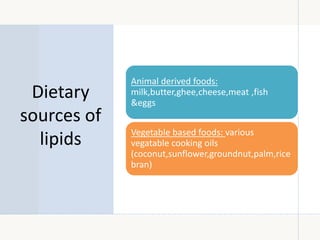
Dietary
sources of
lipids
Animal derived foods:
milk,butter,ghee,cheese,meat ,fish
&eggs
Vegetable based foods: various
vegatable cooking oils
(coconut,sunflower,groundnut,palm,rice
bran)
Lipid
Digestion
in Mouth
&Stomach
• Very little digestion
• No significant amount of
lipase is present in the
secretion of mouth or
stomach
 No mechanism for
emulsification of lipid exists
here
 Acid ph of gastric secretion
is not helpful to lipid
digestion.
• In mouth:
• The lingual lipase (secreted from ebner’s
gland)from the mouth enters stomach along
with the food.
• It has an optimum pH of 2.5-5 (acid stable
lipase)
• it acts on triglycerides with short chain fatty
acids & medium chain fatty acids.
• In stomach:
• Gastric lipase is also acid stable, with an optimum
pH around 5.4.
• It is secreted by chief cells; the secretion is
stimulated by gastrin.
• It acts on dietary triacylglycerols mainly composed
of short & medium chain FA.
• The action of lingual & gastric lipase most active in
infants & young children whose stomach ph is
nearer to neutrality & diet contain milk lipids-
short & medium chain FA.
Digestion in small Intestines
• The acidic stomach contents containing dietary fat
upon entering the duodenum will stimulate
secretion of enteric hormones secretin &
cholecystokinin.
• Cholecystokinin acts on gall bladder and causes
release of bile into small intestine & also acts on
pancreas causing them to release lipase.
• Secretin stimulates pancreas to release pancreatic
juice rich in bicarbonate which changes ph
necessary for activity of pancreatic & intestinal
enzymes.
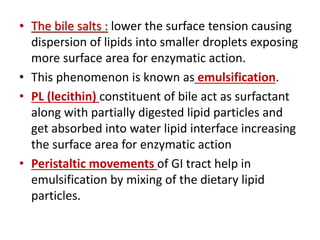
Emulsification of lipids
• Emulsification is a prerequisite for digestion of
lipids.
• This process is favored by:
1. Bile salts(detergent action)
2. Peristalsis (mechanical mixing)
3. Phospholipids
• The bile salts : lower the surface tension causing
dispersion of lipids into smaller droplets exposing
more surface area for enzymatic action.
• This phenomenon is known as emulsification.
• PL (lecithin) constituent of bile act as surfactant
along with partially digested lipid particles and
get absorbed into water lipid interface increasing
the surface area for enzymatic action
• Peristaltic movements of GI tract help in
emulsification by mixing of the dietary lipid
particles.
Action of pancreatic Enzymes on
dietary lipids in small Intestines
• The three lipid digestive enzymes secreted by
pancreas are:
• 1. Pancreatic lipase with Co-lipase
• 2. Cholesterol esterase
• 3. Phospholipase A2.
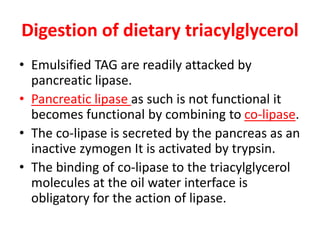
Digestion of dietary triacylglycerol
• Emulsified TAG are readily attacked by
pancreatic lipase.
• Pancreatic lipase as such is not functional it
becomes functional by combining to co-lipase.
• The co-lipase is secreted by the pancreas as an
inactive zymogen It is activated by trypsin.
• The binding of co-lipase to the triacylglycerol
molecules at the oil water interface is
obligatory for the action of lipase.
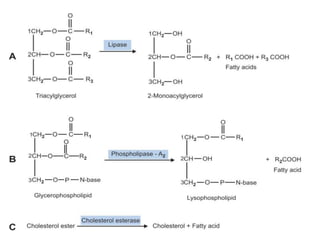
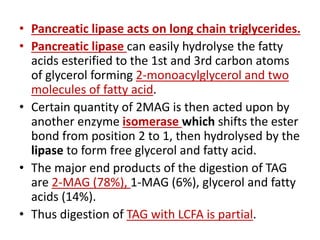
• Pancreatic lipase acts on long chain triglycerides.
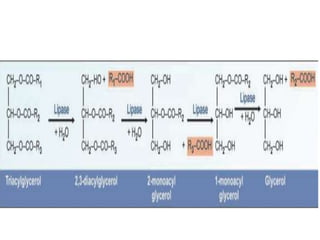
• Pancreatic lipase can easily hydrolyse the fatty
acids esterified to the 1st and 3rd carbon atoms
of glycerol forming 2-monoacylglycerol and two
molecules of fatty acid.
• Certain quantity of 2MAG is then acted upon by
another enzyme isomerase which shifts the ester
bond from position 2 to 1, then hydrolysed by the
lipase to form free glycerol and fatty acid.
• The major end products of the digestion of TAG
are 2-MAG (78%), 1-MAG (6%), glycerol and fatty
acids (14%).
• Thus digestion of TAG with LCFA is partial.
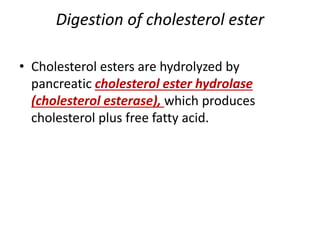
Digestion of cholesterol ester
• Cholesterol esters are hydrolyzed by
pancreatic cholesterol ester hydrolase
(cholesterol esterase), which produces
cholesterol plus free fatty acid.
Digestion of phospholipids
• Phospholipases are enzymes which hydrolyze
phospholipids.
• Dietary & biliary origin glycerophospholipids
are digested by pancreatic phospholipase-A2.
• This enzyme catalyzes the hydrolysis of fatty
acid residues at the 2-position of the
phospholipid, leaving lysophospholipids and a
molecule of fatty acid
• INTESTINAL LIPASE:
• Lipase produced by ileum which also
hydrolyzes TAG .
• But its action is very limited because TAG are
digested completely by time they reach lower
intestine.
Absorption of Long Chain Fatty Acids
• The major end products of lipid digestion include
 2MAG
 FFA
 Cholesterol
 Lysophospholipids
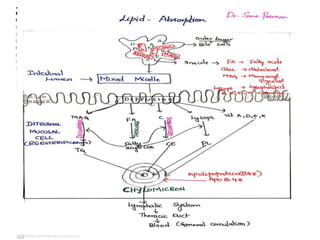
• These, together with bile salts, form mixed micelles.
• Bile salts beside their role in digestion also play crucial
role in absorption.
• Fat soluble vitamins A, D, E and K are also packaged in
these micelles and are absorbed from the micelles along
with the products of dietary lipid digestion
Bergstorm
theory
• The theory proposed by Bergstrom
has the following steps.
1. Mixed Micelle Formation
• the end product of lipid digestion
form tiny spherical particles known
as micelles in combination with
bile salts.
• The micelles are organized in a
manner that end products of lipid
digestion occupy hydrophobic
interior core & bile salts take up
exterior
• These are known as mixed micelles
because they poses mixed variety
of lipid molecules.
• The mixed micelles approach the brush border
membrane of the intestinal mucosal cells.
• There the lipid components from mixed
micelles are absorbed into the mucosal cells
by diffusion.
• The net result is the transfer of
monoacylglycerol, fatty acids, cholesterol, and
lysophospholipid molecules into the mucosal
cell.
• About 98% of dietary lipids is normally
absorbed.
Enterohepatic Circulation of Bile Salts:
• The bile salts are left behind which are mostly
reabsorbed from the ileum and returned to
the liver to be re-excreted (enterohepatic
circulation).
2. Re-esterification Inside the
Mucosal Cell
• inside the intestinal mucosal cell, the long chain
fatty acids are re-esterified to form Triglycerides.
• The fatty acids are first activated to fatty acyl CoA
by the enzyme, acyl CoA synthetase or
thiokinase.
• Two such activated fatty acids react with
monoacylglycerol to form the triglyceride.
• The absorbed lysophospholipids and cholesterol
are also reconverted to phospholipids and
cholesterol esters
• Free glycerol absorbed from intestinal lumen
directly enters into the bloodstream.
• But the intestinal cells convert glucose to
glycerol -3-phosphate, and then add 3
molecules of acylgroups to synthesize TAG.
3.Secretion of lipids from intestinal
mucosal cells
• Triacylglycerol, phospholipid, cholesterol
esters resynthesized in the intestinal mucosa
and absorbed fat soluble vitamins along with
apoprotein B-48&apolipoprotein –A I(APO –A)
are are incorporated as chylomicrons.
• chylomicrons migrate to the plasma
membrane of intestinal mucosal cells are
secreted into lymphatic vessels by exocytosis.
• The chyle from intestinal cells loaded with
chylomicrons are transported into thoracic
duct and then into blood circulation.
• After a fatty meal, the plasma is milky in
appearance due to the presence of
chylomicrons.
• Blood carries chylomicrons to various
peripheral tissues including muscle and
adipose tissue and finally to liver.
• Adipose tissue take up large quantity of lipids
from chylomicrons for storage.
SCFA &MCFA Absorption
• Short chain fatty acids (seen in milk, butter, ghee)
and medium chain fatty acids (in coconut oil and
mother's milk) do not need re-esterification.
• They can directly enter into blood vessels, then to
portal vein, finally to liver where they are
immediately utilized for energy.
• Their absorption is rapid.
• They are better absorbed than long chain fatty
acids
Abnormalities in Digestion &
Absorption of Lipids
Defective digestion:
• Daily excretion of fat in feces is more than 6 g
per day is called as steatorrhea.
• It is due to chronic diseases of pancreas.
• In such cases, unsplit fat is seen in feces
• Defective absorption: the absorption is defective,
most of the fat in feces are split fat, i.e. fatty acids and
monoglycerides .
• Causes:
1.Celiac disease
2.Surgical removal of intestine.
3.Obstruction of bile duct: due to gall stones, tumors of
head of pancreas, enlarged lymph glands, etc
due to obstruction there is deficiency of bile salts.
In such cases, triglycerides with short chain and medium
chain fatty acids are digested and absorbed properly,
because they do not require micellerisation for
absorption.
• Chyluria:
• There is an abnormal connection between the
urinary tract and lymphatic drainage system of
the intestine.
• Urine appears milky due to lipid droplets.
• Chylothorax: can result from an abnormal
connection between the pleural cavity and
thoracic duct
References
• Textbook of Biochemistry for medical students-DM Vasudevan
• Textbook of Biochemistry for MBBS-Dr S.K. Gupta
• Harper's Illustrated Biochemistry

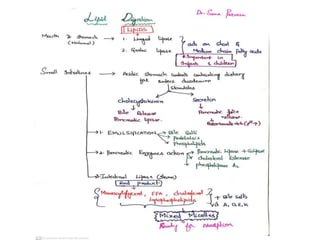
LIPID DIGESTION & ABSORPTION

  • 1.
    DIGESTION & ABSORPTION OFLIPIDS Dr Sana Parveen MD Biochemistry
  • 2.
    DIGESTION OF LIPIDS •Dietary consumption of lipids is variable across globe based on economic status & dietary habits. • An average Indian diet contains 20–50 gm of lipids per day(western diet-2-3 times more) • 90% fat intake in the diet is as triacylglycerols, rest consisting of cholesterol, cholesterol ester, phospholipid and free fatty acid.
  • 3.
    Dietary sources of lipids Animal derivedfoods: milk,butter,ghee,cheese,meat ,fish &eggs Vegetable based foods: various vegatable cooking oils (coconut,sunflower,groundnut,palm,rice bran)
  • 5.
    Lipid Digestion in Mouth &Stomach • Verylittle digestion • No significant amount of lipase is present in the secretion of mouth or stomach  No mechanism for emulsification of lipid exists here  Acid ph of gastric secretion is not helpful to lipid digestion.
  • 7.
    • In mouth: •The lingual lipase (secreted from ebner’s gland)from the mouth enters stomach along with the food. • It has an optimum pH of 2.5-5 (acid stable lipase) • it acts on triglycerides with short chain fatty acids & medium chain fatty acids.
  • 8.
    • In stomach: •Gastric lipase is also acid stable, with an optimum pH around 5.4. • It is secreted by chief cells; the secretion is stimulated by gastrin. • It acts on dietary triacylglycerols mainly composed of short & medium chain FA. • The action of lingual & gastric lipase most active in infants & young children whose stomach ph is nearer to neutrality & diet contain milk lipids- short & medium chain FA.
  • 9.
    Digestion in smallIntestines • The acidic stomach contents containing dietary fat upon entering the duodenum will stimulate secretion of enteric hormones secretin & cholecystokinin. • Cholecystokinin acts on gall bladder and causes release of bile into small intestine & also acts on pancreas causing them to release lipase. • Secretin stimulates pancreas to release pancreatic juice rich in bicarbonate which changes ph necessary for activity of pancreatic & intestinal enzymes.
  • 10.
    Emulsification of lipids •Emulsification is a prerequisite for digestion of lipids. • This process is favored by: 1. Bile salts(detergent action) 2. Peristalsis (mechanical mixing) 3. Phospholipids
  • 11.
    • The bilesalts : lower the surface tension causing dispersion of lipids into smaller droplets exposing more surface area for enzymatic action. • This phenomenon is known as emulsification. • PL (lecithin) constituent of bile act as surfactant along with partially digested lipid particles and get absorbed into water lipid interface increasing the surface area for enzymatic action • Peristaltic movements of GI tract help in emulsification by mixing of the dietary lipid particles.
  • 12.
    Action of pancreaticEnzymes on dietary lipids in small Intestines • The three lipid digestive enzymes secreted by pancreas are: • 1. Pancreatic lipase with Co-lipase • 2. Cholesterol esterase • 3. Phospholipase A2.
  • 14.
    Digestion of dietarytriacylglycerol • Emulsified TAG are readily attacked by pancreatic lipase. • Pancreatic lipase as such is not functional it becomes functional by combining to co-lipase. • The co-lipase is secreted by the pancreas as an inactive zymogen It is activated by trypsin. • The binding of co-lipase to the triacylglycerol molecules at the oil water interface is obligatory for the action of lipase.
  • 15.
    • Pancreatic lipaseacts on long chain triglycerides. • Pancreatic lipase can easily hydrolyse the fatty acids esterified to the 1st and 3rd carbon atoms of glycerol forming 2-monoacylglycerol and two molecules of fatty acid. • Certain quantity of 2MAG is then acted upon by another enzyme isomerase which shifts the ester bond from position 2 to 1, then hydrolysed by the lipase to form free glycerol and fatty acid. • The major end products of the digestion of TAG are 2-MAG (78%), 1-MAG (6%), glycerol and fatty acids (14%). • Thus digestion of TAG with LCFA is partial.
  • 16.
    Digestion of cholesterolester • Cholesterol esters are hydrolyzed by pancreatic cholesterol ester hydrolase (cholesterol esterase), which produces cholesterol plus free fatty acid.
  • 17.
    Digestion of phospholipids •Phospholipases are enzymes which hydrolyze phospholipids. • Dietary & biliary origin glycerophospholipids are digested by pancreatic phospholipase-A2. • This enzyme catalyzes the hydrolysis of fatty acid residues at the 2-position of the phospholipid, leaving lysophospholipids and a molecule of fatty acid
  • 18.
    • INTESTINAL LIPASE: •Lipase produced by ileum which also hydrolyzes TAG . • But its action is very limited because TAG are digested completely by time they reach lower intestine.
  • 19.
    Absorption of LongChain Fatty Acids • The major end products of lipid digestion include  2MAG  FFA  Cholesterol  Lysophospholipids • These, together with bile salts, form mixed micelles. • Bile salts beside their role in digestion also play crucial role in absorption. • Fat soluble vitamins A, D, E and K are also packaged in these micelles and are absorbed from the micelles along with the products of dietary lipid digestion
  • 21.
    Bergstorm theory • The theoryproposed by Bergstrom has the following steps. 1. Mixed Micelle Formation • the end product of lipid digestion form tiny spherical particles known as micelles in combination with bile salts. • The micelles are organized in a manner that end products of lipid digestion occupy hydrophobic interior core & bile salts take up exterior • These are known as mixed micelles because they poses mixed variety of lipid molecules.
  • 22.
    • The mixedmicelles approach the brush border membrane of the intestinal mucosal cells. • There the lipid components from mixed micelles are absorbed into the mucosal cells by diffusion. • The net result is the transfer of monoacylglycerol, fatty acids, cholesterol, and lysophospholipid molecules into the mucosal cell. • About 98% of dietary lipids is normally absorbed.
  • 23.
    Enterohepatic Circulation ofBile Salts: • The bile salts are left behind which are mostly reabsorbed from the ileum and returned to the liver to be re-excreted (enterohepatic circulation).
  • 24.
    2. Re-esterification Insidethe Mucosal Cell • inside the intestinal mucosal cell, the long chain fatty acids are re-esterified to form Triglycerides. • The fatty acids are first activated to fatty acyl CoA by the enzyme, acyl CoA synthetase or thiokinase. • Two such activated fatty acids react with monoacylglycerol to form the triglyceride. • The absorbed lysophospholipids and cholesterol are also reconverted to phospholipids and cholesterol esters
  • 25.
    • Free glycerolabsorbed from intestinal lumen directly enters into the bloodstream. • But the intestinal cells convert glucose to glycerol -3-phosphate, and then add 3 molecules of acylgroups to synthesize TAG.
  • 26.
    3.Secretion of lipidsfrom intestinal mucosal cells • Triacylglycerol, phospholipid, cholesterol esters resynthesized in the intestinal mucosa and absorbed fat soluble vitamins along with apoprotein B-48&apolipoprotein –A I(APO –A) are are incorporated as chylomicrons. • chylomicrons migrate to the plasma membrane of intestinal mucosal cells are secreted into lymphatic vessels by exocytosis.
  • 27.
    • The chylefrom intestinal cells loaded with chylomicrons are transported into thoracic duct and then into blood circulation. • After a fatty meal, the plasma is milky in appearance due to the presence of chylomicrons. • Blood carries chylomicrons to various peripheral tissues including muscle and adipose tissue and finally to liver. • Adipose tissue take up large quantity of lipids from chylomicrons for storage.
  • 28.
    SCFA &MCFA Absorption •Short chain fatty acids (seen in milk, butter, ghee) and medium chain fatty acids (in coconut oil and mother's milk) do not need re-esterification. • They can directly enter into blood vessels, then to portal vein, finally to liver where they are immediately utilized for energy. • Their absorption is rapid. • They are better absorbed than long chain fatty acids
  • 29.
    Abnormalities in Digestion& Absorption of Lipids Defective digestion: • Daily excretion of fat in feces is more than 6 g per day is called as steatorrhea. • It is due to chronic diseases of pancreas. • In such cases, unsplit fat is seen in feces
  • 30.
    • Defective absorption:the absorption is defective, most of the fat in feces are split fat, i.e. fatty acids and monoglycerides . • Causes: 1.Celiac disease 2.Surgical removal of intestine. 3.Obstruction of bile duct: due to gall stones, tumors of head of pancreas, enlarged lymph glands, etc due to obstruction there is deficiency of bile salts. In such cases, triglycerides with short chain and medium chain fatty acids are digested and absorbed properly, because they do not require micellerisation for absorption.
  • 31.
    • Chyluria: • Thereis an abnormal connection between the urinary tract and lymphatic drainage system of the intestine. • Urine appears milky due to lipid droplets. • Chylothorax: can result from an abnormal connection between the pleural cavity and thoracic duct
  • 32.
    References • Textbook ofBiochemistry for medical students-DM Vasudevan • Textbook of Biochemistry for MBBS-Dr S.K. Gupta • Harper's Illustrated Biochemistry