Lipid Metabolism-2
Dr. Priyamvada Pandey
PG 1st
year
Department of Biochemistry
Contents
• Digestion and Absorption of lipids
• Lipids
• Digestion of lipids
• Physiologically important lipases
• Absorption of lipids
• Triglycerides
• Metabolism of Triglycerides
• White and brown adipose tissue
Digestion and Absorption of Lipids
What is Digestion?
Large and complex
molecules(foodstuffs)
Smaller and water soluble
molecules
Easily absorbable and
utilizable
Lipids
 Lipids are a heterogenous group of water-insoluble (hydrophobic)
organic molecules.
 Body lipids are found in compartments such as
Membrane associated lipids,
Droplets of triacylglycerol in adipocytes, or
Transported in blood in association with proteins(lipoproteins) or
albumin.
 Lipids are a major source of energy.
The average normal Indian diet contains about 20-30 g of lipids per
day.
The major dietary lipids are 1.Triacylglycerol
(long chain,>16-18 C)
2. Cholesterol
3.Phospholipids
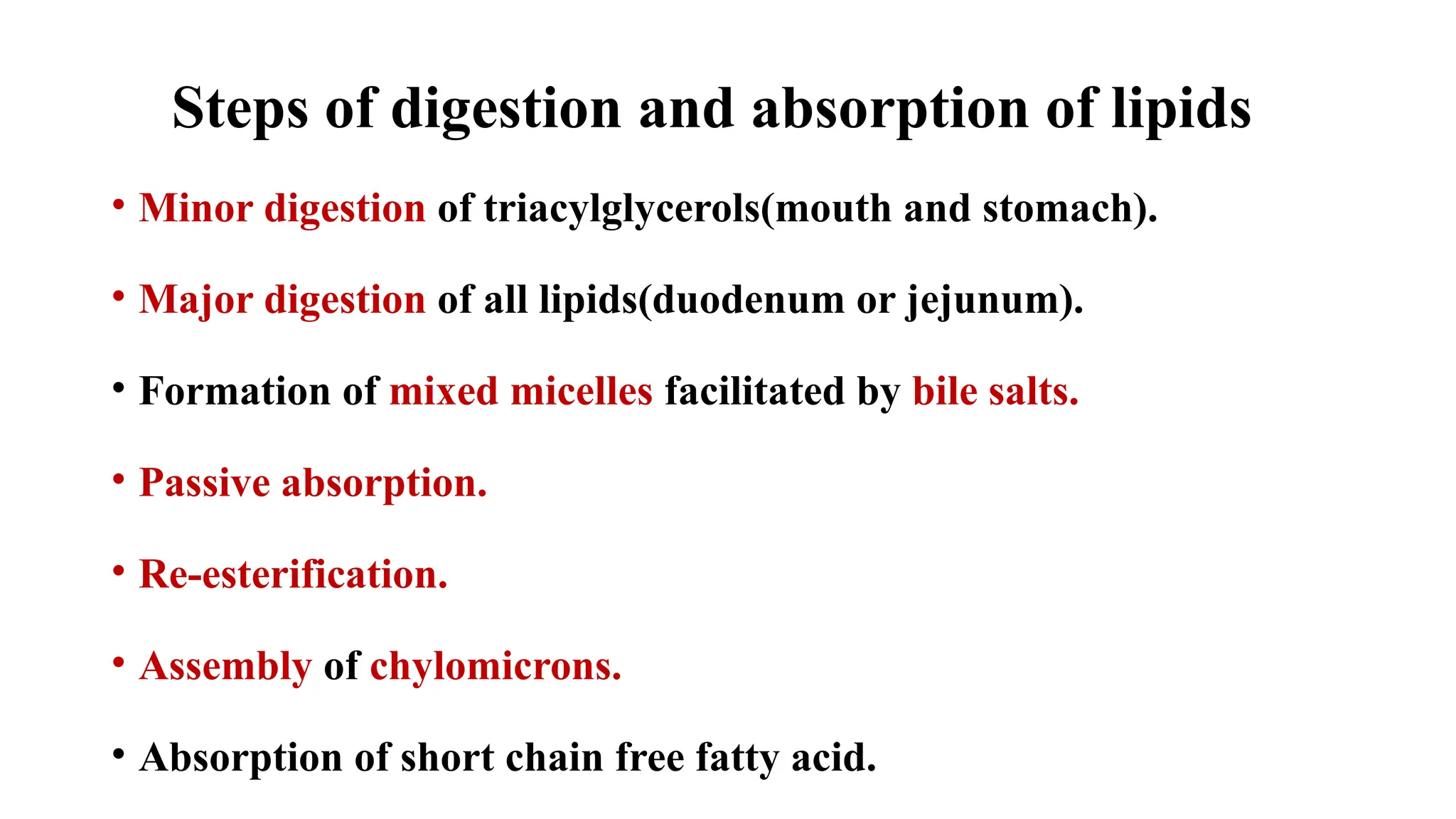
Steps of digestion and absorption of lipids
• Minor digestion of triacylglycerols(mouth and stomach).
• Major digestion of all lipids(duodenum or jejunum).
• Formation of mixed micelles facilitated by bile salts.
• Passive absorption.
• Re-esterification.
• Assembly of chylomicrons.
• Absorption of short chain free fatty acid.
Some physiologically important lipases
Digestion of lipids in mouth
 Insignificant.
 Lingual lipase :secreted by Von Ebner serous gland(serous
salivary glands located in the posterior part of tongue).
 Optimum pH of 2.5-3, is acid stable.
 Enters stomach along with food. and continues to be active in the
stomach.
Digestion of lipids in stomach
• Upto 30% digestion of triglycerides occurs in stomach.
• Enzymes – 1. Lingual lipase
2. Gastric lipase –acid stable , optimum pH of around 5.4,
secreted by chief cells , secretion stimulated by gastrin.
• These acid lipases hydrolyze fatty acids from TAG molecules ,
particularly those containing short or medium chain –length(<12 C)
FA such as found in milk fat.
• These lipases play an important role in lipid digestion in infants for
whom milk fat is the primary source and in cases of pancreatic
insufficiency such as cystic fibrosis.
Digestion of lipids in small intestine
It includes 1. Emulsification and
2. Degradation by pancreatic enzymes
1. Emulsification
1. It is a pre-requisite for digestion of lipids.
2. Lipids are dispersed into smaller droplets; surface tension is
reduced; and surface area of droplets is increased.
3. Occurs in the duodenum.
Emulsification Bil;e salts-
detergent action
Peristalsis-
mechanical mixing
Phospholipids
Action of bile salts
• Bile salts are biological detergents synthesized from cholesterol in
liver and stored in gall bladder.
• Bile salts possess steroid nucleus , the side chain is attached to either
glycine(glycocholic acid) or taurine(taurocholic acid).
• They interact with dietary lipid droplets and aqueous duodenal contents,
stabilize the lipid droplets as they become smaller by peristalsis and
prevent them from coalescing.
• The emulsification increases the surface area of fat droplets that
enhances activity of lipolytic enzymes.
Emulsification by bile salts and phospholipids
2. Degradation by pancreatic enzymes
• Pancreatic enzymes in intestine with lipolytic activity are -
Pancreatic lipase with co-lipase ,
Cholesterol esterase ,
Phospholipase A2.
• The bile(pH 7.7) entering the duodenum neutralizes the acid chyme
from the stomach and provides a pH favourable for action of
pancreatic enzymes.
TAG degradation
• TAG molecules are too large to be taken up by the mucosal
cells(enterocytes) of the intestinal villi.
• Pancreatic lipase is an esterase which preferably removes the FA at
carbons 1 and 3 to form a mixture of 2-MAG and FFA.
TAG is successively broken down into DAG,1-MAG ,glycerol and FAs.
Colipase
• Secreted by the pancreas as an inactive zymogen, procolipase
which is activated in the intestine by trypsin.
• Binds the lipase at a ratio of 1:1, obligatory for the action of
lipase(overcomes the inhibition of lipase by bile salts).
• It binds at the lipid-aqueous interface and helps to anchor and
stabilize pancreatic lipase.
• Orlistat, an anti obesity drug ,inhibits gastric and pancreatic lipases
thereby decreasing fat absorption, resulting in weight loss.
Cholesterol ester degradation
• Most dietary cholesterol is present in the free (non esterified) form,
10-15% present in the esterified form.
• Cholesterol ester is hydrolyzed by cholesterol esterase into cholesterol
and FFA.
• Requires bile salts for increased activity.
Phospholipid degradation
• Proenzyme of Phospholipase A2 is activated by trypsin .
• Requires bile salts for optimum activity.
• Phospholipase A2 removes one FA from carbon 2 of a phospholipid leaving a
Lysophospholipid.
Hormonal control of
lipid digestion
The primary products of digestion are
• They are incorporated into molecular aggregrates to form Mixed
micelle.
Absorption of lipids by enterocytes
Absorption of Long Chain Fatty Acids(LCFAs)
• LCFAs(>14 C) are absorbed into the lymph ,not directly to blood.
• Theory proposed by Bergstrom(Nobel Prize ,1982)
• Steps-
1. Mixed micelle formation
2. Re-esterification inside the mucosal cell
•Micelles
• The micelles are spherical particles with a hydrophilic exterior and
hydrophobic interior core.
• Due to their amphipathic nature , bile salts help to form micellar
aggregates.
• Micelle formation is essential for the absorption of fat soluble
vitamins.
• Micelles are aligned at the microvillous surface of jejunal mucosa.
• Mechanism of lipid absorption is passive diffusion into the mucosal
cell.
• Fatty acids,2-MAG and other digested products passively diffuse into
the mucosal cell.
Enterohepatic circulation of Bile salts-
• The bile salts are left behind in the small intestinal lumen which are
mostly reabsorbed from the ileum and returned to the liver to be re-
excreted.
• Normally about 98% of dietary lipids are absorbed.
Re- esterification inside the mucosal cell
• Once inside the mucosal cell, LCFAs are re-esterified to form TAGs.
• The fatty acids are first activated to fatty acyl CoA by the enzyme ,
acyl CoA synthetase or thiokinase.
• Two such activated fatty acids react with monoacyl-glycerol(MAG) to
form TAG (MAG pathway).
• Majority of molecules follow this MAG pathway.
• Free glycerol absorbed from intestinal lumen directly enters the blood
stream. So free glycerol is not available for re-esterification.
Chylomicrons
• The lipids that are resynthesized in the intestinal cells are hydrophobic in nature.
• They are put together as lipid droplets and surrounded by a thin layer consisting
of mostly apolipoproteins(A1 and B 48) and phospholipids.
• The TAG ,cholesterol ester and phospholipid molecules along with apoproteins
B48, and apo-A form chylomicrons.
• This package of lipids enveloped in the layer stabilizes the droplets and
increases their solubility.
• The chyle(milky fluid)from the intestinal mucosal cells loaded with
chylomicrons are transported through the lacteals into the thoracic
duct and then systemic circulation.
• Through the systemic circulation they reach the peripheral
tissues(muscle, adipose tissues) and finally to the liver.
Re-esterification and Assembly of
chylomicrons
Mixed micelle
Chylomicrons
Transport of chylomicrons
The absorbed (exogenous) triacylglycerols are transported in blood
as chylomicrons.They are taken up by adipose tissue, skeletal muscle
and liver.
SCFAAbsorption is different
• Short Chain Fatty Acids, SCFA (seen in milk, butter and ghee)
and Medium Chain Fatty Acids, MCFA (seen in coconut oil and
mother’s milk) do not need re-esterification.
• They can directly enter blood vessels ,then to portal vein ,transported
to liver bound to albumin where they are utilized for energy.
• Their absorption is rapid.
• They are better absorbed than long chain fatty acids.
Triacylglycerol/Triglycerides/TAG
• Simple lipid.
• Made up of fatty acid and alcohol(glycerol).
• Non polar.
• Serves as energy storage.
• Primarily stored in adipose tissue.
• Fats and oils are chemically TAGs.
Structure of Acylglycerol
e.g. sunflower oil ,
soyabean oil
e.g. ghee
TAG/Glycogen as fuel reserve
Non polar , hydrophobic
Stored in anhydrous form.
A gram of anhydrous fat stores more
than 6 times energy as compared to a
gram of hydrated glycogen.
Highly concentrated form of energy.
Produces 9 Cal/g
More polar
A gram of glycogen binds about two grams of water
Quick source of
Energy , because of water solubility.
Produces only 4 Cal/g
Triacylglycerol metabolism
Lipogenesis
• TAG synthesis
• Well fed state
• 3FA +Glycerol= TAG
• Insulin+
• Dephosphorylation of enzymes
• Liver, Adipose tissue
Lipolysis
• TAG breakdown
• Fasting/starvation/DM
• TAG =3FA +Glycerol
• Glucagon/Epi/NE +
• Phosphorylation of enzymes
• Adipose tissues
Lipogenesis
• Liver and adipose tissues are the major sites . Occurs in smooth
endoplasmic reticulum.
• TAG synthesis in adipose tissues is for storage of energy.
• In liver it is mainly secreted as VLDL and is transported to peripheral
tissues.
• 2 major pathway-
Glycerol 3 P pathway in liver and adipose tissue.
MAG pathway in the intestine.
Pathways for production of Glycerol 3-phosphate in
liver and adipose tissue
Synthesis of TAG
Lipolysis
(Adipose tissue)
Regulation of Lipogenesis
• Insulin favours lipogenesis
• Increases uptake of glucose by
adipocytes.
• Increases activity of
•
• Decreases activity of hormone
sensitive lipase.
• Glucagon inhibits lipogenesis.
• Glucagon and epinephrine are
lipolytic.
• They inhibit Acetyl CoA
Carboxylase by keeping the
enzyme in the inactive
phosphorylated state.
Pyruvate dehydrogenase---- Acetyl
CoA
Acetyl CoA carboxylase----- Fatty
acid synthesis
White Adipose tissue
• Mainly concerned with energy storage.
• Made of spherical cells with very few mitochondria
• The triglycerides form the major component (about 80%)
Brown Adipose tissue
• Cells are polygonal with more abundant cytoplasm.
• The brown colour is due to the presence of numerous mitochondria.
• Involved in non-shivering thermogenesis.
• Plays an important role in the control of body temperature.
• Heat is liberated by uncoupling oxidation from phosphorylation. So energy is
released as heat instead of trapping it in high energy bonds of ATP.
• Primarily important in newborns.
Abnormalities of lipid metabolism
• Cystic fibrosis
• Defective digestion-Steatorrhea
• Defective absorption- Celiac disease
• Obstruction of bile duct –gall stone, tumour of head of pancreas.
• Chyluria
• Chylothorax
Summary
THANK YOU

LIPID METABOLISM-digestion and absorption.pptx

  • 1.
    Lipid Metabolism-2 Dr. PriyamvadaPandey PG 1st year Department of Biochemistry
  • 2.
    Contents • Digestion andAbsorption of lipids • Lipids • Digestion of lipids • Physiologically important lipases • Absorption of lipids • Triglycerides • Metabolism of Triglycerides • White and brown adipose tissue
  • 3.
    Digestion and Absorptionof Lipids What is Digestion? Large and complex molecules(foodstuffs) Smaller and water soluble molecules Easily absorbable and utilizable
  • 4.
    Lipids  Lipids area heterogenous group of water-insoluble (hydrophobic) organic molecules.  Body lipids are found in compartments such as Membrane associated lipids, Droplets of triacylglycerol in adipocytes, or Transported in blood in association with proteins(lipoproteins) or albumin.  Lipids are a major source of energy.
  • 5.
    The average normalIndian diet contains about 20-30 g of lipids per day. The major dietary lipids are 1.Triacylglycerol (long chain,>16-18 C) 2. Cholesterol 3.Phospholipids
  • 6.
    Steps of digestionand absorption of lipids • Minor digestion of triacylglycerols(mouth and stomach). • Major digestion of all lipids(duodenum or jejunum). • Formation of mixed micelles facilitated by bile salts. • Passive absorption. • Re-esterification. • Assembly of chylomicrons. • Absorption of short chain free fatty acid.
  • 7.
  • 8.
    Digestion of lipidsin mouth  Insignificant.  Lingual lipase :secreted by Von Ebner serous gland(serous salivary glands located in the posterior part of tongue).  Optimum pH of 2.5-3, is acid stable.  Enters stomach along with food. and continues to be active in the stomach.
  • 9.
    Digestion of lipidsin stomach • Upto 30% digestion of triglycerides occurs in stomach. • Enzymes – 1. Lingual lipase 2. Gastric lipase –acid stable , optimum pH of around 5.4, secreted by chief cells , secretion stimulated by gastrin. • These acid lipases hydrolyze fatty acids from TAG molecules , particularly those containing short or medium chain –length(<12 C) FA such as found in milk fat.
  • 10.
    • These lipasesplay an important role in lipid digestion in infants for whom milk fat is the primary source and in cases of pancreatic insufficiency such as cystic fibrosis.
  • 11.
    Digestion of lipidsin small intestine It includes 1. Emulsification and 2. Degradation by pancreatic enzymes
  • 12.
    1. Emulsification 1. Itis a pre-requisite for digestion of lipids. 2. Lipids are dispersed into smaller droplets; surface tension is reduced; and surface area of droplets is increased. 3. Occurs in the duodenum. Emulsification Bil;e salts- detergent action Peristalsis- mechanical mixing Phospholipids
  • 13.
    Action of bilesalts • Bile salts are biological detergents synthesized from cholesterol in liver and stored in gall bladder. • Bile salts possess steroid nucleus , the side chain is attached to either glycine(glycocholic acid) or taurine(taurocholic acid). • They interact with dietary lipid droplets and aqueous duodenal contents, stabilize the lipid droplets as they become smaller by peristalsis and prevent them from coalescing. • The emulsification increases the surface area of fat droplets that enhances activity of lipolytic enzymes.
  • 14.
    Emulsification by bilesalts and phospholipids
  • 15.
    2. Degradation bypancreatic enzymes • Pancreatic enzymes in intestine with lipolytic activity are - Pancreatic lipase with co-lipase , Cholesterol esterase , Phospholipase A2. • The bile(pH 7.7) entering the duodenum neutralizes the acid chyme from the stomach and provides a pH favourable for action of pancreatic enzymes.
  • 16.
    TAG degradation • TAGmolecules are too large to be taken up by the mucosal cells(enterocytes) of the intestinal villi. • Pancreatic lipase is an esterase which preferably removes the FA at carbons 1 and 3 to form a mixture of 2-MAG and FFA. TAG is successively broken down into DAG,1-MAG ,glycerol and FAs.
  • 17.
    Colipase • Secreted bythe pancreas as an inactive zymogen, procolipase which is activated in the intestine by trypsin. • Binds the lipase at a ratio of 1:1, obligatory for the action of lipase(overcomes the inhibition of lipase by bile salts). • It binds at the lipid-aqueous interface and helps to anchor and stabilize pancreatic lipase. • Orlistat, an anti obesity drug ,inhibits gastric and pancreatic lipases thereby decreasing fat absorption, resulting in weight loss.
  • 18.
    Cholesterol ester degradation •Most dietary cholesterol is present in the free (non esterified) form, 10-15% present in the esterified form. • Cholesterol ester is hydrolyzed by cholesterol esterase into cholesterol and FFA. • Requires bile salts for increased activity.
  • 19.
    Phospholipid degradation • Proenzymeof Phospholipase A2 is activated by trypsin . • Requires bile salts for optimum activity. • Phospholipase A2 removes one FA from carbon 2 of a phospholipid leaving a Lysophospholipid.
  • 20.
  • 21.
    The primary productsof digestion are • They are incorporated into molecular aggregrates to form Mixed micelle.
  • 22.
    Absorption of lipidsby enterocytes Absorption of Long Chain Fatty Acids(LCFAs) • LCFAs(>14 C) are absorbed into the lymph ,not directly to blood. • Theory proposed by Bergstrom(Nobel Prize ,1982) • Steps- 1. Mixed micelle formation 2. Re-esterification inside the mucosal cell
  • 23.
    •Micelles • The micellesare spherical particles with a hydrophilic exterior and hydrophobic interior core. • Due to their amphipathic nature , bile salts help to form micellar aggregates.
  • 24.
    • Micelle formationis essential for the absorption of fat soluble vitamins. • Micelles are aligned at the microvillous surface of jejunal mucosa. • Mechanism of lipid absorption is passive diffusion into the mucosal cell. • Fatty acids,2-MAG and other digested products passively diffuse into the mucosal cell.
  • 26.
    Enterohepatic circulation ofBile salts- • The bile salts are left behind in the small intestinal lumen which are mostly reabsorbed from the ileum and returned to the liver to be re- excreted. • Normally about 98% of dietary lipids are absorbed.
  • 27.
    Re- esterification insidethe mucosal cell • Once inside the mucosal cell, LCFAs are re-esterified to form TAGs. • The fatty acids are first activated to fatty acyl CoA by the enzyme , acyl CoA synthetase or thiokinase. • Two such activated fatty acids react with monoacyl-glycerol(MAG) to form TAG (MAG pathway). • Majority of molecules follow this MAG pathway.
  • 28.
    • Free glycerolabsorbed from intestinal lumen directly enters the blood stream. So free glycerol is not available for re-esterification.
  • 29.
    Chylomicrons • The lipidsthat are resynthesized in the intestinal cells are hydrophobic in nature. • They are put together as lipid droplets and surrounded by a thin layer consisting of mostly apolipoproteins(A1 and B 48) and phospholipids. • The TAG ,cholesterol ester and phospholipid molecules along with apoproteins B48, and apo-A form chylomicrons. • This package of lipids enveloped in the layer stabilizes the droplets and increases their solubility.
  • 30.
    • The chyle(milkyfluid)from the intestinal mucosal cells loaded with chylomicrons are transported through the lacteals into the thoracic duct and then systemic circulation. • Through the systemic circulation they reach the peripheral tissues(muscle, adipose tissues) and finally to the liver.
  • 31.
    Re-esterification and Assemblyof chylomicrons Mixed micelle
  • 32.
  • 33.
    Transport of chylomicrons Theabsorbed (exogenous) triacylglycerols are transported in blood as chylomicrons.They are taken up by adipose tissue, skeletal muscle and liver.
  • 34.
    SCFAAbsorption is different •Short Chain Fatty Acids, SCFA (seen in milk, butter and ghee) and Medium Chain Fatty Acids, MCFA (seen in coconut oil and mother’s milk) do not need re-esterification. • They can directly enter blood vessels ,then to portal vein ,transported to liver bound to albumin where they are utilized for energy. • Their absorption is rapid. • They are better absorbed than long chain fatty acids.
  • 35.
    Triacylglycerol/Triglycerides/TAG • Simple lipid. •Made up of fatty acid and alcohol(glycerol). • Non polar. • Serves as energy storage. • Primarily stored in adipose tissue. • Fats and oils are chemically TAGs.
  • 36.
  • 37.
    e.g. sunflower oil, soyabean oil e.g. ghee
  • 38.
    TAG/Glycogen as fuelreserve Non polar , hydrophobic Stored in anhydrous form. A gram of anhydrous fat stores more than 6 times energy as compared to a gram of hydrated glycogen. Highly concentrated form of energy. Produces 9 Cal/g More polar A gram of glycogen binds about two grams of water Quick source of Energy , because of water solubility. Produces only 4 Cal/g
  • 39.
    Triacylglycerol metabolism Lipogenesis • TAGsynthesis • Well fed state • 3FA +Glycerol= TAG • Insulin+ • Dephosphorylation of enzymes • Liver, Adipose tissue Lipolysis • TAG breakdown • Fasting/starvation/DM • TAG =3FA +Glycerol • Glucagon/Epi/NE + • Phosphorylation of enzymes • Adipose tissues
  • 40.
    Lipogenesis • Liver andadipose tissues are the major sites . Occurs in smooth endoplasmic reticulum. • TAG synthesis in adipose tissues is for storage of energy. • In liver it is mainly secreted as VLDL and is transported to peripheral tissues. • 2 major pathway- Glycerol 3 P pathway in liver and adipose tissue. MAG pathway in the intestine.
  • 41.
    Pathways for productionof Glycerol 3-phosphate in liver and adipose tissue
  • 42.
  • 43.
  • 44.
    Regulation of Lipogenesis •Insulin favours lipogenesis • Increases uptake of glucose by adipocytes. • Increases activity of • • Decreases activity of hormone sensitive lipase. • Glucagon inhibits lipogenesis. • Glucagon and epinephrine are lipolytic. • They inhibit Acetyl CoA Carboxylase by keeping the enzyme in the inactive phosphorylated state. Pyruvate dehydrogenase---- Acetyl CoA Acetyl CoA carboxylase----- Fatty acid synthesis
  • 45.
    White Adipose tissue •Mainly concerned with energy storage. • Made of spherical cells with very few mitochondria • The triglycerides form the major component (about 80%)
  • 46.
    Brown Adipose tissue •Cells are polygonal with more abundant cytoplasm. • The brown colour is due to the presence of numerous mitochondria. • Involved in non-shivering thermogenesis. • Plays an important role in the control of body temperature. • Heat is liberated by uncoupling oxidation from phosphorylation. So energy is released as heat instead of trapping it in high energy bonds of ATP. • Primarily important in newborns.
  • 47.
    Abnormalities of lipidmetabolism • Cystic fibrosis • Defective digestion-Steatorrhea • Defective absorption- Celiac disease • Obstruction of bile duct –gall stone, tumour of head of pancreas. • Chyluria • Chylothorax
  • 48.
  • 50.