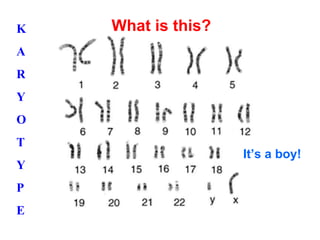
What is this? It’s a boy! K A R Y O T Y P E
A chromosome is a very long DNA molecule which contains hundreds or thousands of genes as well as some specialized protein molecules which hold it in shape. In organisms more complex than bacteria, the chromosomes are usually paired, so that each gene is represented twice -- except that the two paired chromosomes could have slightly different genes.  What’s a chromosome?
 
In a karyotype, the TOTAL number of chromosomes is shown.  This is called the  diploid number   (2n). In gametes,only half the number of chromosomes (1 from each pair)are present.  This is called the  haploid number   (1n).
How’s this karyotype different from the first one? It’s a girl!
What’s wrong with this karyotype? ↑ Down’s Syndrome
Sarah Pailin Do famous people have babies with Down Syndrome?
MITOSIS CELL DIVISION TO MAKE TWO IDENTICAL CELLS FOR GROWTH OR REPAIR
How often do cells divide? 30 minutes 3 days 3 minutes NEVER! Type of cell How often these cells divide Embryonic cells Intestinal cells Blood cells Nerve cells
What is the result of uncontrolled cell division?   CANCER
90 % of the cell cycle is spent in interphase!
Phases of the Cell Cycle I nterphase P rophase M etaphase A naphase T elophase
Phases of the Mitosis P rophase M etaphase A naphase T elophase
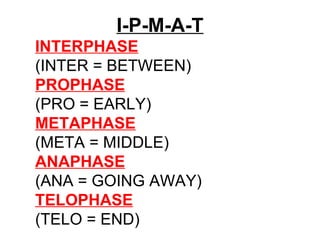
I-P-M-A-T INTERPHASE (INTER = BETWEEN) PROPHASE (PRO = EARLY) METAPHASE (META = MIDDLE) ANAPHASE (ANA = GOING AWAY) TELOPHASE (TELO = END)
INTERPHASE •  Not (technically) a part of Mitosis •  Nucleus and nucleolus intact G1 = GROWTH •  Normal Cell Activities •  END OF G1  ->  The cell either dies or    prepares for cell division S = SYNTHESIS •  Replication (copying) of DNA •  Two IDENTICAL sets of DNA G2 = GROWTH •  Preparation for Mitosis •  Organelles double in number
PROPHASE •  Centrioles move to the  opposite poles of the cell •  Spindle apparatus forms •  Chromatin condenses to  form chromosomes •  Nuclear membrane and nucleolus  disappear
Spindle fibers SPINDLE APPARATUS Note:   No centrioles in plant cells
METAPHASE •  SISTER CHROMATIDS  (copied  chromosomes) held together with  centromere •  Spindle fibers attach to centromere  of each sister chromatid •  Sister chromatids are pulled into line  along the equator (middle) of the cell
 
ANAPHASE •  Centromeres divide •  Sister chromatids separate •  Chromatids are pulled to  opposite poles of the cell by  spindle fibers
 
TELOPHASE •  Nucleus and nucleolus form •  Chromosomes unwind to form chromatin •  Spindle apparatus disappears and  cytokinesis   (division of the cytoplasm)  and  karyokinesis  (division of the nucleus)  occurs TWO IDENTICAL CELLS ARE FORMED!
 
 
http://www.johnkyrk.com/mitosis.html http://iknow.net/cell_div_education.html http://www.cellsalive.com/mitosis.htm http://www.sinauer.com/cooper/4e/videos0501.html
 

Mitosis

  • 1.
    What is this?It’s a boy! K A R Y O T Y P E
  • 2.
    A chromosome isa very long DNA molecule which contains hundreds or thousands of genes as well as some specialized protein molecules which hold it in shape. In organisms more complex than bacteria, the chromosomes are usually paired, so that each gene is represented twice -- except that the two paired chromosomes could have slightly different genes. What’s a chromosome?
  • 3.
  • 4.
    In a karyotype,the TOTAL number of chromosomes is shown. This is called the diploid number (2n). In gametes,only half the number of chromosomes (1 from each pair)are present. This is called the haploid number (1n).
  • 5.
    How’s this karyotypedifferent from the first one? It’s a girl!
  • 6.
    What’s wrong withthis karyotype? ↑ Down’s Syndrome
  • 7.
    Sarah Pailin Dofamous people have babies with Down Syndrome?
  • 8.
    MITOSIS CELL DIVISIONTO MAKE TWO IDENTICAL CELLS FOR GROWTH OR REPAIR
  • 9.
    How often docells divide? 30 minutes 3 days 3 minutes NEVER! Type of cell How often these cells divide Embryonic cells Intestinal cells Blood cells Nerve cells
  • 10.
    What is theresult of uncontrolled cell division? CANCER
  • 11.
    90 % ofthe cell cycle is spent in interphase!
  • 12.
    Phases of theCell Cycle I nterphase P rophase M etaphase A naphase T elophase
  • 13.
    Phases of theMitosis P rophase M etaphase A naphase T elophase
  • 14.
    I-P-M-A-T INTERPHASE (INTER= BETWEEN) PROPHASE (PRO = EARLY) METAPHASE (META = MIDDLE) ANAPHASE (ANA = GOING AWAY) TELOPHASE (TELO = END)
  • 15.
    INTERPHASE • Not (technically) a part of Mitosis • Nucleus and nucleolus intact G1 = GROWTH • Normal Cell Activities • END OF G1 -> The cell either dies or prepares for cell division S = SYNTHESIS • Replication (copying) of DNA • Two IDENTICAL sets of DNA G2 = GROWTH • Preparation for Mitosis • Organelles double in number
  • 16.
    PROPHASE • Centrioles move to the opposite poles of the cell • Spindle apparatus forms • Chromatin condenses to form chromosomes • Nuclear membrane and nucleolus disappear
  • 17.
    Spindle fibers SPINDLEAPPARATUS Note: No centrioles in plant cells
  • 18.
    METAPHASE • SISTER CHROMATIDS (copied chromosomes) held together with centromere • Spindle fibers attach to centromere of each sister chromatid • Sister chromatids are pulled into line along the equator (middle) of the cell
  • 19.
  • 20.
    ANAPHASE • Centromeres divide • Sister chromatids separate • Chromatids are pulled to opposite poles of the cell by spindle fibers
  • 21.
  • 22.
    TELOPHASE • Nucleus and nucleolus form • Chromosomes unwind to form chromatin • Spindle apparatus disappears and cytokinesis (division of the cytoplasm) and karyokinesis (division of the nucleus) occurs TWO IDENTICAL CELLS ARE FORMED!
  • 23.
  • 24.
  • 25.
  • 26.