Diffusion & Osmosis
Define Diffusion
The movement of molecules from a
 area in which they are highly
 concentrated to an area in which
 they are less concentrated.
Diffusion


            3
Diffusion

• Particles in a liquid or gas
spread out…


                                 3
Diffusion

• Particles in a liquid or gas
spread out…
• … from regions of high
concentration…


                                 3
Diffusion

• Particles in a liquid or gas
spread out…
• … from regions of high
concentration…
• … to regions of low
concentration…


                                 3
Diffusion

• Particles in a liquid or gas
spread out…
• … from regions of high
concentration…
• … to regions of low
concentration…
• …until the particles are
evenly spread out.


                                 3
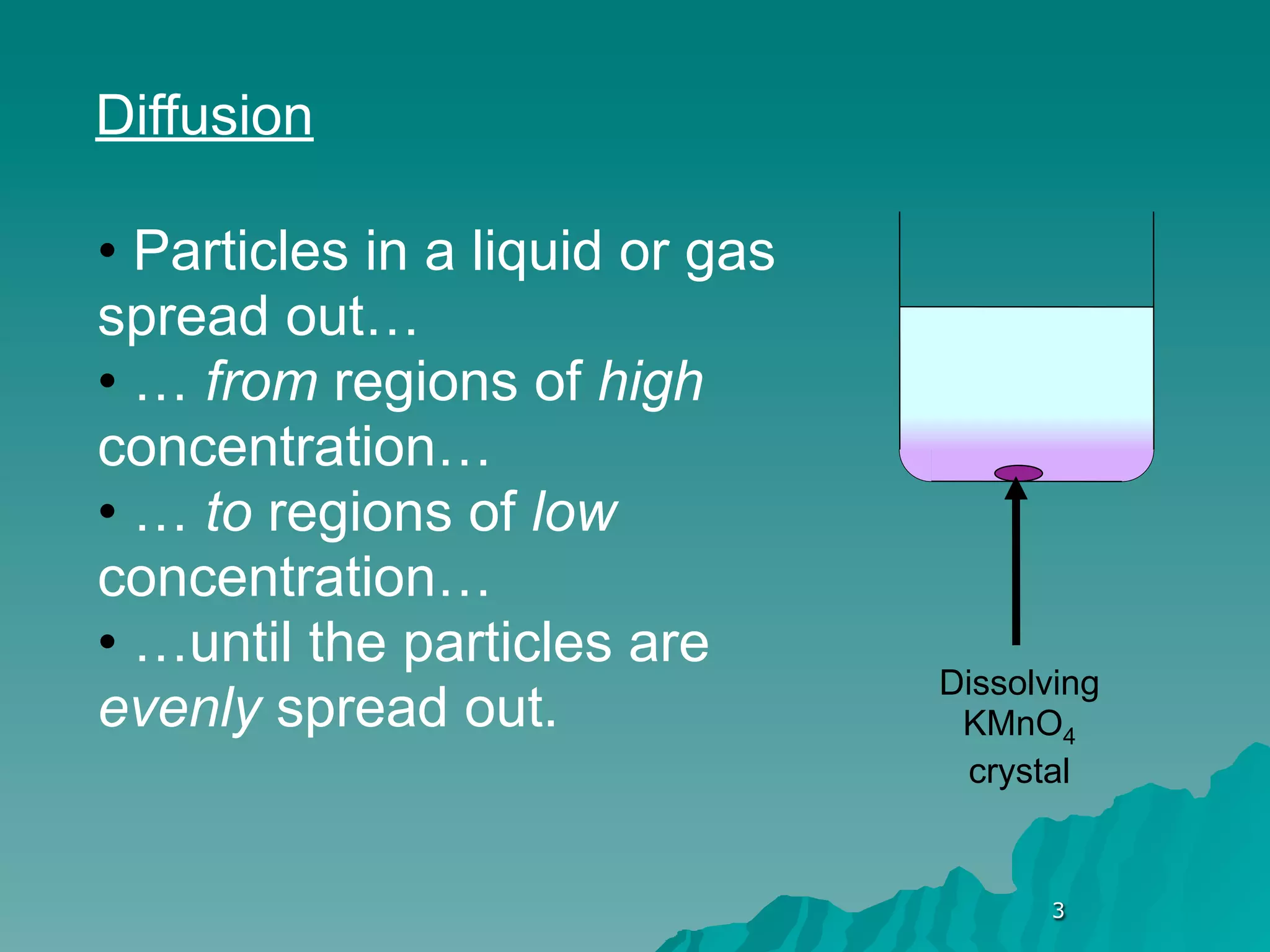
Diffusion

• Particles in a liquid or gas
spread out…
• … from regions of high
concentration…
• … to regions of low
concentration…
• …until the particles are
                                 Dissolving
evenly spread out.                KMnO4
                                   crystal


                                       3
Examples
   Perfume - perfume gas molecules diffuse into the
    air when put on so you can smell it.
   Air freshener/deodorant - same concept as
    above.
   Any smell (flower fragrance, garbage stink,
    skunk, body odor xD)
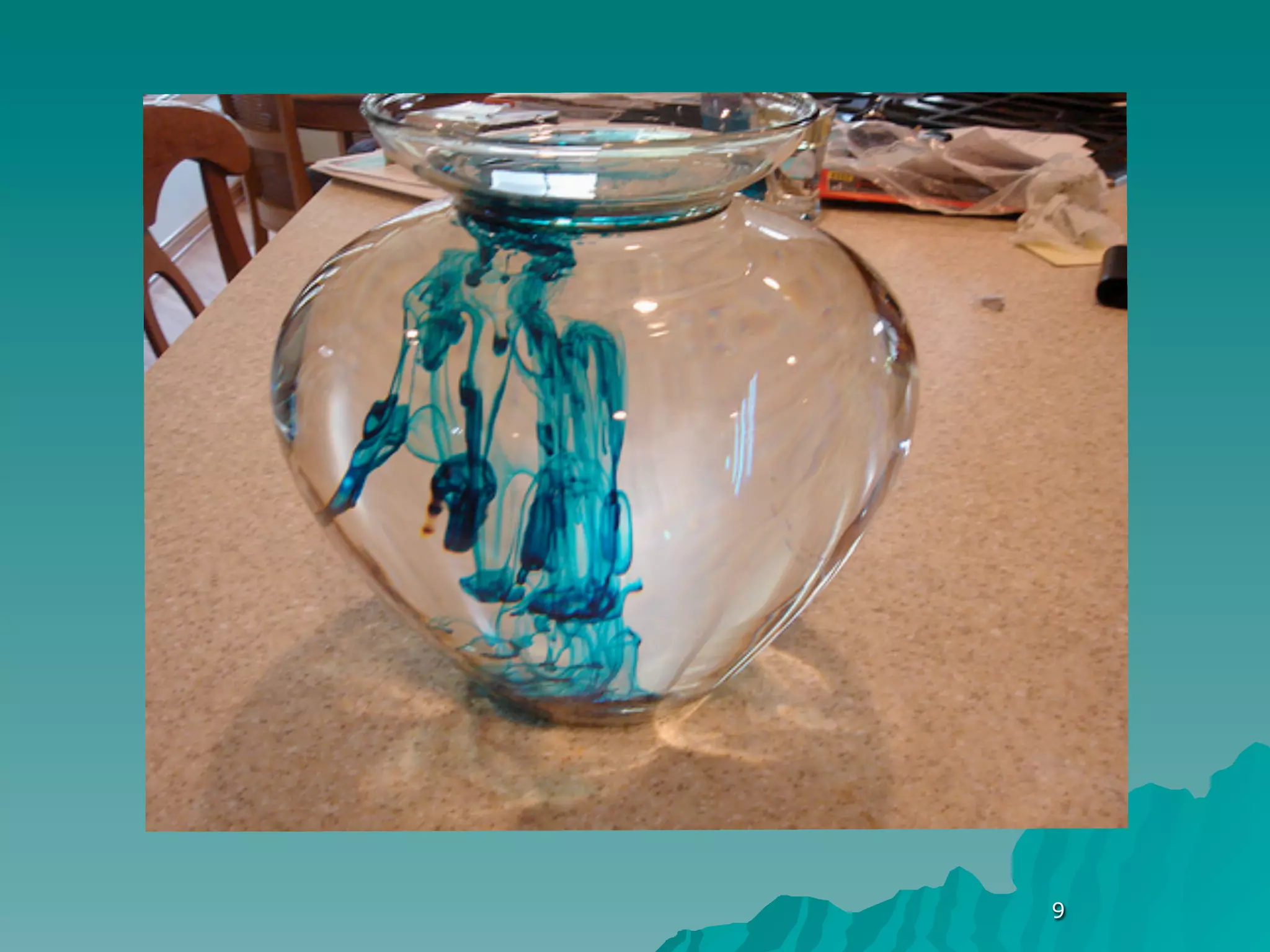
   Drop a drop of ink into a glass of water - the ink
    would diffuse
   Teabag diffusion - tea leaves diffuse through
    teabag to give the water its color and taste of
    tea
   Cigarette smoke - it diffuses into the air and
    spreads throughout the room
                                              4
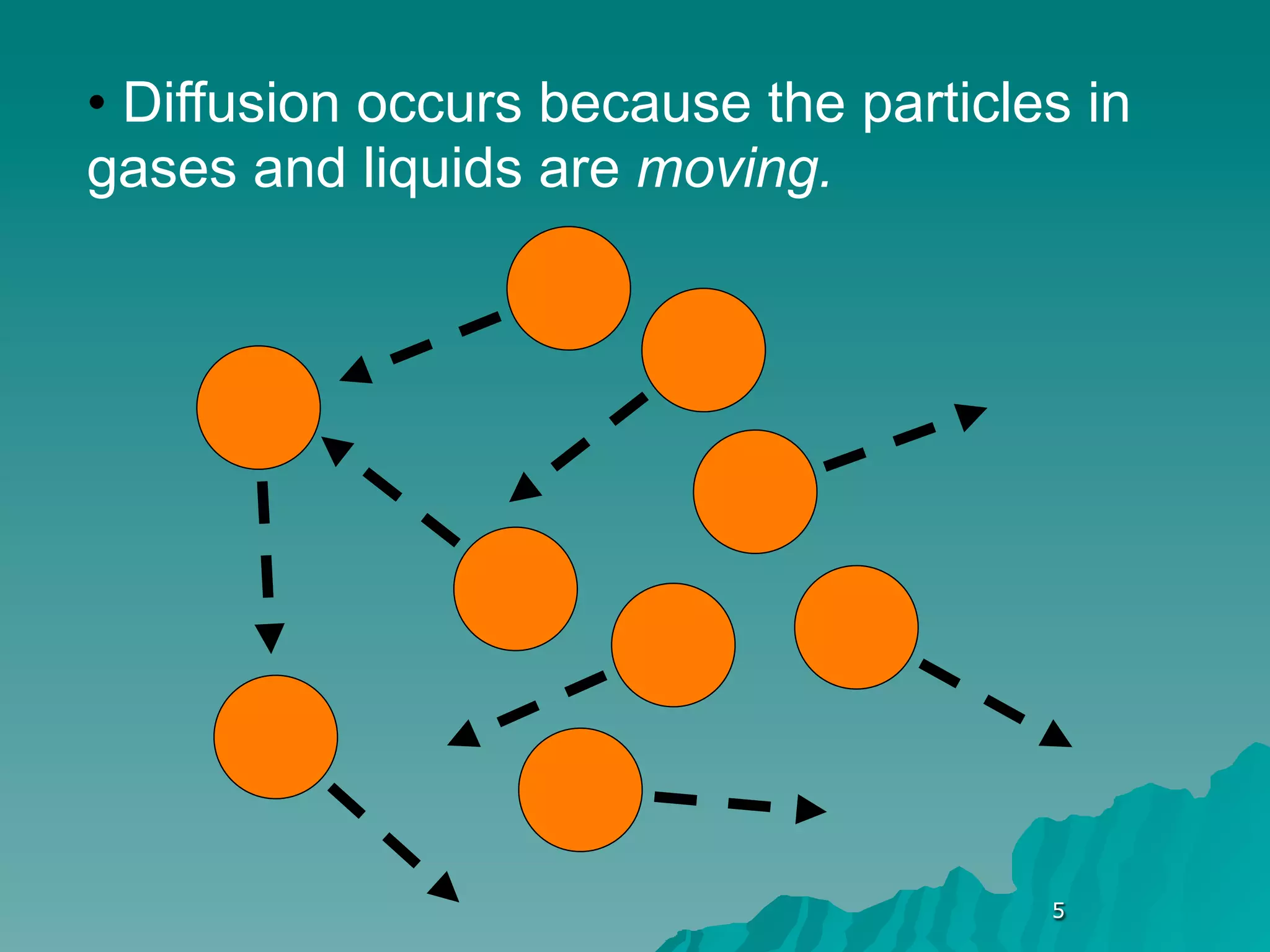
• Diffusion occurs because the particles in
gases and liquids are moving.


                                       5
• Diffusion occurs because the particles in
gases and liquids are moving.


                                       5
Dissolving substances in water


                                 6
Dissolving substances in water

• The molecules in liquid water are constantly moving


                                                  6
Dissolving substances in water

• The molecules in liquid water are constantly moving

• When water molecules bump into particles of a soluble
substance, they stick to them


                                                  6
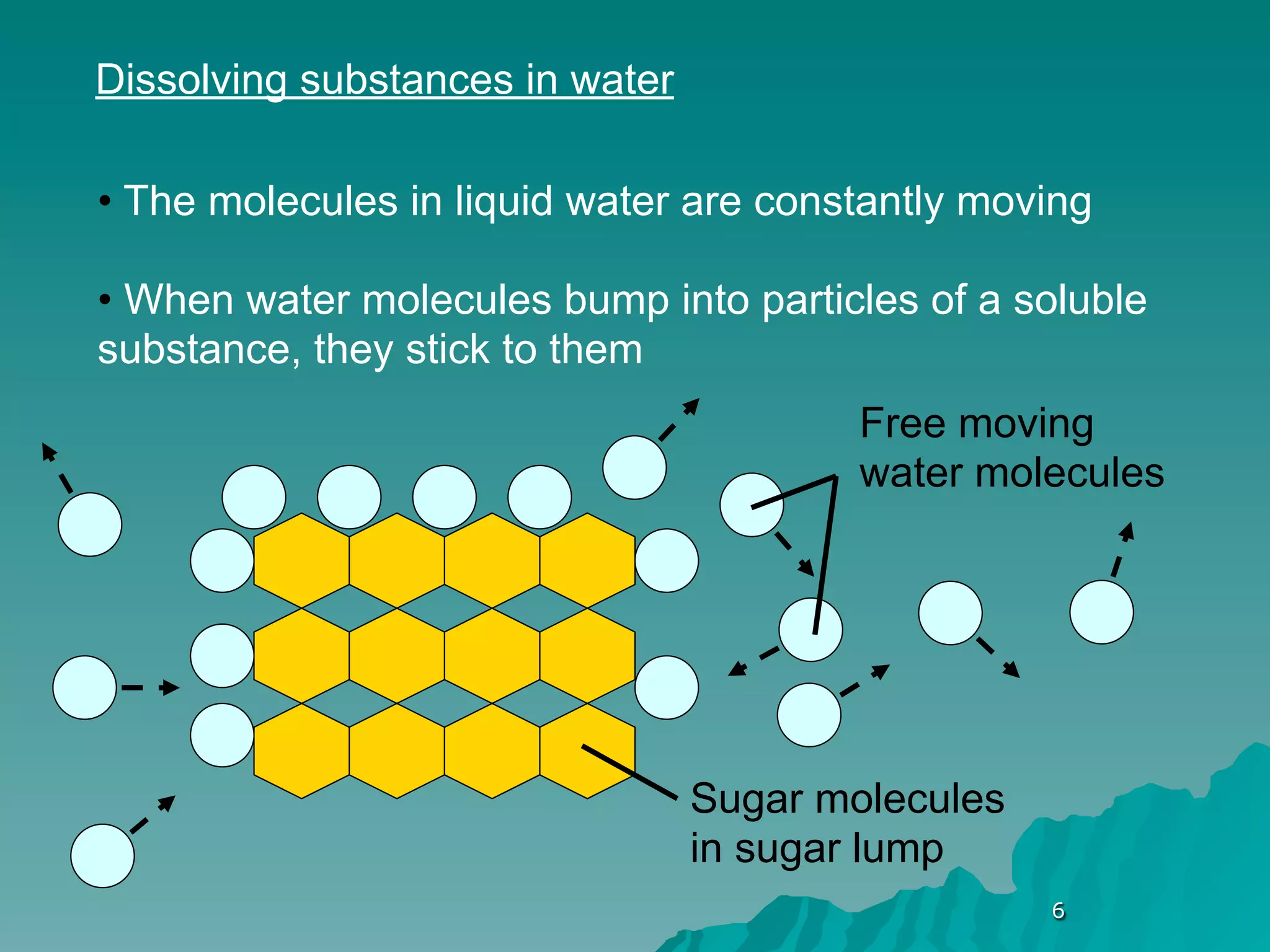
Dissolving substances in water

• The molecules in liquid water are constantly moving

• When water molecules bump into particles of a soluble
substance, they stick to them
                                         Free moving
                                         water molecules


                                 Sugar molecules
                                 in sugar lump
                                                   6
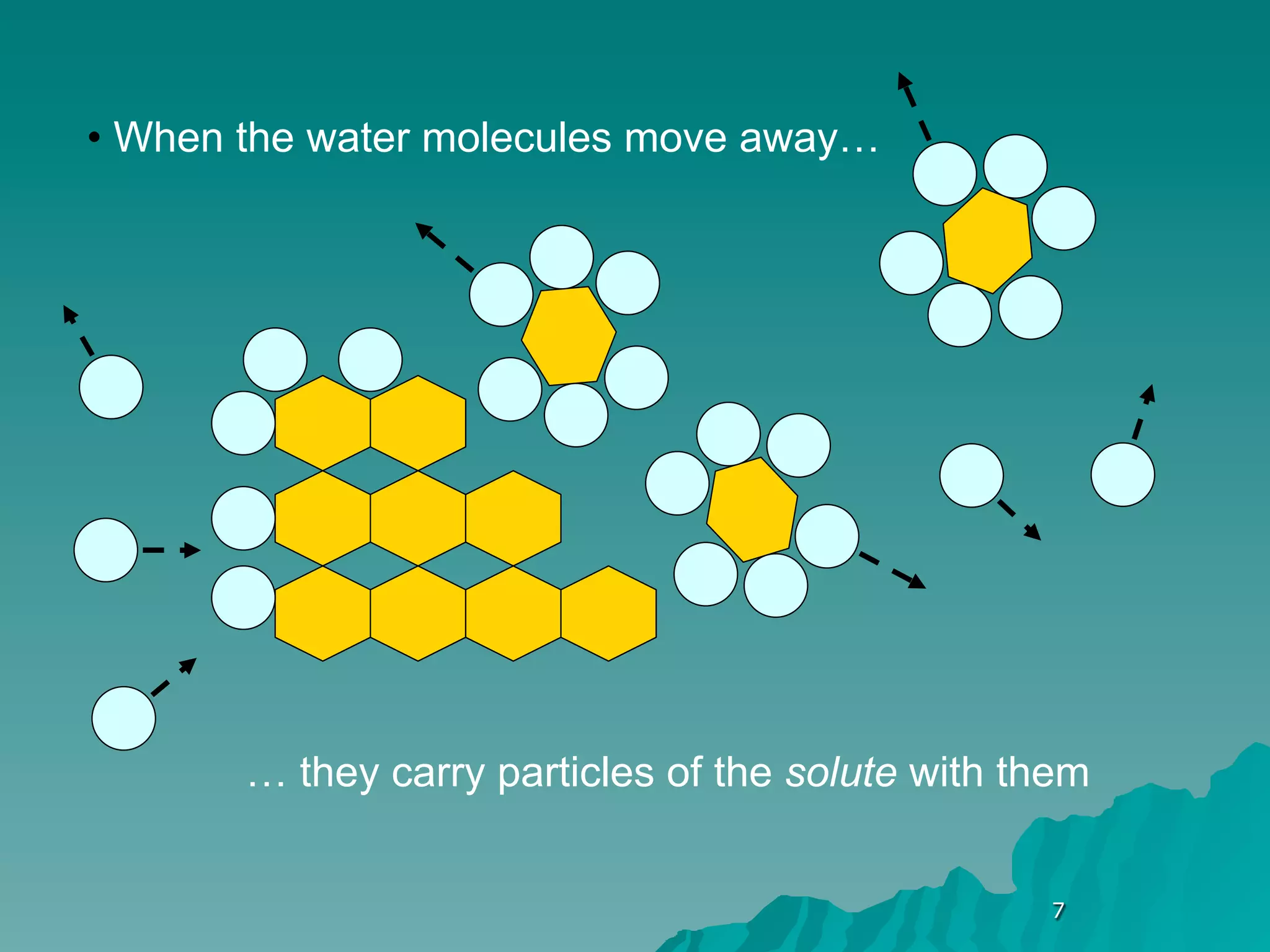
• When the water molecules move away…


                                        7
• When the water molecules move away…


                                        7
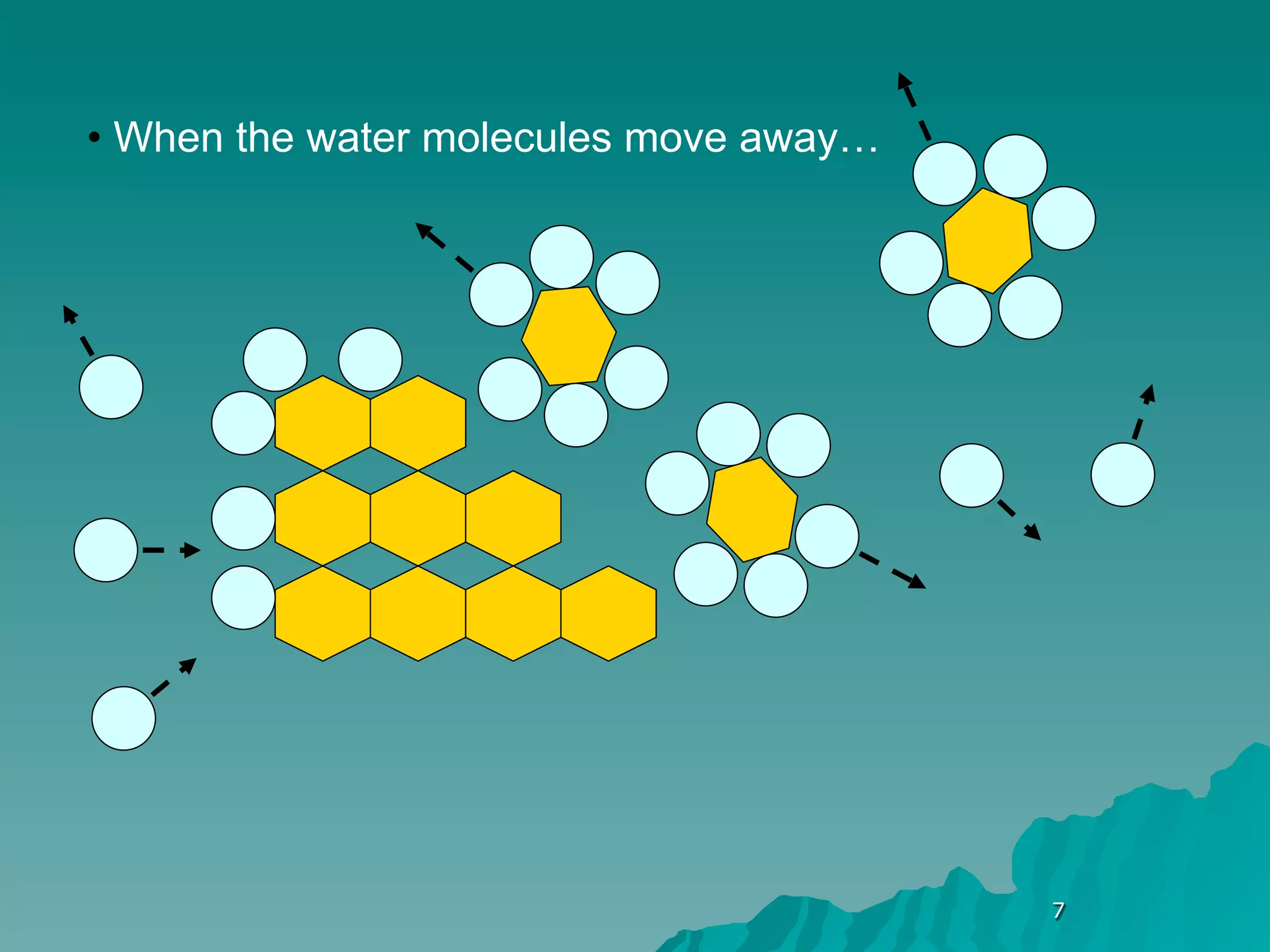
• When the water molecules move away…


       … they carry particles of the solute with them


                                                  7
9
See animations of
       diffusion here:
http://highered.mcgraw-hill.com/sites/0072495855/
student_view0/chapter2/
animation__how_diffusion_works.html


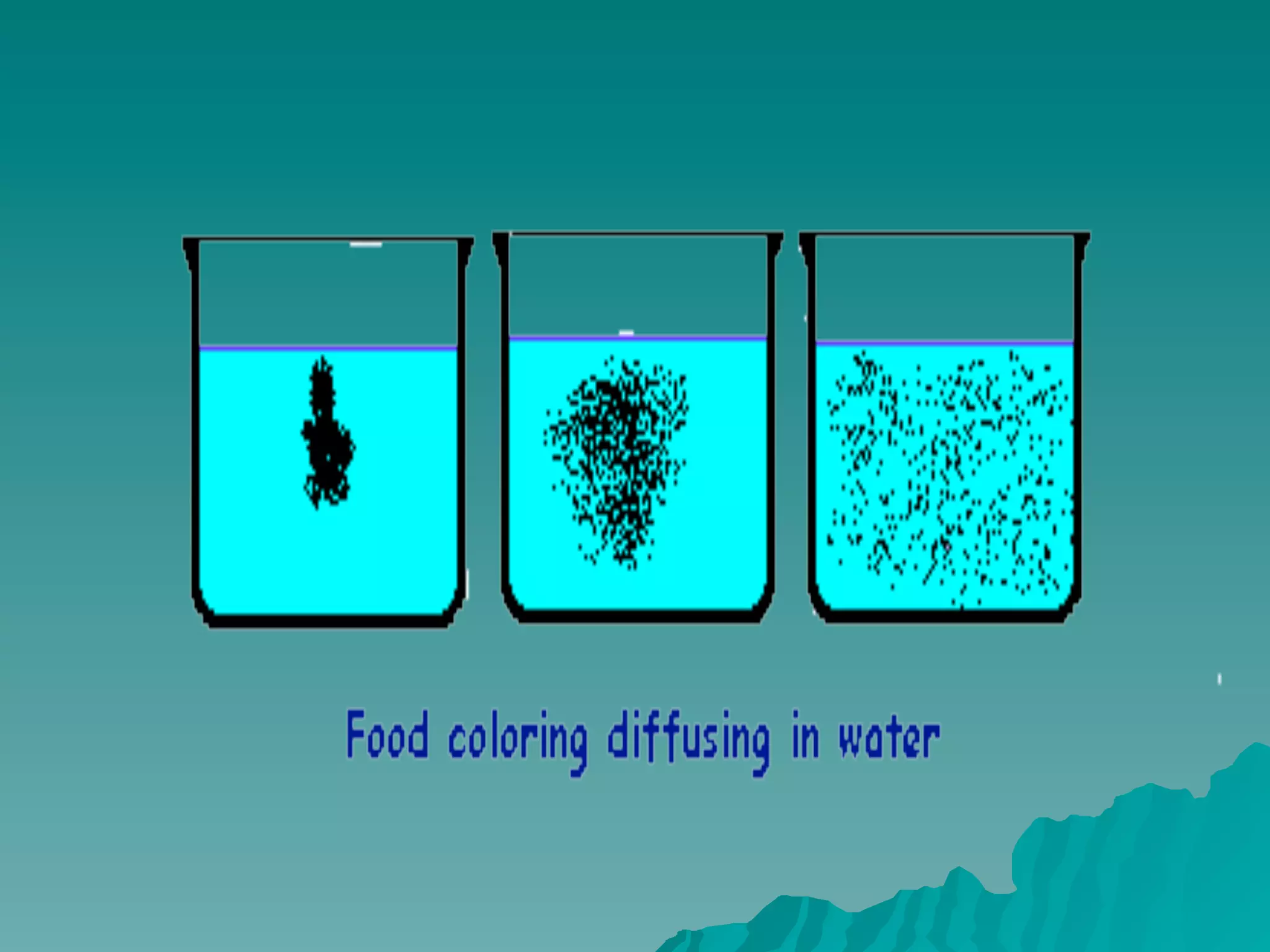
       FOOD COLORING DIFFUSION

 http://www.youtube.com/watch?v=STLAJH7_zkY
Define osmosis
 Thediffusion of water across a
 selectively permeable membrane.
Define osmosis
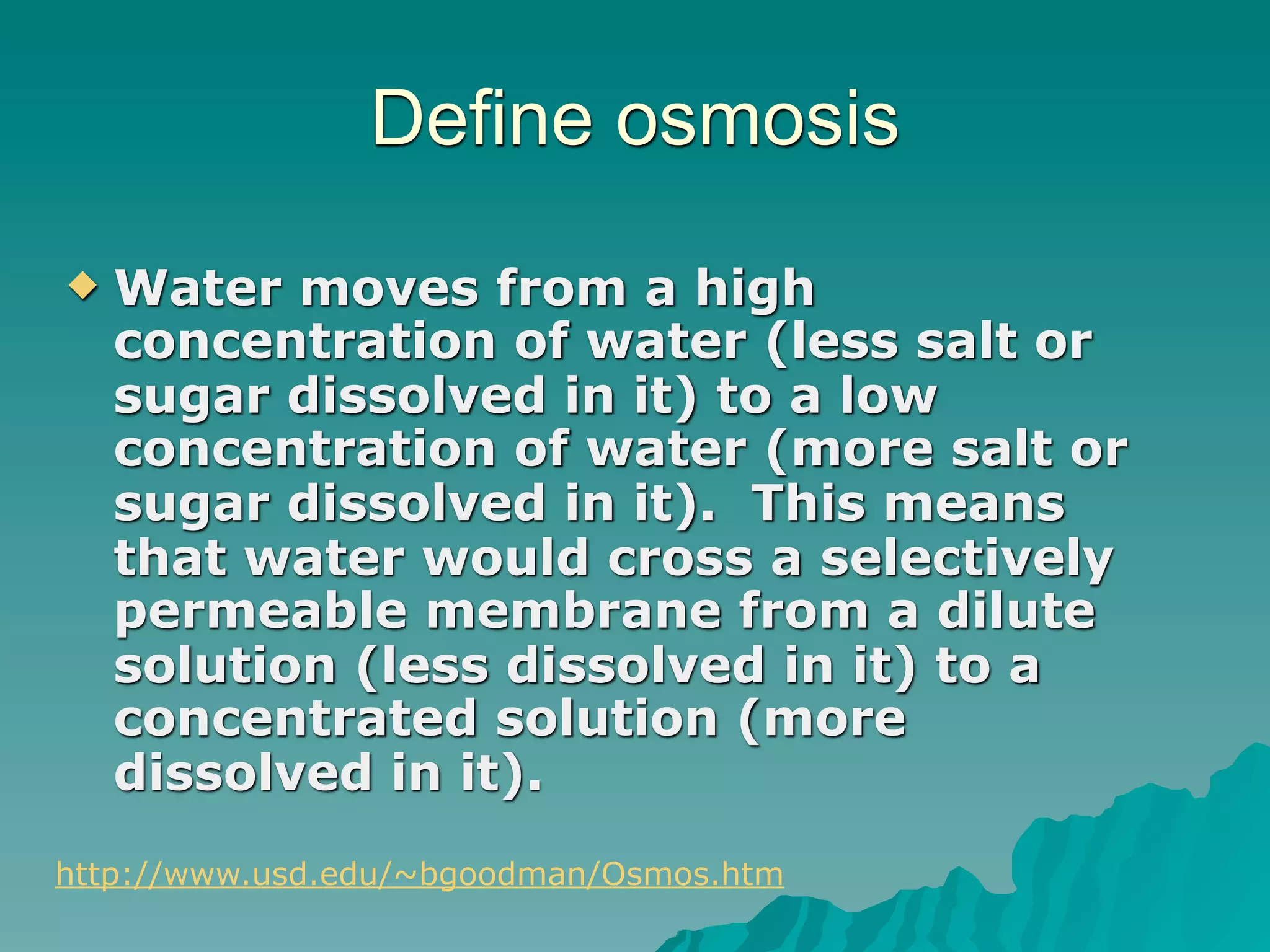
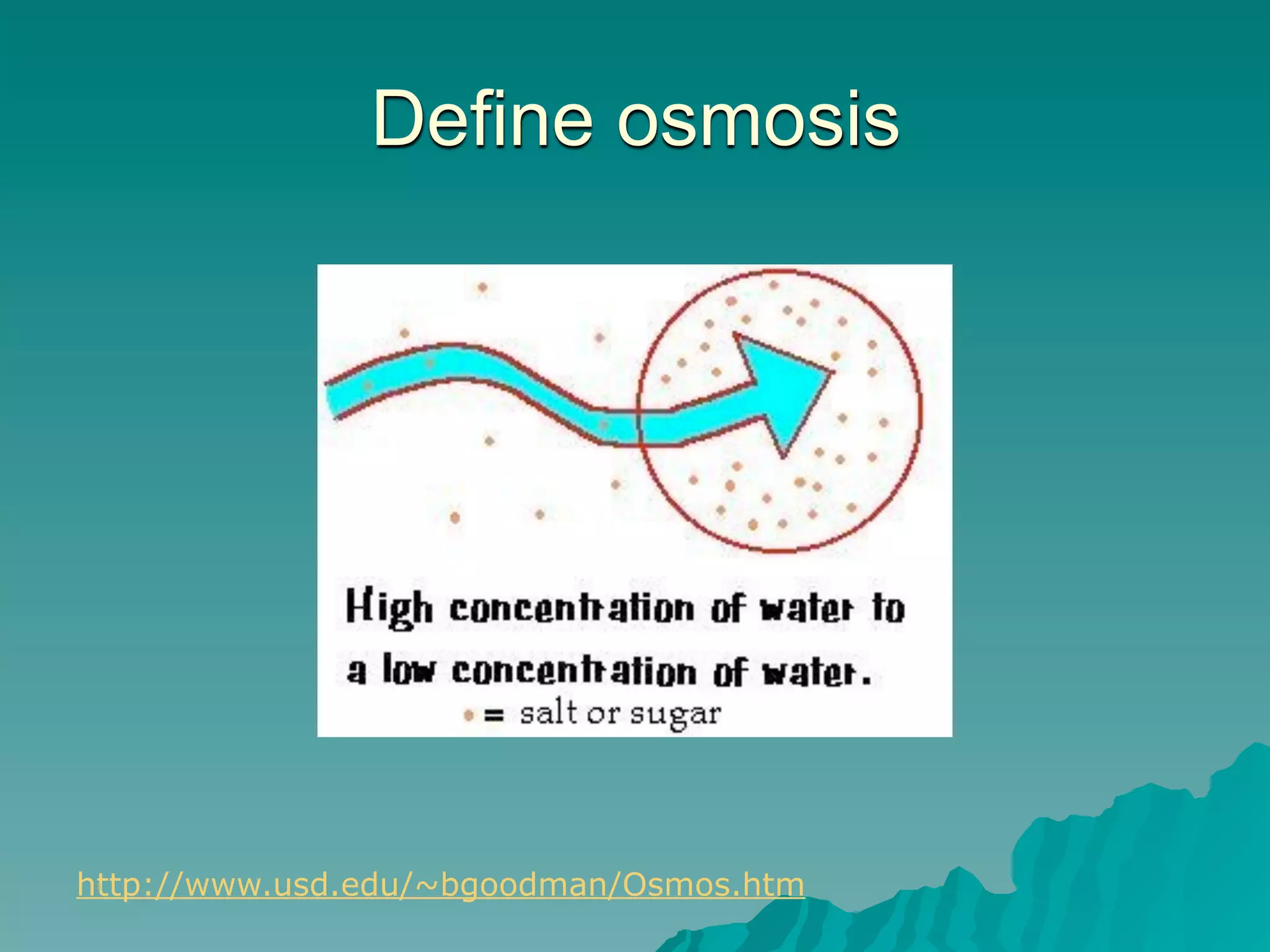
   Water moves from a high
    concentration of water (less salt or
    sugar dissolved in it) to a low
    concentration of water (more salt or
    sugar dissolved in it). This means
    that water would cross a selectively
    permeable membrane from a dilute
    solution (less dissolved in it) to a
    concentrated solution (more
    dissolved in it).
http://www.usd.edu/~bgoodman/Osmos.htm
Define osmosis


http://www.usd.edu/~bgoodman/Osmos.htm
Define osmosis
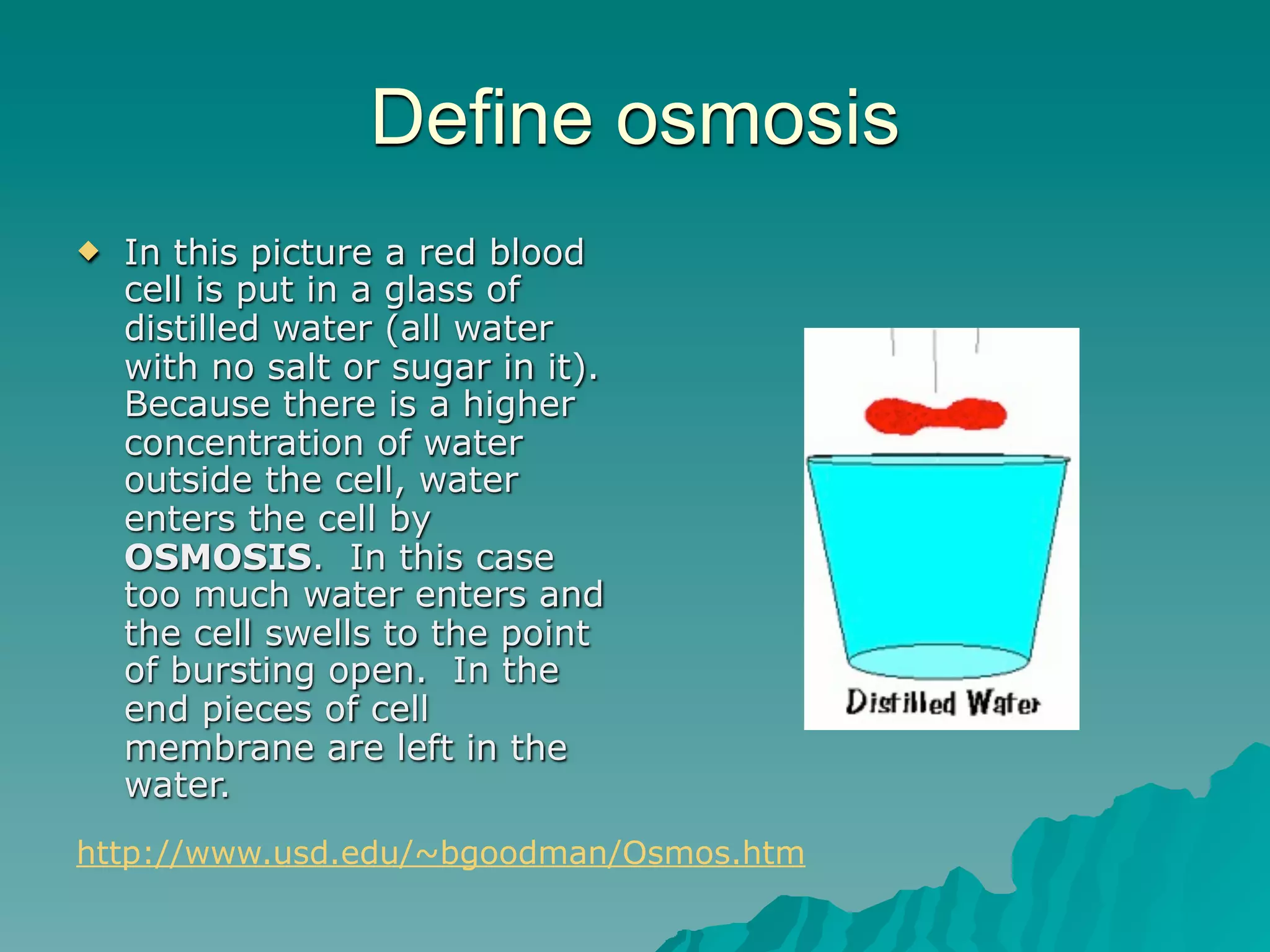
   In this picture a red blood
    cell is put in a glass of
    distilled water (all water
    with no salt or sugar in it).
    Because there is a higher
    concentration of water
    outside the cell, water
    enters the cell by
    OSMOSIS. In this case
    too much water enters and
    the cell swells to the point
    of bursting open. In the
    end pieces of cell
    membrane are left in the
    water.
http://www.usd.edu/~bgoodman/Osmos.htm
See an animation of
  osmosis here:
http://highered.mcgraw-hill.com/sites/0072495855/
student_view0/chapter2/
animation__how_osmosis_works.html


  YOU TUBE OSMOSIS
  http://www.youtube.com/watch?v=sdiJtDRJQEc
Define selectively permeable
              membrane
A membrane that allows only certain
  materials to cross it
 Materials pass through pores in the
  membrane
Partially-Permeable Membranes


                                17
Partially-Permeable Membranes

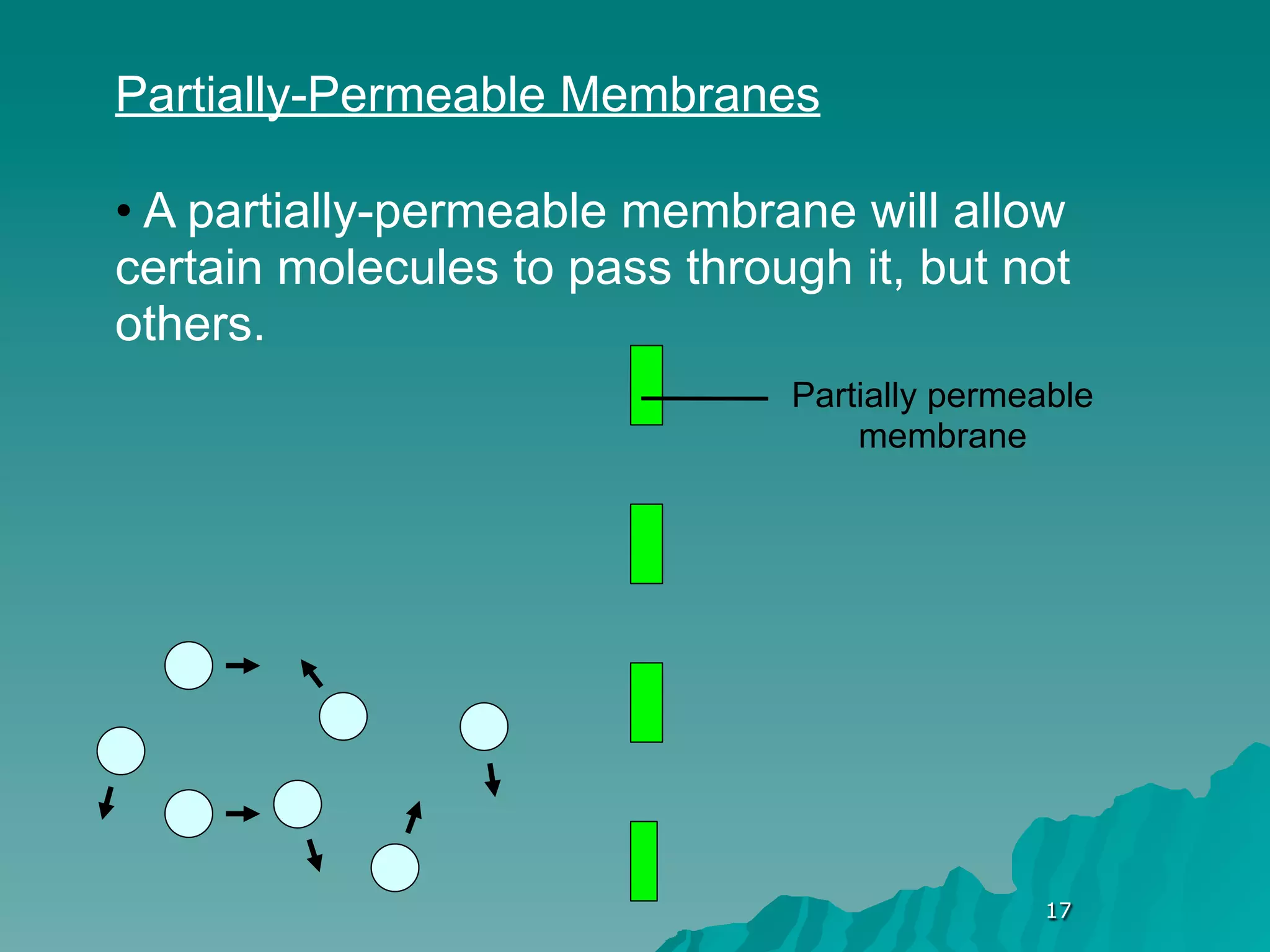
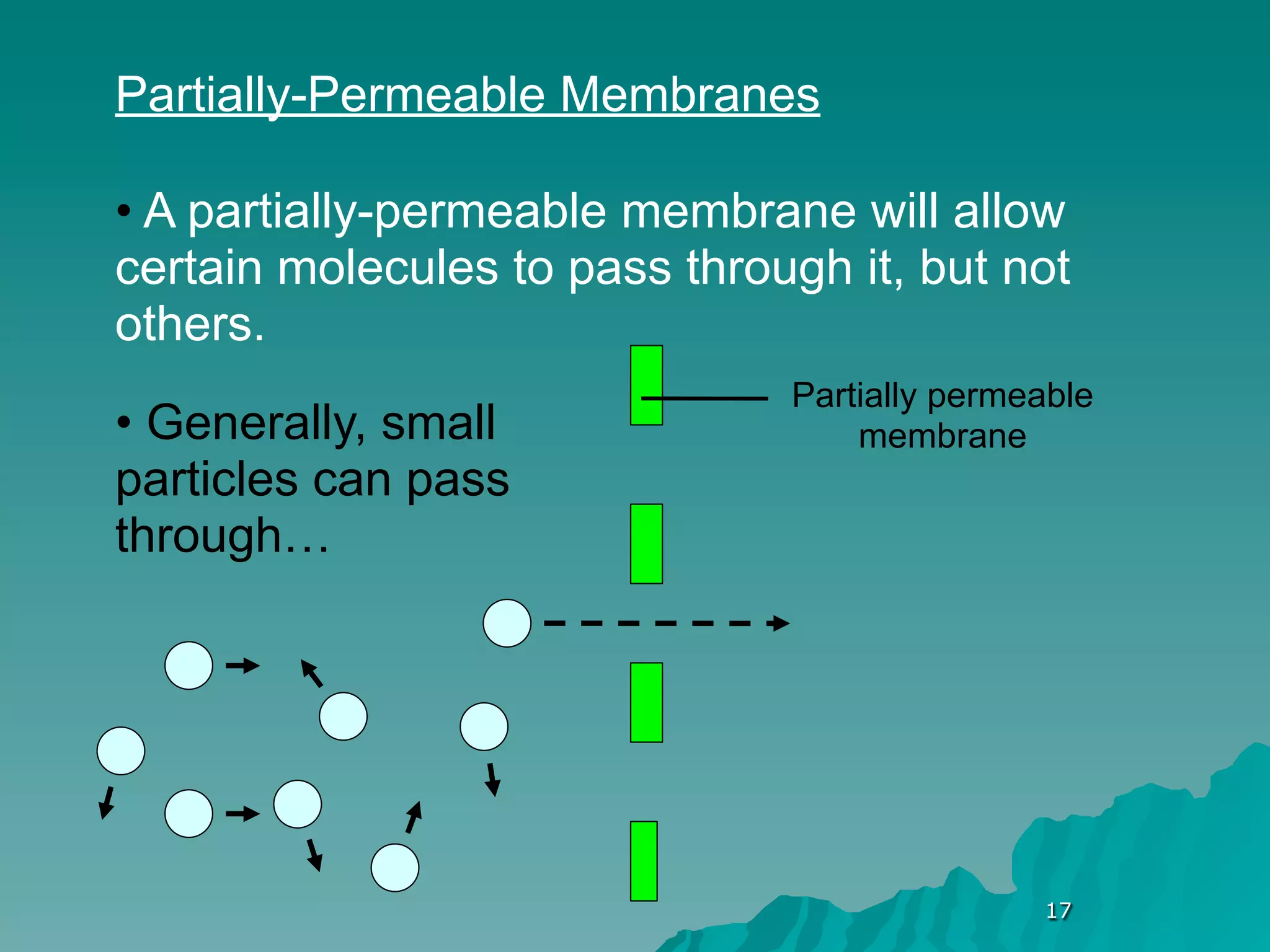
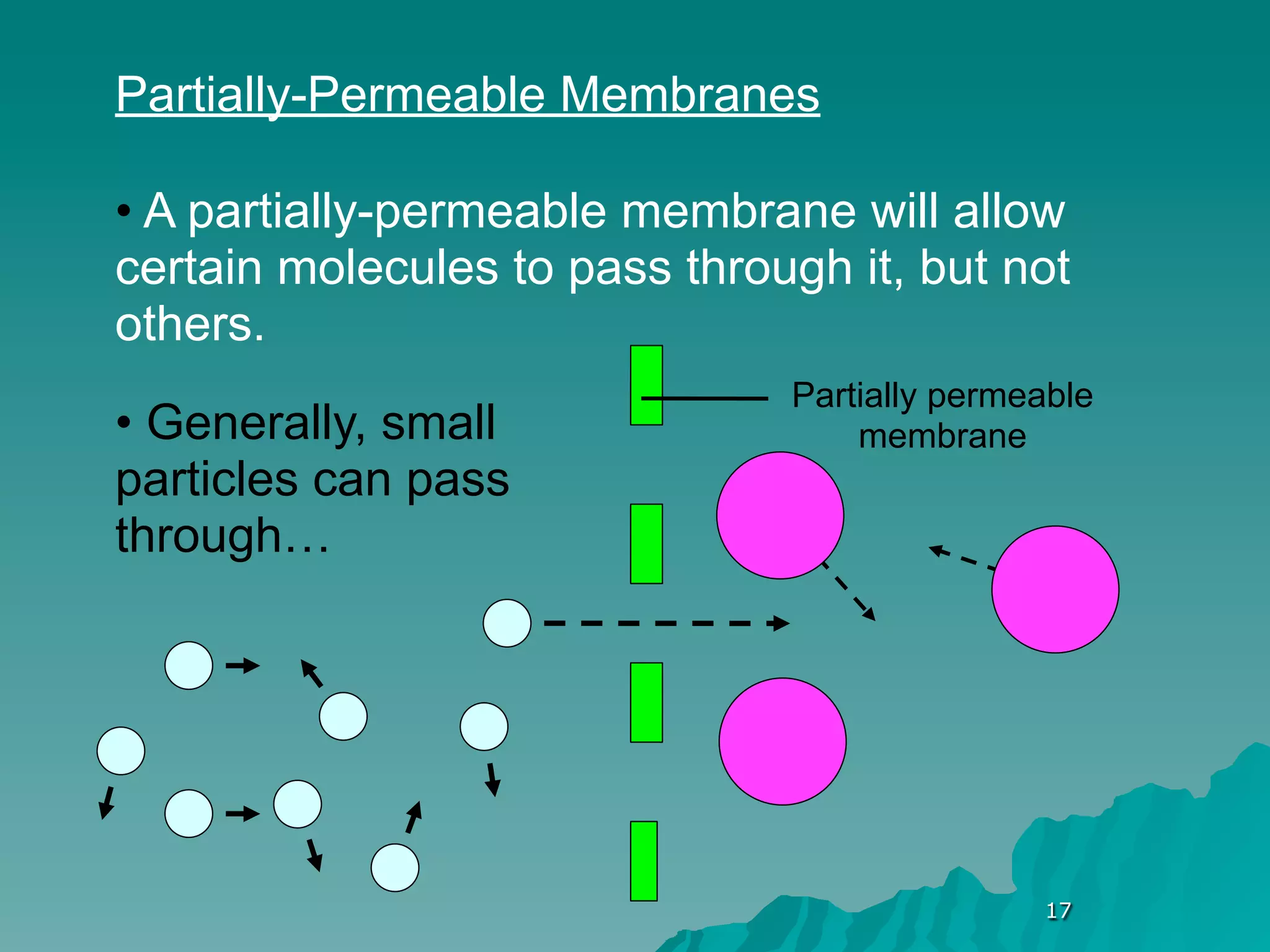
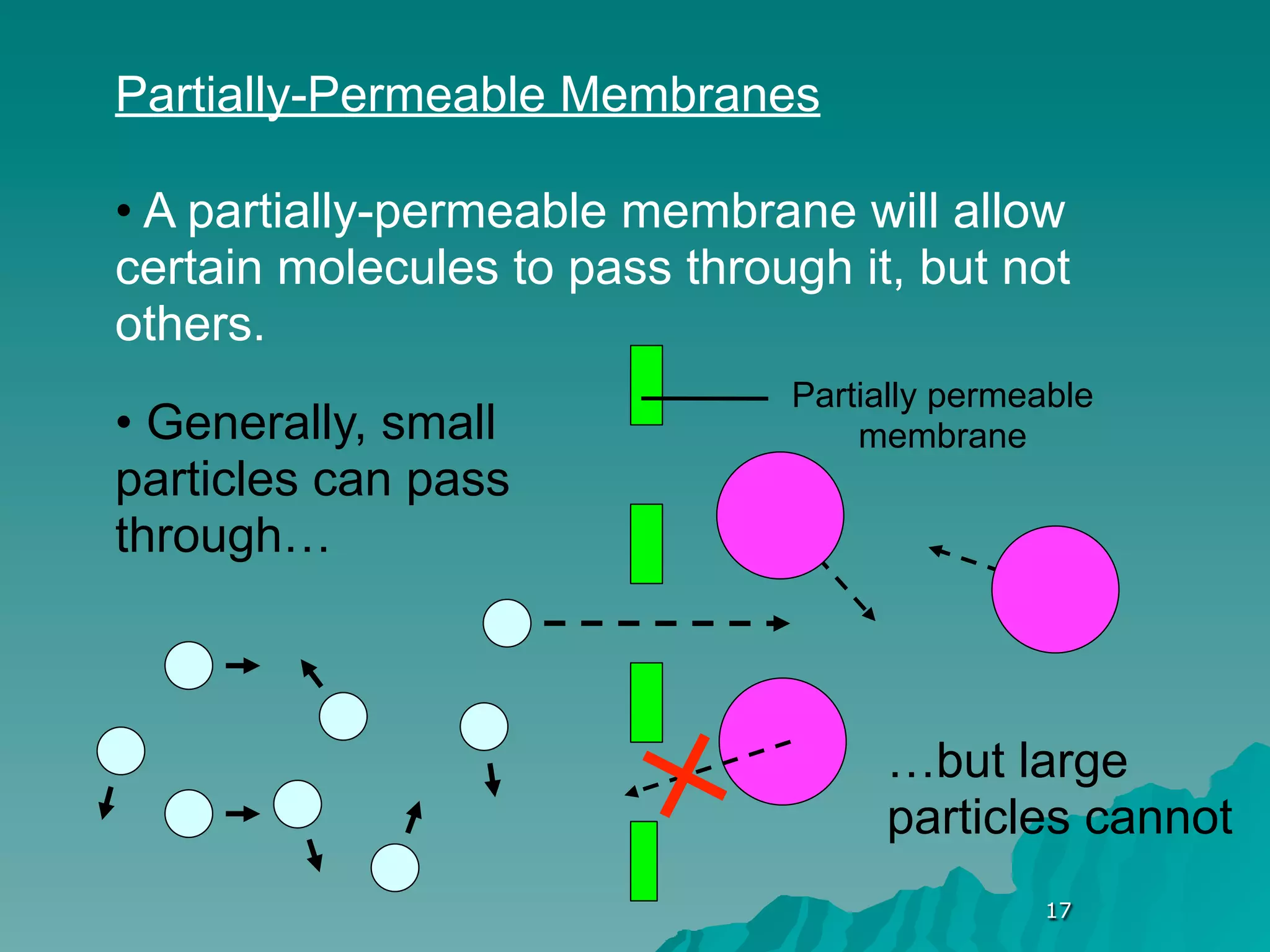
• A partially-permeable membrane will allow
certain molecules to pass through it, but not
others.


                                           17
Partially-Permeable Membranes

• A partially-permeable membrane will allow
certain molecules to pass through it, but not
others.
                               Partially permeable
                                   membrane


                                              17
Partially-Permeable Membranes

• A partially-permeable membrane will allow
certain molecules to pass through it, but not
others.
                               Partially permeable
• Generally, small                 membrane
particles can pass
through…


                                              17
Partially-Permeable Membranes

• A partially-permeable membrane will allow
certain molecules to pass through it, but not
others.
                               Partially permeable
• Generally, small                 membrane
particles can pass
through…


                                              17
Partially-Permeable Membranes

• A partially-permeable membrane will allow
certain molecules to pass through it, but not
others.
                               Partially permeable
• Generally, small                 membrane
particles can pass
through…


                                    …but large
                                    particles cannot
                                              17
Why are osmosis &
diffusion important?
Why are osmosis & diffusion
            important?
 All living things have certain requirements
  they must satisfy in order to remain alive
  – maintain homeostasis
 These include exchanging gases (usually
  CO2 and O2), taking in water, minerals,
  and food, and eliminating wastes.
 These tasks happen at the cellular level.

 Molecules move through the cell
  membrane by diffusion
Why are osmosis & diffusion
            important?
 Allliving things have certain
  requirements they must satisfy in
  order to remain alive. These include
  exchanging gases (usually CO2 and
  O2), taking in water, minerals, and
  food, and eliminating wastes. These
  tasks ultimately occur at the cellular
  level, and require that molecules
  move through the membrane that
  surrounds the cell.
Why are osmosis & diffusion
            important?
 Thismembrane is a complex
 structure that is responsible for
 separating the contents of the cell
 from its surroundings, for controlling
 the movement of materials into and
 out of the cell, and for interacting
 with the environment surrounding
 the cell.

Diffusion osmosis

  • 1.
  • 2.
    Define Diffusion The movementof molecules from a area in which they are highly concentrated to an area in which they are less concentrated.
  • 3.
  • 4.
    Diffusion • Particles ina liquid or gas spread out… 3
  • 5.
    Diffusion • Particles ina liquid or gas spread out… • … from regions of high concentration… 3
  • 6.
    Diffusion • Particles ina liquid or gas spread out… • … from regions of high concentration… • … to regions of low concentration… 3
  • 7.
    Diffusion • Particles ina liquid or gas spread out… • … from regions of high concentration… • … to regions of low concentration… • …until the particles are evenly spread out. 3
  • 8.
    Diffusion • Particles ina liquid or gas spread out… • … from regions of high concentration… • … to regions of low concentration… • …until the particles are Dissolving evenly spread out. KMnO4 crystal 3
  • 9.
    Examples  Perfume - perfume gas molecules diffuse into the air when put on so you can smell it.  Air freshener/deodorant - same concept as above.  Any smell (flower fragrance, garbage stink, skunk, body odor xD)  Drop a drop of ink into a glass of water - the ink would diffuse  Teabag diffusion - tea leaves diffuse through teabag to give the water its color and taste of tea  Cigarette smoke - it diffuses into the air and spreads throughout the room 4
  • 10.
    • Diffusion occursbecause the particles in gases and liquids are moving. 5
  • 11.
    • Diffusion occursbecause the particles in gases and liquids are moving. 5
  • 12.
  • 13.
    Dissolving substances inwater • The molecules in liquid water are constantly moving 6
  • 14.
    Dissolving substances inwater • The molecules in liquid water are constantly moving • When water molecules bump into particles of a soluble substance, they stick to them 6
  • 15.
    Dissolving substances inwater • The molecules in liquid water are constantly moving • When water molecules bump into particles of a soluble substance, they stick to them Free moving water molecules Sugar molecules in sugar lump 6
  • 16.
    • When thewater molecules move away… 7
  • 17.
    • When thewater molecules move away… 7
  • 18.
    • When thewater molecules move away… … they carry particles of the solute with them 7
  • 20.
  • 21.
    See animations of diffusion here: http://highered.mcgraw-hill.com/sites/0072495855/ student_view0/chapter2/ animation__how_diffusion_works.html FOOD COLORING DIFFUSION http://www.youtube.com/watch?v=STLAJH7_zkY
  • 22.
    Define osmosis  Thediffusionof water across a selectively permeable membrane.
  • 23.
    Define osmosis  Water moves from a high concentration of water (less salt or sugar dissolved in it) to a low concentration of water (more salt or sugar dissolved in it). This means that water would cross a selectively permeable membrane from a dilute solution (less dissolved in it) to a concentrated solution (more dissolved in it). http://www.usd.edu/~bgoodman/Osmos.htm
  • 24.
  • 25.
    Define osmosis  In this picture a red blood cell is put in a glass of distilled water (all water with no salt or sugar in it). Because there is a higher concentration of water outside the cell, water enters the cell by OSMOSIS. In this case too much water enters and the cell swells to the point of bursting open. In the end pieces of cell membrane are left in the water. http://www.usd.edu/~bgoodman/Osmos.htm
  • 26.
    See an animationof osmosis here: http://highered.mcgraw-hill.com/sites/0072495855/ student_view0/chapter2/ animation__how_osmosis_works.html YOU TUBE OSMOSIS http://www.youtube.com/watch?v=sdiJtDRJQEc
  • 27.
    Define selectively permeable membrane A membrane that allows only certain materials to cross it  Materials pass through pores in the membrane
  • 28.
  • 29.
    Partially-Permeable Membranes • Apartially-permeable membrane will allow certain molecules to pass through it, but not others. 17
  • 30.
    Partially-Permeable Membranes • Apartially-permeable membrane will allow certain molecules to pass through it, but not others. Partially permeable membrane 17
  • 31.
    Partially-Permeable Membranes • Apartially-permeable membrane will allow certain molecules to pass through it, but not others. Partially permeable • Generally, small membrane particles can pass through… 17
  • 32.
    Partially-Permeable Membranes • Apartially-permeable membrane will allow certain molecules to pass through it, but not others. Partially permeable • Generally, small membrane particles can pass through… 17
  • 33.
    Partially-Permeable Membranes • Apartially-permeable membrane will allow certain molecules to pass through it, but not others. Partially permeable • Generally, small membrane particles can pass through… …but large particles cannot 17
  • 34.
    Why are osmosis& diffusion important?
  • 35.
    Why are osmosis& diffusion important?  All living things have certain requirements they must satisfy in order to remain alive – maintain homeostasis  These include exchanging gases (usually CO2 and O2), taking in water, minerals, and food, and eliminating wastes.  These tasks happen at the cellular level.  Molecules move through the cell membrane by diffusion
  • 36.
    Why are osmosis& diffusion important?  Allliving things have certain requirements they must satisfy in order to remain alive. These include exchanging gases (usually CO2 and O2), taking in water, minerals, and food, and eliminating wastes. These tasks ultimately occur at the cellular level, and require that molecules move through the membrane that surrounds the cell.
  • 37.
    Why are osmosis& diffusion important?  Thismembrane is a complex structure that is responsible for separating the contents of the cell from its surroundings, for controlling the movement of materials into and out of the cell, and for interacting with the environment surrounding the cell.