Diffusion and Osmosis
A Brief Look at Cell Membranes
What is Diffusion?
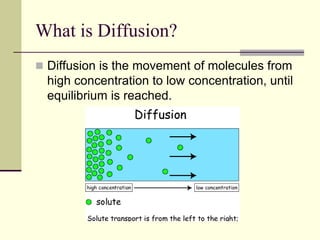
 Diffusion is the movement of molecules from
high concentration to low concentration, until
equilibrium is reached.
What is Equilibrium?
 Static equilibrium: no change in the system
is occurring.
 For example, a
bucket of water
is in equilibrium
because there is
no change
occurring to it.
What is Equilibrium?
 For example, a
bucket of water
with a hole in it is
releasing water. At
the same time
more water is
being poured in the
bucket at the same
rate it is pouring
out.
 Dynamic equilibrium: changes in the system
are occurring, but at the same rate as one
another.
For Example…
 Suppose you have a balloon filled with
helium. As you know this balloon will not float
forever and after a day or so will eventually
shrink and remain on the ground.
 This is an example of diffusion. The helium
slowly escapes the balloon across the
surface until the concentration is equal on
both sides.
 Why is it some balloons float for longer
periods of time than others?
How is this Important?
 Diffusion is an important
concept for humans
because our very
existence depends on it.
 The cells of the human
body utilize diffusion
every day!
 Can you think of where
in the human body
diffusion might be
important?
Osmosis
 Osmosis can be defined as diffusion across a
semi-permeable membrane.
 Osmosis is a special case of diffusion
commonly found in biological systems (e.g.
your cells).
 Water transport and turgor pressure in the
cell is maintained by osmosis.
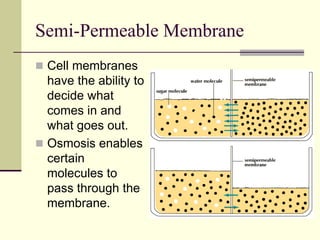
Semi-Permeable Membrane
 Cell membranes
have the ability to
decide what
comes in and
what goes out.
 Osmosis enables
certain
molecules to
pass through the
membrane.
Turgor Pressure
 Turgor: pressure against the cell membrane
 Hypotonic: there is an excess of water and
the cell bursts.
 Hypertonic: there is not enough water and the
cells shrivels.
 Osmosis
regulates these
occurrences.
How is Osmosis Useful to Us?
 Reverse osmosis is used in every day
applications like desalination, water
purification, water treatment and food
processing.
 Forward osmosis is currently being
researched to also perform these processes.
Works Cited
 http://biology.arizona.edu/sciconn/lessons/mc
candless/reading.html
 www.educypedia.be/education/biologycelldiff
usion.htm
 http://en.wikipedia.org/wiki/Diffusion
 http://en.wikipedia.org/wiki/Osmosis

Diffusion-and-Osmosis.ppt

  • 1.
    Diffusion and Osmosis ABrief Look at Cell Membranes
  • 2.
    What is Diffusion? Diffusion is the movement of molecules from high concentration to low concentration, until equilibrium is reached.
  • 3.
    What is Equilibrium? Static equilibrium: no change in the system is occurring.  For example, a bucket of water is in equilibrium because there is no change occurring to it.
  • 4.
    What is Equilibrium? For example, a bucket of water with a hole in it is releasing water. At the same time more water is being poured in the bucket at the same rate it is pouring out.  Dynamic equilibrium: changes in the system are occurring, but at the same rate as one another.
  • 5.
    For Example…  Supposeyou have a balloon filled with helium. As you know this balloon will not float forever and after a day or so will eventually shrink and remain on the ground.  This is an example of diffusion. The helium slowly escapes the balloon across the surface until the concentration is equal on both sides.  Why is it some balloons float for longer periods of time than others?
  • 6.
    How is thisImportant?  Diffusion is an important concept for humans because our very existence depends on it.  The cells of the human body utilize diffusion every day!  Can you think of where in the human body diffusion might be important?
  • 7.
    Osmosis  Osmosis canbe defined as diffusion across a semi-permeable membrane.  Osmosis is a special case of diffusion commonly found in biological systems (e.g. your cells).  Water transport and turgor pressure in the cell is maintained by osmosis.
  • 8.
    Semi-Permeable Membrane  Cellmembranes have the ability to decide what comes in and what goes out.  Osmosis enables certain molecules to pass through the membrane.
  • 9.
    Turgor Pressure  Turgor:pressure against the cell membrane  Hypotonic: there is an excess of water and the cell bursts.  Hypertonic: there is not enough water and the cells shrivels.  Osmosis regulates these occurrences.
  • 10.
    How is OsmosisUseful to Us?  Reverse osmosis is used in every day applications like desalination, water purification, water treatment and food processing.  Forward osmosis is currently being researched to also perform these processes.
  • 11.
    Works Cited  http://biology.arizona.edu/sciconn/lessons/mc candless/reading.html www.educypedia.be/education/biologycelldiff usion.htm  http://en.wikipedia.org/wiki/Diffusion  http://en.wikipedia.org/wiki/Osmosis

Editor's Notes

  • #3 Movement of the solutes is due to the concentration of gradient, dC/dx.
  • #6 Some balloons float for a longer period of time because the balloon is thicker, making it more difficult for the helium to diffuse out into the surrounding air.
  • #7 An important place in the human body where diffusion occurs is the lungs. Oxygen diffuses from inside the lungs to the circulatory system.