1
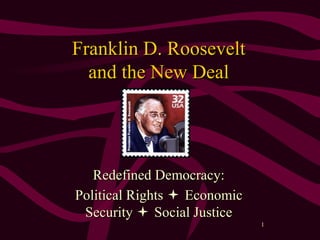
Franklin D. RooseveltFranklin D. Roosevelt
and the New Dealand the New Deal
Redefined Democracy:Redefined Democracy:
Political RightsPolitical Rights  EconomicEconomic
SecuritySecurity  Social JusticeSocial Justice
2
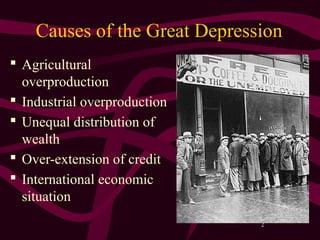
Causes of the Great Depression
 Agricultural
overproduction
 Industrial overproduction
 Unequal distribution of
wealth
 Over-extension of credit
 International economic
situation
3
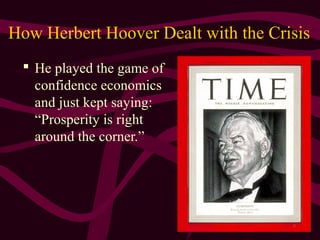
How Herbert Hoover Dealt with the Crisis
 He played the game of
confidence economics
and just kept saying:
“Prosperity is right
around the corner.”
4
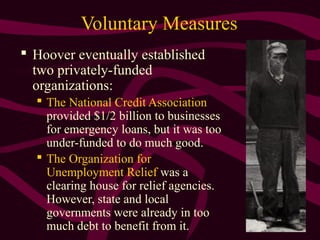
Voluntary Measures
 Hoover eventually established
two privately-funded
organizations:
 The National Credit Association
provided $1/2 billion to businesses
for emergency loans, but it was too
under-funded to do much good.
 The Organization for
Unemployment Relief was a
clearing house for relief agencies.
However, state and local
governments were already in too
much debt to benefit from it.
5
Limited Government
Intervention
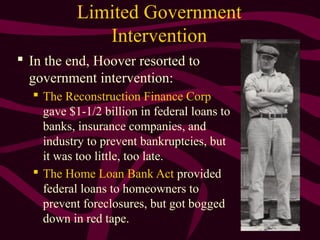
 In the end, Hoover resorted to
government intervention:
 The Reconstruction Finance Corp
gave $1-1/2 billion in federal loans to
banks, insurance companies, and
industry to prevent bankruptcies, but
it was too little, too late.
 The Home Loan Bank Act provided
federal loans to homeowners to
prevent foreclosures, but got bogged
down in red tape.
6
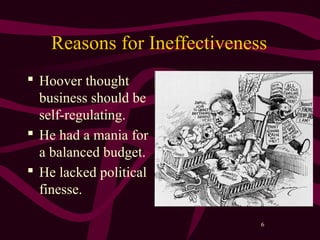
Reasons for Ineffectiveness
 Hoover thought
business should be
self-regulating.
 He had a mania for
a balanced budget.
 He lacked political
finesse.
7
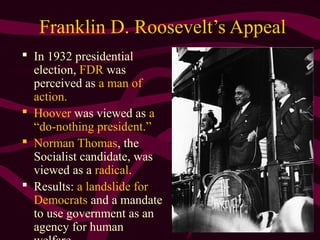
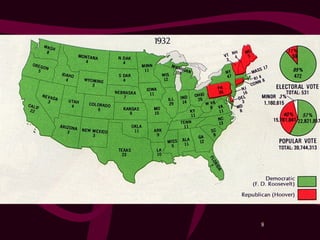
Franklin D. Roosevelt’s Appeal
 In 1932 presidential
election, FDR was
perceived as a man of
action.
 Hoover was viewed as a
“do-nothing president.”
 Norman Thomas, the
Socialist candidate, was
viewed as a radical.
 Results: a landslide for
Democrats and a mandate
to use government as an
agency for human
8
9
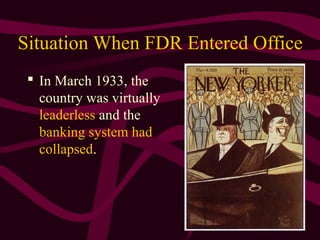
Situation When FDR Entered Office
 In March 1933, the
country was virtually
leaderless and the
banking system had
collapsed.
10
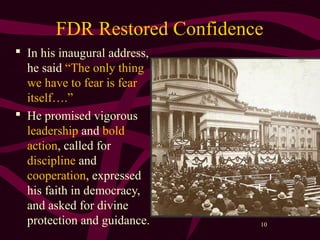
FDR Restored Confidence
 In his inaugural address,
he said “The only thing
we have to fear is fear
itself….”
 He promised vigorous
leadership and bold
action, called for
discipline and
cooperation, expressed
his faith in democracy,
and asked for divine
protection and guidance.
11
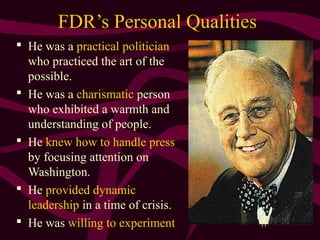
FDR’s Personal Qualities
 He was a practical politician
who practiced the art of the
possible.
 He was a charismatic person
who exhibited a warmth and
understanding of people.
 He knew how to handle press
by focusing attention on
Washington.
 He provided dynamic
leadership in a time of crisis.
 He was willing to experiment
12
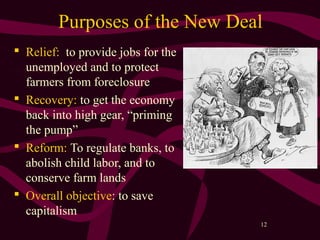
Purposes of the New Deal
 Relief: to provide jobs for the
unemployed and to protect
farmers from foreclosure
 Recovery: to get the economy
back into high gear, “priming
the pump”
 Reform: To regulate banks, to
abolish child labor, and to
conserve farm lands
 Overall objective: to save
capitalism
13
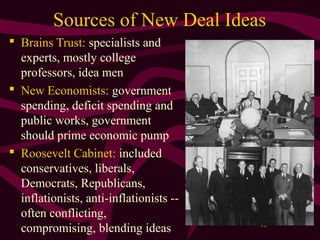
Sources of New Deal Ideas
 Brains Trust: specialists and
experts, mostly college
professors, idea men
 New Economists: government
spending, deficit spending and
public works, government
should prime economic pump
 Roosevelt Cabinet: included
conservatives, liberals,
Democrats, Republicans,
inflationists, anti-inflationists --
often conflicting,
compromising, blending ideas
14
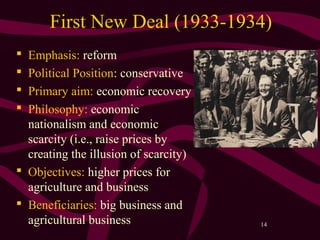
First New Deal (1933-1934)
 Emphasis: reform
 Political Position: conservative
 Primary aim: economic recovery
 Philosophy: economic
nationalism and economic
scarcity (i.e., raise prices by
creating the illusion of scarcity)
 Objectives: higher prices for
agriculture and business
 Beneficiaries: big business and
agricultural business
15
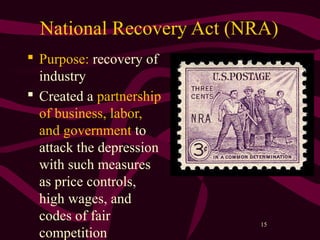
National Recovery Act (NRA)
 Purpose: recovery of
industry
 Created a partnership
of business, labor,
and government to
attack the depression
with such measures
as price controls,
high wages, and
codes of fair
competition
16
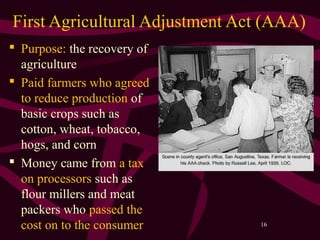
First Agricultural Adjustment Act (AAA)
 Purpose: the recovery of
agriculture
 Paid farmers who agreed
to reduce production of
basic crops such as
cotton, wheat, tobacco,
hogs, and corn
 Money came from a tax
on processors such as
flour millers and meat
packers who passed the
cost on to the consumer
17
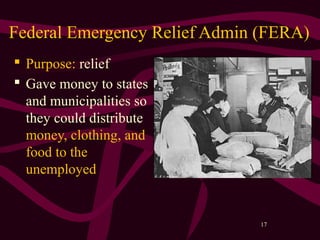
Federal Emergency Relief Admin (FERA)
 Purpose: relief
 Gave money to states
and municipalities so
they could distribute
money, clothing, and
food to the
unemployed
18
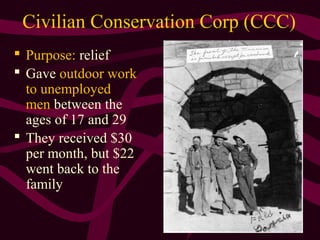
Civilian Conservation Corp (CCC)
 Purpose: relief
 Gave outdoor work
to unemployed
men between the
ages of 17 and 29
 They received $30
per month, but $22
went back to the
family
19
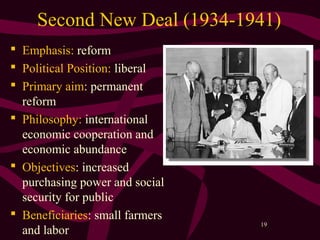
Second New Deal (1934-1941)
 Emphasis: reform
 Political Position: liberal
 Primary aim: permanent
reform
 Philosophy: international
economic cooperation and
economic abundance
 Objectives: increased
purchasing power and social
security for public
 Beneficiaries: small farmers
and labor
20
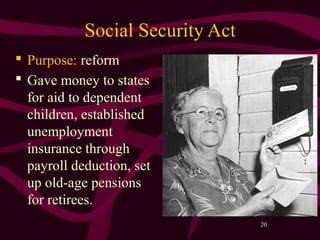
Social Security Act
 Purpose: reform
 Gave money to states
for aid to dependent
children, established
unemployment
insurance through
payroll deduction, set
up old-age pensions
for retirees.
21
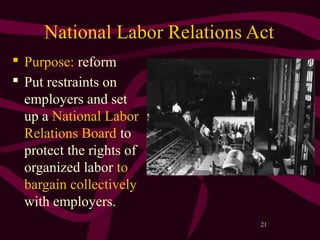
National Labor Relations Act
 Purpose: reform
 Put restraints on
employers and set
up a National Labor
Relations Board to
protect the rights of
organized labor to
bargain collectively
with employers.
22
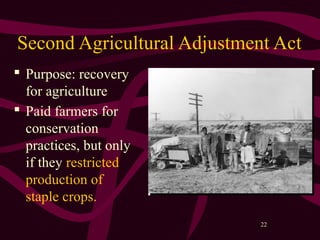
Second Agricultural Adjustment Act
 Purpose: recovery
for agriculture
 Paid farmers for
conservation
practices, but only
if they restricted
production of
staple crops.
23
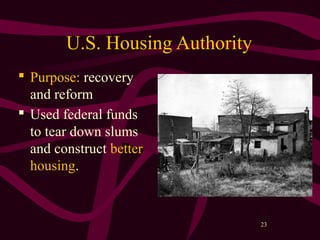
U.S. Housing Authority
 Purpose: recovery
and reform
 Used federal funds
to tear down slums
and construct better
housing.
24
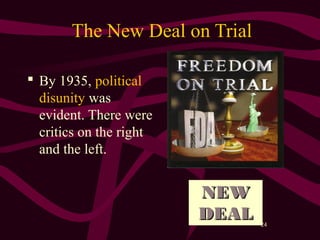
The New Deal on Trial
 By 1935, political
disunity was
evident. There were
critics on the right
and the left.
NEWNEW
DEALDEAL
25
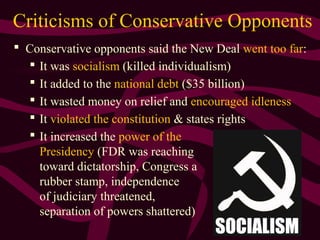
Criticisms of Conservative Opponents
 Conservative opponents said the New Deal went too far:
 It was socialism (killed individualism)
 It added to the national debt ($35 billion)
 It wasted money on relief and encouraged idleness
 It violated the constitution & states rights
 It increased the power of the
Presidency (FDR was reaching
toward dictatorship, Congress a
rubber stamp, independence
of judiciary threatened,
separation of powers shattered)
26
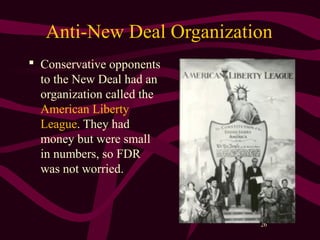
Anti-New Deal Organization
 Conservative opponents
to the New Deal had an
organization called the
American Liberty
League. They had
money but were small
in numbers, so FDR
was not worried.
27
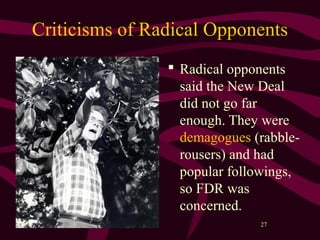
Criticisms of Radical Opponents
 Radical opponents
said the New Deal
did not go far
enough. They were
demagogues (rabble-
rousers) and had
popular followings,
so FDR was
concerned.
28
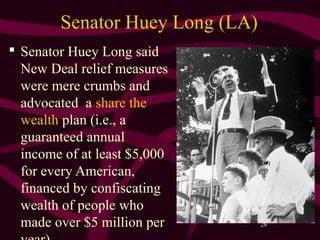
Senator Huey Long (LA)
 Senator Huey Long said
New Deal relief measures
were mere crumbs and
advocated a share the
wealth plan (i.e., a
guaranteed annual
income of at least $5,000
for every American,
financed by confiscating
wealth of people who
made over $5 million per
29
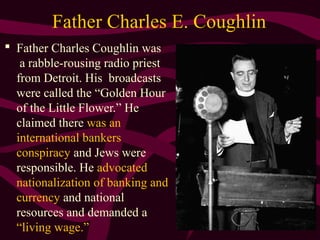
Father Charles E. Coughlin
 Father Charles Coughlin was
a rabble-rousing radio priest
from Detroit. His broadcasts
were called the “Golden Hour
of the Little Flower.” He
claimed there was an
international bankers
conspiracy and Jews were
responsible. He advocated
nationalization of banking and
currency and national
resources and demanded a
“living wage.”
30
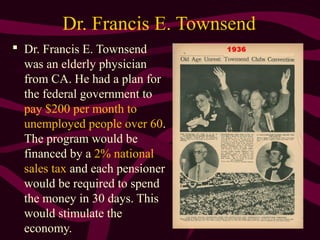
Dr. Francis E. Townsend
 Dr. Francis E. Townsend
was an elderly physician
from CA. He had a plan for
the federal government to
pay $200 per month to
unemployed people over 60.
The program would be
financed by a 2% national
sales tax and each pensioner
would be required to spend
the money in 30 days. This
would stimulate the
economy.
31
Moderate Legislation
 FDR sponsored moderate legislation to silence radical
opposition:
 Revenue Act of 1935 – Response to Huey Long.
Increased taxes on large incomes and corporations.
 Banking Act of 1935 – Response to Coughlin.
Extended federal control
over private banking practices.
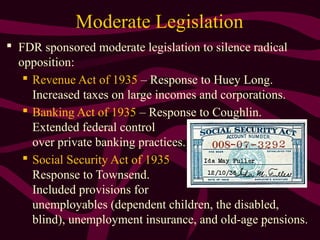
 Social Security Act of 1935
Response to Townsend.
Included provisions for
unemployables (dependent children, the disabled,
blind), unemployment insurance, and old-age pensions.
32
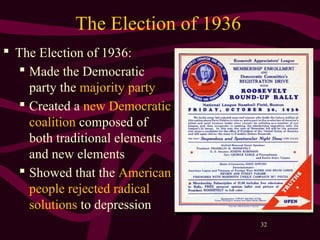
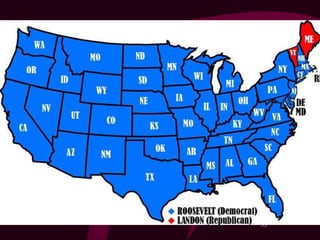
The Election of 1936
 The Election of 1936:
 Made the Democratic
party the majority party
 Created a new Democratic
coalition composed of
both traditional elements
and new elements
 Showed that the American
people rejected radical
solutions to depression
33
34
Candidate Party
% Popular
Vote
Electoral
Votes
FDR Democratic 60.3% 523
Alfred E. Landon Republican 36.56% 8
William Lemke Radical 1.93%
Norman Thomas Socialist
0.41%
(2.21 in 1932)
Earl Browder Communist
0.17 (0.25 in
1932)
The Election of 1936
35
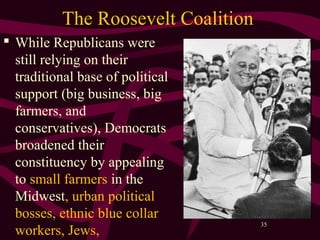
The Roosevelt Coalition
 While Republicans were
still relying on their
traditional base of political
support (big business, big
farmers, and
conservatives), Democrats
broadened their
constituency by appealing
to small farmers in the
Midwest, urban political
bosses, ethnic blue collar
workers, Jews,
36
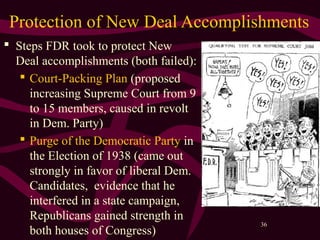
Protection of New Deal Accomplishments
 Steps FDR took to protect New
Deal accomplishments (both failed):
 Court-Packing Plan (proposed
increasing Supreme Court from 9
to 15 members, caused in revolt
in Dem. Party)
 Purge of the Democratic Party in
the Election of 1938 (came out
strongly in favor of liberal Dem.
Candidates, evidence that he
interfered in a state campaign,
Republicans gained strength in
both houses of Congress)
37
Decline of New Deal Reform after 1937
 Reasons for decline of New Deal reform after 1937:
 Court-packing plan made Congress irritable.
 Recession of 1937-38 weakened confidence in New
Deal measures. Republicans gained strength in both
houses.
 Attempted purge of Democratic party failed.
 Conservative Democrats were elected to office.
Resentful of attempted party purge, they joined ranks
with Republicans to block New Deal legislation.
 Increasing focus on foreign affairs.
38
The Significance of
the New Deal
39
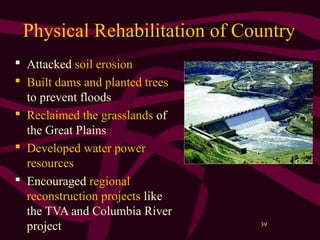
Physical Rehabilitation of Country
 Attacked soil erosion
 Built dams and planted trees
to prevent floods
 Reclaimed the grasslands of
the Great Plains
 Developed water power
resources
 Encouraged regional
reconstruction projects like
the TVA and Columbia River
project
40
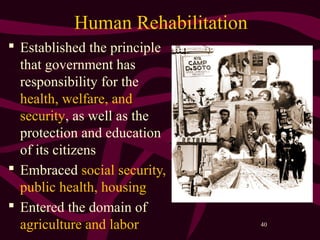
Human Rehabilitation
 Established the principle
that government has
responsibility for the
health, welfare, and
security, as well as the
protection and education
of its citizens
 Embraced social security,
public health, housing
 Entered the domain of
agriculture and labor
41
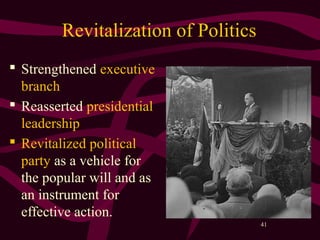
Revitalization of Politics
 Strengthened executive
branch
 Reasserted presidential
leadership
 Revitalized political
party as a vehicle for
the popular will and as
an instrument for
effective action.
42
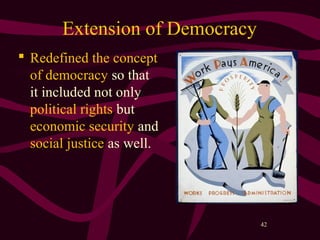
Extension of Democracy
 Redefined the concept
of democracy so that
it included not only
political rights but
economic security and
social justice as well.
43
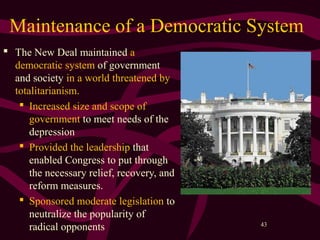
Maintenance of a Democratic System
 The New Deal maintained a
democratic system of government
and society in a world threatened by
totalitarianism.
 Increased size and scope of
government to meet needs of the
depression
 Provided the leadership that
enabled Congress to put through
the necessary relief, recovery, and
reform measures.
 Sponsored moderate legislation to
neutralize the popularity of
radical opponents
44
45
46
47
48
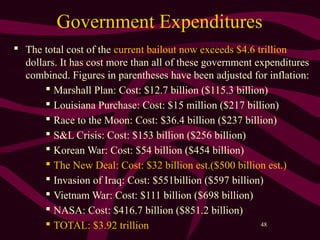
Government Expenditures
 The total cost of the current bailout now exceeds $4.6 trillion
dollars. It has cost more than all of these government expenditures
combined. Figures in parentheses have been adjusted for inflation:
 Marshall Plan: Cost: $12.7 billion ($115.3 billion)
 Louisiana Purchase: Cost: $15 million ($217 billion)
 Race to the Moon: Cost: $36.4 billion ($237 billion)
 S&L Crisis: Cost: $153 billion ($256 billion)
 Korean War: Cost: $54 billion ($454 billion)
 The New Deal: Cost: $32 billion est.($500 billion est.)
 Invasion of Iraq: Cost: $551billion ($597 billion)
 Vietnam War: Cost: $111 billion ($698 billion)
 NASA: Cost: $416.7 billion ($851.2 billion)
 TOTAL: $3.92 trillion

Fdr new-deal

  • 1.
    1 Franklin D. RooseveltFranklinD. Roosevelt and the New Dealand the New Deal Redefined Democracy:Redefined Democracy: Political RightsPolitical Rights  EconomicEconomic SecuritySecurity  Social JusticeSocial Justice
  • 2.
    2 Causes of theGreat Depression  Agricultural overproduction  Industrial overproduction  Unequal distribution of wealth  Over-extension of credit  International economic situation
  • 3.
    3 How Herbert HooverDealt with the Crisis  He played the game of confidence economics and just kept saying: “Prosperity is right around the corner.”
  • 4.
    4 Voluntary Measures  Hoovereventually established two privately-funded organizations:  The National Credit Association provided $1/2 billion to businesses for emergency loans, but it was too under-funded to do much good.  The Organization for Unemployment Relief was a clearing house for relief agencies. However, state and local governments were already in too much debt to benefit from it.
  • 5.
    5 Limited Government Intervention  Inthe end, Hoover resorted to government intervention:  The Reconstruction Finance Corp gave $1-1/2 billion in federal loans to banks, insurance companies, and industry to prevent bankruptcies, but it was too little, too late.  The Home Loan Bank Act provided federal loans to homeowners to prevent foreclosures, but got bogged down in red tape.
  • 6.
    6 Reasons for Ineffectiveness Hoover thought business should be self-regulating.  He had a mania for a balanced budget.  He lacked political finesse.
  • 7.
    7 Franklin D. Roosevelt’sAppeal  In 1932 presidential election, FDR was perceived as a man of action.  Hoover was viewed as a “do-nothing president.”  Norman Thomas, the Socialist candidate, was viewed as a radical.  Results: a landslide for Democrats and a mandate to use government as an agency for human
  • 8.
  • 9.
    9 Situation When FDREntered Office  In March 1933, the country was virtually leaderless and the banking system had collapsed.
  • 10.
    10 FDR Restored Confidence In his inaugural address, he said “The only thing we have to fear is fear itself….”  He promised vigorous leadership and bold action, called for discipline and cooperation, expressed his faith in democracy, and asked for divine protection and guidance.
  • 11.
    11 FDR’s Personal Qualities He was a practical politician who practiced the art of the possible.  He was a charismatic person who exhibited a warmth and understanding of people.  He knew how to handle press by focusing attention on Washington.  He provided dynamic leadership in a time of crisis.  He was willing to experiment
  • 12.
    12 Purposes of theNew Deal  Relief: to provide jobs for the unemployed and to protect farmers from foreclosure  Recovery: to get the economy back into high gear, “priming the pump”  Reform: To regulate banks, to abolish child labor, and to conserve farm lands  Overall objective: to save capitalism
  • 13.
    13 Sources of NewDeal Ideas  Brains Trust: specialists and experts, mostly college professors, idea men  New Economists: government spending, deficit spending and public works, government should prime economic pump  Roosevelt Cabinet: included conservatives, liberals, Democrats, Republicans, inflationists, anti-inflationists -- often conflicting, compromising, blending ideas
  • 14.
    14 First New Deal(1933-1934)  Emphasis: reform  Political Position: conservative  Primary aim: economic recovery  Philosophy: economic nationalism and economic scarcity (i.e., raise prices by creating the illusion of scarcity)  Objectives: higher prices for agriculture and business  Beneficiaries: big business and agricultural business
  • 15.
    15 National Recovery Act(NRA)  Purpose: recovery of industry  Created a partnership of business, labor, and government to attack the depression with such measures as price controls, high wages, and codes of fair competition
  • 16.
    16 First Agricultural AdjustmentAct (AAA)  Purpose: the recovery of agriculture  Paid farmers who agreed to reduce production of basic crops such as cotton, wheat, tobacco, hogs, and corn  Money came from a tax on processors such as flour millers and meat packers who passed the cost on to the consumer
  • 17.
    17 Federal Emergency ReliefAdmin (FERA)  Purpose: relief  Gave money to states and municipalities so they could distribute money, clothing, and food to the unemployed
  • 18.
    18 Civilian Conservation Corp(CCC)  Purpose: relief  Gave outdoor work to unemployed men between the ages of 17 and 29  They received $30 per month, but $22 went back to the family
  • 19.
    19 Second New Deal(1934-1941)  Emphasis: reform  Political Position: liberal  Primary aim: permanent reform  Philosophy: international economic cooperation and economic abundance  Objectives: increased purchasing power and social security for public  Beneficiaries: small farmers and labor
  • 20.
    20 Social Security Act Purpose: reform  Gave money to states for aid to dependent children, established unemployment insurance through payroll deduction, set up old-age pensions for retirees.
  • 21.
    21 National Labor RelationsAct  Purpose: reform  Put restraints on employers and set up a National Labor Relations Board to protect the rights of organized labor to bargain collectively with employers.
  • 22.
    22 Second Agricultural AdjustmentAct  Purpose: recovery for agriculture  Paid farmers for conservation practices, but only if they restricted production of staple crops.
  • 23.
    23 U.S. Housing Authority Purpose: recovery and reform  Used federal funds to tear down slums and construct better housing.
  • 24.
    24 The New Dealon Trial  By 1935, political disunity was evident. There were critics on the right and the left. NEWNEW DEALDEAL
  • 25.
    25 Criticisms of ConservativeOpponents  Conservative opponents said the New Deal went too far:  It was socialism (killed individualism)  It added to the national debt ($35 billion)  It wasted money on relief and encouraged idleness  It violated the constitution & states rights  It increased the power of the Presidency (FDR was reaching toward dictatorship, Congress a rubber stamp, independence of judiciary threatened, separation of powers shattered)
  • 26.
    26 Anti-New Deal Organization Conservative opponents to the New Deal had an organization called the American Liberty League. They had money but were small in numbers, so FDR was not worried.
  • 27.
    27 Criticisms of RadicalOpponents  Radical opponents said the New Deal did not go far enough. They were demagogues (rabble- rousers) and had popular followings, so FDR was concerned.
  • 28.
    28 Senator Huey Long(LA)  Senator Huey Long said New Deal relief measures were mere crumbs and advocated a share the wealth plan (i.e., a guaranteed annual income of at least $5,000 for every American, financed by confiscating wealth of people who made over $5 million per
  • 29.
    29 Father Charles E.Coughlin  Father Charles Coughlin was a rabble-rousing radio priest from Detroit. His broadcasts were called the “Golden Hour of the Little Flower.” He claimed there was an international bankers conspiracy and Jews were responsible. He advocated nationalization of banking and currency and national resources and demanded a “living wage.”
  • 30.
    30 Dr. Francis E.Townsend  Dr. Francis E. Townsend was an elderly physician from CA. He had a plan for the federal government to pay $200 per month to unemployed people over 60. The program would be financed by a 2% national sales tax and each pensioner would be required to spend the money in 30 days. This would stimulate the economy.
  • 31.
    31 Moderate Legislation  FDRsponsored moderate legislation to silence radical opposition:  Revenue Act of 1935 – Response to Huey Long. Increased taxes on large incomes and corporations.  Banking Act of 1935 – Response to Coughlin. Extended federal control over private banking practices.  Social Security Act of 1935 Response to Townsend. Included provisions for unemployables (dependent children, the disabled, blind), unemployment insurance, and old-age pensions.
  • 32.
    32 The Election of1936  The Election of 1936:  Made the Democratic party the majority party  Created a new Democratic coalition composed of both traditional elements and new elements  Showed that the American people rejected radical solutions to depression
  • 33.
  • 34.
    34 Candidate Party % Popular Vote Electoral Votes FDRDemocratic 60.3% 523 Alfred E. Landon Republican 36.56% 8 William Lemke Radical 1.93% Norman Thomas Socialist 0.41% (2.21 in 1932) Earl Browder Communist 0.17 (0.25 in 1932) The Election of 1936
  • 35.
    35 The Roosevelt Coalition While Republicans were still relying on their traditional base of political support (big business, big farmers, and conservatives), Democrats broadened their constituency by appealing to small farmers in the Midwest, urban political bosses, ethnic blue collar workers, Jews,
  • 36.
    36 Protection of NewDeal Accomplishments  Steps FDR took to protect New Deal accomplishments (both failed):  Court-Packing Plan (proposed increasing Supreme Court from 9 to 15 members, caused in revolt in Dem. Party)  Purge of the Democratic Party in the Election of 1938 (came out strongly in favor of liberal Dem. Candidates, evidence that he interfered in a state campaign, Republicans gained strength in both houses of Congress)
  • 37.
    37 Decline of NewDeal Reform after 1937  Reasons for decline of New Deal reform after 1937:  Court-packing plan made Congress irritable.  Recession of 1937-38 weakened confidence in New Deal measures. Republicans gained strength in both houses.  Attempted purge of Democratic party failed.  Conservative Democrats were elected to office. Resentful of attempted party purge, they joined ranks with Republicans to block New Deal legislation.  Increasing focus on foreign affairs.
  • 38.
  • 39.
    39 Physical Rehabilitation ofCountry  Attacked soil erosion  Built dams and planted trees to prevent floods  Reclaimed the grasslands of the Great Plains  Developed water power resources  Encouraged regional reconstruction projects like the TVA and Columbia River project
  • 40.
    40 Human Rehabilitation  Establishedthe principle that government has responsibility for the health, welfare, and security, as well as the protection and education of its citizens  Embraced social security, public health, housing  Entered the domain of agriculture and labor
  • 41.
    41 Revitalization of Politics Strengthened executive branch  Reasserted presidential leadership  Revitalized political party as a vehicle for the popular will and as an instrument for effective action.
  • 42.
    42 Extension of Democracy Redefined the concept of democracy so that it included not only political rights but economic security and social justice as well.
  • 43.
    43 Maintenance of aDemocratic System  The New Deal maintained a democratic system of government and society in a world threatened by totalitarianism.  Increased size and scope of government to meet needs of the depression  Provided the leadership that enabled Congress to put through the necessary relief, recovery, and reform measures.  Sponsored moderate legislation to neutralize the popularity of radical opponents
  • 44.
  • 45.
  • 46.
  • 47.
  • 48.
    48 Government Expenditures  Thetotal cost of the current bailout now exceeds $4.6 trillion dollars. It has cost more than all of these government expenditures combined. Figures in parentheses have been adjusted for inflation:  Marshall Plan: Cost: $12.7 billion ($115.3 billion)  Louisiana Purchase: Cost: $15 million ($217 billion)  Race to the Moon: Cost: $36.4 billion ($237 billion)  S&L Crisis: Cost: $153 billion ($256 billion)  Korean War: Cost: $54 billion ($454 billion)  The New Deal: Cost: $32 billion est.($500 billion est.)  Invasion of Iraq: Cost: $551billion ($597 billion)  Vietnam War: Cost: $111 billion ($698 billion)  NASA: Cost: $416.7 billion ($851.2 billion)  TOTAL: $3.92 trillion