Page 1 of 3
Diffusion and Osmosis
Two processes which help to prove the particle theory of matter are diffusion and osmosis.
Diffusion is the movement of particles in between each other from a region of high concentration to
a region of low concentration until there is uniform distribution.
For example, you can smell (1) bread baking (2) perfume from a distance because the tiny gaseous particles
travel to you by moving in between the air particles from a region where they are in high concentration.
Diffusion takes place more quickly in the gaseous state than in the liquid state because the particles
in a gas are moving more quickly than the particles in a liquid and the particles in a gas are more widely
spaced. Diffusion does not take place in solids because the particles are closely packed and the particles
cannot move about.
The rate of diffusion is faster
(a) in gases than in liquid
(b) for lighter particles than heavier particles
(c) at higher temperatures
DIFFUSION OF GAS IN GAS
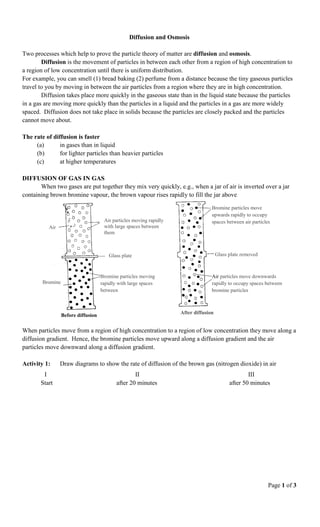
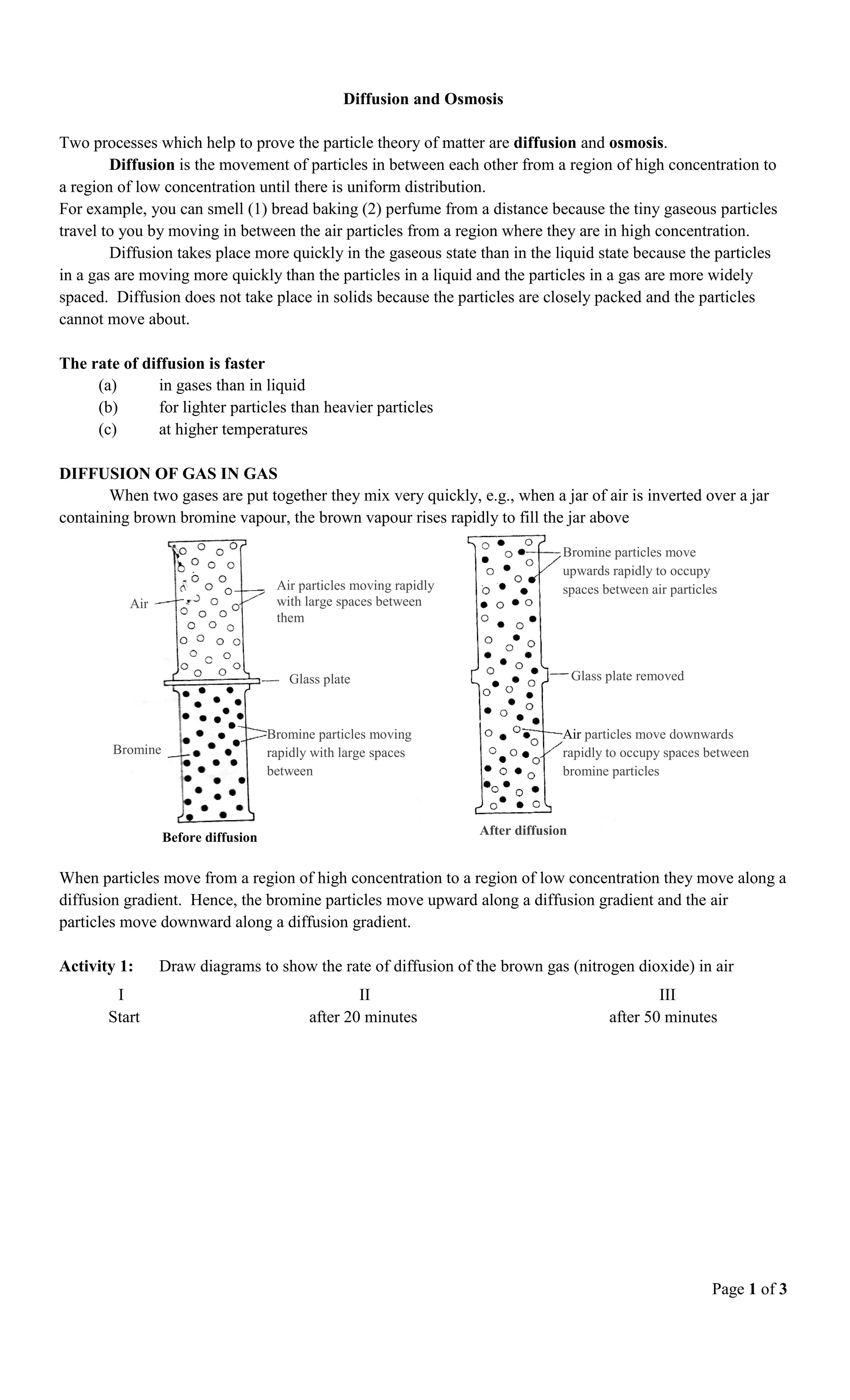
When two gases are put together they mix very quickly, e.g., when a jar of air is inverted over a jar
containing brown bromine vapour, the brown vapour rises rapidly to fill the jar above
When particles move from a region of high concentration to a region of low concentration they move along a
diffusion gradient. Hence, the bromine particles move upward along a diffusion gradient and the air
particles move downward along a diffusion gradient.
Activity 1: Draw diagrams to show the rate of diffusion of the brown gas (nitrogen dioxide) in air
I II III
Start after 20 minutes after 50 minutes
Air particles moving rapidly
with large spaces between
them
Glass plate
Bromine particles moving
rapidly with large spaces
between
Bromine
Air
Bromine particles move
upwards rapidly to occupy
spaces between air particles
Glass plate removed
Air particles move downwards
rapidly to occupy spaces between
bromine particles
Before diffusion
After diffusion
Page 2 of 3
Diffusion of solid in liquid
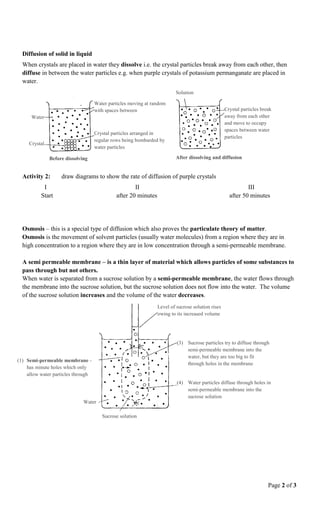
When crystals are placed in water they dissolve i.e. the crystal particles break away from each other, then
diffuse in between the water particles e.g. when purple crystals of potassium permanganate are placed in
water.
Activity 2: draw diagrams to show the rate of diffusion of purple crystals
I II III
Start after 20 minutes after 50 minutes
Osmosis – this is a special type of diffusion which also proves the particulate theory of matter.
Osmosis is the movement of solvent particles (usually water molecules) from a region where they are in
high concentration to a region where they are in low concentration through a semi-permeable membrane.
A semi permeable membrane – is a thin layer of material which allows particles of some substances to
pass through but not others.
When water is separated from a sucrose solution by a semi-permeable membrane, the water flows through
the membrane into the sucrose solution, but the sucrose solution does not flow into the water. The volume
of the sucrose solution increases and the volume of the water decreases.
Water particles moving at random
with spaces between
Crystal particles arranged in
regular rows being bombarded by
water particles
Water
Crystal
Solution
Crystal particles break
away from each other
and move to occupy
spaces between water
particles
After dissolving and diffusionBefore dissolving
Level of sucrose solution rises
owing to its increased volume
(3) Sucrose particles try to diffuse through
semi-permeable membrane into the
water, but they are too big to fit
through holes in the membrane
(4) Water particles diffuse through holes in
semi-permeable membrane into the
sucrose solution
(1) Semi-permeable membrane -
has minute holes which only
allow water particles through
Water
Sucrose solution
Page 3 of 3
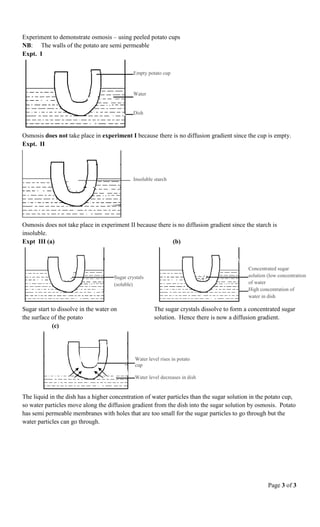
Experiment to demonstrate osmosis – using peeled potato cups
NB: The walls of the potato are semi permeable
Expt. I
Osmosis does not take place in experiment I because there is no diffusion gradient since the cup is empty.
Expt. II
Osmosis does not take place in experiment II because there is no diffusion gradient since the starch is
insoluble.
Expt III (a) (b)
Sugar start to dissolve in the water on The sugar crystals dissolve to form a concentrated sugar
the surface of the potato solution. Hence there is now a diffusion gradient.
(c)
The liquid in the dish has a higher concentration of water particles than the sugar solution in the potato cup,
so water particles move along the diffusion gradient from the dish into the sugar solution by osmosis. Potato
has semi permeable membranes with holes that are too small for the sugar particles to go through but the
water particles can go through.
Empty potato cup
Water
Dish
Insoluble starch
Sugar crystals
(soluble)
Concentrated sugar
solution (low concentration
of water
High concentration of
water in dish
Water level rises in potato
cup
Water level decreases in dish

Diffusion and osmosis 2

  • 1.
    Page 1 of3 Diffusion and Osmosis Two processes which help to prove the particle theory of matter are diffusion and osmosis. Diffusion is the movement of particles in between each other from a region of high concentration to a region of low concentration until there is uniform distribution. For example, you can smell (1) bread baking (2) perfume from a distance because the tiny gaseous particles travel to you by moving in between the air particles from a region where they are in high concentration. Diffusion takes place more quickly in the gaseous state than in the liquid state because the particles in a gas are moving more quickly than the particles in a liquid and the particles in a gas are more widely spaced. Diffusion does not take place in solids because the particles are closely packed and the particles cannot move about. The rate of diffusion is faster (a) in gases than in liquid (b) for lighter particles than heavier particles (c) at higher temperatures DIFFUSION OF GAS IN GAS When two gases are put together they mix very quickly, e.g., when a jar of air is inverted over a jar containing brown bromine vapour, the brown vapour rises rapidly to fill the jar above When particles move from a region of high concentration to a region of low concentration they move along a diffusion gradient. Hence, the bromine particles move upward along a diffusion gradient and the air particles move downward along a diffusion gradient. Activity 1: Draw diagrams to show the rate of diffusion of the brown gas (nitrogen dioxide) in air I II III Start after 20 minutes after 50 minutes Air particles moving rapidly with large spaces between them Glass plate Bromine particles moving rapidly with large spaces between Bromine Air Bromine particles move upwards rapidly to occupy spaces between air particles Glass plate removed Air particles move downwards rapidly to occupy spaces between bromine particles Before diffusion After diffusion
  • 2.
    Page 2 of3 Diffusion of solid in liquid When crystals are placed in water they dissolve i.e. the crystal particles break away from each other, then diffuse in between the water particles e.g. when purple crystals of potassium permanganate are placed in water. Activity 2: draw diagrams to show the rate of diffusion of purple crystals I II III Start after 20 minutes after 50 minutes Osmosis – this is a special type of diffusion which also proves the particulate theory of matter. Osmosis is the movement of solvent particles (usually water molecules) from a region where they are in high concentration to a region where they are in low concentration through a semi-permeable membrane. A semi permeable membrane – is a thin layer of material which allows particles of some substances to pass through but not others. When water is separated from a sucrose solution by a semi-permeable membrane, the water flows through the membrane into the sucrose solution, but the sucrose solution does not flow into the water. The volume of the sucrose solution increases and the volume of the water decreases. Water particles moving at random with spaces between Crystal particles arranged in regular rows being bombarded by water particles Water Crystal Solution Crystal particles break away from each other and move to occupy spaces between water particles After dissolving and diffusionBefore dissolving Level of sucrose solution rises owing to its increased volume (3) Sucrose particles try to diffuse through semi-permeable membrane into the water, but they are too big to fit through holes in the membrane (4) Water particles diffuse through holes in semi-permeable membrane into the sucrose solution (1) Semi-permeable membrane - has minute holes which only allow water particles through Water Sucrose solution
  • 3.
    Page 3 of3 Experiment to demonstrate osmosis – using peeled potato cups NB: The walls of the potato are semi permeable Expt. I Osmosis does not take place in experiment I because there is no diffusion gradient since the cup is empty. Expt. II Osmosis does not take place in experiment II because there is no diffusion gradient since the starch is insoluble. Expt III (a) (b) Sugar start to dissolve in the water on The sugar crystals dissolve to form a concentrated sugar the surface of the potato solution. Hence there is now a diffusion gradient. (c) The liquid in the dish has a higher concentration of water particles than the sugar solution in the potato cup, so water particles move along the diffusion gradient from the dish into the sugar solution by osmosis. Potato has semi permeable membranes with holes that are too small for the sugar particles to go through but the water particles can go through. Empty potato cup Water Dish Insoluble starch Sugar crystals (soluble) Concentrated sugar solution (low concentration of water High concentration of water in dish Water level rises in potato cup Water level decreases in dish