MOVEMENT OF MOLECULES
Do they ever stop moving?!!
DIFFUSION
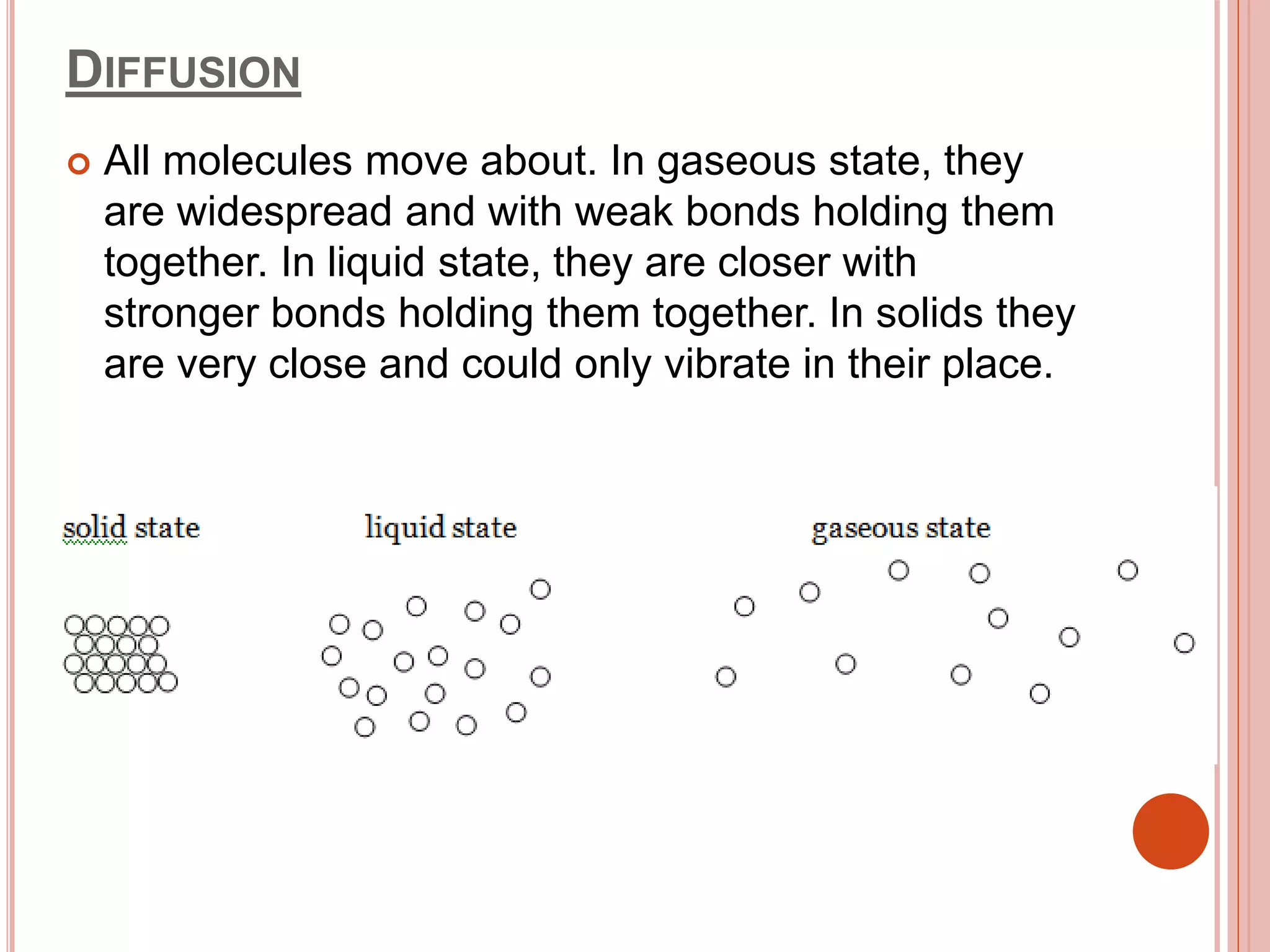
 All molecules move about. In gaseous state, they
are widespread and with weak bonds holding them
together. In liquid state, they are closer with
stronger bonds holding them together. In solids they
are very close and could only vibrate in their place.
NOW PUT UP YOUR HAND AS SOON AS YOU
CAN DETECT THE SMELL OF THE AIR
FRESHENER.
WHAT DO YOU NOTICE?
 Who were the first to detect the smell?
 Who were last to detect the smell?
 Why isn’t there anyone who did not detect the
smell?
 Explain how you could smell the scent although you
are far away from the air freshener.
 What if we opened the door or window? Would
others outside be able to smell the scent?
WHAT WOULD HAPPEN TO A LUMP OF SUGAR
PLACED IN A CUP OF WATER?
WHAT WOULD MAKE MOLECULES
MOVE/SPREAD OUT FASTER OR SLOWER?
 Temperature
 Stirring/ air currents
 Number of molecules
 Surface area
 Distance/ thickness of membrane
 Difference between molecule concentration in both
areas
OSMOSIS
 A special type of diffusion involving the movement
of water molecules only, through a partially
permeable membrane.
 Partially permeable membrane is a membrane
with small holes that can allow only small molecules
to pass through.
NOW I NEED FOUR VOLUNTEERS!
OSMOSIS
Is the movement of water molecules
from a dilute solution (high water
potential) to a concentrated solution
(low water potential) through a partially
permeable membrane.
 A cell membrane is a partially permeable
membrane.
WHAT HAPPENS TO ANIMAL CELLS IF THEY WERE
PLACED IN A SOLUTION OF A DIFFERENT
CONCENTRATION THAN OF THEIR CYTOPLASM?
WHAT ABOUT PLANT CELLS?
OSMOSIS IN PLANT CELLS.
 Water enters a plant
cell, the water
molecules put pressure
on the walls. The rigid
cell wall will prevent the
cell from bursting. This
plant cell is said to be
turgid.
 This keeps the plant
firm.
OSMOSIS IN PLANT CELLS
 When water leaves the
plant cell the elastic
cell membrane shrinks,
while the rigid cell wall
keeps the shape of the
cell fixed. This plant
cell is said to be
plasmolysed.
 ACTIVE TRANSPORT
 In some situations, there is a need to move
molecules from a region of low concentration to a
region of high concentration.
 A root hair cell needs to take in minerals from the
soil, even if the concentration in the soil is lower
than that in the cells.
 Active transport is the movement of molecules from
an area of low concentration to an area of high
concentration against the concentration gradient,
this requires energy and the presence of a carrier.
ACTIVE TRANSPORT, PROTEIN CARRIER
10
ATP

3 movement of molecules 2019

  • 1.
    MOVEMENT OF MOLECULES Dothey ever stop moving?!!
  • 2.
    DIFFUSION  All moleculesmove about. In gaseous state, they are widespread and with weak bonds holding them together. In liquid state, they are closer with stronger bonds holding them together. In solids they are very close and could only vibrate in their place.
  • 3.
    NOW PUT UPYOUR HAND AS SOON AS YOU CAN DETECT THE SMELL OF THE AIR FRESHENER.
  • 4.
    WHAT DO YOUNOTICE?  Who were the first to detect the smell?  Who were last to detect the smell?  Why isn’t there anyone who did not detect the smell?  Explain how you could smell the scent although you are far away from the air freshener.  What if we opened the door or window? Would others outside be able to smell the scent?
  • 5.
    WHAT WOULD HAPPENTO A LUMP OF SUGAR PLACED IN A CUP OF WATER?
  • 6.
    WHAT WOULD MAKEMOLECULES MOVE/SPREAD OUT FASTER OR SLOWER?  Temperature  Stirring/ air currents  Number of molecules  Surface area  Distance/ thickness of membrane  Difference between molecule concentration in both areas
  • 7.
    OSMOSIS  A specialtype of diffusion involving the movement of water molecules only, through a partially permeable membrane.  Partially permeable membrane is a membrane with small holes that can allow only small molecules to pass through.
  • 9.
    NOW I NEEDFOUR VOLUNTEERS!
  • 10.
    OSMOSIS Is the movementof water molecules from a dilute solution (high water potential) to a concentrated solution (low water potential) through a partially permeable membrane.  A cell membrane is a partially permeable membrane.
  • 11.
    WHAT HAPPENS TOANIMAL CELLS IF THEY WERE PLACED IN A SOLUTION OF A DIFFERENT CONCENTRATION THAN OF THEIR CYTOPLASM?
  • 12.
  • 13.
    OSMOSIS IN PLANTCELLS.  Water enters a plant cell, the water molecules put pressure on the walls. The rigid cell wall will prevent the cell from bursting. This plant cell is said to be turgid.  This keeps the plant firm.
  • 14.
    OSMOSIS IN PLANTCELLS  When water leaves the plant cell the elastic cell membrane shrinks, while the rigid cell wall keeps the shape of the cell fixed. This plant cell is said to be plasmolysed.
  • 15.
     ACTIVE TRANSPORT In some situations, there is a need to move molecules from a region of low concentration to a region of high concentration.  A root hair cell needs to take in minerals from the soil, even if the concentration in the soil is lower than that in the cells.  Active transport is the movement of molecules from an area of low concentration to an area of high concentration against the concentration gradient, this requires energy and the presence of a carrier.
  • 16.