DIFFERENCE BETWEEN ABSOLUTE AND SECONDAY INSTRUMENTS
1.
EE304.1 1
Name ofthe faculty : K.V.Ramana Babu,
Designation : HEEES,
Branch : Electrical and Electronics
Engineering
Institute : S.V.G.Polytechnic,Tirupathi
Year/Semester : II Year / III semester
Subject : Measuring Instruments and
Batteries
Sub.Code : EE-304,
Topic : Basic Measuring Instruments
Duration : 50 Min.
Sub Topic : Distinguish between
Absolute and Secondary
Measuring Instruments.
Teaching Aids : 1PPT, Animation, Photograph
DEPARTMENT OF TECHNICAL EDUCATION
ANDHRA PRADESH
EE304.1 3
Measurement isa process in which the magnitude
of a quantity is compared with another similar
quantity.
Measurement is the process by which one can
Convert physical parameters to meaningful
number
Measurement
OR
4.
EE304.1 4
Measuring Instruments
•The instrument used to measure any quantity like
electrical or non-electrical is known as measuring
instrument.
For example;
• Speedometer,
• Ammeter etc.
5.
EE304.1 5
Necessity OfMeasuring Instruments
• In day-to-day life the electrical and non-electrical
quantities measurement is very essential.
• Because we need to know the electrical quantities in
sub-stations, laboratories etc.
• We also need to know the speed, temperature of the
machines in work-shops or laboratories etc. for better
performance.
6.
EE304.1 6
• Theinstrument used to measure the electrical
quantity is known as electrical measuring instrument.
Electrical measuring instruments
7.
EE304.1 7
Examples OfElectrical Measuring
Instruments
• AMMETER : used to measure the current
• VOLTMETER : used to measure the voltage
• OHMETER : used to measure the resistance
• WATTMETER : used to measure the power
• POWER FACTOR METER: used to measure the power factor
EE304.1 10
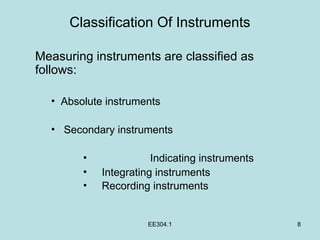
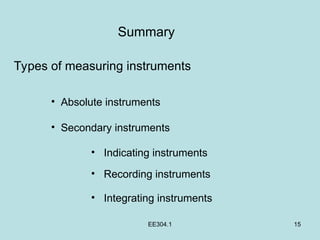
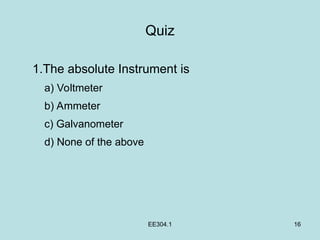
Absolute instrumentsdo not require any
previous calibration or comparison.
Example:
Uses :
As standardizing instruments in standard
laboratories like R&D.
1) Tangent galvanometer
2) Rayleigh’s current balance instruments
11.
EE304.1 11
Secondary instruments
•The value of the electrical quantity to be measured can
be determined from the deflection of instruments directly.
• The instrument doesn't have any meter constant.
12.
EE304.1 12
• Needto be calibrated with an absolute instrument.
• Without calibration, the deflection of the instruments is
meaningless.
Requirements of secondary instruments
13.
EE304.1 13
Examples ofSecondary Instruments &
Applications
• Ammeter : used to measure the current
• Tachometer : used to measure the speed
• Thermometer : used to measure the temperature
• Sismograph : used to measure the intensity of
earth-quake.
14.
EE304.1 14
Difference betweenAbsolute and Secondary
Instruments
All the instruments we
see in the market are
secondary type
It is used in R&D
laboratories
3
It is cheap compared to
absolute instrument
It is costly instrument
2
The reading is directly
obtained from the meter
reading
The reading obtained in
terms of meter constant
1
Secondary Instrument
Absolute Instrument
S.No
EE304.1 17
Quiz
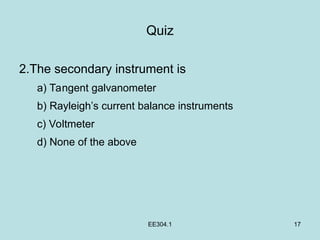
2.The secondaryinstrument is
a) Tangent galvanometer
b) Rayleigh’s current balance instruments
c) Voltmeter
d) None of the above
18.
EE304.1 18
Quiz
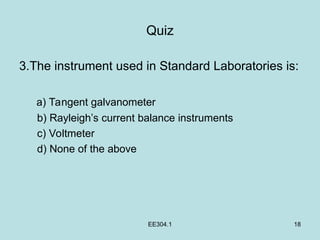
3.The instrumentused in Standard Laboratories is:
a) Tangent galvanometer
b) Rayleigh’s current balance instruments
c) Voltmeter
d) None of the above
19.
EE304.1 19
Frequently AskedQuestions
• What is the difference between Absolute Instruments
and Secondary Instruments?
• How the Measuring Instruments are classified?