1
SOLAR TREE
Presented By,
SIVASANKARI B
Final Year,
Department of EEE
Einstein College of
Engineering, Tirunelveli - 12
2
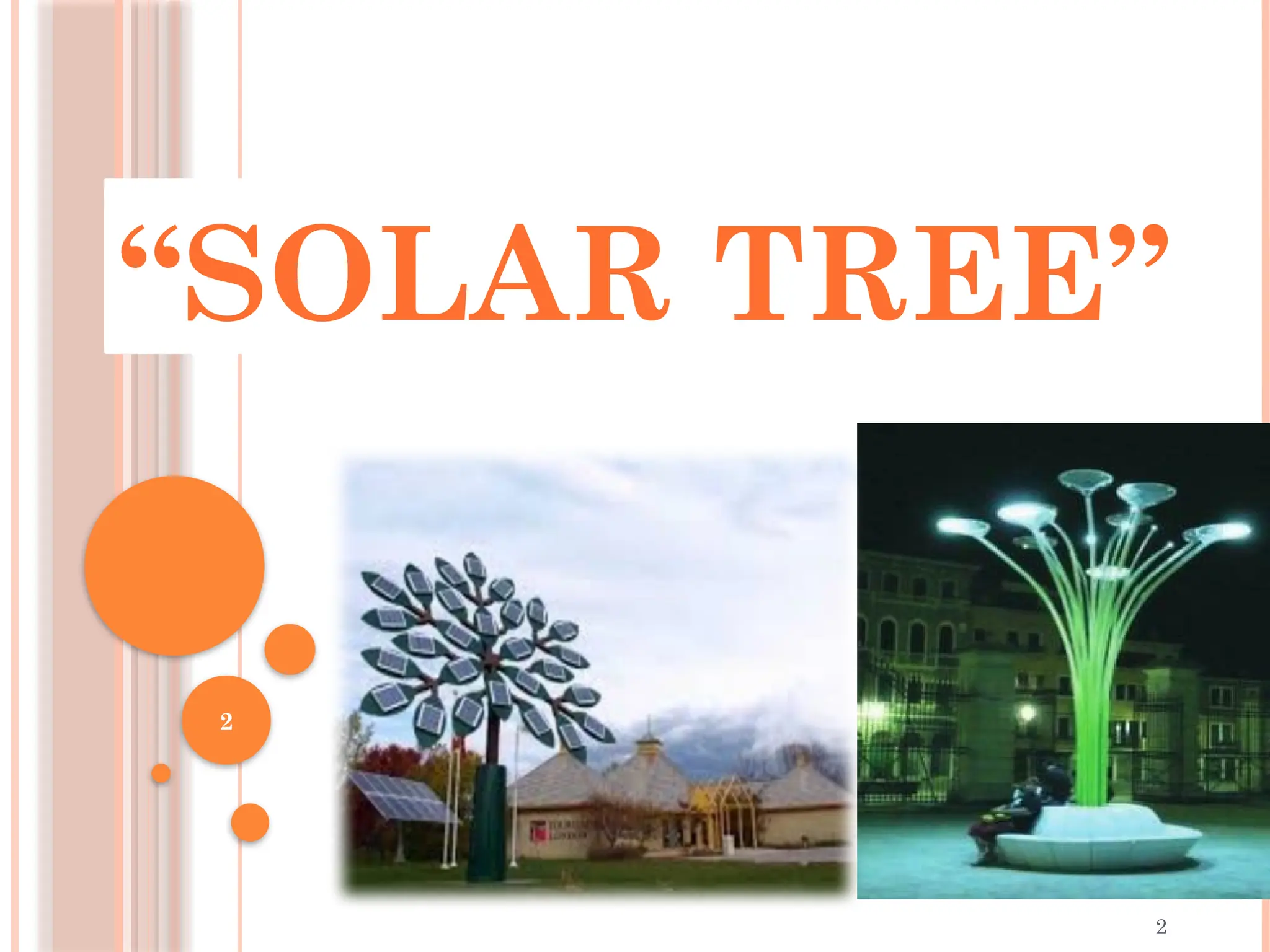
“SOLAR TREE”
2
INDEX
 Introduction.
 History.
 What is SOLAR TREE?.
 Components of Solar Tree
 Why we called it as solar tree
 Block Diagram.
 How Solar panel works
 Specifications
 Need of Solar Tree
 Why it is better than traditional system
 Solar Tree in India
 Application.
 Advantages.
 Disadvantages.
 Future of Solar Tree
 Conclusion
3
4
INTRODUCTION
 solar energy is the best option.
 Solar tree sounds like the perfect solution
for our future energy needs.
 A solar tree is an artificial tree with
photo-voltaic cells arranged in Fibonacci
series manner.
 Uses multiple no. of solar panels which
forms the shape of a tree.
HISTORY
1. In 1800 solar energy
plants developed .
2. In 1839 Alexandre
Edmond discovered
the photo voltalic effect.
3. In 1941 Russell ohl
invented solar cell .
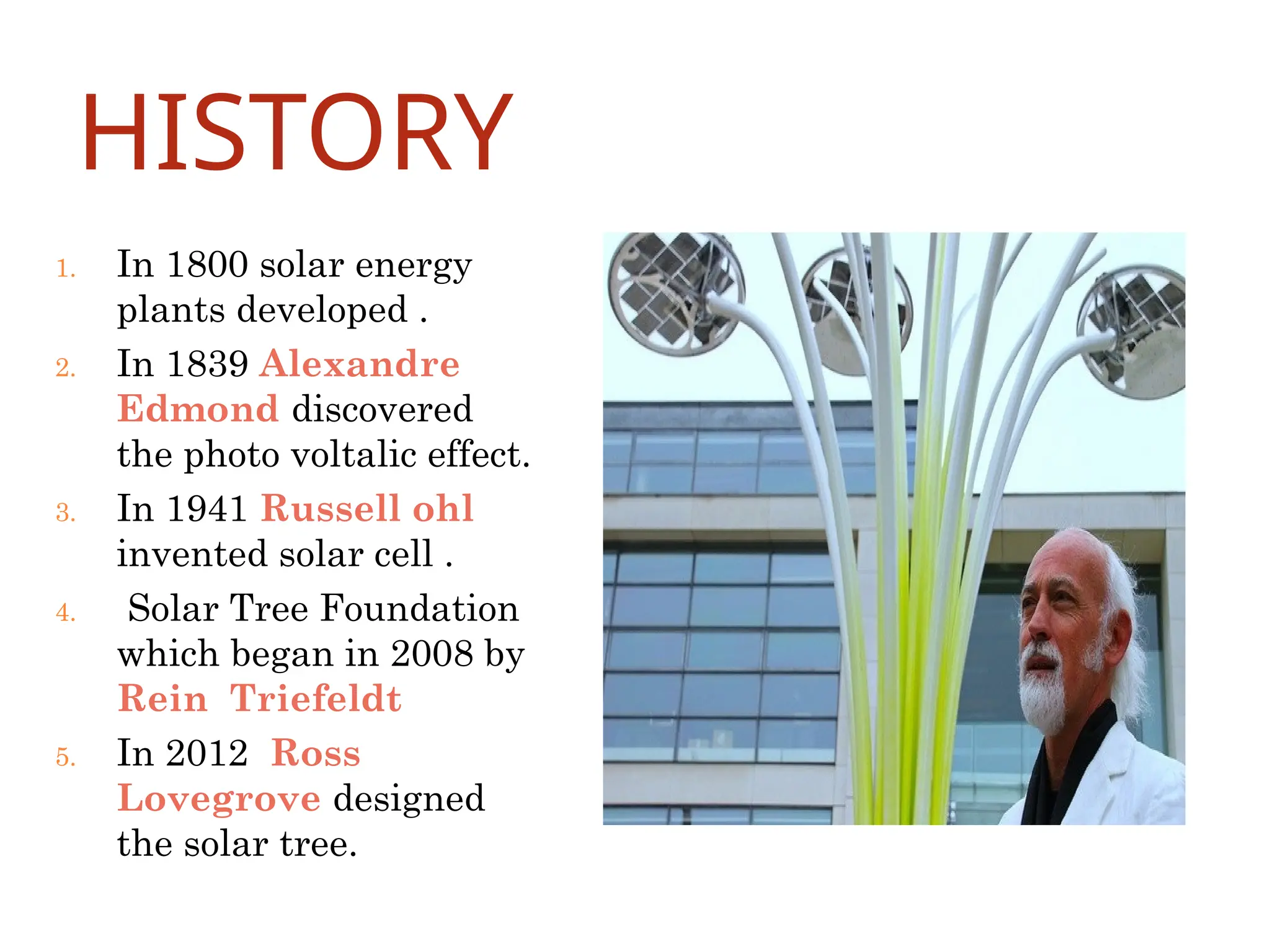
4. Solar Tree Foundation
which began in 2008 by
Rein Triefeldt
5. In 2012 Ross
Lovegrove designed
the solar tree.
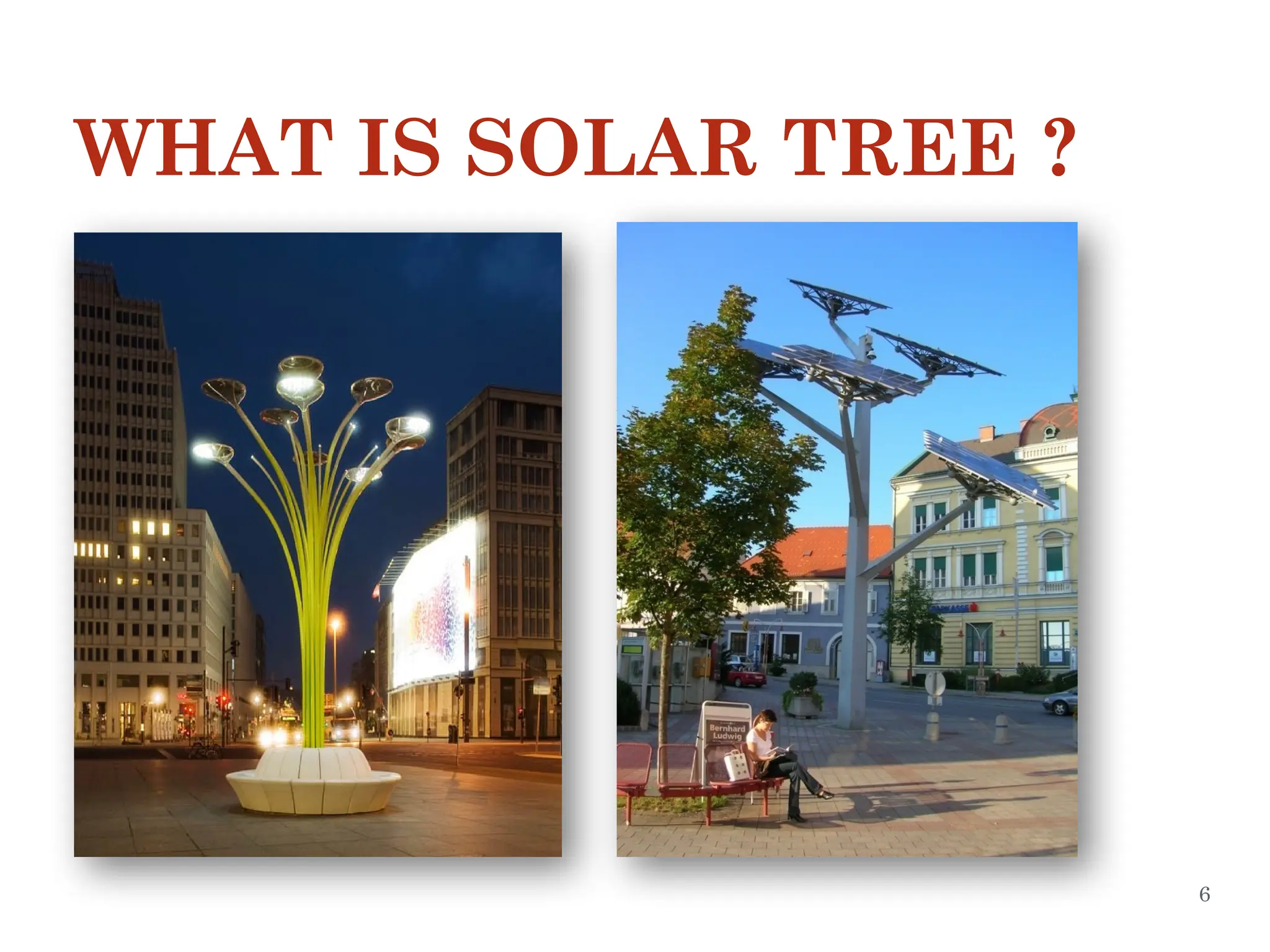
WHAT IS SOLAR TREE ?
6
7
WHAT IS SOLAR TREE
A solar tree is a decorative means of producing solar energy
and also electricity. It uses multiple no. of solar panels which
forms the shape of a tree. The panels are arranged in a tree
fashion in a tall tower/pole.
TREE stands for
T= TREE GENERATING
R=RENEWABLE
E=ENERGY and
E=ELECTRICITY
This is like a tree in structure and the panels are like leaves of
the tree which produces energy.
8
COMPONENTS OF SOLAR TREE
The solar tree consists of mainly five parts to design.
 Solar panels
 Long tower
 LEDs
 Batteries
 Stems for connecting the panels
9
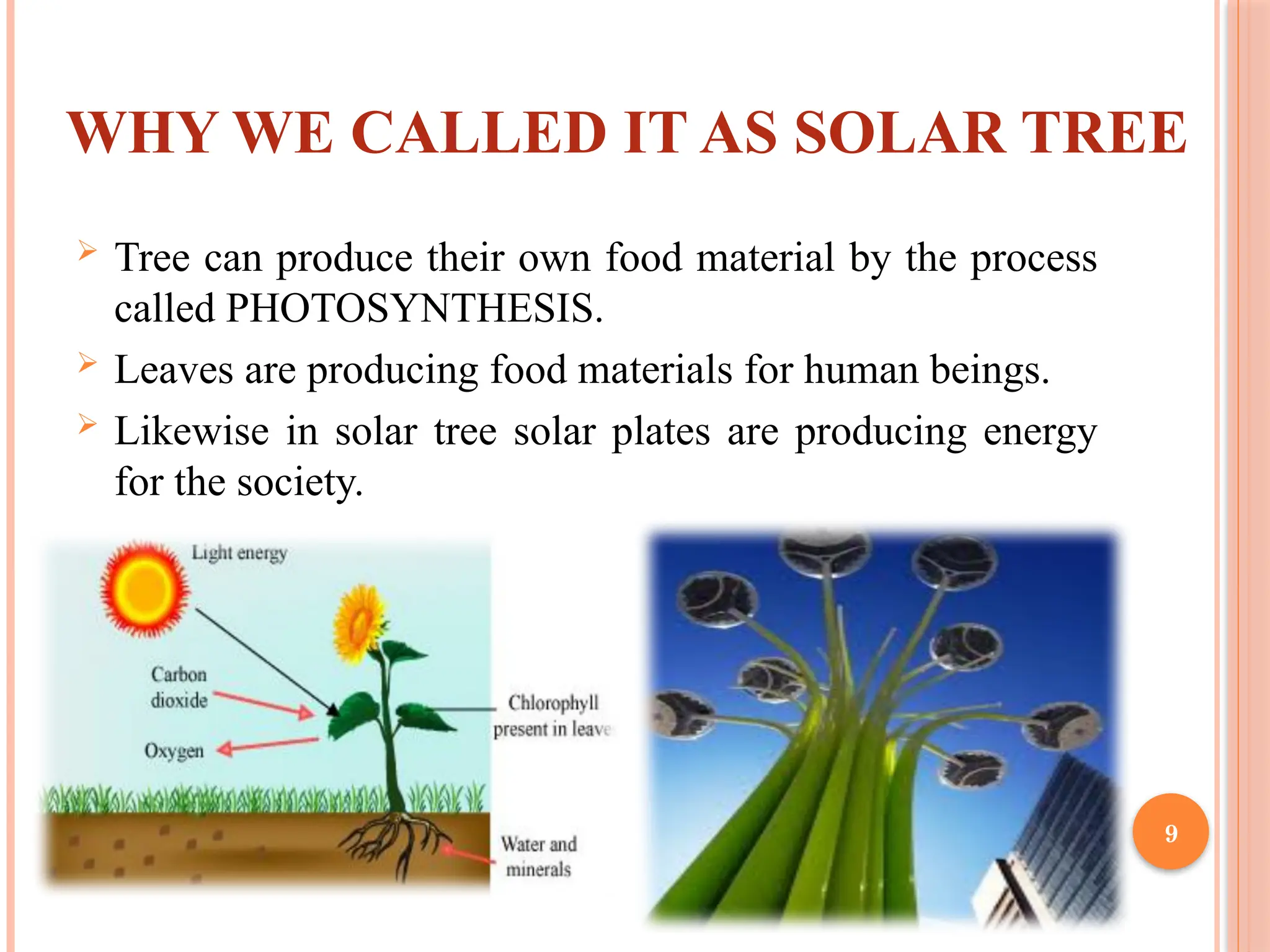
 Tree can produce their own food material by the process
called PHOTOSYNTHESIS.
 Leaves are producing food materials for human beings.
 Likewise in solar tree solar plates are producing energy
for the society.
WHY WE CALLED IT AS SOLAR TREE
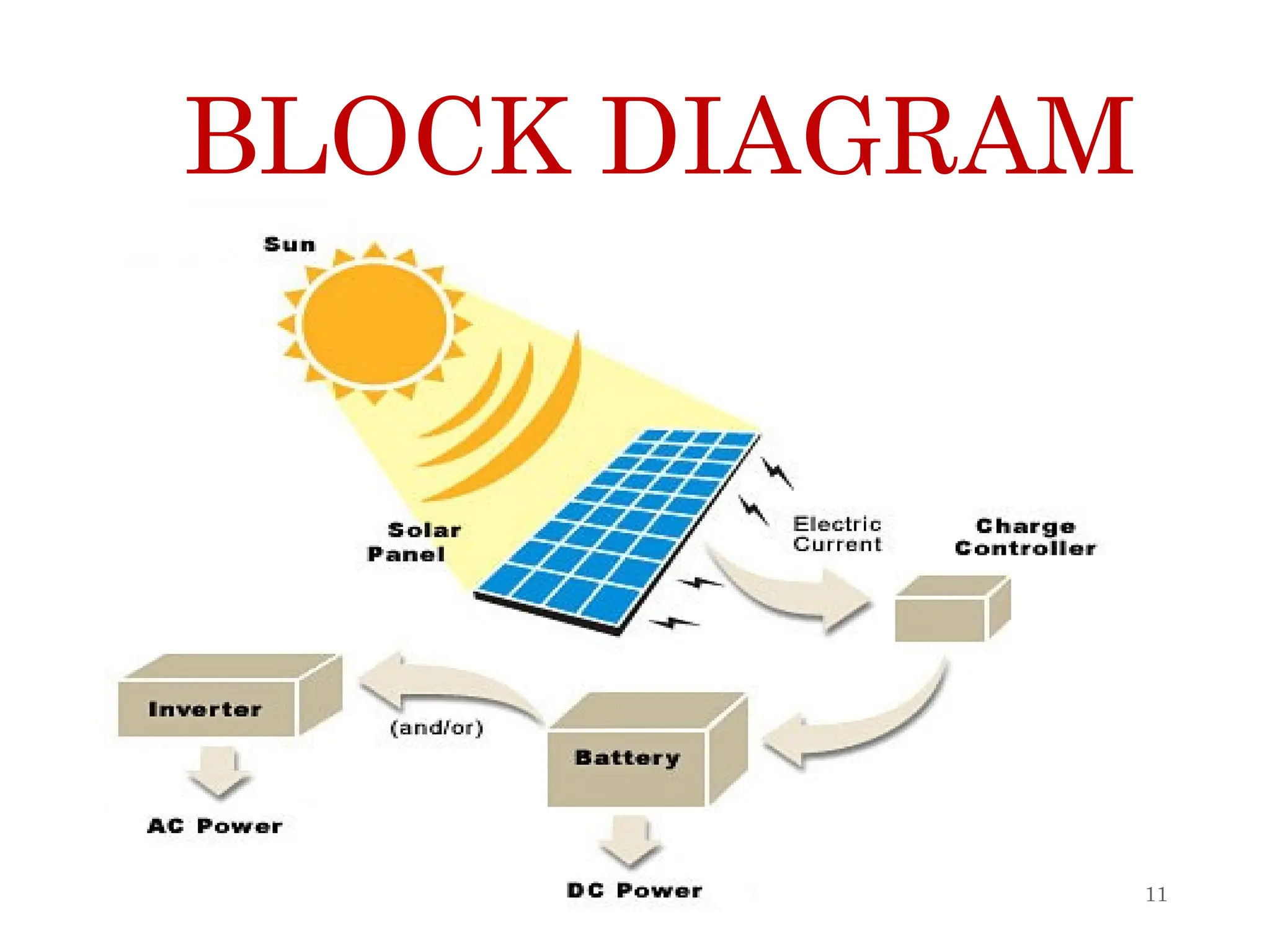
BLOCK DIAGRAM
11
11
HOW SOLAR PANELS WORK?
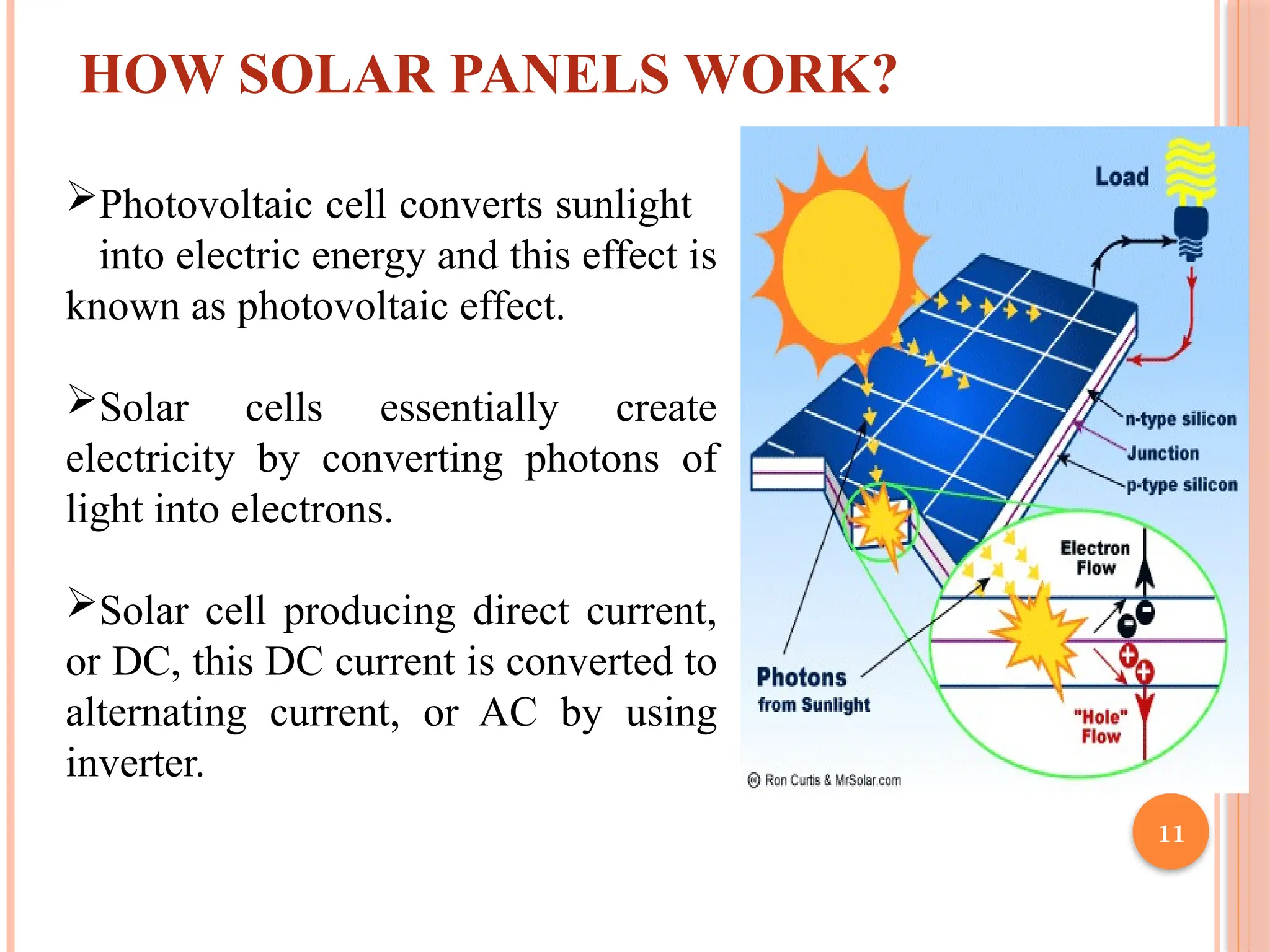
Photovoltaic cell converts sunlight
into electric energy and this effect is
known as photovoltaic effect.
Solar cells essentially create
electricity by converting photons of
light into electrons.
Solar cell producing direct current,
or DC, this DC current is converted to
alternating current, or AC by using
inverter.
12
ADVANTAGES OF SOLAR
PANEL
 Ecologically Friendly
 Decreased Electrical Bill
 Low Maintenance
 Efficiency
13
NEED OF SOLAR TREE
 Due to less land requirement
It require less land as compare to traditional PV system. So we
require such a plant which can generate max. energy
using minimum land.
 Efficient energy generation
It can generate energy very efficiently as compare to
traditional system.
 It can collect energy from wind
The stem are flexible so that they can rotate in any
direction and by shaking themselves they produce
energy also from wind as in the case of a natural tree.
14
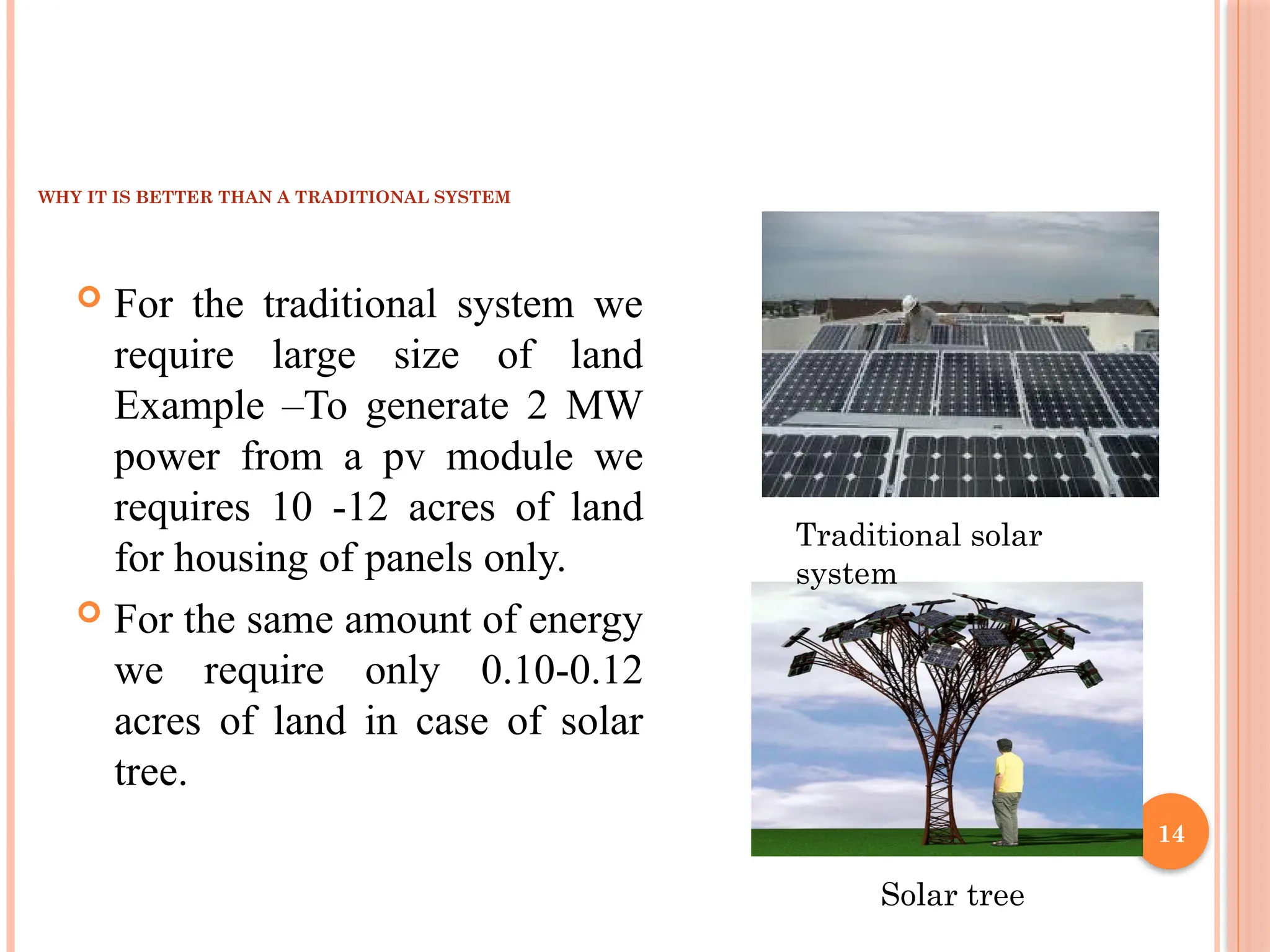
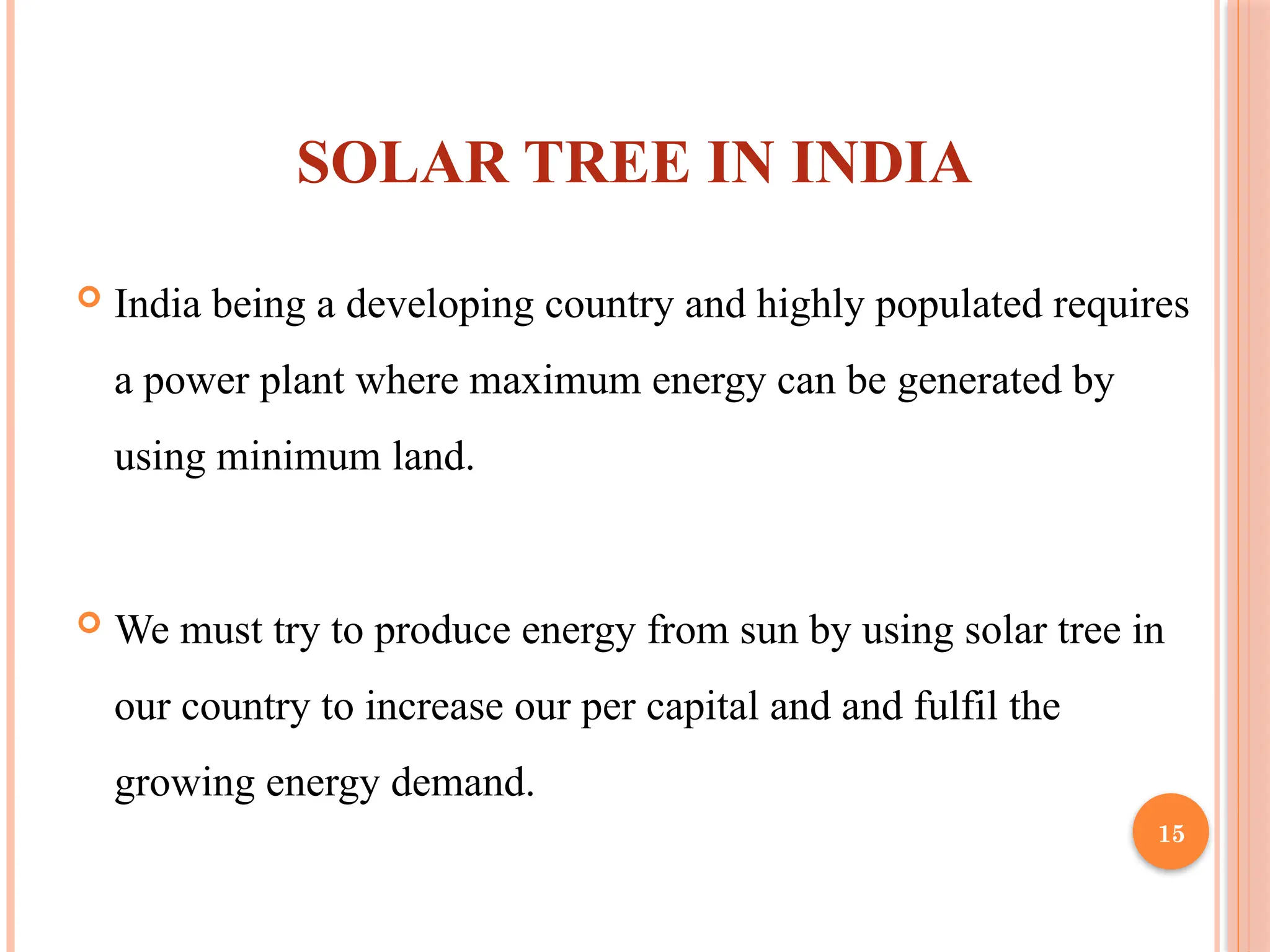
WHY IT IS BETTER THAN A TRADITIONAL SYSTEM
 For the traditional system we
require large size of land
Example –To generate 2 MW
power from a pv module we
requires 10 -12 acres of land
for housing of panels only.
 For the same amount of energy
we require only 0.10-0.12
acres of land in case of solar
tree.
Traditional solar
system
Solar tree
15
SOLAR TREE IN INDIA
 India being a developing country and highly populated requires
a power plant where maximum energy can be generated by
using minimum land.
 We must try to produce energy from sun by using solar tree in
our country to increase our per capital and and fulfil the
growing energy demand.
16
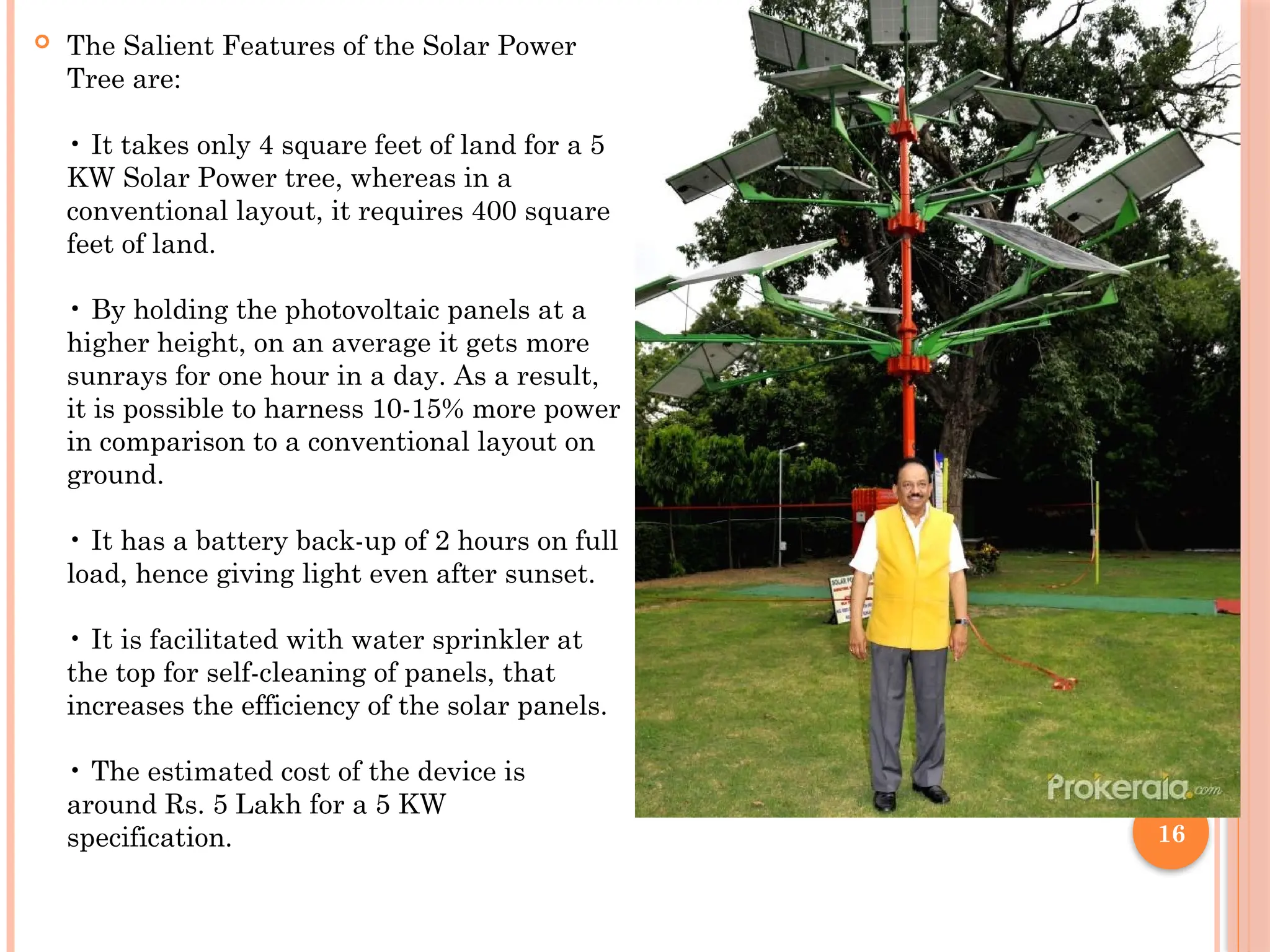
 The Salient Features of the Solar Power
Tree are:
• It takes only 4 square feet of land for a 5
KW Solar Power tree, whereas in a
conventional layout, it requires 400 square
feet of land.
• By holding the photovoltaic panels at a
higher height, on an average it gets more
sunrays for one hour in a day. As a result,
it is possible to harness 10-15% more power
in comparison to a conventional layout on
ground.
• It has a battery back-up of 2 hours on full
load, hence giving light even after sunset.
• It is facilitated with water sprinkler at
the top for self-cleaning of panels, that
increases the efficiency of the solar panels.
• The estimated cost of the device is
around Rs. 5 Lakh for a 5 KW
specification.
17
APPLICATION
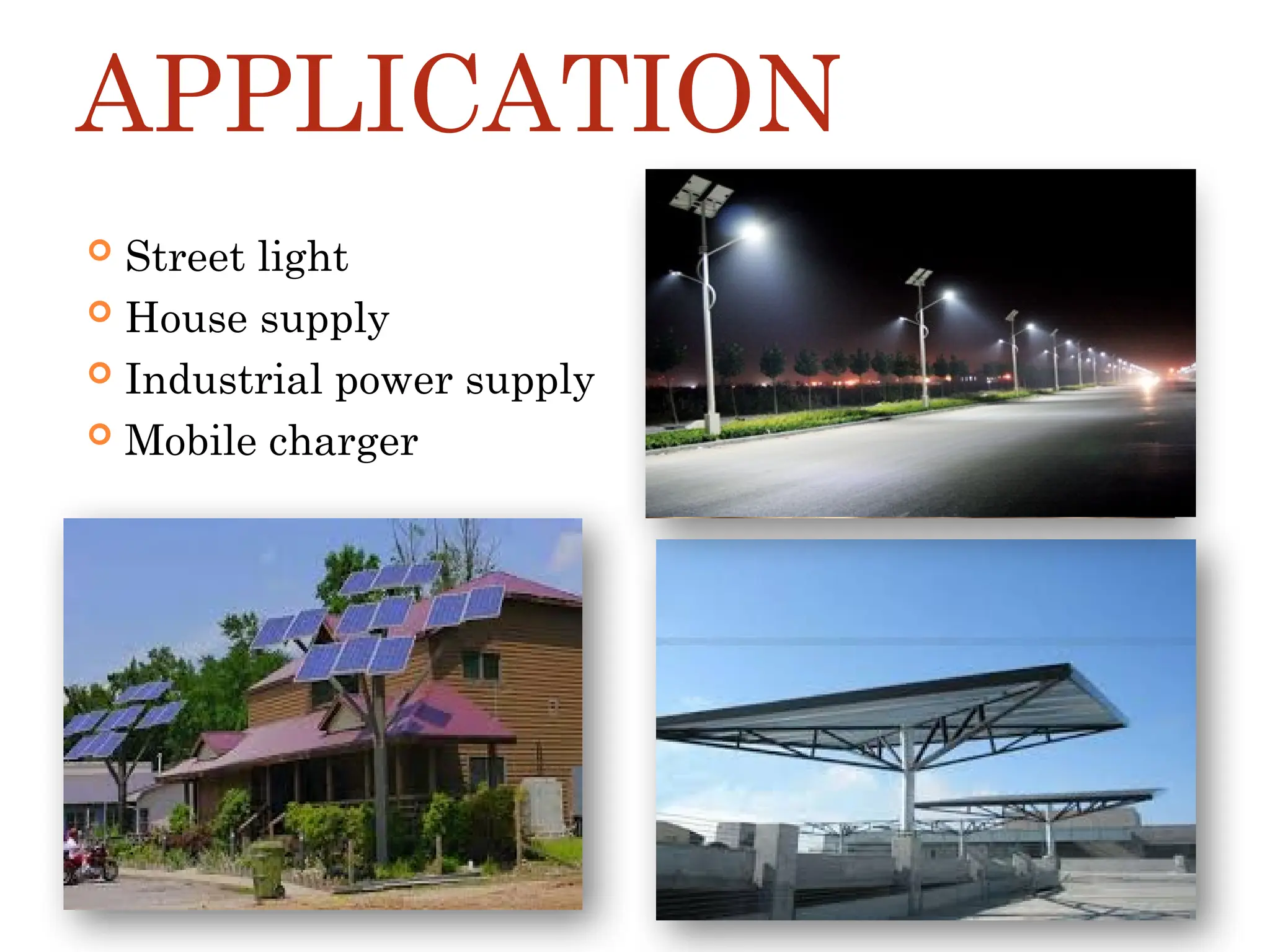
 Street light
 House supply
 Industrial power supply
 Mobile charger
ADVANTAGES
 No air pollution
 We wouldn’t have to worry as much about future
energy sources
 People in poor country would have access to
electricity
 People can save money
 Land requirement is very less
DISADVANTAGES
As we know nothing is perfect in the world, so is Solar
tree.
Here are some of its disadvantages
 Cost is high
 May cause hazards to the birds and insects
 Hazards to eyesight from solar reflectors
21
FUTURE OF SOLAR TREE
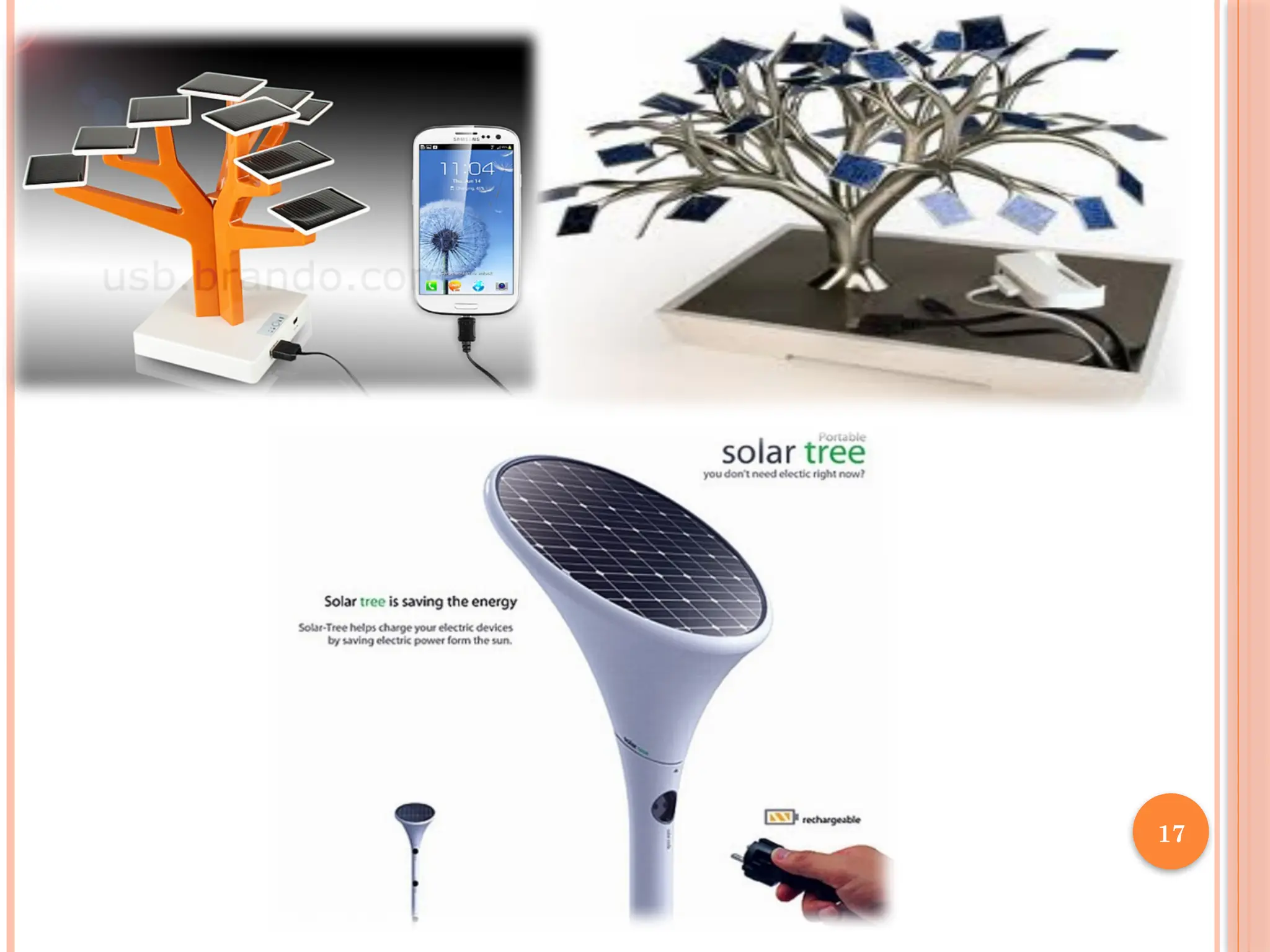
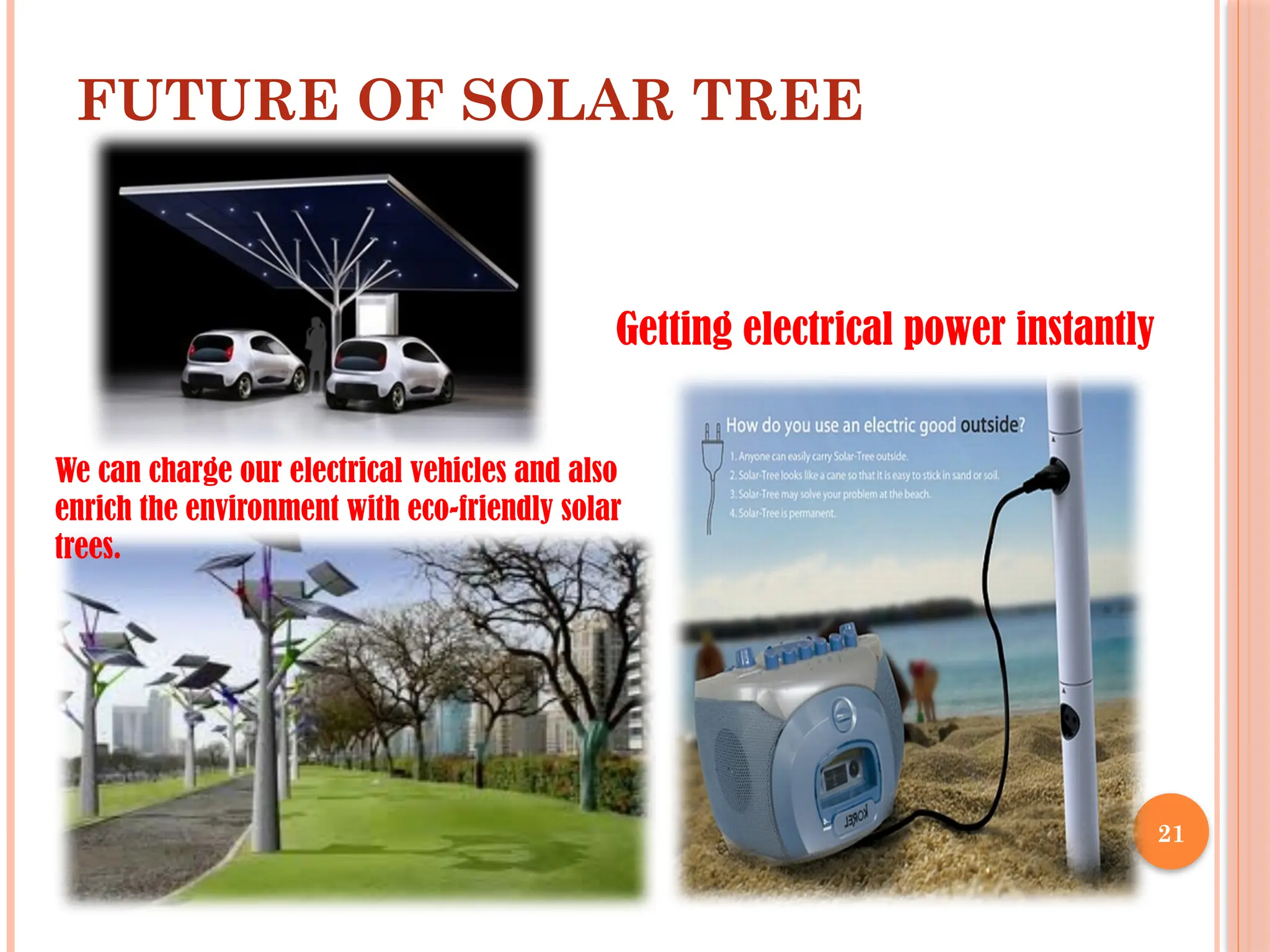
We can charge our electrical vehicles and also
enrich the environment with eco-friendly solar
trees.
Getting electrical power instantly
22
CONCLUSION
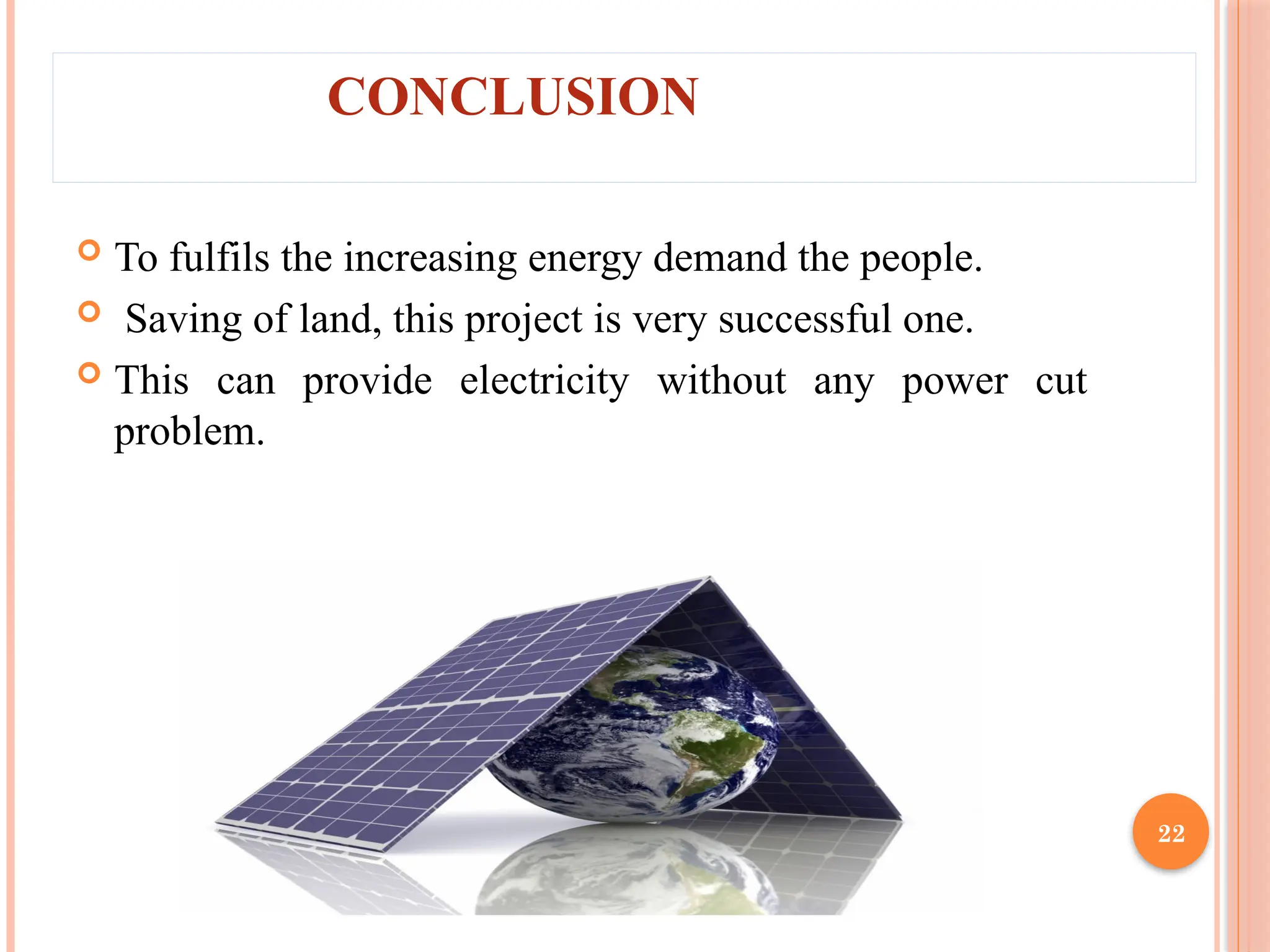
 To fulfils the increasing energy demand the people.
 Saving of land, this project is very successful one.
 This can provide electricity without any power cut
problem.
23

Solar Tree for power Generation in street

  • 1.
    1 SOLAR TREE Presented By, SIVASANKARIB Final Year, Department of EEE Einstein College of Engineering, Tirunelveli - 12
  • 2.
  • 3.
    INDEX  Introduction.  History. What is SOLAR TREE?.  Components of Solar Tree  Why we called it as solar tree  Block Diagram.  How Solar panel works  Specifications  Need of Solar Tree  Why it is better than traditional system  Solar Tree in India  Application.  Advantages.  Disadvantages.  Future of Solar Tree  Conclusion 3
  • 4.
    4 INTRODUCTION  solar energyis the best option.  Solar tree sounds like the perfect solution for our future energy needs.  A solar tree is an artificial tree with photo-voltaic cells arranged in Fibonacci series manner.  Uses multiple no. of solar panels which forms the shape of a tree.
  • 5.
    HISTORY 1. In 1800solar energy plants developed . 2. In 1839 Alexandre Edmond discovered the photo voltalic effect. 3. In 1941 Russell ohl invented solar cell . 4. Solar Tree Foundation which began in 2008 by Rein Triefeldt 5. In 2012 Ross Lovegrove designed the solar tree.
  • 6.
    WHAT IS SOLARTREE ? 6
  • 7.
    7 WHAT IS SOLARTREE A solar tree is a decorative means of producing solar energy and also electricity. It uses multiple no. of solar panels which forms the shape of a tree. The panels are arranged in a tree fashion in a tall tower/pole. TREE stands for T= TREE GENERATING R=RENEWABLE E=ENERGY and E=ELECTRICITY This is like a tree in structure and the panels are like leaves of the tree which produces energy.
  • 8.
    8 COMPONENTS OF SOLARTREE The solar tree consists of mainly five parts to design.  Solar panels  Long tower  LEDs  Batteries  Stems for connecting the panels
  • 9.
    9  Tree canproduce their own food material by the process called PHOTOSYNTHESIS.  Leaves are producing food materials for human beings.  Likewise in solar tree solar plates are producing energy for the society. WHY WE CALLED IT AS SOLAR TREE
  • 10.
  • 11.
    11 HOW SOLAR PANELSWORK? Photovoltaic cell converts sunlight into electric energy and this effect is known as photovoltaic effect. Solar cells essentially create electricity by converting photons of light into electrons. Solar cell producing direct current, or DC, this DC current is converted to alternating current, or AC by using inverter.
  • 12.
    12 ADVANTAGES OF SOLAR PANEL Ecologically Friendly  Decreased Electrical Bill  Low Maintenance  Efficiency
  • 13.
    13 NEED OF SOLARTREE  Due to less land requirement It require less land as compare to traditional PV system. So we require such a plant which can generate max. energy using minimum land.  Efficient energy generation It can generate energy very efficiently as compare to traditional system.  It can collect energy from wind The stem are flexible so that they can rotate in any direction and by shaking themselves they produce energy also from wind as in the case of a natural tree.
  • 14.
    14 WHY IT ISBETTER THAN A TRADITIONAL SYSTEM  For the traditional system we require large size of land Example –To generate 2 MW power from a pv module we requires 10 -12 acres of land for housing of panels only.  For the same amount of energy we require only 0.10-0.12 acres of land in case of solar tree. Traditional solar system Solar tree
  • 15.
    15 SOLAR TREE ININDIA  India being a developing country and highly populated requires a power plant where maximum energy can be generated by using minimum land.  We must try to produce energy from sun by using solar tree in our country to increase our per capital and and fulfil the growing energy demand.
  • 16.
    16  The SalientFeatures of the Solar Power Tree are: • It takes only 4 square feet of land for a 5 KW Solar Power tree, whereas in a conventional layout, it requires 400 square feet of land. • By holding the photovoltaic panels at a higher height, on an average it gets more sunrays for one hour in a day. As a result, it is possible to harness 10-15% more power in comparison to a conventional layout on ground. • It has a battery back-up of 2 hours on full load, hence giving light even after sunset. • It is facilitated with water sprinkler at the top for self-cleaning of panels, that increases the efficiency of the solar panels. • The estimated cost of the device is around Rs. 5 Lakh for a 5 KW specification.
  • 17.
  • 18.
    APPLICATION  Street light House supply  Industrial power supply  Mobile charger
  • 19.
    ADVANTAGES  No airpollution  We wouldn’t have to worry as much about future energy sources  People in poor country would have access to electricity  People can save money  Land requirement is very less
  • 20.
    DISADVANTAGES As we knownothing is perfect in the world, so is Solar tree. Here are some of its disadvantages  Cost is high  May cause hazards to the birds and insects  Hazards to eyesight from solar reflectors
  • 21.
    21 FUTURE OF SOLARTREE We can charge our electrical vehicles and also enrich the environment with eco-friendly solar trees. Getting electrical power instantly
  • 22.
    22 CONCLUSION  To fulfilsthe increasing energy demand the people.  Saving of land, this project is very successful one.  This can provide electricity without any power cut problem.
  • 23.