Measurements and
Measurement Systems
Lecture 1
1st year electrical
Dr. Shimaa Hassan Barakat
Course Evaluation
Total degree = 125
Mid-term and Assignments = 35
Lab and Section = 25
Final exam = 65
2
Measurements
Definition of Measurements:
• Process of determining the size,
amount, or degree of a physical
quantity.
• Fundamental aspect of science
and engineering.
• Quantifies and compares physical
quantities.
Importance of Measurements:
• Describes properties of objects
and systems.
• Compares different things.
• Makes predictions and decisions.
• Tests theories and models.
• Used in various fields such as
physics, chemistry, biology,
engineering, etc.
3
Real-world Applications of
Electrical and Electronic
Measurements
• Electrical and Electronic Measurements are a
crucial aspect of Electrical Engineering and have
many real-world applications.
• These measurements help Electrical Engineers
understand and improve the performance of
electrical systems and devices in various
industries, including telecommunications,
automotive, renewable energy, and more.
4
Examples of real-world applications
1.Power transmission and distribution systems
• Measuring voltage, current, and resistance in high voltage electrical systems to ensure safe and efficient power
transmission.
2.Renewable energy systems
• Measuring power output in solar panels and wind turbines to optimize energy production and improve system
performance.
3.Electronic circuits
• Measuring voltage, current, and resistance in computer systems, smartphones, and other electronic devices to
ensure their proper functioning.
4.Battery-operated devices
• Measuring current in laptops, mobile phones, and other battery-operated devices to monitor energy consumption
and extend battery life.
5.Energy consumption monitoring
• Measuring energy consumption in smart homes and buildings to reduce energy waste and improve energy
efficiency. 5
Types of Measurements
Direct Measurements:
• Definition: Direct measurement is
obtaining the value of a physical
quantity by measuring it directly
with a suitable instrument.
• Examples: Measuring length of an
object with a ruler, weight of an
object with a scale.
• Advantages: Accurate and less room
for error.
Indirect Measurements:
• Definition: Indirect measurement is
obtaining the value of a physical quantity
by inferring it from one or more other
measurements.
• Examples: Measuring speed of a car by
measuring time it takes to cover a certain
distance.
• Advantages: Necessary when direct
measurement is not possible.
Instruments and
Measurement Systems
• Instruments: Tools used to make measurements.
• Measurement Systems: Combination of instruments and
associated hardware, software, and methods used to make
measurements.
• Types of Instruments:
• Mechanical: Ruler, scale, micrometer, etc.
• Electrical: Voltmeter, ammeter, oscilloscope, etc.
• Optical: Microscope, camera, spectrometer, etc.
• Chemical: pH meter, spectrophotometer, gas
chromatograph, etc.
• Measurement system consists of:
• a detector,
• an intermediate transfer device, and
• an indicator, recorder, or a storage device.
7
Mechanical Instruments
8
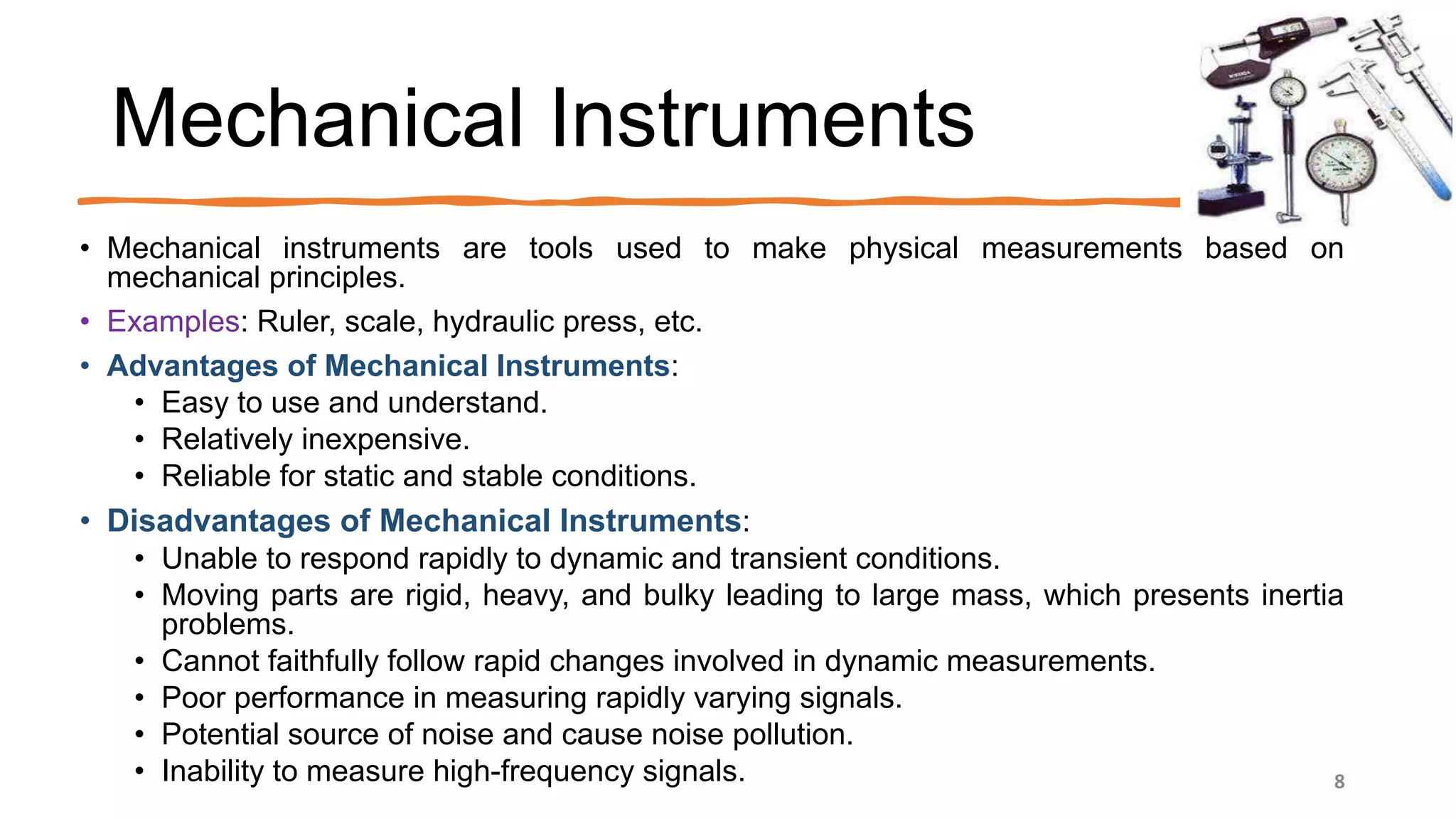
• Mechanical instruments are tools used to make physical measurements based on
mechanical principles.
• Examples: Ruler, scale, hydraulic press, etc.
• Advantages of Mechanical Instruments:
• Easy to use and understand.
• Relatively inexpensive.
• Reliable for static and stable conditions.
• Disadvantages of Mechanical Instruments:
• Unable to respond rapidly to dynamic and transient conditions.
• Moving parts are rigid, heavy, and bulky leading to large mass, which presents inertia
problems.
• Cannot faithfully follow rapid changes involved in dynamic measurements.
• Poor performance in measuring rapidly varying signals.
• Potential source of noise and cause noise pollution.
• Inability to measure high-frequency signals.
Electrical Instruments
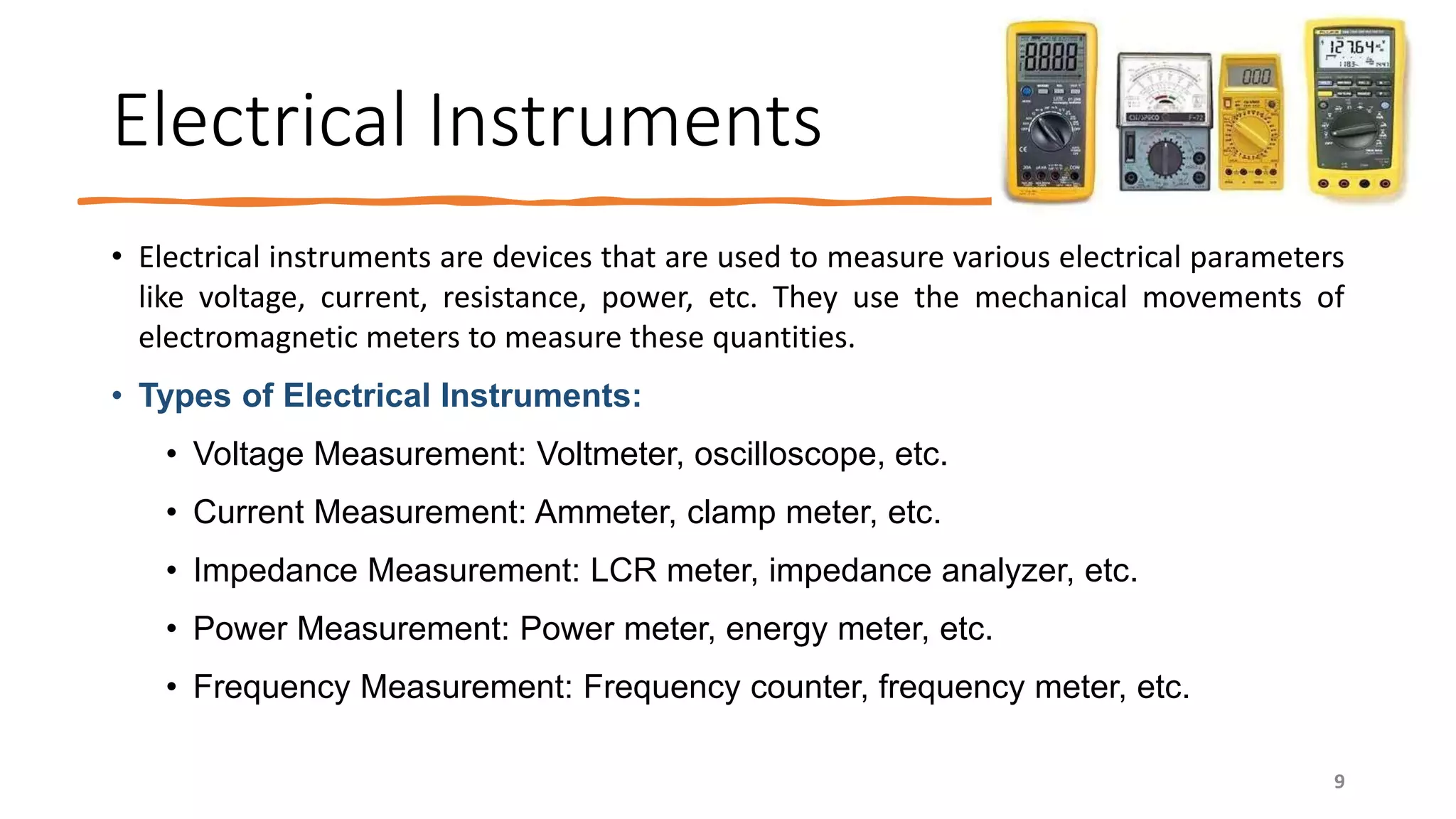
• Electrical instruments are devices that are used to measure various electrical parameters
like voltage, current, resistance, power, etc. They use the mechanical movements of
electromagnetic meters to measure these quantities.
• Types of Electrical Instruments:
• Voltage Measurement: Voltmeter, oscilloscope, etc.
• Current Measurement: Ammeter, clamp meter, etc.
• Impedance Measurement: LCR meter, impedance analyzer, etc.
• Power Measurement: Power meter, energy meter, etc.
• Frequency Measurement: Frequency counter, frequency meter, etc.
9
Electrical Instruments
• Advantages of Electrical Instruments:
• High accuracy and precision compared to mechanical instruments.
• Faster response than mechanical methods.
• Wide range of measurement capabilities.
• Can be used to measure high-frequency signals.
• Less affected by environmental conditions such as temperature, humidity, and
vibration.
• Limitations:
• Depend on mechanical meter movement for indication.
• Mechanical movement has inertia, leading to limited time response.
• More expensive compared to mechanical instruments.
• Most industrial recorders have responses of 0.5 to 24 s.
10
Electronic Instruments
• Definition: Electronic Instruments are tools that use electronic
circuits to make scientific and industrial measurements.
• Need for Fast Responses: Most modern measurements require fast
responses, which can't be met by mechanical and electrical
instruments.
• Use of Semiconductor Devices: Electronic instruments use
semiconductor devices, which have small inertia, resulting in a faster
response time.
• Electronic instruments offer higher sensitivity, faster response,
greater flexibility, lower weight, lower power consumption, and
higher reliability compared to mechanical and electrical instruments,
making them essential for modern scientific and industrial
11
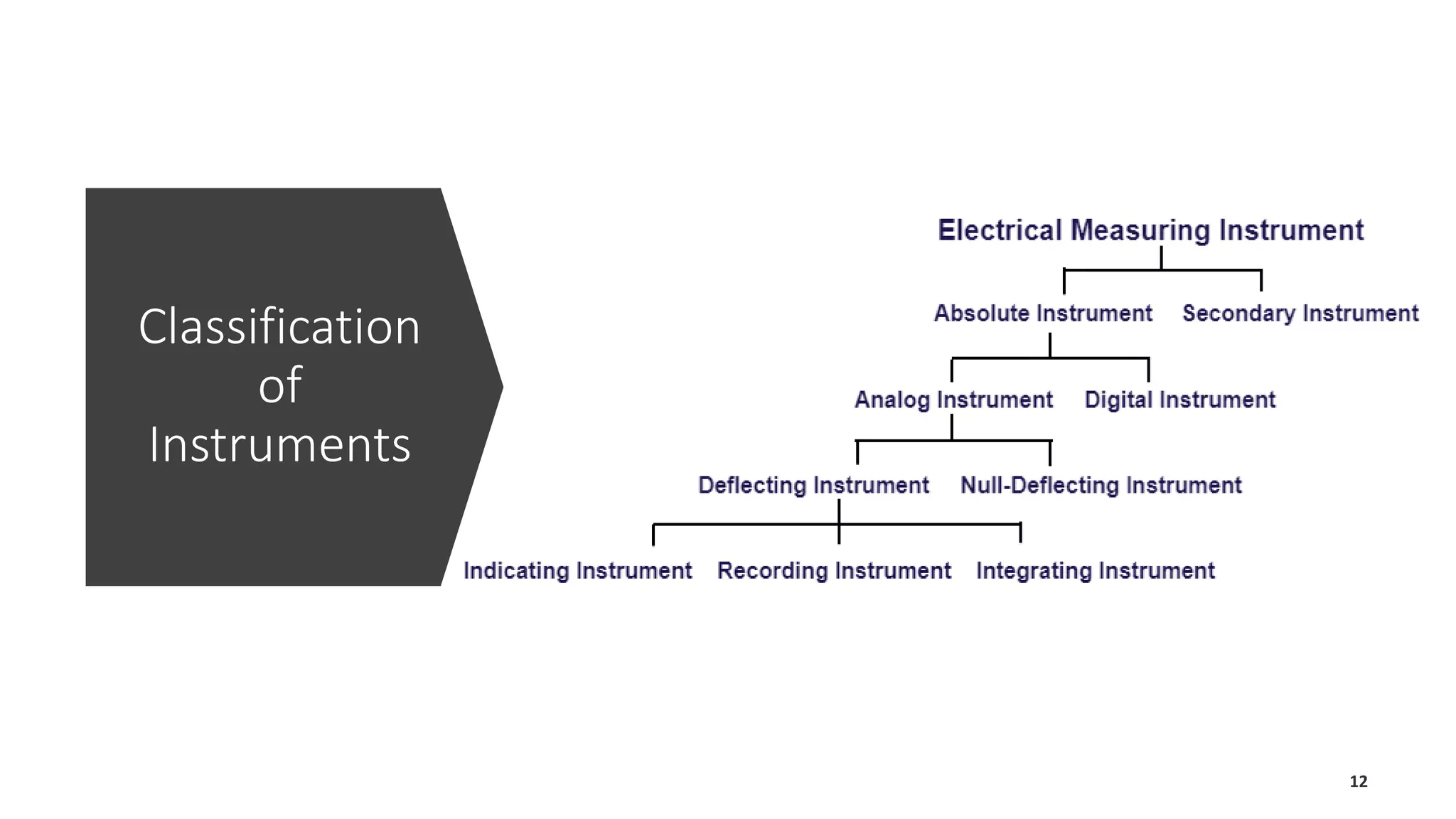
Classification
of
Instruments
Absolute Instrument &
Secondary Instrument
13
• Absolute Instrument:
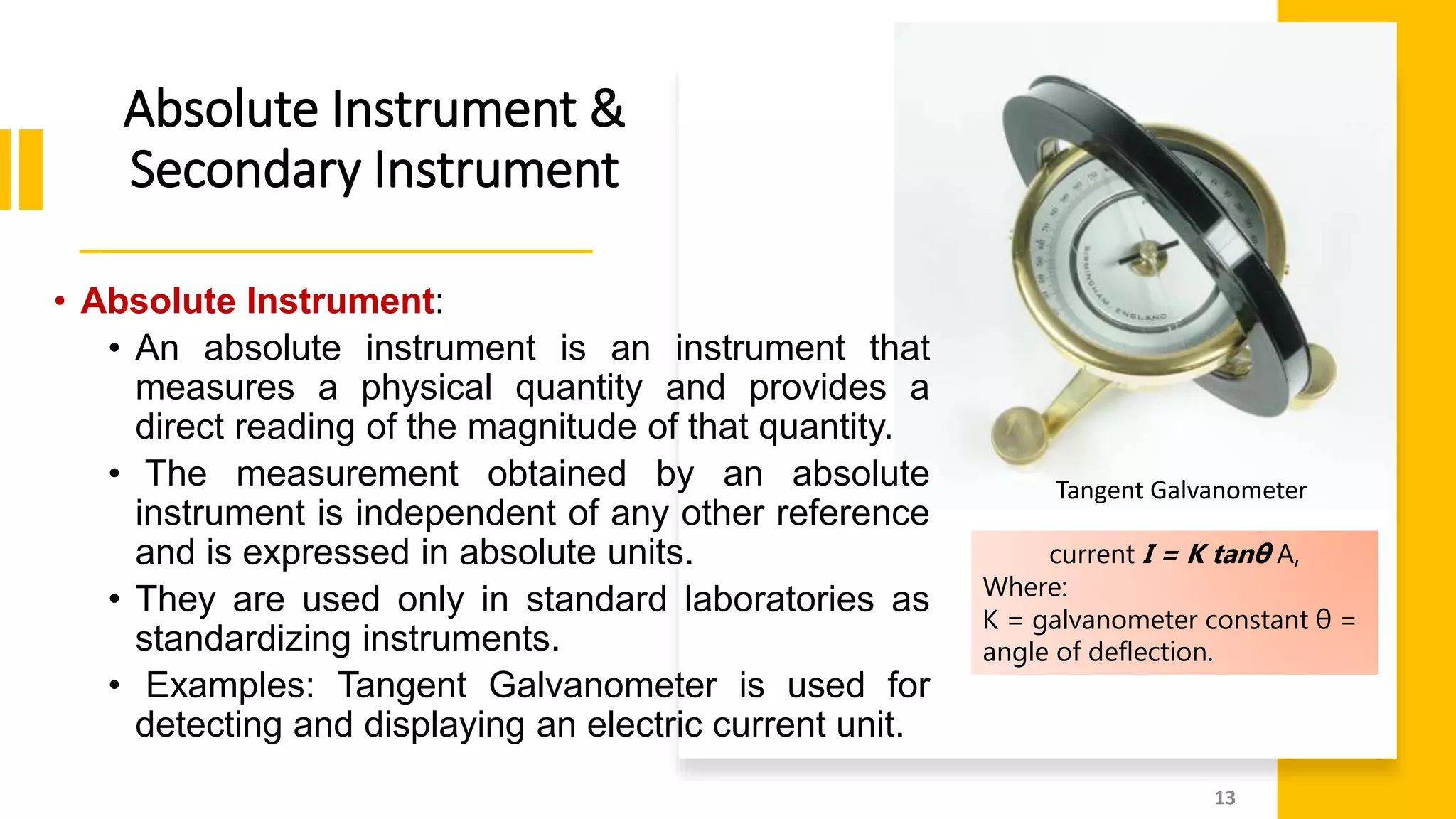
• An absolute instrument is an instrument that
measures a physical quantity and provides a
direct reading of the magnitude of that quantity.
• The measurement obtained by an absolute
instrument is independent of any other reference
and is expressed in absolute units.
• They are used only in standard laboratories as
standardizing instruments.
• Examples: Tangent Galvanometer is used for
detecting and displaying an electric current unit.
current I = K tanθ A,
Where:
K = galvanometer constant θ =
angle of deflection.
Tangent Galvanometer
Absolute Instrument & Secondary Instrument
• Secondary Instrument:
• A secondary instrument is an instrument that measures a physical quantity by
determining some other related quantity.
• The measurement obtained by a secondary instrument is expressed in relative terms,
with reference to some other quantity or standard.
• Secondary instruments are used when direct measurement of a physical quantity is not
feasible or practical.
• Secondary measuring instruments are the widely used measuring instruments.
• For example, a tachometer measures the speed of a rotating object by counting the
number of revolutions it makes.
14
Deflection and Null Type Instruments
• Deflection Type Instruments:
• Deflection type instruments are instruments that
measure a physical quantity by measuring the
deflection or displacement of a mechanical system
or an electrical signal.
• The measurement is proportional to the
magnitude of the physical quantity being
measured.
• Examples of deflection type instruments include
spring balances, load cells, and strain gauges.
15
Deflection type instrument
(PMMC type instrument)
Deflection and Null Type Instruments
• Null Type Instruments:
• Null type instruments are instruments that
measure a physical quantity by comparing it to a
reference or a standard value.
• The measurement is performed by adjusting the
physical quantity until a balance or a null condition
is achieved.
• Examples of null type instruments include
Wheatstone bridges, potentiometers, and balance
scales.
16
Null type instrument
(D.C. potentiometer)
Analog & Digital Modes of Operation
1.Analog Mode of Operation: Analog mode
of operation involves continuous signals
and analog displays.
1. In this mode of operation, the
physical quantity being measured is
converted into an electrical signal
that is proportional to the magnitude
of the physical quantity.
2. The signal is then processed and
displayed on an analog meter or
display, such as a dial gauge or a
CRO (cathode ray oscilloscope)
screen.
3.Analog instruments are used for
measuring continuously varying
physical quantities such as
temperature, pressure, or flow rate.
17
Analog & Digital Modes of Operation
2. Digital Mode of Operation: Digital
mode of operation involves discrete
signals and digital displays.
1.In this mode of operation, the physical
quantity being measured is converted
into a digital signal that is represented
as a series of binary digits (0s and 1s).
2.The digital signal is then processed and
displayed on a digital display, such as a
LCD or LED display.
3. Digital instruments are used for
measuring physical quantities that can
be quantized, such as temperature,
pressure, or flow rate.
18
Functions of Instruments and Measurement
Systems
This classification is based upon the functions they perform.
1. Indicating Instrument
• The Indicating Instrument displays only the value of the
electrical quantities per time of measurement.
• This instrument gives the reading only when connected to the
electrical supply. Otherwise, it goes to zero position.
• Example: Ammeters, Voltmeters, Watt-meters, etc.
19
Functions of Instruments and
Measurement Systems
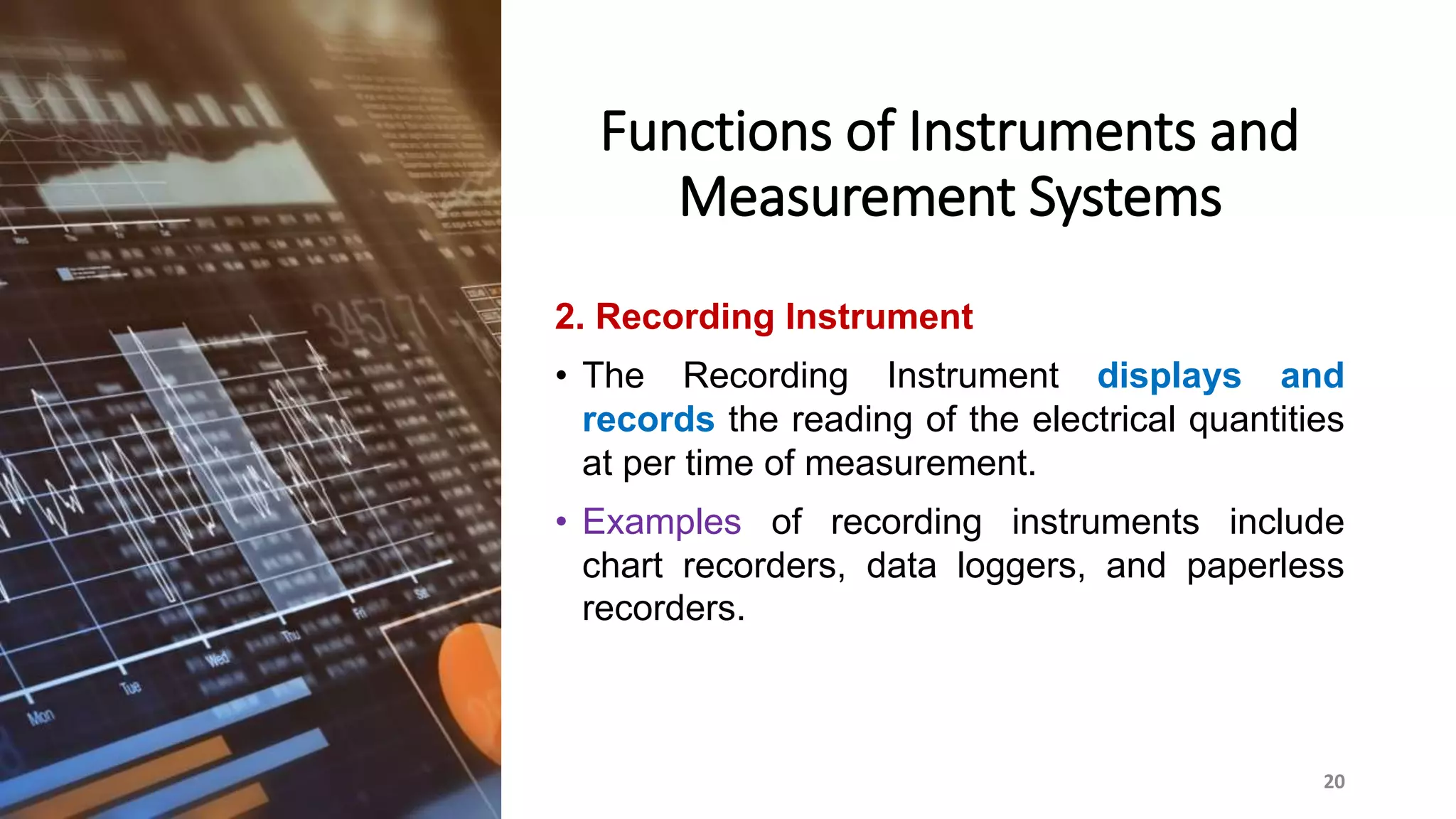
2. Recording Instrument
• The Recording Instrument displays and
records the reading of the electrical quantities
at per time of measurement.
• Examples of recording instruments include
chart recorders, data loggers, and paperless
recorders.
20
3. Integrating Instrument
• The Integrating Instrument displays,
record, and sum the measurement values
over a period of time to provide an integration
of the signal.
• Example: Energy meter, and Ampere-
hour meter are examples of the integrating
instrument.
21
Functions of Instruments and Measurement Systems
• Consider the watt-hour (energy) meter employed for domestic purposes.
• The disc inside the meter will rotate with a speed proportional to the power
consumed at that instant of time.
• The number of revolutions made by the disc is counted continuously by the special
gear arrangement and it is displayed.
• So, the amount of power consumed is being added (i.e., integrated) over the specified
period and thus, the reading gives the energy consumption during the period of
consideration.
Functions of Instruments and Measurement
Systems
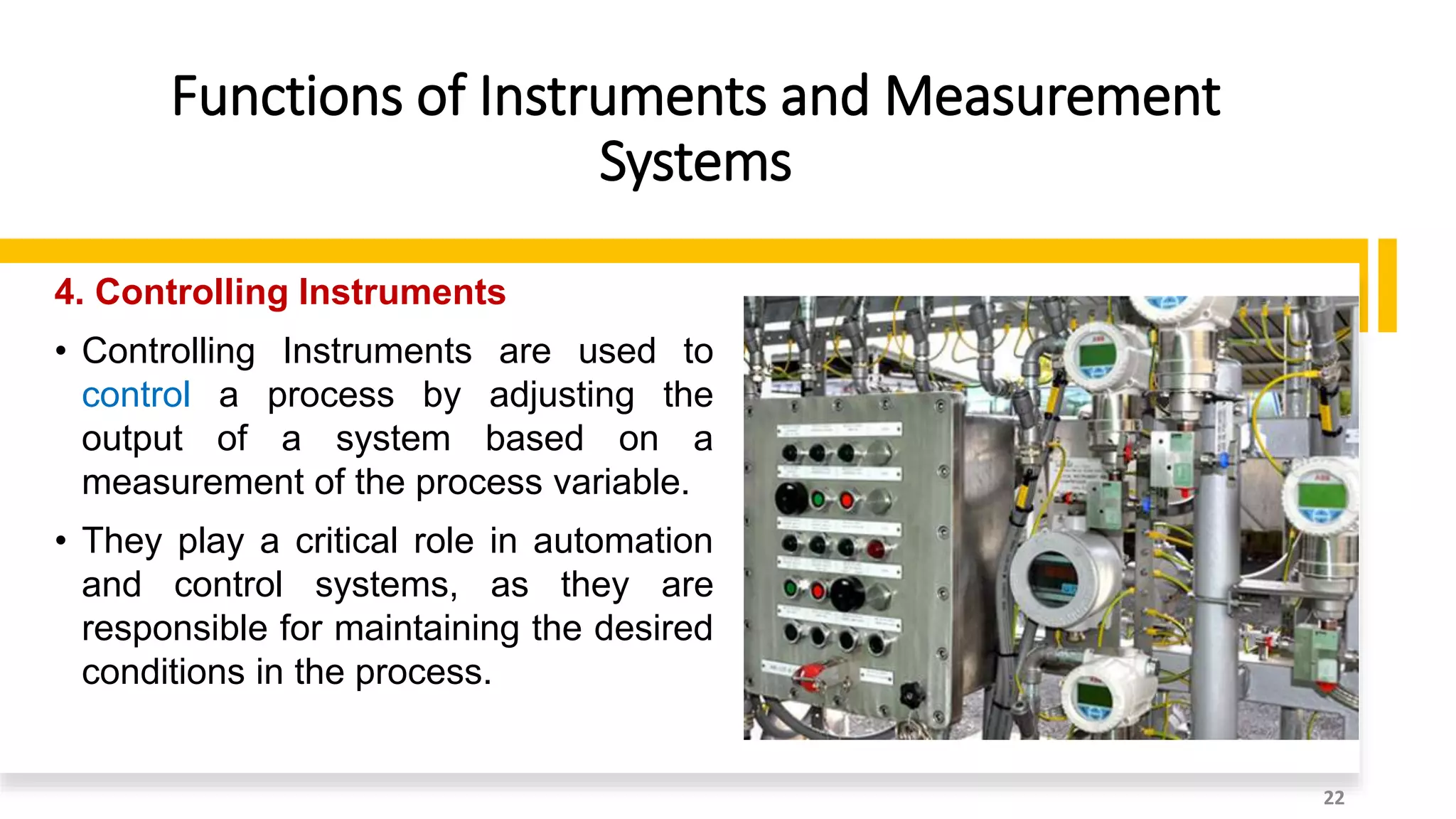
4. Controlling Instruments
• Controlling Instruments are used to
control a process by adjusting the
output of a system based on a
measurement of the process variable.
• They play a critical role in automation
and control systems, as they are
responsible for maintaining the desired
conditions in the process.
22
Applications of
Measurement Systems
The way the instruments and measurement
systems are used for different applications are
as under:
1. Monitoring of processes and operations,
2. Control of processes and operations, and
3. Experimental Engineering analysis.
23
Monitoring of processes and operations
• There are certain applications of measuring instruments that have essentially a
monitoring function.
• They simply indicate the value or condition of parameter under study and their
readings do not serve any control functions.
• For example:
water and electric energy meters installed in homes keep track of commodity used
so that later its cost may be computed to be realized from the user.
24
Control of processes and operations
25
• A very useful application of instruments
is in automatic control systems.
• In order that process variables like
temperature, pressure, humidity, etc. may
be controlled, the prerequisite is that
they can be measured at the desired
location in the individual plants. Same is
true of servo-systems, i.e., systems
connected with measurement of position,
velocity, and acceleration.
Experimental engineering analysis
• For solution of engineering problems, theoretical and experimental methods are
available.
• Experimental engineering analysis has many uses, and some are listed below:
1. Testing the validity of theoretical predictions.
2. Formulations of generalized empirical relationships in cases where no
proper theoretical backing exists.
3. Determination of system parameters, variables and performance indices.
4. For development in important spheres of study where there is ample scope
of study.
5. Solutions of mathematical relationships with the help of analogies.
26
Types of Instrumentation Systems
1. Intelligent instrumentation:
• refers to the type of instrumentation system that is equipped with advanced features such as
digital processing, data storage, and communication capabilities.
• These instruments can perform various functions, such as data acquisition, data processing,
data analysis, and data transmission, without the need for a separate computer.
2. Dumb instrumentation:
• refers to the type of instrumentation system that is limited to basic measurement and
display functions.
• These instruments typically only have the ability to measure a physical quantity and display
the result on a meter or display.
• They do not have any processing, data storage, or communication capabilities, and are
typically used in simple measurement applications.
27

Lect 1 Measurements and Measurement Systems.pptx

  • 1.
    Measurements and Measurement Systems Lecture1 1st year electrical Dr. Shimaa Hassan Barakat
  • 2.
    Course Evaluation Total degree= 125 Mid-term and Assignments = 35 Lab and Section = 25 Final exam = 65 2
  • 3.
    Measurements Definition of Measurements: •Process of determining the size, amount, or degree of a physical quantity. • Fundamental aspect of science and engineering. • Quantifies and compares physical quantities. Importance of Measurements: • Describes properties of objects and systems. • Compares different things. • Makes predictions and decisions. • Tests theories and models. • Used in various fields such as physics, chemistry, biology, engineering, etc. 3
  • 4.
    Real-world Applications of Electricaland Electronic Measurements • Electrical and Electronic Measurements are a crucial aspect of Electrical Engineering and have many real-world applications. • These measurements help Electrical Engineers understand and improve the performance of electrical systems and devices in various industries, including telecommunications, automotive, renewable energy, and more. 4
  • 5.
    Examples of real-worldapplications 1.Power transmission and distribution systems • Measuring voltage, current, and resistance in high voltage electrical systems to ensure safe and efficient power transmission. 2.Renewable energy systems • Measuring power output in solar panels and wind turbines to optimize energy production and improve system performance. 3.Electronic circuits • Measuring voltage, current, and resistance in computer systems, smartphones, and other electronic devices to ensure their proper functioning. 4.Battery-operated devices • Measuring current in laptops, mobile phones, and other battery-operated devices to monitor energy consumption and extend battery life. 5.Energy consumption monitoring • Measuring energy consumption in smart homes and buildings to reduce energy waste and improve energy efficiency. 5
  • 6.
    Types of Measurements DirectMeasurements: • Definition: Direct measurement is obtaining the value of a physical quantity by measuring it directly with a suitable instrument. • Examples: Measuring length of an object with a ruler, weight of an object with a scale. • Advantages: Accurate and less room for error. Indirect Measurements: • Definition: Indirect measurement is obtaining the value of a physical quantity by inferring it from one or more other measurements. • Examples: Measuring speed of a car by measuring time it takes to cover a certain distance. • Advantages: Necessary when direct measurement is not possible.
  • 7.
    Instruments and Measurement Systems •Instruments: Tools used to make measurements. • Measurement Systems: Combination of instruments and associated hardware, software, and methods used to make measurements. • Types of Instruments: • Mechanical: Ruler, scale, micrometer, etc. • Electrical: Voltmeter, ammeter, oscilloscope, etc. • Optical: Microscope, camera, spectrometer, etc. • Chemical: pH meter, spectrophotometer, gas chromatograph, etc. • Measurement system consists of: • a detector, • an intermediate transfer device, and • an indicator, recorder, or a storage device. 7
  • 8.
    Mechanical Instruments 8 • Mechanicalinstruments are tools used to make physical measurements based on mechanical principles. • Examples: Ruler, scale, hydraulic press, etc. • Advantages of Mechanical Instruments: • Easy to use and understand. • Relatively inexpensive. • Reliable for static and stable conditions. • Disadvantages of Mechanical Instruments: • Unable to respond rapidly to dynamic and transient conditions. • Moving parts are rigid, heavy, and bulky leading to large mass, which presents inertia problems. • Cannot faithfully follow rapid changes involved in dynamic measurements. • Poor performance in measuring rapidly varying signals. • Potential source of noise and cause noise pollution. • Inability to measure high-frequency signals.
  • 9.
    Electrical Instruments • Electricalinstruments are devices that are used to measure various electrical parameters like voltage, current, resistance, power, etc. They use the mechanical movements of electromagnetic meters to measure these quantities. • Types of Electrical Instruments: • Voltage Measurement: Voltmeter, oscilloscope, etc. • Current Measurement: Ammeter, clamp meter, etc. • Impedance Measurement: LCR meter, impedance analyzer, etc. • Power Measurement: Power meter, energy meter, etc. • Frequency Measurement: Frequency counter, frequency meter, etc. 9
  • 10.
    Electrical Instruments • Advantagesof Electrical Instruments: • High accuracy and precision compared to mechanical instruments. • Faster response than mechanical methods. • Wide range of measurement capabilities. • Can be used to measure high-frequency signals. • Less affected by environmental conditions such as temperature, humidity, and vibration. • Limitations: • Depend on mechanical meter movement for indication. • Mechanical movement has inertia, leading to limited time response. • More expensive compared to mechanical instruments. • Most industrial recorders have responses of 0.5 to 24 s. 10
  • 11.
    Electronic Instruments • Definition:Electronic Instruments are tools that use electronic circuits to make scientific and industrial measurements. • Need for Fast Responses: Most modern measurements require fast responses, which can't be met by mechanical and electrical instruments. • Use of Semiconductor Devices: Electronic instruments use semiconductor devices, which have small inertia, resulting in a faster response time. • Electronic instruments offer higher sensitivity, faster response, greater flexibility, lower weight, lower power consumption, and higher reliability compared to mechanical and electrical instruments, making them essential for modern scientific and industrial 11
  • 12.
  • 13.
    Absolute Instrument & SecondaryInstrument 13 • Absolute Instrument: • An absolute instrument is an instrument that measures a physical quantity and provides a direct reading of the magnitude of that quantity. • The measurement obtained by an absolute instrument is independent of any other reference and is expressed in absolute units. • They are used only in standard laboratories as standardizing instruments. • Examples: Tangent Galvanometer is used for detecting and displaying an electric current unit. current I = K tanθ A, Where: K = galvanometer constant θ = angle of deflection. Tangent Galvanometer
  • 14.
    Absolute Instrument &Secondary Instrument • Secondary Instrument: • A secondary instrument is an instrument that measures a physical quantity by determining some other related quantity. • The measurement obtained by a secondary instrument is expressed in relative terms, with reference to some other quantity or standard. • Secondary instruments are used when direct measurement of a physical quantity is not feasible or practical. • Secondary measuring instruments are the widely used measuring instruments. • For example, a tachometer measures the speed of a rotating object by counting the number of revolutions it makes. 14
  • 15.
    Deflection and NullType Instruments • Deflection Type Instruments: • Deflection type instruments are instruments that measure a physical quantity by measuring the deflection or displacement of a mechanical system or an electrical signal. • The measurement is proportional to the magnitude of the physical quantity being measured. • Examples of deflection type instruments include spring balances, load cells, and strain gauges. 15 Deflection type instrument (PMMC type instrument)
  • 16.
    Deflection and NullType Instruments • Null Type Instruments: • Null type instruments are instruments that measure a physical quantity by comparing it to a reference or a standard value. • The measurement is performed by adjusting the physical quantity until a balance or a null condition is achieved. • Examples of null type instruments include Wheatstone bridges, potentiometers, and balance scales. 16 Null type instrument (D.C. potentiometer)
  • 17.
    Analog & DigitalModes of Operation 1.Analog Mode of Operation: Analog mode of operation involves continuous signals and analog displays. 1. In this mode of operation, the physical quantity being measured is converted into an electrical signal that is proportional to the magnitude of the physical quantity. 2. The signal is then processed and displayed on an analog meter or display, such as a dial gauge or a CRO (cathode ray oscilloscope) screen. 3.Analog instruments are used for measuring continuously varying physical quantities such as temperature, pressure, or flow rate. 17
  • 18.
    Analog & DigitalModes of Operation 2. Digital Mode of Operation: Digital mode of operation involves discrete signals and digital displays. 1.In this mode of operation, the physical quantity being measured is converted into a digital signal that is represented as a series of binary digits (0s and 1s). 2.The digital signal is then processed and displayed on a digital display, such as a LCD or LED display. 3. Digital instruments are used for measuring physical quantities that can be quantized, such as temperature, pressure, or flow rate. 18
  • 19.
    Functions of Instrumentsand Measurement Systems This classification is based upon the functions they perform. 1. Indicating Instrument • The Indicating Instrument displays only the value of the electrical quantities per time of measurement. • This instrument gives the reading only when connected to the electrical supply. Otherwise, it goes to zero position. • Example: Ammeters, Voltmeters, Watt-meters, etc. 19
  • 20.
    Functions of Instrumentsand Measurement Systems 2. Recording Instrument • The Recording Instrument displays and records the reading of the electrical quantities at per time of measurement. • Examples of recording instruments include chart recorders, data loggers, and paperless recorders. 20
  • 21.
    3. Integrating Instrument •The Integrating Instrument displays, record, and sum the measurement values over a period of time to provide an integration of the signal. • Example: Energy meter, and Ampere- hour meter are examples of the integrating instrument. 21 Functions of Instruments and Measurement Systems • Consider the watt-hour (energy) meter employed for domestic purposes. • The disc inside the meter will rotate with a speed proportional to the power consumed at that instant of time. • The number of revolutions made by the disc is counted continuously by the special gear arrangement and it is displayed. • So, the amount of power consumed is being added (i.e., integrated) over the specified period and thus, the reading gives the energy consumption during the period of consideration.
  • 22.
    Functions of Instrumentsand Measurement Systems 4. Controlling Instruments • Controlling Instruments are used to control a process by adjusting the output of a system based on a measurement of the process variable. • They play a critical role in automation and control systems, as they are responsible for maintaining the desired conditions in the process. 22
  • 23.
    Applications of Measurement Systems Theway the instruments and measurement systems are used for different applications are as under: 1. Monitoring of processes and operations, 2. Control of processes and operations, and 3. Experimental Engineering analysis. 23
  • 24.
    Monitoring of processesand operations • There are certain applications of measuring instruments that have essentially a monitoring function. • They simply indicate the value or condition of parameter under study and their readings do not serve any control functions. • For example: water and electric energy meters installed in homes keep track of commodity used so that later its cost may be computed to be realized from the user. 24
  • 25.
    Control of processesand operations 25 • A very useful application of instruments is in automatic control systems. • In order that process variables like temperature, pressure, humidity, etc. may be controlled, the prerequisite is that they can be measured at the desired location in the individual plants. Same is true of servo-systems, i.e., systems connected with measurement of position, velocity, and acceleration.
  • 26.
    Experimental engineering analysis •For solution of engineering problems, theoretical and experimental methods are available. • Experimental engineering analysis has many uses, and some are listed below: 1. Testing the validity of theoretical predictions. 2. Formulations of generalized empirical relationships in cases where no proper theoretical backing exists. 3. Determination of system parameters, variables and performance indices. 4. For development in important spheres of study where there is ample scope of study. 5. Solutions of mathematical relationships with the help of analogies. 26
  • 27.
    Types of InstrumentationSystems 1. Intelligent instrumentation: • refers to the type of instrumentation system that is equipped with advanced features such as digital processing, data storage, and communication capabilities. • These instruments can perform various functions, such as data acquisition, data processing, data analysis, and data transmission, without the need for a separate computer. 2. Dumb instrumentation: • refers to the type of instrumentation system that is limited to basic measurement and display functions. • These instruments typically only have the ability to measure a physical quantity and display the result on a meter or display. • They do not have any processing, data storage, or communication capabilities, and are typically used in simple measurement applications. 27