ELECTRICAL AND ELECTRONIC
MEASUREMENTS
SYLLABUS
OVERVIEW
UNIT-I MEASUREMENT
SYSTEM AND MEASURING
INSTRUMENTS
Generalized Measurement system,
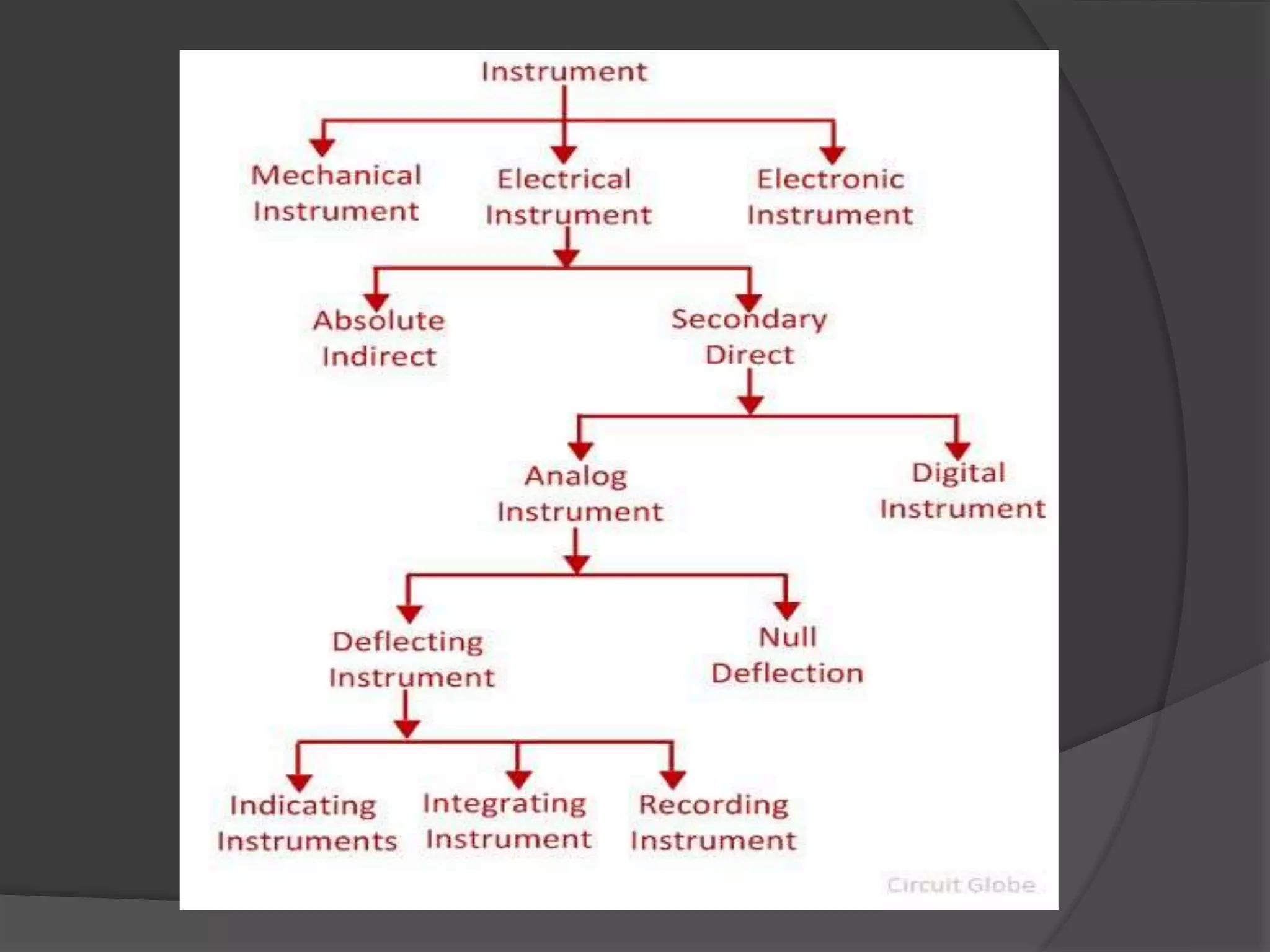
Classification of instruments, Error in
measurement, Classification of errors.
Principle, Construction, Operation of
Moving Coil and Moving Iron Instruments -
Ammeters and Voltmeters - Single phase
Watt meters and Energy Meters - D.C &
A.C Potentiometers - Instrument
Transformers- Instruments for
Measurement of Frequency and Phase-
Calibration of watt meter.
UNIT-II MEASUREMENT OF
R,L,C USING BRIDGES
D.C Bridges: Wheatstone - Kelvin double
bridge- Megger – A.C Bridges: Anderson
Bridge –Maxwell Bridge- Hay’s Bridge
and Schering bridge - Measurement of
Unknown Capacitance using Schering
Bridge.
UNIT-III ELECTRONIC
INSTRUMENTS
Analog Meters: D.C Ammeter and Voltmeters
- Multimeter - Q meter - True RMS Meter -
Vector Impedance Meter - RF Voltage and
Power Measurements - Instrumentation
Amplifier.
Digital Meters: Digital Tachometer – DMM-
ADC: Successive Approximation, Dual
Slope –DAC: Weighted Resistor, R-2R
Ladder type- Digital Frequency Counters -
LCR meter- Calibration of DC Ammeter
and DC Voltmeter.
UNIT-IV DIGITAL STORAGE
OSCILLOSCOPE AND SIGNAL
GENERATORS
Analog Storage Oscilloscope - Sampling
Oscilloscopes - Digital Storage
Oscilloscopes - Sine Wave Generator -
Sweep Frequency Generator, Pulse and
Square Wave Generator - Wave
Analyzer: Harmonic Distortion Analyzer -
Spectrum Analyzer- Measurement of
frequency and voltage at different ac
inputs using DSO.
UNIT-V SMART
INSTRUMENTS AND
RECORDERS
Serial, Parallel ports, USB–IEEE 488-
Applications of Digital Instruments-
Elements of Data Acquisition - Smart
Sensor. Acquiring and Generating
Signals using DAQ Card.
Recording Devices: X-Y Plotters, Magnetic
Tape Recording - Data Loggers- Display
Devices: LED, LCD
MEASUREMENT
The measurement of a given quantity is
essentially an act or the result of
comparison between the quantity
(whose magnitude is unknown) and a
predefined standard.
Two Basic Requirements
 The standard used for comparison
purposes must be accurately defined
and should be commonly accepted.
 The apparatus used and the method
adopted must be provable.
METHODS OF
MEASUREMENTS
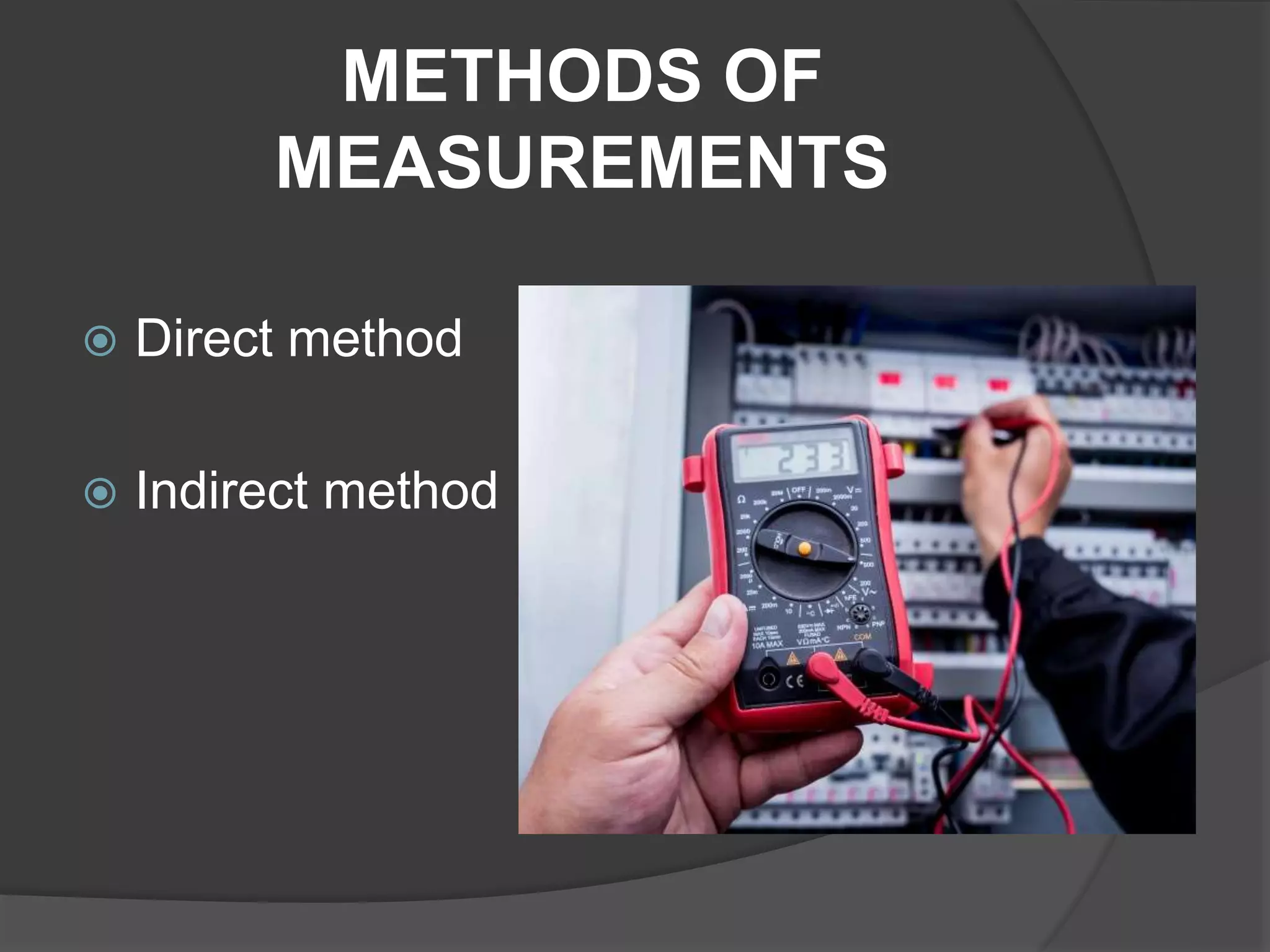
 Direct method
 Indirect method
Direct Method
 The unknown quantity (also called the
measurand) is directly compared against
a standard.
 Result is expressed as a numerical
number and a unit. The standard, in fact,
is a physical embodiment of a unit.
 Quite common for the measurement of
physical quantities like length, mass and
time.
Drawbacks of direct Method
 Not always possible, feasible and
practicable.
 Most of the cases, are inaccurate
because they involve human factors.
 Less sensitive.
 Hence direct methods are not preferred
and are rarely used.
MEASURING SYSTEM
(Indirect Method)
 A measurement system consists of a
transducing element which converts the
quantity to be measured in an
analogous form.
 The analogous signal is then processed
by some intermediate means and is then
fed to the end devices which present the
results of the measurement.
INSTRUMENT
INSTRUMENT
 An instrument may be defined as a device
for determining the value or magnitude of a
quantity or variable.
 The earliest scientific instruments used the
three essential elements as our modern
instruments do. These elements are
 (i) a detector,
 (ii) an intermediate transfer device, and
 (iii) an indicator, recorder or a storage
device.
MECHANICAL
INSTRUMENTS
 These instruments are very reliable for
static and stable conditions.
 But they suffer from a very major
disadvantage. They are unable to
respond rapidly to measurements of
dynamic and transient conditions.
ELECTRICAL
INSTRUMENTS
 Electrical methods of indicating the output
of detectors are more rapid than
mechanical methods.
 It is unfortunate that electrical system
normally depends upon a mechanical
meter movement as indicating device.
 This mechanical movement has some
inertia and therefore these instruments
have a limited time (and hence, frequency)
response.
ELECTRONIC
INSTRUMENTS
 These instruments require vacuum tubes or
semiconductor devices. Recent practice is to
use semiconductor devices as they have
many advantages over their vacuum tube
counterparts.
 Since in electronic devices, the only
movement involved is that of electrons, the
response time is extremely small on account
of very small inertia of electrons
 example, a C.R.O. is capable of following
dynamic and transient changes of the order of
a few ns (l0-9 s).
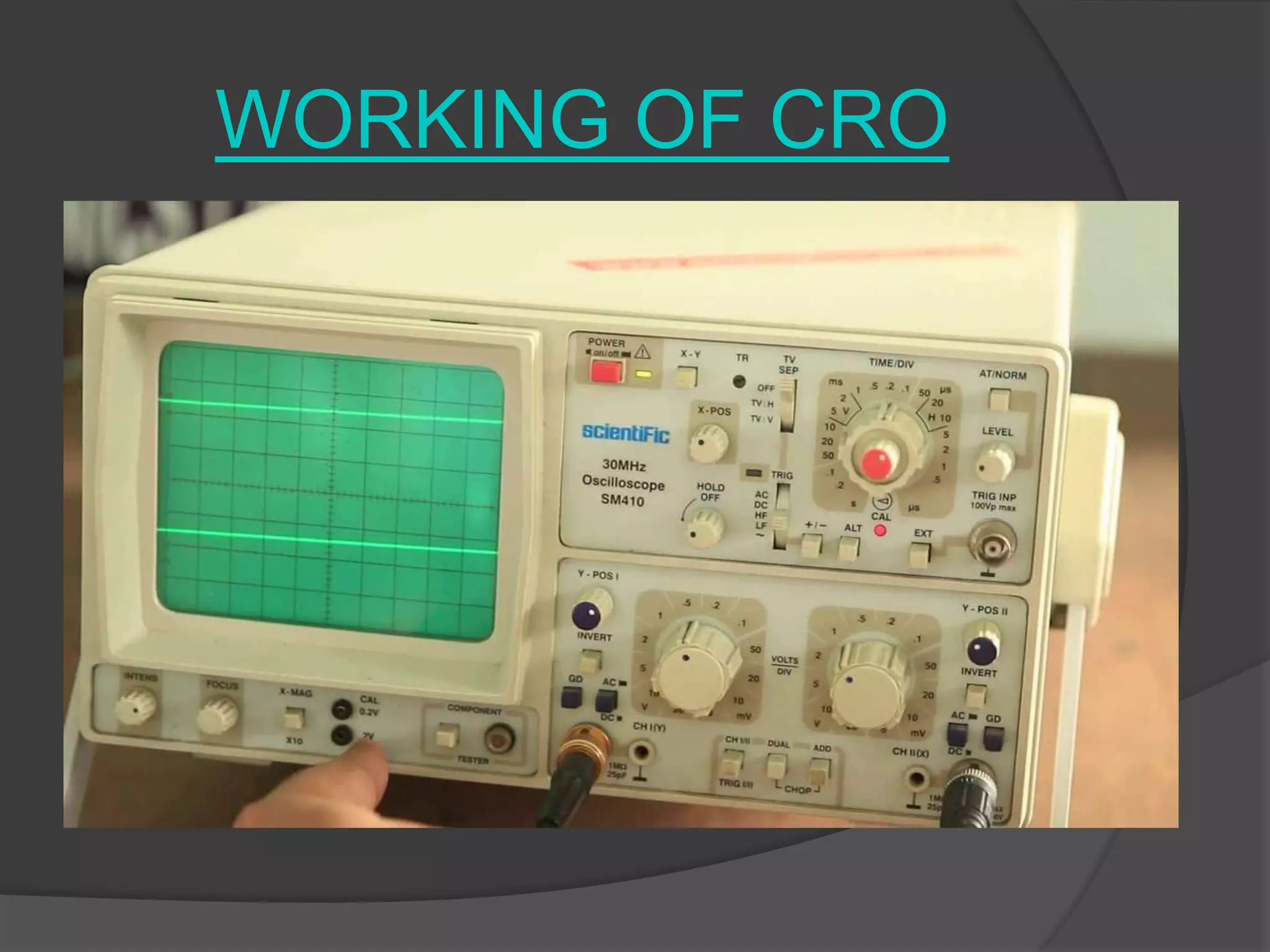
WORKING OF CRO
Absolute Instruments
 These instruments give the magnitude
of the quantity under measurements in
terms of physical constants of the
instrument.
 The examples of this class of
instruments are Tangent Galvanometer
and Rayleigh's current balance.
Secondary Instruments
 These instruments are so constructed
that the quantity being measured can
only be measured by observing the
output indicated by the instrument.
 These instruments are calibrated by
comparison with an absolute instrument
or another secondary instrument which
has already been calibrated against an
absolute instrument.
 Examples: Voltmeter, pressure gauge
Analog and Digital Instruments
Secondary instruments work in two modes :
(i) Analog mode, and (ii) Digital mode.
 Signals that vary in a continuous fashion and
take on an infinity of values in any given range
are called analog signals. The devices which
produce these signals are called analog
devices.
 In contrast, the signals which vary in discrete
steps and thus take up only finite different
values in a given range are called digital
signals. The devices that produce such
signals are called digital devices.
Indicating Instrument
 Instruments and systems use different kinds of
methods for supplying information concerning
the variable quantity under measurement.
 Most of the time this information is obtained as
a deflection of a pointer of a measuring
instrument. In this way the instrument
performs a function which is commonly known
as indicating function.
 For example, the deflection of pointer of a
speedometer indicates the speed of the
automobile at that moment. A pressure gauge
is used for indicating pressure'.
Recording Instruments
 In many cases the instrument makes a
written record, usually on paper, of the
value of the quantity under measurement
against time or against some other
variable. Thus the instrument performs a
recording function.
 For example, a potentiometric type of
recorder used for monitoring temperature
records the instantaneous temperatures on
a strip chart recorder.
Integrating Instrument
 The integrating instrument measures the
total energy supplied by the circuit in a
given interval of time. It is independent
of the rate at which the total energy
consumed.
 The watt hour meter is the example of
integrating instruments. This type of
meter directly measures the energy in
watt hour.

CLASS1 12.8.20.pptx

  • 1.
  • 2.
  • 3.
    UNIT-I MEASUREMENT SYSTEM ANDMEASURING INSTRUMENTS Generalized Measurement system, Classification of instruments, Error in measurement, Classification of errors. Principle, Construction, Operation of Moving Coil and Moving Iron Instruments - Ammeters and Voltmeters - Single phase Watt meters and Energy Meters - D.C & A.C Potentiometers - Instrument Transformers- Instruments for Measurement of Frequency and Phase- Calibration of watt meter.
  • 4.
    UNIT-II MEASUREMENT OF R,L,CUSING BRIDGES D.C Bridges: Wheatstone - Kelvin double bridge- Megger – A.C Bridges: Anderson Bridge –Maxwell Bridge- Hay’s Bridge and Schering bridge - Measurement of Unknown Capacitance using Schering Bridge.
  • 5.
    UNIT-III ELECTRONIC INSTRUMENTS Analog Meters:D.C Ammeter and Voltmeters - Multimeter - Q meter - True RMS Meter - Vector Impedance Meter - RF Voltage and Power Measurements - Instrumentation Amplifier. Digital Meters: Digital Tachometer – DMM- ADC: Successive Approximation, Dual Slope –DAC: Weighted Resistor, R-2R Ladder type- Digital Frequency Counters - LCR meter- Calibration of DC Ammeter and DC Voltmeter.
  • 6.
    UNIT-IV DIGITAL STORAGE OSCILLOSCOPEAND SIGNAL GENERATORS Analog Storage Oscilloscope - Sampling Oscilloscopes - Digital Storage Oscilloscopes - Sine Wave Generator - Sweep Frequency Generator, Pulse and Square Wave Generator - Wave Analyzer: Harmonic Distortion Analyzer - Spectrum Analyzer- Measurement of frequency and voltage at different ac inputs using DSO.
  • 7.
    UNIT-V SMART INSTRUMENTS AND RECORDERS Serial,Parallel ports, USB–IEEE 488- Applications of Digital Instruments- Elements of Data Acquisition - Smart Sensor. Acquiring and Generating Signals using DAQ Card. Recording Devices: X-Y Plotters, Magnetic Tape Recording - Data Loggers- Display Devices: LED, LCD
  • 8.
    MEASUREMENT The measurement ofa given quantity is essentially an act or the result of comparison between the quantity (whose magnitude is unknown) and a predefined standard.
  • 10.
    Two Basic Requirements The standard used for comparison purposes must be accurately defined and should be commonly accepted.  The apparatus used and the method adopted must be provable.
  • 11.
    METHODS OF MEASUREMENTS  Directmethod  Indirect method
  • 12.
    Direct Method  Theunknown quantity (also called the measurand) is directly compared against a standard.  Result is expressed as a numerical number and a unit. The standard, in fact, is a physical embodiment of a unit.  Quite common for the measurement of physical quantities like length, mass and time.
  • 13.
    Drawbacks of directMethod  Not always possible, feasible and practicable.  Most of the cases, are inaccurate because they involve human factors.  Less sensitive.  Hence direct methods are not preferred and are rarely used.
  • 14.
    MEASURING SYSTEM (Indirect Method) A measurement system consists of a transducing element which converts the quantity to be measured in an analogous form.  The analogous signal is then processed by some intermediate means and is then fed to the end devices which present the results of the measurement.
  • 15.
  • 16.
    INSTRUMENT  An instrumentmay be defined as a device for determining the value or magnitude of a quantity or variable.  The earliest scientific instruments used the three essential elements as our modern instruments do. These elements are  (i) a detector,  (ii) an intermediate transfer device, and  (iii) an indicator, recorder or a storage device.
  • 18.
    MECHANICAL INSTRUMENTS  These instrumentsare very reliable for static and stable conditions.  But they suffer from a very major disadvantage. They are unable to respond rapidly to measurements of dynamic and transient conditions.
  • 20.
    ELECTRICAL INSTRUMENTS  Electrical methodsof indicating the output of detectors are more rapid than mechanical methods.  It is unfortunate that electrical system normally depends upon a mechanical meter movement as indicating device.  This mechanical movement has some inertia and therefore these instruments have a limited time (and hence, frequency) response.
  • 22.
    ELECTRONIC INSTRUMENTS  These instrumentsrequire vacuum tubes or semiconductor devices. Recent practice is to use semiconductor devices as they have many advantages over their vacuum tube counterparts.  Since in electronic devices, the only movement involved is that of electrons, the response time is extremely small on account of very small inertia of electrons  example, a C.R.O. is capable of following dynamic and transient changes of the order of a few ns (l0-9 s).
  • 23.
  • 24.
    Absolute Instruments  Theseinstruments give the magnitude of the quantity under measurements in terms of physical constants of the instrument.  The examples of this class of instruments are Tangent Galvanometer and Rayleigh's current balance.
  • 25.
    Secondary Instruments  Theseinstruments are so constructed that the quantity being measured can only be measured by observing the output indicated by the instrument.  These instruments are calibrated by comparison with an absolute instrument or another secondary instrument which has already been calibrated against an absolute instrument.  Examples: Voltmeter, pressure gauge
  • 26.
    Analog and DigitalInstruments Secondary instruments work in two modes : (i) Analog mode, and (ii) Digital mode.  Signals that vary in a continuous fashion and take on an infinity of values in any given range are called analog signals. The devices which produce these signals are called analog devices.  In contrast, the signals which vary in discrete steps and thus take up only finite different values in a given range are called digital signals. The devices that produce such signals are called digital devices.
  • 27.
    Indicating Instrument  Instrumentsand systems use different kinds of methods for supplying information concerning the variable quantity under measurement.  Most of the time this information is obtained as a deflection of a pointer of a measuring instrument. In this way the instrument performs a function which is commonly known as indicating function.  For example, the deflection of pointer of a speedometer indicates the speed of the automobile at that moment. A pressure gauge is used for indicating pressure'.
  • 28.
    Recording Instruments  Inmany cases the instrument makes a written record, usually on paper, of the value of the quantity under measurement against time or against some other variable. Thus the instrument performs a recording function.  For example, a potentiometric type of recorder used for monitoring temperature records the instantaneous temperatures on a strip chart recorder.
  • 29.
    Integrating Instrument  Theintegrating instrument measures the total energy supplied by the circuit in a given interval of time. It is independent of the rate at which the total energy consumed.  The watt hour meter is the example of integrating instruments. This type of meter directly measures the energy in watt hour.