Profession Courses
vs Academic
Courses
Choosingthe right educational path is crucial for your future
success. This presentation explores the differences between
profession courses and academic courses, highlighting the benefits
and challenges of each.
SJ
by SUBRAMANIAN JOHN
2.
Defining Profession Courses
Professioncourses are designed to provide practical skills and knowledge needed for a specific profession. These
courses often have a strong emphasis on hands-on training, industry-specific software, and real-world applications.
Examples
Examples of profession courses include coding
bootcamps, culinary schools, and trade schools.
Career Focus
They prepare individuals for specific roles within a
particular industry, equipping them with the
necessary skills to enter the workforce.
3.
Defining Academic Courses
Academiccourses are more theoretical and focus on developing critical thinking, research skills, and a broader
understanding of a subject. They emphasize intellectual inquiry and the pursuit of knowledge for its own sake.
Examples
Examples of academic courses include bachelor's
degrees in fields like history, philosophy, or literature.
General Knowledge
They aim to provide students with a foundational
understanding of a subject, helping them to develop
analytical and problem-solving skills.
4.
Advantages of Profession
Courses
Professioncourses offer several advantages, such as practical training, industry
connections, and a clear pathway to employment.
1 Job-Ready Skills
The curriculum is tailored to
meet the specific requirements
of the industry, ensuring
graduates are equipped with the
necessary skills to perform their
roles effectively.
2 Career Advancement
These courses often provide
access to industry networks,
internships, and potential job
placement opportunities,
accelerating career
advancement.
3 Cost-Effective
Profession courses are typically shorter and more focused, making them a
cost-effective option for those seeking a career transition or to acquire
specific skills.
5.
Advantages of AcademicCourses
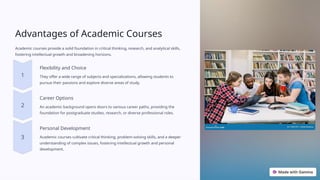
Academic courses provide a solid foundation in critical thinking, research, and analytical skills,
fostering intellectual growth and broadening horizons.
Flexibility and Choice
They offer a wide range of subjects and specializations, allowing students to
pursue their passions and explore diverse areas of study.
Career Options
An academic background opens doors to various career paths, providing the
foundation for postgraduate studies, research, or diverse professional roles.
Personal Development
Academic courses cultivate critical thinking, problem-solving skills, and a deeper
understanding of complex issues, fostering intellectual growth and personal
development.
6.
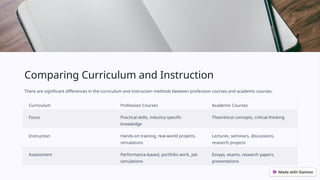
Comparing Curriculum andInstruction
There are significant differences in the curriculum and instruction methods between profession courses and academic courses.
Curriculum Profession Courses Academic Courses
Focus Practical skills, industry-specific
knowledge
Theoretical concepts, critical thinking
Instruction Hands-on training, real-world projects,
simulations
Lectures, seminars, discussions,
research projects
Assessment Performance-based, portfolio work, job
simulations
Essays, exams, research papers,
presentations
7.
Employability and CareerProspects
Both profession courses and academic courses can lead to successful careers, depending on the chosen field and individual
aspirations.
Profession Courses
They provide a direct path to employment in specific
industries, often leading to specialized roles.
Academic Courses
They offer a broader foundation for a range of careers,
opening doors to various industries and professional fields.
8.
Conclusion: Choosing theRight Path
Choosing between profession courses and academic courses is a personal decision based on individual
goals, career aspirations, and learning styles. Consider your interests, skills, and future ambitions when
making this important decision.
1 Self-Assessment
Reflect on your strengths, weaknesses, interests, and career goals.
2 Research Options
Explore different profession courses and academic programs that align with your interests.
3 Seek Guidance
Talk to professionals in your desired field, educators, and career counselors for advice.
4 Make a Decision
Choose the educational path that best suits your aspirations and long-term goals.