ELECTRONIC MEASURING
SYSTEM
BY – SAMIR K
ELECTRONIC
MEASURMENT
• An electronic instrument is the one which is
based on electronic or electrical principles for
its measurement function. The measurement
of any electronic or electrical quantity or
variable is termed as an electronic
measurement.
• . The major problem with any measuring
instrument is the error. Hence, it is necessary
to select the appropriate measuring
instrument and measurement procedure
which minimises the error.
MEASURMENT ERRORS
• The errors, which occur during
measurement are known
as measurement errors.
• Gross Errors
• Random Errors
• Systematic Errors
• GROSS ERRORS
• The errors, which occur due to the lack of
experience of the observer while taking the
measurement values are known as gross errors.
• SYSTEMATIC ERRORS
• If the instrument produces an error, which is of a
constant uniform deviation during its operation is
known as systematic error.
• RANDOM ERRORS
• The errors, which occur due to unknown sources
during measurement time are known as random
errors.
ADVANTAGES OF EMS
THE ADVANTAGES OF AN
ELECTRONIC MEASUREMENT
ARE
1. MOST OF THE QUANTITIES
CAN BE CONVERTED BY
TRANSDUCERS INTO THE
ELECTRICAL OR ELECTRONIC
SIGNALS.
2. AN ELECTRICAL OR
ELECTRONIC SIGNAL CAN BE
AMPLIFIED, FILTERED,
MULTIPLEXED, SAMPLED AND
MEASURED.
3. THE MEASUREMENT CAN
EASILY BE OBTAINED IN OR
CONVERTED INTO DIGITAL
FORM FOR AUTOMATIC
ANALYSIS AND RECORDING.
4 THE MEASURED SIGNALS CAN
BE TRANSMITTED OVER LONG
DISTANCES WITH THE HELP OF
CABLES OR RADIO LINKS,
WITHOUT ANY LOSS OF
INFORMATION
TRANSDUCERS AND TYPES
• A device that converts variations in a physical quantity, such as pressure or brightness,
into an electrical signal, or vice versa.
• TYPES:-
• Temperature transducers (e.g. a thermocouple)
• Pressure transducers (e.g. a diaphragm)
• Displacement transducers (e.g. LVDT)
• Oscillator transducer.
• Flow transducers.
• Inductive Transducer.
ELECTRONIC TESTING EQUIPMENT
• VOLTMETER MULTIMETER OSCILLOMETER
AMMETER LCR METER OHMMETER
VOLTMETER
• As the name suggests, voltmeter is a measuring
instrument which measures the voltage across
any two points of an electric circuit. There are
two types of voltmeters:
• DC voltmeter:-
• DC voltmeter measures the DC
voltage across any two points of an electric
circuit.
• AC Voltmeter:-
• AC voltmeter measures the AC
voltage across any two points of an electric
circuit.
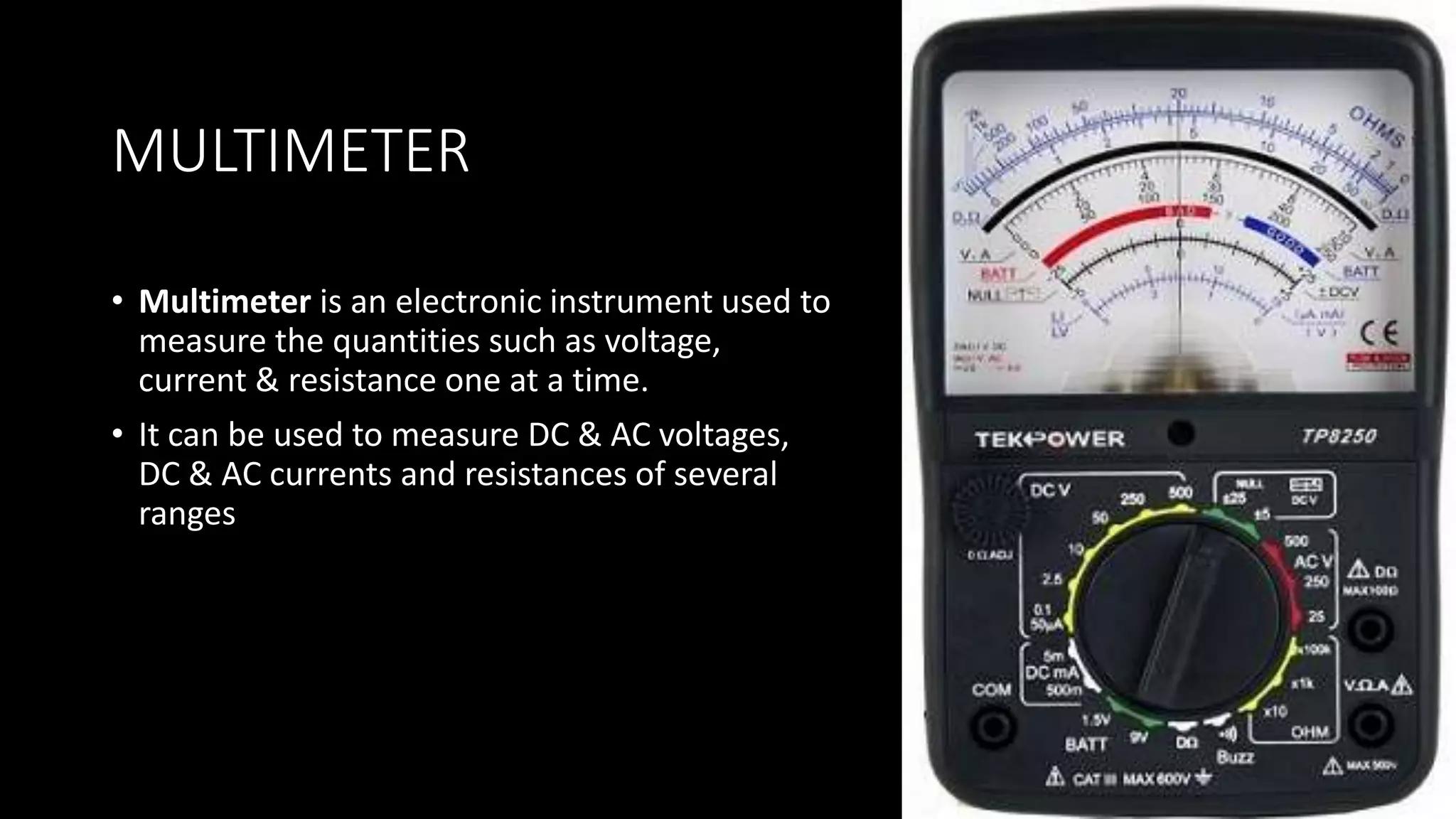
MULTIMETER
• Multimeter is an electronic instrument used to
measure the quantities such as voltage,
current & resistance one at a time.
• It can be used to measure DC & AC voltages,
DC & AC currents and resistances of several
ranges
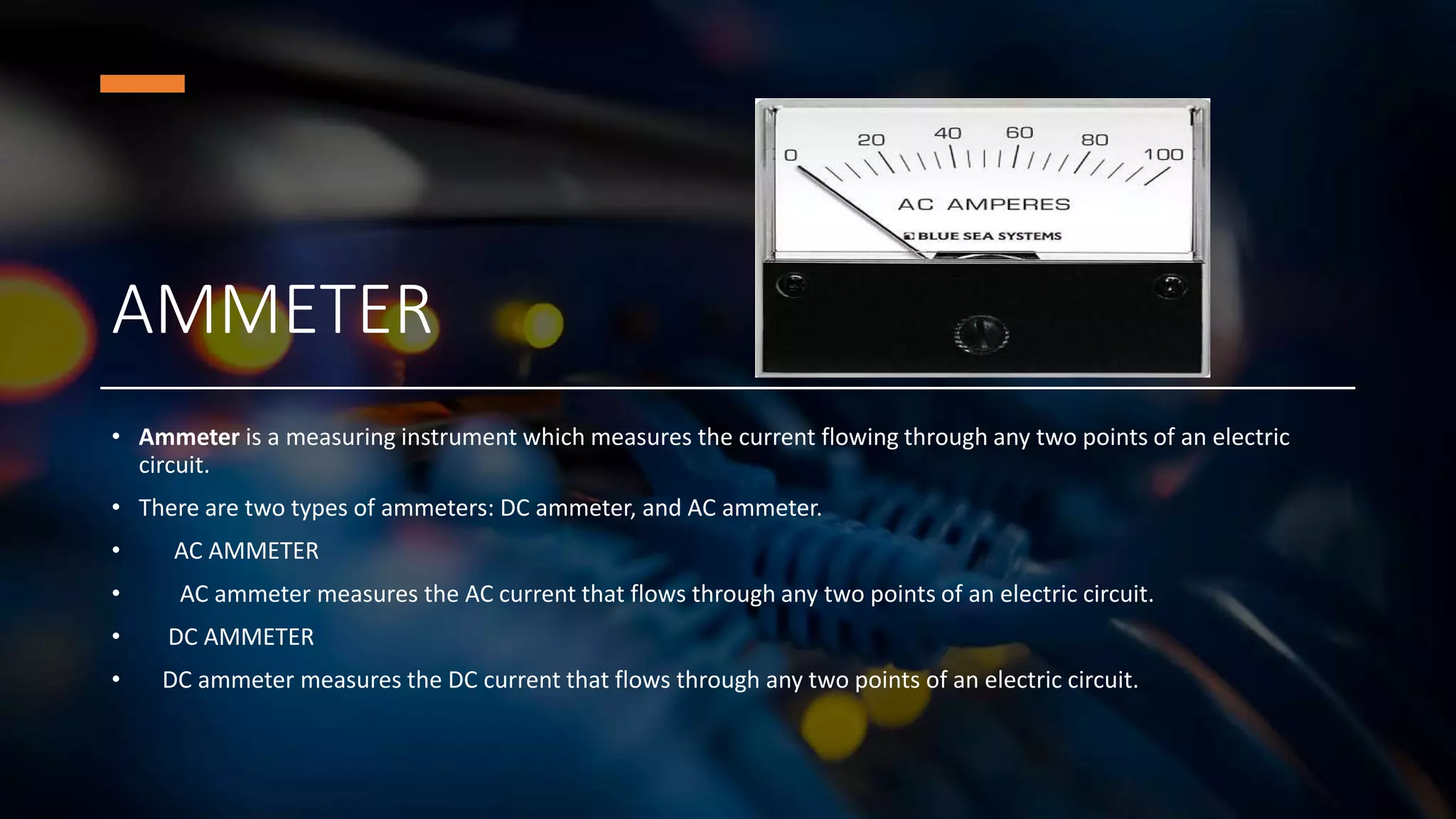
AMMETER
• Ammeter is a measuring instrument which measures the current flowing through any two points of an electric
circuit.
• There are two types of ammeters: DC ammeter, and AC ammeter.
• AC AMMETER
• AC ammeter measures the AC current that flows through any two points of an electric circuit.
• DC AMMETER
• DC ammeter measures the DC current that flows through any two points of an electric circuit.
OHMMETER
• Ohmmeter is used to measure the value
of resistance between any two points of
an electric circuit.
• It can also be used for finding the value
of an unknown resistor.
• There are two types of ohmmeters:
series ohmmeter, and shunt ohmmeter.
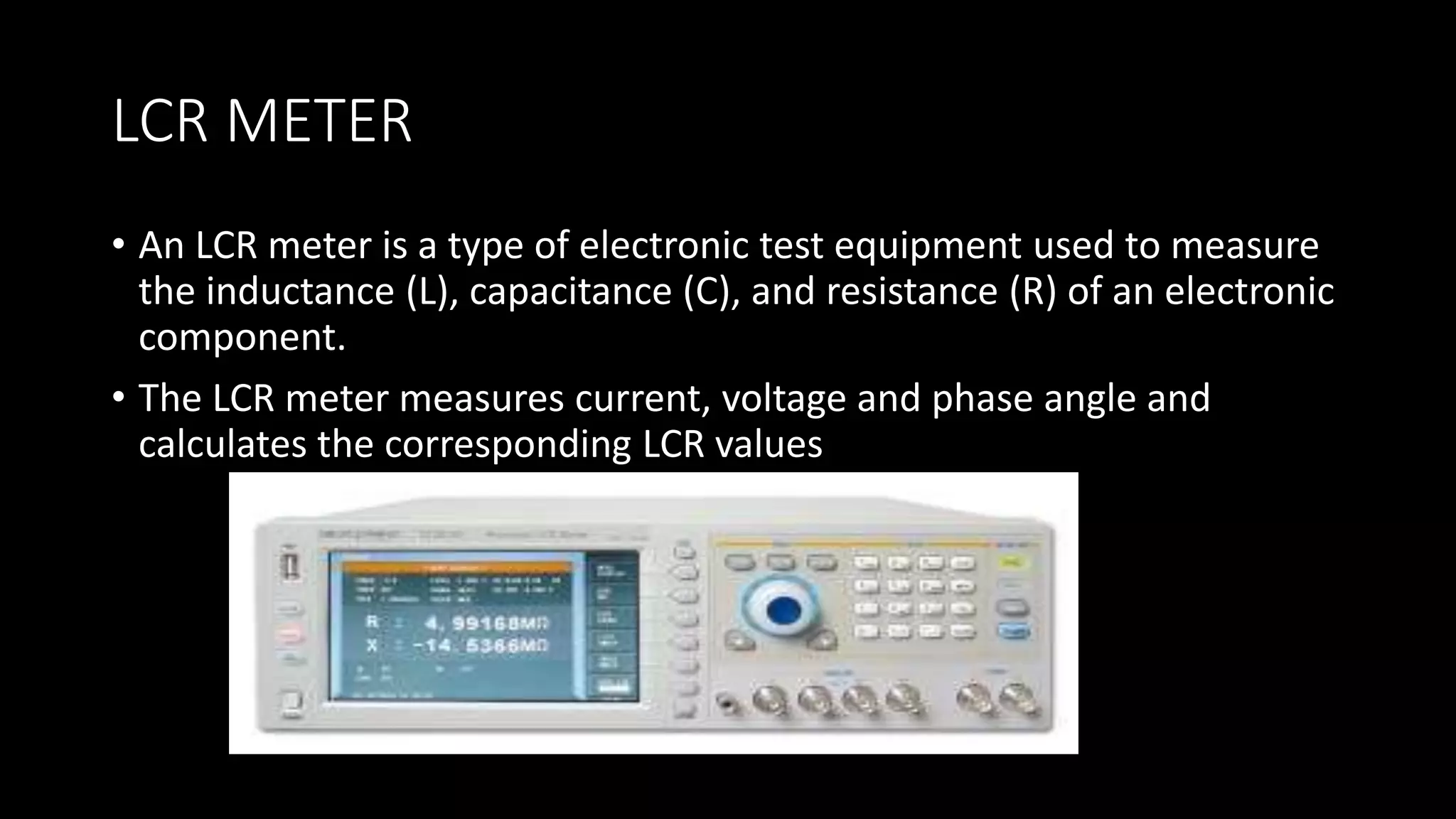
LCR METER
• An LCR meter is a type of electronic test equipment used to measure
the inductance (L), capacitance (C), and resistance (R) of an electronic
component.
• The LCR meter measures current, voltage and phase angle and
calculates the corresponding LCR values
RECORDING
INSTRUMENTS
• Definition: The recording instrument is defined as
the instrument which records the continuous
variation of the magnitude of an electrical
quantity for a particular period. It is used in a
placed where the continuous reading of circuit
conditions is required. The record is used for future
reference or computational work.
• The voltmeter, thermoscope, ECG
machine, galvanometer recorder are the examples
of the recording instrument
PERFORMANCE
CHARACTERISTICS
• The characteristics of measurement
instruments which are helpful to know the
performance of instrument and help in
measuring any quantity or parameter, are
known as Performance Characteristics.
• Performance characteristics of instruments can
be classified into the following two types.
• Static Characteristics
• Dynamic Characteristics
STATIC
CHARACTERISTICS
• The characteristics of quantities or
parameters measuring instruments
that do not vary with respect to time
are called static characteristics.
• 1.Accuracy
• 2.Precision
• 3.Sensitivity
• 4.Resolution
• 5.Static Error
• PRECISION
• If an instrument indicates the same value
repeatedly when it is used to measure the
same quantity under same circumstances
for any number of times, then we can say
that the instrument has high precision.
• SENSITIVITY
• The term sensitivity signifies the smallest
change in the measurable input that is
required for an instrument to respond.
• Resolution
• If the output of an instrument will change
only when there is a specific increment of
the input, then that increment of the input
is called Resolution.
• STATIC ERROR
• Static error signifies the inaccuracy of the
instrument
• If the static error is represented in terms of
percentage, then it is called percentage of
static error.
DYNAMIC
CHARACTERISTICS
The characteristics of the instruments, which are used to
measure the quantities or parameters that vary very quickly
with respect to time are called dynamic characteristics.
Speed of Response
Dynamic Error
Fidelity
Lag
• SPEED OF RESPONSE
• The speed at which the instrument responds
whenever there is any change in the quantity
to be measured is called speed of response. It
indicates how fast the instrument is.
• LAG
• The amount of delay present in the response
of an instrument whenever there is a change
in the quantity to be measured is called
measuring lag. It is also simply called lag
• Fidelity
• The degree to which an instrument
indicates changes in the measured
quantity without any dynamic error
is known as Fidelity

Electronic measuring system (EMS)

  • 1.
  • 2.
    ELECTRONIC MEASURMENT • An electronicinstrument is the one which is based on electronic or electrical principles for its measurement function. The measurement of any electronic or electrical quantity or variable is termed as an electronic measurement. • . The major problem with any measuring instrument is the error. Hence, it is necessary to select the appropriate measuring instrument and measurement procedure which minimises the error.
  • 3.
    MEASURMENT ERRORS • Theerrors, which occur during measurement are known as measurement errors. • Gross Errors • Random Errors • Systematic Errors
  • 4.
    • GROSS ERRORS •The errors, which occur due to the lack of experience of the observer while taking the measurement values are known as gross errors. • SYSTEMATIC ERRORS • If the instrument produces an error, which is of a constant uniform deviation during its operation is known as systematic error. • RANDOM ERRORS • The errors, which occur due to unknown sources during measurement time are known as random errors.
  • 5.
    ADVANTAGES OF EMS THEADVANTAGES OF AN ELECTRONIC MEASUREMENT ARE 1. MOST OF THE QUANTITIES CAN BE CONVERTED BY TRANSDUCERS INTO THE ELECTRICAL OR ELECTRONIC SIGNALS. 2. AN ELECTRICAL OR ELECTRONIC SIGNAL CAN BE AMPLIFIED, FILTERED, MULTIPLEXED, SAMPLED AND MEASURED. 3. THE MEASUREMENT CAN EASILY BE OBTAINED IN OR CONVERTED INTO DIGITAL FORM FOR AUTOMATIC ANALYSIS AND RECORDING. 4 THE MEASURED SIGNALS CAN BE TRANSMITTED OVER LONG DISTANCES WITH THE HELP OF CABLES OR RADIO LINKS, WITHOUT ANY LOSS OF INFORMATION
  • 6.
    TRANSDUCERS AND TYPES •A device that converts variations in a physical quantity, such as pressure or brightness, into an electrical signal, or vice versa. • TYPES:- • Temperature transducers (e.g. a thermocouple) • Pressure transducers (e.g. a diaphragm) • Displacement transducers (e.g. LVDT) • Oscillator transducer. • Flow transducers. • Inductive Transducer.
  • 7.
    ELECTRONIC TESTING EQUIPMENT •VOLTMETER MULTIMETER OSCILLOMETER AMMETER LCR METER OHMMETER
  • 8.
    VOLTMETER • As thename suggests, voltmeter is a measuring instrument which measures the voltage across any two points of an electric circuit. There are two types of voltmeters: • DC voltmeter:- • DC voltmeter measures the DC voltage across any two points of an electric circuit. • AC Voltmeter:- • AC voltmeter measures the AC voltage across any two points of an electric circuit.
  • 9.
    MULTIMETER • Multimeter isan electronic instrument used to measure the quantities such as voltage, current & resistance one at a time. • It can be used to measure DC & AC voltages, DC & AC currents and resistances of several ranges
  • 10.
    AMMETER • Ammeter isa measuring instrument which measures the current flowing through any two points of an electric circuit. • There are two types of ammeters: DC ammeter, and AC ammeter. • AC AMMETER • AC ammeter measures the AC current that flows through any two points of an electric circuit. • DC AMMETER • DC ammeter measures the DC current that flows through any two points of an electric circuit.
  • 11.
    OHMMETER • Ohmmeter isused to measure the value of resistance between any two points of an electric circuit. • It can also be used for finding the value of an unknown resistor. • There are two types of ohmmeters: series ohmmeter, and shunt ohmmeter.
  • 12.
    LCR METER • AnLCR meter is a type of electronic test equipment used to measure the inductance (L), capacitance (C), and resistance (R) of an electronic component. • The LCR meter measures current, voltage and phase angle and calculates the corresponding LCR values
  • 13.
    RECORDING INSTRUMENTS • Definition: Therecording instrument is defined as the instrument which records the continuous variation of the magnitude of an electrical quantity for a particular period. It is used in a placed where the continuous reading of circuit conditions is required. The record is used for future reference or computational work. • The voltmeter, thermoscope, ECG machine, galvanometer recorder are the examples of the recording instrument
  • 14.
    PERFORMANCE CHARACTERISTICS • The characteristicsof measurement instruments which are helpful to know the performance of instrument and help in measuring any quantity or parameter, are known as Performance Characteristics. • Performance characteristics of instruments can be classified into the following two types. • Static Characteristics • Dynamic Characteristics
  • 15.
    STATIC CHARACTERISTICS • The characteristicsof quantities or parameters measuring instruments that do not vary with respect to time are called static characteristics. • 1.Accuracy • 2.Precision • 3.Sensitivity • 4.Resolution • 5.Static Error
  • 16.
    • PRECISION • Ifan instrument indicates the same value repeatedly when it is used to measure the same quantity under same circumstances for any number of times, then we can say that the instrument has high precision. • SENSITIVITY • The term sensitivity signifies the smallest change in the measurable input that is required for an instrument to respond.
  • 17.
    • Resolution • Ifthe output of an instrument will change only when there is a specific increment of the input, then that increment of the input is called Resolution. • STATIC ERROR • Static error signifies the inaccuracy of the instrument • If the static error is represented in terms of percentage, then it is called percentage of static error.
  • 18.
    DYNAMIC CHARACTERISTICS The characteristics ofthe instruments, which are used to measure the quantities or parameters that vary very quickly with respect to time are called dynamic characteristics. Speed of Response Dynamic Error Fidelity Lag
  • 19.
    • SPEED OFRESPONSE • The speed at which the instrument responds whenever there is any change in the quantity to be measured is called speed of response. It indicates how fast the instrument is. • LAG • The amount of delay present in the response of an instrument whenever there is a change in the quantity to be measured is called measuring lag. It is also simply called lag
  • 20.
    • Fidelity • Thedegree to which an instrument indicates changes in the measured quantity without any dynamic error is known as Fidelity