Gujarat Power Engineering & 
Research Institute,Mewad. 
Ppt on 
Characteristics of 
instruments…
Created by:- 
1.Ravi Patel :- 131040109051 
2.Harsh Patel :- 131040109030 
3.Panchal Hiten :- 131040109022 
4.Parmar Sumit :- 131040109024 
5.Deep Modi :- 131040109021 
Guided By :- 
Prof. Manish G. Prajapati
Characteristics of 
Instruments 
 There are Two types of 
characteristics of instruments:- 
 1.Static characteristics of 
instruments 
 2.Dynamic Characteristics of 
instruments.
1.Static Characteristics 
 The static characteristics of an 
instrument are required to be 
considered for the instruments which 
measure unvarying process 
conditions. 
 The static characteristics are defined 
for the instruments which measure 
quantities which do not vary with 
time.
The main static characteristics 
are :- 
1. Accuracy 
2. Sensitivity 
3. Reproducibility 
4. Drift 
5. Static error 
6. Dead zone 
7. Precision 
8. Threshold 
9. Linearity 
10. Stability 
11. Range or Span 
12. Bais 
13. Tolerance 
14. Hysteresis
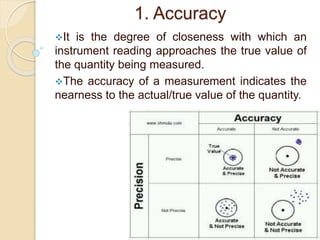
1. Accuracy 
It is the degree of closeness with which an 
instrument reading approaches the true value of 
the quantity being measured. 
The accuracy of a measurement indicates the 
nearness to the actual/true value of the quantity.
2.Sensitivity 
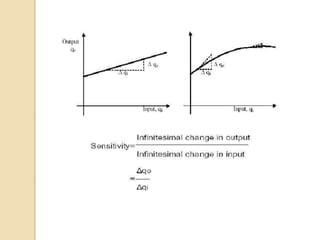
 Sensitivity is the ratio of change in output of 
an instrument to the change in input. 
 The manufactures specify sensitivity as the 
ratio of magnitude of the measured quantity 
to the magnitude of the response.This ratio is 
called as Inverse sensitivity or deflection 
factor.
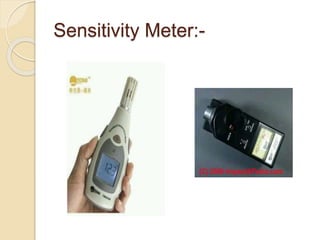
Sensitivity Meter:-
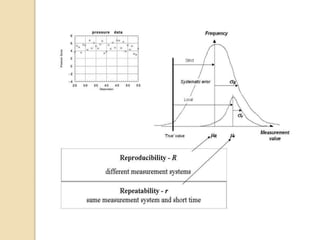
3.Reproducibility 
Reproducibility is defined as the degree of 
closeness by which a given value can be 
repeatedly measured. 
The reproducibility is specified for a period of 
time. 
Perfect reproducibility signifies that the given 
readings that are taken for an input, do not vary 
with time..
4.Drift 
The drift is defined as the gradual shift in the 
indication over a period of time where in the 
input variable does not change. 
Drift may be caused because of environment 
factors like stray electric fields, stray magnetic 
fields, thermal e.m.fs, changes in temperature, 
mechanical vibrations etc. 
 Drift is classified into three categories: 
1. Zero drift 
2. Span drift or sensitivity drift 
3. Zonal drift
5. Static error 
It is the deviation from the true value of the 
measured variable. 
It involves the comparison of an unknown 
quantity with an accepted standard quantity. 
The degree to which an instrument approaches 
to its excepted value is expressed terms of error 
of measurement.
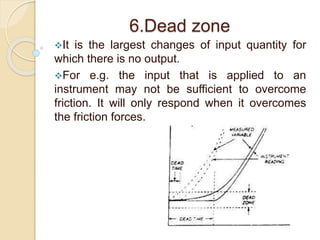
6.Dead zone 
It is the largest changes of input quantity for 
which there is no output. 
For e.g. the input that is applied to an 
instrument may not be sufficient to overcome 
friction. It will only respond when it overcomes 
the friction forces.
7.Precision 
It is a measure of the reproducibility of the 
measurement that is given a fixed value of 
variable. 
Precision is a measure of the degree to which 
successive measurements differ from each 
other. 
For example consider an instrument on which 
readings can be taken upto 1∕100th of unit. 
 The instrument has zero adjustment error. 
So, when we take a readings, the instrument is 
highly precise. However as the instrument has 
a zero adjustment error the readings obtained 
are precise, but they are not accurate. 
Thus, when a set of readings show precision, 
the results agree among themselves. However, it 
is not essential that the results are accurate.
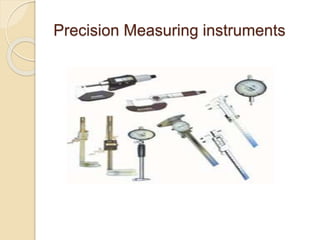
Precision Measuring instruments
8.Threshsold 
Threshold is the smallest measurable input, 
below which no output change can be identified. 
While specifying threshold, manufactures give 
the first detectable output change.
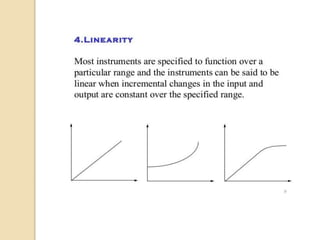
9.Linearity 
Linearity is defined as the ability of an 
instrument to reproduce its input linearly. 
Linearity is simply a measure of the maximum 
deviation of the calibration points from the ideal 
straight line. 
Linearity is defined as, 
linearity=Maximum deviation of o/p from 
idealized straight line ∕ Actual readings
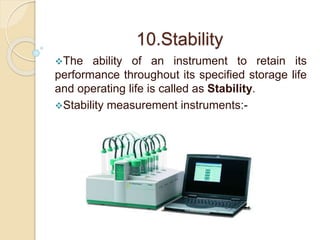
10.Stability 
The ability of an instrument to retain its 
performance throughout its specified storage life 
and operating life is called as Stability. 
Stability measurement instruments:-
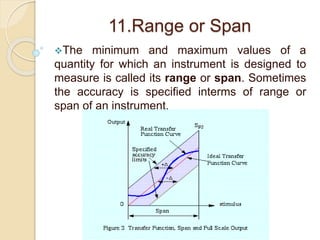
11.Range or Span 
The minimum and maximum values of a 
quantity for which an instrument is designed to 
measure is called its range or span. Sometimes 
the accuracy is specified interms of range or 
span of an instrument.
12.Bais 
The constant error which exists over the full 
range of measurement of an instrument is called 
bias. Such a bais can be completely eliminated 
by calibration. The zero error is an example of 
bais which can be removed by calibration.
13.Tolerance 
It is the maximum allowable error that is 
specified in terms of certain value while 
measurement, it is called as tolerance. 
It specifies the maximum allowable deviation of 
a manufactured device from a mentioned value.
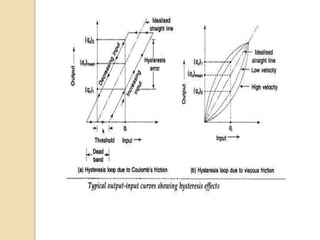
14.Hysteresis 
Hysteresis is a phenomenon which depicts 
different output effects while loading and 
unloading. 
Hysteresis takes place due to the fact that all 
the energy put into the stressed parts when 
loading is not recoverable while unloading. 
When the input of an instrument is varied from 
zero to its full scale and then if the input is 
decreased from its full scale value to zero, the 
output varies. The output at the particular input 
while increasing and decreasing varies because 
of internal friction or hysteric damping.
2.Dynamic Characteristics 
Instruments rarely respond to the 
instantaneous changes in the measured 
variables.Their response is slow or sluggish due 
to mass, thermal capacitance, electrical 
capacitance, inductance etc. sometimes, even 
the instrument has to wait for some time till, the 
response occurs. 
These type of instruments are normally used 
for the measurement of quantities that fluctuate 
with time. 
The behaviour of such a system, where as the 
input varies from instant to instant, the output 
also varies from instant to instant is called as 
dynamic response of the system. 
Hence, the dynamic behaviour of the system is 
also important as the static behaviour.
The dynamic inputs are of two types: 
1. Transient 
2. Steady state periodic. 
 Transient response is defined as that part of 
the response which goes to zero as the time 
becomes large. 
 The steady state response is the response 
that has a definite periodic cycle.
The variations in the input, that are used 
practically to achieve dynamic behaviour are: 
I. Step input:-The input is subjected to a finite 
and instantaneous change. E.g.: closing of 
switch. 
II. Ramp input:- The input linearly changes with 
respect to time. 
III. Parabolic input:- The input varies to the 
square of time. This represents constant 
acceleration. 
IV. Sinusoidal input:- The input changes in 
accordance with a sinusoidal function of 
constant amplitude.
The dynamic characteristics of a measurement 
system are: 
1) Speed of response 
2) Fidelity 
3) Lag 
4) Dynamic error
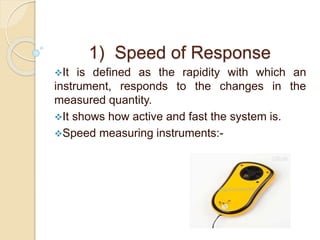
1) Speed of Response 
It is defined as the rapidity with which an 
instrument, responds to the changes in the 
measured quantity. 
It shows how active and fast the system is. 
Speed measuring instruments:-
2) Fidelity 
It is defined as the degree to which a 
measurement system is capable of faithfully 
reproducing the changes in input, without any 
dynamic error.
3)Lag 
Every system requires its own time to respond to 
the changes in input. This time is called as lag. 
It is defined as the retardation or delay, in the 
response of a system to the changes in the input. 
The lags are of two types: 
1. Retardation lag: 
As soon as there is a changes in the 
measured quantity, the measurement system 
begins to respond. 
2. Time delay: 
The response of the measurement system 
starts after a dead time, once the input is 
applied.They cause dynamic error.
4)Dynamic error 
It is the difference between the true value of 
the quantity that is to be measured, changing 
with time and the measured value, if no static 
error is assumed.
Thank 
You….

Characteristics of instruments

  • 1.
    Gujarat Power Engineering& Research Institute,Mewad. Ppt on Characteristics of instruments…
  • 2.
    Created by:- 1.RaviPatel :- 131040109051 2.Harsh Patel :- 131040109030 3.Panchal Hiten :- 131040109022 4.Parmar Sumit :- 131040109024 5.Deep Modi :- 131040109021 Guided By :- Prof. Manish G. Prajapati
  • 3.
    Characteristics of Instruments  There are Two types of characteristics of instruments:-  1.Static characteristics of instruments  2.Dynamic Characteristics of instruments.
  • 4.
    1.Static Characteristics The static characteristics of an instrument are required to be considered for the instruments which measure unvarying process conditions.  The static characteristics are defined for the instruments which measure quantities which do not vary with time.
  • 5.
    The main staticcharacteristics are :- 1. Accuracy 2. Sensitivity 3. Reproducibility 4. Drift 5. Static error 6. Dead zone 7. Precision 8. Threshold 9. Linearity 10. Stability 11. Range or Span 12. Bais 13. Tolerance 14. Hysteresis
  • 6.
    1. Accuracy Itis the degree of closeness with which an instrument reading approaches the true value of the quantity being measured. The accuracy of a measurement indicates the nearness to the actual/true value of the quantity.
  • 7.
    2.Sensitivity  Sensitivityis the ratio of change in output of an instrument to the change in input.  The manufactures specify sensitivity as the ratio of magnitude of the measured quantity to the magnitude of the response.This ratio is called as Inverse sensitivity or deflection factor.
  • 9.
  • 10.
    3.Reproducibility Reproducibility isdefined as the degree of closeness by which a given value can be repeatedly measured. The reproducibility is specified for a period of time. Perfect reproducibility signifies that the given readings that are taken for an input, do not vary with time..
  • 12.
    4.Drift The driftis defined as the gradual shift in the indication over a period of time where in the input variable does not change. Drift may be caused because of environment factors like stray electric fields, stray magnetic fields, thermal e.m.fs, changes in temperature, mechanical vibrations etc.  Drift is classified into three categories: 1. Zero drift 2. Span drift or sensitivity drift 3. Zonal drift
  • 13.
    5. Static error It is the deviation from the true value of the measured variable. It involves the comparison of an unknown quantity with an accepted standard quantity. The degree to which an instrument approaches to its excepted value is expressed terms of error of measurement.
  • 14.
    6.Dead zone Itis the largest changes of input quantity for which there is no output. For e.g. the input that is applied to an instrument may not be sufficient to overcome friction. It will only respond when it overcomes the friction forces.
  • 15.
    7.Precision It isa measure of the reproducibility of the measurement that is given a fixed value of variable. Precision is a measure of the degree to which successive measurements differ from each other. For example consider an instrument on which readings can be taken upto 1∕100th of unit.  The instrument has zero adjustment error. So, when we take a readings, the instrument is highly precise. However as the instrument has a zero adjustment error the readings obtained are precise, but they are not accurate. Thus, when a set of readings show precision, the results agree among themselves. However, it is not essential that the results are accurate.
  • 16.
  • 17.
    8.Threshsold Threshold isthe smallest measurable input, below which no output change can be identified. While specifying threshold, manufactures give the first detectable output change.
  • 18.
    9.Linearity Linearity isdefined as the ability of an instrument to reproduce its input linearly. Linearity is simply a measure of the maximum deviation of the calibration points from the ideal straight line. Linearity is defined as, linearity=Maximum deviation of o/p from idealized straight line ∕ Actual readings
  • 20.
    10.Stability The abilityof an instrument to retain its performance throughout its specified storage life and operating life is called as Stability. Stability measurement instruments:-
  • 21.
    11.Range or Span The minimum and maximum values of a quantity for which an instrument is designed to measure is called its range or span. Sometimes the accuracy is specified interms of range or span of an instrument.
  • 22.
    12.Bais The constanterror which exists over the full range of measurement of an instrument is called bias. Such a bais can be completely eliminated by calibration. The zero error is an example of bais which can be removed by calibration.
  • 23.
    13.Tolerance It isthe maximum allowable error that is specified in terms of certain value while measurement, it is called as tolerance. It specifies the maximum allowable deviation of a manufactured device from a mentioned value.
  • 24.
    14.Hysteresis Hysteresis isa phenomenon which depicts different output effects while loading and unloading. Hysteresis takes place due to the fact that all the energy put into the stressed parts when loading is not recoverable while unloading. When the input of an instrument is varied from zero to its full scale and then if the input is decreased from its full scale value to zero, the output varies. The output at the particular input while increasing and decreasing varies because of internal friction or hysteric damping.
  • 26.
    2.Dynamic Characteristics Instrumentsrarely respond to the instantaneous changes in the measured variables.Their response is slow or sluggish due to mass, thermal capacitance, electrical capacitance, inductance etc. sometimes, even the instrument has to wait for some time till, the response occurs. These type of instruments are normally used for the measurement of quantities that fluctuate with time. The behaviour of such a system, where as the input varies from instant to instant, the output also varies from instant to instant is called as dynamic response of the system. Hence, the dynamic behaviour of the system is also important as the static behaviour.
  • 27.
    The dynamic inputsare of two types: 1. Transient 2. Steady state periodic.  Transient response is defined as that part of the response which goes to zero as the time becomes large.  The steady state response is the response that has a definite periodic cycle.
  • 28.
    The variations inthe input, that are used practically to achieve dynamic behaviour are: I. Step input:-The input is subjected to a finite and instantaneous change. E.g.: closing of switch. II. Ramp input:- The input linearly changes with respect to time. III. Parabolic input:- The input varies to the square of time. This represents constant acceleration. IV. Sinusoidal input:- The input changes in accordance with a sinusoidal function of constant amplitude.
  • 29.
    The dynamic characteristicsof a measurement system are: 1) Speed of response 2) Fidelity 3) Lag 4) Dynamic error
  • 30.
    1) Speed ofResponse It is defined as the rapidity with which an instrument, responds to the changes in the measured quantity. It shows how active and fast the system is. Speed measuring instruments:-
  • 31.
    2) Fidelity Itis defined as the degree to which a measurement system is capable of faithfully reproducing the changes in input, without any dynamic error.
  • 32.
    3)Lag Every systemrequires its own time to respond to the changes in input. This time is called as lag. It is defined as the retardation or delay, in the response of a system to the changes in the input. The lags are of two types: 1. Retardation lag: As soon as there is a changes in the measured quantity, the measurement system begins to respond. 2. Time delay: The response of the measurement system starts after a dead time, once the input is applied.They cause dynamic error.
  • 33.
    4)Dynamic error Itis the difference between the true value of the quantity that is to be measured, changing with time and the measured value, if no static error is assumed.
  • 34.