23
CHAPTER 5
EQUIPMENT DESIGN
In this chapter, detailed equipment design and mechanical design of
5.1 Fixed Bed Catalytic Reactor Process Design:
Reaction temperature =250 0
C ( 523K)
Catalyst: γ - alumina
Density of catalyst particle: 1392 kg/m3
[8]
Catalyst porosity: 0.52 [8]
Type of reactor: Shell and tube heat exchanger type in which catalyst is placed inside the
tube.
Reaction is exothermic: It is carried out in isothermal manner. Water is to be circulated in
liquid form on shell side to maintain the isothermal condition.
Mass of catalyst required in commercial scale plant = 6579.711 kg
Superficial velocity of feed gas V=0.802 m/s
Capacity of plant =50000 MTA of diethyl ether (DEE)
Let no. of working days per annum=340 days
Production rate of diethyl ether (DEE) = (50000*1000)/(340*24)
=6127.45 Kg/hr
!""=
#$%%&'()*
2
&'()*
2
+ #1&'()*&,-(%
(5.1) [3]
"./03"4"=
#%(567%8%&'()*
&'()*
2
+ #1&'()*&,-(% + #2&'()*
2
+ #9&,-(%
2
Design equation (5.2) [3]
:
;
= <
!>
?@AB
CCCCCCCCCCCCCCCCCCCCCCCCCCCCCCCCCCCCCCCCCCCCCCCCCCCCCCCCCCCCCCCCCCCCCCCCCCCCCCCCCCCCCCCCCCCCCCCCCCCCCCCCCCCCCCCCCCCCCCCCCCCCCCCCCC?DE9B [4]
24
In table 5.1 conversion of ethanol and rate of reaction data is given. Unit of rate of reaction
is mol/(gm catalyst sec)
Table 5.1: rate of reaction and conversion data
r (total) 1/r
Ethanol
conversion
2.77216E-06 360729.1 0
2.24531E-06 445373.6 0.1
1.81423E-06 551197.8 0.2
1.45502E-06 687277 0.3
1.15111E-06 868729.7 0.4
8.90654E-07 1122770 0.5
8.31259E-07 1202994 0.525
4.67523E-07 2138934 0.7
2.9333E-07 3409130 0.8
From the graph (appendix A)
Area= 340000 unit
Weight of catalyst= 6579711 gm
= 6579.711 Kg
Bulk density =0.9333 gm/cc [8]
Volume = 6579.711/9333
= 7.049942 m3
Feed rate = 0.1382 Kmol/sec
= 0.1382 x 43.312
= 5.99 Kg/sec
25
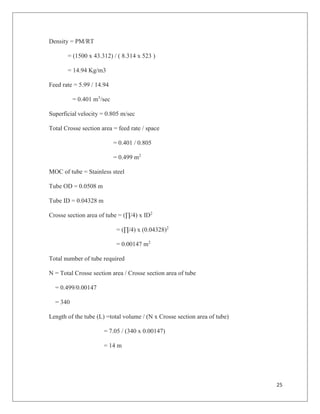
Density = PM/RT
= (1500 x 43.312) / ( 8.314 x 523 )
= 14.94 Kg/m3
Feed rate = 5.99 / 14.94
= 0.401 m3
/sec
Superficial velocity = 0.805 m/sec
Total Crosse section area = feed rate / space
= 0.401 / 0.805
= 0.499 m2
MOC of tube = Stainless steel
Tube OD = 0.0508 m
Tube ID = 0.04328 m
Crosse section area of tube = (∏/4) x ID2
= (∏/4) x (0.04328)2
= 0.00147 m2
Total number of tube required
N = Total Crosse section area / Crosse section area of tube
= 0.499/0.00147
= 340
Length of the tube (L) =total volume / (N x Crosse section area of tube)
= 7.05 / (340 x 0.00147)
= 14 m
26
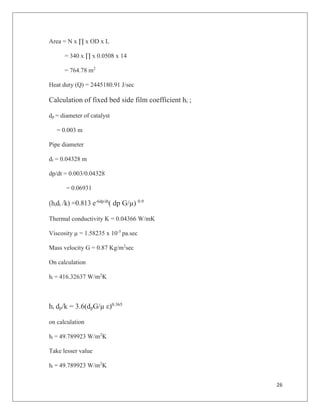
Area = N x ∏ x OD x L
= 340 x ∏ x 0.0508 x 14
= 764.78 m2
Heat duty (Q) = 2445180.91 J/sec
Calculation of fixed bed side film coefficient hi ;
dp = diameter of catalyst
= 0.003 m
Pipe diameter
dt = 0.04328 m
dp/dt = 0.003/0.04328
= 0.06931
(hidt /k) =0.813 e-6dp/dt
( dp G/µ) 0.9
Thermal conductivity K = 0.04366 W/mK
Viscosity µ = 1.58235 x 10⁻⁵
pa.sec
Mass velocity G = 0.87 Kg/m2
sec
On calculation
hi = 416.32637 W/m2
K
hi dp/k = 3.6(dpG/µ ε)0.365
on calculation
hi = 49.789923 W/m2
K
Take lesser value
hi = 49.789923 W/m2
K
27
Calculation of shell side heat transfer, h0
Shell side heat transfer coefficient calculated here [11]
Tube pitch Pt =1.25d0
=1.25 x 0.0508
= 0.0635 m
Type of arrangement = Equilateral triangular
Equivalent diameter de = 1.1/d0 (Pt – 0.907 d0
2
)
= 1.1/0.0508[0.06352
– 0.907*0.0508 2
]
= 0.03663 m
Shell side mass flow rate m ;
∆H = m*Cp*∆T
Here coolant used is dowtherm Q because operating temperature is 523 K and dowtherm Q is
stable up to 603 K ( Properties from dowtherm Q product technical data)
Properties of dowtherm Q
Cp = 1811 J/Kg K
Viscosity µ = 1.28 x 10⁻³
pa.sec
Thermal conductivity K = 0.1156 W/mK
∆T= 60 K
m = 2445180.91/(1811 x 60)
= 22.5 Kg/s
Density = 927.6 Kg/ m3
Circulation rate qv = (22.5/927.6)
= 0.024 m3
/sec
28
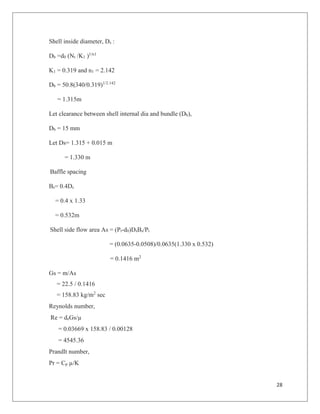
Shell inside diameter, Ds :
Db =d0 (Nt /K1 )1/n1
K1 = 0.319 and n1 = 2.142
Db = 50.8(340/0.319)1/2.142
= 1.315m
Let clearance between shell internal dia and bundle (Db),
Db = 15 mm
Let Ds= 1.315 + 0.015 m
= 1.330 m
Baffle spacing
Bs= 0.4Ds
= 0.4 x 1.33
= 0.532m
Shell side flow area As = (Pt-d0)DsBs/Pt
= (0.0635-0.0508)/0.0635(1.330 x 0.532)
= 0.1416 m2
Gs = m/As
= 22.5 / 0.1416
= 158.83 kg/m2
sec
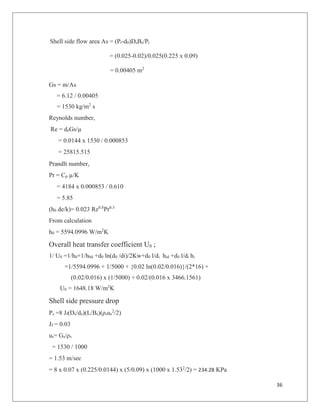
Reynolds number,
Re = deGs/µ
= 0.03669 x 158.83 / 0.00128
= 4545.36
Prandlt number,
Pr = Cp µ/K
29
= 1811 x 0.00128 / 0.1156
= 20.05
(h0 de/k)= 0.027 Re0.8
Pr0.3
From calculation
h0 = 150.50 W/m2
K
Overall heat transfer coefficient U0 ;
1/ U0 =1/h0+1/h0d +d0 ln(d0 /di)/2Kw+d0 l/di hid +d0 l/di hi
=1/150.50 + 1/5000 + {0.0508 ln(0.0508/0.04328)}/(2*16) +
(0.0508/0.04328)*(1/5000) + 0.0508/(0.04328 x 49.78)
U0 = 37.06 W/m2
K
Shell side pressure drop
Ps =8 Jf(Ds/de)(L/Bs)(ρsus
2
/2)
Jf = 0.07 from Jf vs Nre graph [11]
us= Gs/ρs
= 158.83 / 927.6
= 0.171 m/sec
= 8*0.07 x (1.330/0.03663) x (14/0.5323) x ( 985.728 x 0.0692
/2)
= 7335.7 Pa
Tube Side pressure drop
Pt =8 Jf(L/di)(ρsus
2
/2)
Jf = 0.03 from Jf vs Nre graph [11]
=8 x 0.03 x (14/0.04328) x (14.95 x 0.8022
)/2
= 0.3760672 KPa
Pressure drop across the bed
Blake – plummer equation
!
="
1.75(1 # $)%&
'
$*+,
"
P = 18.07 KPa
30
Total tube side pressure drop
Pt = 18.45 KPa
5.1.1 Mechanical Design of reactor
Shell and tube type reactor [6]
(a) Shell side
Material carbon steel - (Corrosion allowance- 3mm)
Number of passes – 1
Fluid – dowtherm Q
Working pressure – 0.3 N/mm2
Design pressure – 0.33 N/mm2
Inlet temperature – 25 0
C
Outlet temperature – 85 0
C
Segmental baffles (25% cut ) with tie rods and spacers
Maximum allowable stress - 80 N/mm2
Shell thickness; [6]
ts =PD/(2fJ+P)
= 0.33 x 1400/((2 x 80 x 0.85)+0.33) + 3 mm
= 6.38 mm
Nozzle thickness (diameter -75mm)
tn=PD/(2fJ-P)
= 0.33 x 75/( 2 x 80 – 0.33)
= 0.155 mm + 3 mm
= 3.155 mm
Head
Head thickness (th) = PCrW/2fJ
Crown radius = 1400 mm
Knuckle radius = 140 mm
31
W=1/4(3+ (Rc/R1)1/2
)
= 1/4(3 + (1400/140)1/2
)
= 1.54
th = 0.33 x 1400 x 1.54 / (2 x 0.85 x 80) + 3mm
= 8.23mm
Transverse Baffles
Spacing between baffles= 0.4Ds
= 0.4 x 1.4
= 0.56m
Thickness of baffles = 5mm
Tube Side [6]
Tube and tube sheet material - stainless steel
Number of tubes – 340
Outside diameter – 50.8 mm
Length – 14m
Tube pitch - 0.0635m
Working pressure – 1.5 N/mm2
Design pressure – 1.65 N/mm2
Inlet temperature – 2500
C
Outlet temperature - 2500
C
Permissible stress – 74.5 N/mm2
tf =PD0/(2fJ+P)
= 1.65 x 50.8 / (2 x 74.5 x 0.85 + 1.65)
= 0.65 mm
No corrosion allowance, since the tubes are of stainless steel.
Design of Gasket and Bolt Size [6]
Gasket material – flat metal jacketed, asbestos fill (iron or soft steel)
Gasket factor, m= 3.75
Minimum design stress = 52.4 N/mm2
32
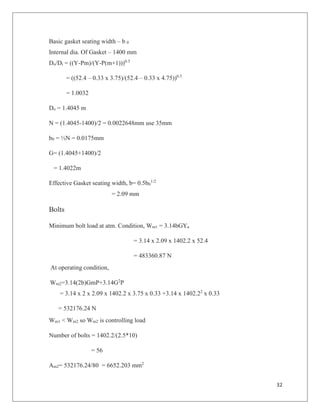
Basic gasket seating width – b 0
Internal dia. Of Gasket – 1400 mm
Do/Di = ((Y-Pm)/(Y-P(m+1)))0.5
= ((52.4 – 0.33 x 3.75)/(52.4 – 0.33 x 4.75))0.5
= 1.0032
Do = 1.4045 m
N = (1.4045-1400)/2 = 0.0022648mm use 35mm
b0 = ½N = 0.0175mm
G= (1.4045+1400)/2
= 1.4022m
Effective Gasket seating width, b= 0.5b0
1/2
= 2.09 mm
Bolts
Minimum bolt load at atm. Condition, Wm1 = 3.14bGYa
= 3.14 x 2.09 x 1402.2 x 52.4
= 483360.87 N
At operating condition,
Wm2=3.14(2b)GmP+3.14G2
P
= 3.14 x 2 x 2.09 x 1402.2 x 3.75 x 0.33 +3.14 x 1402.22
x 0.33
= 532176.24 N
Wm1 < Wm2 so Wm2 is controlling load
Number of bolts = 1402.2/(2.5*10)
= 56
Am2= 532176.24/80 = 6652.203 mm2
33
Diameter of bolts = [(Am2/no. of bolts) x 3.14/4]1/2
= [(6652.203)/56 x (4/3.14)]1/2
=12.29 mm
Bolt area, Ab = 2 x 3.14 x YaGN/fa
= 2 x 3.14 x 52.48 x 1402.2 x 35 / 80
=202204.36 mm2
Pitch of bolts = 4.75*18
= 85.6 mm
Pitch circle dia.= (85.6*56)/3.14
=1526.62mm
Flange Thickness,
K= 1/[0.3+1.5WmhG/HG]
= 1/[0.3 + 1.5 x 532176.24 x 62.52136 /( 509382.1 X 1402.2)]
= 2.7
tf = G(p/kf)1/2
+c
= 1402.2 x (0.33/2.7/80) ½
+ 3
= 70.62 mm
5.2 Heat exchanger Design
For heat exchanger tube side is waste water and shell side is cooling water is used. Here we
assume over all heat transfer coefficient (U) is 800 W/m2
K.In table 5.1 tube side and shell
side fluid inlet, outlet temperature and mass flowrate values given. [11]
Table 5.2: tube side and shell side flowrate and temperature
tube side shell side
flow rate(Kg/sec) 0.6714 6.12
inlet temperature(K) 401 308
outlet temperature(K) 310 318
34
U=800 W/m2
K (assumed) [11]
LMTD= [(401-318)-(310-308)/ln((401-318)/(310-308))]
= 21.74 K
Q = 256454.44 J/sec
Q = UA(LMTD)
A=256454.44/(800 x 21.74)
= 14.74 m2
Material of construction (MOC) of tube = Stainless steel
Tube OD = 0.02 m
Tube ID = 0.016 m
Length of tube (L) = 5 m
Area of tube = ∏ x ID x L
= ∏ x (0.04328) x 5
= 0.303 m2
Total number of tube required
N = total area / area of tube
= 14.74/0.303
= 49
Tube side heat transfer coefficient
Cross section area = n x (∏/4) x ID2
= 49 x (∏/4) x (0.016)2
= 0.0098 m2
Velocity (u) = 0.000692/0.0098
= 0.0706 m/sec
35
Density = 969.972 Kg/m3
Viscosity = 0.000345 Pa.sec
hi = 4200(1.35 + 0.02t)u0.8
/ID0.2
= 4200 (1.35 + 0.02 x 82.5) (0.0706)0.8
/(0.016)0.2
= 3466.1561
Shell side
Water flow rate = 6.12 Kg/sec
Pitch (P) = 1.25 x OD
= 1.25 x 0.02
= 0.025 m
Equivalent diameter de = 1.1/d0 (Pt – 0.907 d0
2
)
= 1.1/0.02[0.0252
– 0.907*0.022
]
= 0.0144 m
Shell inside diameter, Ds :
Db =d0 (Nt /K1 )1/n1
K1 = 0.319 and n1 = 2.142
Db = 0.02(49/0.319)1/2.142
= 0.21 m
Let clearance between shell internal dia and bundle (Db),
Db = 15 mm
Let Ds= 0.21 + 0.015 m
= 0.225 m
Baffle spacing
Bs= 0.4Ds
= 0.4 x 0.225 = 0.09 m
36
Shell side flow area As = (Pt-d0)DsBs/Pt
= (0.025-0.02)/0.025(0.225 x 0.09)
= 0.00405 m2
Gs = m/As
= 6.12 / 0.00405
= 1530 kg/m2
s
Reynolds number,
Re = deGs/µ
= 0.0144 x 1530 / 0.000853
= 25815.515
Prandlt number,
Pr = Cp µ/K
= 4184 x 0.000853 / 0.610
= 5.85
(h0 de/k)= 0.023 Re0.8
Pr0.3
From calculation
h0 = 5594.0996 W/m2
K
Overall heat transfer coefficient U0 ;
1/ U0 =1/h0+1/h0d +d0 ln(d0 /di)/2Kw+d0 l/di hid +d0 l/di hi
=1/5594.0996 + 1/5000 + {0.02 ln(0.02/0.016)}/(2*16) +
(0.02/0.016) x (1/5000) + 0.02/(0.016 x 3466.1561)
U0 = 1648.18 W/m2
K
Shell side pressure drop
Ps =8 Jf(Ds/de)(L/Bs)(ρsus
2
/2)
Jf = 0.03
us= Gs/ρs
= 1530 / 1000
= 1.53 m/sec
= 8 x 0.07 x (0.225/0.0144) x (5/0.09) x (1000 x 1.532
/2) = 234.28 KPa
37
Tube Side pressure drop
Pt = (8Jf(L/di) + 2.5)(ρtut
2
/2)
= ( 8 x 0.008 x (5/0.016) + 2.5)(969.69 x 0.0712
/2)
= 54.99 Pa
5.2.1 Mechanical Design for heat exchanger
Shell and tube type heat exchanger [6]
(a) Shell side
Material carbon steel - (Corrosion allowance- 3mm)
Number of passes – 1
Fluid – water
Working pressure – 0.4 N/mm2
Design pressure – 0.44 N/mm2
Inlet temperature – 25 0
C
Outlet temperature – 85 0
C
Segmental baffles (25% cut ) with tie rods and spacers
Shell thickness;
ts =PD/(2fJ+P)
= 0.44 x 300/((2 x 80 x 0.85)+0.44) + 3 mm
= 3.96 mm
Nozzle thickness (diameter -75mm)
tn=PD/(2fJ-P)
= 0.44 x 75/( 2 x 80 – 0.44)
= 0.21 mm + 3 mm
= 3.21 mm
Head
Head thickness (th) = PCrW/2fJ
Crown radius = 300 mm
Knuckle radius = 30 mm
38
W=1/4(3+ (Rc/R1)1/2
)
= 1/4(3 + (300/30)1/2
)
= 1.54
th = 0.44 x 300 x 1.54 / (2 x 0.85 x 80) + 3mm
= 4.49 mm
Transverse Baffles
Spacing between baffles= 0.4Ds
= 0.4 x 0.3
= 0.12 m
Thickness of baffles = 5mm
Tube Side
Tube and tube sheet material - stainless steel
Number of tubes – 49
Outside diameter – 20 mm
Length – 5 m
Tube pitch - 0.025 m
Working pressure – 0.5 N/mm2
Design pressure – 0.55 N/mm2
Inlet temperature – 1280
C
Outlet temperature - 370
C
Permissible stress – 74.5 N/mm2
tf =PD0/(2fJ+P)
= 0.55 x 20 / (2 x 74.5 x 0.85 + 0.55)
= 0.086 mm
No corrosion allowance, since the tubes are of stainless steel.
Design of Gasket and Bolt Size [6]
Gasket material – flat metal jacketed, asbestos fill (iron or soft steel)
Gasket factor, m= 3.75
39
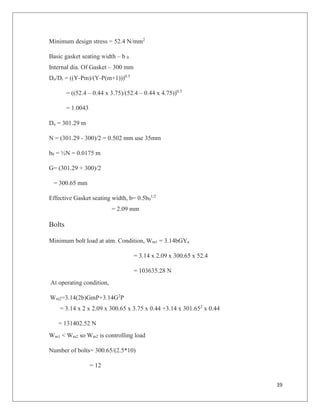
Minimum design stress = 52.4 N/mm2
Basic gasket seating width – b 0
Internal dia. Of Gasket – 300 mm
Do/Di = ((Y-Pm)/(Y-P(m+1)))0.5
= ((52.4 – 0.44 x 3.75)/(52.4 – 0.44 x 4.75))0.5
= 1.0043
Do = 301.29 m
N = (301.29 - 300)/2 = 0.502 mm use 35mm
b0 = ½N = 0.0175 m
G= (301.29 + 300)/2
= 300.65 mm
Effective Gasket seating width, b= 0.5b0
1/2
= 2.09 mm
Bolts
Minimum bolt load at atm. Condition, Wm1 = 3.14bGYa
= 3.14 x 2.09 x 300.65 x 52.4
= 103635.28 N
At operating condition,
Wm2=3.14(2b)GmP+3.14G2
P
= 3.14 x 2 x 2.09 x 300.65 x 3.75 x 0.44 +3.14 x 301.652
x 0.44
= 131402.52 N
Wm1 < Wm2 so Wm2 is controlling load
Number of bolts= 300.65/(2.5*10)
= 12
40
Am2= 131402.52/80
= 1642.53 mm2
Diameter of bolts= [(Am2/no. of bolts) x 3.14/4]1/2
= [(1642.53)/12 x (4/3.14)]1/2
=13.19 mm
Bolt area, Ab = 2 x 3.14 x YaGN/fa
= 2 x 3.14 x 52.48 x 300.65 x 35 / 80
= 43350.36 mm2
Pitch of bolts = 4.75*18
= 85.6 mm
Pitch circle dia.= (85.6*12)/3.14
= 327.13 mm
Flange Thickness,
K= 1/[0.3+1.5WmhG/HG]
= 1/[0.3 + 1.5 x 131402.52 x 13.4 /( 31221.65 X 300.65)]
= 1.75
tf = G(p/kf)1/2
+c
= 300.65 x (0.44/1.75/80) ½
+ 3
= 23.99 mm
Use 24 mm
5.3 Distillation column Design:
Operating pressure at top = 1 atm = 101.325 KPa
Reflux ratio = 3.49
Number of plates = 40
Distillation molar rate D = 0.0327 Kmol/sec
Liquid molar rate L= D x R
= 0.0327 x 3.49
= 0.114 Kmol/sec
41
Vapor molar rate = D x (R + 1)
= 0.0327 x (3.49 + 1)
= 0.1468 Kmol/sec
Vapor density ρv = 3.91 Kg/m3
Liquid density ρl = 653.64 Kg/m3
Vapor and liquid flowrate is given in table 5.2
Table 5.3: vapor and liquid flowrate
vapor liquid
molar flow rate 0.1468 0.1141
mass rate 10.8649 8.4451
vol. rate 2.7750 0.0129
Vload = Q [ρv / (ρl - ρv)]0.5
= 2.77 [ 3.91/(653.64 – 3.91)]0.5
= 0.2154 m3
/sec
q = 0.0129 m3
/sec
Single pass
Dt = 1.7 m (from graph of Vload and liquid flowrate)
System factor S = 1
Flooding factor = 0.8 ( 80 % flooding)
Flow path length L = 0.75 x Dt / number of pass
= 0.75 x 1.7 / 1
= 1.275 m
C* = 0.125
C = S x C*
= 1 x 0.125
= 0.125
Aamin = [ vapor load + 1.36qL]/ (C x F)
= [ 0.2154 + 1.36 x 0.0129 x 1.275 ]/(0.125 x 0.8) = 2.37 m2
42
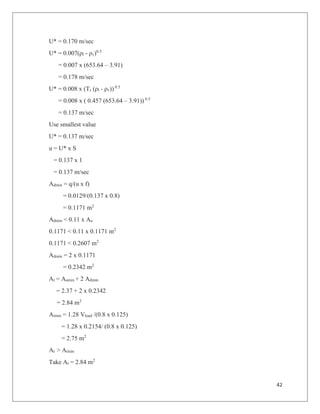
U* = 0.170 m/sec
U* = 0.007(ρl - ρv)0.5
= 0.007 x (653.64 – 3.91)
= 0.178 m/sec
U* = 0.008 x (Ts (ρl - ρv)) 0.5
= 0.008 x ( 0.457 (653.64 – 3.91)) 0.5
= 0.137 m/sec
Use smallest value
U* = 0.137 m/sec
u = U* x S
= 0.137 x 1
= 0.137 m/sec
Admin = q/(u x f)
= 0.0129/(0.137 x 0.8)
= 0.1171 m2
Admin < 0.11 x Aa
0.1171 < 0.11 x 0.1171 m2
0.1171 < 0.2607 m2
Admin = 2 x 0.1171
= 0.2342 m2
At = Aamin + 2 Admin
= 2.37 + 2 x 0.2342
= 2.84 m2
Atmin = 1.28 Vload /(0.8 x 0.125)
= 1.28 x 0.2154/ (0.8 x 0.125)
= 2.75 m2
At > Atmin
Take At = 2.84 m2
43
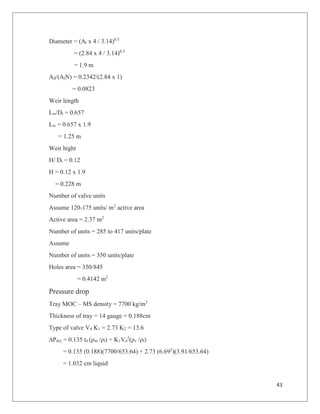
Diameter = (At x 4 / 3.14)0.5
= (2.84 x 4 / 3.14)0.5
= 1.9 m
Ad/(AtN) = 0.2342/(2.84 x 1)
= 0.0823
Weir length
Lw/Dt = 0.657
Lw = 0.657 x 1.9
= 1.25 m
Weir hight
H/ Dt = 0.12
H = 0.12 x 1.9
= 0.228 m
Number of valve units
Assume 120-175 units/ m2
active area
Active area = 2.37 m2
Number of units = 285 to 417 units/plate
Assume
Number of units = 350 units/plate
Holes area = 350/845
= 0.4142 m2
Pressure drop
Tray MOC – MS density = 7700 kg/m3
Thickness of tray = 14 gauge = 0.188cm
Type of valve V4 K1 = 2.73 K2 = 13.6
∆Pdry = 0.135 tn (ρm /ρl) + K1Vn
2
(ρv /ρl)
= 0.135 (0.188)(7700/653.64) + 2.73 (6.692
)(3.91/653.64)
= 1.032 cm liquid
44
∆Pdry = K2Vn
2
(ρv /ρl)
= 13.6 (6.692
)(3.91/653.64)
= 3.65 cm liquid
∆Pt = ∆Pdry + 55.4(q/Lw)0.67
+ 0.04hw
= 3.65 + 55.4(0.0129/1.25)0.67
+ 0.04 x 50
= 8.44 cm liquid
= 0.076 psi
Hde = 55.4(q/Lw)0.67
+ 0.1 hw + (∆Pt + 1.66)( ρl / (ρl - ρv))
= 55.4(0.0129/1.25)0.67
+ 0.1 x 50 + (8.44 + 1.66)(653.64/(653.64-3.91))
= 17.96 cm liquid < 0.6 TS
%Flooding = Vload / (0.78ATC)
= 0.2154 / (0.78 x 2.84 x0.125)
= 77.60%
5.3.1 Mechanical design of distillation column
Mechanical design of distillation column including support. [14]
Operating pressure = 101.325 Kpa
Design pressure = 1.1 x 101.325 = 111.45 Kpa = 0.11145 N/mm2
Design temperature = 423 K
MOC = carbon steel
Diameter = 1900 mm
Thickness of the column
tc = PD/(2fJ - P)
= 0.44 x 300/((2 x 80 x 0.85) - 0.44) + 3 mm
= 3.065 mm
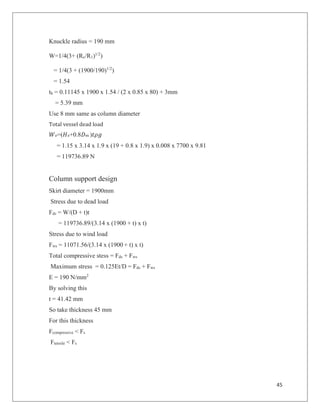
But take 8mm
Head
Torispherical head [6]
Head thickness (th) = PCrW/2fJ
Crown radius = 1900 mm
45
Knuckle radius = 190 mm
W=1/4(3+ (Rc/R1)1/2
)
= 1/4(3 + (1900/190)1/2
)
= 1.54
th = 0.11145 x 1900 x 1.54 / (2 x 0.85 x 80) + 3mm
= 5.39 mm
Use 8 mm same as column diameter
Total vessel dead load
!=("!+0.8#$ )%&'
= 1.15 x 3.14 x 1.9 x (19 + 0.8 x 1.9) x 0.008 x 7700 x 9.81
= 119736.89 N
Column support design
Skirt diameter = 1900mm
Stress due to dead load
Fds = W/(D + t)t
= 119736.89/(3.14 x (1900 + t) x t)
Stress due to wind load
Fws = 11071.56/(3.14 x (1900 + t) x t)
Total compressive stess = Fds + Fws
Maximum stress = 0.125Et/D = Fds + Fws
E = 190 N/mm2
By solving this
t = 41.42 mm
So take thickness 45 mm
For this thickness
Fcompressive < Fs
Ftensile < Fs

Diethyl Ether (DEE): Equipments Design

  • 1.
    23 CHAPTER 5 EQUIPMENT DESIGN Inthis chapter, detailed equipment design and mechanical design of 5.1 Fixed Bed Catalytic Reactor Process Design: Reaction temperature =250 0 C ( 523K) Catalyst: γ - alumina Density of catalyst particle: 1392 kg/m3 [8] Catalyst porosity: 0.52 [8] Type of reactor: Shell and tube heat exchanger type in which catalyst is placed inside the tube. Reaction is exothermic: It is carried out in isothermal manner. Water is to be circulated in liquid form on shell side to maintain the isothermal condition. Mass of catalyst required in commercial scale plant = 6579.711 kg Superficial velocity of feed gas V=0.802 m/s Capacity of plant =50000 MTA of diethyl ether (DEE) Let no. of working days per annum=340 days Production rate of diethyl ether (DEE) = (50000*1000)/(340*24) =6127.45 Kg/hr !""= #$%%&'()* 2 &'()* 2 + #1&'()*&,-(% (5.1) [3] "./03"4"= #%(567%8%&'()* &'()* 2 + #1&'()*&,-(% + #2&'()* 2 + #9&,-(% 2 Design equation (5.2) [3] : ; = < !> ?@AB CCCCCCCCCCCCCCCCCCCCCCCCCCCCCCCCCCCCCCCCCCCCCCCCCCCCCCCCCCCCCCCCCCCCCCCCCCCCCCCCCCCCCCCCCCCCCCCCCCCCCCCCCCCCCCCCCCCCCCCCCCCCCCCCCC?DE9B [4]
  • 2.
    24 In table 5.1conversion of ethanol and rate of reaction data is given. Unit of rate of reaction is mol/(gm catalyst sec) Table 5.1: rate of reaction and conversion data r (total) 1/r Ethanol conversion 2.77216E-06 360729.1 0 2.24531E-06 445373.6 0.1 1.81423E-06 551197.8 0.2 1.45502E-06 687277 0.3 1.15111E-06 868729.7 0.4 8.90654E-07 1122770 0.5 8.31259E-07 1202994 0.525 4.67523E-07 2138934 0.7 2.9333E-07 3409130 0.8 From the graph (appendix A) Area= 340000 unit Weight of catalyst= 6579711 gm = 6579.711 Kg Bulk density =0.9333 gm/cc [8] Volume = 6579.711/9333 = 7.049942 m3 Feed rate = 0.1382 Kmol/sec = 0.1382 x 43.312 = 5.99 Kg/sec
  • 3.
    25 Density = PM/RT =(1500 x 43.312) / ( 8.314 x 523 ) = 14.94 Kg/m3 Feed rate = 5.99 / 14.94 = 0.401 m3 /sec Superficial velocity = 0.805 m/sec Total Crosse section area = feed rate / space = 0.401 / 0.805 = 0.499 m2 MOC of tube = Stainless steel Tube OD = 0.0508 m Tube ID = 0.04328 m Crosse section area of tube = (∏/4) x ID2 = (∏/4) x (0.04328)2 = 0.00147 m2 Total number of tube required N = Total Crosse section area / Crosse section area of tube = 0.499/0.00147 = 340 Length of the tube (L) =total volume / (N x Crosse section area of tube) = 7.05 / (340 x 0.00147) = 14 m
  • 4.
    26 Area = Nx ∏ x OD x L = 340 x ∏ x 0.0508 x 14 = 764.78 m2 Heat duty (Q) = 2445180.91 J/sec Calculation of fixed bed side film coefficient hi ; dp = diameter of catalyst = 0.003 m Pipe diameter dt = 0.04328 m dp/dt = 0.003/0.04328 = 0.06931 (hidt /k) =0.813 e-6dp/dt ( dp G/µ) 0.9 Thermal conductivity K = 0.04366 W/mK Viscosity µ = 1.58235 x 10⁻⁵ pa.sec Mass velocity G = 0.87 Kg/m2 sec On calculation hi = 416.32637 W/m2 K hi dp/k = 3.6(dpG/µ ε)0.365 on calculation hi = 49.789923 W/m2 K Take lesser value hi = 49.789923 W/m2 K
  • 5.
    27 Calculation of shellside heat transfer, h0 Shell side heat transfer coefficient calculated here [11] Tube pitch Pt =1.25d0 =1.25 x 0.0508 = 0.0635 m Type of arrangement = Equilateral triangular Equivalent diameter de = 1.1/d0 (Pt – 0.907 d0 2 ) = 1.1/0.0508[0.06352 – 0.907*0.0508 2 ] = 0.03663 m Shell side mass flow rate m ; ∆H = m*Cp*∆T Here coolant used is dowtherm Q because operating temperature is 523 K and dowtherm Q is stable up to 603 K ( Properties from dowtherm Q product technical data) Properties of dowtherm Q Cp = 1811 J/Kg K Viscosity µ = 1.28 x 10⁻³ pa.sec Thermal conductivity K = 0.1156 W/mK ∆T= 60 K m = 2445180.91/(1811 x 60) = 22.5 Kg/s Density = 927.6 Kg/ m3 Circulation rate qv = (22.5/927.6) = 0.024 m3 /sec
  • 6.
    28 Shell inside diameter,Ds : Db =d0 (Nt /K1 )1/n1 K1 = 0.319 and n1 = 2.142 Db = 50.8(340/0.319)1/2.142 = 1.315m Let clearance between shell internal dia and bundle (Db), Db = 15 mm Let Ds= 1.315 + 0.015 m = 1.330 m Baffle spacing Bs= 0.4Ds = 0.4 x 1.33 = 0.532m Shell side flow area As = (Pt-d0)DsBs/Pt = (0.0635-0.0508)/0.0635(1.330 x 0.532) = 0.1416 m2 Gs = m/As = 22.5 / 0.1416 = 158.83 kg/m2 sec Reynolds number, Re = deGs/µ = 0.03669 x 158.83 / 0.00128 = 4545.36 Prandlt number, Pr = Cp µ/K
  • 7.
    29 = 1811 x0.00128 / 0.1156 = 20.05 (h0 de/k)= 0.027 Re0.8 Pr0.3 From calculation h0 = 150.50 W/m2 K Overall heat transfer coefficient U0 ; 1/ U0 =1/h0+1/h0d +d0 ln(d0 /di)/2Kw+d0 l/di hid +d0 l/di hi =1/150.50 + 1/5000 + {0.0508 ln(0.0508/0.04328)}/(2*16) + (0.0508/0.04328)*(1/5000) + 0.0508/(0.04328 x 49.78) U0 = 37.06 W/m2 K Shell side pressure drop Ps =8 Jf(Ds/de)(L/Bs)(ρsus 2 /2) Jf = 0.07 from Jf vs Nre graph [11] us= Gs/ρs = 158.83 / 927.6 = 0.171 m/sec = 8*0.07 x (1.330/0.03663) x (14/0.5323) x ( 985.728 x 0.0692 /2) = 7335.7 Pa Tube Side pressure drop Pt =8 Jf(L/di)(ρsus 2 /2) Jf = 0.03 from Jf vs Nre graph [11] =8 x 0.03 x (14/0.04328) x (14.95 x 0.8022 )/2 = 0.3760672 KPa Pressure drop across the bed Blake – plummer equation ! =" 1.75(1 # $)%& ' $*+, " P = 18.07 KPa
  • 8.
    30 Total tube sidepressure drop Pt = 18.45 KPa 5.1.1 Mechanical Design of reactor Shell and tube type reactor [6] (a) Shell side Material carbon steel - (Corrosion allowance- 3mm) Number of passes – 1 Fluid – dowtherm Q Working pressure – 0.3 N/mm2 Design pressure – 0.33 N/mm2 Inlet temperature – 25 0 C Outlet temperature – 85 0 C Segmental baffles (25% cut ) with tie rods and spacers Maximum allowable stress - 80 N/mm2 Shell thickness; [6] ts =PD/(2fJ+P) = 0.33 x 1400/((2 x 80 x 0.85)+0.33) + 3 mm = 6.38 mm Nozzle thickness (diameter -75mm) tn=PD/(2fJ-P) = 0.33 x 75/( 2 x 80 – 0.33) = 0.155 mm + 3 mm = 3.155 mm Head Head thickness (th) = PCrW/2fJ Crown radius = 1400 mm Knuckle radius = 140 mm
  • 9.
    31 W=1/4(3+ (Rc/R1)1/2 ) = 1/4(3+ (1400/140)1/2 ) = 1.54 th = 0.33 x 1400 x 1.54 / (2 x 0.85 x 80) + 3mm = 8.23mm Transverse Baffles Spacing between baffles= 0.4Ds = 0.4 x 1.4 = 0.56m Thickness of baffles = 5mm Tube Side [6] Tube and tube sheet material - stainless steel Number of tubes – 340 Outside diameter – 50.8 mm Length – 14m Tube pitch - 0.0635m Working pressure – 1.5 N/mm2 Design pressure – 1.65 N/mm2 Inlet temperature – 2500 C Outlet temperature - 2500 C Permissible stress – 74.5 N/mm2 tf =PD0/(2fJ+P) = 1.65 x 50.8 / (2 x 74.5 x 0.85 + 1.65) = 0.65 mm No corrosion allowance, since the tubes are of stainless steel. Design of Gasket and Bolt Size [6] Gasket material – flat metal jacketed, asbestos fill (iron or soft steel) Gasket factor, m= 3.75 Minimum design stress = 52.4 N/mm2
  • 10.
    32 Basic gasket seatingwidth – b 0 Internal dia. Of Gasket – 1400 mm Do/Di = ((Y-Pm)/(Y-P(m+1)))0.5 = ((52.4 – 0.33 x 3.75)/(52.4 – 0.33 x 4.75))0.5 = 1.0032 Do = 1.4045 m N = (1.4045-1400)/2 = 0.0022648mm use 35mm b0 = ½N = 0.0175mm G= (1.4045+1400)/2 = 1.4022m Effective Gasket seating width, b= 0.5b0 1/2 = 2.09 mm Bolts Minimum bolt load at atm. Condition, Wm1 = 3.14bGYa = 3.14 x 2.09 x 1402.2 x 52.4 = 483360.87 N At operating condition, Wm2=3.14(2b)GmP+3.14G2 P = 3.14 x 2 x 2.09 x 1402.2 x 3.75 x 0.33 +3.14 x 1402.22 x 0.33 = 532176.24 N Wm1 < Wm2 so Wm2 is controlling load Number of bolts = 1402.2/(2.5*10) = 56 Am2= 532176.24/80 = 6652.203 mm2
  • 11.
    33 Diameter of bolts= [(Am2/no. of bolts) x 3.14/4]1/2 = [(6652.203)/56 x (4/3.14)]1/2 =12.29 mm Bolt area, Ab = 2 x 3.14 x YaGN/fa = 2 x 3.14 x 52.48 x 1402.2 x 35 / 80 =202204.36 mm2 Pitch of bolts = 4.75*18 = 85.6 mm Pitch circle dia.= (85.6*56)/3.14 =1526.62mm Flange Thickness, K= 1/[0.3+1.5WmhG/HG] = 1/[0.3 + 1.5 x 532176.24 x 62.52136 /( 509382.1 X 1402.2)] = 2.7 tf = G(p/kf)1/2 +c = 1402.2 x (0.33/2.7/80) ½ + 3 = 70.62 mm 5.2 Heat exchanger Design For heat exchanger tube side is waste water and shell side is cooling water is used. Here we assume over all heat transfer coefficient (U) is 800 W/m2 K.In table 5.1 tube side and shell side fluid inlet, outlet temperature and mass flowrate values given. [11] Table 5.2: tube side and shell side flowrate and temperature tube side shell side flow rate(Kg/sec) 0.6714 6.12 inlet temperature(K) 401 308 outlet temperature(K) 310 318
  • 12.
    34 U=800 W/m2 K (assumed)[11] LMTD= [(401-318)-(310-308)/ln((401-318)/(310-308))] = 21.74 K Q = 256454.44 J/sec Q = UA(LMTD) A=256454.44/(800 x 21.74) = 14.74 m2 Material of construction (MOC) of tube = Stainless steel Tube OD = 0.02 m Tube ID = 0.016 m Length of tube (L) = 5 m Area of tube = ∏ x ID x L = ∏ x (0.04328) x 5 = 0.303 m2 Total number of tube required N = total area / area of tube = 14.74/0.303 = 49 Tube side heat transfer coefficient Cross section area = n x (∏/4) x ID2 = 49 x (∏/4) x (0.016)2 = 0.0098 m2 Velocity (u) = 0.000692/0.0098 = 0.0706 m/sec
  • 13.
    35 Density = 969.972Kg/m3 Viscosity = 0.000345 Pa.sec hi = 4200(1.35 + 0.02t)u0.8 /ID0.2 = 4200 (1.35 + 0.02 x 82.5) (0.0706)0.8 /(0.016)0.2 = 3466.1561 Shell side Water flow rate = 6.12 Kg/sec Pitch (P) = 1.25 x OD = 1.25 x 0.02 = 0.025 m Equivalent diameter de = 1.1/d0 (Pt – 0.907 d0 2 ) = 1.1/0.02[0.0252 – 0.907*0.022 ] = 0.0144 m Shell inside diameter, Ds : Db =d0 (Nt /K1 )1/n1 K1 = 0.319 and n1 = 2.142 Db = 0.02(49/0.319)1/2.142 = 0.21 m Let clearance between shell internal dia and bundle (Db), Db = 15 mm Let Ds= 0.21 + 0.015 m = 0.225 m Baffle spacing Bs= 0.4Ds = 0.4 x 0.225 = 0.09 m
  • 14.
    36 Shell side flowarea As = (Pt-d0)DsBs/Pt = (0.025-0.02)/0.025(0.225 x 0.09) = 0.00405 m2 Gs = m/As = 6.12 / 0.00405 = 1530 kg/m2 s Reynolds number, Re = deGs/µ = 0.0144 x 1530 / 0.000853 = 25815.515 Prandlt number, Pr = Cp µ/K = 4184 x 0.000853 / 0.610 = 5.85 (h0 de/k)= 0.023 Re0.8 Pr0.3 From calculation h0 = 5594.0996 W/m2 K Overall heat transfer coefficient U0 ; 1/ U0 =1/h0+1/h0d +d0 ln(d0 /di)/2Kw+d0 l/di hid +d0 l/di hi =1/5594.0996 + 1/5000 + {0.02 ln(0.02/0.016)}/(2*16) + (0.02/0.016) x (1/5000) + 0.02/(0.016 x 3466.1561) U0 = 1648.18 W/m2 K Shell side pressure drop Ps =8 Jf(Ds/de)(L/Bs)(ρsus 2 /2) Jf = 0.03 us= Gs/ρs = 1530 / 1000 = 1.53 m/sec = 8 x 0.07 x (0.225/0.0144) x (5/0.09) x (1000 x 1.532 /2) = 234.28 KPa
  • 15.
    37 Tube Side pressuredrop Pt = (8Jf(L/di) + 2.5)(ρtut 2 /2) = ( 8 x 0.008 x (5/0.016) + 2.5)(969.69 x 0.0712 /2) = 54.99 Pa 5.2.1 Mechanical Design for heat exchanger Shell and tube type heat exchanger [6] (a) Shell side Material carbon steel - (Corrosion allowance- 3mm) Number of passes – 1 Fluid – water Working pressure – 0.4 N/mm2 Design pressure – 0.44 N/mm2 Inlet temperature – 25 0 C Outlet temperature – 85 0 C Segmental baffles (25% cut ) with tie rods and spacers Shell thickness; ts =PD/(2fJ+P) = 0.44 x 300/((2 x 80 x 0.85)+0.44) + 3 mm = 3.96 mm Nozzle thickness (diameter -75mm) tn=PD/(2fJ-P) = 0.44 x 75/( 2 x 80 – 0.44) = 0.21 mm + 3 mm = 3.21 mm Head Head thickness (th) = PCrW/2fJ Crown radius = 300 mm Knuckle radius = 30 mm
  • 16.
    38 W=1/4(3+ (Rc/R1)1/2 ) = 1/4(3+ (300/30)1/2 ) = 1.54 th = 0.44 x 300 x 1.54 / (2 x 0.85 x 80) + 3mm = 4.49 mm Transverse Baffles Spacing between baffles= 0.4Ds = 0.4 x 0.3 = 0.12 m Thickness of baffles = 5mm Tube Side Tube and tube sheet material - stainless steel Number of tubes – 49 Outside diameter – 20 mm Length – 5 m Tube pitch - 0.025 m Working pressure – 0.5 N/mm2 Design pressure – 0.55 N/mm2 Inlet temperature – 1280 C Outlet temperature - 370 C Permissible stress – 74.5 N/mm2 tf =PD0/(2fJ+P) = 0.55 x 20 / (2 x 74.5 x 0.85 + 0.55) = 0.086 mm No corrosion allowance, since the tubes are of stainless steel. Design of Gasket and Bolt Size [6] Gasket material – flat metal jacketed, asbestos fill (iron or soft steel) Gasket factor, m= 3.75
  • 17.
    39 Minimum design stress= 52.4 N/mm2 Basic gasket seating width – b 0 Internal dia. Of Gasket – 300 mm Do/Di = ((Y-Pm)/(Y-P(m+1)))0.5 = ((52.4 – 0.44 x 3.75)/(52.4 – 0.44 x 4.75))0.5 = 1.0043 Do = 301.29 m N = (301.29 - 300)/2 = 0.502 mm use 35mm b0 = ½N = 0.0175 m G= (301.29 + 300)/2 = 300.65 mm Effective Gasket seating width, b= 0.5b0 1/2 = 2.09 mm Bolts Minimum bolt load at atm. Condition, Wm1 = 3.14bGYa = 3.14 x 2.09 x 300.65 x 52.4 = 103635.28 N At operating condition, Wm2=3.14(2b)GmP+3.14G2 P = 3.14 x 2 x 2.09 x 300.65 x 3.75 x 0.44 +3.14 x 301.652 x 0.44 = 131402.52 N Wm1 < Wm2 so Wm2 is controlling load Number of bolts= 300.65/(2.5*10) = 12
  • 18.
    40 Am2= 131402.52/80 = 1642.53mm2 Diameter of bolts= [(Am2/no. of bolts) x 3.14/4]1/2 = [(1642.53)/12 x (4/3.14)]1/2 =13.19 mm Bolt area, Ab = 2 x 3.14 x YaGN/fa = 2 x 3.14 x 52.48 x 300.65 x 35 / 80 = 43350.36 mm2 Pitch of bolts = 4.75*18 = 85.6 mm Pitch circle dia.= (85.6*12)/3.14 = 327.13 mm Flange Thickness, K= 1/[0.3+1.5WmhG/HG] = 1/[0.3 + 1.5 x 131402.52 x 13.4 /( 31221.65 X 300.65)] = 1.75 tf = G(p/kf)1/2 +c = 300.65 x (0.44/1.75/80) ½ + 3 = 23.99 mm Use 24 mm 5.3 Distillation column Design: Operating pressure at top = 1 atm = 101.325 KPa Reflux ratio = 3.49 Number of plates = 40 Distillation molar rate D = 0.0327 Kmol/sec Liquid molar rate L= D x R = 0.0327 x 3.49 = 0.114 Kmol/sec
  • 19.
    41 Vapor molar rate= D x (R + 1) = 0.0327 x (3.49 + 1) = 0.1468 Kmol/sec Vapor density ρv = 3.91 Kg/m3 Liquid density ρl = 653.64 Kg/m3 Vapor and liquid flowrate is given in table 5.2 Table 5.3: vapor and liquid flowrate vapor liquid molar flow rate 0.1468 0.1141 mass rate 10.8649 8.4451 vol. rate 2.7750 0.0129 Vload = Q [ρv / (ρl - ρv)]0.5 = 2.77 [ 3.91/(653.64 – 3.91)]0.5 = 0.2154 m3 /sec q = 0.0129 m3 /sec Single pass Dt = 1.7 m (from graph of Vload and liquid flowrate) System factor S = 1 Flooding factor = 0.8 ( 80 % flooding) Flow path length L = 0.75 x Dt / number of pass = 0.75 x 1.7 / 1 = 1.275 m C* = 0.125 C = S x C* = 1 x 0.125 = 0.125 Aamin = [ vapor load + 1.36qL]/ (C x F) = [ 0.2154 + 1.36 x 0.0129 x 1.275 ]/(0.125 x 0.8) = 2.37 m2
  • 20.
    42 U* = 0.170m/sec U* = 0.007(ρl - ρv)0.5 = 0.007 x (653.64 – 3.91) = 0.178 m/sec U* = 0.008 x (Ts (ρl - ρv)) 0.5 = 0.008 x ( 0.457 (653.64 – 3.91)) 0.5 = 0.137 m/sec Use smallest value U* = 0.137 m/sec u = U* x S = 0.137 x 1 = 0.137 m/sec Admin = q/(u x f) = 0.0129/(0.137 x 0.8) = 0.1171 m2 Admin < 0.11 x Aa 0.1171 < 0.11 x 0.1171 m2 0.1171 < 0.2607 m2 Admin = 2 x 0.1171 = 0.2342 m2 At = Aamin + 2 Admin = 2.37 + 2 x 0.2342 = 2.84 m2 Atmin = 1.28 Vload /(0.8 x 0.125) = 1.28 x 0.2154/ (0.8 x 0.125) = 2.75 m2 At > Atmin Take At = 2.84 m2
  • 21.
    43 Diameter = (Atx 4 / 3.14)0.5 = (2.84 x 4 / 3.14)0.5 = 1.9 m Ad/(AtN) = 0.2342/(2.84 x 1) = 0.0823 Weir length Lw/Dt = 0.657 Lw = 0.657 x 1.9 = 1.25 m Weir hight H/ Dt = 0.12 H = 0.12 x 1.9 = 0.228 m Number of valve units Assume 120-175 units/ m2 active area Active area = 2.37 m2 Number of units = 285 to 417 units/plate Assume Number of units = 350 units/plate Holes area = 350/845 = 0.4142 m2 Pressure drop Tray MOC – MS density = 7700 kg/m3 Thickness of tray = 14 gauge = 0.188cm Type of valve V4 K1 = 2.73 K2 = 13.6 ∆Pdry = 0.135 tn (ρm /ρl) + K1Vn 2 (ρv /ρl) = 0.135 (0.188)(7700/653.64) + 2.73 (6.692 )(3.91/653.64) = 1.032 cm liquid
  • 22.
    44 ∆Pdry = K2Vn 2 (ρv/ρl) = 13.6 (6.692 )(3.91/653.64) = 3.65 cm liquid ∆Pt = ∆Pdry + 55.4(q/Lw)0.67 + 0.04hw = 3.65 + 55.4(0.0129/1.25)0.67 + 0.04 x 50 = 8.44 cm liquid = 0.076 psi Hde = 55.4(q/Lw)0.67 + 0.1 hw + (∆Pt + 1.66)( ρl / (ρl - ρv)) = 55.4(0.0129/1.25)0.67 + 0.1 x 50 + (8.44 + 1.66)(653.64/(653.64-3.91)) = 17.96 cm liquid < 0.6 TS %Flooding = Vload / (0.78ATC) = 0.2154 / (0.78 x 2.84 x0.125) = 77.60% 5.3.1 Mechanical design of distillation column Mechanical design of distillation column including support. [14] Operating pressure = 101.325 Kpa Design pressure = 1.1 x 101.325 = 111.45 Kpa = 0.11145 N/mm2 Design temperature = 423 K MOC = carbon steel Diameter = 1900 mm Thickness of the column tc = PD/(2fJ - P) = 0.44 x 300/((2 x 80 x 0.85) - 0.44) + 3 mm = 3.065 mm But take 8mm Head Torispherical head [6] Head thickness (th) = PCrW/2fJ Crown radius = 1900 mm
  • 23.
    45 Knuckle radius =190 mm W=1/4(3+ (Rc/R1)1/2 ) = 1/4(3 + (1900/190)1/2 ) = 1.54 th = 0.11145 x 1900 x 1.54 / (2 x 0.85 x 80) + 3mm = 5.39 mm Use 8 mm same as column diameter Total vessel dead load !=("!+0.8#$ )%&' = 1.15 x 3.14 x 1.9 x (19 + 0.8 x 1.9) x 0.008 x 7700 x 9.81 = 119736.89 N Column support design Skirt diameter = 1900mm Stress due to dead load Fds = W/(D + t)t = 119736.89/(3.14 x (1900 + t) x t) Stress due to wind load Fws = 11071.56/(3.14 x (1900 + t) x t) Total compressive stess = Fds + Fws Maximum stress = 0.125Et/D = Fds + Fws E = 190 N/mm2 By solving this t = 41.42 mm So take thickness 45 mm For this thickness Fcompressive < Fs Ftensile < Fs