1
Die Design
Part 3- Forming Operation
J5811 - Tool Design
(Based on notes of Prof Dr Simin Nasseri,
Southern Polytechnic State University)
Sources:
 Handbook of Die Design, Suchy
 The Ohio State University
 Manufacturing Processes, Groover
Southern Polytechnic State University2MET3331, Prof Simin Nasseri, Dies, Part 3
Forming
 Similar to bending, but the blank is bent along a curved axis.
 There is little stretching or compressing of the material.
 All forming operations deform sheet material by exposing it to tension,
compression, or both.
 Most part defects, such as splits and wrinkles, occur in forming
operations.
 Successful sheet metal forming relies heavily on the metal's mechanical
properties (the metal being formed must have the ability to stretch and
compress within given limits).
part
Some design considerations:
 Select the class of die,
 Choose number of stampings required,
 Cheapest and simplest tools may not be
the best ones.
Southern Polytechnic State University3MET3331, Prof Simin Nasseri, Dies, Part 3
Forming
 Most common forming operations:
 Bending (will be reviewed in detail)
 Coining
 Embossing
 Flanging
 Hole flanging or extrusion
 Beading and curling
 Ironing
 Drawing
Forming die
Southern Polytechnic State University4MET3331, Prof Simin Nasseri, Dies, Part 3
Coining
 Coining dies create the part's shape by squeezing the metal under
extreme pressure (up to yield strength of material).
 A simple round metal slug is placed into the die and forced to flow into a
given shape by compressing it.
 Coining also can reduce the metal thickness.
Coins are created with the coining
process.
Advantages:
 Capable of producing sharp, accurate bends
with less sensitivity to material conditions.
Disadvantages:
 High force requirements (tonnage is 5 to 10
times that required for simple air bending)
 Accelerated die wear (high forces increase
machine deflection).
Southern Polytechnic State University5MET3331, Prof Simin Nasseri, Dies, Part 3
Embossing
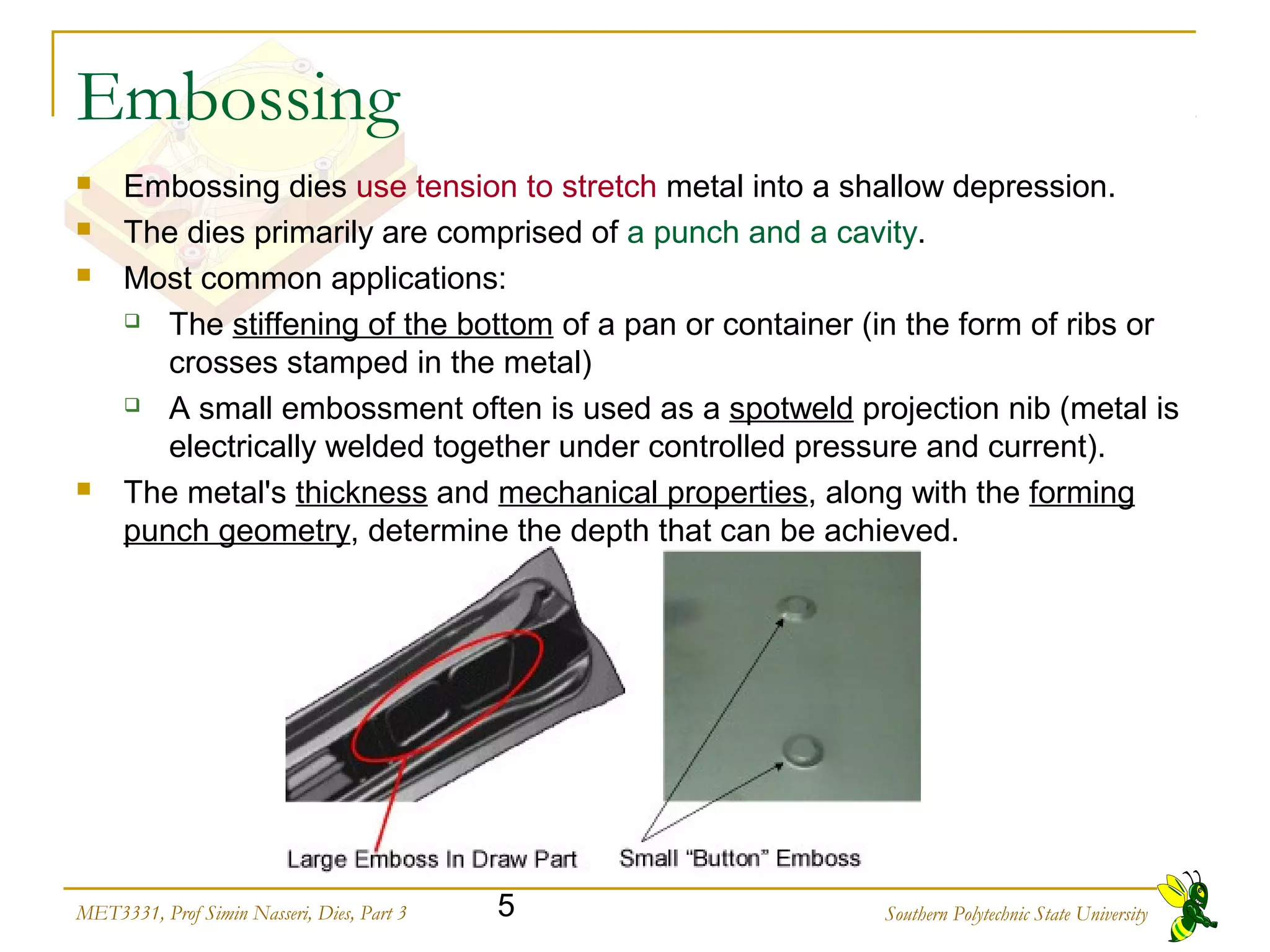
 Embossing dies use tension to stretch metal into a shallow depression.
 The dies primarily are comprised of a punch and a cavity.
 Most common applications:
 The stiffening of the bottom of a pan or container (in the form of ribs or
crosses stamped in the metal)
 A small embossment often is used as a spotweld projection nib (metal is
electrically welded together under controlled pressure and current).
 The metal's thickness and mechanical properties, along with the forming
punch geometry, determine the depth that can be achieved.
Southern Polytechnic State University6MET3331, Prof Simin Nasseri, Dies, Part 3
Flanging
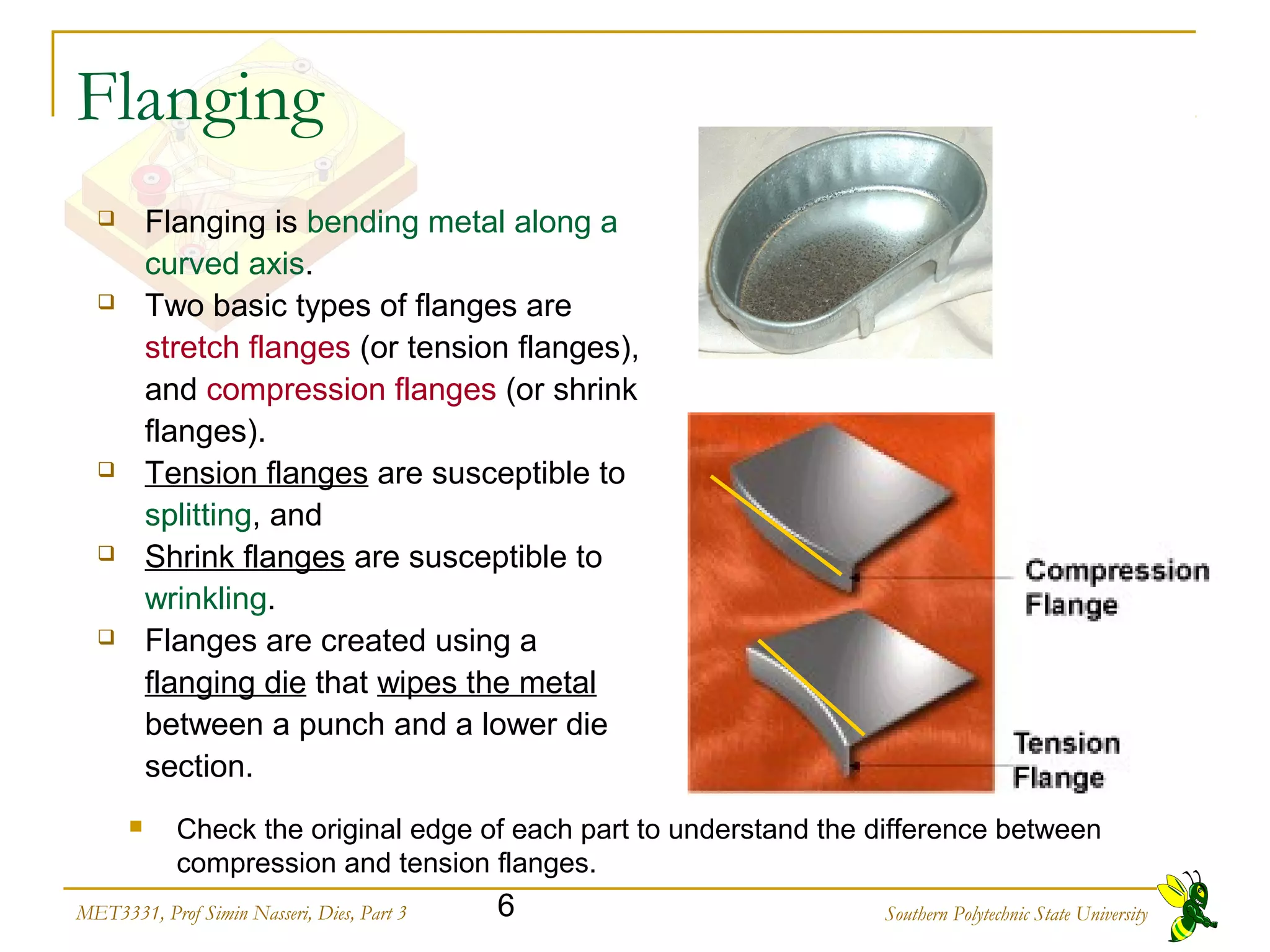
 Flanging is bending metal along a
curved axis.
 Two basic types of flanges are
stretch flanges (or tension flanges),
and compression flanges (or shrink
flanges).
 Tension flanges are susceptible to
splitting, and
 Shrink flanges are susceptible to
wrinkling.
 Flanges are created using a
flanging die that wipes the metal
between a punch and a lower die
section.
 Check the original edge of each part to understand the difference between
compression and tension flanges.
Southern Polytechnic State University7MET3331, Prof Simin Nasseri, Dies, Part 3
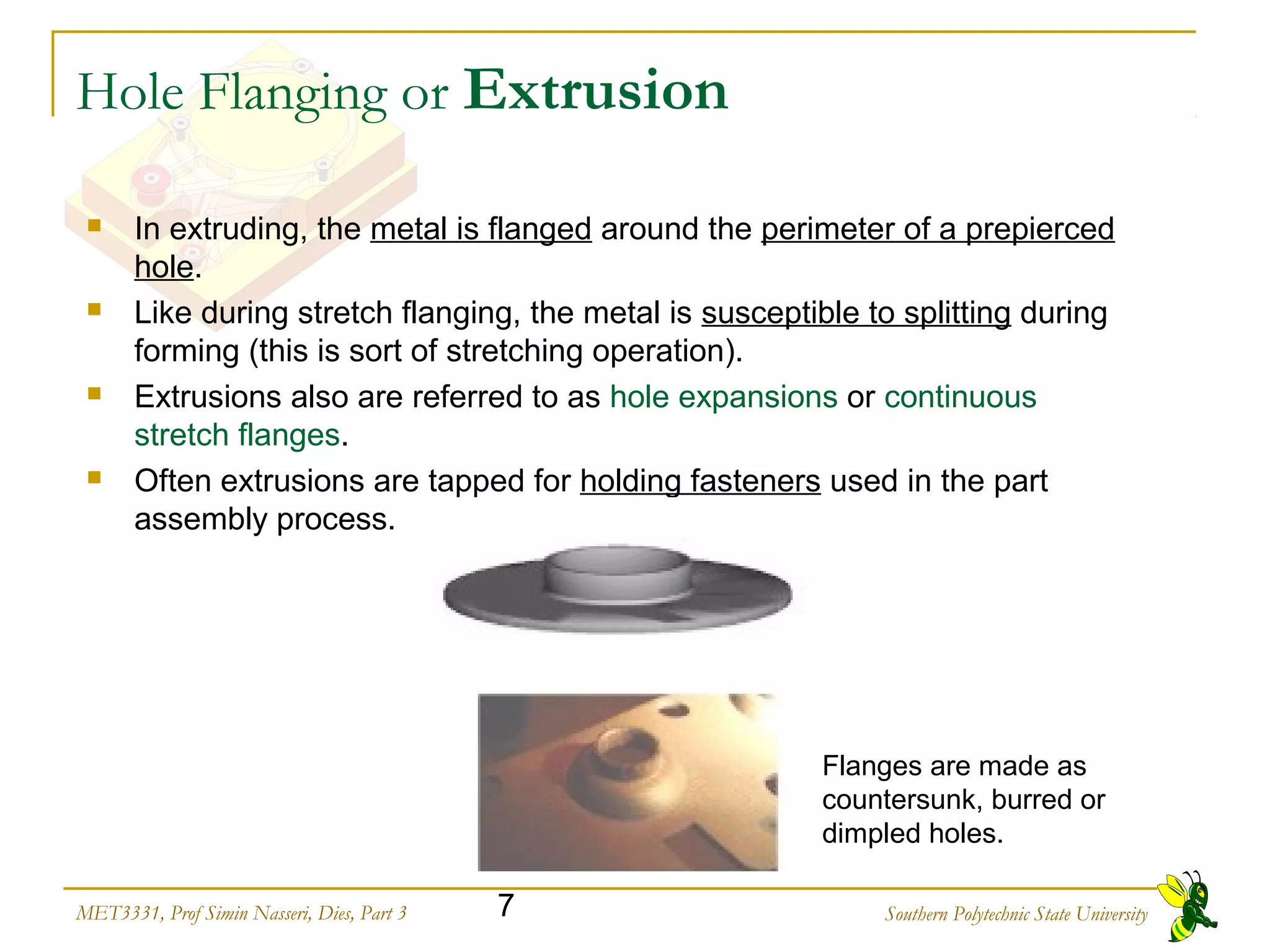
 Flanges are made as
countersunk, burred or
dimpled holes.
Hole Flanging or Extrusion
 In extruding, the metal is flanged around the perimeter of a prepierced
hole.
 Like during stretch flanging, the metal is susceptible to splitting during
forming (this is sort of stretching operation).
 Extrusions also are referred to as hole expansions or continuous
stretch flanges.
 Often extrusions are tapped for holding fasteners used in the part
assembly process.
Southern Polytechnic State University8MET3331, Prof Simin Nasseri, Dies, Part 3
Hole Flanging or Extrusion (Countersunk)
 For countersunk holes, it is necessary to coin the metal
around the upper face and beveled sides to set the
material.
 The holes are made about 0.005 in (0.13 mm) deeper
than the required height of the rivet or screw head
(allows the metal compression that occurs when
squeezing the rivet in place).
Southern Polytechnic State University9MET3331, Prof Simin Nasseri, Dies, Part 3
Beading & Curling
 The edges of the ductile metal are formed into a roll or curl.
 This is done to strengthen the part or to produce a better-
looking product.
 Curls are used in the manufacturing of hinges, pots, pans, and
other items (sometimes wires may be rolled inside for strength).
 Radius of the curl ≥ twice the metal thickness.
Metal to be curled
Spring pad
Curling punch
Spring pad
Southern Polytechnic State University10MET3331, Prof Simin Nasseri, Dies, Part 3
Ironing
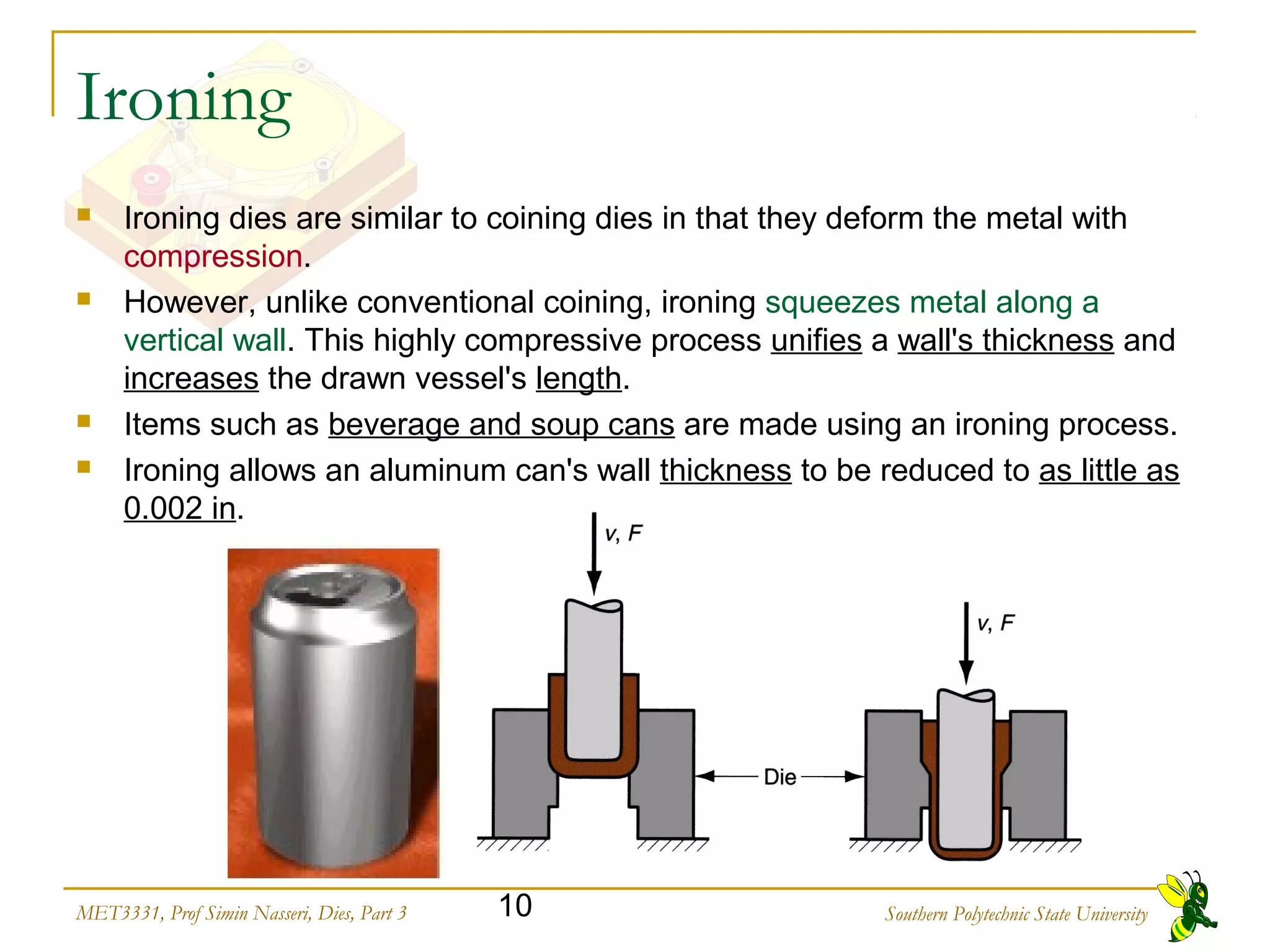
 Ironing dies are similar to coining dies in that they deform the metal with
compression.
 However, unlike conventional coining, ironing squeezes metal along a
vertical wall. This highly compressive process unifies a wall's thickness and
increases the drawn vessel's length.
 Items such as beverage and soup cans are made using an ironing process.
 Ironing allows an aluminum can's wall thickness to be reduced to as little as
0.002 in.
11
Drawing
Southern Polytechnic State University12MET3331, Prof Simin Nasseri, Dies, Part 3
Drawing
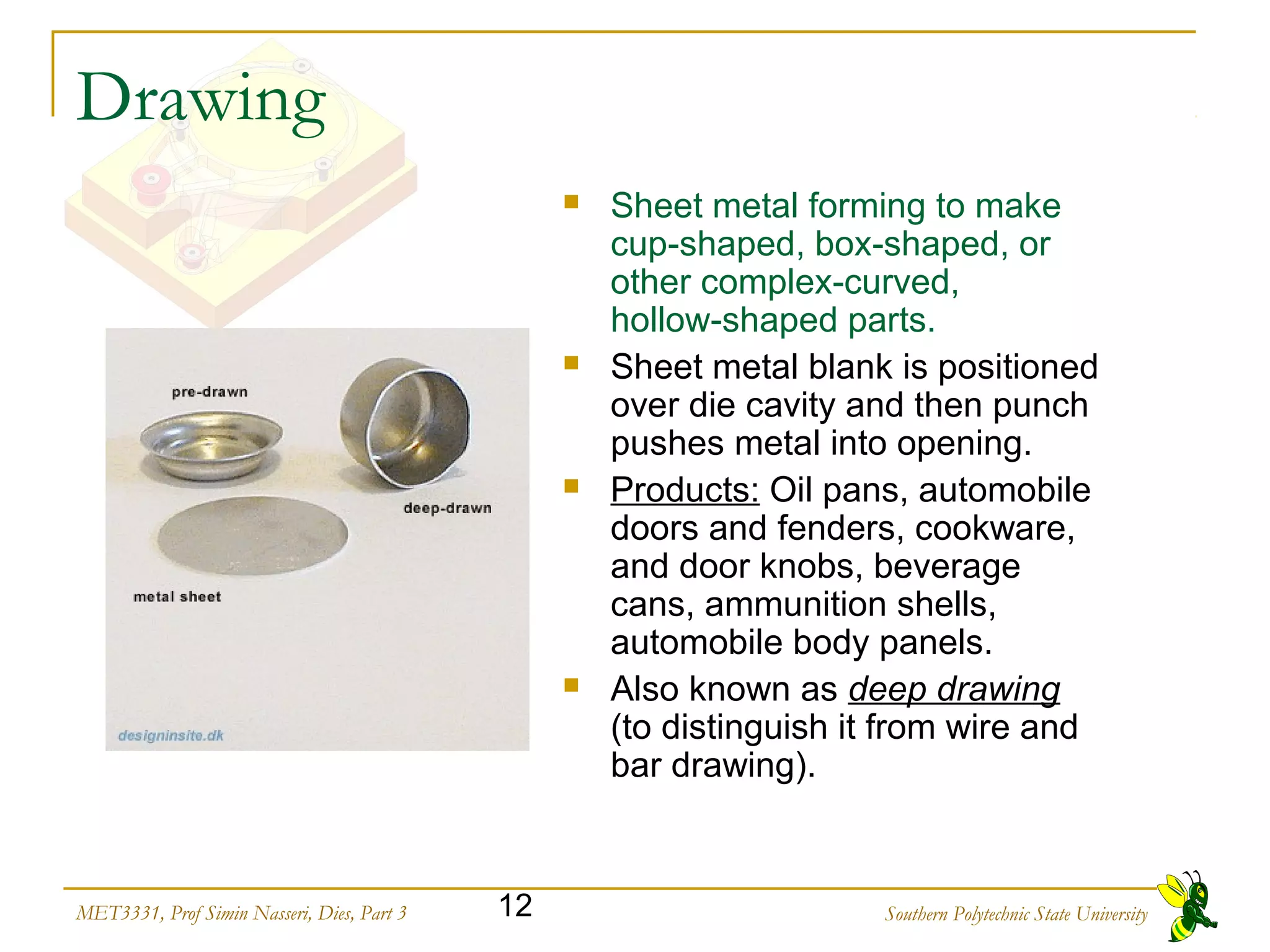
 Sheet metal forming to make
cup shaped, box shaped, or‑ ‑
other complex curved,‑
hollow shaped parts.‑
 Sheet metal blank is positioned
over die cavity and then punch
pushes metal into opening.
 Products: Oil pans, automobile
doors and fenders, cookware,
and door knobs, beverage
cans, ammunition shells,
automobile body panels.
 Also known as deep drawing
(to distinguish it from wire and
bar drawing).
Southern Polytechnic State University13MET3331, Prof Simin Nasseri, Dies, Part 3
Shapes other than Cylindrical Cups
 Square or rectangular boxes
(as in sinks),
 Stepped cups
 Cones
 Cups with spherical rather than
flat bases
 Irregular curved forms (as in
automobile body panels)
 Each of these shapes presents
its own unique technical
problems in drawing
Southern Polytechnic State University14MET3331, Prof Simin Nasseri, Dies, Part 3
(a) Drawing of cup shaped part: (1) before punch‑
contacts work, (2) near end of stroke; (b)
workpart: (1) starting blank, (2) drawn part.
Drawing
 Draw dies utilize a
special pressure-
loaded plate or ring
called a draw pad or
blankholder to control
the metal's flow into
the cavity.
 This plate prevents the
metal from wrinkling as
it flows into the cavity.
Increasing or
decreasing the
pressure exerted under
the pad also controls
how much metal feeds
into the die.
Southern Polytechnic State University15MET3331, Prof Simin Nasseri, Dies, Part 3
Drawing
 Although compression can occur when the metal is drawn,
drawing uses mostly tension to obtain the part geometry.
Southern Polytechnic State University16MET3331, Prof Simin Nasseri, Dies, Part 3
Clearance in Drawing
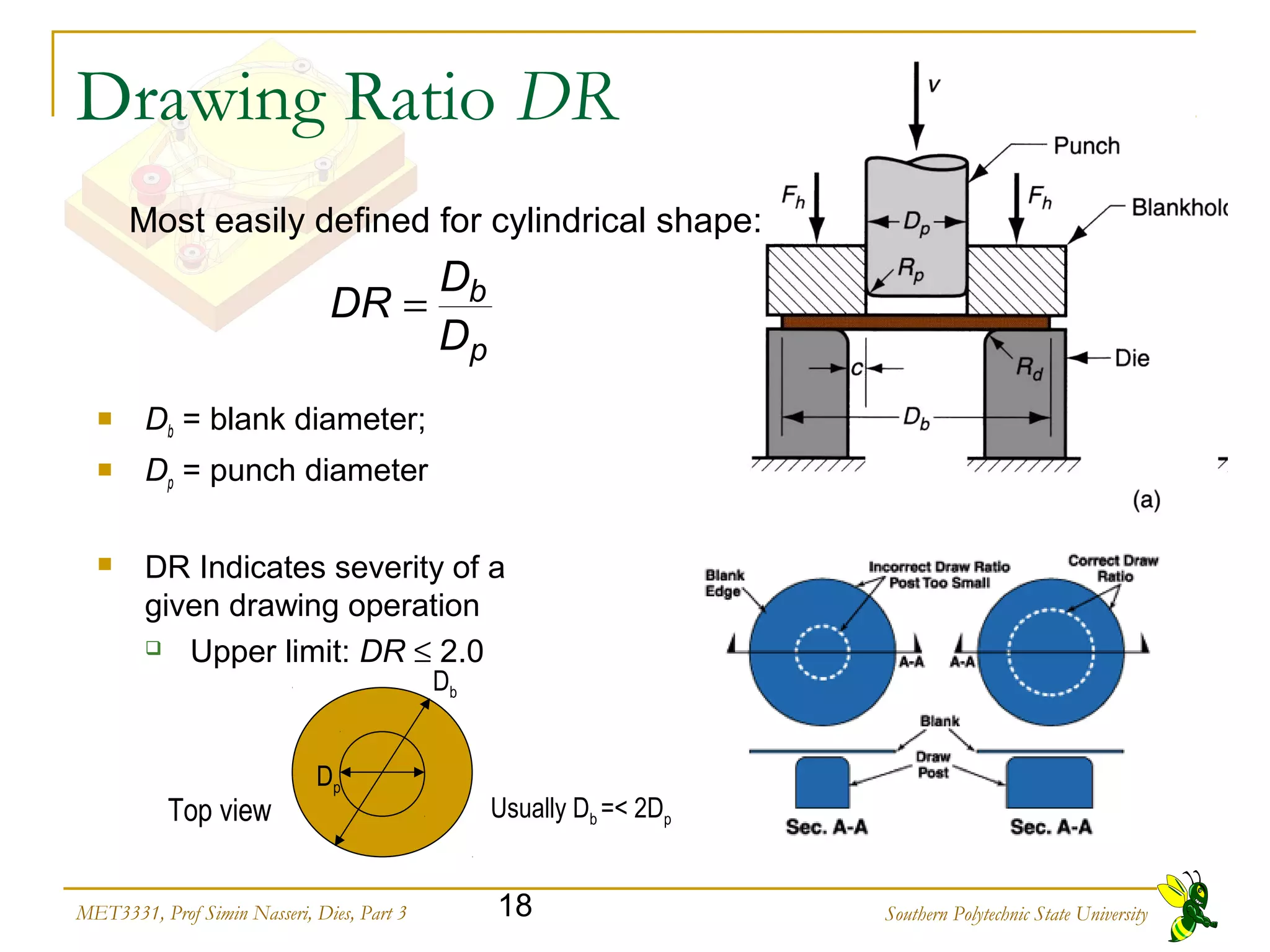
Sides of punch and die separated by a clearance c given by:
c = 1.1 t
where t = stock thickness
In other words,
clearance c is about
10% greater than
stock thickness
Southern Polytechnic State University17MET3331, Prof Simin Nasseri, Dies, Part 3
Tests of Drawing Feasibility
 Drawing ratio
 Reduction
 Thickness-to-diameter ratio
Successful deep draw progression
Southern Polytechnic State University18MET3331, Prof Simin Nasseri, Dies, Part 3
Drawing Ratio DR
 Db = blank diameter;
 Dp = punch diameter
 DR Indicates severity of a
given drawing operation
 Upper limit: DR ≤ 2.0
Most easily defined for cylindrical shape:
p
b
D
D
DR =
Db
Dp
Usually Db =< 2DpTop view
Southern Polytechnic State University19MET3331, Prof Simin Nasseri, Dies, Part 3
t/Db and Reduction r
Thickness to Diameter Ratio‑ ‑ = Thickness of
starting blank divided by blank diameter
 Desirable for t/Db ratio to be greater than 1%
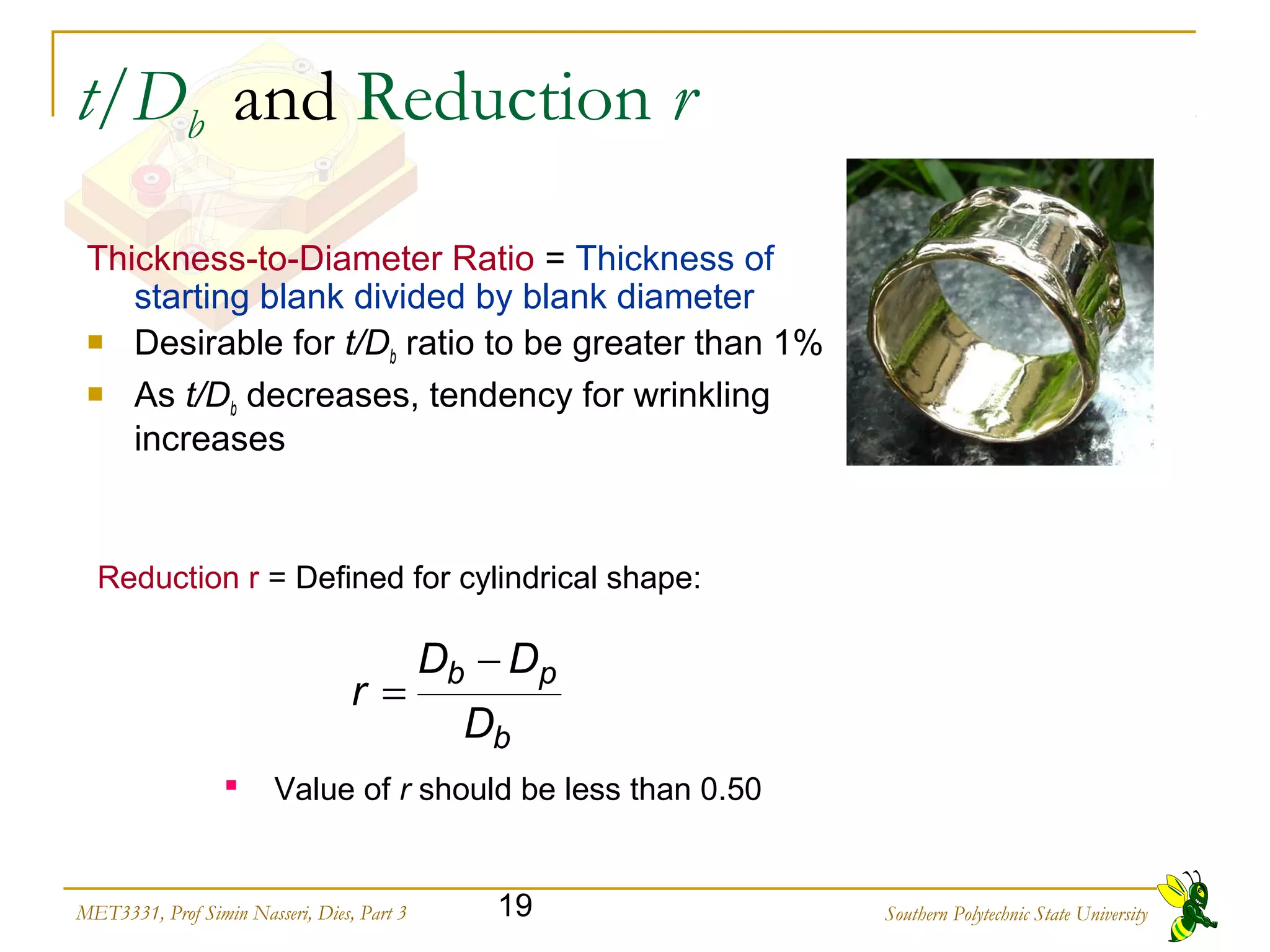
 As t/Db decreases, tendency for wrinkling
increases
Reduction r = Defined for cylindrical shape:
b
pb
D
DD
r
−
=
 Value of r should be less than 0.50
20
Cool Design!
Southern Polytechnic State University21MET3331, Prof Simin Nasseri, Dies, Part 3
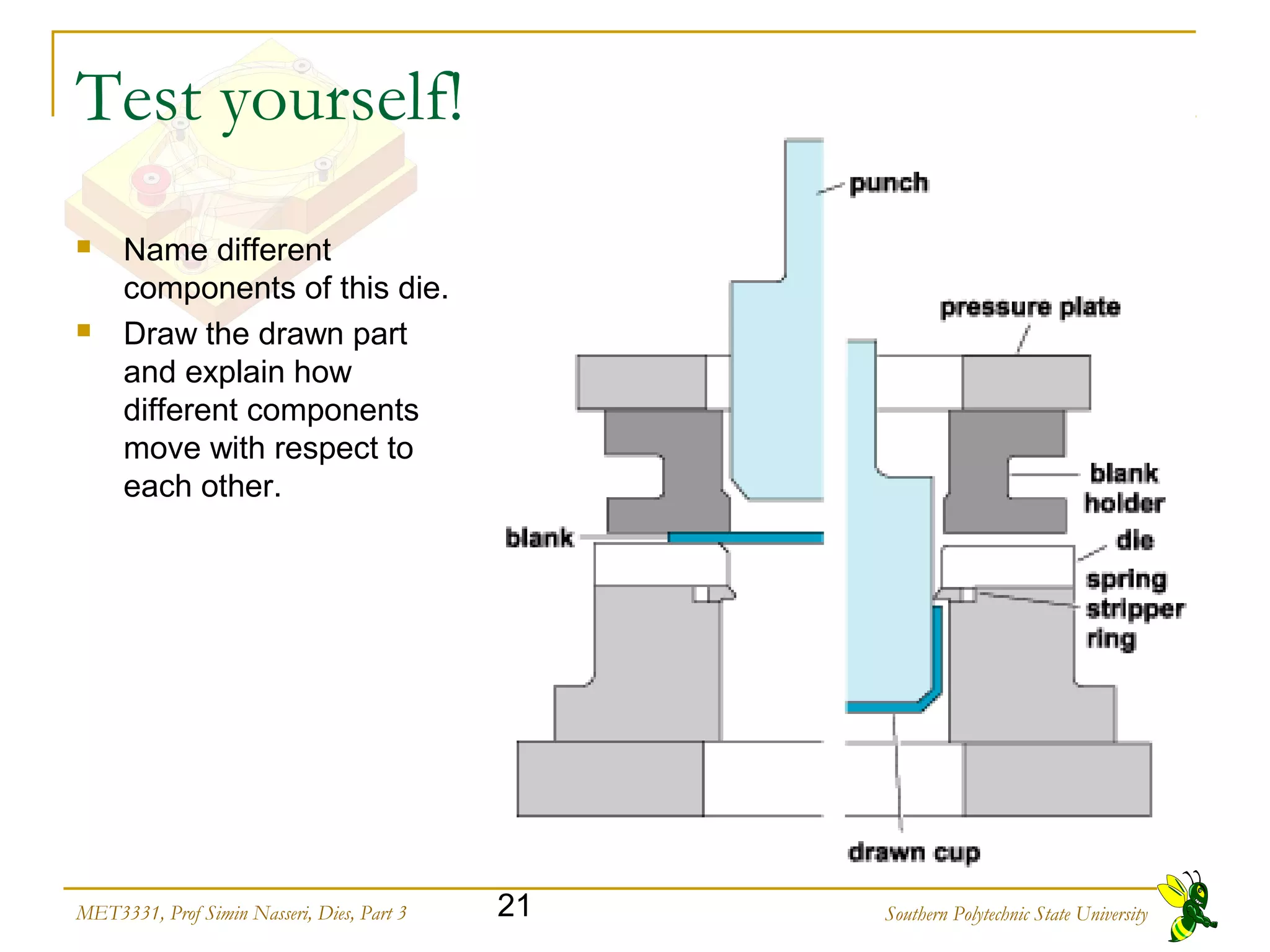
Test yourself!
 Name different
components of this die.
 Draw the drawn part
and explain how
different components
move with respect to
each other.
Southern Polytechnic State University22MET3331, Prof Simin Nasseri, Dies, Part 3
Test yourself!
 Draw the drawn part (the
final shape of the part)
and explain how different
components move with
respect to each other..
Southern Polytechnic State University23MET3331, Prof Simin Nasseri, Dies, Part 3
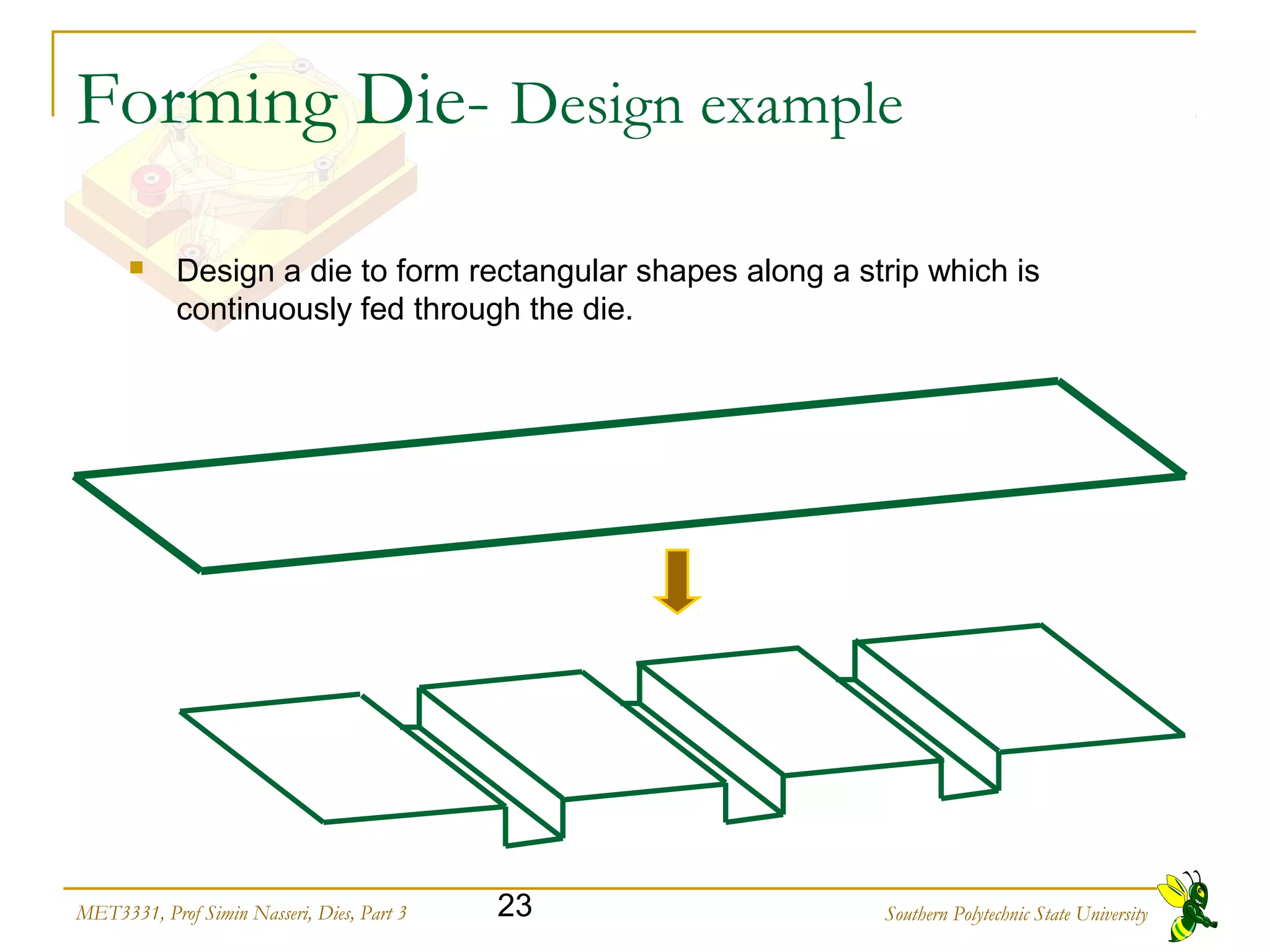
Forming Die- Design example
 Design a die to form rectangular shapes along a strip which is
continuously fed through the die.
Southern Polytechnic State University24MET3331, Prof Simin Nasseri, Dies, Part 3
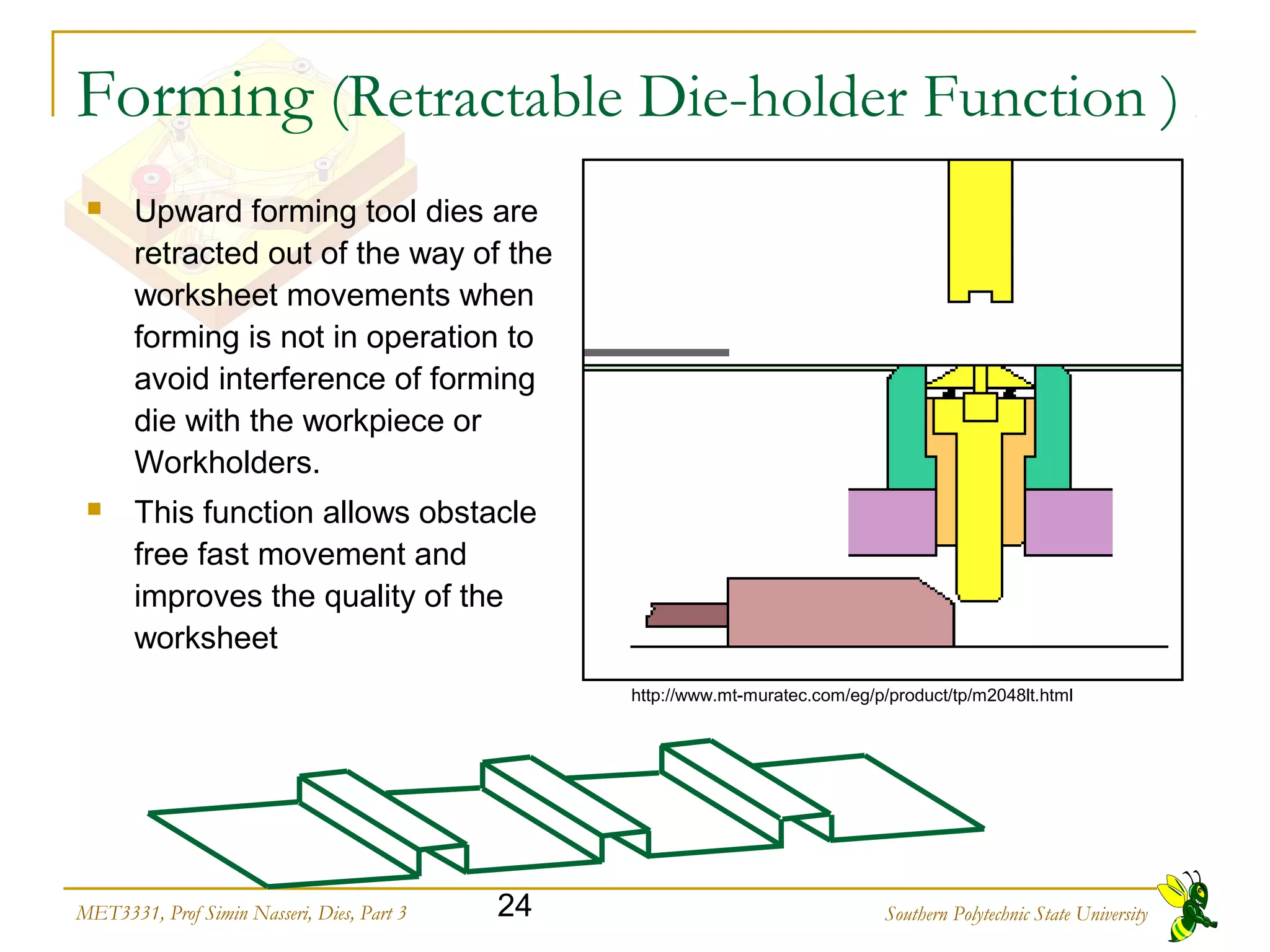
Forming (Retractable Die-holder Function )
 Upward forming tool dies are
retracted out of the way of the
worksheet movements when
forming is not in operation to
avoid interference of forming
die with the workpiece or
Workholders.
 This function allows obstacle
free fast movement and
improves the quality of the
worksheet
http://www.mt-muratec.com/eg/p/product/tp/m2048lt.html

Dies 3

  • 1.
    1 Die Design Part 3-Forming Operation J5811 - Tool Design (Based on notes of Prof Dr Simin Nasseri, Southern Polytechnic State University) Sources:  Handbook of Die Design, Suchy  The Ohio State University  Manufacturing Processes, Groover
  • 2.
    Southern Polytechnic StateUniversity2MET3331, Prof Simin Nasseri, Dies, Part 3 Forming  Similar to bending, but the blank is bent along a curved axis.  There is little stretching or compressing of the material.  All forming operations deform sheet material by exposing it to tension, compression, or both.  Most part defects, such as splits and wrinkles, occur in forming operations.  Successful sheet metal forming relies heavily on the metal's mechanical properties (the metal being formed must have the ability to stretch and compress within given limits). part Some design considerations:  Select the class of die,  Choose number of stampings required,  Cheapest and simplest tools may not be the best ones.
  • 3.
    Southern Polytechnic StateUniversity3MET3331, Prof Simin Nasseri, Dies, Part 3 Forming  Most common forming operations:  Bending (will be reviewed in detail)  Coining  Embossing  Flanging  Hole flanging or extrusion  Beading and curling  Ironing  Drawing Forming die
  • 4.
    Southern Polytechnic StateUniversity4MET3331, Prof Simin Nasseri, Dies, Part 3 Coining  Coining dies create the part's shape by squeezing the metal under extreme pressure (up to yield strength of material).  A simple round metal slug is placed into the die and forced to flow into a given shape by compressing it.  Coining also can reduce the metal thickness. Coins are created with the coining process. Advantages:  Capable of producing sharp, accurate bends with less sensitivity to material conditions. Disadvantages:  High force requirements (tonnage is 5 to 10 times that required for simple air bending)  Accelerated die wear (high forces increase machine deflection).
  • 5.
    Southern Polytechnic StateUniversity5MET3331, Prof Simin Nasseri, Dies, Part 3 Embossing  Embossing dies use tension to stretch metal into a shallow depression.  The dies primarily are comprised of a punch and a cavity.  Most common applications:  The stiffening of the bottom of a pan or container (in the form of ribs or crosses stamped in the metal)  A small embossment often is used as a spotweld projection nib (metal is electrically welded together under controlled pressure and current).  The metal's thickness and mechanical properties, along with the forming punch geometry, determine the depth that can be achieved.
  • 6.
    Southern Polytechnic StateUniversity6MET3331, Prof Simin Nasseri, Dies, Part 3 Flanging  Flanging is bending metal along a curved axis.  Two basic types of flanges are stretch flanges (or tension flanges), and compression flanges (or shrink flanges).  Tension flanges are susceptible to splitting, and  Shrink flanges are susceptible to wrinkling.  Flanges are created using a flanging die that wipes the metal between a punch and a lower die section.  Check the original edge of each part to understand the difference between compression and tension flanges.
  • 7.
    Southern Polytechnic StateUniversity7MET3331, Prof Simin Nasseri, Dies, Part 3  Flanges are made as countersunk, burred or dimpled holes. Hole Flanging or Extrusion  In extruding, the metal is flanged around the perimeter of a prepierced hole.  Like during stretch flanging, the metal is susceptible to splitting during forming (this is sort of stretching operation).  Extrusions also are referred to as hole expansions or continuous stretch flanges.  Often extrusions are tapped for holding fasteners used in the part assembly process.
  • 8.
    Southern Polytechnic StateUniversity8MET3331, Prof Simin Nasseri, Dies, Part 3 Hole Flanging or Extrusion (Countersunk)  For countersunk holes, it is necessary to coin the metal around the upper face and beveled sides to set the material.  The holes are made about 0.005 in (0.13 mm) deeper than the required height of the rivet or screw head (allows the metal compression that occurs when squeezing the rivet in place).
  • 9.
    Southern Polytechnic StateUniversity9MET3331, Prof Simin Nasseri, Dies, Part 3 Beading & Curling  The edges of the ductile metal are formed into a roll or curl.  This is done to strengthen the part or to produce a better- looking product.  Curls are used in the manufacturing of hinges, pots, pans, and other items (sometimes wires may be rolled inside for strength).  Radius of the curl ≥ twice the metal thickness. Metal to be curled Spring pad Curling punch Spring pad
  • 10.
    Southern Polytechnic StateUniversity10MET3331, Prof Simin Nasseri, Dies, Part 3 Ironing  Ironing dies are similar to coining dies in that they deform the metal with compression.  However, unlike conventional coining, ironing squeezes metal along a vertical wall. This highly compressive process unifies a wall's thickness and increases the drawn vessel's length.  Items such as beverage and soup cans are made using an ironing process.  Ironing allows an aluminum can's wall thickness to be reduced to as little as 0.002 in.
  • 11.
  • 12.
    Southern Polytechnic StateUniversity12MET3331, Prof Simin Nasseri, Dies, Part 3 Drawing  Sheet metal forming to make cup shaped, box shaped, or‑ ‑ other complex curved,‑ hollow shaped parts.‑  Sheet metal blank is positioned over die cavity and then punch pushes metal into opening.  Products: Oil pans, automobile doors and fenders, cookware, and door knobs, beverage cans, ammunition shells, automobile body panels.  Also known as deep drawing (to distinguish it from wire and bar drawing).
  • 13.
    Southern Polytechnic StateUniversity13MET3331, Prof Simin Nasseri, Dies, Part 3 Shapes other than Cylindrical Cups  Square or rectangular boxes (as in sinks),  Stepped cups  Cones  Cups with spherical rather than flat bases  Irregular curved forms (as in automobile body panels)  Each of these shapes presents its own unique technical problems in drawing
  • 14.
    Southern Polytechnic StateUniversity14MET3331, Prof Simin Nasseri, Dies, Part 3 (a) Drawing of cup shaped part: (1) before punch‑ contacts work, (2) near end of stroke; (b) workpart: (1) starting blank, (2) drawn part. Drawing  Draw dies utilize a special pressure- loaded plate or ring called a draw pad or blankholder to control the metal's flow into the cavity.  This plate prevents the metal from wrinkling as it flows into the cavity. Increasing or decreasing the pressure exerted under the pad also controls how much metal feeds into the die.
  • 15.
    Southern Polytechnic StateUniversity15MET3331, Prof Simin Nasseri, Dies, Part 3 Drawing  Although compression can occur when the metal is drawn, drawing uses mostly tension to obtain the part geometry.
  • 16.
    Southern Polytechnic StateUniversity16MET3331, Prof Simin Nasseri, Dies, Part 3 Clearance in Drawing Sides of punch and die separated by a clearance c given by: c = 1.1 t where t = stock thickness In other words, clearance c is about 10% greater than stock thickness
  • 17.
    Southern Polytechnic StateUniversity17MET3331, Prof Simin Nasseri, Dies, Part 3 Tests of Drawing Feasibility  Drawing ratio  Reduction  Thickness-to-diameter ratio Successful deep draw progression
  • 18.
    Southern Polytechnic StateUniversity18MET3331, Prof Simin Nasseri, Dies, Part 3 Drawing Ratio DR  Db = blank diameter;  Dp = punch diameter  DR Indicates severity of a given drawing operation  Upper limit: DR ≤ 2.0 Most easily defined for cylindrical shape: p b D D DR = Db Dp Usually Db =< 2DpTop view
  • 19.
    Southern Polytechnic StateUniversity19MET3331, Prof Simin Nasseri, Dies, Part 3 t/Db and Reduction r Thickness to Diameter Ratio‑ ‑ = Thickness of starting blank divided by blank diameter  Desirable for t/Db ratio to be greater than 1%  As t/Db decreases, tendency for wrinkling increases Reduction r = Defined for cylindrical shape: b pb D DD r − =  Value of r should be less than 0.50
  • 20.
  • 21.
    Southern Polytechnic StateUniversity21MET3331, Prof Simin Nasseri, Dies, Part 3 Test yourself!  Name different components of this die.  Draw the drawn part and explain how different components move with respect to each other.
  • 22.
    Southern Polytechnic StateUniversity22MET3331, Prof Simin Nasseri, Dies, Part 3 Test yourself!  Draw the drawn part (the final shape of the part) and explain how different components move with respect to each other..
  • 23.
    Southern Polytechnic StateUniversity23MET3331, Prof Simin Nasseri, Dies, Part 3 Forming Die- Design example  Design a die to form rectangular shapes along a strip which is continuously fed through the die.
  • 24.
    Southern Polytechnic StateUniversity24MET3331, Prof Simin Nasseri, Dies, Part 3 Forming (Retractable Die-holder Function )  Upward forming tool dies are retracted out of the way of the worksheet movements when forming is not in operation to avoid interference of forming die with the workpiece or Workholders.  This function allows obstacle free fast movement and improves the quality of the worksheet http://www.mt-muratec.com/eg/p/product/tp/m2048lt.html