DiarrheoaDiarrheoa
Haseeb Ahmed BhattiIHaseeb Ahmed BhattiI
 Second leading causes of all deathSecond leading causes of all death
worldwideworldwide
 Most common cause of morbidity andMost common cause of morbidity and
mortality in children worldwidemortality in children worldwide
 Accounts for 9% of hospitalizations inAccounts for 9% of hospitalizations in
children <5 years old in the United Stateschildren <5 years old in the United States
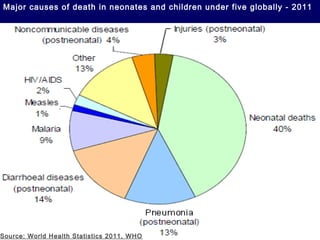
Source: World Health Statistics 2011, WHO
Major causes of death in neonates and children under five globally - 2011
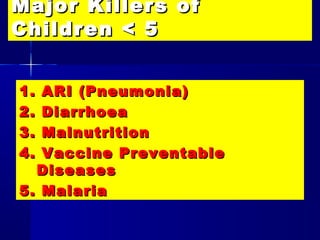
Major Killers ofMajor Killers of
Children < 5Children < 5
1. ARI (Pneumonia)1. ARI (Pneumonia)
2. Diarrhoea2. Diarrhoea
3. Malnutrition3. Malnutrition
4. Vaccine Preventable4. Vaccine Preventable
DiseasesDiseases
5. Malaria5. Malaria
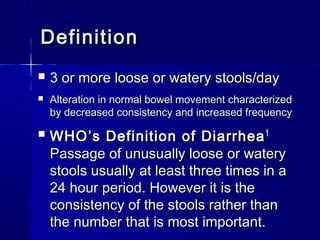
DefinitionDefinition
 3 or more loose or watery stools/day3 or more loose or watery stools/day
 Alteration in normal bowel movement characterizedAlteration in normal bowel movement characterized
by decreased consistency and increased frequencyby decreased consistency and increased frequency
 WHO’s Definition of DiarrheaWHO’s Definition of Diarrhea1
Passage of unusually loose or wateryPassage of unusually loose or watery
stools usually at least three times in astools usually at least three times in a
24 hour period. However it is the24 hour period. However it is the
consistency of the stools rather thanconsistency of the stools rather than
the number that is most important. the number that is most important. 
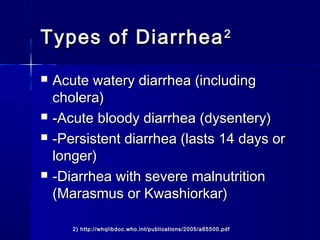
Types of DiarrheaTypes of Diarrhea22
 Acute watery diarrhea (includingAcute watery diarrhea (including
cholera)cholera)
 -Acute bloody diarrhea (dysentery)-Acute bloody diarrhea (dysentery)
 -Persistent diarrhea (lasts 14 days or-Persistent diarrhea (lasts 14 days or
longer)longer)
 -Diarrhea with severe malnutrition-Diarrhea with severe malnutrition
(Marasmus or Kwashiorkar)(Marasmus or Kwashiorkar)
2) http://whqlibdoc.who.int/publications/2005/a85500.pdf
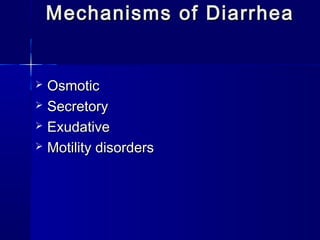
Mechanisms of DiarrheaMechanisms of Diarrhea
 OsmoticOsmotic
 SecretorySecretory
 ExudativeExudative
 Motility disordersMotility disorders
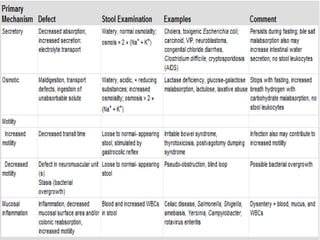
Mechanisms of DiarrheaMechanisms of Diarrhea
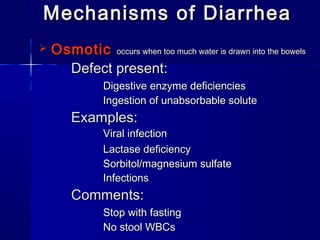
 OsmoticOsmotic occurs when too much water is drawn into the bowelsoccurs when too much water is drawn into the bowels
Defect present:Defect present:
Digestive enzyme deficienciesDigestive enzyme deficiencies
Ingestion of unabsorbable soluteIngestion of unabsorbable solute
Examples:Examples:
Viral infectionViral infection
Lactase deficiencyLactase deficiency
Sorbitol/magnesium sulfateSorbitol/magnesium sulfate
InfectionsInfections
Comments:Comments:
Stop with fastingStop with fasting
No stool WBCsNo stool WBCs
Mechanisms of DiarrheaMechanisms of Diarrhea
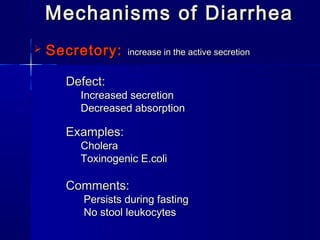
 Secretory:Secretory: increase in the active secretionincrease in the active secretion
Defect:Defect:
Increased secretionIncreased secretion
Decreased absorptionDecreased absorption
Examples:Examples:
CholeraCholera
Toxinogenic E.coliToxinogenic E.coli
Comments:Comments:
Persists during fastingPersists during fasting
No stool leukocytesNo stool leukocytes
Mechanisms of DiarrheaMechanisms of Diarrhea
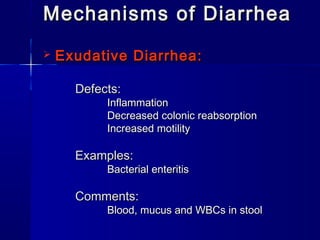
 Exudative Diarrhea:Exudative Diarrhea:
Defects:Defects:
InflammationInflammation
Decreased colonic reabsorptionDecreased colonic reabsorption
Increased motilityIncreased motility
Examples:Examples:
Bacterial enteritisBacterial enteritis
Comments:Comments:
Blood, mucus and WBCs in stoolBlood, mucus and WBCs in stool
Mechanisms of DiarrheaMechanisms of Diarrhea
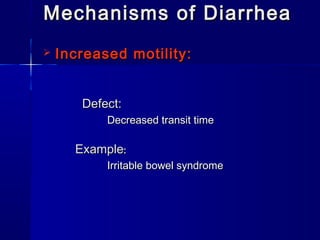
 Increased motility:Increased motility:
Defect:Defect:
Decreased transit timeDecreased transit time
ExampleExample::
Irritable bowel syndromeIrritable bowel syndrome
EpidemiologyEpidemiology3-53-5
 1.2-1.9 episodes per person annually1.2-1.9 episodes per person annually
in the general populationin the general population44
 National survey shows every child inNational survey shows every child in
Pakistan has average 5 episodes /Pakistan has average 5 episodes /
yearyear33
 200,000 children < 5 years died200,000 children < 5 years died
/ year/ year
 Seasonal peak in the winterSeasonal peak in the winter
EtiologyEtiology
 ViralViral: 70-80% of infectious diarrhea in: 70-80% of infectious diarrhea in
developed countriesdeveloped countries
 BacterialBacterial: 10-20% of infectious: 10-20% of infectious
diarrhea but responsible for mostdiarrhea but responsible for most
cases of severe diarrheacases of severe diarrhea
 ProtozoanProtozoan: less than 10%: less than 10%
Viral DiarrheaViral Diarrhea
 Rotavirus (57%)Rotavirus (57%)
 Norovirus (Norwalk-like)Norovirus (Norwalk-like)
 Enteric AdenovirusEnteric Adenovirus
 AstrovirusAstrovirus
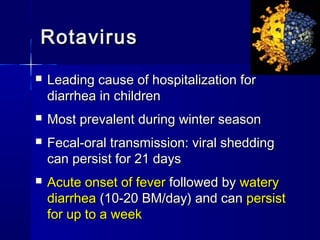
RotavirusRotavirus
 Leading cause of hospitalization forLeading cause of hospitalization for
diarrhea in childrendiarrhea in children
 Most prevalent during winter seasonMost prevalent during winter season
 Fecal-oral transmission: viral sheddingFecal-oral transmission: viral shedding
can persist for 21 dayscan persist for 21 days
 Acute onset of feverAcute onset of fever followed byfollowed by waterywatery
diarrheadiarrhea (10-20 BM/day) and can(10-20 BM/day) and can persistpersist
for up to a weekfor up to a week
NorovirusNorovirus
 Most common cause of diarrhealMost common cause of diarrheal
outbreaks/epidemicsoutbreaks/epidemics
 Fecal-oral transmissionFecal-oral transmission
 Acute onset of nausea and vomiting,Acute onset of nausea and vomiting,
watery diarrheawatery diarrhea withwith abdominalabdominal
crampscramps and can persist for 1-3 daysand can persist for 1-3 days
Enteric AdenovirusEnteric Adenovirus
 Primarily affects children < 4 years oldPrimarily affects children < 4 years old
 Fecal-oral transmissionFecal-oral transmission
 Clinical picture similar to rotavirusClinical picture similar to rotavirus
((fever and watery diarrheafever and watery diarrhea))
AstrovirusAstrovirus
 Primarily affects children < 4 years oldPrimarily affects children < 4 years old
and immunocompromisedand immunocompromised
 Seasonal peak in the winterSeasonal peak in the winter
 Fecal-oral transmission: viral sheddingFecal-oral transmission: viral shedding
can occur for several weekscan occur for several weeks
 Fever, nausea and vomiting, abdominalFever, nausea and vomiting, abdominal
painpain, and, and diarrheadiarrhea lasting up to a weeklasting up to a week
Summary of ViralSummary of Viral
DiarrheaDiarrhea
 Most likely causeMost likely cause of infectious diarrheaof infectious diarrhea
 Rotavirus and Norovirus are mostRotavirus and Norovirus are most
commoncommon
 Symptoms usually includeSymptoms usually include low gradelow grade
fever, nausea and vomiting, abdominalfever, nausea and vomiting, abdominal
cramps, and watery diarrheacramps, and watery diarrhea lasting up tolasting up to
1 week1 week
Bacterial DiarrheaBacterial Diarrhea
 Campylobacter (17.6%)Campylobacter (17.6%)
 Salmonella (30%)Salmonella (30%)
 ShigellaShigella
 Enterohemorrhagic Escherichia coliEnterohemorrhagic Escherichia coli
(27%)(27%)
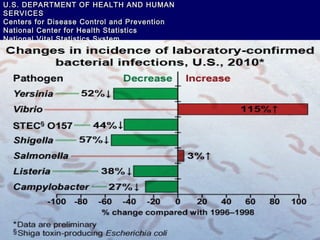
U.S. DEPARTMENT OF HEALTH AND HUMANU.S. DEPARTMENT OF HEALTH AND HUMAN
SERVICESSERVICES
Centers for Disease Control and PreventionCenters for Disease Control and Prevention
National Center for Health StatisticsNational Center for Health Statistics
National Vital Statistics SystemNational Vital Statistics System
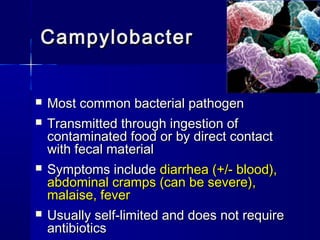
CampylobacterCampylobacter
 Most common bacterial pathogenMost common bacterial pathogen
 Transmitted through ingestion ofTransmitted through ingestion of
contaminated food or by direct contactcontaminated food or by direct contact
with fecal materialwith fecal material
 Symptoms includeSymptoms include diarrhea (+/- blood),diarrhea (+/- blood),
abdominal cramps (can be severe),abdominal cramps (can be severe),
malaise, fevermalaise, fever
 Usually self-limited and does not requireUsually self-limited and does not require
antibioticsantibiotics
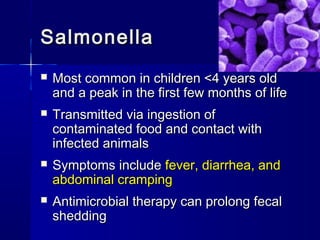
SalmonellaSalmonella
 Most common in children <4 years oldMost common in children <4 years old
and a peak in the first few months of lifeand a peak in the first few months of life
 Transmitted via ingestion ofTransmitted via ingestion of
contaminated food and contact withcontaminated food and contact with
infected animalsinfected animals
 Symptoms includeSymptoms include fever, diarrhea, andfever, diarrhea, and
abdominal crampingabdominal cramping
 Antimicrobial therapy can prolong fecalAntimicrobial therapy can prolong fecal
sheddingshedding
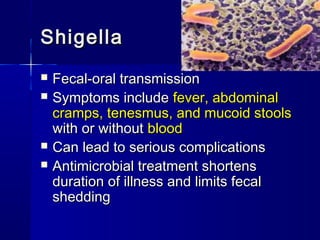
ShigellaShigella
 Fecal-oral transmissionFecal-oral transmission
 Symptoms includeSymptoms include fever, abdominalfever, abdominal
cramps, tenesmus, and mucoid stoolscramps, tenesmus, and mucoid stools
with or withoutwith or without bloodblood
 Can lead to serious complicationsCan lead to serious complications
 Antimicrobial treatment shortensAntimicrobial treatment shortens
duration of illness and limits fecalduration of illness and limits fecal
sheddingshedding
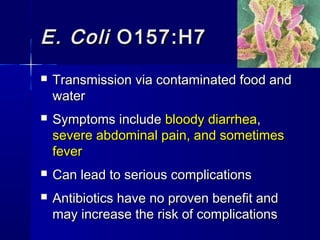
E. ColiE. Coli O157:H7O157:H7
 Transmission via contaminated food andTransmission via contaminated food and
waterwater
 Symptoms includeSymptoms include bloody diarrheabloody diarrhea,,
severe abdominal pain, and sometimessevere abdominal pain, and sometimes
feverfever
 Can lead to serious complicationsCan lead to serious complications
 Antibiotics have no proven benefit andAntibiotics have no proven benefit and
may increase the risk of complicationsmay increase the risk of complications
Summary of BacterialSummary of Bacterial
DiarrheaDiarrhea
 Can affect all age groupsCan affect all age groups
 Fecal-oral transmission, often throughFecal-oral transmission, often through
contaminated foodcontaminated food
 Typical symptoms include bloodyTypical symptoms include bloody
diarrhea, severe cramping, and malaisediarrhea, severe cramping, and malaise
 Antibiotic treatment not always necessaryAntibiotic treatment not always necessary
PARASITESPARASITES
 Giardia Lambia.Giardia Lambia.
 Entamoeba Histolitica.Entamoeba Histolitica.
FUNGIFUNGI
Candida AlbicansCandida Albicans
DIETARY FACTORSDIETARY FACTORS
Over Feeding.Over Feeding.
Starvation.Starvation.
Food Poisoning.Food Poisoning.
Food IntoleranceFood Intolerance
DRUGSDRUGS
AntibioticsAntibiotics
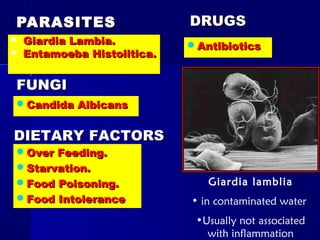
Giardia lamblia
• in contaminated water
•Usually not associated
with inflammation
• Food Poisoning
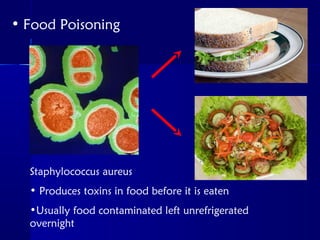
Staphylococcus aureus
• Produces toxins in food before it is eaten
•Usually food contaminated left unrefrigerated
overnight
• Food Poisoning
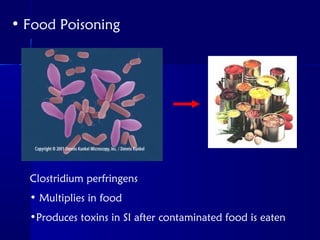
Clostridium perfringens
• Multiplies in food
•Produces toxins in SI after contaminated food is eaten
Complications ofComplications of
DiarrheaDiarrhea
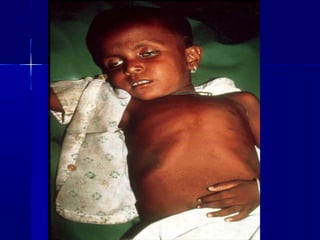
 DehydrationDehydration
 Metabolic AcidosisMetabolic Acidosis
 Gastrointestinal complicationsGastrointestinal complications
 Nutritional complications(electrolytes,Nutritional complications(electrolytes,
micro & macro nutrients)micro & macro nutrients)
Complications ofComplications of
DiarrheaDiarrhea
Metabolic AcidosisMetabolic Acidosis
 Reduced serum bicarbonateReduced serum bicarbonate
 Reduced arterial PHReduced arterial PH
 Compensating respiratory alkalosisCompensating respiratory alkalosis
Complications ofComplications of
DiarrheaDiarrhea
Gastrointestinal complicationsGastrointestinal complications
 Secondary carbohydrateSecondary carbohydrate
malabsorptionmalabsorption
 Protein intoleranceProtein intolerance
 Persistent diarrheaPersistent diarrhea
History and PhysicalHistory and Physical
ExamExam
 3 main goals3 main goals
– Estimate the level of dehydrationEstimate the level of dehydration
– Identify likely causes on the basis ofIdentify likely causes on the basis of
history and clinical findingshistory and clinical findings
– Determine if additional studies and/orDetermine if additional studies and/or
medications are necessarymedications are necessary
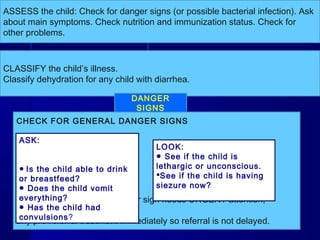
CHECK FOR GENERAL DANGER SIGNS
A child with any general danger sign needs URGENT attention;
complete the assessment and
any pre-referral treatment immediately so referral is not delayed.
ASK:
● Is the child able to drink
or breastfeed?
● Does the child vomit
everything?
● Has the child had
convulsions?
LOOK:
● See if the child is
lethargic or unconscious.
See if the child is having
siezure now?
ASSESS the child: Check for danger signs (or possible bacterial infection). Ask
about main symptoms. Check nutrition and immunization status. Check for
other problems.
CLASSIFY the child’s illness.
Classify dehydration for any child with diarrhea.
DANGER
SIGNS
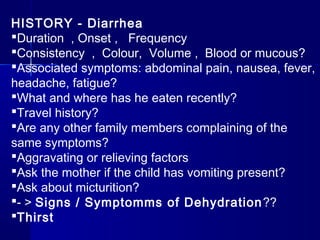
HISTORY - Diarrhea
Duration , Onset , Frequency
Consistency , Colour, Volume , Blood or mucous?
Associated symptoms: abdominal pain, nausea, fever,
headache, fatigue?
What and where has he eaten recently?
Travel history?
Are any other family members complaining of the
same symptoms?
Aggravating or relieving factors
Ask the mother if the child has vomiting present?
Ask about micturition?
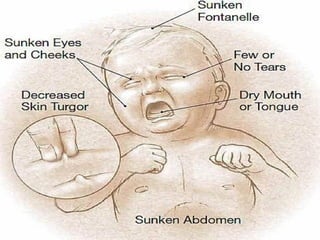
- > Signs / Symptomms of Dehydration??
Thirst
Physical ExamPhysical Exam
 VITALSVITALS
 Anthropometric MeseauresAnthropometric Meseaures
 GPE (+Signs of dehydration)GPE (+Signs of dehydration)
 Abdomen ExamAbdomen Exam
 Systemic ExamSystemic Exam
CONT. in Assessment
Laboratory EvaluationLaboratory Evaluation
 Unnecessary for patients who presentUnnecessary for patients who present
within 1 day from onset of diarrheawithin 1 day from onset of diarrhea
 Warning signs/symptoms: bloodyWarning signs/symptoms: bloody
diarrhea, high fever, severe abd pain,diarrhea, high fever, severe abd pain,
dehydration, or comorbid conditiondehydration, or comorbid condition
 Fecal leukocytes followed by bacterialFecal leukocytes followed by bacterial
culture, ova & parasites, viral antigensculture, ova & parasites, viral antigens
 CBC, chemistriesCBC, chemistries
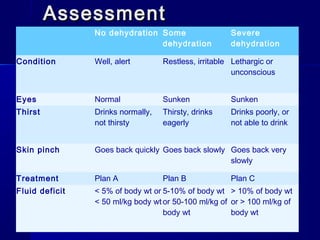
AssessmentAssessment
  No dehydration Some
dehydration
Severe
dehydration
Condition Well, alert Restless, irritable Lethargic or
unconscious
Eyes Normal Sunken Sunken
Thirst Drinks normally,
not thirsty
Thirsty, drinks
eagerly
Drinks poorly, or
not able to drink
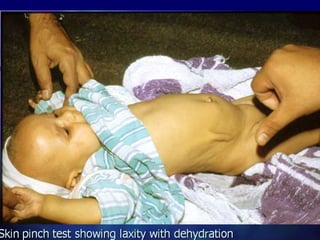
Skin pinch Goes back quickly Goes back slowly Goes back very
slowly
Treatment Plan A Plan B Plan C
Fluid deficit < 5% of body wt or
< 50 ml/kg body wt
5-10% of body wt
or 50-100 ml/kg of
body wt
> 10% of body wt
or > 100 ml/kg of
body wt
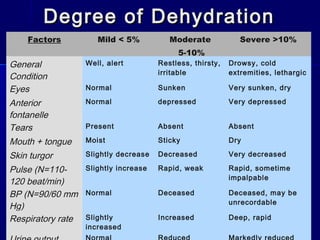
Degree of DehydrationDegree of Dehydration
Factors Mild < 5% Moderate
5-10%
Severe >10%
General
Condition
Well, alert Restless, thirsty,
irritable
Drowsy, cold
extremities, lethargic
Eyes Normal Sunken Very sunken, dry
Anterior
fontanelle
Normal depressed Very depressed
Tears Present Absent Absent
Mouth + tongue Moist Sticky Dry
Skin turgor Slightly decrease Decreased Very decreased
Pulse (N=110-
120 beat/min)
Slightly increase Rapid, weak Rapid, sometime
impalpable
BP (N=90/60 mm
Hg)
Normal Deceased Deceased, may be
unrecordable
Respiratory rate Slightly
increased
Increased Deep, rapid
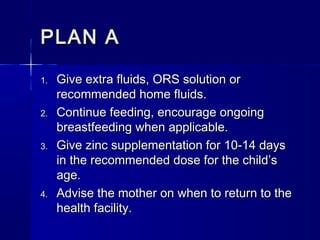
PLAN APLAN A
1.1. Give extra fluids, ORS solution orGive extra fluids, ORS solution or
recommended home fluids.recommended home fluids.
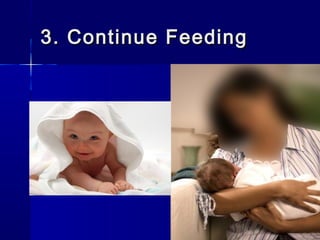
2.2. Continue feeding, encourage ongoingContinue feeding, encourage ongoing
breastfeeding when applicable.breastfeeding when applicable.
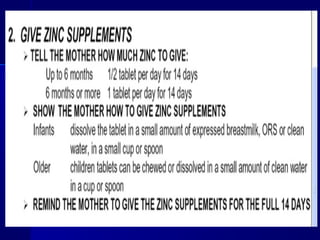
3.3. Give zinc supplementation for 10-14 daysGive zinc supplementation for 10-14 days
in the recommended dose for the child’sin the recommended dose for the child’s
age.age.
4.4. Advise the mother on when to return to theAdvise the mother on when to return to the
health facility.health facility.
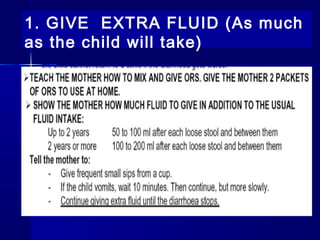
1. GIVE EXTRA FLUID (As much
as the child will take)
3. Continue Feeding3. Continue Feeding
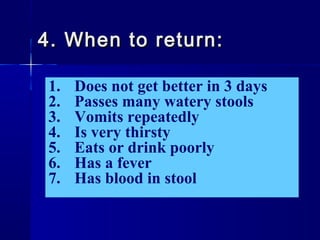
1. Does not get better in 3 days
2. Passes many watery stools
3. Vomits repeatedly
4. Is very thirsty
5. Eats or drink poorly
6. Has a fever
7. Has blood in stool
4. When to return:4. When to return:
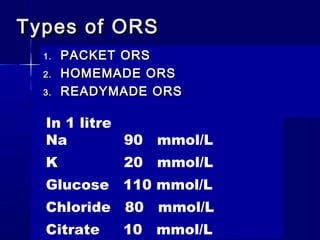
Types of ORSTypes of ORS
1.1. PACKET ORSPACKET ORS
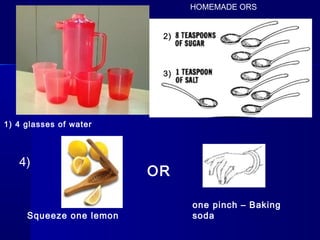
2.2. HOMEMADE ORSHOMEMADE ORS
3.3. READYMADE ORSREADYMADE ORS
In 1 litre
Na 90 mmol/L
K 20 mmol/L
Glucose 110 mmol/L
Chloride 80 mmol/L
Citrate 10 mmol/L
OR
Squeeze one lemon
one pinch – Baking
soda
1) 4 glasses of water
HOMEMADE ORS
2)
3)
4)
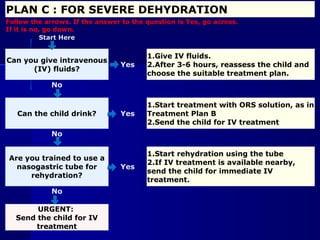
PLAN C : FOR SEVERE DEHYDRATION
Follow the arrows. If the answer to the question is Yes, go across.
If it is no, go down.
Start Here
 
Can you give intravenous
(IV) fluids?
Yes
1.Give IV fluids.
2.After 3-6 hours, reassess the child and
choose the suitable treatment plan.
No
Can the child drink? Yes
1.Start treatment with ORS solution, as in
Treatment Plan B
2.Send the child for IV treatment
No
Are you trained to use a
nasogastric tube for
rehydration?
Yes
1.Start rehydration using the tube
2.If IV treatment is available nearby,
send the child for immediate IV
treatment.
No
URGENT:
Send the child for IV
treatment
USE OF DRUGS FOR CHILDREN WITHUSE OF DRUGS FOR CHILDREN WITH
DIARRHOEADIARRHOEA
• ANTIBIOTICS: Dysentery and suspected choleraANTIBIOTICS: Dysentery and suspected cholera
• ANTIPARASTIC:ANTIPARASTIC:
AMOEBIASIS:AMOEBIASIS: After antibiotic Rx of bloodyAfter antibiotic Rx of bloody
diarrhoea for Shigella has failed ORdiarrhoea for Shigella has failed OR
Tropozoites of E. histolytica seen in stool.Tropozoites of E. histolytica seen in stool.
GIARDIASIS:GIARDIASIS: when diarrhoea has lasted atleastwhen diarrhoea has lasted atleast
14 days and cyst or trophozoites of Giardia14 days and cyst or trophozoites of Giardia
are see in stool.are see in stool.
• ANTIDIARRHOEAL DRUGS and ANTIEMETICS: notANTIDIARRHOEAL DRUGS and ANTIEMETICS: not
used. None has proven practical value even some areused. None has proven practical value even some are
dangerousdangerous
PREVENTIOPREVENTIO
NN
1. Giving breast milk for the first 6 months1. Giving breast milk for the first 6 months
and continuing to breast-feed atleast oneand continuing to breast-feed atleast one
year.year.
2. Weaning Start at 6 months of age.2. Weaning Start at 6 months of age.
3. Giving freshly prepared food & clean3. Giving freshly prepared food & clean
drinking water.drinking water.
4. Giving milk & other fluids by cup & spoon4. Giving milk & other fluids by cup & spoon
instead of bottle feeding.instead of bottle feeding.
5. All family members wash hands
after
passing stool and before preparing
or
eating food.
6. All family members use a latrine.
7. Proper disposal of young child’s
stools.
8. Child immunized against measles
as
soon after 9 months of age as
PREVENTIOPREVENTIO
NN
In SummaryIn Summary
 ExtremelyExtremely commoncommon
 Most isMost is viralviral in origin and self-limitedin origin and self-limited
 AA good H&Pgood H&P is crucialis crucial
 Warning signs includeWarning signs include high fever, severehigh fever, severe
abd. pain, dehydration, and bloody stoolabd. pain, dehydration, and bloody stool
 Fluid replacementFluid replacement is most importantis most important
 Antibiotics are usuallyAntibiotics are usually notnot necessarynecessary
ReferencesReferences
 http://www.pediatriconcall.com/fordoctor/diarrhehttp://www.pediatriconcall.com/fordoctor/diarrhe
 http://whqlibdoc.who.int/publications/2005/a8550http://whqlibdoc.who.int/publications/2005/a8550
The MOST Project, 1820 N. Fort Myer Drive, Suite 600 Arlington, VA 22209 USA,Telephone: (703)The MOST Project, 1820 N. Fort Myer Drive, Suite 600 Arlington, VA 22209 USA,Telephone: (703)
807-0236, Fax: (703) 807-0278, Web site:807-0236, Fax: (703) 807-0278, Web site: http://www.mostproject.orghttp://www.mostproject.org, E-mail: most@istiinc.com, E-mail: most@istiinc.com
 David S, Lobo ML. Childhood diarrhea andDavid S, Lobo ML. Childhood diarrhea and
malnutrition in Pakistan, Part I: Incidencemalnutrition in Pakistan, Part I: Incidence
and prevalence. J Pediatr Nurs. 1995and prevalence. J Pediatr Nurs. 1995
Apr;10(2):131-7. PubMed PMID: 7752042.Apr;10(2):131-7. PubMed PMID: 7752042.
 Dennehy P.H., Acute Diarrheal Disease in Children:Dennehy P.H., Acute Diarrheal Disease in Children:
Epidemiology, Prevention, and Treatment.Epidemiology, Prevention, and Treatment. Infect DisInfect Dis
Clin North AClin North A 2005;(19) 3:2005;(19) 3:
 Thielman N.M., (2004) Acute Infectious Diarrhea.Thielman N.M., (2004) Acute Infectious Diarrhea. N EnglN Engl
J MedJ Med 2004;350:38-47.2004;350:38-47.
 Burkhart D.M., Management of Acute Gastroenteritis inBurkhart D.M., Management of Acute Gastroenteritis in
Children.Children. Am Fam PhysicianAm Fam Physician. 1999 Dec;60(9):2555-63. 1999 Dec;60(9):2555-63
Diarrhea

Diarrhea

  • 1.
  • 2.
     Second leadingcauses of all deathSecond leading causes of all death worldwideworldwide  Most common cause of morbidity andMost common cause of morbidity and mortality in children worldwidemortality in children worldwide  Accounts for 9% of hospitalizations inAccounts for 9% of hospitalizations in children <5 years old in the United Stateschildren <5 years old in the United States
  • 3.
    Source: World HealthStatistics 2011, WHO Major causes of death in neonates and children under five globally - 2011
  • 4.
    Major Killers ofMajorKillers of Children < 5Children < 5 1. ARI (Pneumonia)1. ARI (Pneumonia) 2. Diarrhoea2. Diarrhoea 3. Malnutrition3. Malnutrition 4. Vaccine Preventable4. Vaccine Preventable DiseasesDiseases 5. Malaria5. Malaria
  • 5.
    DefinitionDefinition  3 ormore loose or watery stools/day3 or more loose or watery stools/day  Alteration in normal bowel movement characterizedAlteration in normal bowel movement characterized by decreased consistency and increased frequencyby decreased consistency and increased frequency  WHO’s Definition of DiarrheaWHO’s Definition of Diarrhea1 Passage of unusually loose or wateryPassage of unusually loose or watery stools usually at least three times in astools usually at least three times in a 24 hour period. However it is the24 hour period. However it is the consistency of the stools rather thanconsistency of the stools rather than the number that is most important. the number that is most important. 
  • 6.
    Types of DiarrheaTypesof Diarrhea22  Acute watery diarrhea (includingAcute watery diarrhea (including cholera)cholera)  -Acute bloody diarrhea (dysentery)-Acute bloody diarrhea (dysentery)  -Persistent diarrhea (lasts 14 days or-Persistent diarrhea (lasts 14 days or longer)longer)  -Diarrhea with severe malnutrition-Diarrhea with severe malnutrition (Marasmus or Kwashiorkar)(Marasmus or Kwashiorkar) 2) http://whqlibdoc.who.int/publications/2005/a85500.pdf
  • 7.
    Mechanisms of DiarrheaMechanismsof Diarrhea  OsmoticOsmotic  SecretorySecretory  ExudativeExudative  Motility disordersMotility disorders
  • 9.
    Mechanisms of DiarrheaMechanismsof Diarrhea  OsmoticOsmotic occurs when too much water is drawn into the bowelsoccurs when too much water is drawn into the bowels Defect present:Defect present: Digestive enzyme deficienciesDigestive enzyme deficiencies Ingestion of unabsorbable soluteIngestion of unabsorbable solute Examples:Examples: Viral infectionViral infection Lactase deficiencyLactase deficiency Sorbitol/magnesium sulfateSorbitol/magnesium sulfate InfectionsInfections Comments:Comments: Stop with fastingStop with fasting No stool WBCsNo stool WBCs
  • 10.
    Mechanisms of DiarrheaMechanismsof Diarrhea  Secretory:Secretory: increase in the active secretionincrease in the active secretion Defect:Defect: Increased secretionIncreased secretion Decreased absorptionDecreased absorption Examples:Examples: CholeraCholera Toxinogenic E.coliToxinogenic E.coli Comments:Comments: Persists during fastingPersists during fasting No stool leukocytesNo stool leukocytes
  • 11.
    Mechanisms of DiarrheaMechanismsof Diarrhea  Exudative Diarrhea:Exudative Diarrhea: Defects:Defects: InflammationInflammation Decreased colonic reabsorptionDecreased colonic reabsorption Increased motilityIncreased motility Examples:Examples: Bacterial enteritisBacterial enteritis Comments:Comments: Blood, mucus and WBCs in stoolBlood, mucus and WBCs in stool
  • 12.
    Mechanisms of DiarrheaMechanismsof Diarrhea  Increased motility:Increased motility: Defect:Defect: Decreased transit timeDecreased transit time ExampleExample:: Irritable bowel syndromeIrritable bowel syndrome
  • 13.
    EpidemiologyEpidemiology3-53-5  1.2-1.9 episodesper person annually1.2-1.9 episodes per person annually in the general populationin the general population44  National survey shows every child inNational survey shows every child in Pakistan has average 5 episodes /Pakistan has average 5 episodes / yearyear33  200,000 children < 5 years died200,000 children < 5 years died / year/ year  Seasonal peak in the winterSeasonal peak in the winter
  • 14.
    EtiologyEtiology  ViralViral: 70-80%of infectious diarrhea in: 70-80% of infectious diarrhea in developed countriesdeveloped countries  BacterialBacterial: 10-20% of infectious: 10-20% of infectious diarrhea but responsible for mostdiarrhea but responsible for most cases of severe diarrheacases of severe diarrhea  ProtozoanProtozoan: less than 10%: less than 10%
  • 15.
    Viral DiarrheaViral Diarrhea Rotavirus (57%)Rotavirus (57%)  Norovirus (Norwalk-like)Norovirus (Norwalk-like)  Enteric AdenovirusEnteric Adenovirus  AstrovirusAstrovirus
  • 16.
    RotavirusRotavirus  Leading causeof hospitalization forLeading cause of hospitalization for diarrhea in childrendiarrhea in children  Most prevalent during winter seasonMost prevalent during winter season  Fecal-oral transmission: viral sheddingFecal-oral transmission: viral shedding can persist for 21 dayscan persist for 21 days  Acute onset of feverAcute onset of fever followed byfollowed by waterywatery diarrheadiarrhea (10-20 BM/day) and can(10-20 BM/day) and can persistpersist for up to a weekfor up to a week
  • 17.
    NorovirusNorovirus  Most commoncause of diarrhealMost common cause of diarrheal outbreaks/epidemicsoutbreaks/epidemics  Fecal-oral transmissionFecal-oral transmission  Acute onset of nausea and vomiting,Acute onset of nausea and vomiting, watery diarrheawatery diarrhea withwith abdominalabdominal crampscramps and can persist for 1-3 daysand can persist for 1-3 days
  • 18.
    Enteric AdenovirusEnteric Adenovirus Primarily affects children < 4 years oldPrimarily affects children < 4 years old  Fecal-oral transmissionFecal-oral transmission  Clinical picture similar to rotavirusClinical picture similar to rotavirus ((fever and watery diarrheafever and watery diarrhea))
  • 19.
    AstrovirusAstrovirus  Primarily affectschildren < 4 years oldPrimarily affects children < 4 years old and immunocompromisedand immunocompromised  Seasonal peak in the winterSeasonal peak in the winter  Fecal-oral transmission: viral sheddingFecal-oral transmission: viral shedding can occur for several weekscan occur for several weeks  Fever, nausea and vomiting, abdominalFever, nausea and vomiting, abdominal painpain, and, and diarrheadiarrhea lasting up to a weeklasting up to a week
  • 20.
    Summary of ViralSummaryof Viral DiarrheaDiarrhea  Most likely causeMost likely cause of infectious diarrheaof infectious diarrhea  Rotavirus and Norovirus are mostRotavirus and Norovirus are most commoncommon  Symptoms usually includeSymptoms usually include low gradelow grade fever, nausea and vomiting, abdominalfever, nausea and vomiting, abdominal cramps, and watery diarrheacramps, and watery diarrhea lasting up tolasting up to 1 week1 week
  • 21.
    Bacterial DiarrheaBacterial Diarrhea Campylobacter (17.6%)Campylobacter (17.6%)  Salmonella (30%)Salmonella (30%)  ShigellaShigella  Enterohemorrhagic Escherichia coliEnterohemorrhagic Escherichia coli (27%)(27%)
  • 22.
    U.S. DEPARTMENT OFHEALTH AND HUMANU.S. DEPARTMENT OF HEALTH AND HUMAN SERVICESSERVICES Centers for Disease Control and PreventionCenters for Disease Control and Prevention National Center for Health StatisticsNational Center for Health Statistics National Vital Statistics SystemNational Vital Statistics System
  • 23.
    CampylobacterCampylobacter  Most commonbacterial pathogenMost common bacterial pathogen  Transmitted through ingestion ofTransmitted through ingestion of contaminated food or by direct contactcontaminated food or by direct contact with fecal materialwith fecal material  Symptoms includeSymptoms include diarrhea (+/- blood),diarrhea (+/- blood), abdominal cramps (can be severe),abdominal cramps (can be severe), malaise, fevermalaise, fever  Usually self-limited and does not requireUsually self-limited and does not require antibioticsantibiotics
  • 24.
    SalmonellaSalmonella  Most commonin children <4 years oldMost common in children <4 years old and a peak in the first few months of lifeand a peak in the first few months of life  Transmitted via ingestion ofTransmitted via ingestion of contaminated food and contact withcontaminated food and contact with infected animalsinfected animals  Symptoms includeSymptoms include fever, diarrhea, andfever, diarrhea, and abdominal crampingabdominal cramping  Antimicrobial therapy can prolong fecalAntimicrobial therapy can prolong fecal sheddingshedding
  • 25.
    ShigellaShigella  Fecal-oral transmissionFecal-oraltransmission  Symptoms includeSymptoms include fever, abdominalfever, abdominal cramps, tenesmus, and mucoid stoolscramps, tenesmus, and mucoid stools with or withoutwith or without bloodblood  Can lead to serious complicationsCan lead to serious complications  Antimicrobial treatment shortensAntimicrobial treatment shortens duration of illness and limits fecalduration of illness and limits fecal sheddingshedding
  • 26.
    E. ColiE. ColiO157:H7O157:H7  Transmission via contaminated food andTransmission via contaminated food and waterwater  Symptoms includeSymptoms include bloody diarrheabloody diarrhea,, severe abdominal pain, and sometimessevere abdominal pain, and sometimes feverfever  Can lead to serious complicationsCan lead to serious complications  Antibiotics have no proven benefit andAntibiotics have no proven benefit and may increase the risk of complicationsmay increase the risk of complications
  • 27.
    Summary of BacterialSummaryof Bacterial DiarrheaDiarrhea  Can affect all age groupsCan affect all age groups  Fecal-oral transmission, often throughFecal-oral transmission, often through contaminated foodcontaminated food  Typical symptoms include bloodyTypical symptoms include bloody diarrhea, severe cramping, and malaisediarrhea, severe cramping, and malaise  Antibiotic treatment not always necessaryAntibiotic treatment not always necessary
  • 28.
    PARASITESPARASITES  Giardia Lambia.GiardiaLambia.  Entamoeba Histolitica.Entamoeba Histolitica. FUNGIFUNGI Candida AlbicansCandida Albicans DIETARY FACTORSDIETARY FACTORS Over Feeding.Over Feeding. Starvation.Starvation. Food Poisoning.Food Poisoning. Food IntoleranceFood Intolerance DRUGSDRUGS AntibioticsAntibiotics Giardia lamblia • in contaminated water •Usually not associated with inflammation
  • 29.
    • Food Poisoning Staphylococcusaureus • Produces toxins in food before it is eaten •Usually food contaminated left unrefrigerated overnight
  • 30.
    • Food Poisoning Clostridiumperfringens • Multiplies in food •Produces toxins in SI after contaminated food is eaten
  • 31.
    Complications ofComplications of DiarrheaDiarrhea DehydrationDehydration  Metabolic AcidosisMetabolic Acidosis  Gastrointestinal complicationsGastrointestinal complications  Nutritional complications(electrolytes,Nutritional complications(electrolytes, micro & macro nutrients)micro & macro nutrients)
  • 32.
    Complications ofComplications of DiarrheaDiarrhea MetabolicAcidosisMetabolic Acidosis  Reduced serum bicarbonateReduced serum bicarbonate  Reduced arterial PHReduced arterial PH  Compensating respiratory alkalosisCompensating respiratory alkalosis
  • 33.
    Complications ofComplications of DiarrheaDiarrhea GastrointestinalcomplicationsGastrointestinal complications  Secondary carbohydrateSecondary carbohydrate malabsorptionmalabsorption  Protein intoleranceProtein intolerance  Persistent diarrheaPersistent diarrhea
  • 35.
    History and PhysicalHistoryand Physical ExamExam  3 main goals3 main goals – Estimate the level of dehydrationEstimate the level of dehydration – Identify likely causes on the basis ofIdentify likely causes on the basis of history and clinical findingshistory and clinical findings – Determine if additional studies and/orDetermine if additional studies and/or medications are necessarymedications are necessary
  • 36.
    CHECK FOR GENERALDANGER SIGNS A child with any general danger sign needs URGENT attention; complete the assessment and any pre-referral treatment immediately so referral is not delayed. ASK: ● Is the child able to drink or breastfeed? ● Does the child vomit everything? ● Has the child had convulsions? LOOK: ● See if the child is lethargic or unconscious. See if the child is having siezure now? ASSESS the child: Check for danger signs (or possible bacterial infection). Ask about main symptoms. Check nutrition and immunization status. Check for other problems. CLASSIFY the child’s illness. Classify dehydration for any child with diarrhea. DANGER SIGNS
  • 37.
    HISTORY - Diarrhea Duration, Onset , Frequency Consistency , Colour, Volume , Blood or mucous? Associated symptoms: abdominal pain, nausea, fever, headache, fatigue? What and where has he eaten recently? Travel history? Are any other family members complaining of the same symptoms? Aggravating or relieving factors Ask the mother if the child has vomiting present? Ask about micturition? - > Signs / Symptomms of Dehydration?? Thirst
  • 38.
    Physical ExamPhysical Exam VITALSVITALS  Anthropometric MeseauresAnthropometric Meseaures  GPE (+Signs of dehydration)GPE (+Signs of dehydration)  Abdomen ExamAbdomen Exam  Systemic ExamSystemic Exam CONT. in Assessment
  • 39.
    Laboratory EvaluationLaboratory Evaluation Unnecessary for patients who presentUnnecessary for patients who present within 1 day from onset of diarrheawithin 1 day from onset of diarrhea  Warning signs/symptoms: bloodyWarning signs/symptoms: bloody diarrhea, high fever, severe abd pain,diarrhea, high fever, severe abd pain, dehydration, or comorbid conditiondehydration, or comorbid condition  Fecal leukocytes followed by bacterialFecal leukocytes followed by bacterial culture, ova & parasites, viral antigensculture, ova & parasites, viral antigens  CBC, chemistriesCBC, chemistries
  • 40.
    AssessmentAssessment   No dehydrationSome dehydration Severe dehydration Condition Well, alert Restless, irritable Lethargic or unconscious Eyes Normal Sunken Sunken Thirst Drinks normally, not thirsty Thirsty, drinks eagerly Drinks poorly, or not able to drink Skin pinch Goes back quickly Goes back slowly Goes back very slowly Treatment Plan A Plan B Plan C Fluid deficit < 5% of body wt or < 50 ml/kg body wt 5-10% of body wt or 50-100 ml/kg of body wt > 10% of body wt or > 100 ml/kg of body wt
  • 41.
    Degree of DehydrationDegreeof Dehydration Factors Mild < 5% Moderate 5-10% Severe >10% General Condition Well, alert Restless, thirsty, irritable Drowsy, cold extremities, lethargic Eyes Normal Sunken Very sunken, dry Anterior fontanelle Normal depressed Very depressed Tears Present Absent Absent Mouth + tongue Moist Sticky Dry Skin turgor Slightly decrease Decreased Very decreased Pulse (N=110- 120 beat/min) Slightly increase Rapid, weak Rapid, sometime impalpable BP (N=90/60 mm Hg) Normal Deceased Deceased, may be unrecordable Respiratory rate Slightly increased Increased Deep, rapid
  • 43.
    PLAN APLAN A 1.1.Give extra fluids, ORS solution orGive extra fluids, ORS solution or recommended home fluids.recommended home fluids. 2.2. Continue feeding, encourage ongoingContinue feeding, encourage ongoing breastfeeding when applicable.breastfeeding when applicable. 3.3. Give zinc supplementation for 10-14 daysGive zinc supplementation for 10-14 days in the recommended dose for the child’sin the recommended dose for the child’s age.age. 4.4. Advise the mother on when to return to theAdvise the mother on when to return to the health facility.health facility.
  • 44.
    1. GIVE EXTRAFLUID (As much as the child will take)
  • 46.
    3. Continue Feeding3.Continue Feeding
  • 47.
    1. Does notget better in 3 days 2. Passes many watery stools 3. Vomits repeatedly 4. Is very thirsty 5. Eats or drink poorly 6. Has a fever 7. Has blood in stool 4. When to return:4. When to return:
  • 50.
    Types of ORSTypesof ORS 1.1. PACKET ORSPACKET ORS 2.2. HOMEMADE ORSHOMEMADE ORS 3.3. READYMADE ORSREADYMADE ORS In 1 litre Na 90 mmol/L K 20 mmol/L Glucose 110 mmol/L Chloride 80 mmol/L Citrate 10 mmol/L
  • 51.
    OR Squeeze one lemon onepinch – Baking soda 1) 4 glasses of water HOMEMADE ORS 2) 3) 4)
  • 53.
    PLAN C :FOR SEVERE DEHYDRATION Follow the arrows. If the answer to the question is Yes, go across. If it is no, go down. Start Here   Can you give intravenous (IV) fluids? Yes 1.Give IV fluids. 2.After 3-6 hours, reassess the child and choose the suitable treatment plan. No Can the child drink? Yes 1.Start treatment with ORS solution, as in Treatment Plan B 2.Send the child for IV treatment No Are you trained to use a nasogastric tube for rehydration? Yes 1.Start rehydration using the tube 2.If IV treatment is available nearby, send the child for immediate IV treatment. No URGENT: Send the child for IV treatment
  • 55.
    USE OF DRUGSFOR CHILDREN WITHUSE OF DRUGS FOR CHILDREN WITH DIARRHOEADIARRHOEA • ANTIBIOTICS: Dysentery and suspected choleraANTIBIOTICS: Dysentery and suspected cholera • ANTIPARASTIC:ANTIPARASTIC: AMOEBIASIS:AMOEBIASIS: After antibiotic Rx of bloodyAfter antibiotic Rx of bloody diarrhoea for Shigella has failed ORdiarrhoea for Shigella has failed OR Tropozoites of E. histolytica seen in stool.Tropozoites of E. histolytica seen in stool. GIARDIASIS:GIARDIASIS: when diarrhoea has lasted atleastwhen diarrhoea has lasted atleast 14 days and cyst or trophozoites of Giardia14 days and cyst or trophozoites of Giardia are see in stool.are see in stool. • ANTIDIARRHOEAL DRUGS and ANTIEMETICS: notANTIDIARRHOEAL DRUGS and ANTIEMETICS: not used. None has proven practical value even some areused. None has proven practical value even some are dangerousdangerous
  • 56.
    PREVENTIOPREVENTIO NN 1. Giving breastmilk for the first 6 months1. Giving breast milk for the first 6 months and continuing to breast-feed atleast oneand continuing to breast-feed atleast one year.year. 2. Weaning Start at 6 months of age.2. Weaning Start at 6 months of age. 3. Giving freshly prepared food & clean3. Giving freshly prepared food & clean drinking water.drinking water. 4. Giving milk & other fluids by cup & spoon4. Giving milk & other fluids by cup & spoon instead of bottle feeding.instead of bottle feeding.
  • 57.
    5. All familymembers wash hands after passing stool and before preparing or eating food. 6. All family members use a latrine. 7. Proper disposal of young child’s stools. 8. Child immunized against measles as soon after 9 months of age as PREVENTIOPREVENTIO NN
  • 58.
    In SummaryIn Summary ExtremelyExtremely commoncommon  Most isMost is viralviral in origin and self-limitedin origin and self-limited  AA good H&Pgood H&P is crucialis crucial  Warning signs includeWarning signs include high fever, severehigh fever, severe abd. pain, dehydration, and bloody stoolabd. pain, dehydration, and bloody stool  Fluid replacementFluid replacement is most importantis most important  Antibiotics are usuallyAntibiotics are usually notnot necessarynecessary
  • 59.
    ReferencesReferences  http://www.pediatriconcall.com/fordoctor/diarrhehttp://www.pediatriconcall.com/fordoctor/diarrhe  http://whqlibdoc.who.int/publications/2005/a8550http://whqlibdoc.who.int/publications/2005/a8550 TheMOST Project, 1820 N. Fort Myer Drive, Suite 600 Arlington, VA 22209 USA,Telephone: (703)The MOST Project, 1820 N. Fort Myer Drive, Suite 600 Arlington, VA 22209 USA,Telephone: (703) 807-0236, Fax: (703) 807-0278, Web site:807-0236, Fax: (703) 807-0278, Web site: http://www.mostproject.orghttp://www.mostproject.org, E-mail: most@istiinc.com, E-mail: most@istiinc.com  David S, Lobo ML. Childhood diarrhea andDavid S, Lobo ML. Childhood diarrhea and malnutrition in Pakistan, Part I: Incidencemalnutrition in Pakistan, Part I: Incidence and prevalence. J Pediatr Nurs. 1995and prevalence. J Pediatr Nurs. 1995 Apr;10(2):131-7. PubMed PMID: 7752042.Apr;10(2):131-7. PubMed PMID: 7752042.  Dennehy P.H., Acute Diarrheal Disease in Children:Dennehy P.H., Acute Diarrheal Disease in Children: Epidemiology, Prevention, and Treatment.Epidemiology, Prevention, and Treatment. Infect DisInfect Dis Clin North AClin North A 2005;(19) 3:2005;(19) 3:  Thielman N.M., (2004) Acute Infectious Diarrhea.Thielman N.M., (2004) Acute Infectious Diarrhea. N EnglN Engl J MedJ Med 2004;350:38-47.2004;350:38-47.  Burkhart D.M., Management of Acute Gastroenteritis inBurkhart D.M., Management of Acute Gastroenteritis in Children.Children. Am Fam PhysicianAm Fam Physician. 1999 Dec;60(9):2555-63. 1999 Dec;60(9):2555-63

Editor's Notes

  • #3 Diarrhea is the second most frequent illness encountered by American families.
  • #6 It is a excessive loss of fluid and electrolytes In the stool. Diarrhea that persist more then 14 days and usually non infectious. In infants more then 15g/kg/day In children 200g/day
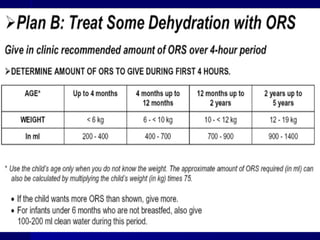
  • #7 Diarrhoea Treatment Guidelines I n c lu d i n g n ew r e c o m m e n d a t i o n s f o r t h e u s e o f O R S a n d z i n c s u p p l e m e n t a t i o n for Clinic-Based Healthcare Workers WHO 2005
  • #10 If a person drinks solutions with excessive sugar or excessive salt, these can draw water from the body into the bowel and cause osmotic diarrhea. Or it can be caused by osmotic laxatives (which work to alleviate constipation by drawing water into the bowels). In healthy individuals, too much magnesium or vitamin C or undigested lactose can produce osmotic diarrhea and distention of the bowel. A person who has lactose intolerance can have difficulty absorbing lactose after an extraordinarily high intake of dairy products. In persons who havefructose malabsorption, excess fructose intake can also cause diarrhea. Excessive sorbitol ingestion Celiac disease Com milk protein allergy Over eating Antibiotics Crohns disease Laxatives Hyprethyrodism Enteris infections Lactose intolerance
  • #11 There is little to no structural damage. The most common cause of this type of diarrhea is a cholera toxin that stimulates the secretion of anions, especially chloride ions. Therefore, to maintain a charge balance in the lumen, sodium is carried with it, along with water. In this type of diarrhea intestinal fluid secretion is isotonic with plasma even during fasting.[8] It continues even when there is no oral food intake Small bowel obstruction Bacteria overgrowth Hirschprung disease E-coli
  • #12 Exudative diarrhea occurs with the presence of blood and pus in the stool. This occurs with inflammatory bowel diseases, such as Crohn&amp;apos;s disease or ulcerative colitis, and other severe infections such as E. coli or other forms of food poisoning
  • #13 Motility-related diarrhea is caused by the rapid movement of food through the intestines (hypermotility). If the food moves too quickly through the gastrointestinal tract, there is not enough time for sufficient nutrients and water to be absorbed. This can be due to a vagotomy or diabetic neuropathy, or a complication of menstruation[citation needed]. Hyperthyroidism can produce hypermotility and lead to pseudodiarrhea and occasionally real diarrhea. Diarrhea can be treated with antimotility agents (such as loperamide). Hypermotility can be observed in people who have had portions of their bowel removed, allowing less total time for absorption of nutrients
  • #17 Rotavirus is the leading cause of viral gastroenteritis worldwide. Virtually every child develops rotavirus gastroenteritis by three years of age. Reinfections are common, but symptoms are typically less severe or asymptomatic. The virus is transmitted principally be the fecal-oral route. Individuals handling diapers of infected chilrden can easily spread the infection if they do not wash their hands carefully. The virus can also survive on hard surfaces like toys and countertops for a limited amount of time. A very small inoculum is considered contagious.
  • #18 Norovirus is the major cause of epidemic viral gastroenteritis. Norovirus outbreaks affect all ages. More than 90% of young adults are seropositive, however, immunity is not long lasting and reinfections are common. Outbreaks are most common at restaurants or catered meals, in hospitals and nursing homes, in schools, daycares, and camps, and on cruise ships. Transmission is fecal-oral through consumption of contaminated food, person to person contact, and contact with contaminated objects. Norovirus is highly contagious. It can even be transmitted through the aerosolization of vomit.
  • #19 Adenoviruses are responsible for only a small amount of viral gastroenteritis. It predominantly affects very young children. Transmission is fecal-oral through person to person contact but much less contagious than rotavirus or noroviruses
  • #20 Astrovirus is a common cause of diarrhea in daycare centers and a common cause of nosocomial disease. It can also cause illness in the immunocomromised, especially AIDS patients and elderly institutionalized patients. Transmission is person to person via the fecal-oral route. There are no commercially available diagnostic tests for astrovirus in the U.S.
  • #24 Campylobacter is the most common bacteria isolated in foodborne diarrheal illness. Improperly cooked poultry, untreated water, and unpasteurized milk are the most common culprits. Transmission occurs by ingestion of contaminated food or by direct contact with fecal material from infected animals or people. Many farm animals and pets (esp. kittens and puppies) harbor the bacteria. Most patients recover in less than 1 week but 20% relapse or have a prolonged illness. Treatment usually shortens the duration of bacterial shedding in the stool.
  • #25 The major vehicles of transmission are foods of animal origin, including poultry, beef, fish, eggs, and dairy products. Salmonella attack rates are highest among people younger than 4 years old with a peak during the first months of life. Antimicrobial treatment can prolong viral shedding but is recommended for those at increased risk of invasive disease or complications, including infants &amp;lt;3m/o, those with chronic GI disease, or who are immunosuppressed. Complications include bacteremia, osteomyletis, and meningitis.
  • #26 Shigella affects people of all ages. Predominant modes of transmission include person-person contact, contact with contaminated objects, ingestion of contaminated food and water, and sexual contact. Most infections are self-limited and do not require antibiotics, however, antimicrobial therapy is effective in shortening the duration of diarrhea and eradicating the organism from feces. Rare complications include bacteremia, toxic megacolon and perforation, and toxic encephalopathy.
  • #27 There are at least 5 types of diarrhea-producing E. Coli, but the only kind that commonly causes diarrhea in the U.S is enterohemmorhagic E. Coli o157:H7. Transmission is from ingestion of contaminated food, especially undercooked ground beef, dirty water and produce, and unpasteurized milk. The most common complication of EH E. Coli infection is HUS, defined as the triad of microangiopathic hemolytic anemia, thrombocytopenia, and acte real dysfunction.. HUS occurs in ~8% of children with EH E. Coli and usually presents about 2 weeks after the onset of diarrhea. TTP occurs in adults and is the same disease as postdiarrheal HUS in children. Patients with bloody stools suggestive of hemorrhagic colits should have a CBC and chem. 7 checked to evaluate for HUS or TTP. If there is no laboratory abnormality 3 days after resolution of the diarrhea, the risk of developing HUS is low.
  • #37 WHO guidelines
  • #38 thirst: --A child is not able to drink if he is not able to take fluid in his mouth and swallow it. -- A child is drinking poorly if the child is weak and cannot drink without help. --He may be able to swallow only if fluid is put in his mouth. --A child has the sign drinking eagerly, thirsty if it is clear that the child wants to drink. --Look to see if the child reaches out for the cup when you offer him water.
  • #45 http://whqlibdoc.who.int/publications/2005/a85500.pdf
  • #55 WHO guidelines