http://www.fitango.com/categories.php?id=262
Fitango Education
Health Topics
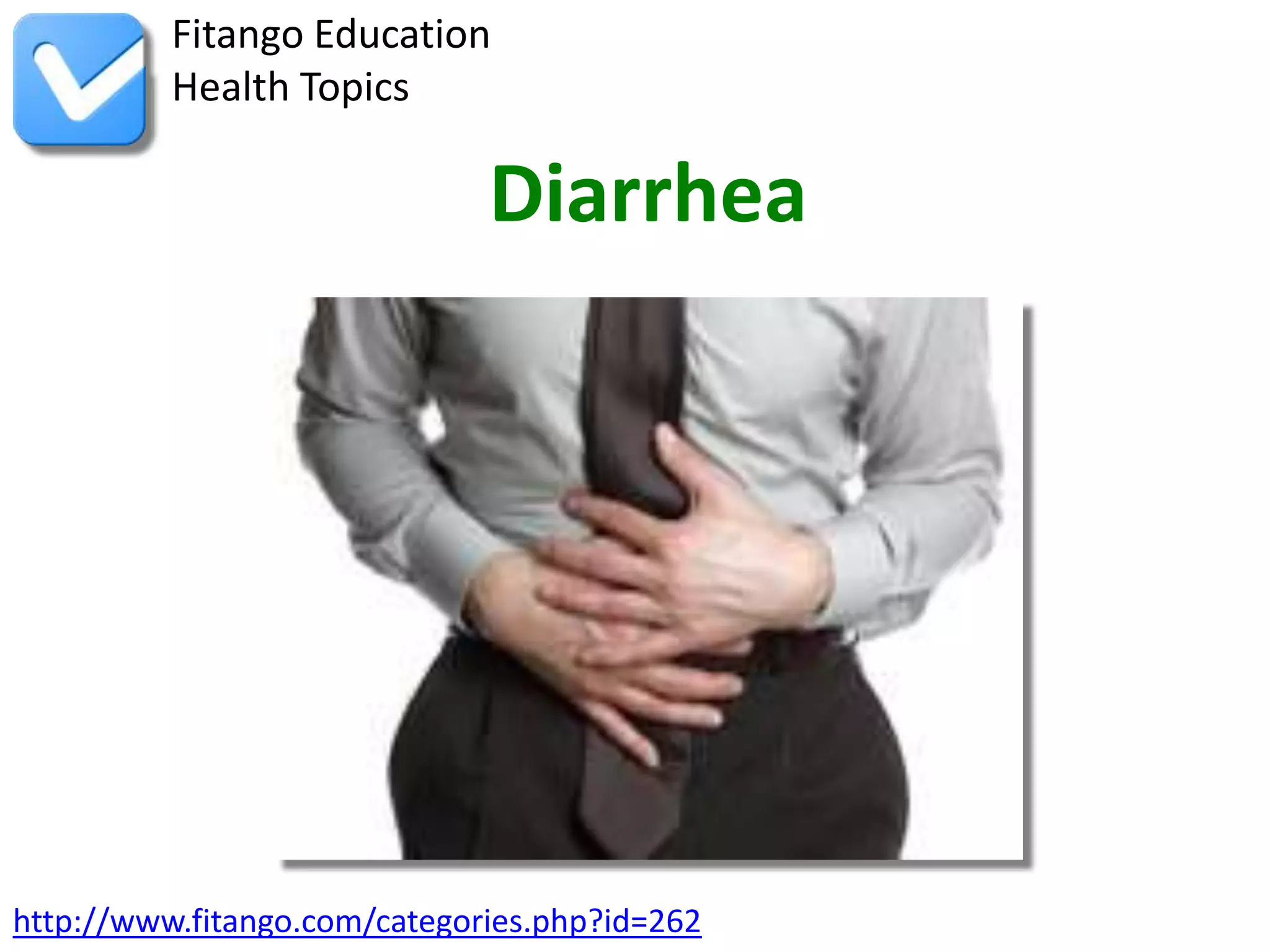
Diarrhea
1
Overview
Diarrhea is loose, watery stools. Having
diarrhea means passing loose stools three or more
times a day. Acute diarrhea
is a common problem that usually lasts 1 or 2 days
and goes away on its own.
2
Overview
Diarrhea lasting more than 2 days may be a
sign of a more serious problem. Chronic diarrhea—
diarrhea that lasts at least 4
weeks—may be a symptom of a chronic disease.
Chronic diarrhea symptoms may be
continual or they may come and go.
3
Overview
Diarrhea of any duration may cause
dehydration, which means the body lacks enough
fluid and electrolytes—chemicals
in salts, including sodium, potassium, and
chloride—to function properly. Loose
stools contain more fluid and electrolytes and
weigh more than solid stools.
4
Overview
People of all ages can get diarrhea. In the
United States, adults average one bout of acute
diarrhea each year, and young
children have an average of two episodes of acute
diarrhea each year.
5
Symptoms
Diarrhea may be accompanied by cramping,
abdominal pain, nausea, an urgent need to use the
bathroom, or loss of bowel
control. Some infections that cause diarrhea can
also cause a fever and chills
6
Symptoms
or bloody stools.
**Dehydration**
Diarrhea can cause dehydration. Loss of
electrolytes through dehydration affects the
amount of water in the body,
muscle activity, and other important functions.
7
Symptoms
Dehydration is particularly dangerous in
children, older adults, and people with weakened
immune systems. Dehydration
must be treated promptly to avoid serious health
problems, such as organ
damage, shock, or coma—a sleeplike state in
which a person is not conscious.
8
Symptoms
Signs of dehydration in adults include:
thirst
less
frequent urination than usual
dark-colored
urine
9
Symptoms
dry skin
fatigue
dizziness
light-headedness
Signs of dehydration in infants and young
children include:
10
Symptoms
dry mouth
and tongue
no tears
when crying
no wet
diapers for 3 hours or more
11
Symptoms
sunken
eyes, cheeks, or soft spot in the skull
high fever
listlessness
or irritability
12
Symptoms
Also, when people are dehydrated, their skin
does not flatten back to normal right away after
being gently pinched and
released.
Anyone with signs of dehydration should see a
13
Symptoms
health care provider immediately. Severe
dehydration may require
hospitalization.
Although drinking plenty of water is
important in preventing dehydration, water does
not contain electrolytes.
14
Symptoms
Adults can prevent dehydration by also drinking
liquids that contain
electrolytes, such as fruit juices, sports drinks,
caffeine-free soft drinks,
and broths. Children with diarrhea should be given
oral rehydration solutions such
15
Symptoms
as Pedialyte, Naturalyte, Infalyte, and CeraLyte to
prevent dehydration.
16
Diagnosis
If acute diarrhea lasts 2 days or less,
diagnostic tests are usually not necessary. If
diarrhea lasts longer or is
accompanied by symptoms such as fever or bloody
stools, a doctor may perform
17
Diagnosis
tests to determine the cause.
Diagnostic tests to find the cause of
diarrhea may include the following:
-- Medical
history and physical examination.
18
Diagnosis
The doctor will ask about eating habits and
medication use and will perform a
physical examination to look for signs of illness.
-- Stool
culture. A sample of stool is
19
Diagnosis
analyzed in a laboratory to check for bacteria,
parasites, or other signs of
disease and infection.
-- Blood
tests. Blood tests can be
helpful in ruling out certain diseases.
20
Diagnosis
-- Fasting
tests. To find out if a food
intolerance or allergy is causing the diarrhea, the
doctor may ask a person to
avoid foods with lactose, carbohydrates, wheat, or
other ingredients to see
21
Diagnosis
whether the diarrhea responds to a change in diet.
-- Sigmoidoscopy
or colonoscopy. These tests may
be used to look for signs of intestinal diseases that
cause chronic diarrhea.
22
Diagnosis
For sigmoidoscopy, the doctor uses a thin, flexible,
lighted tube with a lens
on the end to look at the inside of the rectum and
lower part of the colon.
Colonoscopy is similar to sigmoidoscopy, but it
allows the doctor to view the
entire colon.
23
Treatment
In most cases of diarrhea, the only treatment
necessary is replacing lost fluids and electrolytes to
prevent dehydration.
Over-the-counter medicines such as loperamide
24
Treatment
(Imodium) and bismuth subsalicylate (Pepto-
Bismol and Kaopectate) may help stop
diarrhea in adults. However, people with bloody
diarrhea—a sign of bacterial or
parasitic infection—should not use these
medicines. If diarrhea is caused by
25
Treatment
bacteria or parasites, over-the-counter medicines
may prolong the problem, so
doctors usually prescribe antibiotics instead.
Medications to treat diarrhea in adults can
be dangerous for infants and children and should
only be given with a doctor’s
26
Treatment
guidance.
Eating,
Diet, and Nutrition
Until diarrhea subsides, avoiding caffeine
and foods that are greasy, high in fiber, or sweet
may lessen symptoms. These
27
Treatment
foods can aggravate diarrhea. Some people also
have problems digesting lactose
during or after a bout of diarrhea. Yogurt, which
has less lactose than milk,
is often better tolerated. Yogurt with active, live
bacterial cultures may even
28
Treatment
help people recover from diarrhea more quickly.
As symptoms improve, soft, bland foods can be
added to the diet, including bananas, plain rice,
boiled potatoes, toast,
crackers, cooked carrots, and baked chicken
without the skin or fat. For
29
Treatment
children, the health care provider may also
recommend a bland diet. Once the
diarrhea stops, the health care provider will likely
encourage children to
return to a normal and healthy diet if it can be
tolerated. Infants with
30
Treatment
diarrhea should be given breast milk or full-
strength formula as usual, along
with oral rehydration solutions. Some children
recovering from viral diarrheas
have problems digesting lactose for up to a month
or more.
31
Causes
Acute diarrhea is usually caused by a
bacterial, viral, or parasitic infection. Chronic
diarrhea is usually related
to a functional disorder such as irritable bowel
syndrome or an intestinal
32
Causes
disease such as Crohn’s Disease.
The most common causes of diarrhea include
the following:
-- Bacterial
infections. Several types of
33
Causes
bacteria consumed through contaminated food or
water can cause diarrhea. Common
culprits include Campylobacter, Salmonella,
Shigella, and Escherichia
coli (E. coli).
-- Viral
34
Causes
infections. Many viruses cause
diarrhea, including rotavirus, norovirus,
cytomegalovirus, herpes simplex
virus, and viral hepatitis. Infection with the
rotavirus is the most common
cause of acute diarrhea in children. Rotavirus
diarrhea usually resolves in 3
35
Causes
to 7 days but can cause problems digesting lactose
for up to a month or longer.
-- Parasites. Parasites can enter the body through
food or water
and settle in the digestive system. Parasites that
cause diarrhea include Giardia
36
Causes
lamblia, Entamoeba histolytica, and
Cryptosporidium.
-- Functional
bowel disorders. Diarrhea can be
a symptom of irritable bowel syndrome.
-- Intestinal
37
Causes
diseases. Inflammatory bowel
disease, ulcerative colitis, Crohn’s disease, and
celiac disease often lead to
diarrhea.
-- Food
intolerances and sensitivities.
38
Causes
Some people have difficulty digesting certain
ingredients, such as lactose, the
sugar found in milk and milk products. Some
people may have diarrhea if they
eat certain types of sugar substitutes in excessive
quantities.
-- Reaction
39
Causes
to medicines. Antibiotics,
cancer drugs, and antacids containing magnesium
can all cause diarrhea.
Some people develop diarrhea after stomach
surgery, which may cause food to move through
the digestive system more
40
Causes
quickly.
People who visit certain foreign countries
are at risk for traveler’s diarrhea, which is caused
by eating food or drinking
water contaminated with bacteria, viruses, or
parasites. Traveler’s diarrhea
41
Causes
can be a problem for people traveling to
developing countries in Africa, Asia,
Latin America, and the Caribbean. Visitors to
Canada, most European countries,
Japan, Australia, and New Zealand do not face
much risk for traveler’s
diarrhea.
42
Causes
In many cases, the cause of diarrhea cannot be
found. As long as diarrhea goes away on its own
within 1 to 2 days, finding the
cause is not usually necessary.
43
Prevention
Two types of diarrhea can be
prevented—rotavirus diarrhea and traveler’s
diarrhea.
Rotavirus
Diarrhea
44
Prevention
Two oral vaccines have been approved by the
U.S. Food and Drug Administration to protect
children from rotavirus
infections: rotavirus vaccine, live, oral, pentavalent
(RotaTeq); and rotavirus
vaccine, live, oral (Rotarix). RotaTeq is given to
infants in three doses at 2,
45
Prevention
4, and 6 months of age. Rotarix is given in two
doses. The first dose is given
when infants are 6 weeks old, and the second is
given at least 4 weeks later
but before infants are 24 weeks old.
Parents of infants should discuss rotavirus
46
Prevention
vaccination with a health care provider. For more
information, parents can
visit the Centers for Disease Control and
Prevention rotavirus vaccination
webpage at www.cdc.gov/vaccines/vpd-
vac/rotavirus.
Traveler’s
47
Prevention
Diarrhea
To prevent traveler’s diarrhea, people
traveling from the United States to developing
countries should avoid:
drinking
tap water, using tap water to brush their teeth, or
using ice made from
48
Prevention
tap water
drinking
unpasteurized milk or milk products
eating raw
fruits and vegetables, including lettuce and fruit
salads, unless they
49
Prevention
peel the fruits or vegetables themselves
eating raw
or rare meat and fish
eating meat
or shellfish that is not hot when served
50
Prevention
eating food
from street vendors
Travelers can drink bottled water, soft
drinks, and hot drinks such as coffee or tea.
People concerned about traveler’s diarrhea
51
Prevention
should talk with a health care provider before
traveling. The health care
provider may recommend that travelers bring
medicine with them in case they
develop diarrhea during their trip. Health care
providers may advise some
52
Prevention
people—especially people with weakened immune
systems—to take antibiotics
before and during a trip to help prevent traveler’s
diarrhea. Early treatment
with antibiotics can shorten a bout of traveler’s
diarrhea.
Diarrhea

Diarrhea

  • 1.
  • 2.
    1 Overview Diarrhea is loose,watery stools. Having diarrhea means passing loose stools three or more times a day. Acute diarrhea is a common problem that usually lasts 1 or 2 days and goes away on its own.
  • 3.
    2 Overview Diarrhea lasting morethan 2 days may be a sign of a more serious problem. Chronic diarrhea— diarrhea that lasts at least 4 weeks—may be a symptom of a chronic disease. Chronic diarrhea symptoms may be continual or they may come and go.
  • 4.
    3 Overview Diarrhea of anyduration may cause dehydration, which means the body lacks enough fluid and electrolytes—chemicals in salts, including sodium, potassium, and chloride—to function properly. Loose stools contain more fluid and electrolytes and weigh more than solid stools.
  • 5.
    4 Overview People of allages can get diarrhea. In the United States, adults average one bout of acute diarrhea each year, and young children have an average of two episodes of acute diarrhea each year.
  • 6.
    5 Symptoms Diarrhea may beaccompanied by cramping, abdominal pain, nausea, an urgent need to use the bathroom, or loss of bowel control. Some infections that cause diarrhea can also cause a fever and chills
  • 7.
    6 Symptoms or bloody stools. **Dehydration** Diarrheacan cause dehydration. Loss of electrolytes through dehydration affects the amount of water in the body, muscle activity, and other important functions.
  • 8.
    7 Symptoms Dehydration is particularlydangerous in children, older adults, and people with weakened immune systems. Dehydration must be treated promptly to avoid serious health problems, such as organ damage, shock, or coma—a sleeplike state in which a person is not conscious.
  • 9.
    8 Symptoms Signs of dehydrationin adults include: thirst less frequent urination than usual dark-colored urine
  • 10.
    9 Symptoms dry skin fatigue dizziness light-headedness Signs ofdehydration in infants and young children include:
  • 11.
    10 Symptoms dry mouth and tongue notears when crying no wet diapers for 3 hours or more
  • 12.
    11 Symptoms sunken eyes, cheeks, orsoft spot in the skull high fever listlessness or irritability
  • 13.
    12 Symptoms Also, when peopleare dehydrated, their skin does not flatten back to normal right away after being gently pinched and released. Anyone with signs of dehydration should see a
  • 14.
    13 Symptoms health care providerimmediately. Severe dehydration may require hospitalization. Although drinking plenty of water is important in preventing dehydration, water does not contain electrolytes.
  • 15.
    14 Symptoms Adults can preventdehydration by also drinking liquids that contain electrolytes, such as fruit juices, sports drinks, caffeine-free soft drinks, and broths. Children with diarrhea should be given oral rehydration solutions such
  • 16.
    15 Symptoms as Pedialyte, Naturalyte,Infalyte, and CeraLyte to prevent dehydration.
  • 17.
    16 Diagnosis If acute diarrhealasts 2 days or less, diagnostic tests are usually not necessary. If diarrhea lasts longer or is accompanied by symptoms such as fever or bloody stools, a doctor may perform
  • 18.
    17 Diagnosis tests to determinethe cause. Diagnostic tests to find the cause of diarrhea may include the following: -- Medical history and physical examination.
  • 19.
    18 Diagnosis The doctor willask about eating habits and medication use and will perform a physical examination to look for signs of illness. -- Stool culture. A sample of stool is
  • 20.
    19 Diagnosis analyzed in alaboratory to check for bacteria, parasites, or other signs of disease and infection. -- Blood tests. Blood tests can be helpful in ruling out certain diseases.
  • 21.
    20 Diagnosis -- Fasting tests. Tofind out if a food intolerance or allergy is causing the diarrhea, the doctor may ask a person to avoid foods with lactose, carbohydrates, wheat, or other ingredients to see
  • 22.
    21 Diagnosis whether the diarrhearesponds to a change in diet. -- Sigmoidoscopy or colonoscopy. These tests may be used to look for signs of intestinal diseases that cause chronic diarrhea.
  • 23.
    22 Diagnosis For sigmoidoscopy, thedoctor uses a thin, flexible, lighted tube with a lens on the end to look at the inside of the rectum and lower part of the colon. Colonoscopy is similar to sigmoidoscopy, but it allows the doctor to view the entire colon.
  • 24.
    23 Treatment In most casesof diarrhea, the only treatment necessary is replacing lost fluids and electrolytes to prevent dehydration. Over-the-counter medicines such as loperamide
  • 25.
    24 Treatment (Imodium) and bismuthsubsalicylate (Pepto- Bismol and Kaopectate) may help stop diarrhea in adults. However, people with bloody diarrhea—a sign of bacterial or parasitic infection—should not use these medicines. If diarrhea is caused by
  • 26.
    25 Treatment bacteria or parasites,over-the-counter medicines may prolong the problem, so doctors usually prescribe antibiotics instead. Medications to treat diarrhea in adults can be dangerous for infants and children and should only be given with a doctor’s
  • 27.
    26 Treatment guidance. Eating, Diet, and Nutrition Untildiarrhea subsides, avoiding caffeine and foods that are greasy, high in fiber, or sweet may lessen symptoms. These
  • 28.
    27 Treatment foods can aggravatediarrhea. Some people also have problems digesting lactose during or after a bout of diarrhea. Yogurt, which has less lactose than milk, is often better tolerated. Yogurt with active, live bacterial cultures may even
  • 29.
    28 Treatment help people recoverfrom diarrhea more quickly. As symptoms improve, soft, bland foods can be added to the diet, including bananas, plain rice, boiled potatoes, toast, crackers, cooked carrots, and baked chicken without the skin or fat. For
  • 30.
    29 Treatment children, the healthcare provider may also recommend a bland diet. Once the diarrhea stops, the health care provider will likely encourage children to return to a normal and healthy diet if it can be tolerated. Infants with
  • 31.
    30 Treatment diarrhea should begiven breast milk or full- strength formula as usual, along with oral rehydration solutions. Some children recovering from viral diarrheas have problems digesting lactose for up to a month or more.
  • 32.
    31 Causes Acute diarrhea isusually caused by a bacterial, viral, or parasitic infection. Chronic diarrhea is usually related to a functional disorder such as irritable bowel syndrome or an intestinal
  • 33.
    32 Causes disease such asCrohn’s Disease. The most common causes of diarrhea include the following: -- Bacterial infections. Several types of
  • 34.
    33 Causes bacteria consumed throughcontaminated food or water can cause diarrhea. Common culprits include Campylobacter, Salmonella, Shigella, and Escherichia coli (E. coli). -- Viral
  • 35.
    34 Causes infections. Many virusescause diarrhea, including rotavirus, norovirus, cytomegalovirus, herpes simplex virus, and viral hepatitis. Infection with the rotavirus is the most common cause of acute diarrhea in children. Rotavirus diarrhea usually resolves in 3
  • 36.
    35 Causes to 7 daysbut can cause problems digesting lactose for up to a month or longer. -- Parasites. Parasites can enter the body through food or water and settle in the digestive system. Parasites that cause diarrhea include Giardia
  • 37.
    36 Causes lamblia, Entamoeba histolytica,and Cryptosporidium. -- Functional bowel disorders. Diarrhea can be a symptom of irritable bowel syndrome. -- Intestinal
  • 38.
    37 Causes diseases. Inflammatory bowel disease,ulcerative colitis, Crohn’s disease, and celiac disease often lead to diarrhea. -- Food intolerances and sensitivities.
  • 39.
    38 Causes Some people havedifficulty digesting certain ingredients, such as lactose, the sugar found in milk and milk products. Some people may have diarrhea if they eat certain types of sugar substitutes in excessive quantities. -- Reaction
  • 40.
    39 Causes to medicines. Antibiotics, cancerdrugs, and antacids containing magnesium can all cause diarrhea. Some people develop diarrhea after stomach surgery, which may cause food to move through the digestive system more
  • 41.
    40 Causes quickly. People who visitcertain foreign countries are at risk for traveler’s diarrhea, which is caused by eating food or drinking water contaminated with bacteria, viruses, or parasites. Traveler’s diarrhea
  • 42.
    41 Causes can be aproblem for people traveling to developing countries in Africa, Asia, Latin America, and the Caribbean. Visitors to Canada, most European countries, Japan, Australia, and New Zealand do not face much risk for traveler’s diarrhea.
  • 43.
    42 Causes In many cases,the cause of diarrhea cannot be found. As long as diarrhea goes away on its own within 1 to 2 days, finding the cause is not usually necessary.
  • 44.
    43 Prevention Two types ofdiarrhea can be prevented—rotavirus diarrhea and traveler’s diarrhea. Rotavirus Diarrhea
  • 45.
    44 Prevention Two oral vaccineshave been approved by the U.S. Food and Drug Administration to protect children from rotavirus infections: rotavirus vaccine, live, oral, pentavalent (RotaTeq); and rotavirus vaccine, live, oral (Rotarix). RotaTeq is given to infants in three doses at 2,
  • 46.
    45 Prevention 4, and 6months of age. Rotarix is given in two doses. The first dose is given when infants are 6 weeks old, and the second is given at least 4 weeks later but before infants are 24 weeks old. Parents of infants should discuss rotavirus
  • 47.
    46 Prevention vaccination with ahealth care provider. For more information, parents can visit the Centers for Disease Control and Prevention rotavirus vaccination webpage at www.cdc.gov/vaccines/vpd- vac/rotavirus. Traveler’s
  • 48.
    47 Prevention Diarrhea To prevent traveler’sdiarrhea, people traveling from the United States to developing countries should avoid: drinking tap water, using tap water to brush their teeth, or using ice made from
  • 49.
    48 Prevention tap water drinking unpasteurized milkor milk products eating raw fruits and vegetables, including lettuce and fruit salads, unless they
  • 50.
    49 Prevention peel the fruitsor vegetables themselves eating raw or rare meat and fish eating meat or shellfish that is not hot when served
  • 51.
    50 Prevention eating food from streetvendors Travelers can drink bottled water, soft drinks, and hot drinks such as coffee or tea. People concerned about traveler’s diarrhea
  • 52.
    51 Prevention should talk witha health care provider before traveling. The health care provider may recommend that travelers bring medicine with them in case they develop diarrhea during their trip. Health care providers may advise some
  • 53.
    52 Prevention people—especially people withweakened immune systems—to take antibiotics before and during a trip to help prevent traveler’s diarrhea. Early treatment with antibiotics can shorten a bout of traveler’s diarrhea.