Dr. Nabila Hassan
MD. Tropical Medicine
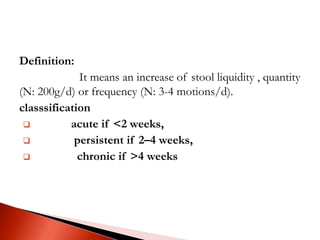
Definition:
It means an increase of stool liquidity , quantity
(N: 200g/d) or frequency (N: 3-4 motions/d).
classsification
 acute if <2 weeks,
 persistent if 2–4 weeks,
 chronic if >4 weeks
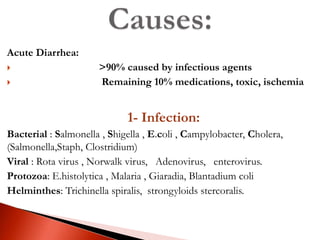
Acute Diarrhea:
 >90% caused by infectious agents
 Remaining 10% medications, toxic, ischemia
1- Infection:
Bacterial : Salmonella , Shigella , E.coli , Campylobacter, Cholera,
(Salmonella,Staph, Clostridium)
Viral : Rota virus , Norwalk virus, Adenovirus, enterovirus.
Protozoa: E.histolytica , Malaria , Giaradia, Blantadium coli
Helminthes: Trichinella spiralis, strongyloids stercoralis.
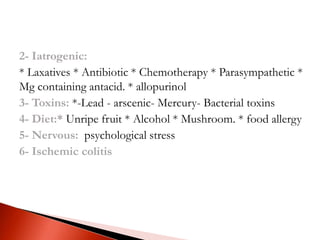
2- Iatrogenic:
* Laxatives * Antibiotic * Chemotherapy * Parasympathetic *
Mg containing antacid. * allopurinol
3- Toxins: *-Lead - arscenic- Mercury- Bacterial toxins
4- Diet:* Unripe fruit * Alcohol * Mushroom. * food allergy
5- Nervous: psychological stress
6- Ischemic colitis
1- malabsorption syndrome. ( enumerate its causes )
2- Diseases of the colon : (ABCD)
Ameabic ---- AIDS--------Bilharizal--------Cancer colon& IBD-----
Diverticulosis.
3- Endocrinal causes :
• Thyrotoxicosis.
• Diabetic neuropathy.
• Addison’s disease.
• Zollinger Ellison syndrome.
• Carcinoid syndrome
• Pancreatic cholera (verner Morrison syndrome)
4- Drugs:
 Laxative
 Anti- acids
- inflammatory
- arrhythmia
- biotics
- neoplastic
1. Osmotic diarrhea:
Presence of non absorbed , hypertonic substances in
intestinal lumen maintain fluid & prevent absorption (e.g.
lactulose, sorbitol, magnesium ).
2. Secretory diarrhea (watery diarrhea) :
increase secretion of water & electrolytes into the
lumen.e.g. cholera , E.coli , _ VIPs ( vaso - active intestinal
peptides)
3. Abnormality of intestinal motility :
e.g. Thyrotoxicosis, IBS, D neuropathy.
4. Abnormality of intestinal mucosa : e.g. inflammation.
 H2O _ dehydration.
 K _ hypokalemia.
 HCO3 _ Acidosis.
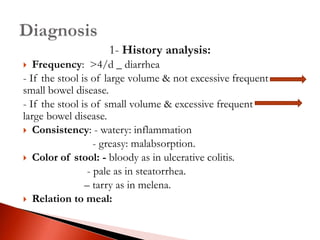
1- History analysis:
 Frequency: >4/d _ diarrhea
- If the stool is of large volume & not excessive frequent
small bowel disease.
- If the stool is of small volume & excessive frequent
large bowel disease.
 Consistency: - watery: inflammation
- greasy: malabsorption.
 Color of stool: - bloody as in ulcerative colitis.
- pale as in steatorrhea.
– tarry as in melena.
 Relation to meal:
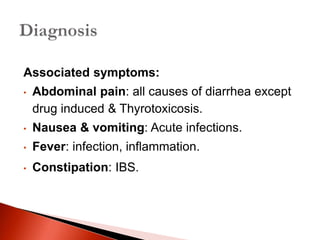
Associated symptoms:
• Abdominal pain: all causes of diarrhea except
drug induced & Thyrotoxicosis.
• Nausea & vomiting: Acute infections.
• Fever: infection, inflammation.
• Constipation: IBS.
2- Examination:
 abdominal tenderness
 bowel sounds
 degree of general hydration
 examination per rectum: to exclude rectal
mass or blood.
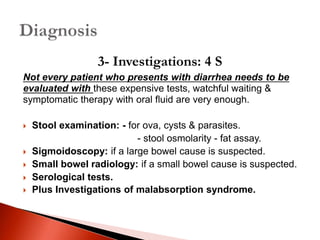
3- Investigations: 4 S
Not every patient who presents with diarrhea needs to be
evaluated with these expensive tests, watchful waiting &
symptomatic therapy with oral fluid are very enough.
 Stool examination: - for ova, cysts & parasites.
- stool osmolarity - fat assay.
 Sigmoidoscopy: if a large bowel cause is suspected.
 Small bowel radiology: if a small bowel cause is suspected.
 Serological tests.
 Plus Investigations of malabsorption syndrome.
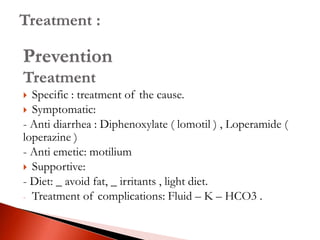
Prevention
Treatment
 Specific : treatment of the cause.
 Symptomatic:
- Anti diarrhea : Diphenoxylate ( lomotil ) , Loperamide (
loperazine )
- Anti emetic: motilium
 Supportive:
- Diet: _ avoid fat, _ irritants , light diet.
- Treatment of complications: Fluid – K – HCO3 .
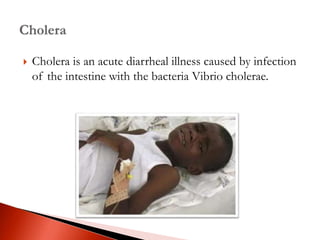
 Cholera is an acute diarrheal illness caused by infection
of the intestine with the bacteria Vibrio cholerae.
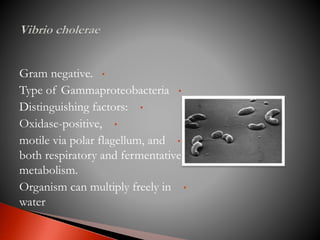
•Gram negative.
•Type of Gammaproteobacteria
•Distinguishing factors:
•Oxidase-positive,
•motile via polar flagellum, and
both respiratory and fermentative
metabolism.
•Organism can multiply freely in
water
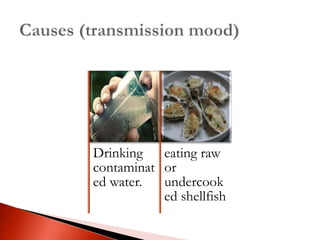
Drinking
contaminat
ed water.
eating raw
or
undercook
ed shellfish
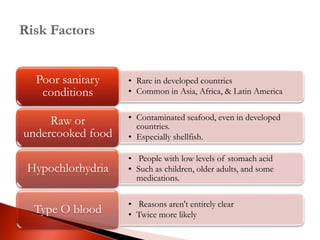
• Rare in developed countries
• Common in Asia, Africa, & Latin America
Poor sanitary
conditions
• Contaminated seafood, even in developed
countries.
• Especially shellfish.
Raw or
undercooked food
• People with low levels of stomach acid
• Such as children, older adults, and some
medications.
Hypochlorhydria
• Reasons aren't entirely clear
• Twice more likelyType O blood
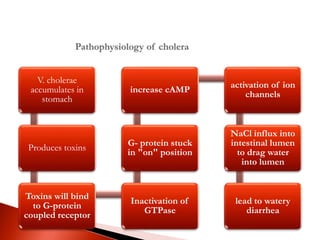
V. cholerae
accumulates in
stomach
Produces toxins
Toxins will bind
to G-protein
coupled receptor
Inactivation of
GTPase
G- protein stuck
in "on" position
increase cAMP
activation of ion
channels
NaCl influx into
intestinal lumen
to drag water
into lumen
lead to watery
diarrhea
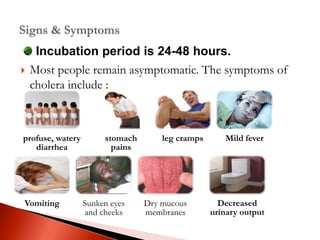
 Most people remain asymptomatic. The symptoms of
cholera include :
profuse, watery
diarrhea
stomach
pains
leg cramps Mild fever
Vomiting Sunken eyes
and cheeks
Dry mucous
membranes
Decreased
urinary output
Incubation period is 24-48 hours.
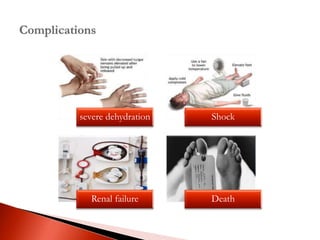
severe dehydration Shock
Renal failure Death
Clinical diagnosis
Cholera should be considered
in all cases with severe watery
diarrhea and vomiting.
Traveling to affected areas and
eating shellfish
No distinguishing clinical
manifestations for cholera.
Differential diagnosis
Enterotoxigenic e. Coli
Bacterial food poisoning
Viral gastroenteritis
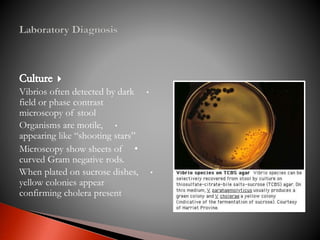
•Vibrios often detected by dark
field or phase contrast
microscopy of stool
•Organisms are motile,
appearing like “shooting stars”
•Microscopy show sheets of
curved Gram negative rods.
•When plated on sucrose dishes,
yellow colonies appear
confirming cholera present
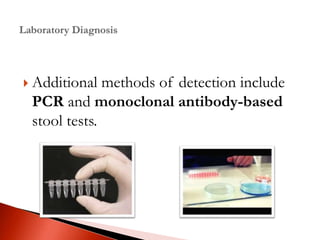
 Additional methods of detection include
PCR and monoclonal antibody-based
stool tests.
Oral rehydration salts
• Up to 80% of cases can be treated through this.
Intravenous fluids (Ringer lactate)
• For severe cases.
Antimicrobial Therapy
• can diminish duration of diarrhea, reduce volume
of rehydration fluids needed, and shorten duration
of V. cholerae excretion.
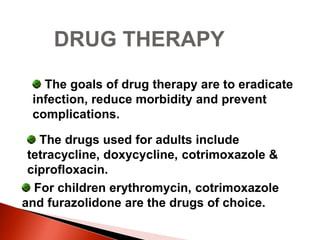
DRUG THERAPY
The goals of drug therapy are to eradicate
infection, reduce morbidity and prevent
complications.
The drugs used for adults include
tetracycline, doxycycline, cotrimoxazole &
ciprofloxacin.
For children erythromycin, cotrimoxazole
and furazolidone are the drugs of choice.
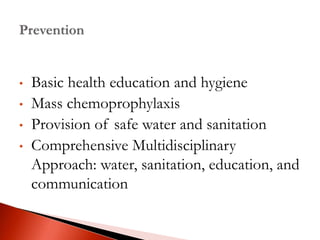
• Basic health education and hygiene
• Mass chemoprophylaxis
• Provision of safe water and sanitation
• Comprehensive Multidisciplinary
Approach: water, sanitation, education, and
communication
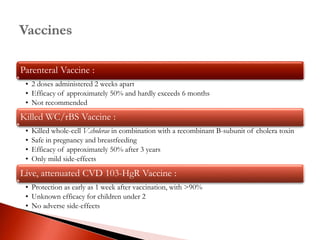
Parenteral Vaccine :
• 2 doses administered 2 weeks apart
• Efficacy of approximately 50% and hardly exceeds 6 months
• Not recommended
Killed WC/rBS Vaccine :
• Killed whole-cell V.cholerae in combination with a recombinant B-subunit of cholera toxin
• Safe in pregnancy and breastfeeding
• Efficacy of approximately 50% after 3 years
• Only mild side-effects
Live, attenuated CVD 103-HgR Vaccine :
• Protection as early as 1 week after vaccination, with >90%
• Unknown efficacy for children under 2
• No adverse side-effects
Diarrhea
Diarrhea

Diarrhea

  • 1.
    Dr. Nabila Hassan MD.Tropical Medicine
  • 2.
    Definition: It means anincrease of stool liquidity , quantity (N: 200g/d) or frequency (N: 3-4 motions/d). classsification  acute if <2 weeks,  persistent if 2–4 weeks,  chronic if >4 weeks
  • 3.
    Acute Diarrhea:  >90%caused by infectious agents  Remaining 10% medications, toxic, ischemia 1- Infection: Bacterial : Salmonella , Shigella , E.coli , Campylobacter, Cholera, (Salmonella,Staph, Clostridium) Viral : Rota virus , Norwalk virus, Adenovirus, enterovirus. Protozoa: E.histolytica , Malaria , Giaradia, Blantadium coli Helminthes: Trichinella spiralis, strongyloids stercoralis.
  • 4.
    2- Iatrogenic: * Laxatives* Antibiotic * Chemotherapy * Parasympathetic * Mg containing antacid. * allopurinol 3- Toxins: *-Lead - arscenic- Mercury- Bacterial toxins 4- Diet:* Unripe fruit * Alcohol * Mushroom. * food allergy 5- Nervous: psychological stress 6- Ischemic colitis
  • 5.
    1- malabsorption syndrome.( enumerate its causes ) 2- Diseases of the colon : (ABCD) Ameabic ---- AIDS--------Bilharizal--------Cancer colon& IBD----- Diverticulosis. 3- Endocrinal causes : • Thyrotoxicosis. • Diabetic neuropathy. • Addison’s disease. • Zollinger Ellison syndrome. • Carcinoid syndrome • Pancreatic cholera (verner Morrison syndrome)
  • 6.
    4- Drugs:  Laxative Anti- acids - inflammatory - arrhythmia - biotics - neoplastic
  • 7.
    1. Osmotic diarrhea: Presenceof non absorbed , hypertonic substances in intestinal lumen maintain fluid & prevent absorption (e.g. lactulose, sorbitol, magnesium ). 2. Secretory diarrhea (watery diarrhea) : increase secretion of water & electrolytes into the lumen.e.g. cholera , E.coli , _ VIPs ( vaso - active intestinal peptides) 3. Abnormality of intestinal motility : e.g. Thyrotoxicosis, IBS, D neuropathy. 4. Abnormality of intestinal mucosa : e.g. inflammation.
  • 8.
     H2O _dehydration.  K _ hypokalemia.  HCO3 _ Acidosis.
  • 9.
    1- History analysis: Frequency: >4/d _ diarrhea - If the stool is of large volume & not excessive frequent small bowel disease. - If the stool is of small volume & excessive frequent large bowel disease.  Consistency: - watery: inflammation - greasy: malabsorption.  Color of stool: - bloody as in ulcerative colitis. - pale as in steatorrhea. – tarry as in melena.  Relation to meal:
  • 10.
    Associated symptoms: • Abdominalpain: all causes of diarrhea except drug induced & Thyrotoxicosis. • Nausea & vomiting: Acute infections. • Fever: infection, inflammation. • Constipation: IBS.
  • 11.
    2- Examination:  abdominaltenderness  bowel sounds  degree of general hydration  examination per rectum: to exclude rectal mass or blood.
  • 12.
    3- Investigations: 4S Not every patient who presents with diarrhea needs to be evaluated with these expensive tests, watchful waiting & symptomatic therapy with oral fluid are very enough.  Stool examination: - for ova, cysts & parasites. - stool osmolarity - fat assay.  Sigmoidoscopy: if a large bowel cause is suspected.  Small bowel radiology: if a small bowel cause is suspected.  Serological tests.  Plus Investigations of malabsorption syndrome.
  • 13.
    Prevention Treatment  Specific :treatment of the cause.  Symptomatic: - Anti diarrhea : Diphenoxylate ( lomotil ) , Loperamide ( loperazine ) - Anti emetic: motilium  Supportive: - Diet: _ avoid fat, _ irritants , light diet. - Treatment of complications: Fluid – K – HCO3 .
  • 15.
     Cholera isan acute diarrheal illness caused by infection of the intestine with the bacteria Vibrio cholerae.
  • 16.
    •Gram negative. •Type ofGammaproteobacteria •Distinguishing factors: •Oxidase-positive, •motile via polar flagellum, and both respiratory and fermentative metabolism. •Organism can multiply freely in water
  • 17.
  • 18.
    • Rare indeveloped countries • Common in Asia, Africa, & Latin America Poor sanitary conditions • Contaminated seafood, even in developed countries. • Especially shellfish. Raw or undercooked food • People with low levels of stomach acid • Such as children, older adults, and some medications. Hypochlorhydria • Reasons aren't entirely clear • Twice more likelyType O blood
  • 19.
    V. cholerae accumulates in stomach Producestoxins Toxins will bind to G-protein coupled receptor Inactivation of GTPase G- protein stuck in "on" position increase cAMP activation of ion channels NaCl influx into intestinal lumen to drag water into lumen lead to watery diarrhea
  • 20.
     Most peopleremain asymptomatic. The symptoms of cholera include : profuse, watery diarrhea stomach pains leg cramps Mild fever Vomiting Sunken eyes and cheeks Dry mucous membranes Decreased urinary output Incubation period is 24-48 hours.
  • 21.
  • 22.
    Clinical diagnosis Cholera shouldbe considered in all cases with severe watery diarrhea and vomiting. Traveling to affected areas and eating shellfish No distinguishing clinical manifestations for cholera. Differential diagnosis Enterotoxigenic e. Coli Bacterial food poisoning Viral gastroenteritis
  • 23.
    •Vibrios often detectedby dark field or phase contrast microscopy of stool •Organisms are motile, appearing like “shooting stars” •Microscopy show sheets of curved Gram negative rods. •When plated on sucrose dishes, yellow colonies appear confirming cholera present
  • 24.
     Additional methodsof detection include PCR and monoclonal antibody-based stool tests.
  • 25.
    Oral rehydration salts •Up to 80% of cases can be treated through this. Intravenous fluids (Ringer lactate) • For severe cases. Antimicrobial Therapy • can diminish duration of diarrhea, reduce volume of rehydration fluids needed, and shorten duration of V. cholerae excretion.
  • 26.
    DRUG THERAPY The goalsof drug therapy are to eradicate infection, reduce morbidity and prevent complications. The drugs used for adults include tetracycline, doxycycline, cotrimoxazole & ciprofloxacin. For children erythromycin, cotrimoxazole and furazolidone are the drugs of choice.
  • 27.
    • Basic healtheducation and hygiene • Mass chemoprophylaxis • Provision of safe water and sanitation • Comprehensive Multidisciplinary Approach: water, sanitation, education, and communication
  • 28.
    Parenteral Vaccine : •2 doses administered 2 weeks apart • Efficacy of approximately 50% and hardly exceeds 6 months • Not recommended Killed WC/rBS Vaccine : • Killed whole-cell V.cholerae in combination with a recombinant B-subunit of cholera toxin • Safe in pregnancy and breastfeeding • Efficacy of approximately 50% after 3 years • Only mild side-effects Live, attenuated CVD 103-HgR Vaccine : • Protection as early as 1 week after vaccination, with >90% • Unknown efficacy for children under 2 • No adverse side-effects