Diarrhea
What is Diarrhea ???
• Overall weight & volume of stool is increased > 200
mg or ml/day.
• Water content of stool is increased to 60 – 90%
• Can have many causes which may be infectious or
non infectious.
Classification of Diarrhea:
According to mechanism:
Motility
Diarrhea
Secretory
Diarrhea
Osmotic
Diarrhea
Motility disorder
results in decreased
contact time of fecal
mass with intestinal
wall so decrease
water absorption
from feces.
Intestinal wall is
damaged resulting in
increased secretion
rather than
absorption of
electrolytes into
intestinal tract.
Non – absorbable
solute pulls excess
water into intestine
tract.DESCRIPTION
Motility disorders:
•IBS
•Gastric/intestinal
resection.
Lactase deficiency
EXAMPLE
According to duration:
Chronic DiarrheaAcute Diarrhea
Lasts more than 2 weeksSelf limiting
Lasts from 2 – 3 days up to 2 weeks
Causes
May be due to:
•IBS
•Protozoal infection
•Malabsorption
•Pancreatic disease
•Hyperthyroidism
May be due
to:
•Infection → (Infection induced
diarrhea) , caused by
microorganisms.
•Diet → (Diet induced diarrhea) ,
results from food allergies.
•Drug → (Drug induced diarrhea) ,
results from medication.
Infection induced Diarrhea
ACUTE
ProtozoaBacteriaViruses
1. Giardia
lamblia
2. Entamoeba
histolytica.
1. Toxigenic Bacteria:
(E-coli, Vibrio cholera,
Shigella, Staph. Aureus)
2. Invasive Bacteria:
(Invasive E-coli, shigella,
salmonella,
campylobacter,
clostriduim difficile)
1. Rotavirus
2. Nowalk virus
CausativeOrganism
•Foul smelling.
•Large Volume.
•Watery Stool.
1. Toxigenic Bacteria:
-large volume
-watery or greasy.
2. Invasive Bacteria:
-Extreme urgency of
defecation & small
volume of stool.
-Contain pus & blood.
•Watery diarrhea.
•No pus, No blood.
•Self limiting.
StoolCharacteristics
:Complications of Diarrhea
Fluid loss & electrolyte imbalance.
Due
to
Adultswith acute Diarrhea
when the intake of fluids is
limited by associated nausea &
Vomiting
Common in Infants& Young children
having viral gastroenteritis or bacterial infection.
When to refer to physician ?
Patient younger than 3 years or older than 60
years (with multiple medication problems)
Blood or mucus in stool.
High fever greater than 38˚C.
Dehydration or weight loss more than 5% of
total body weight.
Diarrhea lasted more than 2 days.
IF patient suffering frequent vomiting.
Diagnostic Tests
Stool Culture test.
Blood tests of the intestines.
X- rays.
Endoscopy.
Colonoscopy.
My child always suffers from diarrhea after drinking milk or
eating dairy products is it a serious condition. How it could be
treated?
Lactose intolerance
(Lactase Deficiency)
Inability to digest lactose due to lacking of enzyme (lactase) that
breakdown lactose in the gut.
So increase lactose in the intestinal tract  Osmotic diarrhea.
It occurs when a non-absorbable solute pulls excess water into the
intestinal tract.
Symptoms of lactose intolerance:
Loose stool.
Abdominal pain.
Bloating and flatulence.
Nausea.
Treatment:
1) Reduced dietary lactose intake:
For infants:
Use Lactose-free formulas (Bebelac FL - S26 LF).
For older children and adults:
- Calcium fortified soy milk and lactose free milk may be used.
- People differ in the amount and type of food they can handle.
- Yogurt containing lactose is well tolerated by the patients as it contains
live culture of bacteria that produce lactase.
2) Administration of commercially available enzyme substitute:
Lactase enzyme (Lactrase - Lactaid – Dairy ease).
3) Maintenance of calcium intake:
• Eat foods that have more calcium:
- Leafy greensand broccoli.
- Sardines, Salmon and shrimp.
• Take calcium supplements.
Lactose Intolerance Tests
• Hydrogen breath test. This is the most accurate lactose intolerance
test..
• Lactose tolerance test. This test measures your blood sugar after
you eat or drink lactose.
• Stool acidity test. Undigested lactose also increases the amount of
acid in the stool.
Complications:
- Osteopenia.
- Fracture.
My physician prescribed Primperan®. Since taking it I
suffered from diarrhea, why?
• Primperan® (Metoclopramide) is a D2- antagonist for treating of
nausea and vomiting.
• It has prokinetic effect which is produced by:
1. Inhibition of D2 receptors, stimulation of 5-HT4 receptors and
antagonism of presynaptic inhibition of muscarinic receptors.
2. This promotes release of acetylcholine (Parasympathomemic).
3. Leading to Motility diarrhea.
Other drugs that cause diarrhea:
• 1) Medications that induce motility diarrhea:
i. Parasymathomimetic drugs  Bethanecol.
ii. D2-Antagonist  Metoclopramide (Primpiran®)
 Domperidone (Motilium®).
iii. Digitalis (Lanoxin®), Quinidine, Furosemide (Laxis®).
iv. Antibiotics by: increase bowl motility and altering bowl
mirobial flora.
• 2) Medications that induce osmotic diarrhea:
- Lactulose and magnesium containing antacids and
laxatives.
• 3) Medication that cause secretory diarrhea:
i. Prostaglandins  Misoprostol (Cytotec® -
Misotec®)
ii. Colchicine.
iii. Chemotherapeutic agents.
• 4) Orlistat : Decrease pancreatic lipase 
Decrease Breakingdown of fats  steatorrhoea
(Fatty diarrhea).
• 5) PPI : Omeprazole (Omez® - Omepac®)
Enumerate different classes of drugs used
in treatment of diarrhea.
• According to FDA classification , 3 agents have
been identified as category 1 “Safe and effective
Kaolin, bismuth subsalicylate & Loperamide”
• In April 2003 The FDA reclassified attapulgite and
polycarbophil products from category 1 to category 3
because of in sufficient effectiveness data.
Anti-diarrheal are classified on the basis of their
chemical class or pharmacologic mechanism action
into:
1. Antiperistalsis drugs.
2. Adsorbents.
3. Miscellaneous agents.
• Bismuth subsalicylate.
• Lactobacillus.
• Lactase.
• Anti-infective agents.
• Anti-cholinergic.
Antiperistalsis drugs
These drugs act by stimulating µ opioid receptors in musculature of
small and large intestine to normalize peristaltic intestinal movement.
Prescriptive
Lomotil®
Dihpenoxylate/Atropine
OTC
Imodium®
Loperamide
2- Adsrobents
These medications are non-selective and adsorb toxins, bacteria,
gases, drugs…
- No systemic absorption.
- For symptomatic relief in large doses.
- Not effective in severe acute diarrhea.
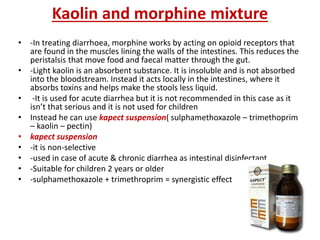
Kapect® Suspension.
Kaolin and pectin.
3- Miscellaneous agents
b- Lactobacillus.
Products containing non-toxic
strains of lactobacillus
acidophilus are intended to
replace normal bacterial flora
that is lost during the
administration of oral antibiotics.
Eg: Lacteol fort®
a- Bismuth subsalicylate.
1- Adsorbent.
2- Decrease the secretion
of water into the bowl.
Cont. Miscellaneous
e. Anticholinergic drugs
1- Decrease bowl motility, so
increase fluid absorption.
2- Decrease abdominal
cramping.
d. Anti-infective agent
Eradicate the organism and
decrease the duration of symptoms.
1- Nifuroxazide. (Antinal)
2- Metronidazole (Flagyl)
c. Lactase enzyme
7) Mrs. Robinson asks what you can recommend for
diarrhea. Her son David, aged 11, has diarrhea and
she's worried that her other two children, Natalie, aged
4, and Tom, aged just over 1 year, may also get it.
David's diarrhea started yesterday, he went to the
toilet and was sick once, but has not been sick since.
He has griping pain, but in generally well and quite
lively. Yesterday he had pie and chips from the local
takeaway during his lunch break at school. No-one else
in the family ate the same food. Mrs. Robinson has not
given him any medicine, but has some kaolin and
morphine mixture at home and wants to know if David
could take some, and also if the other children could
take it if necessary.
Kaolin and morphine mixture
• -In treating diarrhoea, morphine works by acting on opioid receptors that
are found in the muscles lining the walls of the intestines. This reduces the
peristalsis that move food and faecal matter through the gut.
• -Light kaolin is an absorbent substance. It is insoluble and is not absorbed
into the bloodstream. Instead it acts locally in the intestines, where it
absorbs toxins and helps make the stools less liquid.
• -It is used for acute diarrhea but it is not recommended in this case as it
isn’t that serious and it is not used for children
• Instead he can use kapect suspension( sulphamethoxazole – trimethoprim
– kaolin – pectin)
• kapect suspension
• -it is non-selective
• -used in case of acute & chronic diarrhea as intestinal disinfectant
• -Suitable for children 2 years or older
• -sulphamethoxazole + trimethroprim = synergistic effect
Recommendation for this case
1. Large fluid intake to replace the lost
fluids this can be achieved by oral
rehydration solutions (ORS)
2. Anti peristaltic drugs
• Example: Loperamide (Imodium tablets).
• Gives effect after 1 hour
• 2-3 times more potent than diphenoxylate (Lomotil tablets)
• 20 times more potent than morphine in slowing GIT motility
• Indication:
• -Acute non-specific diarrhea
• -chronic diarrhea with IBD
• Advantages:
• No CNS penetration
• Administration:
• Adults: 4mg followed by 2 mg after each loose stool, not exceed 16mg/day
• Children:1-2 mg up to three times/day
• Her other children shouldn’t take any medicine as they didn’t eat from the
same food and it is not contagious
8) Mrs. Jean Berry wants to stock up on some
medicine before her family sets off on their
first vacation abroad; they will be going to
Spain next week. Mrs. Berry tell you she has
heard of people whose holiday have been
ruined by holiday diarrhea and she wants you
to recommend a good treatment. On
questioning you find out that she has 2 boys
aged 10 and 14
• Travelers' diarrhea is a gastrointestinal illness
that occurs in travelers it is caused by eating
food contaminated with bacteria or, less
commonly, with parasites or viruses.
• Drugs that are used in prophylaxis and
treatment of travelers' diarrhea are bismuth
subsalicylate and anti infective agents
• If antibiotics are used to prevent Travelers' diarrhea,
therapy should be started 1 day before arrival and
continued 2 days after departure, if diarrhea has occurred,
antibiotic treatment should last for 3 days
• Anti motility drugs shouldn't be used in Traveler's diarrhea
with fever or bloody diarrhea as the increase contact time
between pathogen and intestine, increase severity of the
case
Prevention:
1. Avoid raw fruits or vegetables-unless you peel
them yourself
2. Avoid raw or undercooked meat or seafood
3. Avoid tap water, ice, unpasteurized milk, or
dairy products
4. Avoid street vendors
5. Avoid swimming in water that maybe
contaminated
Stomach flu
Stomach flu
• Viral gastroenteritis-winter
vomiting disease
• An infection of the stomach and
intestines
• It is frequently referred to as the
stomach or intestinal flu
CAUSES
• Viruses – such as
rotavirus, norwalk virus.
• By eating contaminated food
• Direct person to person spread
(contagious)
SYMPTOMS
•Nausea and Vomiting
•Diarrhea
SYMPTOMS
• Abdominal Pain and
Cramps
• Body Aches
SYMPTOMS
• Fever and Weakness
• Often begins suddenly and the
infected person feel very sick
TREATMENT
• Self limiting course
• Plenty of fluids and Right Diet
• Oral rehydration drinks,
available from your chemist
• No antiviral and vaccine for
prevention
• Cannot be treated with antibiotic
MR Radcliff suffer from mobility
disorder and drug induced diarrhea
(motility diarrhea) after taking
amoxycilline
Recommendation for treatment:
• Stop amoxicillin or the effect could be
minimized by taking with food or milk
• 2days cut off strategy (no medication)
• Avoid dehydration by fluids and rehydration
solution
• Adsorbent may used
• The U.S. Food and Drug Administration today approved
Fulyzaq (crofelemer) to relieve symptoms of diarrhea in
HIV/AIDS patients taking antiretroviral therapy, a combination
of medicines used to treat HIV infection.
• Diarrhea is experienced by many HIV/AIDS patients and is a
common reason why patients discontinue or switch their
antiretroviral therapies. Fulyzaq is intended to be used in
HIV/AIDS patients whose diarrhea is not caused by an
infection from a virus, bacteria, or parasite.
• Fulyzaq decrease chloride ions are excreted into gut which
also decreases the excretion of sodium ions and water ,
improving stool consistency and reducing duration of the
diarrhea Patients take Fulyzaq two times a day to manage
watery diarrhea due to the secretion of electrolytes and water
in the gastrointestinal tract.
Causes of diarrhea during pregnancy
1. Certain hormonal changes that take place within the
body during this time
2. Changes in diet to provide the fetus with all the
necessary nutrients
3. The extra water for keeping the body hydrated
4. Pregnancy workouts in prenatal vitamins , (changing
brand of vitamin may also be responsible)
5. Food poisoning
6. Stomach flu caused by certain bacteria or viruses
7. Maternal gastrointestinal conditions like
inflammatory bowel disease and irritable bowel
syndrome (chronic diarrhea)
In most cases it does not cause any harm to
the baby , however severe diarrhea can
hydrate the mother , hampering the blood
flow to the fetus.
 Diarrhea occuring due to some serious
pregnancy complications such as abdominal or
uterine infections , especially during the
second and third trimesters may also be
dangerous for the baby.
• I am taking bismuth subsalicylate for
diarrhea, I noticed some annoying
effects. What are adverse effects and
contraindications ?
Adverse Effects:
1. Black tongue & black stool.
2. Ringing in the ears (Tinnitus)
Occur with high doses specially if patient is
simultaneously taking other salicylate products.
Contraindications:
1. Patient with black or bloody stools.
2. Children or teenagers during or other recovery from
chiken pox or flu because of possible associations of
salicylates with Reye’s syndrome.
3. Patients with documented allergies to salicylates.
4. Pregnant & Breast feeding women.
5. Patients in anticoagulants should be monitored
closely if taking these products.
• A patient is taking Lanoxin®, he suffers from
diarrhea & takes Kapect®.
What do you recommend ? What is Kapect Compound
?
 I recommend to do dose spacing between Kapect® &
Lanoxin® at least 3 hours because Kapect® decreases
absorption of other concomitant oral administered
drugs, specially the potent like Lanoxin®
 Kapect® Compound is ( Kaolin, pectin, trimethoprim,
& sulphamethoxazole ) suspension.
• 13) Dehydration is a serious
complication of persistent diarrhea,
especially in infants as it could be
lethal. How does this imbalance be
corrected? What is ORS according
WHO/UNICEF definition?
• All patients should receive their normal diet or
breast feeding
• fatty foods, foods rich in simple sugars and spicy
food should be avoided
• Most important part of treating acute diarrhea is
the replacement of lost electrolytes
• If patient has mild to moderate fluid loss: oral
rehydration solution (ORS)
• If fluid loss is severe (>10% loss of body weight)
and/or severe vomiting: IV rehydration is needed
• Fluids to be avoided : hypertonic fruit juices and
drinks, carbonated beverages and caffeine.
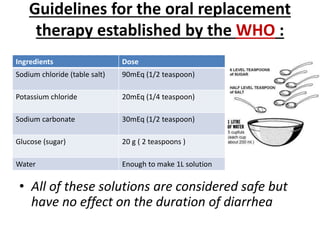
Guidelines for the oral replacement
therapy established by the WHO :
• All of these solutions are considered safe but
have no effect on the duration of diarrhea
DoseIngredients
90mEq (1/2 teaspoon)Sodium chloride (table salt)
20mEq (1/4 teaspoon)Potassium chloride
30mEq (1/2 teaspoon)Sodium carbonate
20 g ( 2 teaspoons )Glucose (sugar)
Enough to make 1L solutionWater
Guidelines for the recommended
doses established by the WHO:
Moderate(4-5 stools/day)Mild (2-3 stools/day)Age group
2-4L/ first 4 hr then replace
ongoing losses
2L/first 4hr then replace
ongoing losses
>5 years of age
100ml/kg/first 4 hr then
1/2-1 cup per stool
50ml/kg/first 4 hr then 1/2-
1 cup per stool
<5 years of age
• 14) What is the mechanism of
action of anti-peristaltic and
adsorbents as anti-diarrheal drugs
and what are their
contraindications?
A) Anti peristaltic drugs:
Mechanism of action
• These drugs act by stimulating μ-opioid receptors in musculature
of small and large intestine to normalize peristaltic intestinal
movement
Contraindication:
1. Acute bacterial diarrhea with fecal leukocytes, fever, blood or
mucus because it
• Decrease bacterial clearance
• Enhance systemic invasion
2. Colitis : Toxic mega colon
3. Children < 6 years
4. Not more than 48 hours
Prescriptive anti peristaltic:
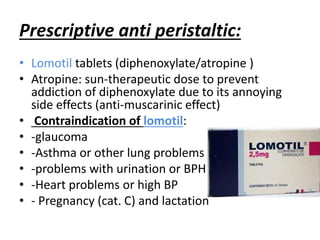
• Lomotil tablets (diphenoxylate/atropine )
• Atropine: sun-therapeutic dose to prevent
addiction of diphenoxylate due to its annoying
side effects (anti-muscarinic effect)
• Contraindication of lomotil:
• -glaucoma
• -Asthma or other lung problems
• -problems with urination or BPH
• -Heart problems or high BP
• - Pregnancy (cat. C) and lactation
ii. Non-prescriptive anti-peristaltic:
• Imodium® tablets
B) Adsorbents:
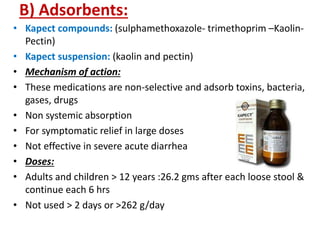
• Kapect compounds: (sulphamethoxazole- trimethoprim –Kaolin-
Pectin)
• Kapect suspension: (kaolin and pectin)
• Mechanism of action:
• These medications are non-selective and adsorb toxins, bacteria,
gases, drugs
• Non systemic absorption
• For symptomatic relief in large doses
• Not effective in severe acute diarrhea
• Doses:
• Adults and children > 12 years :26.2 gms after each loose stool &
continue each 6 hrs
• Not used > 2 days or >262 g/day
I suffered from diarrhea and I was
prescribed Lacteol Fort® Which cause
me to siffer from flatulence, Is it
necessary to continue the treatment ??
• . Many people, when they first start taking probiotics, whether it
is acidophilusor one of the other helpful bacteria, notice an
increase in wind (intestinal gas, flatulence.)
• Inside our intestinal tract are various types of bacteria. As they
digest the fiber from our diet some of these bacteria produce gas in
the form of methane and hydrogen. Other bacteria need this gas
for them to grow and so they absorb it.
• I'm sure you can see that as long as those two different types of
bacteria are in balance - everything is sweet. But let the gas
producers outstrip the gas absorbers, and you have a bad flatulence
problem! - the most common of the acidophilus side effects.
• Another type of acidophilus side effect is caused by the toxins
that bacteria release as they die off. Harmful bacteria are
being defeated and this can lead to a worsening of symptoms
for a short time but it is not dangerous
• You feel worse before you feel better
• So, the temporary side effects of acidophilus may take the form of
bloating, diarrhea and flatulence or they may be more flu like or
allergenic.
• Most people will experience nothing at all
• Sometimes you can get round the side effects by taking a more
balanced probiotic such as iFlora but remember to start slowly
 Is there anything you can do to avoid this bloating and wind?
• Yes!
• Because this is the result of your intestinal microflora getting out of
balance, your aim is to get it back in balance as rapidly as you can.
• First of all stop taking the acidophilus supplement
• The next day divide the capsule or tablet that you
normally take into quarters. Do NOT worry about how
exact all of this is. All we're trying to do is dramatically
reduce the amount of acidophilus you are taking
• Take a quarter dose each day until the symptoms go
• Now increase to a half dose, again staying at that level
until you are symptom free.
• When should I use Anti infective
agent for treatment of diarrhea ? Give
example to anti infective agent ?
• I use anti infective agent in infectious diarrhea
which is caused by Bacteria as salmonella or
shigella or viruses as ruta virus or parasites As
Giardia lamblia this is called infectious diarrhea
• Ciprodiazole® is a good drug for treating these
types of diarrhea Ciprodiazole® is a
combination of Ciprofloxacin 500 mg (Oral
Fluroquinolones) and Metronidazole 500 mg (for
anaerobic infections )
Diarrhea all

Diarrhea all

  • 1.
  • 2.
    What is Diarrhea??? • Overall weight & volume of stool is increased > 200 mg or ml/day. • Water content of stool is increased to 60 – 90% • Can have many causes which may be infectious or non infectious.
  • 3.
    Classification of Diarrhea: Accordingto mechanism: Motility Diarrhea Secretory Diarrhea Osmotic Diarrhea Motility disorder results in decreased contact time of fecal mass with intestinal wall so decrease water absorption from feces. Intestinal wall is damaged resulting in increased secretion rather than absorption of electrolytes into intestinal tract. Non – absorbable solute pulls excess water into intestine tract.DESCRIPTION Motility disorders: •IBS •Gastric/intestinal resection. Lactase deficiency EXAMPLE
  • 4.
    According to duration: ChronicDiarrheaAcute Diarrhea Lasts more than 2 weeksSelf limiting Lasts from 2 – 3 days up to 2 weeks Causes May be due to: •IBS •Protozoal infection •Malabsorption •Pancreatic disease •Hyperthyroidism May be due to: •Infection → (Infection induced diarrhea) , caused by microorganisms. •Diet → (Diet induced diarrhea) , results from food allergies. •Drug → (Drug induced diarrhea) , results from medication.
  • 5.
    Infection induced Diarrhea ACUTE ProtozoaBacteriaViruses 1.Giardia lamblia 2. Entamoeba histolytica. 1. Toxigenic Bacteria: (E-coli, Vibrio cholera, Shigella, Staph. Aureus) 2. Invasive Bacteria: (Invasive E-coli, shigella, salmonella, campylobacter, clostriduim difficile) 1. Rotavirus 2. Nowalk virus CausativeOrganism •Foul smelling. •Large Volume. •Watery Stool. 1. Toxigenic Bacteria: -large volume -watery or greasy. 2. Invasive Bacteria: -Extreme urgency of defecation & small volume of stool. -Contain pus & blood. •Watery diarrhea. •No pus, No blood. •Self limiting. StoolCharacteristics
  • 6.
    :Complications of Diarrhea Fluidloss & electrolyte imbalance. Due to Adultswith acute Diarrhea when the intake of fluids is limited by associated nausea & Vomiting Common in Infants& Young children having viral gastroenteritis or bacterial infection.
  • 8.
    When to referto physician ? Patient younger than 3 years or older than 60 years (with multiple medication problems) Blood or mucus in stool. High fever greater than 38˚C. Dehydration or weight loss more than 5% of total body weight. Diarrhea lasted more than 2 days. IF patient suffering frequent vomiting.
  • 9.
    Diagnostic Tests Stool Culturetest. Blood tests of the intestines. X- rays. Endoscopy. Colonoscopy.
  • 10.
    My child alwayssuffers from diarrhea after drinking milk or eating dairy products is it a serious condition. How it could be treated? Lactose intolerance (Lactase Deficiency) Inability to digest lactose due to lacking of enzyme (lactase) that breakdown lactose in the gut. So increase lactose in the intestinal tract  Osmotic diarrhea. It occurs when a non-absorbable solute pulls excess water into the intestinal tract.
  • 11.
    Symptoms of lactoseintolerance: Loose stool. Abdominal pain. Bloating and flatulence. Nausea.
  • 12.
    Treatment: 1) Reduced dietarylactose intake: For infants: Use Lactose-free formulas (Bebelac FL - S26 LF). For older children and adults: - Calcium fortified soy milk and lactose free milk may be used. - People differ in the amount and type of food they can handle. - Yogurt containing lactose is well tolerated by the patients as it contains live culture of bacteria that produce lactase.
  • 13.
    2) Administration ofcommercially available enzyme substitute: Lactase enzyme (Lactrase - Lactaid – Dairy ease). 3) Maintenance of calcium intake: • Eat foods that have more calcium: - Leafy greensand broccoli. - Sardines, Salmon and shrimp. • Take calcium supplements.
  • 14.
    Lactose Intolerance Tests •Hydrogen breath test. This is the most accurate lactose intolerance test.. • Lactose tolerance test. This test measures your blood sugar after you eat or drink lactose. • Stool acidity test. Undigested lactose also increases the amount of acid in the stool. Complications: - Osteopenia. - Fracture.
  • 15.
    My physician prescribedPrimperan®. Since taking it I suffered from diarrhea, why? • Primperan® (Metoclopramide) is a D2- antagonist for treating of nausea and vomiting. • It has prokinetic effect which is produced by: 1. Inhibition of D2 receptors, stimulation of 5-HT4 receptors and antagonism of presynaptic inhibition of muscarinic receptors. 2. This promotes release of acetylcholine (Parasympathomemic). 3. Leading to Motility diarrhea.
  • 16.
    Other drugs thatcause diarrhea: • 1) Medications that induce motility diarrhea: i. Parasymathomimetic drugs  Bethanecol. ii. D2-Antagonist  Metoclopramide (Primpiran®)  Domperidone (Motilium®). iii. Digitalis (Lanoxin®), Quinidine, Furosemide (Laxis®). iv. Antibiotics by: increase bowl motility and altering bowl mirobial flora. • 2) Medications that induce osmotic diarrhea: - Lactulose and magnesium containing antacids and laxatives.
  • 17.
    • 3) Medicationthat cause secretory diarrhea: i. Prostaglandins  Misoprostol (Cytotec® - Misotec®) ii. Colchicine. iii. Chemotherapeutic agents. • 4) Orlistat : Decrease pancreatic lipase  Decrease Breakingdown of fats  steatorrhoea (Fatty diarrhea). • 5) PPI : Omeprazole (Omez® - Omepac®)
  • 18.
    Enumerate different classesof drugs used in treatment of diarrhea. • According to FDA classification , 3 agents have been identified as category 1 “Safe and effective Kaolin, bismuth subsalicylate & Loperamide” • In April 2003 The FDA reclassified attapulgite and polycarbophil products from category 1 to category 3 because of in sufficient effectiveness data.
  • 19.
    Anti-diarrheal are classifiedon the basis of their chemical class or pharmacologic mechanism action into: 1. Antiperistalsis drugs. 2. Adsorbents. 3. Miscellaneous agents. • Bismuth subsalicylate. • Lactobacillus. • Lactase. • Anti-infective agents. • Anti-cholinergic.
  • 20.
    Antiperistalsis drugs These drugsact by stimulating µ opioid receptors in musculature of small and large intestine to normalize peristaltic intestinal movement. Prescriptive Lomotil® Dihpenoxylate/Atropine OTC Imodium® Loperamide
  • 21.
    2- Adsrobents These medicationsare non-selective and adsorb toxins, bacteria, gases, drugs… - No systemic absorption. - For symptomatic relief in large doses. - Not effective in severe acute diarrhea. Kapect® Suspension. Kaolin and pectin.
  • 22.
    3- Miscellaneous agents b-Lactobacillus. Products containing non-toxic strains of lactobacillus acidophilus are intended to replace normal bacterial flora that is lost during the administration of oral antibiotics. Eg: Lacteol fort® a- Bismuth subsalicylate. 1- Adsorbent. 2- Decrease the secretion of water into the bowl.
  • 23.
    Cont. Miscellaneous e. Anticholinergicdrugs 1- Decrease bowl motility, so increase fluid absorption. 2- Decrease abdominal cramping. d. Anti-infective agent Eradicate the organism and decrease the duration of symptoms. 1- Nifuroxazide. (Antinal) 2- Metronidazole (Flagyl) c. Lactase enzyme
  • 24.
    7) Mrs. Robinsonasks what you can recommend for diarrhea. Her son David, aged 11, has diarrhea and she's worried that her other two children, Natalie, aged 4, and Tom, aged just over 1 year, may also get it. David's diarrhea started yesterday, he went to the toilet and was sick once, but has not been sick since. He has griping pain, but in generally well and quite lively. Yesterday he had pie and chips from the local takeaway during his lunch break at school. No-one else in the family ate the same food. Mrs. Robinson has not given him any medicine, but has some kaolin and morphine mixture at home and wants to know if David could take some, and also if the other children could take it if necessary.
  • 25.
    Kaolin and morphinemixture • -In treating diarrhoea, morphine works by acting on opioid receptors that are found in the muscles lining the walls of the intestines. This reduces the peristalsis that move food and faecal matter through the gut. • -Light kaolin is an absorbent substance. It is insoluble and is not absorbed into the bloodstream. Instead it acts locally in the intestines, where it absorbs toxins and helps make the stools less liquid. • -It is used for acute diarrhea but it is not recommended in this case as it isn’t that serious and it is not used for children • Instead he can use kapect suspension( sulphamethoxazole – trimethoprim – kaolin – pectin) • kapect suspension • -it is non-selective • -used in case of acute & chronic diarrhea as intestinal disinfectant • -Suitable for children 2 years or older • -sulphamethoxazole + trimethroprim = synergistic effect
  • 26.
    Recommendation for thiscase 1. Large fluid intake to replace the lost fluids this can be achieved by oral rehydration solutions (ORS)
  • 27.
    2. Anti peristalticdrugs • Example: Loperamide (Imodium tablets). • Gives effect after 1 hour • 2-3 times more potent than diphenoxylate (Lomotil tablets) • 20 times more potent than morphine in slowing GIT motility • Indication: • -Acute non-specific diarrhea • -chronic diarrhea with IBD • Advantages: • No CNS penetration • Administration: • Adults: 4mg followed by 2 mg after each loose stool, not exceed 16mg/day • Children:1-2 mg up to three times/day • Her other children shouldn’t take any medicine as they didn’t eat from the same food and it is not contagious
  • 28.
    8) Mrs. JeanBerry wants to stock up on some medicine before her family sets off on their first vacation abroad; they will be going to Spain next week. Mrs. Berry tell you she has heard of people whose holiday have been ruined by holiday diarrhea and she wants you to recommend a good treatment. On questioning you find out that she has 2 boys aged 10 and 14
  • 29.
    • Travelers' diarrheais a gastrointestinal illness that occurs in travelers it is caused by eating food contaminated with bacteria or, less commonly, with parasites or viruses. • Drugs that are used in prophylaxis and treatment of travelers' diarrhea are bismuth subsalicylate and anti infective agents
  • 30.
    • If antibioticsare used to prevent Travelers' diarrhea, therapy should be started 1 day before arrival and continued 2 days after departure, if diarrhea has occurred, antibiotic treatment should last for 3 days • Anti motility drugs shouldn't be used in Traveler's diarrhea with fever or bloody diarrhea as the increase contact time between pathogen and intestine, increase severity of the case
  • 31.
    Prevention: 1. Avoid rawfruits or vegetables-unless you peel them yourself 2. Avoid raw or undercooked meat or seafood 3. Avoid tap water, ice, unpasteurized milk, or dairy products 4. Avoid street vendors 5. Avoid swimming in water that maybe contaminated
  • 32.
  • 33.
    Stomach flu • Viralgastroenteritis-winter vomiting disease • An infection of the stomach and intestines • It is frequently referred to as the stomach or intestinal flu
  • 34.
    CAUSES • Viruses –such as rotavirus, norwalk virus. • By eating contaminated food • Direct person to person spread (contagious)
  • 35.
  • 36.
    SYMPTOMS • Abdominal Painand Cramps • Body Aches
  • 37.
    SYMPTOMS • Fever andWeakness • Often begins suddenly and the infected person feel very sick
  • 38.
    TREATMENT • Self limitingcourse • Plenty of fluids and Right Diet • Oral rehydration drinks, available from your chemist • No antiviral and vaccine for prevention • Cannot be treated with antibiotic
  • 39.
    MR Radcliff sufferfrom mobility disorder and drug induced diarrhea (motility diarrhea) after taking amoxycilline Recommendation for treatment: • Stop amoxicillin or the effect could be minimized by taking with food or milk • 2days cut off strategy (no medication) • Avoid dehydration by fluids and rehydration solution • Adsorbent may used
  • 40.
    • The U.S.Food and Drug Administration today approved Fulyzaq (crofelemer) to relieve symptoms of diarrhea in HIV/AIDS patients taking antiretroviral therapy, a combination of medicines used to treat HIV infection. • Diarrhea is experienced by many HIV/AIDS patients and is a common reason why patients discontinue or switch their antiretroviral therapies. Fulyzaq is intended to be used in HIV/AIDS patients whose diarrhea is not caused by an infection from a virus, bacteria, or parasite. • Fulyzaq decrease chloride ions are excreted into gut which also decreases the excretion of sodium ions and water , improving stool consistency and reducing duration of the diarrhea Patients take Fulyzaq two times a day to manage watery diarrhea due to the secretion of electrolytes and water in the gastrointestinal tract.
  • 41.
    Causes of diarrheaduring pregnancy 1. Certain hormonal changes that take place within the body during this time 2. Changes in diet to provide the fetus with all the necessary nutrients 3. The extra water for keeping the body hydrated 4. Pregnancy workouts in prenatal vitamins , (changing brand of vitamin may also be responsible) 5. Food poisoning 6. Stomach flu caused by certain bacteria or viruses 7. Maternal gastrointestinal conditions like inflammatory bowel disease and irritable bowel syndrome (chronic diarrhea)
  • 42.
    In most casesit does not cause any harm to the baby , however severe diarrhea can hydrate the mother , hampering the blood flow to the fetus.  Diarrhea occuring due to some serious pregnancy complications such as abdominal or uterine infections , especially during the second and third trimesters may also be dangerous for the baby.
  • 43.
    • I amtaking bismuth subsalicylate for diarrhea, I noticed some annoying effects. What are adverse effects and contraindications ? Adverse Effects: 1. Black tongue & black stool. 2. Ringing in the ears (Tinnitus) Occur with high doses specially if patient is simultaneously taking other salicylate products.
  • 44.
    Contraindications: 1. Patient withblack or bloody stools. 2. Children or teenagers during or other recovery from chiken pox or flu because of possible associations of salicylates with Reye’s syndrome. 3. Patients with documented allergies to salicylates. 4. Pregnant & Breast feeding women. 5. Patients in anticoagulants should be monitored closely if taking these products.
  • 45.
    • A patientis taking Lanoxin®, he suffers from diarrhea & takes Kapect®. What do you recommend ? What is Kapect Compound ?  I recommend to do dose spacing between Kapect® & Lanoxin® at least 3 hours because Kapect® decreases absorption of other concomitant oral administered drugs, specially the potent like Lanoxin®  Kapect® Compound is ( Kaolin, pectin, trimethoprim, & sulphamethoxazole ) suspension.
  • 46.
    • 13) Dehydrationis a serious complication of persistent diarrhea, especially in infants as it could be lethal. How does this imbalance be corrected? What is ORS according WHO/UNICEF definition?
  • 47.
    • All patientsshould receive their normal diet or breast feeding • fatty foods, foods rich in simple sugars and spicy food should be avoided • Most important part of treating acute diarrhea is the replacement of lost electrolytes • If patient has mild to moderate fluid loss: oral rehydration solution (ORS) • If fluid loss is severe (>10% loss of body weight) and/or severe vomiting: IV rehydration is needed • Fluids to be avoided : hypertonic fruit juices and drinks, carbonated beverages and caffeine.
  • 48.
    Guidelines for theoral replacement therapy established by the WHO : • All of these solutions are considered safe but have no effect on the duration of diarrhea DoseIngredients 90mEq (1/2 teaspoon)Sodium chloride (table salt) 20mEq (1/4 teaspoon)Potassium chloride 30mEq (1/2 teaspoon)Sodium carbonate 20 g ( 2 teaspoons )Glucose (sugar) Enough to make 1L solutionWater
  • 49.
    Guidelines for therecommended doses established by the WHO: Moderate(4-5 stools/day)Mild (2-3 stools/day)Age group 2-4L/ first 4 hr then replace ongoing losses 2L/first 4hr then replace ongoing losses >5 years of age 100ml/kg/first 4 hr then 1/2-1 cup per stool 50ml/kg/first 4 hr then 1/2- 1 cup per stool <5 years of age
  • 50.
    • 14) Whatis the mechanism of action of anti-peristaltic and adsorbents as anti-diarrheal drugs and what are their contraindications?
  • 51.
    A) Anti peristalticdrugs: Mechanism of action • These drugs act by stimulating μ-opioid receptors in musculature of small and large intestine to normalize peristaltic intestinal movement Contraindication: 1. Acute bacterial diarrhea with fecal leukocytes, fever, blood or mucus because it • Decrease bacterial clearance • Enhance systemic invasion 2. Colitis : Toxic mega colon 3. Children < 6 years 4. Not more than 48 hours
  • 52.
    Prescriptive anti peristaltic: •Lomotil tablets (diphenoxylate/atropine ) • Atropine: sun-therapeutic dose to prevent addiction of diphenoxylate due to its annoying side effects (anti-muscarinic effect) • Contraindication of lomotil: • -glaucoma • -Asthma or other lung problems • -problems with urination or BPH • -Heart problems or high BP • - Pregnancy (cat. C) and lactation
  • 53.
  • 54.
    B) Adsorbents: • Kapectcompounds: (sulphamethoxazole- trimethoprim –Kaolin- Pectin) • Kapect suspension: (kaolin and pectin) • Mechanism of action: • These medications are non-selective and adsorb toxins, bacteria, gases, drugs • Non systemic absorption • For symptomatic relief in large doses • Not effective in severe acute diarrhea • Doses: • Adults and children > 12 years :26.2 gms after each loose stool & continue each 6 hrs • Not used > 2 days or >262 g/day
  • 55.
    I suffered fromdiarrhea and I was prescribed Lacteol Fort® Which cause me to siffer from flatulence, Is it necessary to continue the treatment ??
  • 56.
    • . Manypeople, when they first start taking probiotics, whether it is acidophilusor one of the other helpful bacteria, notice an increase in wind (intestinal gas, flatulence.) • Inside our intestinal tract are various types of bacteria. As they digest the fiber from our diet some of these bacteria produce gas in the form of methane and hydrogen. Other bacteria need this gas for them to grow and so they absorb it. • I'm sure you can see that as long as those two different types of bacteria are in balance - everything is sweet. But let the gas producers outstrip the gas absorbers, and you have a bad flatulence problem! - the most common of the acidophilus side effects. • Another type of acidophilus side effect is caused by the toxins that bacteria release as they die off. Harmful bacteria are being defeated and this can lead to a worsening of symptoms for a short time but it is not dangerous • You feel worse before you feel better
  • 57.
    • So, thetemporary side effects of acidophilus may take the form of bloating, diarrhea and flatulence or they may be more flu like or allergenic. • Most people will experience nothing at all • Sometimes you can get round the side effects by taking a more balanced probiotic such as iFlora but remember to start slowly  Is there anything you can do to avoid this bloating and wind? • Yes! • Because this is the result of your intestinal microflora getting out of balance, your aim is to get it back in balance as rapidly as you can.
  • 58.
    • First ofall stop taking the acidophilus supplement • The next day divide the capsule or tablet that you normally take into quarters. Do NOT worry about how exact all of this is. All we're trying to do is dramatically reduce the amount of acidophilus you are taking • Take a quarter dose each day until the symptoms go • Now increase to a half dose, again staying at that level until you are symptom free.
  • 59.
    • When shouldI use Anti infective agent for treatment of diarrhea ? Give example to anti infective agent ?
  • 60.
    • I useanti infective agent in infectious diarrhea which is caused by Bacteria as salmonella or shigella or viruses as ruta virus or parasites As Giardia lamblia this is called infectious diarrhea • Ciprodiazole® is a good drug for treating these types of diarrhea Ciprodiazole® is a combination of Ciprofloxacin 500 mg (Oral Fluroquinolones) and Metronidazole 500 mg (for anaerobic infections )