PRESENTED BY;
AMAR PANDEY {170133103019}
BIOMEDICAL DEPARTMENT
TOPIC :- Dialyzer
 Overview dialysis machines are artificial kidney that perform most, but not all, kidney function
for patients who have permanent or temporary renal failure
 The machine use HEMODIALYSIS to cleanse the blood and balance its constituents.
History
Introduction
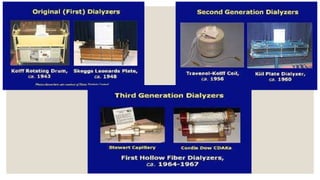
 Dr .Willem KOLFF is considered the father of dialysis
 This young Dutch physician constructed the first dialyzer (artificial kidney) in 1943.
 The road to Willem KOLFF’S creation of an artificial kidney began in the late 1930
 When he was working in a small ward at the university of Groningen hospital in the Netherlands.
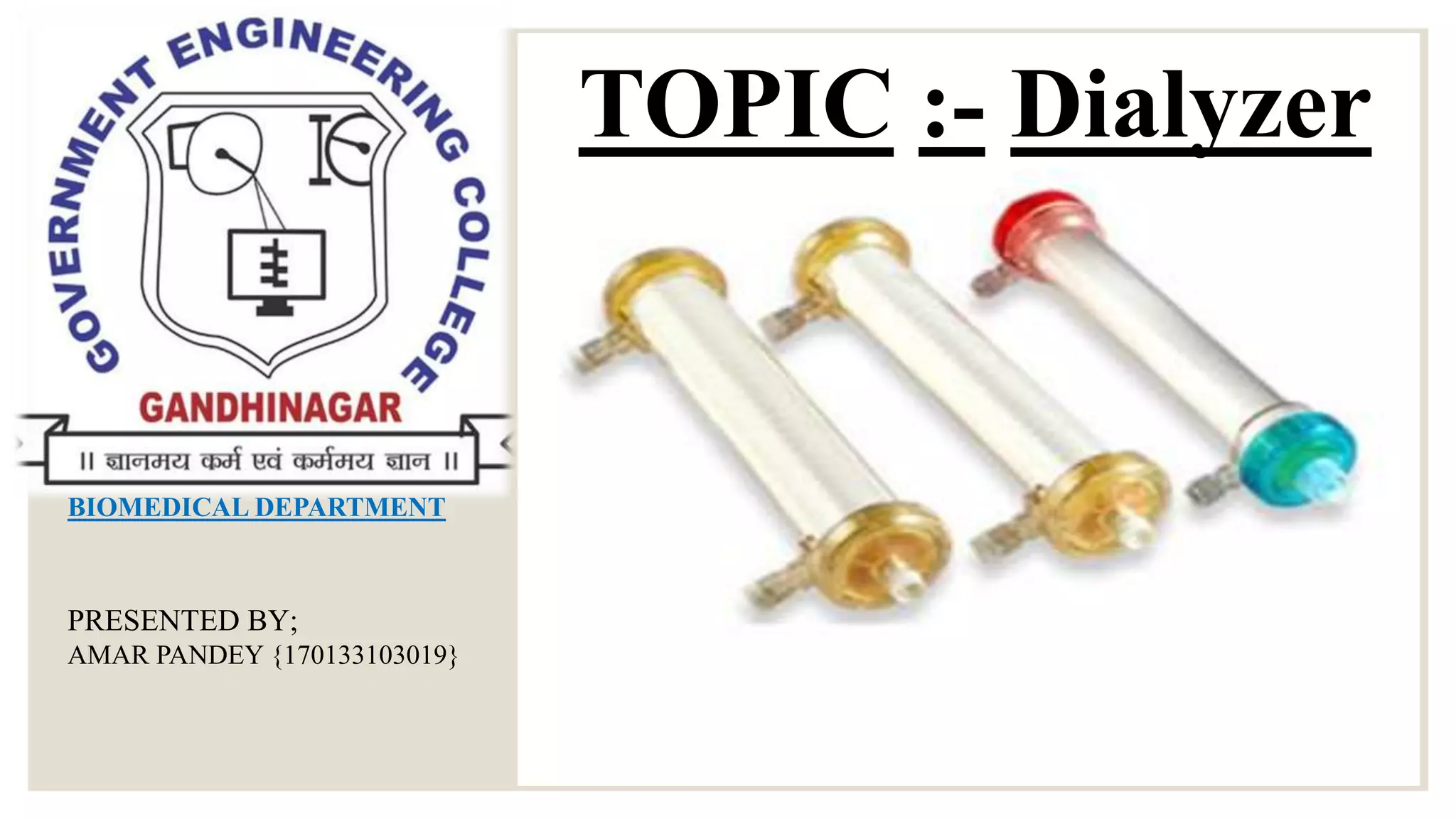
Dialyzer
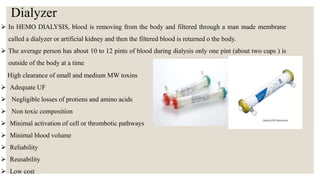
 In HEMO DIALYSIS, blood is removing from the body and filtered through a man made membrane
called a dialyzer or artificial kidney and then the filtered blood is returned o the body.
 The average person has about 10 to 12 pints of blood during dialysis only one pint (about two cups ) is
outside of the body at a time
High clearance of small and medium MW toxins
 Adequate UF
 Negligible losses of protiens and amino acids
 Non toxic composition
 Minimal activation of cell or thrombotic pathways
 Minimal blood volume
 Reliability
 Reusability
 Low cost
Components
 A dialyzer is composed of a dialysis membrane and supporting structure three or four components.
 Blood compartment.
 DIALYSATE compartment.
 Semi permeable membrane separating (1)and(20).
 Membrane support structure .
 Dialysis work on the principle of the diffusion of solutes and ultra filtration of fluid
across a SEMI PERMEABLE MEMBARANE .
Principle
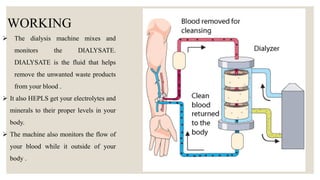
 The dialysis machine mixes and
monitors the DIALYSATE.
DIALYSATE is the fluid that helps
remove the unwanted waste products
from your blood .
 It also HEPLS get your electrolytes and
minerals to their proper levels in your
body.
 The machine also monitors the flow of
your blood while it outside of your
body .
WORKING
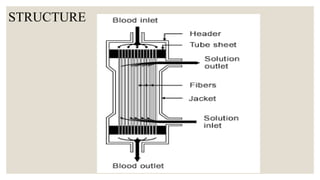
STRUCTURE
DIALYZER MEMBRANE
Cellulose:
 Obtained form processed cotton (regenerated cellulose, cuprammonium cellulose, cuprammonium
rayon and saponified cellulose)
Substituted cellulose:
 Cellulose polymer has a large number of free hydroxyl group at its surface
 Free hydroxyl group are responsible for blood cell activation causing bio-incompatibiltiy of the
dialyzer (cellulose acetate, cellulose diacetate, triacetate)
DIALYZER MEMBRANE
Cellulosynthetic:
 A synthetic material ( a tertiary amino compound) is added to liquefied cellulose during formation
of the membrane as result the surface of the membrane is altered and biocompatibility is increased
(cellosyn or hemphan)
Synthetics:
 Not cellulose based but are synthetic plastics and materials used include polyacrylonitrile (PAN)
polysulfone, polycarbonate, polyamide and polymethyl-methacrylate (PMMA)
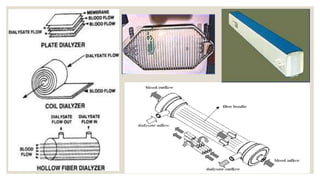
1. Coil dialyzer:
 Flattened cellulose tubing wrapped as a coil
and through which patients blood flow
during dialysis.
 The blood channels was long to obtain the
needed surface area, and resistance was
high
 UF was unpredictable and blood leak were
frequent.
DIALYZER TYPES
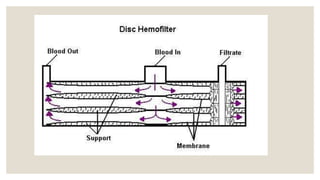
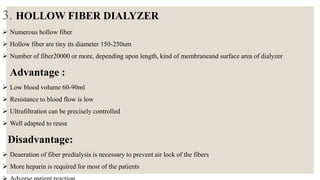
2. PARALLEL PLATE DIALYZER
 Sheets of membrane are placed between supporting plates.
 The plates have ridges and grooves to support the membrane and allow flow of dialysate along it
 Resistance to blood flow is low. The surface area vary from 0.25 to 1.5 msq.
Advantage:
 Blood volume is about 50-100 ml at 100 mmHg increase with high TMP
 Heparin requirement usually low, minimal clotting in the blood compartment
 Ultrafiltration is reasonably predictable and controllable
Disadvantage:
 Formation of local thrombi around inlet and outlet ports and corners
 May lead to bacterial growth and endotoxin formation therefore plates are not often reused
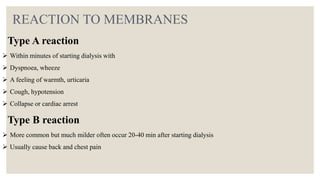
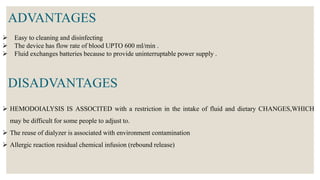
3. HOLLOW FIBER DIALYZER
 Numerous hollow fiber
 Hollow fiber are tiny its diameter 150-250um
 Number of fiber20000 or more, depending upon length, kind of membraneand surface area of dialyzer
Advantage :
 Low blood volume 60-90ml
 Resistance to blood flow is low
 Ultrafiltration can be precisely controlled
 Well adapted to reuse
Disadvantage:
 Deaeration of fiber predialysis is necessary to prevent air lock of the fibers
 More heparin is required for most of the patients
REACTION TO MEMBRANES
Type A reaction
 Within minutes of starting dialysis with
 Dyspnoea, wheeze
 A feeling of warmth, urticaria
 Cough, hypotension
 Collapse or cardiac arrest
Type B reaction
 More common but much milder often occur 20-40 min after starting dialysis
 Usually cause back and chest pain
 Easy to cleaning and disinfecting
 The device has flow rate of blood UPTO 600 ml/min .
 Fluid exchanges batteries because to provide uninterruptable power supply .
ADVANTAGES
 HEMODOIALYSIS IS ASSOCITED with a restriction in the intake of fluid and dietary CHANGES,WHICH
may be difficult for some people to adjust to.
 The reuse of dialyzer is associated with environment contamination
 Allergic reaction residual chemical infusion (rebound release)
DISADVANTAGES
 In medicine, dialysis is a process for removing waste and excess water from he blood and in
used primarily a as an artificial replacement for lost kidney functions in people with kidney
failure .
Application
Thank you

DIALYZER

  • 1.
    PRESENTED BY; AMAR PANDEY{170133103019} BIOMEDICAL DEPARTMENT TOPIC :- Dialyzer
  • 2.
     Overview dialysismachines are artificial kidney that perform most, but not all, kidney function for patients who have permanent or temporary renal failure  The machine use HEMODIALYSIS to cleanse the blood and balance its constituents. History Introduction  Dr .Willem KOLFF is considered the father of dialysis  This young Dutch physician constructed the first dialyzer (artificial kidney) in 1943.  The road to Willem KOLFF’S creation of an artificial kidney began in the late 1930  When he was working in a small ward at the university of Groningen hospital in the Netherlands.
  • 4.
    Dialyzer  In HEMODIALYSIS, blood is removing from the body and filtered through a man made membrane called a dialyzer or artificial kidney and then the filtered blood is returned o the body.  The average person has about 10 to 12 pints of blood during dialysis only one pint (about two cups ) is outside of the body at a time High clearance of small and medium MW toxins  Adequate UF  Negligible losses of protiens and amino acids  Non toxic composition  Minimal activation of cell or thrombotic pathways  Minimal blood volume  Reliability  Reusability  Low cost
  • 5.
    Components  A dialyzeris composed of a dialysis membrane and supporting structure three or four components.  Blood compartment.  DIALYSATE compartment.  Semi permeable membrane separating (1)and(20).  Membrane support structure .  Dialysis work on the principle of the diffusion of solutes and ultra filtration of fluid across a SEMI PERMEABLE MEMBARANE . Principle
  • 6.
     The dialysismachine mixes and monitors the DIALYSATE. DIALYSATE is the fluid that helps remove the unwanted waste products from your blood .  It also HEPLS get your electrolytes and minerals to their proper levels in your body.  The machine also monitors the flow of your blood while it outside of your body . WORKING
  • 7.
  • 9.
    DIALYZER MEMBRANE Cellulose:  Obtainedform processed cotton (regenerated cellulose, cuprammonium cellulose, cuprammonium rayon and saponified cellulose) Substituted cellulose:  Cellulose polymer has a large number of free hydroxyl group at its surface  Free hydroxyl group are responsible for blood cell activation causing bio-incompatibiltiy of the dialyzer (cellulose acetate, cellulose diacetate, triacetate)
  • 10.
    DIALYZER MEMBRANE Cellulosynthetic:  Asynthetic material ( a tertiary amino compound) is added to liquefied cellulose during formation of the membrane as result the surface of the membrane is altered and biocompatibility is increased (cellosyn or hemphan) Synthetics:  Not cellulose based but are synthetic plastics and materials used include polyacrylonitrile (PAN) polysulfone, polycarbonate, polyamide and polymethyl-methacrylate (PMMA)
  • 11.
    1. Coil dialyzer: Flattened cellulose tubing wrapped as a coil and through which patients blood flow during dialysis.  The blood channels was long to obtain the needed surface area, and resistance was high  UF was unpredictable and blood leak were frequent. DIALYZER TYPES
  • 12.
    2. PARALLEL PLATEDIALYZER  Sheets of membrane are placed between supporting plates.  The plates have ridges and grooves to support the membrane and allow flow of dialysate along it  Resistance to blood flow is low. The surface area vary from 0.25 to 1.5 msq. Advantage:  Blood volume is about 50-100 ml at 100 mmHg increase with high TMP  Heparin requirement usually low, minimal clotting in the blood compartment  Ultrafiltration is reasonably predictable and controllable Disadvantage:  Formation of local thrombi around inlet and outlet ports and corners  May lead to bacterial growth and endotoxin formation therefore plates are not often reused
  • 14.
    3. HOLLOW FIBERDIALYZER  Numerous hollow fiber  Hollow fiber are tiny its diameter 150-250um  Number of fiber20000 or more, depending upon length, kind of membraneand surface area of dialyzer Advantage :  Low blood volume 60-90ml  Resistance to blood flow is low  Ultrafiltration can be precisely controlled  Well adapted to reuse Disadvantage:  Deaeration of fiber predialysis is necessary to prevent air lock of the fibers  More heparin is required for most of the patients
  • 15.
    REACTION TO MEMBRANES TypeA reaction  Within minutes of starting dialysis with  Dyspnoea, wheeze  A feeling of warmth, urticaria  Cough, hypotension  Collapse or cardiac arrest Type B reaction  More common but much milder often occur 20-40 min after starting dialysis  Usually cause back and chest pain
  • 16.
     Easy tocleaning and disinfecting  The device has flow rate of blood UPTO 600 ml/min .  Fluid exchanges batteries because to provide uninterruptable power supply . ADVANTAGES  HEMODOIALYSIS IS ASSOCITED with a restriction in the intake of fluid and dietary CHANGES,WHICH may be difficult for some people to adjust to.  The reuse of dialyzer is associated with environment contamination  Allergic reaction residual chemical infusion (rebound release) DISADVANTAGES
  • 17.
     In medicine,dialysis is a process for removing waste and excess water from he blood and in used primarily a as an artificial replacement for lost kidney functions in people with kidney failure . Application
  • 18.