DIALYZER
By
SATHISHKUMAR G
(sathishsak111@gmail.com)
Contents :
• Introduction
• History
• Dialyzer
• Components
• Principle
• Working
• Structure
• Advantages
• Disadvantages
• Application
Introduction
• Overview dialysis machines are artificial kidney that
perform most, but not all, kidney function for patients
who have permanent or temporary renal failure
• The machine use HEMODIALYSIS to cleanse the blood
and balance its constituents.
History
 Dr .Willem KOLFF is considered the father of dialysis
 This young Dutch physician constructed the first
dialyzer (artificial kidney) in 1943.
 The road to Willem KOLFF’S creation of an artificial
kidney began in the late 1930
 When he was working in a small ward at the university
of Groningen hospital in the Netherlands.
Dialyzer
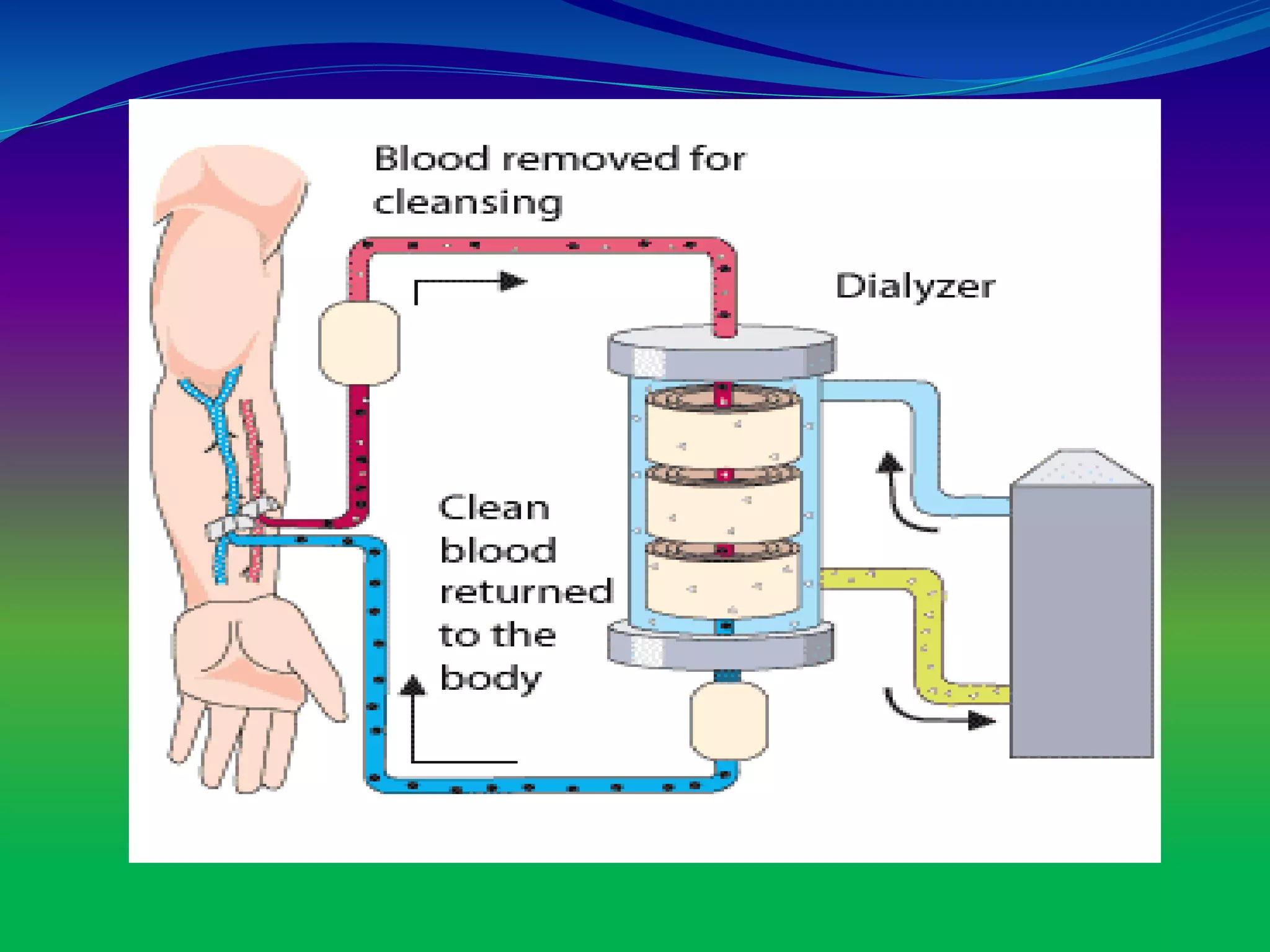
 In HEMO DIALYSIS, blood is removing from the body
and filtered through a man made membrane called a
dialyzer or artificial kidney and then the filtered
blood is returned o the body.
The average person has about 10 to 12 pints of blood
during dialysis only one pint (about two cups ) is
outside of the body at a time
Components
 A dialyzer is composed of a dialysis membrane and
supporting structure three or four components.
 Blood compartment.
 DIALYSATE compartment.
 Semi permeable membrane separating (1)and(20).
 Membrane support structure .
Principle
Dialysis work on the principle of the
diffusion of solutes and ultra filtration of fluid across a
SEMI PERMEABLE MEMBARANE .
Working
 The dialysis machine mixes and monitors the
DIALYSATE. DIALYSATE is the fluid that helps remove
the unwanted waste products from your blood .
 It also HEPLS get your electrolytes and minerals to
their proper levels in your body.
 The machine also monitors the flow of your blood
while it outside of your body .
structure
Advantages :
 Easy to cleaning and disinfecting
 The device has flow rate of blood UPTO 600 ml/min .
 Fluid exchanges batteries because to provide
uninterruptable power supply .
Disadvantages
• HEMODOIALYSIS IS ASSOCITED with a restriction
in the intake of fluid and dietary CHANGES,WHICH
may be difficult for some people to adjust to.
• The reuse of dialyzer is associated with environment
contamination
• Allergic reaction residual chemical infusion (rebound
release)
Application
 In medicine, dialysis is a process for removing waste
and excess water from he blood and in used primarily a
as an artificial replacement for lost kidney functions in
people with kidney failure .
Thank you
?

DIALYZER

  • 1.
  • 2.
    Contents : • Introduction •History • Dialyzer • Components • Principle • Working • Structure • Advantages • Disadvantages • Application
  • 3.
    Introduction • Overview dialysismachines are artificial kidney that perform most, but not all, kidney function for patients who have permanent or temporary renal failure • The machine use HEMODIALYSIS to cleanse the blood and balance its constituents.
  • 4.
    History  Dr .WillemKOLFF is considered the father of dialysis  This young Dutch physician constructed the first dialyzer (artificial kidney) in 1943.  The road to Willem KOLFF’S creation of an artificial kidney began in the late 1930  When he was working in a small ward at the university of Groningen hospital in the Netherlands.
  • 5.
    Dialyzer  In HEMODIALYSIS, blood is removing from the body and filtered through a man made membrane called a dialyzer or artificial kidney and then the filtered blood is returned o the body. The average person has about 10 to 12 pints of blood during dialysis only one pint (about two cups ) is outside of the body at a time
  • 7.
    Components  A dialyzeris composed of a dialysis membrane and supporting structure three or four components.  Blood compartment.  DIALYSATE compartment.  Semi permeable membrane separating (1)and(20).  Membrane support structure .
  • 8.
    Principle Dialysis work onthe principle of the diffusion of solutes and ultra filtration of fluid across a SEMI PERMEABLE MEMBARANE .
  • 10.
    Working  The dialysismachine mixes and monitors the DIALYSATE. DIALYSATE is the fluid that helps remove the unwanted waste products from your blood .  It also HEPLS get your electrolytes and minerals to their proper levels in your body.  The machine also monitors the flow of your blood while it outside of your body .
  • 11.
  • 13.
    Advantages :  Easyto cleaning and disinfecting  The device has flow rate of blood UPTO 600 ml/min .  Fluid exchanges batteries because to provide uninterruptable power supply .
  • 14.
    Disadvantages • HEMODOIALYSIS ISASSOCITED with a restriction in the intake of fluid and dietary CHANGES,WHICH may be difficult for some people to adjust to. • The reuse of dialyzer is associated with environment contamination • Allergic reaction residual chemical infusion (rebound release)
  • 15.
    Application  In medicine,dialysis is a process for removing waste and excess water from he blood and in used primarily a as an artificial replacement for lost kidney functions in people with kidney failure .
  • 16.
  • 17.