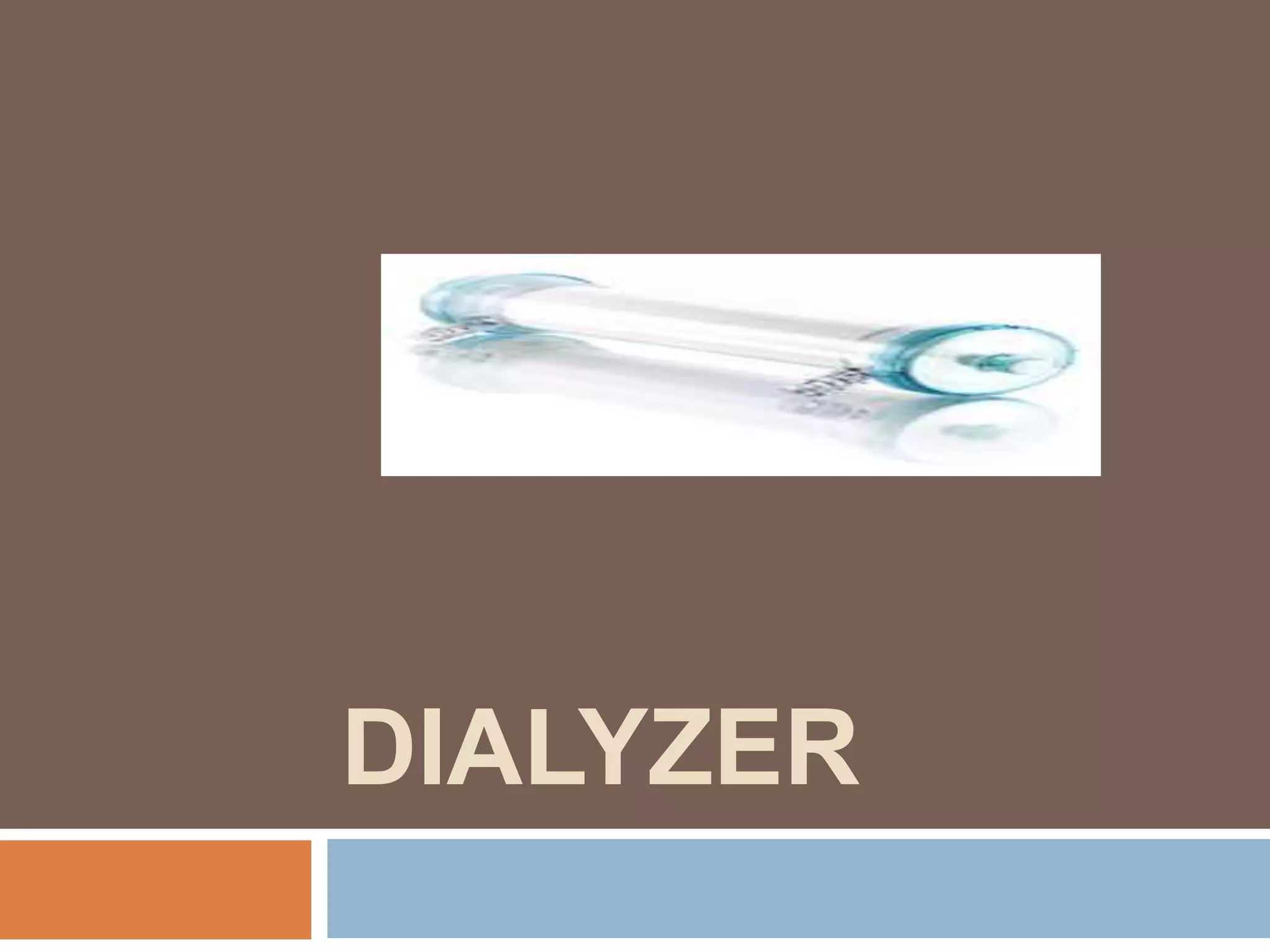
DIALYZER
INTRODUCTION
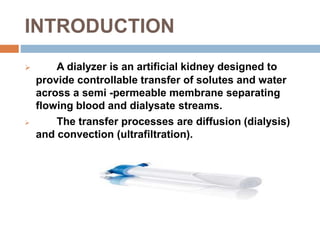
 A dialyzer is an artificial kidney designed to
provide controllable transfer of solutes and water
across a semi -permeable membrane separating
flowing blood and dialysate streams.
 The transfer processes are diffusion (dialysis)
and convection (ultrafiltration).
COMPONENTS OF DIALYZER
 BLOOD COMPARTMENT
 DIALYSATE
COMPARTMENT
 the fluid pumped into the canister
to surround the hollow fibers
 dialysate helps remove uremic
wastes, it also helps maintain a
proper balance of electrolytes –
sodium, chloride, and magnesium
– in the blood.
 SEMI PERMEABLE
MEMBRANE
 MEMBRANE SUPPORT
STRUCTURE
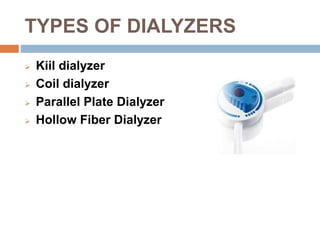
TYPES OF DIALYZERS
 Kiil dialyzer
 Coil dialyzer
 Parallel Plate Dialyzer
 Hollow Fiber Dialyzer
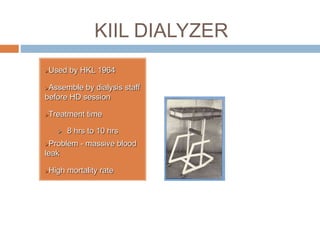
KIIL DIALYZER
Used by HKL 1964
Assemble by dialysis staff
before HD session
Treatment time
 8 hrs to 10 hrs
Problem - massive blood
leak
High mortality rate
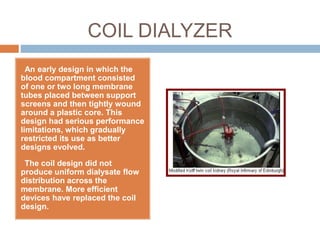
COIL DIALYZER
An early design in which the
blood compartment consisted
of one or two long membrane
tubes placed between support
screens and then tightly wound
around a plastic core. This
design had serious performance
limitations, which gradually
restricted its use as better
designs evolved.
The coil design did not
produce uniform dialysate flow
distribution across the
membrane. More efficient
devices have replaced the coil
design.
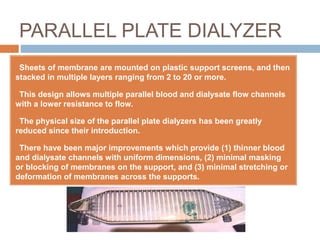
PARALLEL PLATE DIALYZER
Sheets of membrane are mounted on plastic support screens, and then
stacked in multiple layers ranging from 2 to 20 or more.
This design allows multiple parallel blood and dialysate flow channels
with a lower resistance to flow.
The physical size of the parallel plate dialyzers has been greatly
reduced since their introduction.
There have been major improvements which provide (1) thinner blood
and dialysate channels with uniform dimensions, (2) minimal masking
or blocking of membranes on the support, and (3) minimal stretching or
deformation of membranes across the supports.
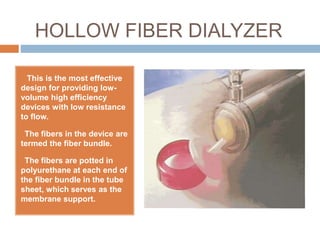
HOLLOW FIBER DIALYZER
 This is the most effective
design for providing low-
volume high efficiency
devices with low resistance
to flow.
The fibers in the device are
termed the fiber bundle.
The fibers are potted in
polyurethane at each end of
the fiber bundle in the tube
sheet, which serves as the
membrane support.
HOLLOW FIBER DIALYZER
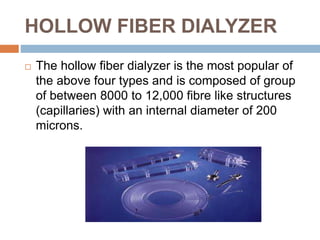
 The hollow fiber dialyzer is the most popular of
the above four types and is composed of group
of between 8000 to 12,000 fibre like structures
(capillaries) with an internal diameter of 200
microns.
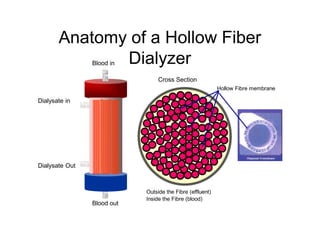
Anatomy of a Hollow Fiber
Dialyzer
Hollow Fibre membrane
Blood in
Blood out
Dialysate in
Dialysate Out
Cross Section
Outside the Fibre (effluent)
Inside the Fibre (blood)
ADVANTAGES OF HOLLOW
FIBER DIALYZER
 LOW OR SMALL PRIMING VOLUME
 HANDY, SMALL AND COMPACT
 INCREASE CLEARANCE OF MIDDLE MOLECULES
 GOOD ULTRAFILTRATION RATE (UFR)
 NO REBUILDING
 REDUCED RISK OF LEAKAGE
CONCLUSION
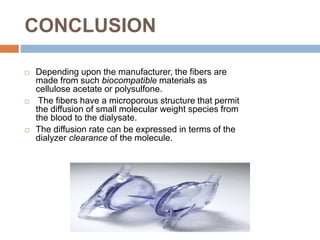
 Depending upon the manufacturer, the fibers are
made from such biocompatible materials as
cellulose acetate or polysulfone.
 The fibers have a microporous structure that permit
the diffusion of small molecular weight species from
the blood to the dialysate.
 The diffusion rate can be expressed in terms of the
dialyzer clearance of the molecule.
….. IS JUST A NEW BEGINNING
THE END

DIALYZER.ppt

  • 1.
  • 2.
    INTRODUCTION  A dialyzeris an artificial kidney designed to provide controllable transfer of solutes and water across a semi -permeable membrane separating flowing blood and dialysate streams.  The transfer processes are diffusion (dialysis) and convection (ultrafiltration).
  • 3.
    COMPONENTS OF DIALYZER BLOOD COMPARTMENT  DIALYSATE COMPARTMENT  the fluid pumped into the canister to surround the hollow fibers  dialysate helps remove uremic wastes, it also helps maintain a proper balance of electrolytes – sodium, chloride, and magnesium – in the blood.  SEMI PERMEABLE MEMBRANE  MEMBRANE SUPPORT STRUCTURE
  • 4.
    TYPES OF DIALYZERS Kiil dialyzer  Coil dialyzer  Parallel Plate Dialyzer  Hollow Fiber Dialyzer
  • 5.
    KIIL DIALYZER Used byHKL 1964 Assemble by dialysis staff before HD session Treatment time  8 hrs to 10 hrs Problem - massive blood leak High mortality rate
  • 6.
    COIL DIALYZER An earlydesign in which the blood compartment consisted of one or two long membrane tubes placed between support screens and then tightly wound around a plastic core. This design had serious performance limitations, which gradually restricted its use as better designs evolved. The coil design did not produce uniform dialysate flow distribution across the membrane. More efficient devices have replaced the coil design.
  • 7.
    PARALLEL PLATE DIALYZER Sheetsof membrane are mounted on plastic support screens, and then stacked in multiple layers ranging from 2 to 20 or more. This design allows multiple parallel blood and dialysate flow channels with a lower resistance to flow. The physical size of the parallel plate dialyzers has been greatly reduced since their introduction. There have been major improvements which provide (1) thinner blood and dialysate channels with uniform dimensions, (2) minimal masking or blocking of membranes on the support, and (3) minimal stretching or deformation of membranes across the supports.
  • 8.
    HOLLOW FIBER DIALYZER This is the most effective design for providing low- volume high efficiency devices with low resistance to flow. The fibers in the device are termed the fiber bundle. The fibers are potted in polyurethane at each end of the fiber bundle in the tube sheet, which serves as the membrane support.
  • 9.
    HOLLOW FIBER DIALYZER The hollow fiber dialyzer is the most popular of the above four types and is composed of group of between 8000 to 12,000 fibre like structures (capillaries) with an internal diameter of 200 microns.
  • 10.
    Anatomy of aHollow Fiber Dialyzer Hollow Fibre membrane Blood in Blood out Dialysate in Dialysate Out Cross Section Outside the Fibre (effluent) Inside the Fibre (blood)
  • 11.
    ADVANTAGES OF HOLLOW FIBERDIALYZER  LOW OR SMALL PRIMING VOLUME  HANDY, SMALL AND COMPACT  INCREASE CLEARANCE OF MIDDLE MOLECULES  GOOD ULTRAFILTRATION RATE (UFR)  NO REBUILDING  REDUCED RISK OF LEAKAGE
  • 12.
    CONCLUSION  Depending uponthe manufacturer, the fibers are made from such biocompatible materials as cellulose acetate or polysulfone.  The fibers have a microporous structure that permit the diffusion of small molecular weight species from the blood to the dialysate.  The diffusion rate can be expressed in terms of the dialyzer clearance of the molecule.
  • 13.
    ….. IS JUSTA NEW BEGINNING THE END