
Everything you really should know,  but were never taught in EMT School Paul A. Peirce, EMT-B I/C 1/16/2011
History Thomas Graham of Glasgow, first presented the principles of solute transport across a semipermeable membrane in 1854 The artificial kidney was first developed by Abel, Rountree and Turner in 1913 The first hemodialysis in a human being was by Hass (February 28, 1924)  In 1945 a 67 year old woman in uremic coma regained consciousness following 11 hours of hemodialysis with the dialyzer, and lived for another 7 years before passing away of an unrelated condition. (This was the first patient to ever be successfully treated with dialysis.) Paul A. Peirce, EMT-B I/C 1/16/2011
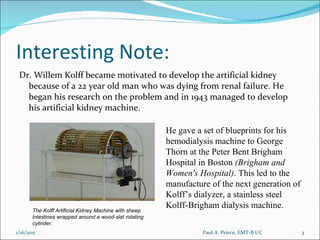
Interesting Note: Dr. Willem Kolff became motivated to develop the artificial kidney because of a 22 year old man who was dying from renal failure. He began his research on the problem and in 1943 managed to develop his artificial kidney machine.  He gave a set of blueprints for his hemodialysis machine to George Thorn at the Peter Bent Brigham Hospital in Boston  (Brigham and Women's Hospital) . This led to the manufacture of the next generation of Kolff’s dialyzer, a stainless steel Kolff-Brigham dialysis machine. The Kolff Artificial Kidney Machine with sheep intestines wrapped around a wood-slat rotating cylinder. Paul A. Peirce, EMT-B I/C 1/16/2011
Dr. Nills Alwell Dr. Nils Alwall encased a modified version of this kidney inside a stainless steel canister, to which a negative pressure could be applied, in this way effecting the first truly practical application of hemodialysis, which was done in 1946 at the University of Lund.  Alwall also was arguably the inventor of the arteriovenous shunt for dialysis.  He reported this first in 1948 where he used such an arteriovenous shunt in rabbits.  He used such shunts, made of glass, as well as his canister-enclosed dialyzer, to treat 1500 patients in renal failure between 1946 and 1960, as reported to the First International Congress of Nephrology held in Evian in September 1960.  Alwall was appointed to a newly-created Chair of Nephrology at the University of Lund in 1957 . Paul A. Peirce, EMT-B I/C 1/16/2011
Dr. Belding H. Scribner Working with a surgeon, Dr. Wayne Quinton, Scribner modified the glass shunts used by Alwall by making them from Teflon Another key improvement was to connect them to a short piece of silicone elastomer tubing After treatment, the circulatory access would be kept open by connecting the two tubes outside the body using a small U-shaped Teflon tube, which would shunt the blood from the tube in the artery back to the tube in the vein. Paul A. Peirce, EMT-B I/C 1/16/2011
Dr. Belding H. Scribner (cont.) In 1962, Scribner started the world’s first outpatient dialysis facility, the Seattle Artificial Kidney Center, later renamed the Northwest Kidney Centers Immediately the problem arose of who should be given dialysis, since demand far exceeded the capacity of the six dialysis machines at the center Scribner decided that the decision about who would receive dialysis and who wouldn’t, would not be made by him These choices would be made by an anonymous committee, which could be viewed as one of the first bioethics committees. Paul A. Peirce, EMT-B I/C 1/16/2011
Just what do they do? Paul A. Peirce, EMT-B I/C 1/16/2011
Kidneys – Facts and Function Located near the center of your back.  There are two kidneys (effectively giving you a "spare" kidney should the other ever fail) Each kidney is only four inches long, two inches wide and an inch thick Contains miles of capillaries and tiny tubes In 24 hours, a kidney can filter about 180 quarts of blood.  Paul A. Peirce, EMT-B I/C 1/16/2011
Kidneys – Facts and Function The kidneys have three main functions:  Control concentrations of body fluids,  Rid the body of unwanted soluble waste Regulate a proper acid-alkaline environment in the body for proper chemical reactions Even small variances may result in death Paul A. Peirce, EMT-B I/C 1/16/2011
What does it mean? Paul A. Peirce, EMT-B I/C 1/16/2011
  Kidney Failure Kidney failure, or renal failure, occurs when the kidneys fail to function adequately.  Kidney failure is normally classified as either acute chronic Paul A. Peirce, EMT-B I/C 1/16/2011
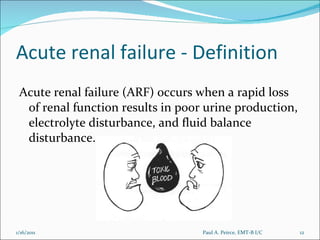
Acute renal failure - Definition Acute renal failure (ARF) occurs when a rapid loss of renal function results in poor urine production, electrolyte disturbance, and fluid balance disturbance.  Paul A. Peirce, EMT-B I/C 1/16/2011
Acute renal failure Causes Decreased blood flow to the kidneys Trauma Cardiac failure Surgery Shock / Sepsis Urinary tract obstruction Reversible if recognized early Many patients will require dialysis. Paul A. Peirce, EMT-B I/C 1/16/2011
Chronic Renal Failure - Definition Chronic renal failure (CRF) or chronic kidney disease (CKD) occurs when a progressive loss of kidney function occurs over a period of months to years. Also known as End Stage Renal Disease (ESRD). Paul A. Peirce, EMT-B I/C 1/16/2011
Chronic Renal Failure Causes Diabetes  (Renalopathy) Hypertension  (Too much pressure pushing through the pipes for too long) Permanent, can be life threatening Requires Dialysis or kidney transplant Paul A. Peirce, EMT-B I/C 1/16/2011
Complications Pulmonary Edema Cardiac Tamponade Electrolyte and other metabolic abnormalities Cardiac Dysrhythmias Congestive heart failure Hypertension Liver Failure Seizures Uremia Paul A. Peirce, EMT-B I/C 1/16/2011
Signs and Symptoms Abdominopelvic or flank pain Hematuria Edema Decreased urine output or cessation of urination Hypertension A norexia Tachycardia Paul A. Peirce, EMT-B I/C 1/16/2011
What is it, and how does it work? Paul A. Peirce, EMT-B I/C 1/16/2011
Dialysis - Definition Dialysis is an artificial process used to remove water and waste substances from the blood when the kidneys fail to function properly.  It generally works through osmosis and filtration of fluid across a semipermeable membrane with the use of a dialysate.  Paul A. Peirce, EMT-B I/C 1/16/2011
Principle Dialysis works on the principles of the diffusion of solutes and ultrafiltration of fluid across a semi-permeable membrane.  Diffusion describes a property of substances in water.  Substances in water tend to move  From an area of high concentration  To an area of low concentration.  Blood flows by one side of a semipermeable membrane A dialysate (or special dialysis fluid) flows by the opposite side. Paul A. Peirce, EMT-B I/C 1/16/2011
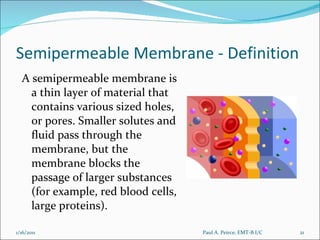
Semipermeable Membrane - Definition A semipermeable membrane is a thin layer of material that contains various sized holes, or pores. Smaller solutes and fluid pass through the membrane, but the membrane blocks the passage of larger substances (for example, red blood cells, large proteins).  Paul A. Peirce, EMT-B I/C 1/16/2011
Dialysate - Definition Dialysate is a Solution containing ultra pure water and chemicals (electrolytes) that passes through the artificial kidney to remove excess fluids and wastes from the blood. Urea and other waste products, potassium, and phosphate diffuse into the dialysis solution. Concentrations of sodium chloride are similar to those of normal plasma to prevent loss.  Sodium bicarbonate is added in a higher concentration than plasma to correct blood acidity.  A small amount of glucose is also commonly used. Paul A. Peirce, EMT-B I/C 1/16/2011
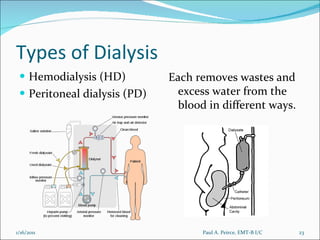
Types of Dialysis Hemodialysis (HD) Peritoneal dialysis (PD) Each removes wastes and excess water from the blood in different ways.  Paul A. Peirce, EMT-B I/C 1/16/2011
Hemodialysis - Definition Hemodialysis is a medical procedure designed to support the lost function of the kidneys. It removes the buildup of toxins that occurs when the kidneys can no longer filter these toxins out. Hemodialysis is the type of dialysis in which blood is extracted from the body and sent through a machine called a dialyzer. Paul A. Peirce, EMT-B I/C 1/16/2011
Hemodialysis – Definition (cont.) In hemodialysis, the patient's blood is pumped through the blood compartment of a dialyzer, exposing it to a partially permeable membrane. The dialyzer is composed of thousands of tiny synthetic hollow fibers. The fiber wall acts as the semipermeable membrane. Blood flows through the fibers, dialysis solution flows around the outside the fibers, and water and wastes move between these two solutions.   The cleansed blood is then returned via the circuit back to the body. Paul A. Peirce, EMT-B I/C 1/16/2011
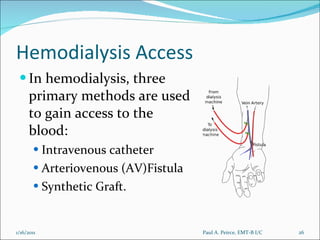
Hemodialysis Access In hemodialysis, three primary methods are used to gain access to the blood:  Intravenous catheter Arteriovenous (AV)Fistula Synthetic Graft.  Paul A. Peirce, EMT-B I/C 1/16/2011
Hemodialysis Access (cont.) Type of access is influenced by factors such as  Expected time course of a patient's renal failure and  Condition of his or her vasculature.  Patients may have multiple accesses An AV fistula or graft is maturing Catheter is still being used A previous fistula or graft was damaged/diseased All three major types of vascular accesses need a surgery to create. Paul A. Peirce, EMT-B I/C 1/16/2011
Catheter Access - Definition Sometimes called a CVC (Central Venous Catheter), it consists of a plastic catheter with two lumens (or occasionally two separate catheters) inserted into a large vein, usually the Vena Cava via the internal Jugular Vein or the Femoral Vein.  This allows large flows of blood to be withdrawn from one lumen, to enter the dialysis circuit, and to be returned via the other lumen.  Blood flow is almost always less than that of a well functioning fistula or graft. Paul A. Peirce, EMT-B I/C 1/16/2011
Catheter Types Catheters are usually found in two general varieties, tunnelled and non-tunnelled. Non-tunnelled catheter access is for short-term access Up to about 10 days Often for one dialysis session only Catheter emerges from the skin at the site of entry into the vein. Paul A. Peirce, EMT-B I/C 1/16/2011
Catheter Types (cont.) Tunnelled access involves a longer catheter “ Tunnelled” under the skin  From the point of insertion in the vein To exit site some distance away Usually placed in the internal jugular vein  Exit site is usually on the chest wall.  The tunnel acts as a barrier to invading microbes, and as such, tunnelled catheters are designed for short- to medium-term access (weeks to months only), because infection is still a frequent problem. Paul A. Peirce, EMT-B I/C 1/16/2011
Catheter Problems Infection (frequent) tunnelled catheters are designed for short-to medium-term access weeks to months only Venous Stenosis (serious) Foreign body in the vein  Often provokes inflammatory reaction in vein wall Paul A. Peirce, EMT-B I/C 1/16/2011
Catheter Problems (cont.) Venous stenosis (continued) Results in scarring and narrowing of vein Often to the point of occlusion Can cause problems with severe venous congestion in the area drained by the vein May render the vein, and the veins drained by it, useless for creating a fistula or graft at a later date Patients on long-term hemodialysis can literally 'run out' of access, so this can be a fatal problem. Paul A. Peirce, EMT-B I/C 1/16/2011
OMG…! Why a Catheter? Catheter access is usually used for Rapid access for immediate dialysis Tunnelled access in patients who are deemed likely to recover from acute renal failure Patients with end-stage renal failure Waiting for alternative access to mature Are unable to have alternative access. Paul A. Peirce, EMT-B I/C 1/16/2011
OMG…! Why a Catheter? (Cont.) Catheter access is often popular with patients Attachment to the dialysis machine doesn't require needles being inserted into skin The serious risks of catheter access previously noted mean that such access is contemplated only as a long-term solution in the most desperate access situation. Paul A. Peirce, EMT-B I/C 1/16/2011
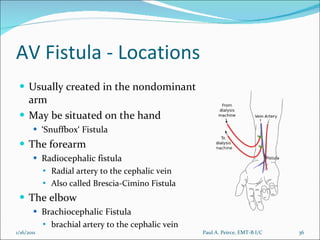
AV Fistula - Definition AV (arteriovenous) fistulas are recognized as the preferred access method. To create a fistula, a vascular surgeon joins an artery and a vein together through anastomosis. Since this bypasses the capillaries, blood flows rapidly through the fistula. One can feel this by placing one's finger over a mature fistula. This is called feeling for "thrill" and produces a distinct 'buzzing' feeling over the fistula. One can also listen through a stethoscope for the sound of the blood "whooshing" through the fistula, a sound called bruit. Paul A. Peirce, EMT-B I/C 1/16/2011
AV Fistula - Locations Usually created in the nondominant arm May be situated on the hand ‘ Snuffbox‘ Fistula The forearm Radiocephalic fistula Radial artery to the cephalic vein Also called Brescia-Cimino Fistula The elbow Brachiocephalic Fistula brachial artery to the cephalic vein Paul A. Peirce, EMT-B I/C 1/16/2011
AV Fistula – Locations (Cont.) A fistula will take a number of weeks to mature, on average perhaps 4–6 weeks. During treatment, two needles are inserted into the fistula, one to draw blood and one to return it. Paul A. Peirce, EMT-B I/C 1/16/2011
AV Fistula - Advantages Lower infection rates No foreign material is involved in their formation Higher blood flow rates Translates to more effective dialysis Lower incidence of thrombosis Paul A. Peirce, EMT-B I/C 1/16/2011
AV Fistula - Complications The complications are few If a fistula has a very high blood flow & supply to  the rest of the limb is poor A steal syndrome can occur Blood entering the limb is drawn into the fistula  Blood is returned to the general circulation without entering the limb's capillaries.  Results in cold extremities of that limb Cramping pains If severe, tissue damage.  Paul A. Peirce, EMT-B I/C 1/16/2011
AV Fistula - Complications Development of an aneurysm Long term complication A bulging in the wall of the vein Weakened by the repeated insertion of needles over time Note: Aneurysms may necessitate corrective surgery and may shorten the useful life of a fistula. Paul A. Peirce, EMT-B I/C 1/16/2011
AV Graft AV (arteriovenous) grafts are much like fistulas in most respects, except that an artificial vessel is used to join the artery and vein. The graft usually is made of a synthetic material, often PTFE, but sometimes chemically treated, sterilized veins from animals are used.  Paul A. Peirce, EMT-B I/C 1/16/2011
AV - Advantages Grafts are inserted when the patient's native vasculature does not permit a fistula.  They mature faster than fistulas May be ready for use several weeks after formation Some newer grafts may be used even sooner More options for sites to place a graft are available Because the graft can be made quite long Can be placed in the thigh Can be placed in the neck (the 'necklace graft'). Paul A. Peirce, EMT-B I/C 1/16/2011
AV Graft - Complications AV grafts are at high risk to develop narrowing Especially in the vein just downstream from where the graft has been sewn to the vein Narrowing often leads to thrombosis (clotting) As foreign material, they are at greater risk for becoming infected Paul A. Peirce, EMT-B I/C 1/16/2011
Dialysis Shunt Generic term for the site that is surgically created in such a way that the repeated needle sticks required to take and return blood to the body several times a week cause a minimal amount of damage to the body. Can also be referred to as  Patient’s “Access” AV Fistula or AV Graft (as a ‘generic term’) Paul A. Peirce, EMT-B I/C 1/16/2011
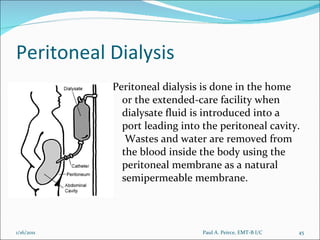
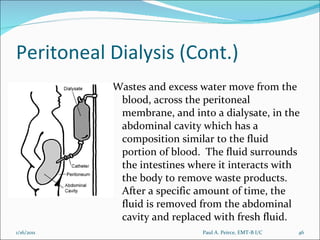
Peritoneal Dialysis Peritoneal dialysis is done in the home or the extended-care facility when dialysate fluid is introduced into a port leading into the peritoneal cavity.  Wastes and water are removed from the blood inside the body using the peritoneal membrane as a natural semipermeable membrane.  Paul A. Peirce, EMT-B I/C 1/16/2011
Peritoneal Dialysis (Cont.) Wastes and excess water move from the blood, across the peritoneal membrane, and into a dialysate, in the abdominal cavity which has a composition similar to the fluid portion of blood.  The fluid surrounds the intestines where it interacts with the body to remove waste products. After a specific amount of time, the fluid is removed from the abdominal cavity and replaced with fresh fluid. Paul A. Peirce, EMT-B I/C 1/16/2011
… for Dialysis Patients Paul A. Peirce, EMT-B I/C 1/16/2011
Problems at Dialysis If an emergency occurs in the midst of a patient’s dialysis treatment: DO NOT attempt to remove the patient prematurely The removal of the patient from the dialysis machine should only occur under the supervision of the dialysis center staff Multiple complications could occur Volume overload Hemorrhage Volume depletion Paul A. Peirce, EMT-B I/C 1/16/2011
Taking Blood Pressure Never   attempt  to obtain a blood pressure in any extremity that has an AV shunt, AV fistula, or AV graft The surgical procedures used to create the shunt can be significantly or irreparably damaged by the application and inflation of a blood pressure cuff Always use an extremity that does not have an AV shunt. Paul A. Peirce, EMT-B I/C 1/16/2011
… that may occur at Dialysis Paul A. Peirce, EMT-B I/C 1/16/2011
Bleeding from AV Shunt If the AV shunt is damaged, it can bleed excessively Bleeding can be external Significant amounts lost rapidly Bleeding can be internal A large hematoma can form beneath surface of skin Apply direct pressure to the site to help control the bleed Treat for shock Expedite transport to the hospital Do not release your direct pressure until told to do so by the receiving physician. Paul A. Peirce, EMT-B I/C 1/16/2011
Peritoneal Dialysis Emergencies Emergencies with peritoneal dialysis are usually not as severe and typically revolve around either a displaced catheter, inflammation at the catheter insertion site, or infection of the peritoneal space (peritonitis). Paul A. Peirce, EMT-B I/C 1/16/2011
Dialysis Complications Hypotension Muscle cramps Peritonitis Nausea and vomiting Hemorrhage Infection Difficulty Breathing Irregular Pulse Cardiac Arrest Paul A. Peirce, EMT-B I/C 1/16/2011
Emergency Medical Care Monitor patient Level of consciousness Vital Signs Maintain airway  Administer Oxygen (per state/local protocols) Support ventilations if or as necessary Control any bleeding from the shunt or access site Place patient in position of comfort Transport to closest appropriate facility Paul A. Peirce, EMT-B I/C 1/16/2011
Summary Dialysis is an artificial process used to remove water and waste substances from the blood when the kidneys fail to function properly. Dialysis has a century-long history of pioneering physicians. It generally works through osmosis and filtration of fluid across a semipermeable membrane with the use of a dialysate. There are two types: Hemodialysis and Peritoneal Dialysis. There are three types of access used: Catheter (CVC), AV Fistula and AV Graft. Paul A. Peirce, EMT-B I/C 1/16/2011
Summary (Cont.) Peritoneal Dialysis is most often conducted in the patient’s home or extended care facility. If there is a problem which requires EMS treatment and transport, the dialysis staff must carefully remove patient from the machine in order to avoid further complications. Blood Pressure is never checked in an extremity in which there’s an AV fistula or graft. Treatment and transport should occur in accordance with state and local protocols and standing orders. Paul A. Peirce, EMT-B I/C 1/16/2011
… thank you for your time and attention. Paul A. Peirce, EMT-B I/C 1/16/2011

Renal failure and dialysis

  • 1.
    Everything you reallyshould know, but were never taught in EMT School Paul A. Peirce, EMT-B I/C 1/16/2011
  • 2.
    History Thomas Grahamof Glasgow, first presented the principles of solute transport across a semipermeable membrane in 1854 The artificial kidney was first developed by Abel, Rountree and Turner in 1913 The first hemodialysis in a human being was by Hass (February 28, 1924) In 1945 a 67 year old woman in uremic coma regained consciousness following 11 hours of hemodialysis with the dialyzer, and lived for another 7 years before passing away of an unrelated condition. (This was the first patient to ever be successfully treated with dialysis.) Paul A. Peirce, EMT-B I/C 1/16/2011
  • 3.
    Interesting Note: Dr.Willem Kolff became motivated to develop the artificial kidney because of a 22 year old man who was dying from renal failure. He began his research on the problem and in 1943 managed to develop his artificial kidney machine. He gave a set of blueprints for his hemodialysis machine to George Thorn at the Peter Bent Brigham Hospital in Boston (Brigham and Women's Hospital) . This led to the manufacture of the next generation of Kolff’s dialyzer, a stainless steel Kolff-Brigham dialysis machine. The Kolff Artificial Kidney Machine with sheep intestines wrapped around a wood-slat rotating cylinder. Paul A. Peirce, EMT-B I/C 1/16/2011
  • 4.
    Dr. Nills AlwellDr. Nils Alwall encased a modified version of this kidney inside a stainless steel canister, to which a negative pressure could be applied, in this way effecting the first truly practical application of hemodialysis, which was done in 1946 at the University of Lund. Alwall also was arguably the inventor of the arteriovenous shunt for dialysis. He reported this first in 1948 where he used such an arteriovenous shunt in rabbits. He used such shunts, made of glass, as well as his canister-enclosed dialyzer, to treat 1500 patients in renal failure between 1946 and 1960, as reported to the First International Congress of Nephrology held in Evian in September 1960. Alwall was appointed to a newly-created Chair of Nephrology at the University of Lund in 1957 . Paul A. Peirce, EMT-B I/C 1/16/2011
  • 5.
    Dr. Belding H.Scribner Working with a surgeon, Dr. Wayne Quinton, Scribner modified the glass shunts used by Alwall by making them from Teflon Another key improvement was to connect them to a short piece of silicone elastomer tubing After treatment, the circulatory access would be kept open by connecting the two tubes outside the body using a small U-shaped Teflon tube, which would shunt the blood from the tube in the artery back to the tube in the vein. Paul A. Peirce, EMT-B I/C 1/16/2011
  • 6.
    Dr. Belding H.Scribner (cont.) In 1962, Scribner started the world’s first outpatient dialysis facility, the Seattle Artificial Kidney Center, later renamed the Northwest Kidney Centers Immediately the problem arose of who should be given dialysis, since demand far exceeded the capacity of the six dialysis machines at the center Scribner decided that the decision about who would receive dialysis and who wouldn’t, would not be made by him These choices would be made by an anonymous committee, which could be viewed as one of the first bioethics committees. Paul A. Peirce, EMT-B I/C 1/16/2011
  • 7.
    Just what dothey do? Paul A. Peirce, EMT-B I/C 1/16/2011
  • 8.
    Kidneys – Factsand Function Located near the center of your back. There are two kidneys (effectively giving you a "spare" kidney should the other ever fail) Each kidney is only four inches long, two inches wide and an inch thick Contains miles of capillaries and tiny tubes In 24 hours, a kidney can filter about 180 quarts of blood. Paul A. Peirce, EMT-B I/C 1/16/2011
  • 9.
    Kidneys – Factsand Function The kidneys have three main functions: Control concentrations of body fluids, Rid the body of unwanted soluble waste Regulate a proper acid-alkaline environment in the body for proper chemical reactions Even small variances may result in death Paul A. Peirce, EMT-B I/C 1/16/2011
  • 10.
    What does itmean? Paul A. Peirce, EMT-B I/C 1/16/2011
  • 11.
    KidneyFailure Kidney failure, or renal failure, occurs when the kidneys fail to function adequately. Kidney failure is normally classified as either acute chronic Paul A. Peirce, EMT-B I/C 1/16/2011
  • 12.
    Acute renal failure- Definition Acute renal failure (ARF) occurs when a rapid loss of renal function results in poor urine production, electrolyte disturbance, and fluid balance disturbance. Paul A. Peirce, EMT-B I/C 1/16/2011
  • 13.
    Acute renal failureCauses Decreased blood flow to the kidneys Trauma Cardiac failure Surgery Shock / Sepsis Urinary tract obstruction Reversible if recognized early Many patients will require dialysis. Paul A. Peirce, EMT-B I/C 1/16/2011
  • 14.
    Chronic Renal Failure- Definition Chronic renal failure (CRF) or chronic kidney disease (CKD) occurs when a progressive loss of kidney function occurs over a period of months to years. Also known as End Stage Renal Disease (ESRD). Paul A. Peirce, EMT-B I/C 1/16/2011
  • 15.
    Chronic Renal FailureCauses Diabetes (Renalopathy) Hypertension (Too much pressure pushing through the pipes for too long) Permanent, can be life threatening Requires Dialysis or kidney transplant Paul A. Peirce, EMT-B I/C 1/16/2011
  • 16.
    Complications Pulmonary EdemaCardiac Tamponade Electrolyte and other metabolic abnormalities Cardiac Dysrhythmias Congestive heart failure Hypertension Liver Failure Seizures Uremia Paul A. Peirce, EMT-B I/C 1/16/2011
  • 17.
    Signs and SymptomsAbdominopelvic or flank pain Hematuria Edema Decreased urine output or cessation of urination Hypertension A norexia Tachycardia Paul A. Peirce, EMT-B I/C 1/16/2011
  • 18.
    What is it,and how does it work? Paul A. Peirce, EMT-B I/C 1/16/2011
  • 19.
    Dialysis - DefinitionDialysis is an artificial process used to remove water and waste substances from the blood when the kidneys fail to function properly. It generally works through osmosis and filtration of fluid across a semipermeable membrane with the use of a dialysate. Paul A. Peirce, EMT-B I/C 1/16/2011
  • 20.
    Principle Dialysis workson the principles of the diffusion of solutes and ultrafiltration of fluid across a semi-permeable membrane. Diffusion describes a property of substances in water. Substances in water tend to move From an area of high concentration To an area of low concentration. Blood flows by one side of a semipermeable membrane A dialysate (or special dialysis fluid) flows by the opposite side. Paul A. Peirce, EMT-B I/C 1/16/2011
  • 21.
    Semipermeable Membrane -Definition A semipermeable membrane is a thin layer of material that contains various sized holes, or pores. Smaller solutes and fluid pass through the membrane, but the membrane blocks the passage of larger substances (for example, red blood cells, large proteins). Paul A. Peirce, EMT-B I/C 1/16/2011
  • 22.
    Dialysate - DefinitionDialysate is a Solution containing ultra pure water and chemicals (electrolytes) that passes through the artificial kidney to remove excess fluids and wastes from the blood. Urea and other waste products, potassium, and phosphate diffuse into the dialysis solution. Concentrations of sodium chloride are similar to those of normal plasma to prevent loss. Sodium bicarbonate is added in a higher concentration than plasma to correct blood acidity. A small amount of glucose is also commonly used. Paul A. Peirce, EMT-B I/C 1/16/2011
  • 23.
    Types of DialysisHemodialysis (HD) Peritoneal dialysis (PD) Each removes wastes and excess water from the blood in different ways. Paul A. Peirce, EMT-B I/C 1/16/2011
  • 24.
    Hemodialysis - DefinitionHemodialysis is a medical procedure designed to support the lost function of the kidneys. It removes the buildup of toxins that occurs when the kidneys can no longer filter these toxins out. Hemodialysis is the type of dialysis in which blood is extracted from the body and sent through a machine called a dialyzer. Paul A. Peirce, EMT-B I/C 1/16/2011
  • 25.
    Hemodialysis – Definition(cont.) In hemodialysis, the patient's blood is pumped through the blood compartment of a dialyzer, exposing it to a partially permeable membrane. The dialyzer is composed of thousands of tiny synthetic hollow fibers. The fiber wall acts as the semipermeable membrane. Blood flows through the fibers, dialysis solution flows around the outside the fibers, and water and wastes move between these two solutions. The cleansed blood is then returned via the circuit back to the body. Paul A. Peirce, EMT-B I/C 1/16/2011
  • 26.
    Hemodialysis Access Inhemodialysis, three primary methods are used to gain access to the blood: Intravenous catheter Arteriovenous (AV)Fistula Synthetic Graft. Paul A. Peirce, EMT-B I/C 1/16/2011
  • 27.
    Hemodialysis Access (cont.)Type of access is influenced by factors such as Expected time course of a patient's renal failure and Condition of his or her vasculature. Patients may have multiple accesses An AV fistula or graft is maturing Catheter is still being used A previous fistula or graft was damaged/diseased All three major types of vascular accesses need a surgery to create. Paul A. Peirce, EMT-B I/C 1/16/2011
  • 28.
    Catheter Access -Definition Sometimes called a CVC (Central Venous Catheter), it consists of a plastic catheter with two lumens (or occasionally two separate catheters) inserted into a large vein, usually the Vena Cava via the internal Jugular Vein or the Femoral Vein. This allows large flows of blood to be withdrawn from one lumen, to enter the dialysis circuit, and to be returned via the other lumen. Blood flow is almost always less than that of a well functioning fistula or graft. Paul A. Peirce, EMT-B I/C 1/16/2011
  • 29.
    Catheter Types Cathetersare usually found in two general varieties, tunnelled and non-tunnelled. Non-tunnelled catheter access is for short-term access Up to about 10 days Often for one dialysis session only Catheter emerges from the skin at the site of entry into the vein. Paul A. Peirce, EMT-B I/C 1/16/2011
  • 30.
    Catheter Types (cont.)Tunnelled access involves a longer catheter “ Tunnelled” under the skin From the point of insertion in the vein To exit site some distance away Usually placed in the internal jugular vein Exit site is usually on the chest wall. The tunnel acts as a barrier to invading microbes, and as such, tunnelled catheters are designed for short- to medium-term access (weeks to months only), because infection is still a frequent problem. Paul A. Peirce, EMT-B I/C 1/16/2011
  • 31.
    Catheter Problems Infection(frequent) tunnelled catheters are designed for short-to medium-term access weeks to months only Venous Stenosis (serious) Foreign body in the vein Often provokes inflammatory reaction in vein wall Paul A. Peirce, EMT-B I/C 1/16/2011
  • 32.
    Catheter Problems (cont.)Venous stenosis (continued) Results in scarring and narrowing of vein Often to the point of occlusion Can cause problems with severe venous congestion in the area drained by the vein May render the vein, and the veins drained by it, useless for creating a fistula or graft at a later date Patients on long-term hemodialysis can literally 'run out' of access, so this can be a fatal problem. Paul A. Peirce, EMT-B I/C 1/16/2011
  • 33.
    OMG…! Why aCatheter? Catheter access is usually used for Rapid access for immediate dialysis Tunnelled access in patients who are deemed likely to recover from acute renal failure Patients with end-stage renal failure Waiting for alternative access to mature Are unable to have alternative access. Paul A. Peirce, EMT-B I/C 1/16/2011
  • 34.
    OMG…! Why aCatheter? (Cont.) Catheter access is often popular with patients Attachment to the dialysis machine doesn't require needles being inserted into skin The serious risks of catheter access previously noted mean that such access is contemplated only as a long-term solution in the most desperate access situation. Paul A. Peirce, EMT-B I/C 1/16/2011
  • 35.
    AV Fistula -Definition AV (arteriovenous) fistulas are recognized as the preferred access method. To create a fistula, a vascular surgeon joins an artery and a vein together through anastomosis. Since this bypasses the capillaries, blood flows rapidly through the fistula. One can feel this by placing one's finger over a mature fistula. This is called feeling for "thrill" and produces a distinct 'buzzing' feeling over the fistula. One can also listen through a stethoscope for the sound of the blood "whooshing" through the fistula, a sound called bruit. Paul A. Peirce, EMT-B I/C 1/16/2011
  • 36.
    AV Fistula -Locations Usually created in the nondominant arm May be situated on the hand ‘ Snuffbox‘ Fistula The forearm Radiocephalic fistula Radial artery to the cephalic vein Also called Brescia-Cimino Fistula The elbow Brachiocephalic Fistula brachial artery to the cephalic vein Paul A. Peirce, EMT-B I/C 1/16/2011
  • 37.
    AV Fistula –Locations (Cont.) A fistula will take a number of weeks to mature, on average perhaps 4–6 weeks. During treatment, two needles are inserted into the fistula, one to draw blood and one to return it. Paul A. Peirce, EMT-B I/C 1/16/2011
  • 38.
    AV Fistula -Advantages Lower infection rates No foreign material is involved in their formation Higher blood flow rates Translates to more effective dialysis Lower incidence of thrombosis Paul A. Peirce, EMT-B I/C 1/16/2011
  • 39.
    AV Fistula -Complications The complications are few If a fistula has a very high blood flow & supply to the rest of the limb is poor A steal syndrome can occur Blood entering the limb is drawn into the fistula Blood is returned to the general circulation without entering the limb's capillaries. Results in cold extremities of that limb Cramping pains If severe, tissue damage. Paul A. Peirce, EMT-B I/C 1/16/2011
  • 40.
    AV Fistula -Complications Development of an aneurysm Long term complication A bulging in the wall of the vein Weakened by the repeated insertion of needles over time Note: Aneurysms may necessitate corrective surgery and may shorten the useful life of a fistula. Paul A. Peirce, EMT-B I/C 1/16/2011
  • 41.
    AV Graft AV(arteriovenous) grafts are much like fistulas in most respects, except that an artificial vessel is used to join the artery and vein. The graft usually is made of a synthetic material, often PTFE, but sometimes chemically treated, sterilized veins from animals are used. Paul A. Peirce, EMT-B I/C 1/16/2011
  • 42.
    AV - AdvantagesGrafts are inserted when the patient's native vasculature does not permit a fistula. They mature faster than fistulas May be ready for use several weeks after formation Some newer grafts may be used even sooner More options for sites to place a graft are available Because the graft can be made quite long Can be placed in the thigh Can be placed in the neck (the 'necklace graft'). Paul A. Peirce, EMT-B I/C 1/16/2011
  • 43.
    AV Graft -Complications AV grafts are at high risk to develop narrowing Especially in the vein just downstream from where the graft has been sewn to the vein Narrowing often leads to thrombosis (clotting) As foreign material, they are at greater risk for becoming infected Paul A. Peirce, EMT-B I/C 1/16/2011
  • 44.
    Dialysis Shunt Genericterm for the site that is surgically created in such a way that the repeated needle sticks required to take and return blood to the body several times a week cause a minimal amount of damage to the body. Can also be referred to as Patient’s “Access” AV Fistula or AV Graft (as a ‘generic term’) Paul A. Peirce, EMT-B I/C 1/16/2011
  • 45.
    Peritoneal Dialysis Peritonealdialysis is done in the home or the extended-care facility when dialysate fluid is introduced into a port leading into the peritoneal cavity. Wastes and water are removed from the blood inside the body using the peritoneal membrane as a natural semipermeable membrane. Paul A. Peirce, EMT-B I/C 1/16/2011
  • 46.
    Peritoneal Dialysis (Cont.)Wastes and excess water move from the blood, across the peritoneal membrane, and into a dialysate, in the abdominal cavity which has a composition similar to the fluid portion of blood. The fluid surrounds the intestines where it interacts with the body to remove waste products. After a specific amount of time, the fluid is removed from the abdominal cavity and replaced with fresh fluid. Paul A. Peirce, EMT-B I/C 1/16/2011
  • 47.
    … for DialysisPatients Paul A. Peirce, EMT-B I/C 1/16/2011
  • 48.
    Problems at DialysisIf an emergency occurs in the midst of a patient’s dialysis treatment: DO NOT attempt to remove the patient prematurely The removal of the patient from the dialysis machine should only occur under the supervision of the dialysis center staff Multiple complications could occur Volume overload Hemorrhage Volume depletion Paul A. Peirce, EMT-B I/C 1/16/2011
  • 49.
    Taking Blood PressureNever attempt to obtain a blood pressure in any extremity that has an AV shunt, AV fistula, or AV graft The surgical procedures used to create the shunt can be significantly or irreparably damaged by the application and inflation of a blood pressure cuff Always use an extremity that does not have an AV shunt. Paul A. Peirce, EMT-B I/C 1/16/2011
  • 50.
    … that mayoccur at Dialysis Paul A. Peirce, EMT-B I/C 1/16/2011
  • 51.
    Bleeding from AVShunt If the AV shunt is damaged, it can bleed excessively Bleeding can be external Significant amounts lost rapidly Bleeding can be internal A large hematoma can form beneath surface of skin Apply direct pressure to the site to help control the bleed Treat for shock Expedite transport to the hospital Do not release your direct pressure until told to do so by the receiving physician. Paul A. Peirce, EMT-B I/C 1/16/2011
  • 52.
    Peritoneal Dialysis EmergenciesEmergencies with peritoneal dialysis are usually not as severe and typically revolve around either a displaced catheter, inflammation at the catheter insertion site, or infection of the peritoneal space (peritonitis). Paul A. Peirce, EMT-B I/C 1/16/2011
  • 53.
    Dialysis Complications HypotensionMuscle cramps Peritonitis Nausea and vomiting Hemorrhage Infection Difficulty Breathing Irregular Pulse Cardiac Arrest Paul A. Peirce, EMT-B I/C 1/16/2011
  • 54.
    Emergency Medical CareMonitor patient Level of consciousness Vital Signs Maintain airway Administer Oxygen (per state/local protocols) Support ventilations if or as necessary Control any bleeding from the shunt or access site Place patient in position of comfort Transport to closest appropriate facility Paul A. Peirce, EMT-B I/C 1/16/2011
  • 55.
    Summary Dialysis isan artificial process used to remove water and waste substances from the blood when the kidneys fail to function properly. Dialysis has a century-long history of pioneering physicians. It generally works through osmosis and filtration of fluid across a semipermeable membrane with the use of a dialysate. There are two types: Hemodialysis and Peritoneal Dialysis. There are three types of access used: Catheter (CVC), AV Fistula and AV Graft. Paul A. Peirce, EMT-B I/C 1/16/2011
  • 56.
    Summary (Cont.) PeritonealDialysis is most often conducted in the patient’s home or extended care facility. If there is a problem which requires EMS treatment and transport, the dialysis staff must carefully remove patient from the machine in order to avoid further complications. Blood Pressure is never checked in an extremity in which there’s an AV fistula or graft. Treatment and transport should occur in accordance with state and local protocols and standing orders. Paul A. Peirce, EMT-B I/C 1/16/2011
  • 57.
    … thank youfor your time and attention. Paul A. Peirce, EMT-B I/C 1/16/2011