Hesham Elsayed
Professor of Nephrology
Ain shams university – Cairo Egypt
BASIC PRINCIPLES OF
HEMODIALYSIS
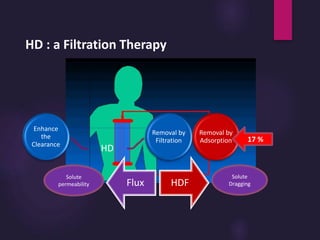
HD : a Filtration Therapy
Enhance
the
Clearance
HD
Removal by
Filtration
Removal by
Adsorption
Flux HDF
17 %
Solute
permeability
Solute
Dragging
Principles of Hemodialysis
Hemodialysis is a treatment which aims to
1- Remove accumulated metabolic waste products and
2-To correct blood electrolyte composition by means of an
exchange between patient's blood and a dialysate fluid
Across a semi-permeable membrane in a countercurrent
mechanism .
3-To remove excess fluids by means of ultrafiltration
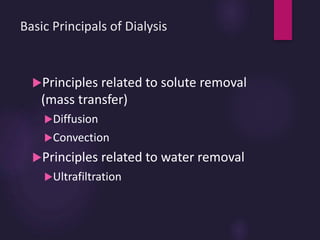
Basic Principals of Dialysis
Principles related to solute removal
(mass transfer)
Diffusion
Convection
Principles related to water removal
Ultrafiltration
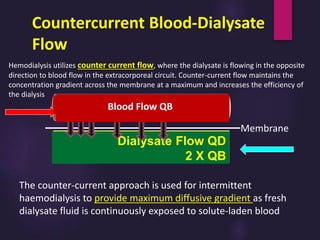
Membrane
Blood
Dialysate
Countercurrent Blood-Dialysate
Flow
Dialysate Flow QD
2 X QB
The counter-current approach is used for intermittent
haemodialysis to provide maximum diffusive gradient as fresh
dialysate fluid is continuously exposed to solute-laden blood
Hemodialysis utilizes counter current flow, where the dialysate is flowing in the opposite
direction to blood flow in the extracorporeal circuit. Counter-current flow maintains the
concentration gradient across the membrane at a maximum and increases the efficiency of
the dialysis
Blood Flow QB
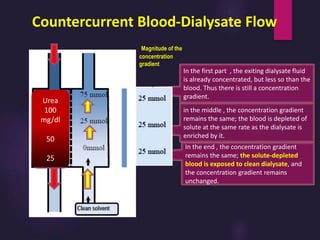
In the end , the concentration gradient
remains the same; the solute-depleted
blood is exposed to clean dialysate, and
the concentration gradient remains
unchanged.
in the middle , the concentration gradient
remains the same; the blood is depleted of
solute at the same rate as the dialysate is
enriched by it.
In the first part , the exiting dialysate fluid
is already concentrated, but less so than the
blood. Thus there is still a concentration
gradient.
Countercurrent Blood-Dialysate Flow
Magnitude of the
concentration
gradient
the
Urea
100
mg/dl
50
25
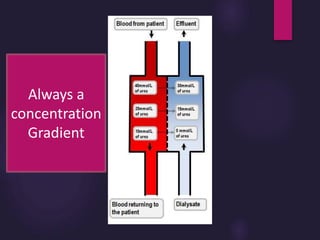
Always a
concentration
Gradient
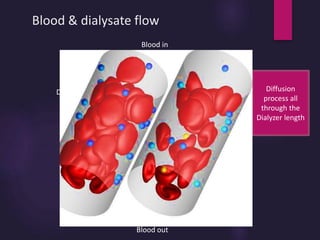
Blood & dialysate flow
Blood in
Blood out
Dialysate out
Dialysate in
Hollow fiber
Casing or jacket
Dialysate
Header
Diffusion
process all
through the
Dialyzer length
Maximumspeed
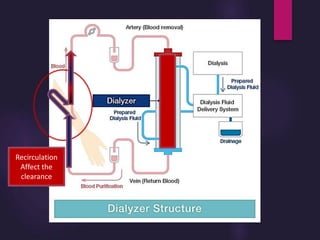
Recirculation
Affect the
clearance
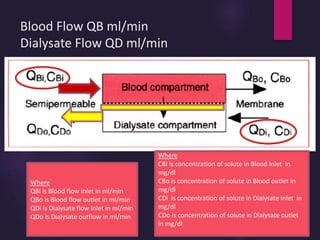
Blood Flow QB ml/min
Dialysate Flow QD ml/min
Where
QBi is Blood flow inlet in ml/min
QBo is Blood flow outlet in ml/min
QDi is Dialysate flow inlet in ml/min
QDo is Dialysate outflow in ml/min
Where
CBi is concentration of solute in Blood inlet in
mg/dl
CBo is concentration of solute in Blood outlet in
mg/dl
CDi is concentration of solute in Dialysate inlet in
mg/dl
CDo is concentration of solute in Dialysate outlet
in mg/dl
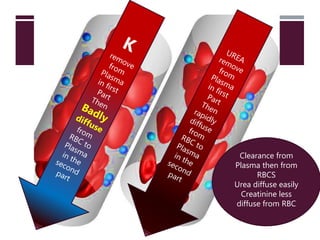
Clearance from
Plasma then from
RBCS
Urea diffuse easily
Creatinine less
diffuse from RBC
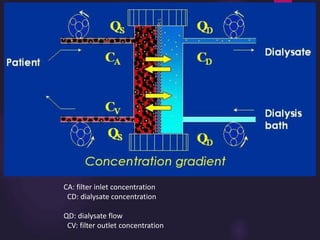
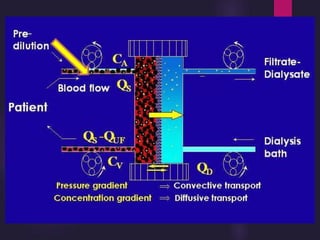
CA: filter inlet concentration
CD: dialysate concentration
QD: dialysate flow
CV: filter outlet concentration
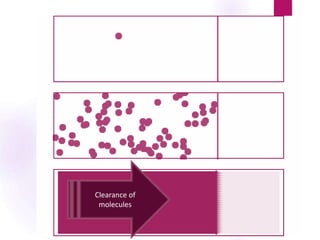
Clearance of
molecules
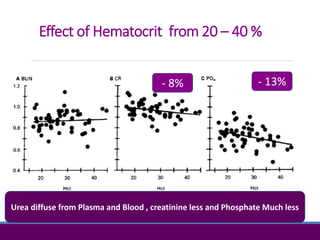
Effect of Hematocrit from 20 – 40 %
Urea diffuse from Plasma and Blood , creatinine less and Phosphate Much less
- 8% - 13%
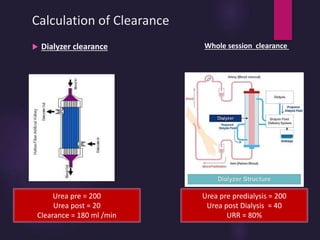
Calculation of Clearance
 Dialyzer clearance
Urea pre = 200
Urea post = 20
Clearance = 180 ml /min
Whole session clearance
Urea pre predialysis = 200
Urea post Dialysis = 40
URR = 80%
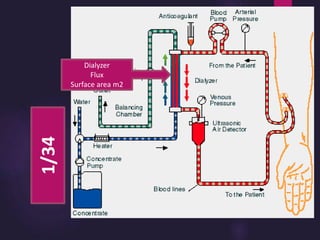
1/34
Dialyzer
Flux
Surface area m2
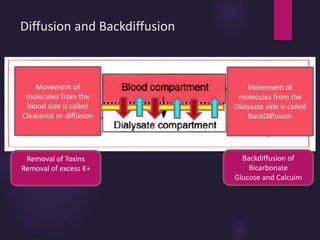
Diffusion and Backdiffusion
Movement of
molecules from the
blood side is called
Clearance or diffusion
Movement of
molecules from the
Dialysate side is called
BackDiffusion
Removal of Toxins
Removal of excess K+
Backdiffusion of
Bicarbonate
Glucose and Calcuim
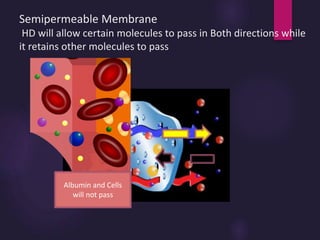
Semipermeable Membrane
HD will allow certain molecules to pass in Both directions while
it retains other molecules to pass
Albumin and Cells
will not pass
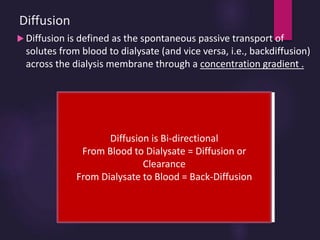
Diffusion
 Diffusion is defined as the spontaneous passive transport of
solutes from blood to dialysate (and vice versa, i.e., backdiffusion)
across the dialysis membrane through a concentration gradient .
Equilibrium
Diffusion is Bi-directional
From Blood to Dialysate = Diffusion or
Clearance
From Dialysate to Blood = Back-Diffusion
Basic Principals of Dialysis
Diffusion
The rate of diffusive transport depends upon:
1- The diffusion coefficients of the solute in blood, in membrane
and in dialysate.
2-The concentration difference across the Membrane.
3-The surface area of the membrane.
The transport rate of solute is inversely proportional to the
Molecular Wright (MW)
So smaller solute can diffuse easier than bigger molecules .
Basic Principals of Dialysis
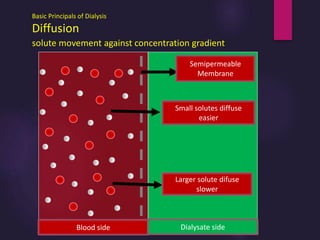
Diffusion
solute movement against concentration gradient
`
Blood side Dialysate side
Semipermeable
Membrane
Larger solute difuse
slower
Small solutes diffuse
easier
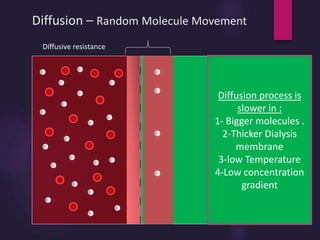
Diffusion – Random Molecule Movement
Diffusive resistance
`
Diffusion process is
slower in :
1- Bigger molecules .
2-Thicker Dialysis
membrane
3-low Temperature
4-Low concentration
gradient
Dialyzer KoA
 The mass transfer area coefficient (KoA),
expressed in mL/min, for a given solute is the
clearance of the dialyzer at infinitely high blood
and dialysate flow rates on a theoretical basis.
 Therefore, KoA is a measure of the maximum
solute removal capacity of the dialyzer and has
been considered as an intrinsic property of the
dialyzer membrane.
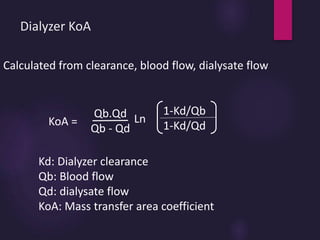
Dialyzer KoA
KoA =
Qb.Qd
Qb - Qd
Ln
1-Kd/Qb
1-Kd/Qd
Calculated from clearance, blood flow, dialysate flow
Kd: Dialyzer clearance
Qb: Blood flow
Qd: dialysate flow
KoA: Mass transfer area coefficient
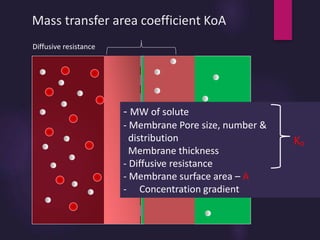
Mass transfer area coefficient KoA
Diffusive resistance
`
- MW of solute
- Membrane Pore size, number &
distribution
Membrane thickness
- Diffusive resistance
- Membrane surface area – A
- Concentration gradient
Ko
Basic Principals of Dialysis
Convection
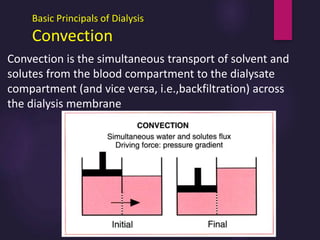
Convection is the simultaneous transport of solvent and
solutes from the blood compartment to the dialysate
compartment (and vice versa, i.e.,backfiltration) across
the dialysis membrane
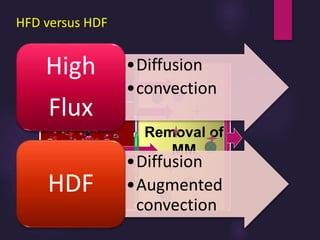
HFD versus HDF
Removal of
MM
•Diffusion
•convection
High
Flux
•Diffusion
•Augmented
convection
HDF
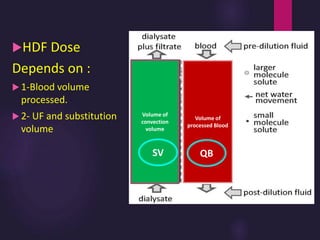
HDF Dose
Depends on :
 1-Blood volume
processed.
 2- UF and substitution
volume
Volume of
processed Blood
Volume of
convection
volume
QBSV
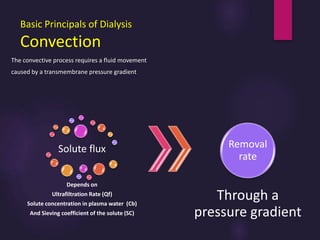
Basic Principals of Dialysis
Convection
The convective process requires a fluid movement
caused by a transmembrane pressure gradient
Solute flux
Depends on
Ultrafiltration Rate (Qf)
Solute concentration in plasma water (Cb)
And Sieving coefficient of the solute (SC)
Removal
rate
Through a
pressure gradient
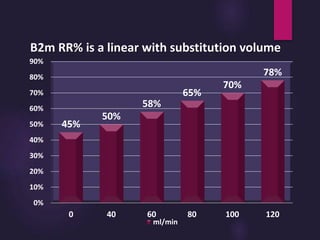
B2m RR% is a linear with substitution volume
45%
50%
58%
65%
70%
78%
0%
10%
20%
30%
40%
50%
60%
70%
80%
90%
0 40 60 80 100 120
ml/min
Basic Principals of Dialysis
Adsorption
 increasing size of middle-sized proteins and
other compounds, relatively more clearance is
achieved by membrane adsorption compared
with loss into the dialysate.
 A high adsorptive capacity, one of the main
features of some dialysis membranes like
polymethylmethacrylate (PMMA) can adsorb
more LMW proteins than others
Basic Principals of Dialysis
Adsorption
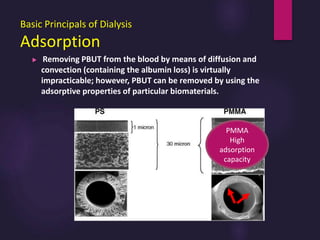
 Removing PBUT from the blood by means of diffusion and
convection (containing the albumin loss) is virtually
impracticable; however, PBUT can be removed by using the
adsorptive properties of particular biomaterials.
PMMA
High
adsorption
capacity
Clark, W. R. et al. J Am Soc Nephrol 2002;13:S41-S47
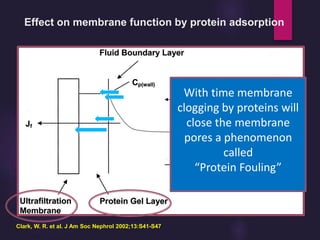
Effect on membrane function by protein adsorption
With time membrane
clogging by proteins will
close the membrane
pores a phenomenon
called
“Protein Fouling”
Basic Principals of Dialysis
Ultrafiltration
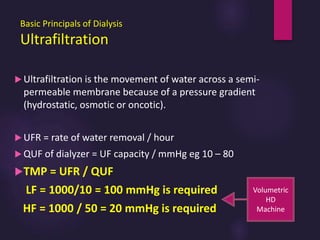
 Ultrafiltration is the movement of water across a semi-
permeable membrane because of a pressure gradient
(hydrostatic, osmotic or oncotic).
 UFR = rate of water removal / hour
 QUF of dialyzer = UF capacity / mmHg eg 10 – 80
TMP = UFR / QUF
LF = 1000/10 = 100 mmHg is required
HF = 1000 / 50 = 20 mmHg is required
Volumetric
HD
Machine
Basic Principals of Dialysis
Ultrafiltration
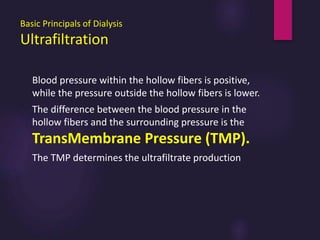
Blood pressure within the hollow fibers is positive,
while the pressure outside the hollow fibers is lower.
The difference between the blood pressure in the
hollow fibers and the surrounding pressure is the
TransMembrane Pressure (TMP).
The TMP determines the ultrafiltrate production
Basic Principals of Dialysis
Ultrafiltration
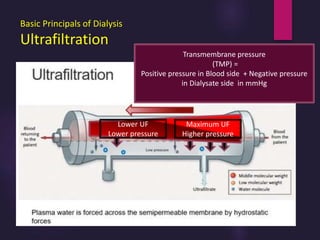
Transmembrane pressure
(TMP) =
Positive pressure in Blood side + Negative pressure
in Dialysate side in mmHg
Maximum UF
Higher pressure
Lower UF
Lower pressure
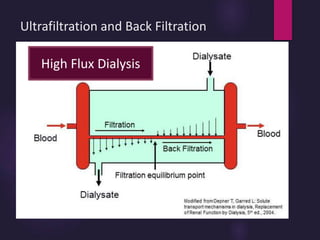
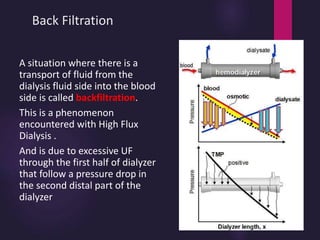
Back Filtration
A situation where there is a
transport of fluid from the
dialysis fluid side into the blood
side is called backfiltration.
This is a phenomenon
encountered with High Flux
Dialysis .
And is due to excessive UF
through the first half of dialyzer
that follow a pressure drop in
the second distal part of the
dialyzer
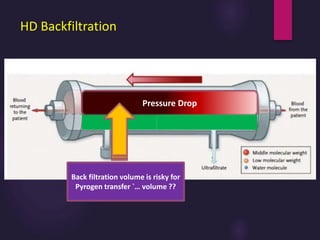
HD Backfiltration
Pressure Drop
Back filtration volume is risky for
Pyrogen transfer `… volume ??
Basic Principals of Dialysis
Ultrafiltration
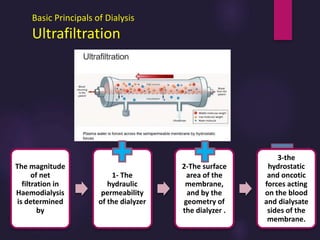
The magnitude
of net
filtration in
Haemodialysis
is determined
by
1- The
hydraulic
permeability
of the dialyzer
2-The surface
area of the
membrane,
and by the
geometry of
the dialyzer .
3-the
hydrostatic
and oncotic
forces acting
on the blood
and dialysate
sides of the
membrane.
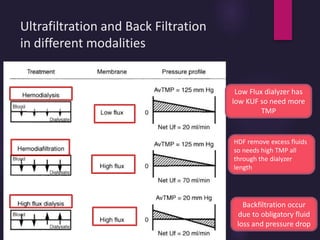
Ultrafiltration and Back Filtration
in different modalities
Low Flux dialyzer has
low KUF so need more
TMP
Backfiltration occur
due to obligatory fluid
loss and pressure drop
HDF remove excess fluids
so needs high TMP all
through the dialyzer
length
Ultrafiltration and Back Filtration
High Flux Dialysis
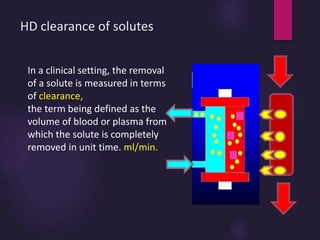
HD clearance of solutes
In a clinical setting, the removal
of a solute is measured in terms
of clearance,
the term being defined as the
volume of blood or plasma from
which the solute is completely
removed in unit time. ml/min.
HD clearance of solutes
During transit across the dialyzer, most
solutes are removed from plasma water
(about 93% of blood volume, depending on
plasma protein concentration).
the clearance of the solute decreases as the
hematocrit increases (since the plasma
volume decreases).
There is a difference between the
manufacture data ( in vitro test ) from the
actual data in clinics ( in vivo test ).
HD clearance of solutes
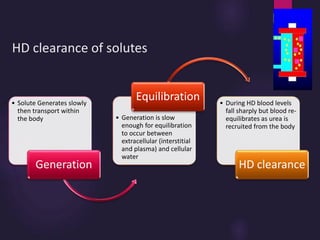
• Solute Generates slowly
then transport within
the body
Generation
• Generation is slow
enough for equilibration
to occur between
extracellular (interstitial
and plasma) and cellular
water
Equilibration • During HD blood levels
fall sharply but blood re-
equilibrates as urea is
recruited from the body
HD clearance
HD clearance of solutes
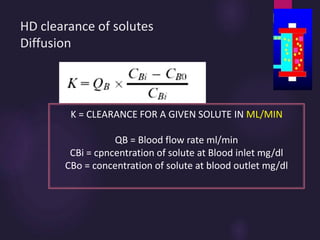
Diffusion
K = CLEARANCE FOR A GIVEN SOLUTE IN ML/MIN
QB = Blood flow rate ml/min
CBi = cpncentration of solute at Blood inlet mg/dl
CBo = concentration of solute at blood outlet mg/dl
HD clearance of solutes
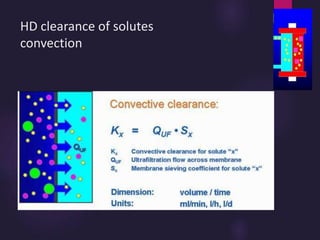
convection
HD clearance of solutes
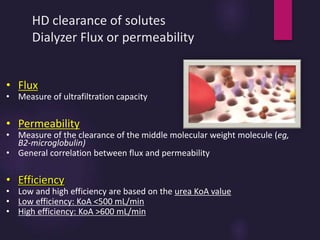
Dialyzer Flux or permeability
• Flux
• Measure of ultrafiltration capacity
• Permeability
• Measure of the clearance of the middle molecular weight molecule (eg,
B2-microglobulin)
• General correlation between flux and permeability
• Efficiency
• Low and high efficiency are based on the urea KoA value
• Low efficiency: KoA <500 mL/min
• High efficiency: KoA >600 mL/min
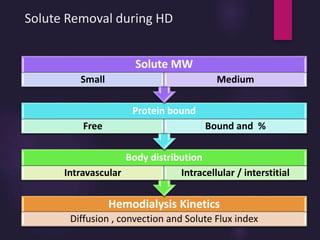
Solute Removal during HD
Hemodialysis Kinetics
Diffusion , convection and Solute Flux index
Body distribution
Intravascular Intracellular / interstitial
Protein bound
Free Bound and %
Solute MW
Small Medium
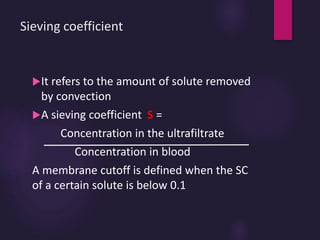
Sieving coefficient
It refers to the amount of solute removed
by convection
A sieving coefficient S =
Concentration in the ultrafiltrate
Concentration in blood
A membrane cutoff is defined when the SC
of a certain solute is below 0.1
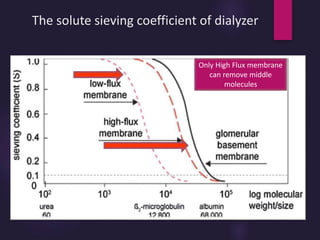
The solute sieving coefficient of dialyzer
Only High Flux membrane
can remove middle
molecules
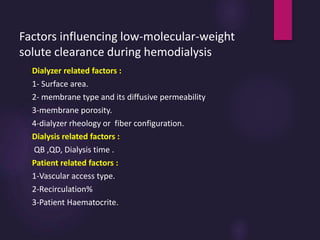
Factors influencing low-molecular-weight
solute clearance during hemodialysis
Dialyzer related factors :
1- Surface area.
2- membrane type and its diffusive permeability
3-membrane porosity.
4-dialyzer rheology or fiber configuration.
Dialysis related factors :
QB ,QD, Dialysis time .
Patient related factors :
1-Vascular access type.
2-Recirculation%
3-Patient Haematocrite.
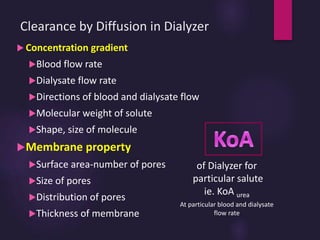
Clearance by Diffusion in Dialyzer
 Concentration gradient
Blood flow rate
Dialysate flow rate
Directions of blood and dialysate flow
Molecular weight of solute
Shape, size of molecule
Membrane property
Surface area-number of pores
Size of pores
Distribution of pores
Thickness of membrane
of Dialyzer for
particular salute
ie. KoA urea
At particular blood and dialysate
flow rate
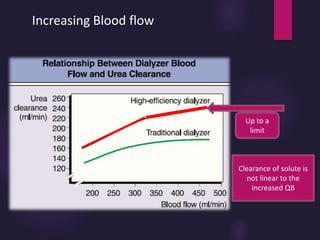
Increasing Blood flow
Up to a
limit
Clearance of solute is
not linear to the
increased QB
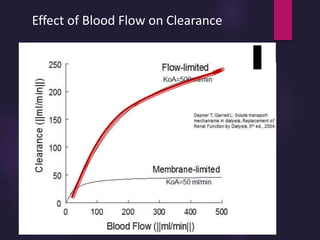
Effect of Blood Flow on Clearance
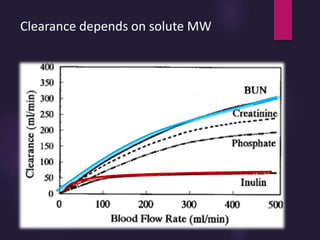
Clearance depends on solute MW
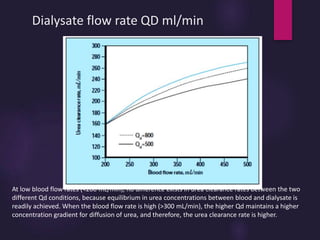
Dialysate flow rate QD ml/min
At low blood flow rates (<200 mL/min), no difference exists in urea clearance rates between the two
different Qd conditions, because equilibrium in urea concentrations between blood and dialysate is
readily achieved. When the blood flow rate is high (>300 mL/min), the higher Qd maintains a higher
concentration gradient for diffusion of urea, and therefore, the urea clearance rate is higher.
Causes of low clearance values despite
use of high efficient dialysis
Vascular access related :
Low Blood flow
High Recirculation rates
Time Related factors :
Not adherent to prescribed dialysis time.
Failure to adjust prescribed time due to repeated
alarms , Hypotension episodes and Dialysate Bypass
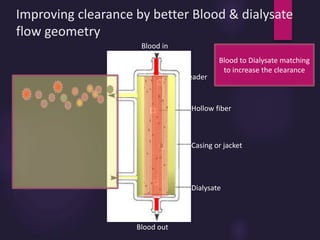
Improving clearance by better Blood & dialysate
flow geometry
Blood in
Blood out
Hollow fiber
Casing or jacket
Dialysate
Header
Blood to Dialysate matching
to increase the clearance
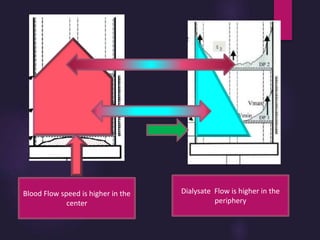
Blood Flow speed is higher in the
center
Dialysate Flow is higher in the
periphery
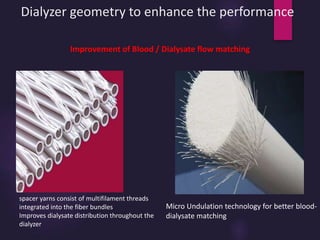
Dialyzer geometry to enhance the performance
Improvement of Blood / Dialysate flow matching
spacer yarns consist of multifilament threads
integrated into the fiber bundles
Improves dialysate distribution throughout the
dialyzer
Micro Undulation technology for better blood-
dialysate matching
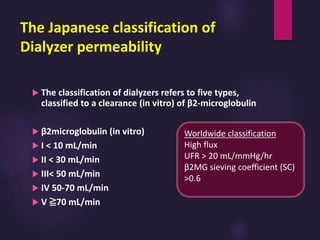
The Japanese classification of
Dialyzer permeability
 The classification of dialyzers refers to five types,
classified to a clearance (in vitro) of β2-microglobulin
 β2microglobulin (in vitro)
 I < 10 mL/min
 II < 30 mL/min
 III< 50 mL/min
 IV 50-70 mL/min
 V ≧70 mL/min
Worldwide classification
High flux
UFR > 20 mL/mmHg/hr
β2MG sieving coefficient (SC)
>0.6
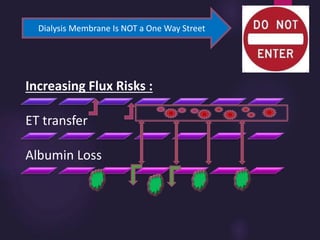
Increasing Flux Risks :
ET transfer
Albumin Loss
Dialysis Membrane Is NOT a One Way Street
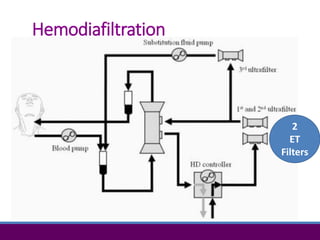
Hemodiafiltration
2
ET
Filters
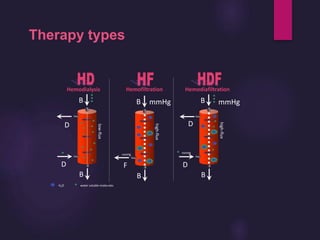
H2O water soluble molecules
F
mmHg
mmHgB
B
B
D
B
D
mmHgB
mmHg
D
B
D
low-flux
high-flux
Therapy types
Hemodialysis Hemofiltration Hemodiafiltration
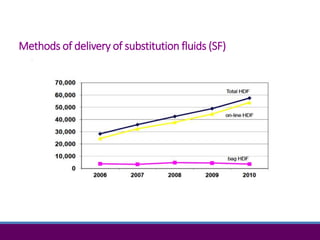
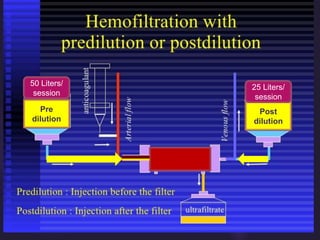
Methods of delivery of substitution fluids (SF)
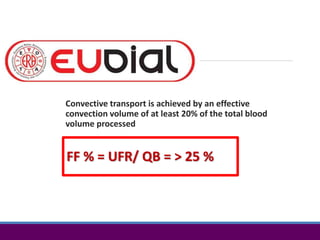
Convective transport is achieved by an effective
convection volume of at least 20% of the total blood
volume processed
FF % = UFR/ QB = > 25 %
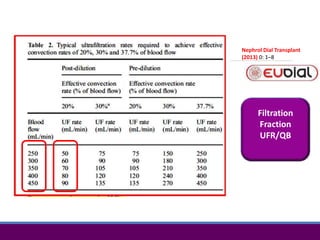
Filtration
Fraction
UFR/QB
Nephrol Dial Transplant
(2013) 0: 1–8
Pre
dilution
Post
dilution
25 Liters/
session
50 Liters/
session
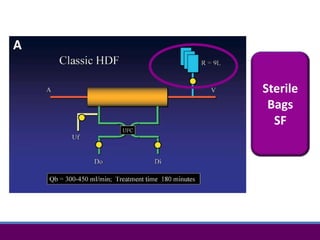
Sterile
Bags
SF
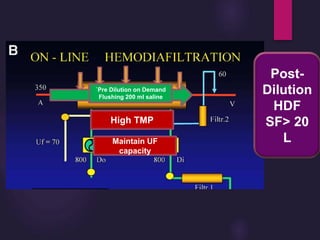
Post-
Dilution
HDF
SF> 20
L
Back filtration
On demand
High TMP
`Pre Dilution on Demand
Flushing 200 ml saline
Maintain UF
capacity
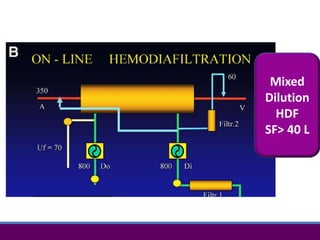
Mixed
Dilution
HDF
SF> 40 L

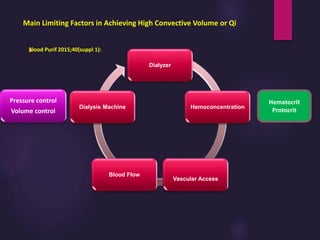
Dialyzer
Hemoconcentration
Vascular Access
Blood Flow
Dialysis Machine
Blood Purif 2015;40(suppl 1):
Hematocrit
Protocrit
Pressure control
Volume control
Main Limiting Factors in Achieving High Convective Volume or Qi
Thank you
for your
Attention
Questions
?

Basic principles of hemodialysis final

  • 1.
    Hesham Elsayed Professor ofNephrology Ain shams university – Cairo Egypt BASIC PRINCIPLES OF HEMODIALYSIS
  • 2.
    HD : aFiltration Therapy Enhance the Clearance HD Removal by Filtration Removal by Adsorption Flux HDF 17 % Solute permeability Solute Dragging
  • 3.
    Principles of Hemodialysis Hemodialysisis a treatment which aims to 1- Remove accumulated metabolic waste products and 2-To correct blood electrolyte composition by means of an exchange between patient's blood and a dialysate fluid Across a semi-permeable membrane in a countercurrent mechanism . 3-To remove excess fluids by means of ultrafiltration
  • 4.
    Basic Principals ofDialysis Principles related to solute removal (mass transfer) Diffusion Convection Principles related to water removal Ultrafiltration
  • 5.
    Membrane Blood Dialysate Countercurrent Blood-Dialysate Flow Dialysate FlowQD 2 X QB The counter-current approach is used for intermittent haemodialysis to provide maximum diffusive gradient as fresh dialysate fluid is continuously exposed to solute-laden blood Hemodialysis utilizes counter current flow, where the dialysate is flowing in the opposite direction to blood flow in the extracorporeal circuit. Counter-current flow maintains the concentration gradient across the membrane at a maximum and increases the efficiency of the dialysis Blood Flow QB
  • 6.
    In the end, the concentration gradient remains the same; the solute-depleted blood is exposed to clean dialysate, and the concentration gradient remains unchanged. in the middle , the concentration gradient remains the same; the blood is depleted of solute at the same rate as the dialysate is enriched by it. In the first part , the exiting dialysate fluid is already concentrated, but less so than the blood. Thus there is still a concentration gradient. Countercurrent Blood-Dialysate Flow Magnitude of the concentration gradient the Urea 100 mg/dl 50 25
  • 7.
  • 8.
    Blood & dialysateflow Blood in Blood out Dialysate out Dialysate in Hollow fiber Casing or jacket Dialysate Header Diffusion process all through the Dialyzer length Maximumspeed
  • 9.
  • 10.
    Blood Flow QBml/min Dialysate Flow QD ml/min Where QBi is Blood flow inlet in ml/min QBo is Blood flow outlet in ml/min QDi is Dialysate flow inlet in ml/min QDo is Dialysate outflow in ml/min Where CBi is concentration of solute in Blood inlet in mg/dl CBo is concentration of solute in Blood outlet in mg/dl CDi is concentration of solute in Dialysate inlet in mg/dl CDo is concentration of solute in Dialysate outlet in mg/dl
  • 11.
    Clearance from Plasma thenfrom RBCS Urea diffuse easily Creatinine less diffuse from RBC
  • 12.
    CA: filter inletconcentration CD: dialysate concentration QD: dialysate flow CV: filter outlet concentration
  • 13.
  • 14.
    Effect of Hematocritfrom 20 – 40 % Urea diffuse from Plasma and Blood , creatinine less and Phosphate Much less - 8% - 13%
  • 15.
    Calculation of Clearance Dialyzer clearance Urea pre = 200 Urea post = 20 Clearance = 180 ml /min Whole session clearance Urea pre predialysis = 200 Urea post Dialysis = 40 URR = 80%
  • 16.
  • 17.
    Diffusion and Backdiffusion Movementof molecules from the blood side is called Clearance or diffusion Movement of molecules from the Dialysate side is called BackDiffusion Removal of Toxins Removal of excess K+ Backdiffusion of Bicarbonate Glucose and Calcuim
  • 18.
    Semipermeable Membrane HD willallow certain molecules to pass in Both directions while it retains other molecules to pass Albumin and Cells will not pass
  • 19.
    Diffusion  Diffusion isdefined as the spontaneous passive transport of solutes from blood to dialysate (and vice versa, i.e., backdiffusion) across the dialysis membrane through a concentration gradient . Equilibrium Diffusion is Bi-directional From Blood to Dialysate = Diffusion or Clearance From Dialysate to Blood = Back-Diffusion
  • 20.
    Basic Principals ofDialysis Diffusion The rate of diffusive transport depends upon: 1- The diffusion coefficients of the solute in blood, in membrane and in dialysate. 2-The concentration difference across the Membrane. 3-The surface area of the membrane. The transport rate of solute is inversely proportional to the Molecular Wright (MW) So smaller solute can diffuse easier than bigger molecules .
  • 21.
    Basic Principals ofDialysis Diffusion solute movement against concentration gradient ` Blood side Dialysate side Semipermeable Membrane Larger solute difuse slower Small solutes diffuse easier
  • 22.
    Diffusion – RandomMolecule Movement Diffusive resistance ` Diffusion process is slower in : 1- Bigger molecules . 2-Thicker Dialysis membrane 3-low Temperature 4-Low concentration gradient
  • 23.
    Dialyzer KoA  Themass transfer area coefficient (KoA), expressed in mL/min, for a given solute is the clearance of the dialyzer at infinitely high blood and dialysate flow rates on a theoretical basis.  Therefore, KoA is a measure of the maximum solute removal capacity of the dialyzer and has been considered as an intrinsic property of the dialyzer membrane.
  • 24.
    Dialyzer KoA KoA = Qb.Qd Qb- Qd Ln 1-Kd/Qb 1-Kd/Qd Calculated from clearance, blood flow, dialysate flow Kd: Dialyzer clearance Qb: Blood flow Qd: dialysate flow KoA: Mass transfer area coefficient
  • 25.
    Mass transfer areacoefficient KoA Diffusive resistance ` - MW of solute - Membrane Pore size, number & distribution Membrane thickness - Diffusive resistance - Membrane surface area – A - Concentration gradient Ko
  • 26.
    Basic Principals ofDialysis Convection Convection is the simultaneous transport of solvent and solutes from the blood compartment to the dialysate compartment (and vice versa, i.e.,backfiltration) across the dialysis membrane
  • 27.
    HFD versus HDF Removalof MM •Diffusion •convection High Flux •Diffusion •Augmented convection HDF
  • 28.
    HDF Dose Depends on:  1-Blood volume processed.  2- UF and substitution volume Volume of processed Blood Volume of convection volume QBSV
  • 29.
    Basic Principals ofDialysis Convection The convective process requires a fluid movement caused by a transmembrane pressure gradient Solute flux Depends on Ultrafiltration Rate (Qf) Solute concentration in plasma water (Cb) And Sieving coefficient of the solute (SC) Removal rate Through a pressure gradient
  • 30.
    B2m RR% isa linear with substitution volume 45% 50% 58% 65% 70% 78% 0% 10% 20% 30% 40% 50% 60% 70% 80% 90% 0 40 60 80 100 120 ml/min
  • 31.
    Basic Principals ofDialysis Adsorption  increasing size of middle-sized proteins and other compounds, relatively more clearance is achieved by membrane adsorption compared with loss into the dialysate.  A high adsorptive capacity, one of the main features of some dialysis membranes like polymethylmethacrylate (PMMA) can adsorb more LMW proteins than others
  • 32.
    Basic Principals ofDialysis Adsorption  Removing PBUT from the blood by means of diffusion and convection (containing the albumin loss) is virtually impracticable; however, PBUT can be removed by using the adsorptive properties of particular biomaterials. PMMA High adsorption capacity
  • 33.
    Clark, W. R.et al. J Am Soc Nephrol 2002;13:S41-S47 Effect on membrane function by protein adsorption With time membrane clogging by proteins will close the membrane pores a phenomenon called “Protein Fouling”
  • 34.
    Basic Principals ofDialysis Ultrafiltration  Ultrafiltration is the movement of water across a semi- permeable membrane because of a pressure gradient (hydrostatic, osmotic or oncotic).  UFR = rate of water removal / hour  QUF of dialyzer = UF capacity / mmHg eg 10 – 80 TMP = UFR / QUF LF = 1000/10 = 100 mmHg is required HF = 1000 / 50 = 20 mmHg is required Volumetric HD Machine
  • 35.
    Basic Principals ofDialysis Ultrafiltration Blood pressure within the hollow fibers is positive, while the pressure outside the hollow fibers is lower. The difference between the blood pressure in the hollow fibers and the surrounding pressure is the TransMembrane Pressure (TMP). The TMP determines the ultrafiltrate production
  • 36.
    Basic Principals ofDialysis Ultrafiltration Transmembrane pressure (TMP) = Positive pressure in Blood side + Negative pressure in Dialysate side in mmHg Maximum UF Higher pressure Lower UF Lower pressure
  • 37.
    Back Filtration A situationwhere there is a transport of fluid from the dialysis fluid side into the blood side is called backfiltration. This is a phenomenon encountered with High Flux Dialysis . And is due to excessive UF through the first half of dialyzer that follow a pressure drop in the second distal part of the dialyzer
  • 38.
    HD Backfiltration Pressure Drop Backfiltration volume is risky for Pyrogen transfer `… volume ??
  • 39.
    Basic Principals ofDialysis Ultrafiltration The magnitude of net filtration in Haemodialysis is determined by 1- The hydraulic permeability of the dialyzer 2-The surface area of the membrane, and by the geometry of the dialyzer . 3-the hydrostatic and oncotic forces acting on the blood and dialysate sides of the membrane.
  • 40.
    Ultrafiltration and BackFiltration in different modalities Low Flux dialyzer has low KUF so need more TMP Backfiltration occur due to obligatory fluid loss and pressure drop HDF remove excess fluids so needs high TMP all through the dialyzer length
  • 41.
    Ultrafiltration and BackFiltration High Flux Dialysis
  • 42.
    HD clearance ofsolutes In a clinical setting, the removal of a solute is measured in terms of clearance, the term being defined as the volume of blood or plasma from which the solute is completely removed in unit time. ml/min.
  • 43.
    HD clearance ofsolutes During transit across the dialyzer, most solutes are removed from plasma water (about 93% of blood volume, depending on plasma protein concentration). the clearance of the solute decreases as the hematocrit increases (since the plasma volume decreases). There is a difference between the manufacture data ( in vitro test ) from the actual data in clinics ( in vivo test ).
  • 44.
    HD clearance ofsolutes • Solute Generates slowly then transport within the body Generation • Generation is slow enough for equilibration to occur between extracellular (interstitial and plasma) and cellular water Equilibration • During HD blood levels fall sharply but blood re- equilibrates as urea is recruited from the body HD clearance
  • 45.
    HD clearance ofsolutes Diffusion K = CLEARANCE FOR A GIVEN SOLUTE IN ML/MIN QB = Blood flow rate ml/min CBi = cpncentration of solute at Blood inlet mg/dl CBo = concentration of solute at blood outlet mg/dl
  • 46.
    HD clearance ofsolutes convection
  • 47.
    HD clearance ofsolutes Dialyzer Flux or permeability • Flux • Measure of ultrafiltration capacity • Permeability • Measure of the clearance of the middle molecular weight molecule (eg, B2-microglobulin) • General correlation between flux and permeability • Efficiency • Low and high efficiency are based on the urea KoA value • Low efficiency: KoA <500 mL/min • High efficiency: KoA >600 mL/min
  • 48.
    Solute Removal duringHD Hemodialysis Kinetics Diffusion , convection and Solute Flux index Body distribution Intravascular Intracellular / interstitial Protein bound Free Bound and % Solute MW Small Medium
  • 49.
    Sieving coefficient It refersto the amount of solute removed by convection A sieving coefficient S = Concentration in the ultrafiltrate Concentration in blood A membrane cutoff is defined when the SC of a certain solute is below 0.1
  • 50.
    The solute sievingcoefficient of dialyzer Only High Flux membrane can remove middle molecules
  • 51.
    Factors influencing low-molecular-weight soluteclearance during hemodialysis Dialyzer related factors : 1- Surface area. 2- membrane type and its diffusive permeability 3-membrane porosity. 4-dialyzer rheology or fiber configuration. Dialysis related factors : QB ,QD, Dialysis time . Patient related factors : 1-Vascular access type. 2-Recirculation% 3-Patient Haematocrite.
  • 52.
    Clearance by Diffusionin Dialyzer  Concentration gradient Blood flow rate Dialysate flow rate Directions of blood and dialysate flow Molecular weight of solute Shape, size of molecule Membrane property Surface area-number of pores Size of pores Distribution of pores Thickness of membrane of Dialyzer for particular salute ie. KoA urea At particular blood and dialysate flow rate
  • 53.
    Increasing Blood flow Upto a limit Clearance of solute is not linear to the increased QB
  • 54.
    Effect of BloodFlow on Clearance
  • 55.
  • 56.
    Dialysate flow rateQD ml/min At low blood flow rates (<200 mL/min), no difference exists in urea clearance rates between the two different Qd conditions, because equilibrium in urea concentrations between blood and dialysate is readily achieved. When the blood flow rate is high (>300 mL/min), the higher Qd maintains a higher concentration gradient for diffusion of urea, and therefore, the urea clearance rate is higher.
  • 57.
    Causes of lowclearance values despite use of high efficient dialysis Vascular access related : Low Blood flow High Recirculation rates Time Related factors : Not adherent to prescribed dialysis time. Failure to adjust prescribed time due to repeated alarms , Hypotension episodes and Dialysate Bypass
  • 58.
    Improving clearance bybetter Blood & dialysate flow geometry Blood in Blood out Hollow fiber Casing or jacket Dialysate Header Blood to Dialysate matching to increase the clearance
  • 59.
    Blood Flow speedis higher in the center Dialysate Flow is higher in the periphery
  • 60.
    Dialyzer geometry toenhance the performance Improvement of Blood / Dialysate flow matching spacer yarns consist of multifilament threads integrated into the fiber bundles Improves dialysate distribution throughout the dialyzer Micro Undulation technology for better blood- dialysate matching
  • 61.
    The Japanese classificationof Dialyzer permeability  The classification of dialyzers refers to five types, classified to a clearance (in vitro) of β2-microglobulin  β2microglobulin (in vitro)  I < 10 mL/min  II < 30 mL/min  III< 50 mL/min  IV 50-70 mL/min  V ≧70 mL/min Worldwide classification High flux UFR > 20 mL/mmHg/hr β2MG sieving coefficient (SC) >0.6
  • 62.
    Increasing Flux Risks: ET transfer Albumin Loss Dialysis Membrane Is NOT a One Way Street
  • 63.
  • 64.
    H2O water solublemolecules F mmHg mmHgB B B D B D mmHgB mmHg D B D low-flux high-flux Therapy types Hemodialysis Hemofiltration Hemodiafiltration
  • 65.
    Methods of deliveryof substitution fluids (SF)
  • 66.
    Convective transport isachieved by an effective convection volume of at least 20% of the total blood volume processed FF % = UFR/ QB = > 25 %
  • 67.
  • 68.
  • 69.
  • 71.
    Post- Dilution HDF SF> 20 L Back filtration Ondemand High TMP `Pre Dilution on Demand Flushing 200 ml saline Maintain UF capacity
  • 72.
  • 73.
     Dialyzer Hemoconcentration Vascular Access Blood Flow DialysisMachine Blood Purif 2015;40(suppl 1): Hematocrit Protocrit Pressure control Volume control Main Limiting Factors in Achieving High Convective Volume or Qi
  • 74.