Data Flow Diagram
Definition
โ€ข In the late 1970s data-flow diagrams (DFDs)
were introduced and popularized for
structured analysis and design (Gane and
Sarson 1979).
โ€ข DFDs show the flow of data from external
entities into the system, showed how the data
moved from one process to another, as well as
its logical storage.
Data Flow Diagram
โ€ข Data flow diagram (DFD) is a picture of the
movement of data between external entities
and the processes and data stores within a
system
Symbols and meaning
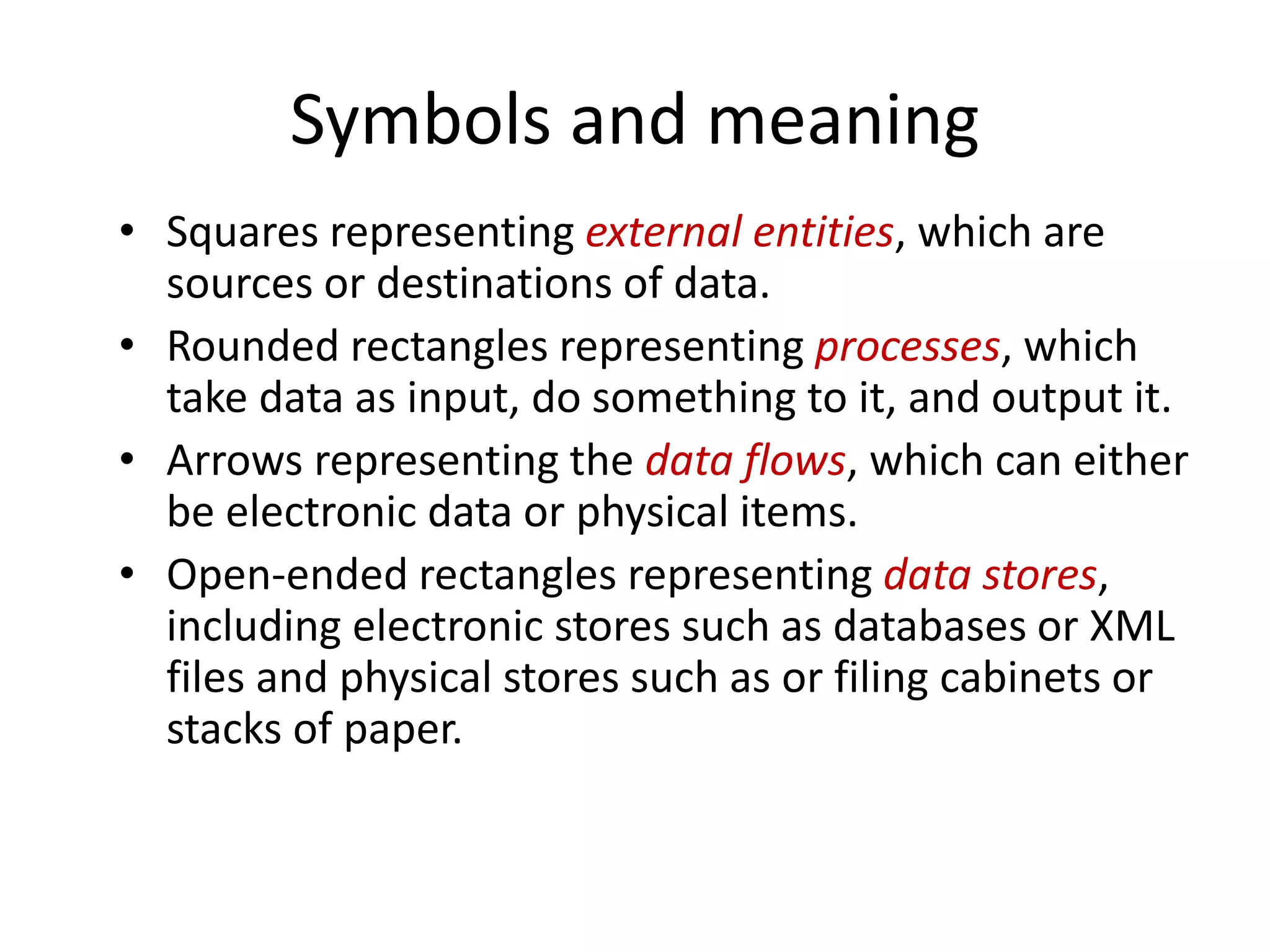
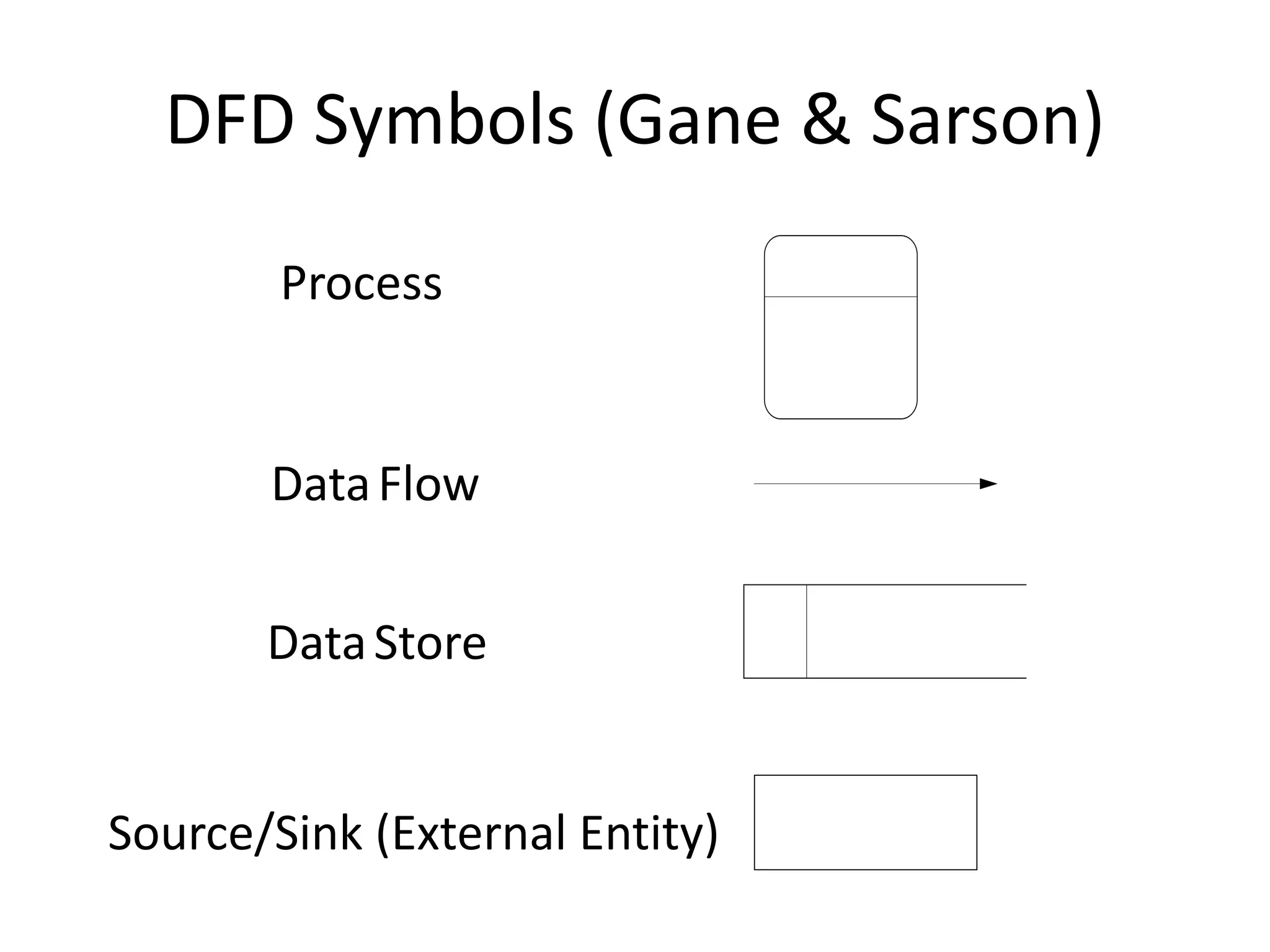
โ€ข Squares representing external entities, which are
sources or destinations of data.
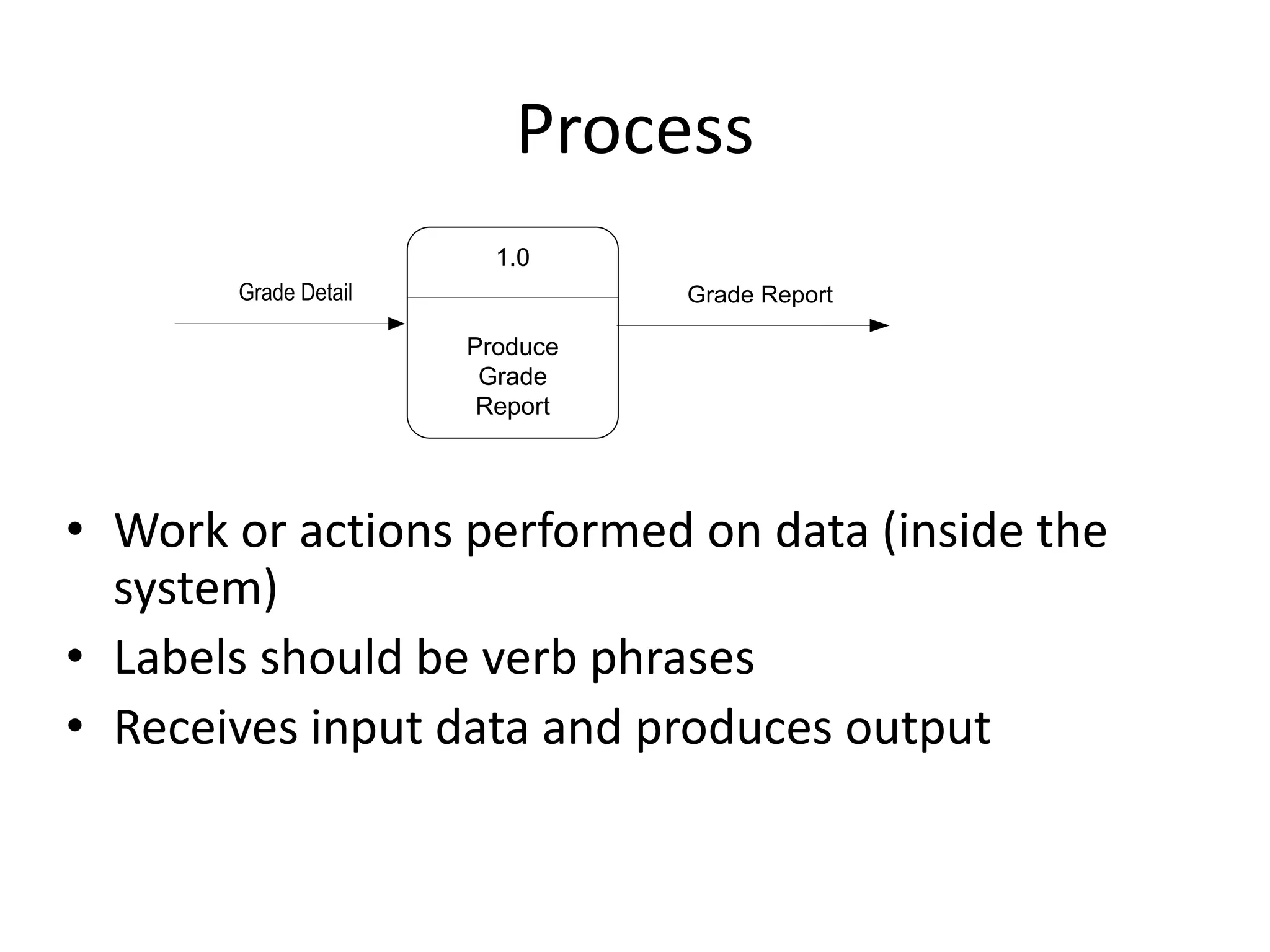
โ€ข Rounded rectangles representing processes, which
take data as input, do something to it, and output it.
โ€ข Arrows representing the data flows, which can either
be electronic data or physical items.
โ€ข Open-ended rectangles representing data stores,
including electronic stores such as databases or XML
files and physical stores such as or filing cabinets or
stacks of paper.
DFD Symbols (Gane & Sarson)
Process
DataFlow
DataStore
Source/Sink (External Entity)
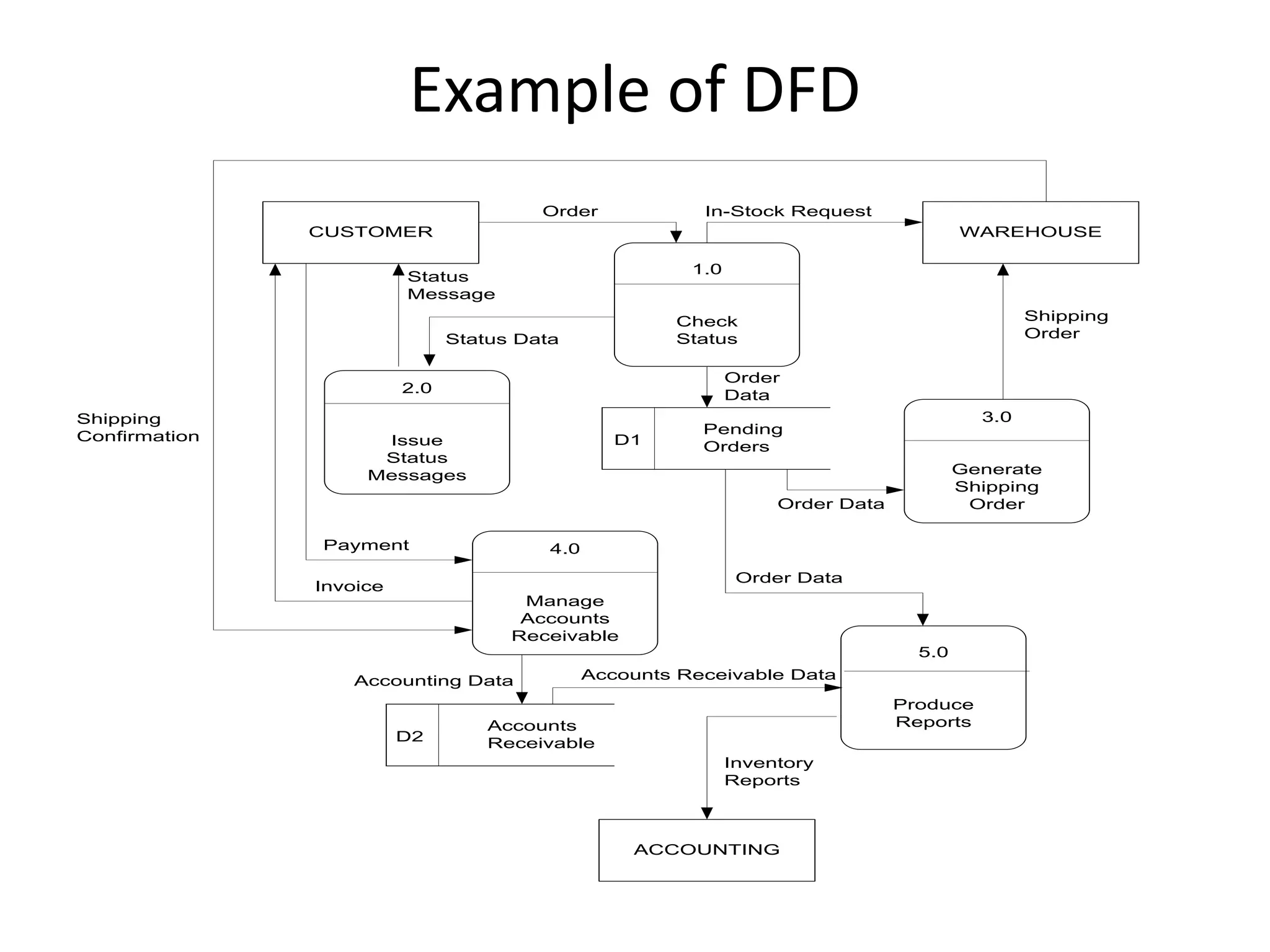
Example of DFD
1.0
Check
Status
2.0
Issue
Status
Messages
3.0
Generate
Shipping
Order
ACCOUNTING
CUSTOMER WAREHOUSE
4.0
Manage
Accounts
Receivable
5.0
Produce
Reports
Order In-Stock Request
Status Data
Status
Message
Pending
Orders
D1
Order
Data
Order Data
Shipping
Order
Shipping
Confirmation
Invoice
Payment
Accounts
Receivable
D2
Accounting Data Accounts Receivable Data
Order Data
Inventory
Reports
Process
Grade Detail
1.0
Produce
Grade
Report
Grade Report
โ€ข Work or actions performed on data (inside the
system)
โ€ข Labels should be verb phrases
โ€ข Receives input data and produces output
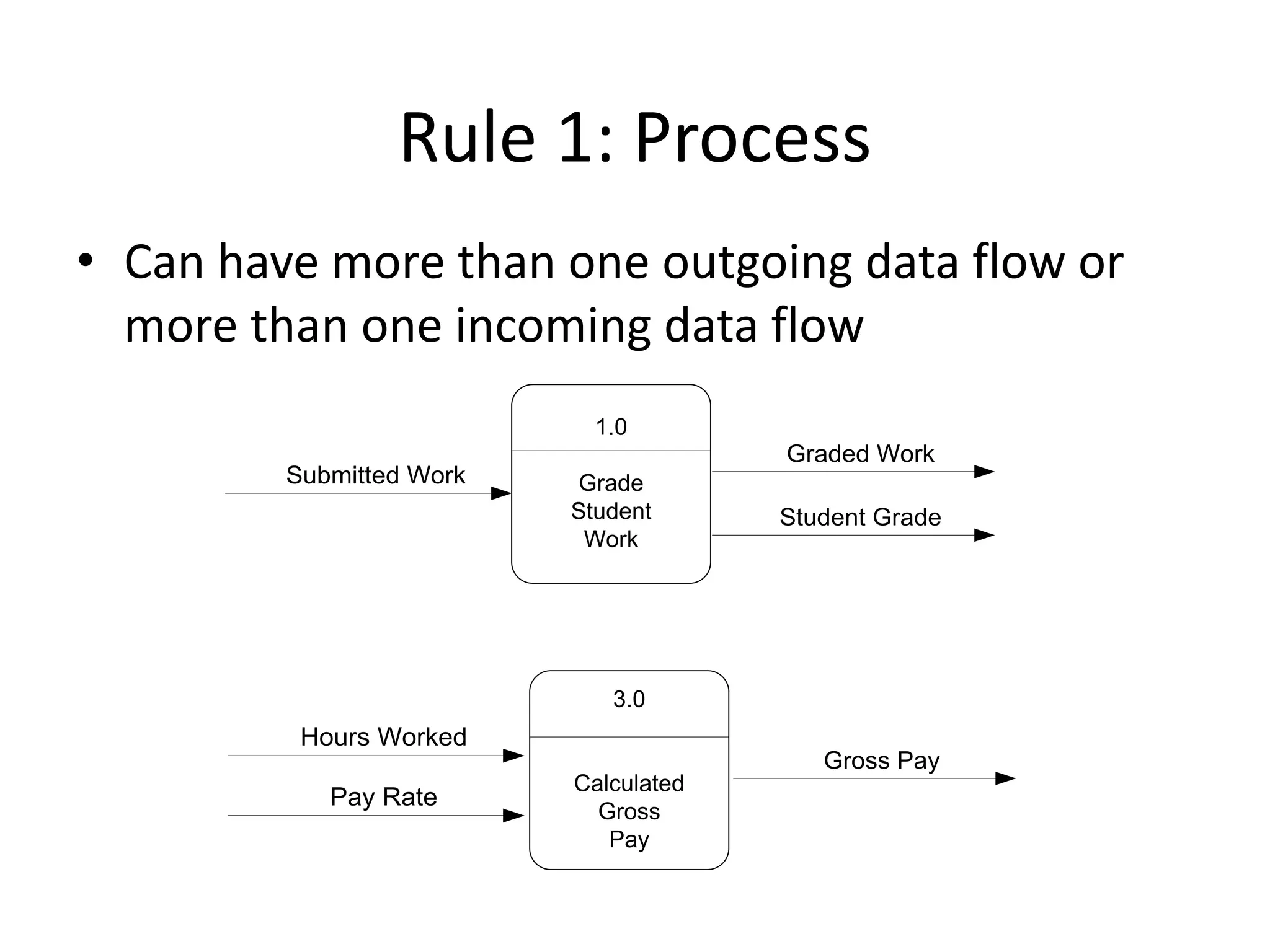
Rule 1: Process
โ€ข Can have more than one outgoing data flow or
more than one incoming data flow
1.0
Grade
Student
Work
Submitted Work
Student Grade
Graded Work
3.0
Calculated
Gross
Pay
Pay Rate
Hours Worked
Gross Pay
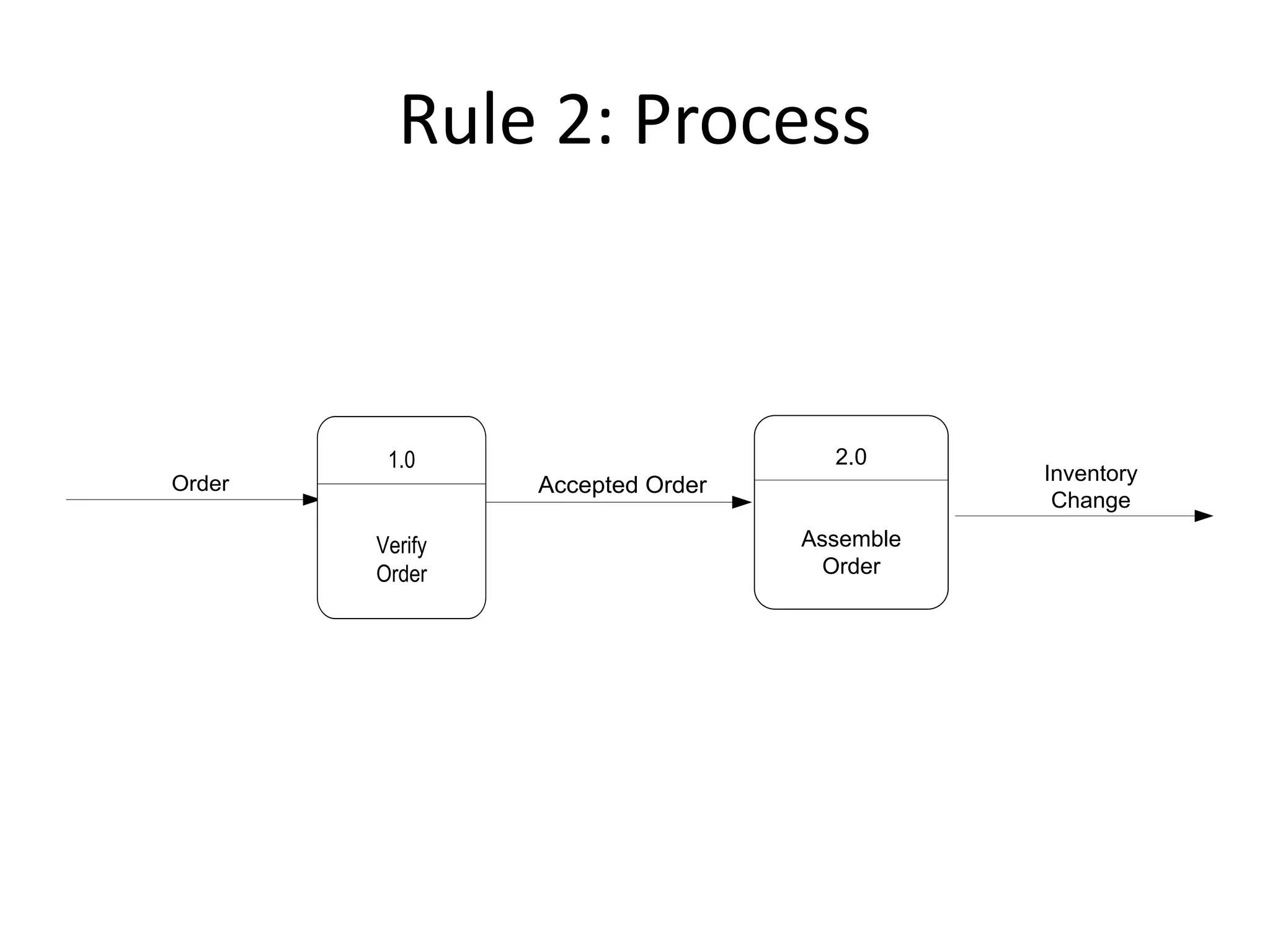
Rule 2: Process
Order Accepted Order
2.0
Assemble
Order
Inventory
Change
1.0
Verify
Order
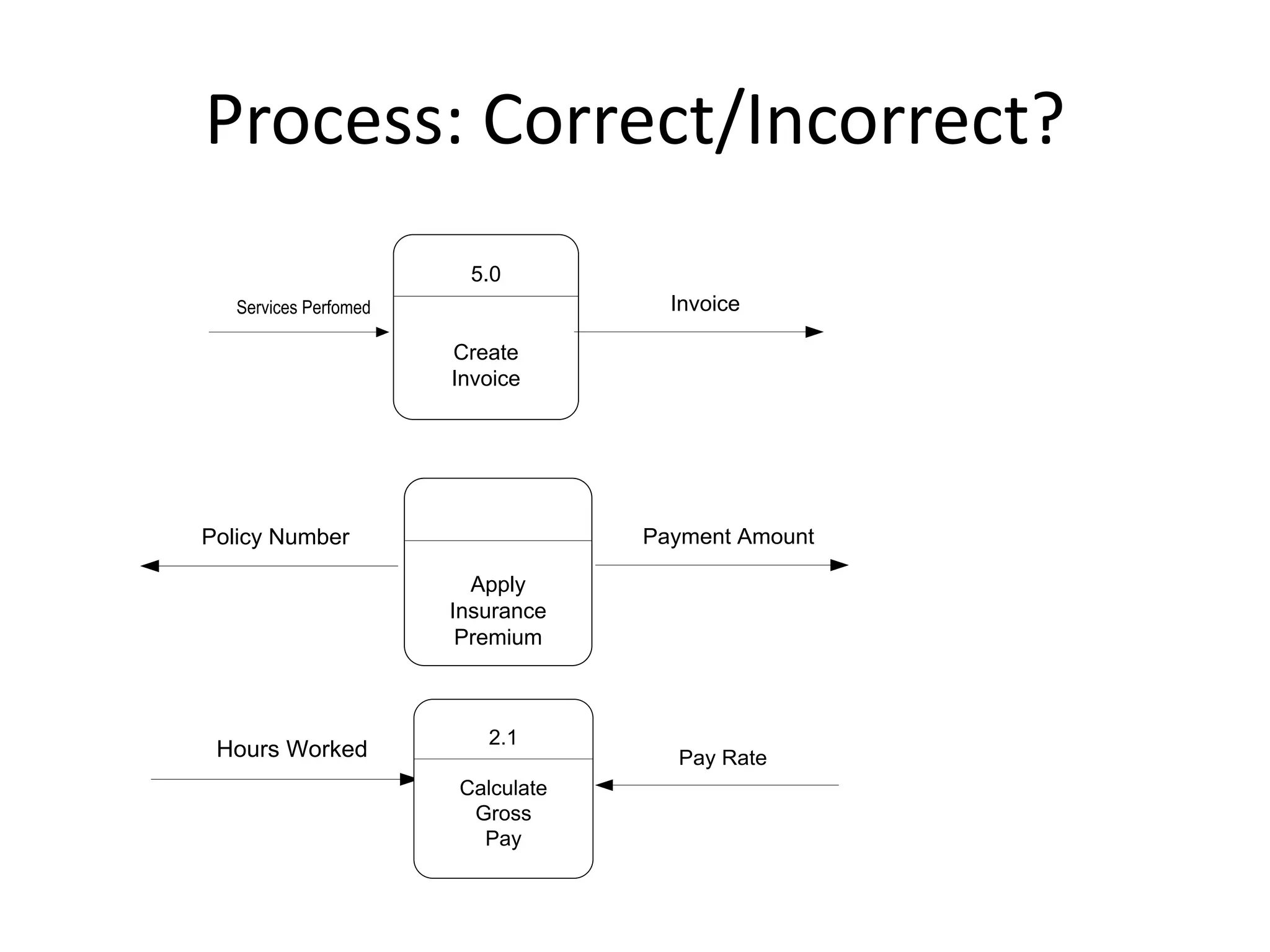
Process: Correct/Incorrect?
Services Perfomed
5.0
Create
Invoice
Invoice
Apply
Insurance
Premium
Policy Number Payment Amount
Hours Worked
2.1
Calculate
Gross
Pay
Pay Rate
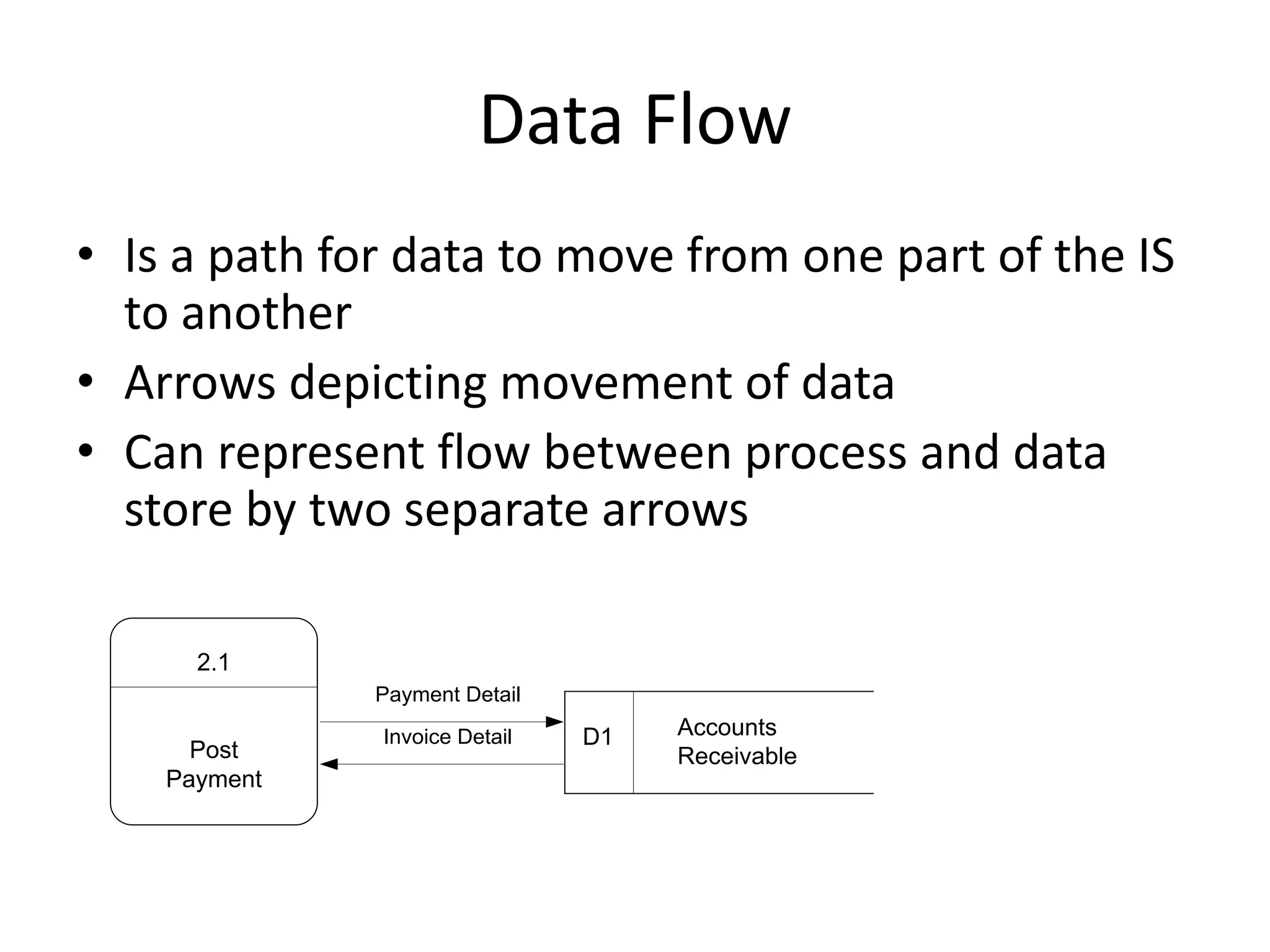
Data Flow
โ€ข Is a path for data to move from one part of the IS
to another
โ€ข Arrows depicting movement of data
โ€ข Can represent flow between process and data
store by two separate arrows
2.1
Post
Payment
Payment Detail
Invoice Detail Accounts
Receivable
D1
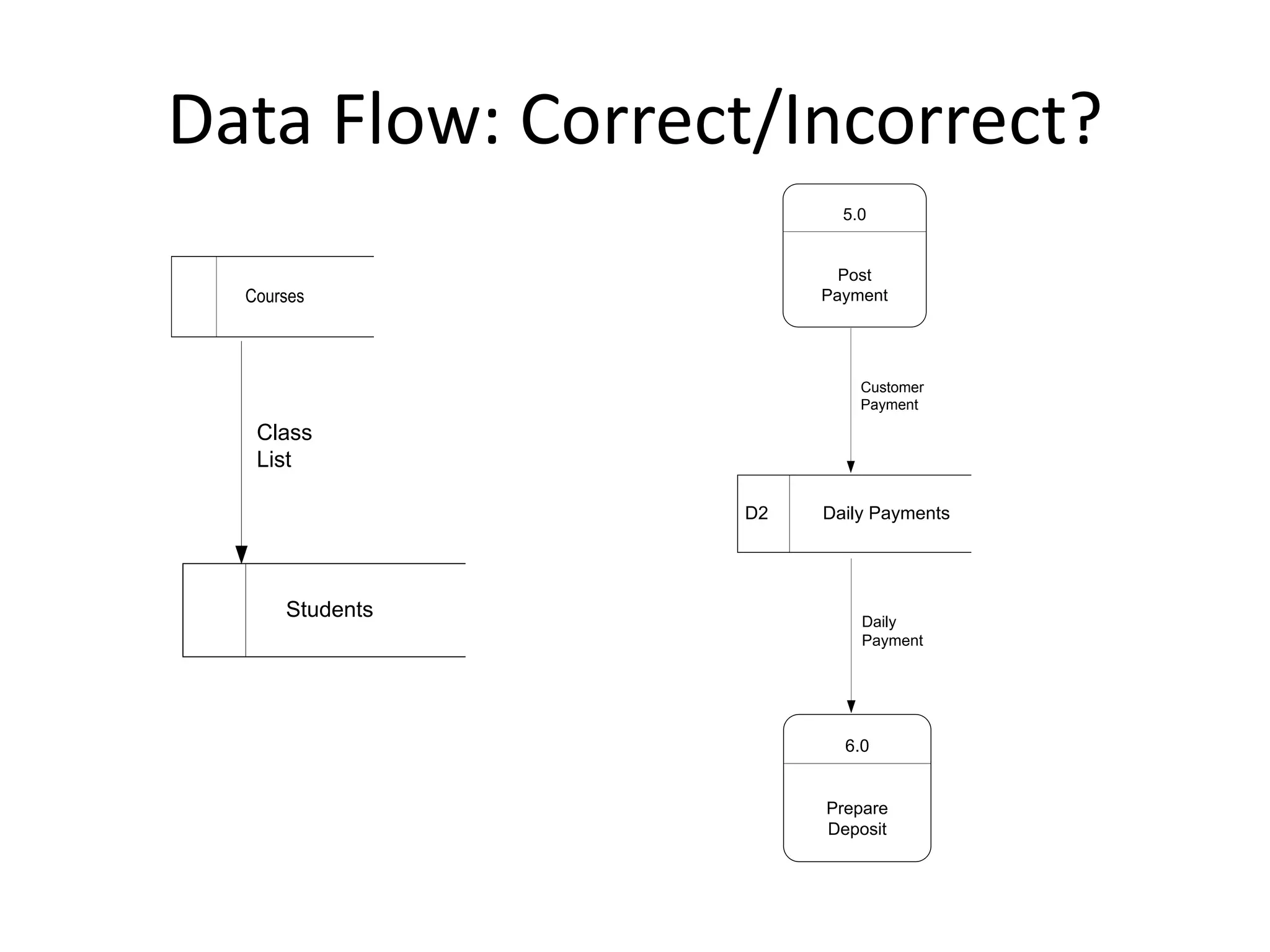
Data Flow: Correct/Incorrect?
Courses
Class
List
Students
5.0
Post
Payment
Customer
Payment
D2 Daily Payments
Daily
Payment
6.0
Prepare
Deposit
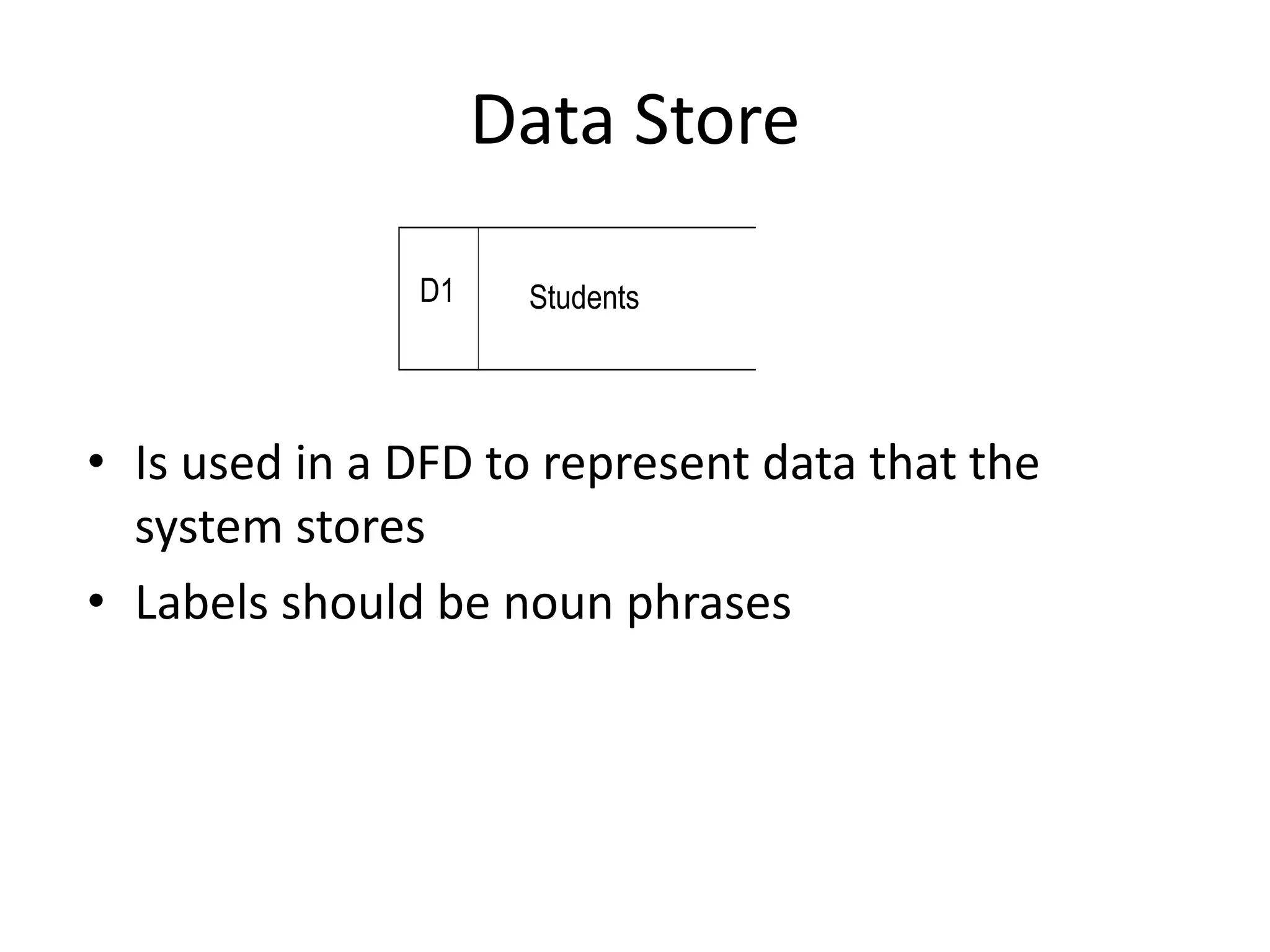
Data Store
Students
D1
โ€ข Is used in a DFD to represent data that the
system stores
โ€ข Labels should be noun phrases
Rule: Data Store
โ€ข Must have at least one incoming and one
outgoing data flow
Customer Payment
Daily
Payments
D1
Daily Payment
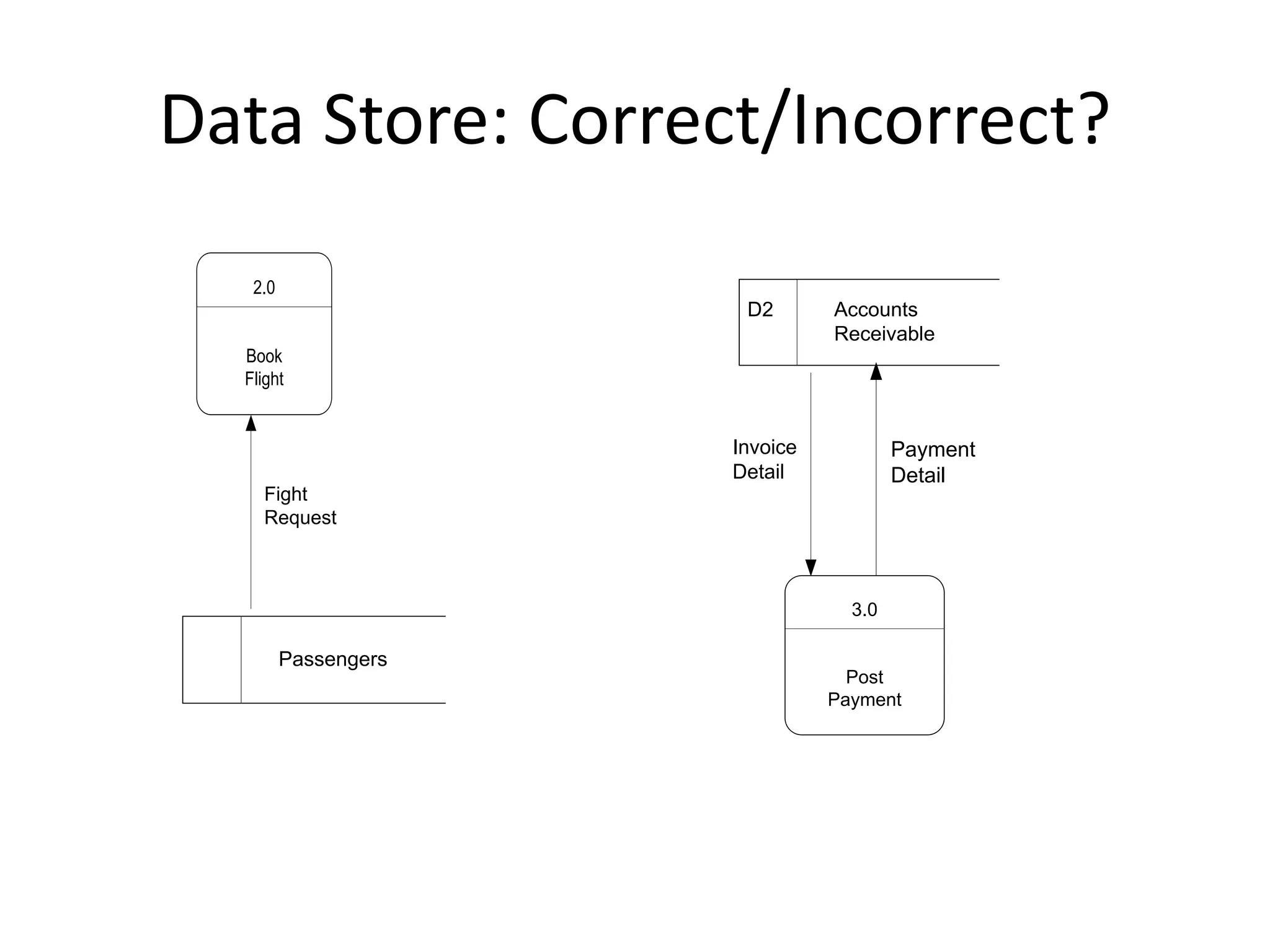
Data Store: Correct/Incorrect?
2.0
Book
Flight
Fight
Request
Passengers
D2 Accounts
Receivable
Invoice
Detail
Payment
Detail
3.0
Post
Payment
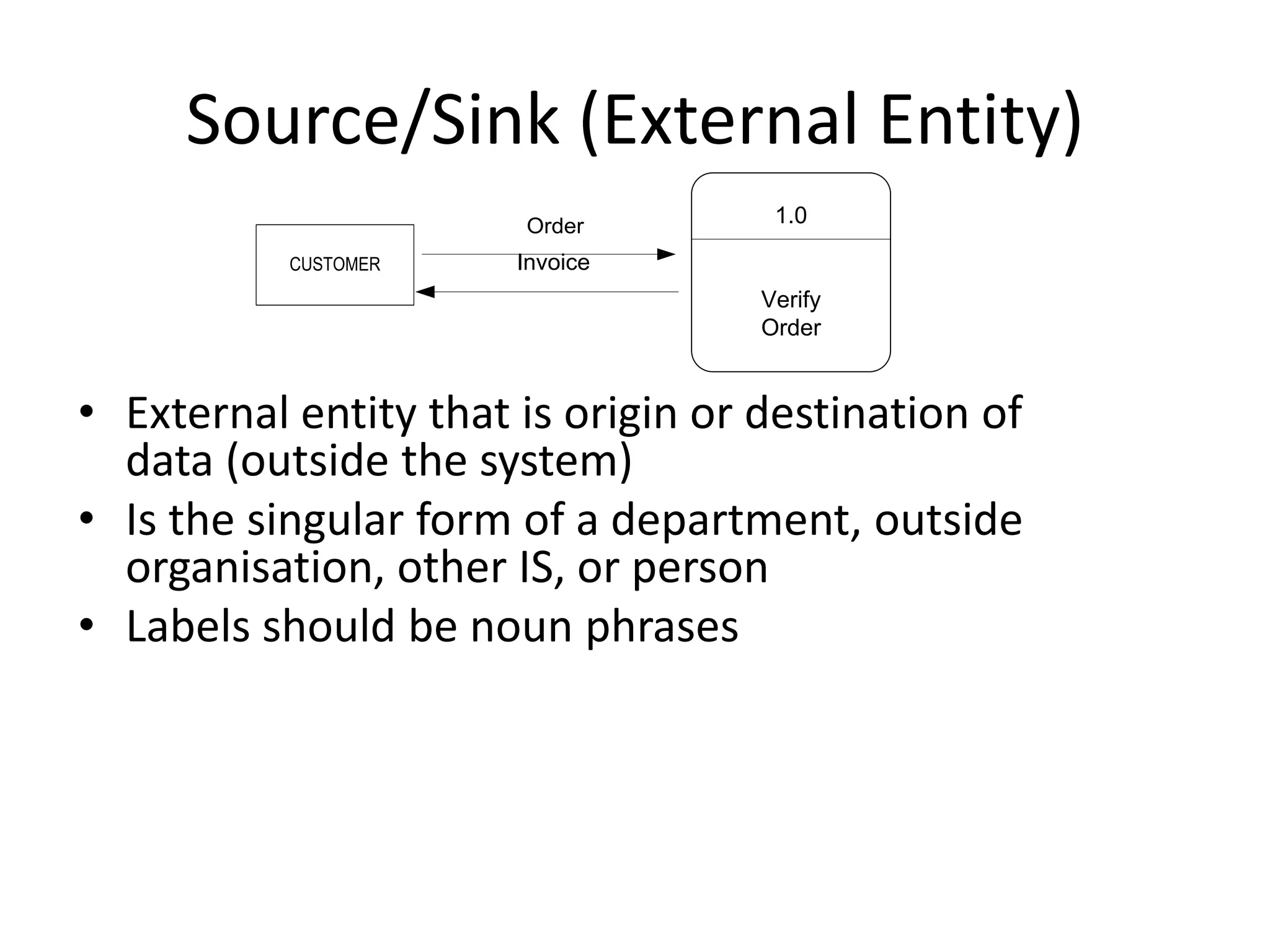
Source/Sink (External Entity)
CUSTOMER Invoice
Order 1.0
Verify
Order
โ€ข External entity that is origin or destination of
data (outside the system)
โ€ข Is the singular form of a department, outside
organisation, other IS, or person
โ€ข Labels should be noun phrases
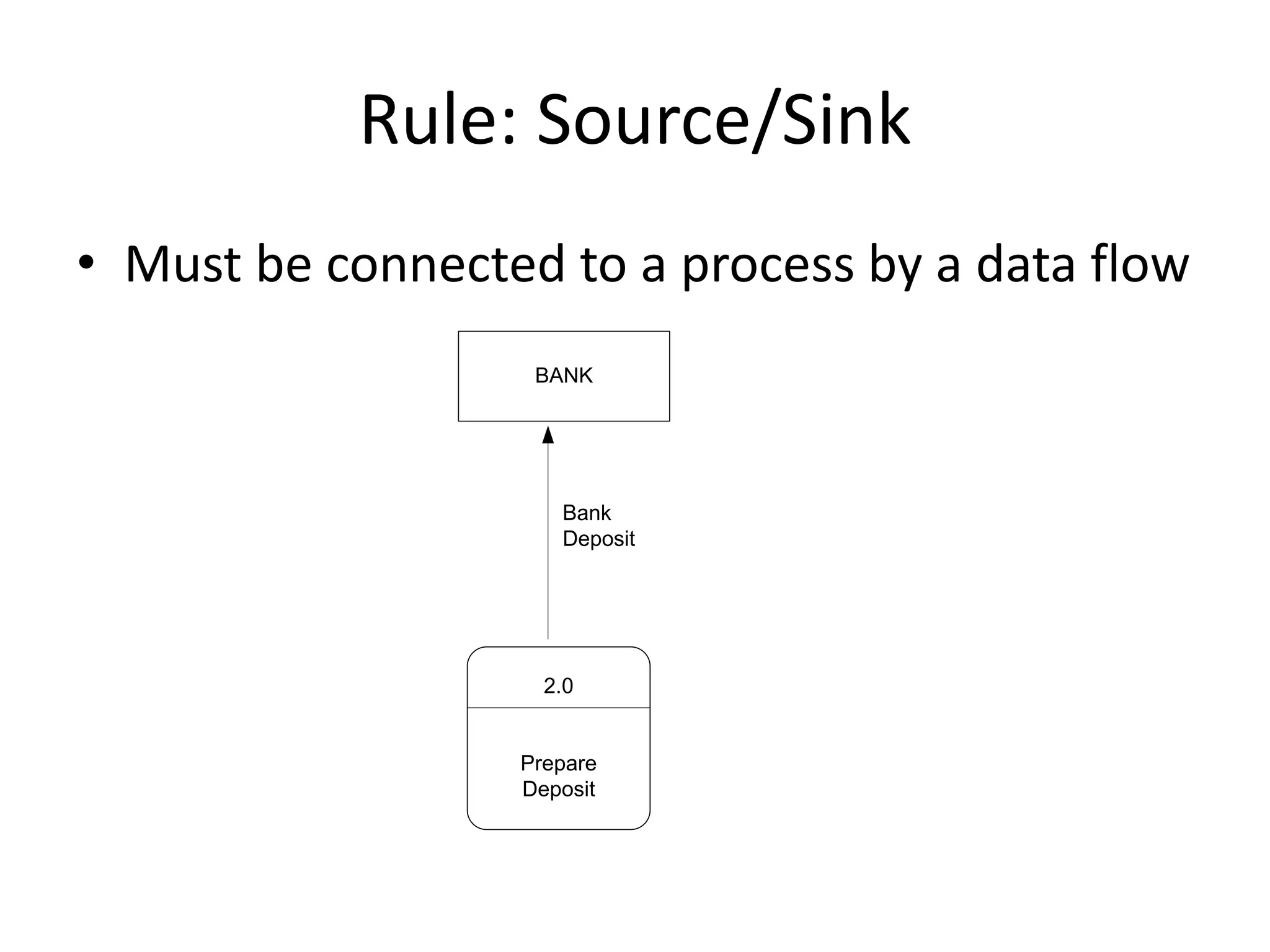
Rule: Source/Sink
โ€ข Must be connected to a process by a data flow
BANK
Bank
Deposit
2.0
Prepare
Deposit
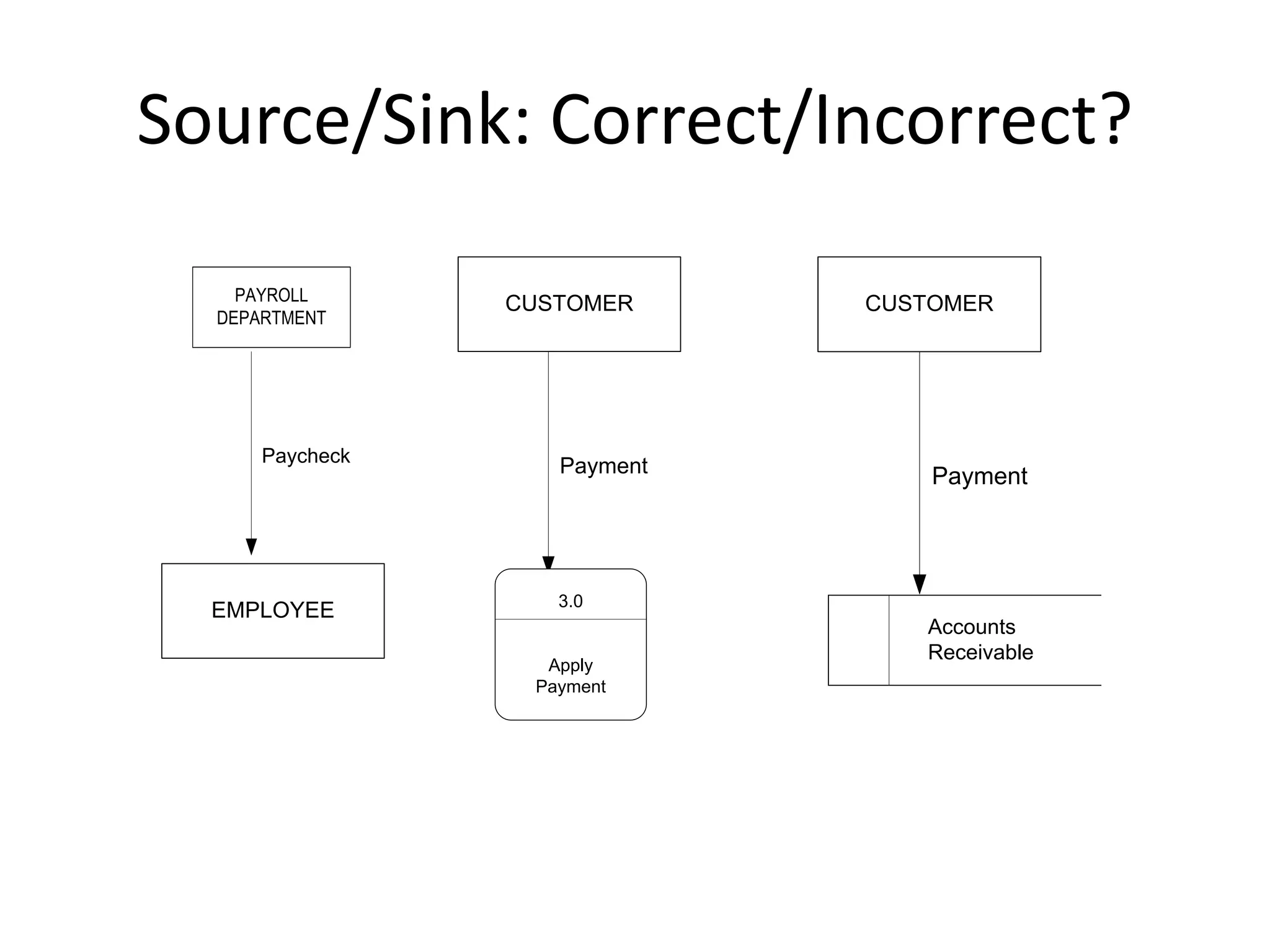
Source/Sink: Correct/Incorrect?
PAYROLL
DEPARTMENT
Paycheck
EMPLOYEE
CUSTOMER
Payment
3.0
Apply
Payment
CUSTOMER
Payment
Accounts
Receivable
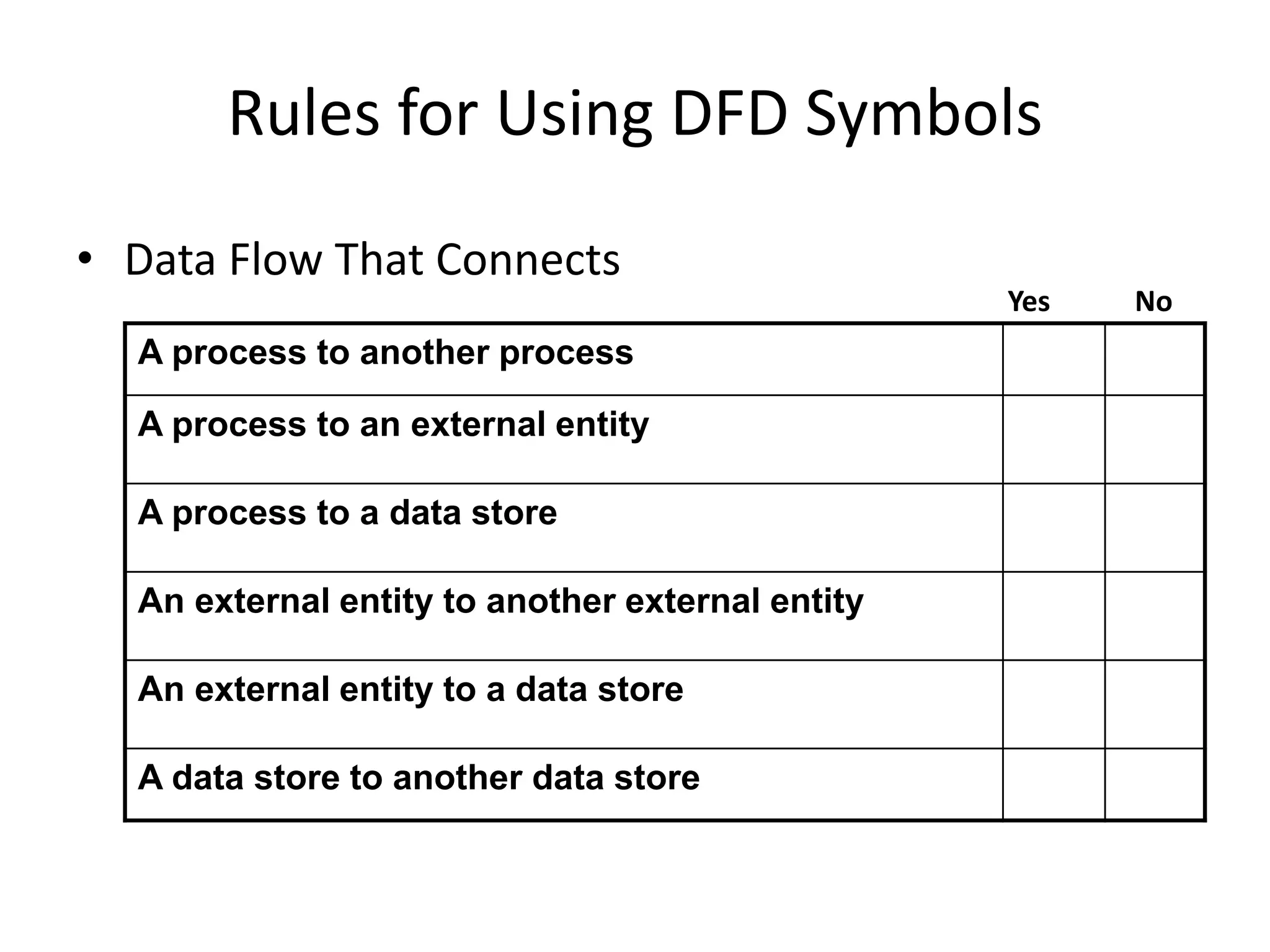
Rules for Using DFD Symbols
โ€ข Data Flow That Connects
A process to another process
A process to an external entity
A process to a data store
An external entity to another external entity
An external entity to a data store
A data store to another data store
Yes No
List the errors of this DFD
E1
E1
P2
P1
1.0
2.0
DS1
DF2
DF2
DF6
DF4
DF3
DF1
DF5
Context Diagram
โ€ข Top-level view of IS
โ€ข Shows the system boundaries, external entities that
interact with the system, and major information flows
between entities and the system.
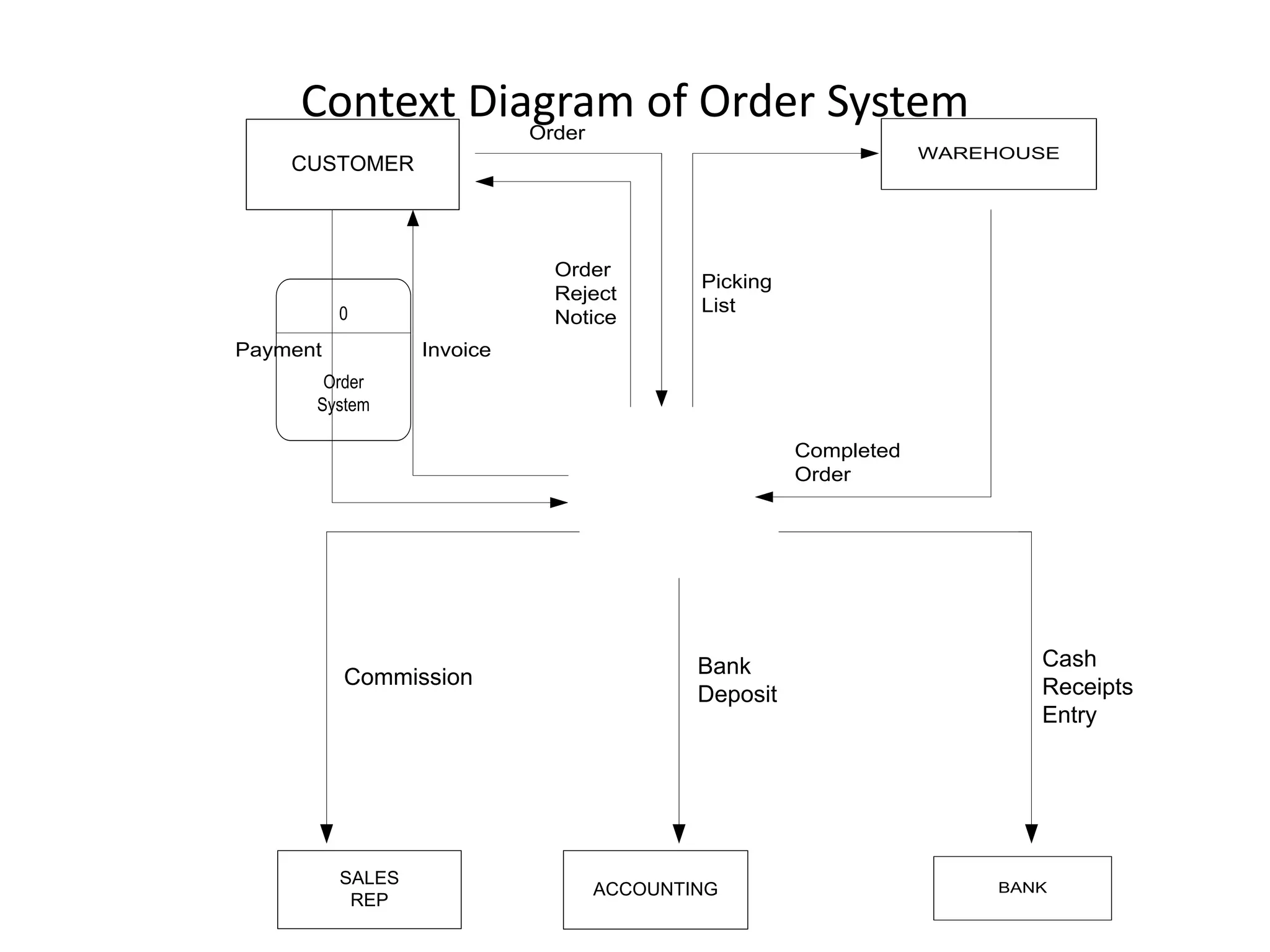
โ€ข Example: Order system that a company uses to enter
orders and apply payments against a customerโ€™s balance
Context Diagram of Order System
0
Order
System
SALES
REP
CUSTOMER
WAREHOUSE
BANK
ACCOUNTING
Order
Order
Reject
Notice
Picking
List
Completed
Order
Payment Invoice
Commission Bank
Deposit
Cash
Receipts
Entry
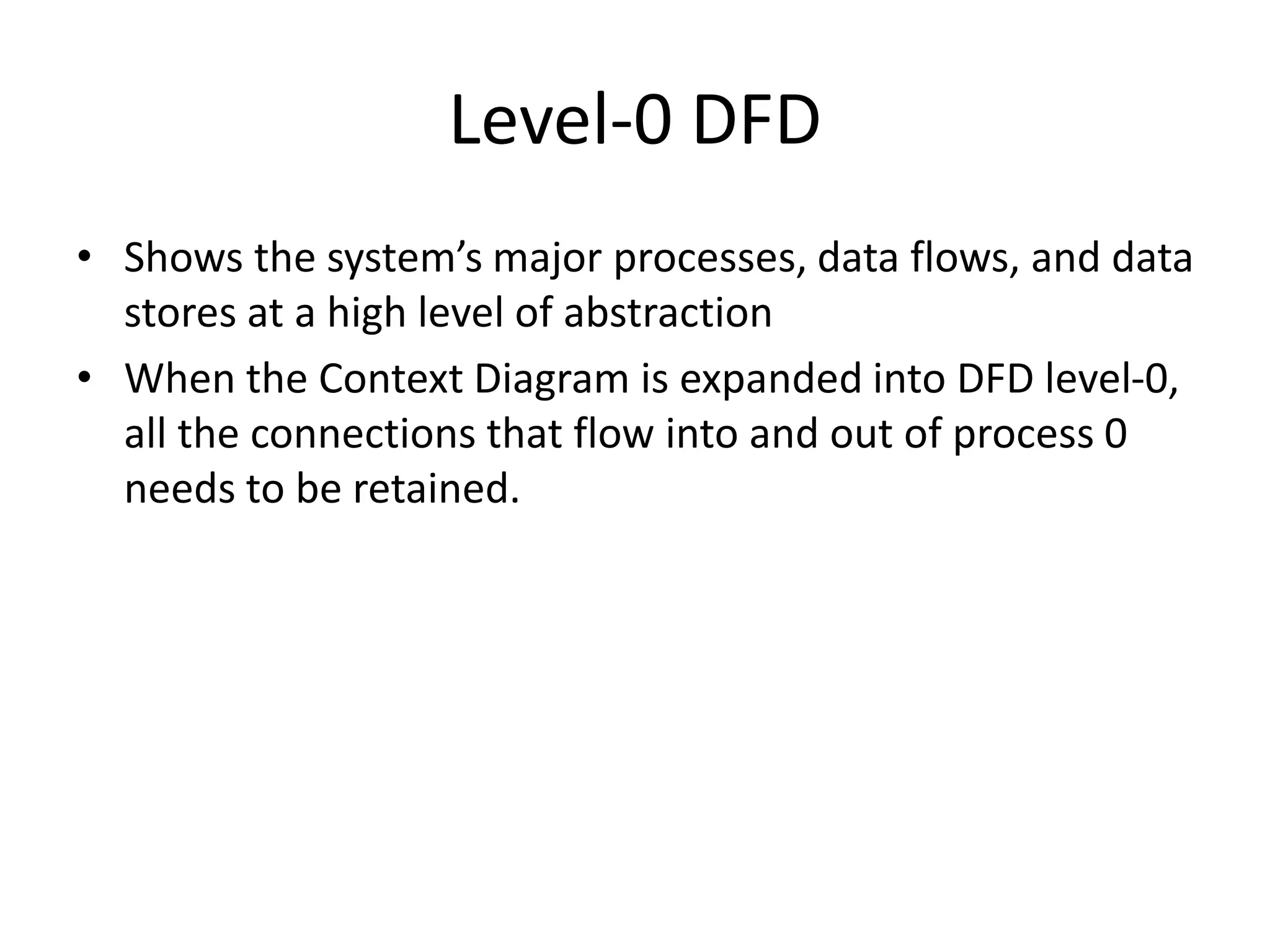
Level-0 DFD
โ€ข Shows the systemโ€™s major processes, data flows, and data
stores at a high level of abstraction
โ€ข When the Context Diagram is expanded into DFD level-0,
all the connections that flow into and out of process 0
needs to be retained.
1.0
Fill
Order
2.0
Create
Invoice
3.0
Apply
Payment
SALES
REP
BANK ACCOUNTING
CUSTOMER WAREHOUSE
Order
Order
Reject
Notice
Picking List
Accounts
Receivable
D1
Invoice
Invoice
Invoice
Detail
Payment
Detail
Payment
Commission Bank Deposit Cash Receipts Entry
Completed
Order
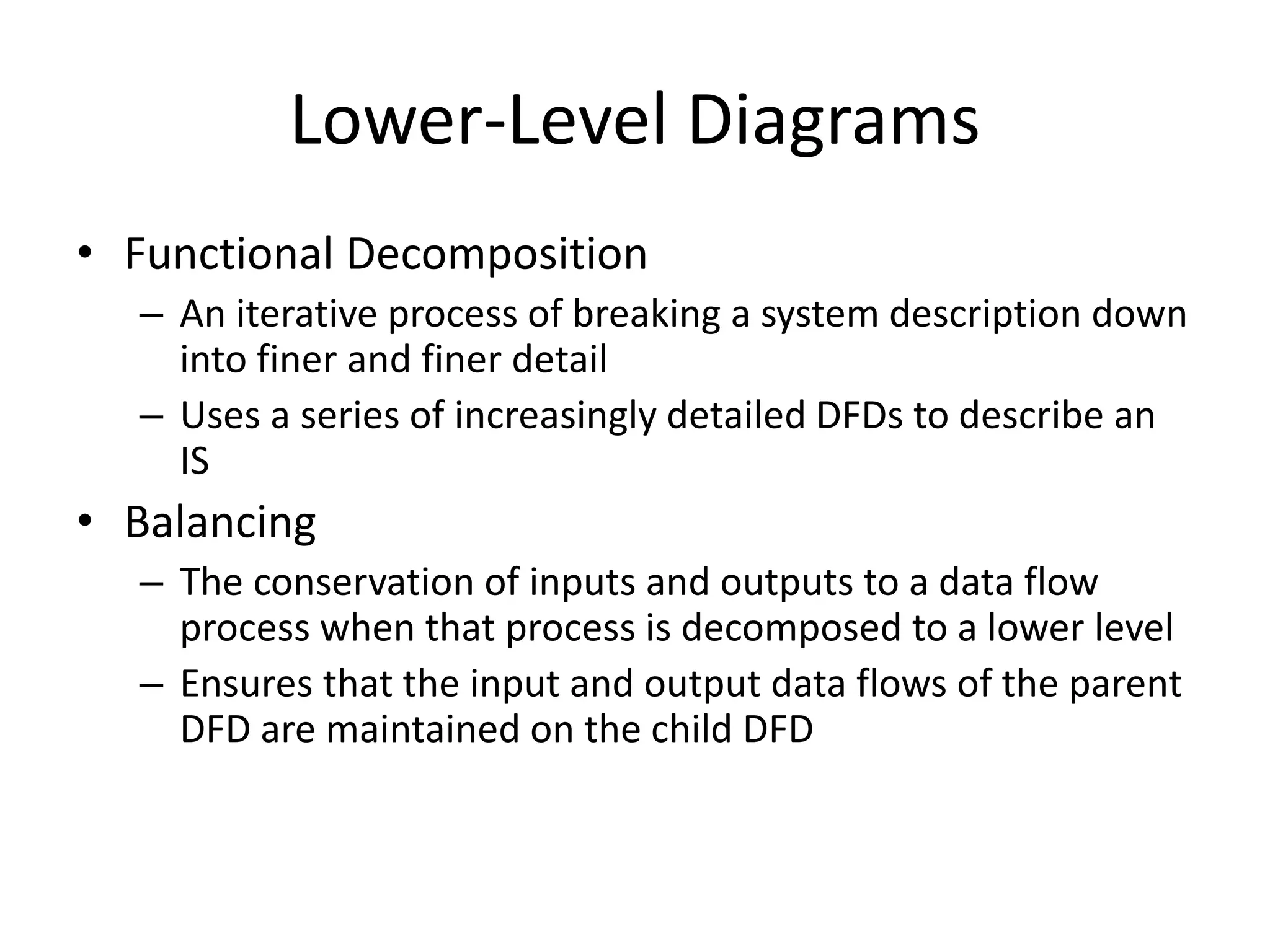
Lower-Level Diagrams
โ€ข Functional Decomposition
โ€“ An iterative process of breaking a system description down
into finer and finer detail
โ€“ Uses a series of increasingly detailed DFDs to describe an
IS
โ€ข Balancing
โ€“ The conservation of inputs and outputs to a data flow
process when that process is decomposed to a lower level
โ€“ Ensures that the input and output data flows of the parent
DFD are maintained on the child DFD
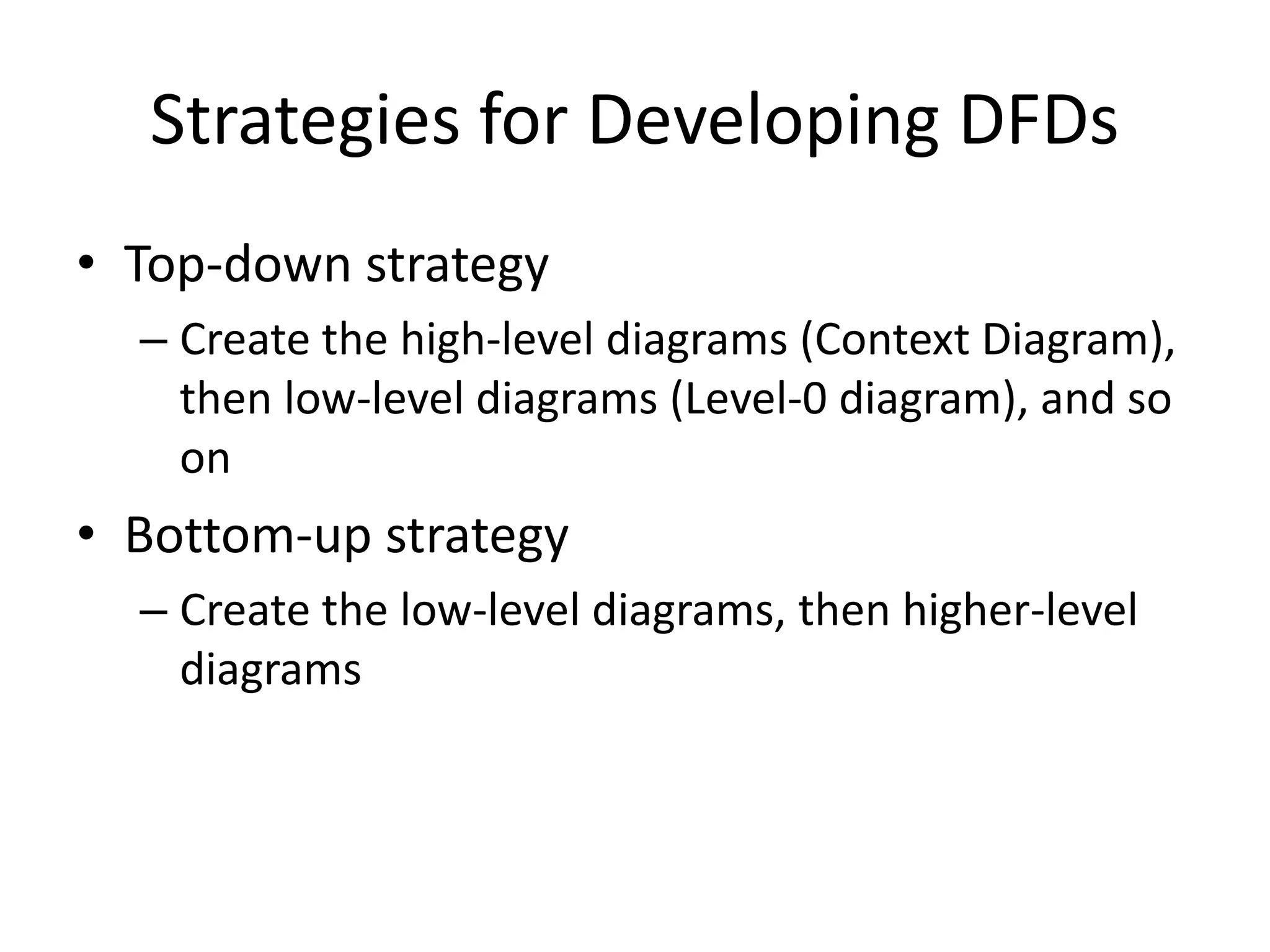
Strategies for Developing DFDs
โ€ข Top-down strategy
โ€“ Create the high-level diagrams (Context Diagram),
then low-level diagrams (Level-0 diagram), and so
on
โ€ข Bottom-up strategy
โ€“ Create the low-level diagrams, then higher-level
diagrams
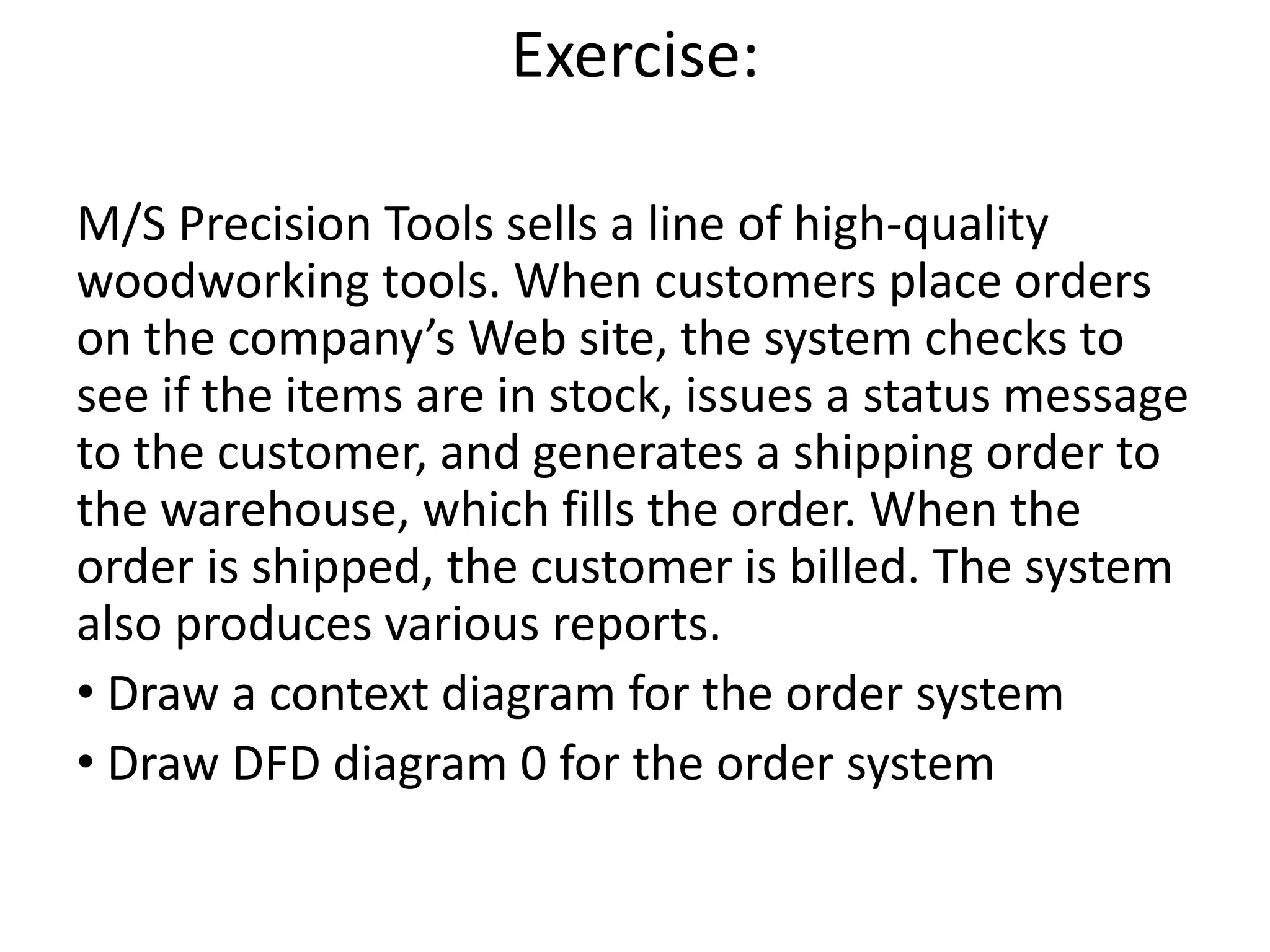
Exercise:
M/S Precision Tools sells a line of high-quality
woodworking tools. When customers place orders
on the companyโ€™s Web site, the system checks to
see if the items are in stock, issues a status message
to the customer, and generates a shipping order to
the warehouse, which fills the order. When the
order is shipped, the customer is billed. The system
also produces various reports.
โ€ข Draw a context diagram for the order system
โ€ข Draw DFD diagram 0 for the order system
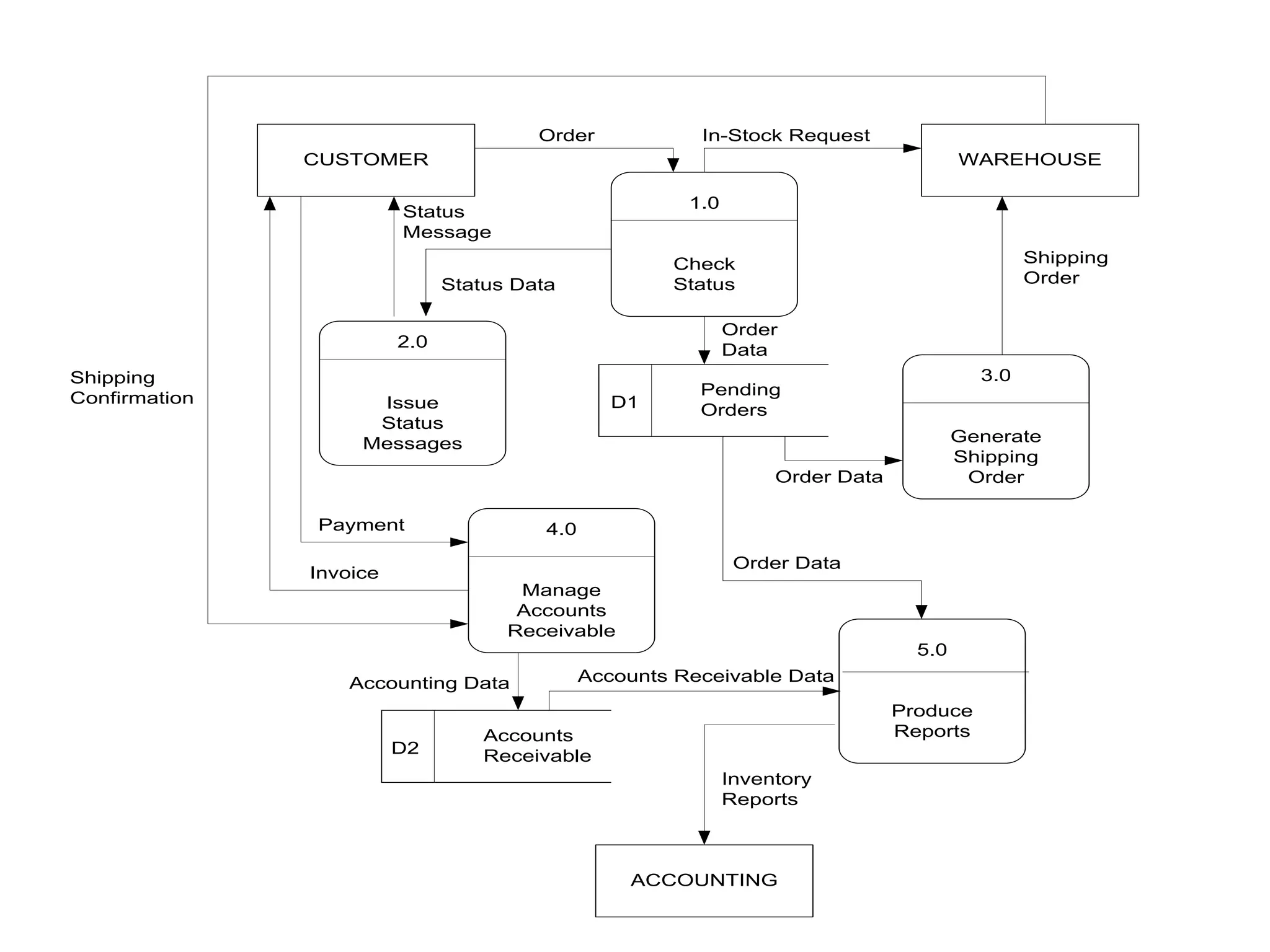
Identify Entities,Process,Data Stores & Data Flow
โ€ข Entities
โ€“ Customer
โ€“ Warehouse
โ€“ Accounting
โ€ข Processes
โ€“ 1.0 Check Status
โ€“ 2.0 Issue Status Messages
โ€“ 3.0 Generate Shipping Order
โ€“ 4.0 Manage Accounts Receivable
โ€“ 5.0 Produce Reports
โ€ข Data Stores
โ€“ D1 Pending Orders
โ€“ D2 Accounts Receivable
๏ฎ Data Flows
๏‚จ Order
๏‚จ In-Stock Request
๏‚จ Order Data
๏‚จ Status Data
๏‚จ Status Message
๏‚จ Shipping Order
๏‚จ Order Data
๏‚จ Invoice
๏‚จ Shipping Confirmation
๏‚จ Payment
๏‚จ Accounting Data
๏‚จ Accounts Receivable Data
๏‚จ Order Data
๏‚จ Inventory Reports
Context Diagram of Order System
ACCOUNTING
WAREHOUSE
CUSTOMER
0
Order
System
Order
Payment
In-Stock
Request
Status
Message
Invoice Shipping Confirmation
Shipping
Order
Inventory
Reports
1.0
Check
Status
2.0
Issue
Status
Messages
3.0
Generate
Shipping
Order
ACCOUNTING
CUSTOMER WAREHOUSE
4.0
Manage
Accounts
Receivable
5.0
Produce
Reports
Order In-Stock Request
Status Data
Status
Message
Pending
Orders
D1
Order
Data
Order Data
Shipping
Order
Shipping
Confirmation
Invoice
Payment
Accounts
Receivable
D2
Accounting Data Accounts Receivable Data
Order Data
Inventory
Reports

Data flow diagram(19th march)

  • 1.
  • 2.
    Definition โ€ข In thelate 1970s data-flow diagrams (DFDs) were introduced and popularized for structured analysis and design (Gane and Sarson 1979). โ€ข DFDs show the flow of data from external entities into the system, showed how the data moved from one process to another, as well as its logical storage.
  • 3.
    Data Flow Diagram โ€ขData flow diagram (DFD) is a picture of the movement of data between external entities and the processes and data stores within a system
  • 4.
    Symbols and meaning โ€ขSquares representing external entities, which are sources or destinations of data. โ€ข Rounded rectangles representing processes, which take data as input, do something to it, and output it. โ€ข Arrows representing the data flows, which can either be electronic data or physical items. โ€ข Open-ended rectangles representing data stores, including electronic stores such as databases or XML files and physical stores such as or filing cabinets or stacks of paper.
  • 5.
    DFD Symbols (Gane& Sarson) Process DataFlow DataStore Source/Sink (External Entity)
  • 6.
    Example of DFD 1.0 Check Status 2.0 Issue Status Messages 3.0 Generate Shipping Order ACCOUNTING CUSTOMERWAREHOUSE 4.0 Manage Accounts Receivable 5.0 Produce Reports Order In-Stock Request Status Data Status Message Pending Orders D1 Order Data Order Data Shipping Order Shipping Confirmation Invoice Payment Accounts Receivable D2 Accounting Data Accounts Receivable Data Order Data Inventory Reports
  • 7.
    Process Grade Detail 1.0 Produce Grade Report Grade Report โ€ขWork or actions performed on data (inside the system) โ€ข Labels should be verb phrases โ€ข Receives input data and produces output
  • 8.
    Rule 1: Process โ€ขCan have more than one outgoing data flow or more than one incoming data flow 1.0 Grade Student Work Submitted Work Student Grade Graded Work 3.0 Calculated Gross Pay Pay Rate Hours Worked Gross Pay
  • 9.
    Rule 2: Process OrderAccepted Order 2.0 Assemble Order Inventory Change 1.0 Verify Order
  • 10.
  • 11.
    Data Flow โ€ข Isa path for data to move from one part of the IS to another โ€ข Arrows depicting movement of data โ€ข Can represent flow between process and data store by two separate arrows 2.1 Post Payment Payment Detail Invoice Detail Accounts Receivable D1
  • 12.
  • 13.
    Data Store Students D1 โ€ข Isused in a DFD to represent data that the system stores โ€ข Labels should be noun phrases
  • 14.
    Rule: Data Store โ€ขMust have at least one incoming and one outgoing data flow Customer Payment Daily Payments D1 Daily Payment
  • 15.
    Data Store: Correct/Incorrect? 2.0 Book Flight Fight Request Passengers D2Accounts Receivable Invoice Detail Payment Detail 3.0 Post Payment
  • 16.
    Source/Sink (External Entity) CUSTOMERInvoice Order 1.0 Verify Order โ€ข External entity that is origin or destination of data (outside the system) โ€ข Is the singular form of a department, outside organisation, other IS, or person โ€ข Labels should be noun phrases
  • 17.
    Rule: Source/Sink โ€ข Mustbe connected to a process by a data flow BANK Bank Deposit 2.0 Prepare Deposit
  • 18.
  • 19.
    Rules for UsingDFD Symbols โ€ข Data Flow That Connects A process to another process A process to an external entity A process to a data store An external entity to another external entity An external entity to a data store A data store to another data store Yes No
  • 20.
    List the errorsof this DFD E1 E1 P2 P1 1.0 2.0 DS1 DF2 DF2 DF6 DF4 DF3 DF1 DF5
  • 21.
    Context Diagram โ€ข Top-levelview of IS โ€ข Shows the system boundaries, external entities that interact with the system, and major information flows between entities and the system. โ€ข Example: Order system that a company uses to enter orders and apply payments against a customerโ€™s balance
  • 22.
    Context Diagram ofOrder System 0 Order System SALES REP CUSTOMER WAREHOUSE BANK ACCOUNTING Order Order Reject Notice Picking List Completed Order Payment Invoice Commission Bank Deposit Cash Receipts Entry
  • 23.
    Level-0 DFD โ€ข Showsthe systemโ€™s major processes, data flows, and data stores at a high level of abstraction โ€ข When the Context Diagram is expanded into DFD level-0, all the connections that flow into and out of process 0 needs to be retained.
  • 24.
    1.0 Fill Order 2.0 Create Invoice 3.0 Apply Payment SALES REP BANK ACCOUNTING CUSTOMER WAREHOUSE Order Order Reject Notice PickingList Accounts Receivable D1 Invoice Invoice Invoice Detail Payment Detail Payment Commission Bank Deposit Cash Receipts Entry Completed Order
  • 25.
    Lower-Level Diagrams โ€ข FunctionalDecomposition โ€“ An iterative process of breaking a system description down into finer and finer detail โ€“ Uses a series of increasingly detailed DFDs to describe an IS โ€ข Balancing โ€“ The conservation of inputs and outputs to a data flow process when that process is decomposed to a lower level โ€“ Ensures that the input and output data flows of the parent DFD are maintained on the child DFD
  • 26.
    Strategies for DevelopingDFDs โ€ข Top-down strategy โ€“ Create the high-level diagrams (Context Diagram), then low-level diagrams (Level-0 diagram), and so on โ€ข Bottom-up strategy โ€“ Create the low-level diagrams, then higher-level diagrams
  • 27.
    Exercise: M/S Precision Toolssells a line of high-quality woodworking tools. When customers place orders on the companyโ€™s Web site, the system checks to see if the items are in stock, issues a status message to the customer, and generates a shipping order to the warehouse, which fills the order. When the order is shipped, the customer is billed. The system also produces various reports. โ€ข Draw a context diagram for the order system โ€ข Draw DFD diagram 0 for the order system
  • 28.
    Identify Entities,Process,Data Stores& Data Flow โ€ข Entities โ€“ Customer โ€“ Warehouse โ€“ Accounting โ€ข Processes โ€“ 1.0 Check Status โ€“ 2.0 Issue Status Messages โ€“ 3.0 Generate Shipping Order โ€“ 4.0 Manage Accounts Receivable โ€“ 5.0 Produce Reports โ€ข Data Stores โ€“ D1 Pending Orders โ€“ D2 Accounts Receivable ๏ฎ Data Flows ๏‚จ Order ๏‚จ In-Stock Request ๏‚จ Order Data ๏‚จ Status Data ๏‚จ Status Message ๏‚จ Shipping Order ๏‚จ Order Data ๏‚จ Invoice ๏‚จ Shipping Confirmation ๏‚จ Payment ๏‚จ Accounting Data ๏‚จ Accounts Receivable Data ๏‚จ Order Data ๏‚จ Inventory Reports
  • 29.
    Context Diagram ofOrder System ACCOUNTING WAREHOUSE CUSTOMER 0 Order System Order Payment In-Stock Request Status Message Invoice Shipping Confirmation Shipping Order Inventory Reports
  • 30.
    1.0 Check Status 2.0 Issue Status Messages 3.0 Generate Shipping Order ACCOUNTING CUSTOMER WAREHOUSE 4.0 Manage Accounts Receivable 5.0 Produce Reports Order In-StockRequest Status Data Status Message Pending Orders D1 Order Data Order Data Shipping Order Shipping Confirmation Invoice Payment Accounts Receivable D2 Accounting Data Accounts Receivable Data Order Data Inventory Reports