

What Is a
Developmental Delay
Assessing infant and toddlers
Analuz A. Fuentebella
MAED MA SPED
MASE422
Submitted to:
Dr. Aida Damian
University of Perpetual Help System DALTA
Do you suspect that your baby or toddler might
have a developmental delay? A developmental delay
is often diagnosed when a child does not reach
their developmental milestone when expected. They
can range from minor to something more
significant.
Most developmental delays are not serious and
usually correct themselves. And for some, there
is no known cause. However, if your child does
have some form of developmental delay, there
are things that you can do to address it.
What Are the Signs of a Developmental
Delay?
There are many types of possible developmental delay in
babies and toddlers; speech, vision and motor skills are
just a few. It can be hard, especially for first-time parents
to distinguish a simple lagging behind with a true
developmental delay in their child. The following are the
warning signs for different types of developmental delays
in children from newborns to two year olds.
Speech and language delay in toddlers are very common. In fact, they are
the most common form of developmental delay. While speech refers to
verbal communications, language is more about how your little one is able
to express and receive information. If your toddler is not speaking at the
same age as his older sister did, or some other kids his age is ahead of him
please do not worry. Early language development is very uneven and
happens in spurts, a few months difference is not significant and your
child will catch up before you expected, and it will likely happen all of a
sudden when he has a big vocabulary growth spurt. One language delay
cause that you should investigate though is a potential hearing loss, luckily
this is rather easy to rule out, but if you are worried check with your
child’s pediatrician. If your school-aged child is still struggling with
language you may need to look into a possible learning disability (like
attention-deficit hyperactivity disorder or ADHD), and autism spectrum
disorder (ASD). If you suspect a speech delay, your pediatrician will likely
refer your child to be evaluated by a speech-language pathologist.
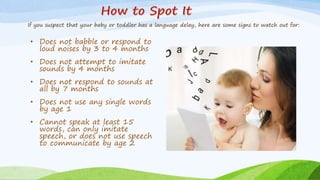
If you suspect that your baby or toddler has a language delay, here are some signs to watch out for:
• Does not babble or respond to
loud noises by 3 to 4 months
• Does not attempt to imitate
sounds by 4 months
• Does not respond to sounds at
all by 7 months
• Does not use any single words
by age 1
• Cannot speak at least 15
words, can only imitate
speech, or does not use speech
to communicate by age 2
Are you afraid that your baby or toddler is not walking when he
or she should be? Or maybe you have noticed that your toddler
is having difficulty grasping a spoon. If so, then it is possible that
he or she may have a gross motor or fine motor delay. Gross
motor delay affects the ability to crawl or walk. Whereas a fine
motor delay will impact your baby or toddler’s ability to use
utensils or hold a crayon properly. Common causes include
premature birth, cerebral palsy, epilepsy, vision problems, and
cognitive delays. If you suspect a delay in motor skills, your
pediatrician may recommend physical therapy for gross motor
delays or occupational therapy for fine motor delays.
If you suspect that your baby or toddler has a motor skills delay, here are some signs to watch out for:
• Does not reach for, grasp, or hold
objects by 3 or 4 months old
• Does not roll over in either
direction by 5 months
• Cannot sit up without help by 6
months
• Does not actively reach for objects
by 7 months
• Does not crawl or cannot stand
while being supported by age 1
• Cannot walk or push a wheeled
toy by 18 months
• Still walks on toes by age 2
A cognitive delay refers to problems with thinking and
can sometimes be referred to as an intellectual
disability. If your little one has a cognitive
developmental delay then it may be due to a learning
disability (like ADHD), lead poisoning, a genetic
disorder, or autism spectrum disorder (ASD). Early
intervention and treatment is key when addressing
this type of developmental delay.
If you suspect that your baby or toddler has a cognitive delay, here are some signs to watch out for
Not producing babbling
sounds
Not imitating gestures
such as waving bye-bye
or shaking head
Plays only with a few
favorite toys
Your baby’s vision is normally blurry within his or
her first 6 months. Eventually, it should improve.
If it doesn’t, there are some signs you should look
out for.
• Does not notice hands by 2
months
• Does not follow moving
objects with his or her eyes
by 3 months
• Experiences constant tearing
or eye drainage by 6 months
• Does not follow near objects
at least 1 foot away or far
objects at least 6 feet away
with both eyes by 6 months
If you suspect that your baby or toddler has a vision delay, here are some signs to watch out for:
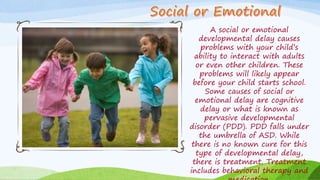
A social or emotional
developmental delay causes
problems with your child’s
ability to interact with adults
or even other children. These
problems will likely appear
before your child starts school.
Some causes of social or
emotional delay are cognitive
delay or what is known as
pervasive developmental
disorder (PDD). PDD falls under
the umbrella of ASD. While
there is no known cure for this
type of developmental delay,
there is treatment. Treatment
includes behavioral therapy and
When a child has many or
all of the previously listed
developmental delays, it is
called “global
developmental delay.”
Common causes include a
genetic defect (like down
syndrome), fragile X
syndrome, fetal alcohal
syndrome, and severe
medical problems
associated with
prematurity.
Watching your child grow and develop new
skills is one of the most exciting aspects of
being a parent. All parents anticipate and
track their child's development, and the
majority of the time children meet their
milestones on time. However, parents get
concerned when a child doesn't do something
by the age he or she is "supposed to." It's even
worse when a friend or relative is telling you
all the amazing things his child is doing that
yours is not.
As long as those periodic evaluations are normal, you can
rest assured that your child is developing appropriately and
should be fine.
• Ages and Stages Questionnaire
• Parents' Evaluation of
Developmental Status
• Modified Checklist for Autism In
Toddlers
• Others
When problems are identified, the first step is a
referral to early intervention, which is provided
under a federal law called the Individuals with
Disabilities Education Act (IDEA). Early
intervention is available in every state. Your
pediatrician may also refer your child to a
developmental-behavioral pediatric specialist
who can provide developmental and medical
evaluations and follow-up for developmental
problems.
Screening, evaluation and assessment are
distinct processes with different purposes.
Screening includes activities to identify
children who may need further evaluation
in order to determine the existence of a
delay in development or a particular
disability. Evaluation is used to determine
the existence of a delay or disability, to
identify the child's strengths and needs in
all areas of development. Assessment is used
to determine the individual child's present
level of performance and early intervention
or educational needs.
screening is at a state's discretion and is part of Post-
Referral Procedures. Screening is conducted using
appropriate instruments, administered by trained
personnel, by the lead agency or an early intervention
program. The purpose of screening is to determine
whether an infant or toddler is suspected of having a
disability and is, therefore, in need of early intervention
services. Screening requires parental notice and consent,
must be performed within the 45 day timeline, and, at a
parent's request and with consent, the EI program must
conduct an initial evaluation of the infant or toddler
even if the results of the screening do not identify the
child as suspected of having a disability. screening may be
conducted as part of child find activities in order to
ascertain whether the child should be referred for an
evaluation to determine if the child has a disability and is
in need of special education and related services.

developmental assessment for infant and toddlers

  • 1.
    What Is a DevelopmentalDelay Assessing infant and toddlers Analuz A. Fuentebella MAED MA SPED MASE422 Submitted to: Dr. Aida Damian University of Perpetual Help System DALTA
  • 2.
    Do you suspectthat your baby or toddler might have a developmental delay? A developmental delay is often diagnosed when a child does not reach their developmental milestone when expected. They can range from minor to something more significant.
  • 3.
    Most developmental delaysare not serious and usually correct themselves. And for some, there is no known cause. However, if your child does have some form of developmental delay, there are things that you can do to address it.
  • 4.
    What Are theSigns of a Developmental Delay? There are many types of possible developmental delay in babies and toddlers; speech, vision and motor skills are just a few. It can be hard, especially for first-time parents to distinguish a simple lagging behind with a true developmental delay in their child. The following are the warning signs for different types of developmental delays in children from newborns to two year olds.
  • 6.
    Speech and languagedelay in toddlers are very common. In fact, they are the most common form of developmental delay. While speech refers to verbal communications, language is more about how your little one is able to express and receive information. If your toddler is not speaking at the same age as his older sister did, or some other kids his age is ahead of him please do not worry. Early language development is very uneven and happens in spurts, a few months difference is not significant and your child will catch up before you expected, and it will likely happen all of a sudden when he has a big vocabulary growth spurt. One language delay cause that you should investigate though is a potential hearing loss, luckily this is rather easy to rule out, but if you are worried check with your child’s pediatrician. If your school-aged child is still struggling with language you may need to look into a possible learning disability (like attention-deficit hyperactivity disorder or ADHD), and autism spectrum disorder (ASD). If you suspect a speech delay, your pediatrician will likely refer your child to be evaluated by a speech-language pathologist.
  • 7.
    If you suspectthat your baby or toddler has a language delay, here are some signs to watch out for: • Does not babble or respond to loud noises by 3 to 4 months • Does not attempt to imitate sounds by 4 months • Does not respond to sounds at all by 7 months • Does not use any single words by age 1 • Cannot speak at least 15 words, can only imitate speech, or does not use speech to communicate by age 2
  • 8.
    Are you afraidthat your baby or toddler is not walking when he or she should be? Or maybe you have noticed that your toddler is having difficulty grasping a spoon. If so, then it is possible that he or she may have a gross motor or fine motor delay. Gross motor delay affects the ability to crawl or walk. Whereas a fine motor delay will impact your baby or toddler’s ability to use utensils or hold a crayon properly. Common causes include premature birth, cerebral palsy, epilepsy, vision problems, and cognitive delays. If you suspect a delay in motor skills, your pediatrician may recommend physical therapy for gross motor delays or occupational therapy for fine motor delays.
  • 9.
    If you suspectthat your baby or toddler has a motor skills delay, here are some signs to watch out for: • Does not reach for, grasp, or hold objects by 3 or 4 months old • Does not roll over in either direction by 5 months • Cannot sit up without help by 6 months • Does not actively reach for objects by 7 months • Does not crawl or cannot stand while being supported by age 1 • Cannot walk or push a wheeled toy by 18 months • Still walks on toes by age 2
  • 10.
    A cognitive delayrefers to problems with thinking and can sometimes be referred to as an intellectual disability. If your little one has a cognitive developmental delay then it may be due to a learning disability (like ADHD), lead poisoning, a genetic disorder, or autism spectrum disorder (ASD). Early intervention and treatment is key when addressing this type of developmental delay.
  • 11.
    If you suspectthat your baby or toddler has a cognitive delay, here are some signs to watch out for Not producing babbling sounds Not imitating gestures such as waving bye-bye or shaking head Plays only with a few favorite toys
  • 12.
    Your baby’s visionis normally blurry within his or her first 6 months. Eventually, it should improve. If it doesn’t, there are some signs you should look out for.
  • 13.
    • Does notnotice hands by 2 months • Does not follow moving objects with his or her eyes by 3 months • Experiences constant tearing or eye drainage by 6 months • Does not follow near objects at least 1 foot away or far objects at least 6 feet away with both eyes by 6 months If you suspect that your baby or toddler has a vision delay, here are some signs to watch out for:
  • 14.
    A social oremotional developmental delay causes problems with your child’s ability to interact with adults or even other children. These problems will likely appear before your child starts school. Some causes of social or emotional delay are cognitive delay or what is known as pervasive developmental disorder (PDD). PDD falls under the umbrella of ASD. While there is no known cure for this type of developmental delay, there is treatment. Treatment includes behavioral therapy and
  • 15.
    When a childhas many or all of the previously listed developmental delays, it is called “global developmental delay.” Common causes include a genetic defect (like down syndrome), fragile X syndrome, fetal alcohal syndrome, and severe medical problems associated with prematurity.
  • 16.
    Watching your childgrow and develop new skills is one of the most exciting aspects of being a parent. All parents anticipate and track their child's development, and the majority of the time children meet their milestones on time. However, parents get concerned when a child doesn't do something by the age he or she is "supposed to." It's even worse when a friend or relative is telling you all the amazing things his child is doing that yours is not.
  • 18.
    As long asthose periodic evaluations are normal, you can rest assured that your child is developing appropriately and should be fine. • Ages and Stages Questionnaire • Parents' Evaluation of Developmental Status • Modified Checklist for Autism In Toddlers • Others
  • 19.
    When problems areidentified, the first step is a referral to early intervention, which is provided under a federal law called the Individuals with Disabilities Education Act (IDEA). Early intervention is available in every state. Your pediatrician may also refer your child to a developmental-behavioral pediatric specialist who can provide developmental and medical evaluations and follow-up for developmental problems.
  • 20.
    Screening, evaluation andassessment are distinct processes with different purposes. Screening includes activities to identify children who may need further evaluation in order to determine the existence of a delay in development or a particular disability. Evaluation is used to determine the existence of a delay or disability, to identify the child's strengths and needs in all areas of development. Assessment is used to determine the individual child's present level of performance and early intervention or educational needs.
  • 21.
    screening is ata state's discretion and is part of Post- Referral Procedures. Screening is conducted using appropriate instruments, administered by trained personnel, by the lead agency or an early intervention program. The purpose of screening is to determine whether an infant or toddler is suspected of having a disability and is, therefore, in need of early intervention services. Screening requires parental notice and consent, must be performed within the 45 day timeline, and, at a parent's request and with consent, the EI program must conduct an initial evaluation of the infant or toddler even if the results of the screening do not identify the child as suspected of having a disability. screening may be conducted as part of child find activities in order to ascertain whether the child should be referred for an evaluation to determine if the child has a disability and is in need of special education and related services.