What is Early Intervention
and Developmental Delay?
Prepared by:
Ms. Caire Ann B. Pangilinan, LPT
Submitted to:
Dr. Aida S. Damian, Ed.D.
1
What is Early
Intervention?
2
Early Childhood
Special
Education
Early Intervention helps improve and
sometimes prevents developmental problems,
helps reduce the number of children retained in
later grades, reduces educational costs (due to
fewer children needing Special Education
Services once entered in school), and helps
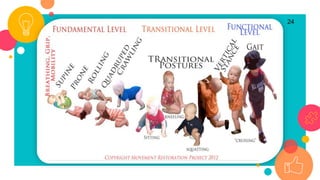
improve the quality of parent, child, and family
relationships.
3
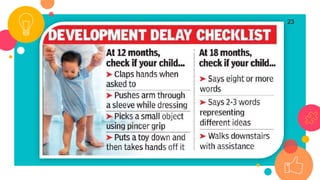
Early Childhood
Special
Education
Early Childhood Special Education
and related services is a state and
federally mandated program for
children (ages 3-5) who meet state
eligibility criteria because they are
experiencing developmental delays.
4
Eligibility for children is determined by criteria
that have been established by federal and state
rules and regulations.
“• Early intervention is the process of providing services, education and
support to young children who are/have:
- deemed to have an established condition
- evaluated and deemed to have a diagnosed physical or mental
condition (with a high probability of resulting in a developmental
delay)
- an existing delay or a child who is *at-risk of developing a delay or
special need that may affect their development or impede their
education.
5
“• Early intervention is about taking action as soon as possible to tackle
problems for children and families before they become more difficult to
reverse.
• Early intervention involves identifying children and families that may
be at risk of running into difficulties and providing timely and effective
support.
• Early intervention is about enhancing the capabilities of every parent to
provide a supportive and enriching environment for their children to
grow up in. Then the next generation has the best chance to flourish
with the skills to engage in positive parenting themselves.
6
According to IDEA
(Individuals with Disabilities
Education Act)
According to
IDEA
The Individuals with
Disabilities Education Act
(IDEA) provides for early
intervention services for
young children (from age 1
until age 3) and special
education services for older
children (ages 3 and older) to
minimize the effects of
developmental delays and
learning disabilities that
could otherwise limit
children’s developmental and
educational prospects.
Early intervention includes
physical, occupational, and
speech therapy for young
children with developmental
problems, and special
education programs provide
therapies and educational
services.
8
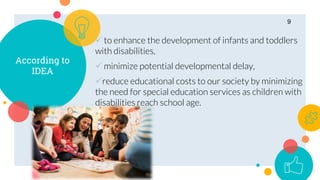
 to enhance the development of infants and toddlers
with disabilities,
 minimize potential developmental delay,
reduce educational costs to our society by minimizing
the need for special education services as children with
disabilities reach school age.
According to
IDEA
9
10
Because of Early Intervention …
Children were more committed to schooling and more of them
finished high school and went on to postsecondary programs and
employment than children who did not attend preschool. They scored
higher on reading, arithmetic, and language achievement tests at all
grade levels; showed a 50% reduction in the need for special education
services through the end of high school; and showed fewer anti-social
or delinquent behaviors outside of school.
11
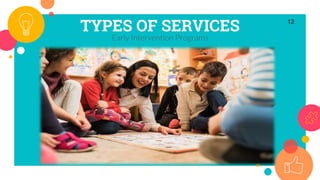
TYPES OF SERVICES
Early Intervention Programs
12
Effectiveness of Early Intervention
Programs have shown positive results for participating children. Children who
participated in an effective Early Intervention program tend to need fewer Special
Education and other habilitative services later in life. Retention in later grades for these
children tends to happen less frequently, and some children are indistinguishable from
children without disabilities many years after intervention. Children who participate in
Early Intervention programs due to high-risk elements tend to be more committed to
school many finish high school, find employment, and attend post-secondary schools
than those who did not attend an intervention program. These at-risk students tend to
score higher on assessments, and have a reduction of Special Education Services through
the end of high school (Kid Source, 2000).
13
One type of Early Intervention
program available for young
children is a Child-Focused Center-
Based Program.
14
This type of program works directly with young
children to help improve chances for positive
development outcomes and successes in school. Some
programs also include parenting groups or home visits
to help enhance positive interactions with their
children. Child-Focused Center-Based Programs provide
special emphasis on providing activities to enhance
developmental skills (cognitive, fine and gross motor,
language, and social adaptive skills). Short term and
long term improvements associated with this program
are found for children who participate in this type of
Early Intervention service.
15
Child-and Parent-Focused Home
Visiting Program
16
An Early Intervention program that is provided
through home visiting for infants with biological and non-
biological risk factors to help improve outcomes. This type
of program provides support to families (by means of
speech therapy, occupational therapy, physical therapy,
etc.) and teaches parents medical interventions that might
be needed for their children. This type of intervention is
family-focused and needs are emphasized by the family
and helping parents become the main interventionist for
their young child(ren).
Multisystem Interventions with
Very High-Risk Families
17
It is typically used with multi-risk families with
complex, intergenerational problems, multiple risks, and
young children. This type of intervention uses a
combination of interventions such as family therapy,
parent training, supportive therapy, social skills training,
case management, and advocacy.
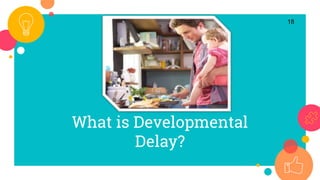
What is Developmental
Delay?
18
Developmental Delay is when your child does not reach
their developmental milestones at the expected times. It
is an ongoing major or minor delay in the process of
development. If your child is temporarily lagging behind,
that is not called developmental delay. Delay can occur in
one or many areas, for example, gross or fine
motor, language, social, or thinking skills.
19
There are five main groups of skills that make up the developmental milestones. A
child may have a developmental delay in one or more of these areas:
○ Gross motor: using large groups of muscles to sit, stand, walk, run, etc., keeping
balance and changing positions.
○ Fine motor: using hands and fingers to be able to eat, draw, dress, play, write and
do many other things.
○ Language: speaking, using body language and gestures, communicating and
understanding what others say.
○ Cognitive: Thinking skills including learning, understanding, problem-solving,
reasoning and remembering.
○ Social: Interacting with others, having relationships with family, friends, and
teachers, cooperating and responding to the feelings of others.
20
Developmental Delay is most often a diagnosis made by a doctor
based on strict guidelines. Usually, though, the parent is the first to
notice that their child is not progressing at the same rate as other
children the same age. If you think your child may be “slow,” or
“seems behind,” talk with your child's doctor about it. In some cases,
your pediatrician might pick up a delay during an office visit. It will
probably take several visits and possibly a referral to a
developmental specialist to be sure that the delay is not just a
temporary lag. Your child's doctor may use a set of screening
tools during regular well-child visits.
21
The first three years of a child's life are an amazing time of
development...
...and what happens during those years stays with a child for a lifetime.
That's why it's so important to watch for signs of delays in development,
and to get help if you suspect problems. The sooner a delayed child gets
early intervention, the better their progress will be. So, if you have
concerns, act early.
22
23
24
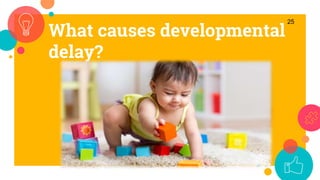
What causes developmental
delay?
25
Developmental delay can have many different causes, such as
genetic causes (like Down syndrome), or complications of
pregnancy and birth (like prematurity or infections). Often,
however, the specific cause is unknown. Some causes can be
easily reversed if caught early enough, such as hearing loss
from chronic ear infections, or lead poisoning.
26
What should I do if I suspect my child has
developmental delay?
27
• If you have concerns, act early.
If you think your child may be delayed, you should
take them to their primary care provider, or to a
developmental and behavioral pediatrician or
pediatric neurologist.
28
29
“What can the school system do for my child? ”
Ask your school system in writing for an evaluation of your child, even if
your child is a baby, toddler or preschooler. They are required to provide
it, at no cost to you. The purpose of an evaluation is to find out why your
child is not meeting their developmental milestones or not doing well in
school. A team of professionals will work with you to evaluate your child.
If they do not find a problem, you can ask the school system to pay for an
Independent Educational Evaluation (IEE).
30
Tips for your child's developmental assessment, from 0-3
years old, is a guide for parents who are concerned about their baby's,
toddler's or preschooler's development and learning. It will help you
prepare for an evaluation, and know what to expect.
Basics for Parents: Your Child's Evaluation explains what
parents of school-aged kids need to know about the evaluation process.
If testing shows your child has developmental delay, the school system
will start your child in either an early intervention or a special
education program, depending on your child's age.
31
“What happens as my child grows up and
eventually becomes an adult? ”
Transition planning is planning to get your child ready to lead a
rewarding life as an adult. As your child gets closer to adulthood,
they will need an IEP transition plan.
Transition planning begins at age 14. It is part of the IEP every
year after that. At age 16, planning will begin for how your child
will transition from school into the community. The goal is for
your child to become as independent as possible.
32
Michigan Medicine, 1500 E. Medical Center Drive Ann Arbor, MI 48109 734-936-4000
© copyright 2018 Regents of the University of Michigan / Template developed &
maintained by: Department of Communication. Contact Us
Key Takeaways:
33
• There’s no one specific cause of developmental delays.
• Developmental delays can be an early sign of a learning or
attention issue.
• Early detection and intervention is important to help your
child develop skills.
34

Early Intervention and Developmental Delay

  • 1.
    What is EarlyIntervention and Developmental Delay? Prepared by: Ms. Caire Ann B. Pangilinan, LPT Submitted to: Dr. Aida S. Damian, Ed.D. 1
  • 2.
  • 3.
    Early Childhood Special Education Early Interventionhelps improve and sometimes prevents developmental problems, helps reduce the number of children retained in later grades, reduces educational costs (due to fewer children needing Special Education Services once entered in school), and helps improve the quality of parent, child, and family relationships. 3
  • 4.
    Early Childhood Special Education Early ChildhoodSpecial Education and related services is a state and federally mandated program for children (ages 3-5) who meet state eligibility criteria because they are experiencing developmental delays. 4 Eligibility for children is determined by criteria that have been established by federal and state rules and regulations.
  • 5.
    “• Early interventionis the process of providing services, education and support to young children who are/have: - deemed to have an established condition - evaluated and deemed to have a diagnosed physical or mental condition (with a high probability of resulting in a developmental delay) - an existing delay or a child who is *at-risk of developing a delay or special need that may affect their development or impede their education. 5
  • 6.
    “• Early interventionis about taking action as soon as possible to tackle problems for children and families before they become more difficult to reverse. • Early intervention involves identifying children and families that may be at risk of running into difficulties and providing timely and effective support. • Early intervention is about enhancing the capabilities of every parent to provide a supportive and enriching environment for their children to grow up in. Then the next generation has the best chance to flourish with the skills to engage in positive parenting themselves. 6
  • 7.
    According to IDEA (Individualswith Disabilities Education Act)
  • 8.
    According to IDEA The Individualswith Disabilities Education Act (IDEA) provides for early intervention services for young children (from age 1 until age 3) and special education services for older children (ages 3 and older) to minimize the effects of developmental delays and learning disabilities that could otherwise limit children’s developmental and educational prospects. Early intervention includes physical, occupational, and speech therapy for young children with developmental problems, and special education programs provide therapies and educational services. 8
  • 9.
     to enhancethe development of infants and toddlers with disabilities,  minimize potential developmental delay, reduce educational costs to our society by minimizing the need for special education services as children with disabilities reach school age. According to IDEA 9
  • 10.
  • 11.
    Because of EarlyIntervention … Children were more committed to schooling and more of them finished high school and went on to postsecondary programs and employment than children who did not attend preschool. They scored higher on reading, arithmetic, and language achievement tests at all grade levels; showed a 50% reduction in the need for special education services through the end of high school; and showed fewer anti-social or delinquent behaviors outside of school. 11
  • 12.
    TYPES OF SERVICES EarlyIntervention Programs 12
  • 13.
    Effectiveness of EarlyIntervention Programs have shown positive results for participating children. Children who participated in an effective Early Intervention program tend to need fewer Special Education and other habilitative services later in life. Retention in later grades for these children tends to happen less frequently, and some children are indistinguishable from children without disabilities many years after intervention. Children who participate in Early Intervention programs due to high-risk elements tend to be more committed to school many finish high school, find employment, and attend post-secondary schools than those who did not attend an intervention program. These at-risk students tend to score higher on assessments, and have a reduction of Special Education Services through the end of high school (Kid Source, 2000). 13
  • 14.
    One type ofEarly Intervention program available for young children is a Child-Focused Center- Based Program. 14
  • 15.
    This type ofprogram works directly with young children to help improve chances for positive development outcomes and successes in school. Some programs also include parenting groups or home visits to help enhance positive interactions with their children. Child-Focused Center-Based Programs provide special emphasis on providing activities to enhance developmental skills (cognitive, fine and gross motor, language, and social adaptive skills). Short term and long term improvements associated with this program are found for children who participate in this type of Early Intervention service. 15
  • 16.
    Child-and Parent-Focused Home VisitingProgram 16 An Early Intervention program that is provided through home visiting for infants with biological and non- biological risk factors to help improve outcomes. This type of program provides support to families (by means of speech therapy, occupational therapy, physical therapy, etc.) and teaches parents medical interventions that might be needed for their children. This type of intervention is family-focused and needs are emphasized by the family and helping parents become the main interventionist for their young child(ren).
  • 17.
    Multisystem Interventions with VeryHigh-Risk Families 17 It is typically used with multi-risk families with complex, intergenerational problems, multiple risks, and young children. This type of intervention uses a combination of interventions such as family therapy, parent training, supportive therapy, social skills training, case management, and advocacy.
  • 18.
  • 19.
    Developmental Delay iswhen your child does not reach their developmental milestones at the expected times. It is an ongoing major or minor delay in the process of development. If your child is temporarily lagging behind, that is not called developmental delay. Delay can occur in one or many areas, for example, gross or fine motor, language, social, or thinking skills. 19
  • 20.
    There are fivemain groups of skills that make up the developmental milestones. A child may have a developmental delay in one or more of these areas: ○ Gross motor: using large groups of muscles to sit, stand, walk, run, etc., keeping balance and changing positions. ○ Fine motor: using hands and fingers to be able to eat, draw, dress, play, write and do many other things. ○ Language: speaking, using body language and gestures, communicating and understanding what others say. ○ Cognitive: Thinking skills including learning, understanding, problem-solving, reasoning and remembering. ○ Social: Interacting with others, having relationships with family, friends, and teachers, cooperating and responding to the feelings of others. 20
  • 21.
    Developmental Delay ismost often a diagnosis made by a doctor based on strict guidelines. Usually, though, the parent is the first to notice that their child is not progressing at the same rate as other children the same age. If you think your child may be “slow,” or “seems behind,” talk with your child's doctor about it. In some cases, your pediatrician might pick up a delay during an office visit. It will probably take several visits and possibly a referral to a developmental specialist to be sure that the delay is not just a temporary lag. Your child's doctor may use a set of screening tools during regular well-child visits. 21
  • 22.
    The first threeyears of a child's life are an amazing time of development... ...and what happens during those years stays with a child for a lifetime. That's why it's so important to watch for signs of delays in development, and to get help if you suspect problems. The sooner a delayed child gets early intervention, the better their progress will be. So, if you have concerns, act early. 22
  • 23.
  • 24.
  • 25.
  • 26.
    Developmental delay canhave many different causes, such as genetic causes (like Down syndrome), or complications of pregnancy and birth (like prematurity or infections). Often, however, the specific cause is unknown. Some causes can be easily reversed if caught early enough, such as hearing loss from chronic ear infections, or lead poisoning. 26
  • 27.
    What should Ido if I suspect my child has developmental delay? 27
  • 28.
    • If youhave concerns, act early. If you think your child may be delayed, you should take them to their primary care provider, or to a developmental and behavioral pediatrician or pediatric neurologist. 28
  • 29.
  • 30.
    “What can theschool system do for my child? ” Ask your school system in writing for an evaluation of your child, even if your child is a baby, toddler or preschooler. They are required to provide it, at no cost to you. The purpose of an evaluation is to find out why your child is not meeting their developmental milestones or not doing well in school. A team of professionals will work with you to evaluate your child. If they do not find a problem, you can ask the school system to pay for an Independent Educational Evaluation (IEE). 30
  • 31.
    Tips for yourchild's developmental assessment, from 0-3 years old, is a guide for parents who are concerned about their baby's, toddler's or preschooler's development and learning. It will help you prepare for an evaluation, and know what to expect. Basics for Parents: Your Child's Evaluation explains what parents of school-aged kids need to know about the evaluation process. If testing shows your child has developmental delay, the school system will start your child in either an early intervention or a special education program, depending on your child's age. 31
  • 32.
    “What happens asmy child grows up and eventually becomes an adult? ” Transition planning is planning to get your child ready to lead a rewarding life as an adult. As your child gets closer to adulthood, they will need an IEP transition plan. Transition planning begins at age 14. It is part of the IEP every year after that. At age 16, planning will begin for how your child will transition from school into the community. The goal is for your child to become as independent as possible. 32 Michigan Medicine, 1500 E. Medical Center Drive Ann Arbor, MI 48109 734-936-4000 © copyright 2018 Regents of the University of Michigan / Template developed & maintained by: Department of Communication. Contact Us
  • 33.
    Key Takeaways: 33 • There’sno one specific cause of developmental delays. • Developmental delays can be an early sign of a learning or attention issue. • Early detection and intervention is important to help your child develop skills.
  • 34.