Developmental and BehavioralDevelopmental and Behavioral
pediatricspediatrics
Sadam
Group-13
Knowledge of the normal growth andKnowledge of the normal growth and
development of children is essential fordevelopment of children is essential for
preventing and detecting disease.preventing and detecting disease.
“Growth” – increase in the size of the
body or in its separate parts.
“Development”- process of changes in
function, which is influenced by the
emotional and social environments.
One of the goals of Pediatrics is to help
each child achieve his/her individual
potential for growth and development
and become a mature adult.
The term – ‘child development’ is used to
describe the skills acquired by children.
Normal development in first years of life is
monitored:
by parents;
at regular child health surveillance checks
The main objective of assessing a young child’s
development is the early detection of delayed
or abnormal development.
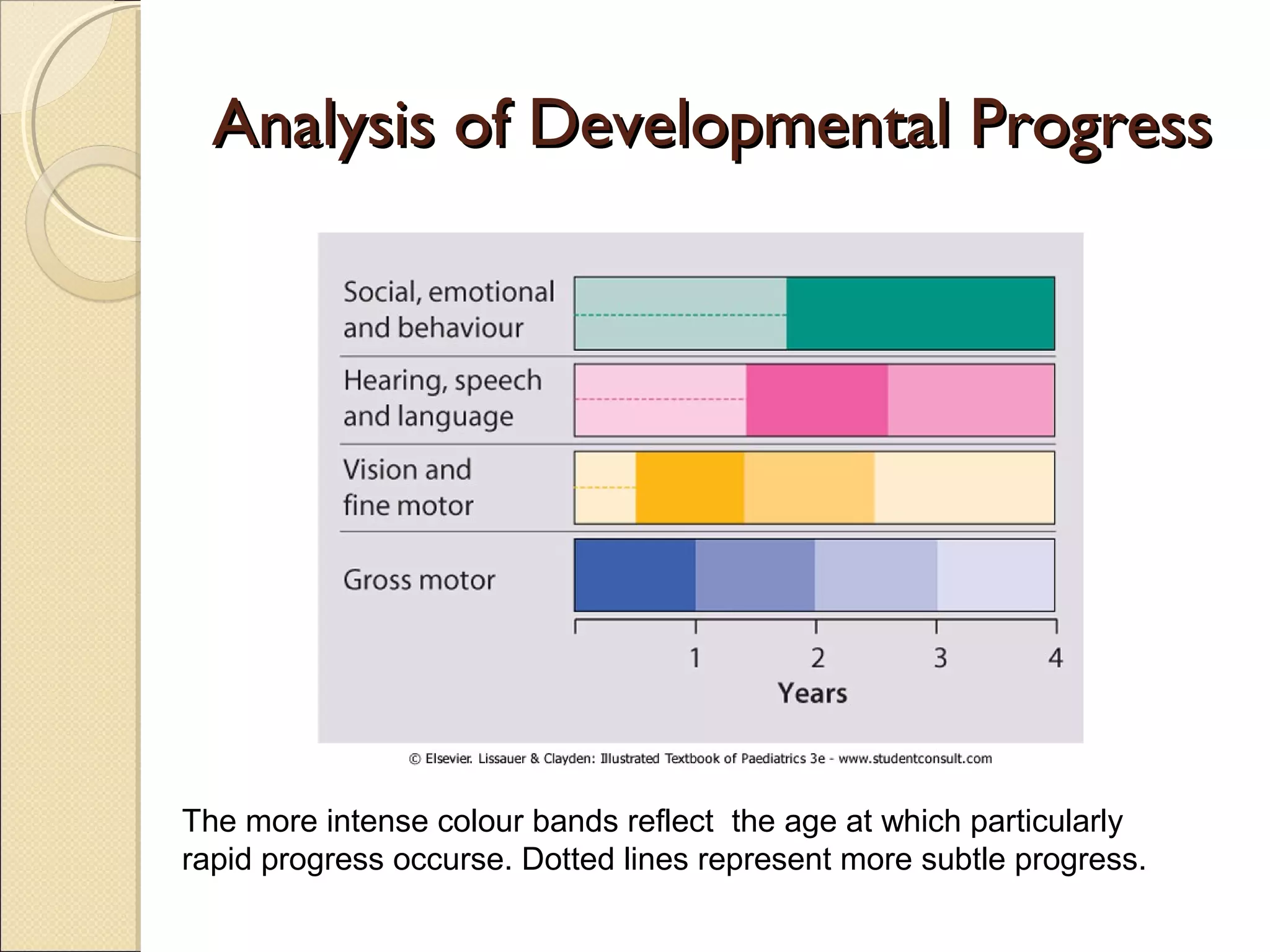
Fields of DevelopmentFields of Development
Gross motor
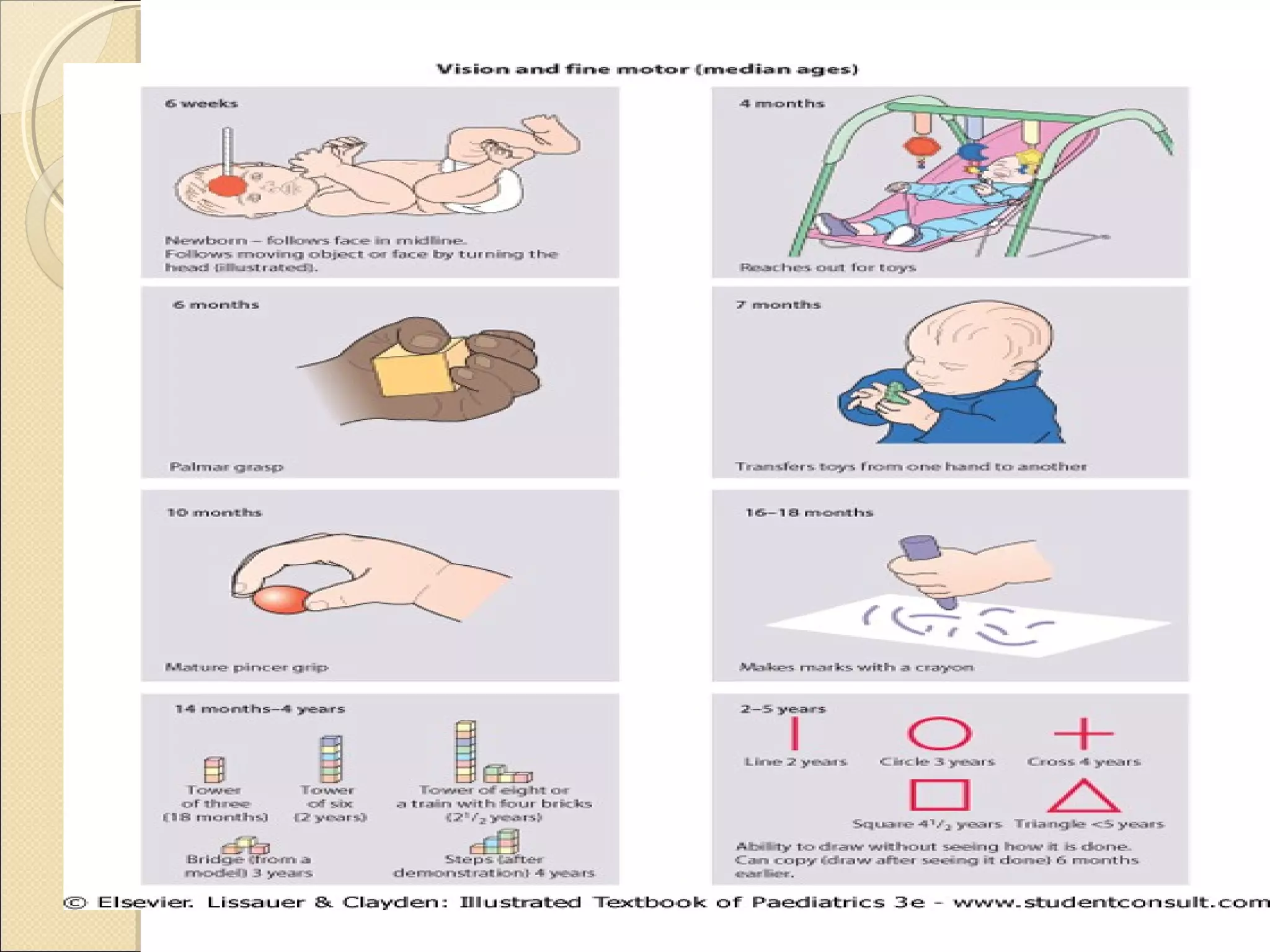
Vision and fine motor
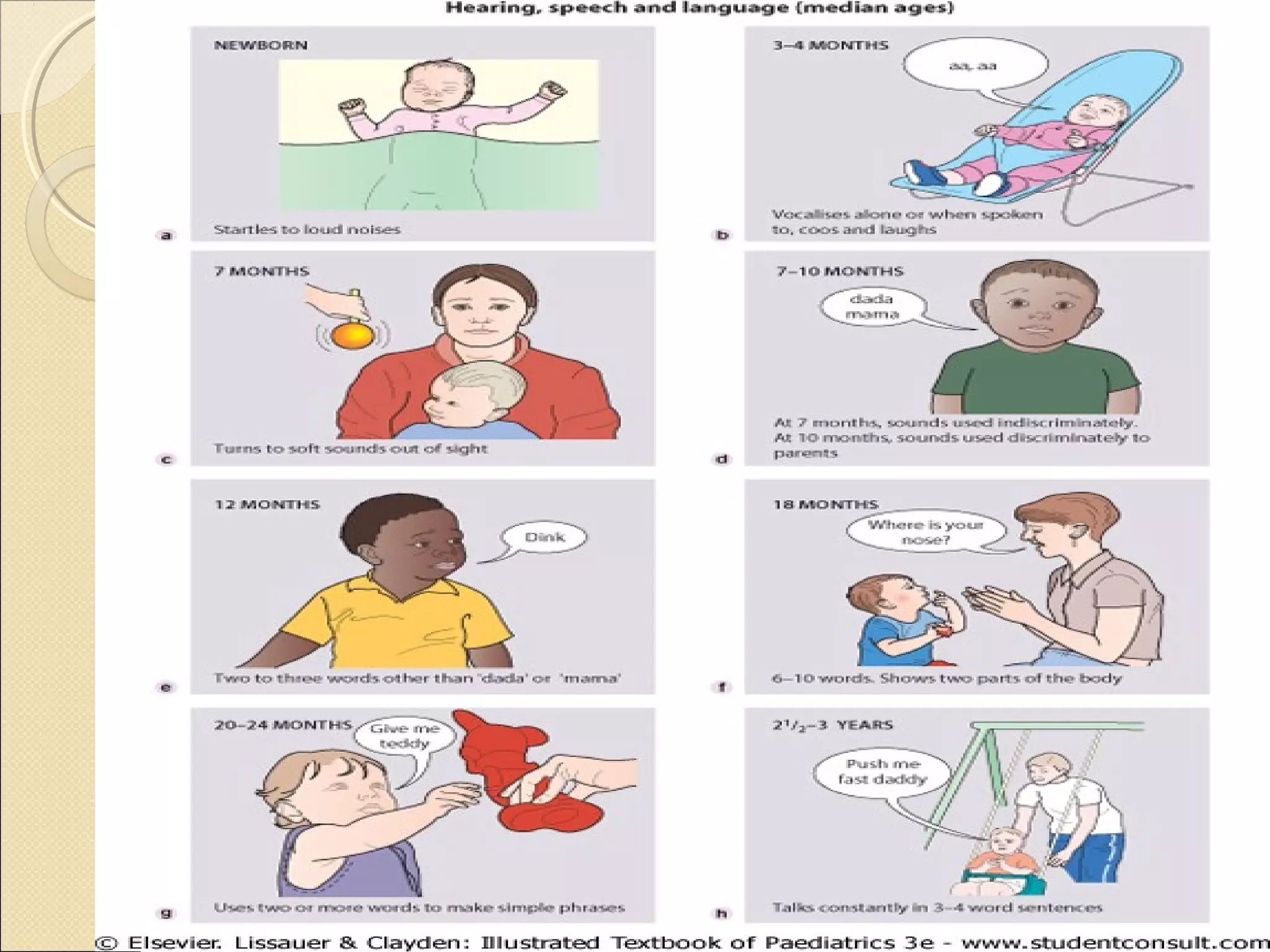
Hearing, speech and language (cognitive
development)
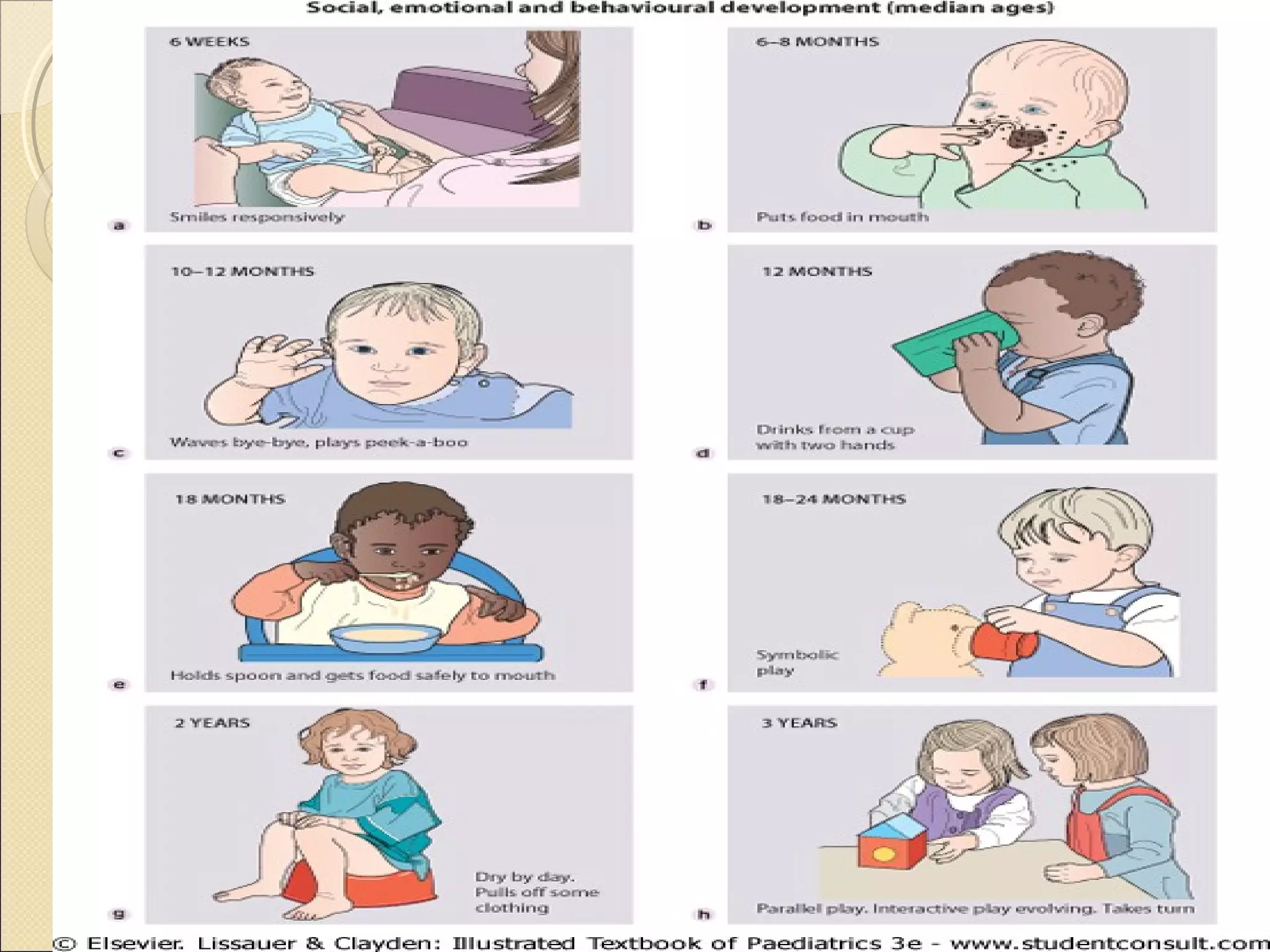
Social, emotional and behavioral
(psychological development)
Analysis of Developmental ProgressAnalysis of Developmental Progress
The more intense colour bands reflect the age at which particularly
rapid progress occurse. Dotted lines represent more subtle progress.
Developmental screening andDevelopmental screening and
assessmentassessment
Screening – checks of whole populations
or groups of children at set ages by
trained professionals.
Assessment – detailed analysis of overall
development or specific areas of
development
Motor development – ability of child to do any
actions by using muscles of different groups.
Motor development includes gross and fine
motor skills.
Gross development skills – ability of child to
control large muscles (head, sit, walk, etc.)
Fine developmental skills – ability of child to
control small muscles (fingers, eyes, etc).
Factors Affecting Child’s MotorFactors Affecting Child’s Motor
DevelopmentDevelopment
Congenital diseases
Acquired diseases
Nutrition
Environment (Stimulation of Physical activity
relevant to age)
Prematurity / twins
Assessment of Motor developmentAssessment of Motor development
For assessing motor development muscle
tonus, passive and active movements and
tendon reflexes are assessed.
Active movement is assessed according
to the action of a child, how he sits,
walks, stands up, takes toys in hand, etc.
Cognitive development – development of
cognition – ability of a child concept, analyze,
remember, make decision and solve the problem.
Speech development indicates cognitive
development in early childhood.
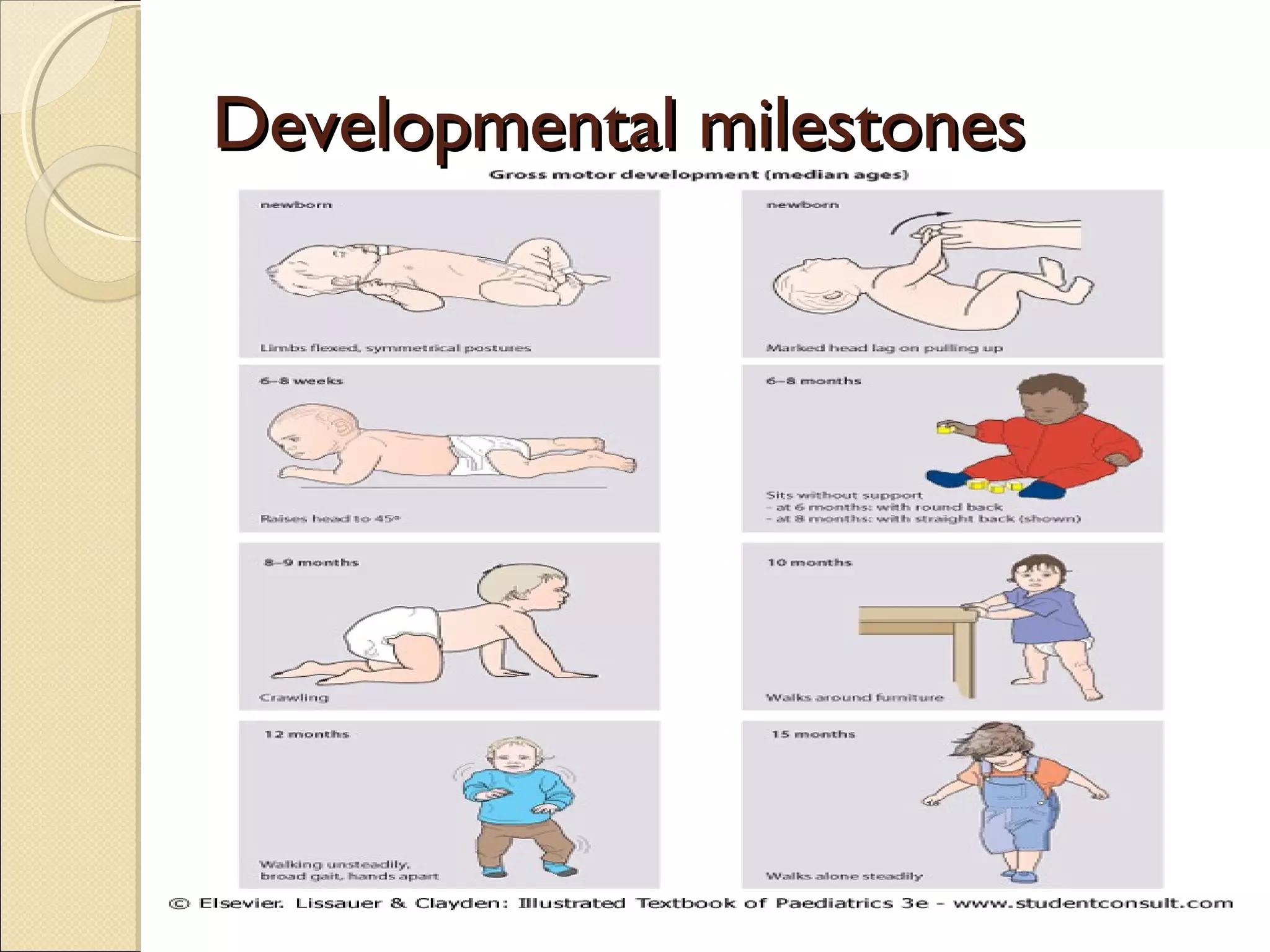
Developmental milestones – the term is to
describe the achievements in any field of
development relevant to child’s age.
Global inhibition of development – is a state
when child (less than 5 years old) is delayed
simultaneously in 2 or more spheres. After 5 years
is used the term – mental retardation (delayed
IQ ).
Developmental milestonesDevelopmental milestones
Pattern of child developmentPattern of child development
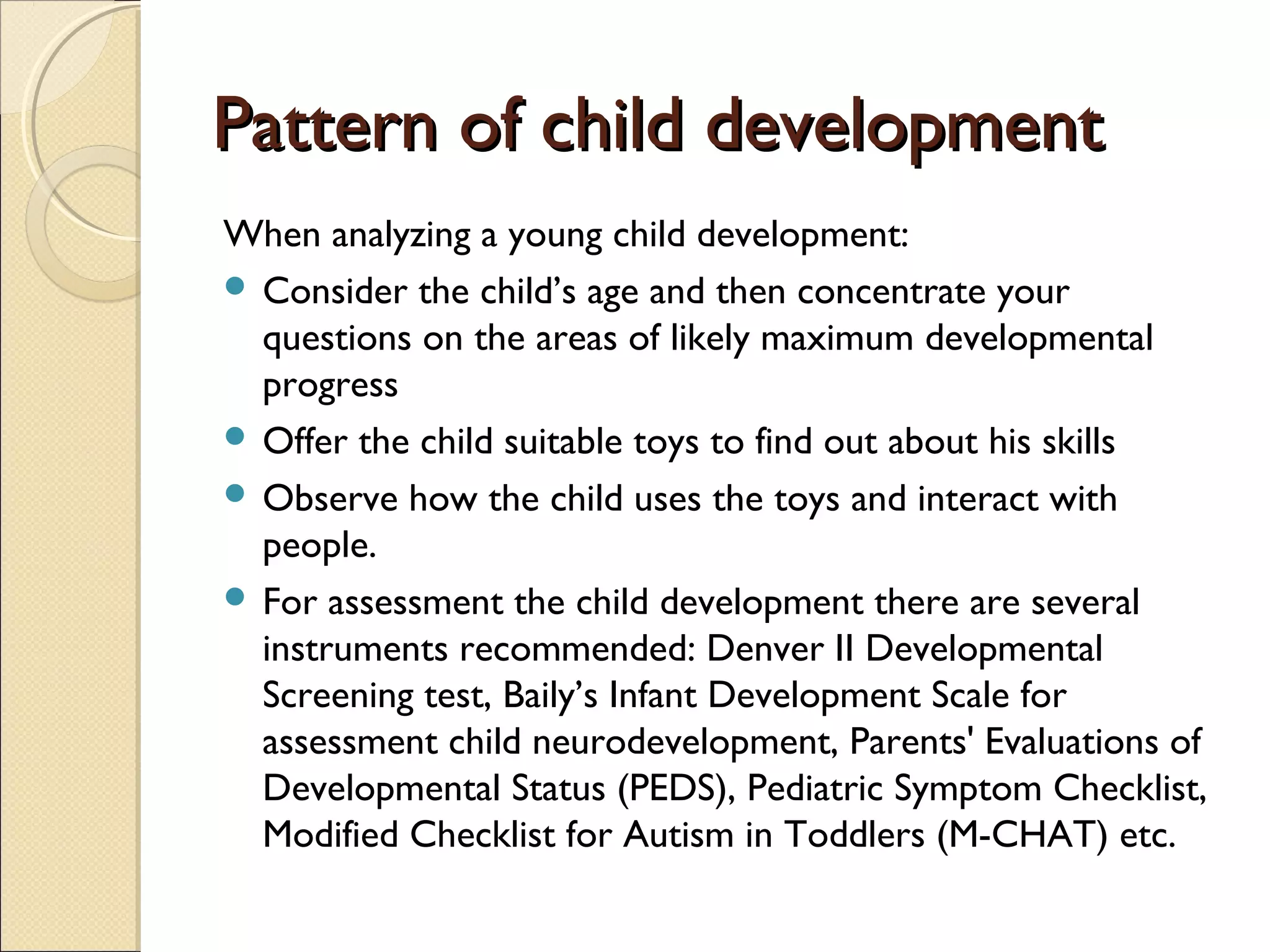
When analyzing a young child development:
 Consider the child’s age and then concentrate your
questions on the areas of likely maximum developmental
progress
 Offer the child suitable toys to find out about his skills
 Observe how the child uses the toys and interact with
people.
 For assessment the child development there are several
instruments recommended: Denver II Developmental
Screening test, Baily’s Infant Development Scale for
assessment child neurodevelopment, Parents' Evaluations of
Developmental Status (PEDS), Pediatric Symptom Checklist,
Modified Checklist for Autism in Toddlers (M-CHAT) etc.
Developmental ScreeningDevelopmental Screening
If child can’t do the milestone relevant to
the age it is necessary to assess the
existence of the danger signs.
Danger sign – Disability of a child to
make any action in the given age limit
In case of revealing danger sign - deeply
examination of a child and an urgent
referral to a specialist is recommended.
Emotional and Social developmentEmotional and Social development
Emotional development – ability of a child to
express adequate emotions.
Social development – ability of a child to make
close contact with people and environment.
Factors influencing emotional and social
development – Adequate feeding (food rich
with vitamins and microelements)
- Congenital (genetic diseases, birth trauma),
or gained diseases (CNS infections, haematoma)
- Appropriate stimulation
HearingHearing
Summary regarding hearingSummary regarding hearing
Early detection and treatment of hearing
impairment improves the outcome of
speech and language and behaviour
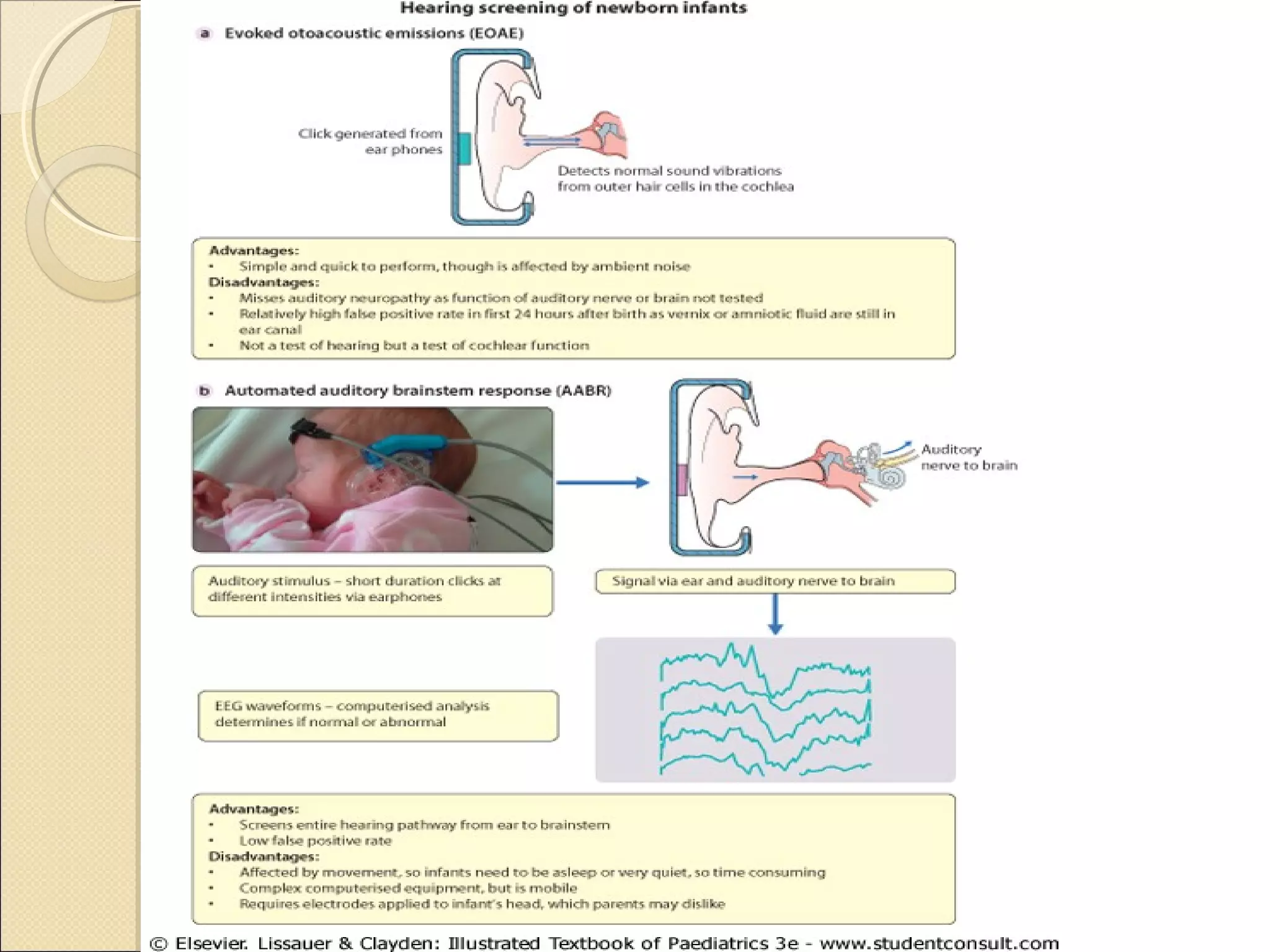
Newborn hearing screening is performed
for the early identification of hearing
impairment
If there is parental concern about
hearing, further assessment is warranted.
Hearing checklist for parentsHearing checklist for parents
 Shortly after birth –startles and blinks at a sudden noise
(slamming of door)
 By 1 month – Notices sudden prolonged sounds (e.g. a
vacuum cleaner) and listens when they begin
 By 4 months – Quietens or smiles to the sound of your
voice even when he cannot see you.
 By 7 months – Turns immediately to your voice
 By 9 months – Listens attentively to familiar everyday
sounds and searches for very quiet sounds maid out of
site
 By 12 months – Shows some response to his own name
and to other familiar words. May respond when you say
‘no’.
Vision TestingVision Testing
 Newborn – Face fixation and following
 6 weeks – Optokinetic nystagmus (normal)
demonstrated on looking at a moving target
 6 months – Reaches well for toys
 2 years – Can identify pictures of reducing size
 3 years – Latter matching using single letters charts
onwards
 5 years – Can identify a line of letters on a long chart
onwards
Summary regarding visionSummary regarding vision
Term newborn infant can fix and follow
horizontally and prefer to watch faces
Visual acuity is poor in newborn but
increases to adult levels by 3 years of age.
Vision screening is performed in
preschool children or at school entry
Influence of heredity andInfluence of heredity and
environmentenvironment
Heredity determines the potential of the
child
Environment influences the extent to
which that potential is achieved.
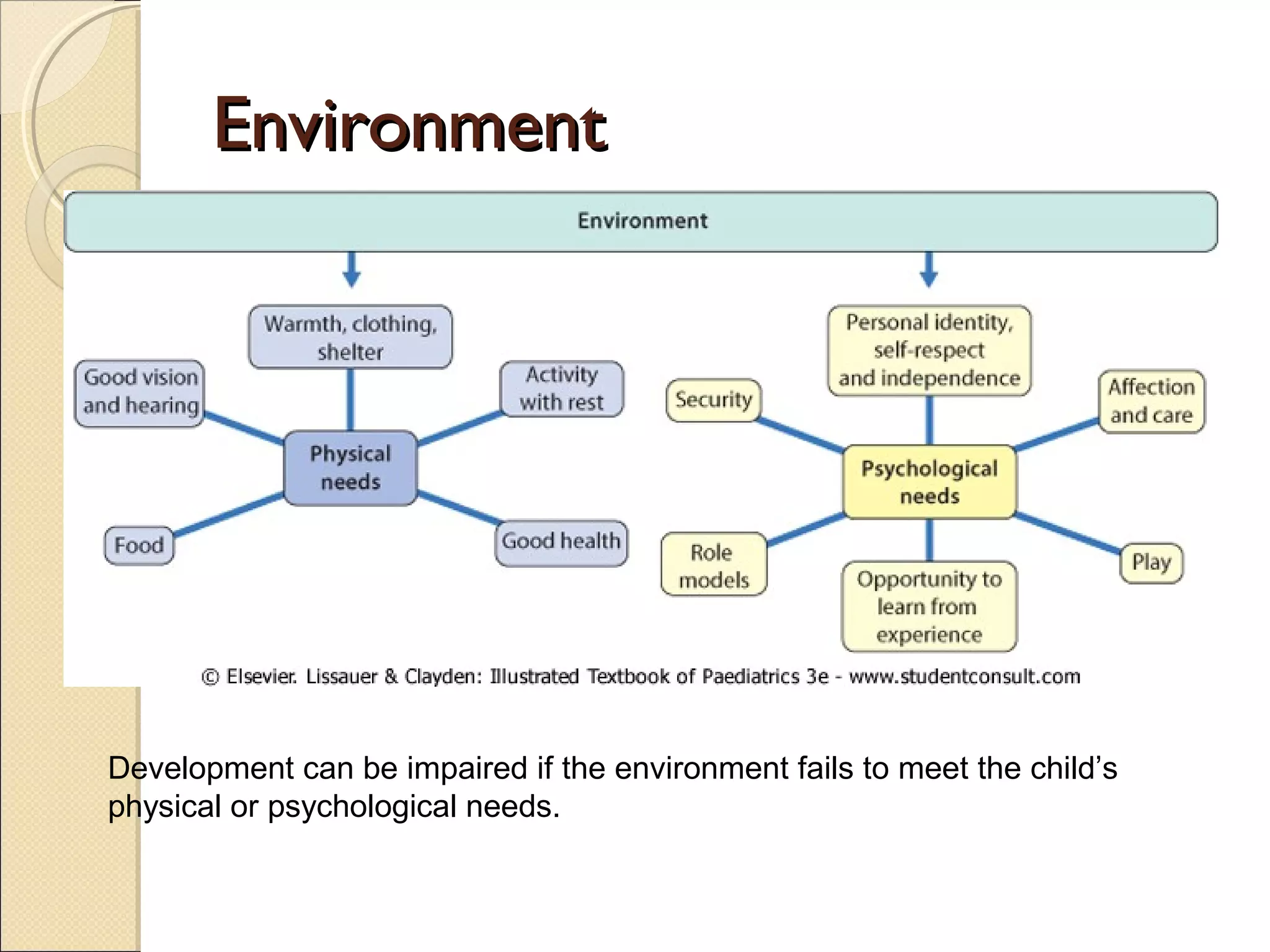
EnvironmentEnvironment
Development can be impaired if the environment fails to meet the child’s
physical or psychological needs.

Developmental and behavioral pediatrics

  • 1.
    Developmental and BehavioralDevelopmentaland Behavioral pediatricspediatrics Sadam Group-13
  • 2.
    Knowledge of thenormal growth andKnowledge of the normal growth and development of children is essential fordevelopment of children is essential for preventing and detecting disease.preventing and detecting disease. “Growth” – increase in the size of the body or in its separate parts. “Development”- process of changes in function, which is influenced by the emotional and social environments. One of the goals of Pediatrics is to help each child achieve his/her individual potential for growth and development and become a mature adult.
  • 3.
    The term –‘child development’ is used to describe the skills acquired by children. Normal development in first years of life is monitored: by parents; at regular child health surveillance checks The main objective of assessing a young child’s development is the early detection of delayed or abnormal development.
  • 4.
    Fields of DevelopmentFieldsof Development Gross motor Vision and fine motor Hearing, speech and language (cognitive development) Social, emotional and behavioral (psychological development)
  • 5.
    Analysis of DevelopmentalProgressAnalysis of Developmental Progress The more intense colour bands reflect the age at which particularly rapid progress occurse. Dotted lines represent more subtle progress.
  • 6.
    Developmental screening andDevelopmentalscreening and assessmentassessment Screening – checks of whole populations or groups of children at set ages by trained professionals. Assessment – detailed analysis of overall development or specific areas of development
  • 7.
    Motor development –ability of child to do any actions by using muscles of different groups. Motor development includes gross and fine motor skills. Gross development skills – ability of child to control large muscles (head, sit, walk, etc.) Fine developmental skills – ability of child to control small muscles (fingers, eyes, etc).
  • 8.
    Factors Affecting Child’sMotorFactors Affecting Child’s Motor DevelopmentDevelopment Congenital diseases Acquired diseases Nutrition Environment (Stimulation of Physical activity relevant to age) Prematurity / twins
  • 9.
    Assessment of MotordevelopmentAssessment of Motor development For assessing motor development muscle tonus, passive and active movements and tendon reflexes are assessed. Active movement is assessed according to the action of a child, how he sits, walks, stands up, takes toys in hand, etc.
  • 10.
    Cognitive development –development of cognition – ability of a child concept, analyze, remember, make decision and solve the problem. Speech development indicates cognitive development in early childhood. Developmental milestones – the term is to describe the achievements in any field of development relevant to child’s age. Global inhibition of development – is a state when child (less than 5 years old) is delayed simultaneously in 2 or more spheres. After 5 years is used the term – mental retardation (delayed IQ ).
  • 11.
  • 15.
    Pattern of childdevelopmentPattern of child development When analyzing a young child development:  Consider the child’s age and then concentrate your questions on the areas of likely maximum developmental progress  Offer the child suitable toys to find out about his skills  Observe how the child uses the toys and interact with people.  For assessment the child development there are several instruments recommended: Denver II Developmental Screening test, Baily’s Infant Development Scale for assessment child neurodevelopment, Parents' Evaluations of Developmental Status (PEDS), Pediatric Symptom Checklist, Modified Checklist for Autism in Toddlers (M-CHAT) etc.
  • 16.
    Developmental ScreeningDevelopmental Screening Ifchild can’t do the milestone relevant to the age it is necessary to assess the existence of the danger signs. Danger sign – Disability of a child to make any action in the given age limit In case of revealing danger sign - deeply examination of a child and an urgent referral to a specialist is recommended.
  • 17.
    Emotional and SocialdevelopmentEmotional and Social development Emotional development – ability of a child to express adequate emotions. Social development – ability of a child to make close contact with people and environment. Factors influencing emotional and social development – Adequate feeding (food rich with vitamins and microelements) - Congenital (genetic diseases, birth trauma), or gained diseases (CNS infections, haematoma) - Appropriate stimulation
  • 18.
  • 19.
    Summary regarding hearingSummaryregarding hearing Early detection and treatment of hearing impairment improves the outcome of speech and language and behaviour Newborn hearing screening is performed for the early identification of hearing impairment If there is parental concern about hearing, further assessment is warranted.
  • 20.
    Hearing checklist forparentsHearing checklist for parents  Shortly after birth –startles and blinks at a sudden noise (slamming of door)  By 1 month – Notices sudden prolonged sounds (e.g. a vacuum cleaner) and listens when they begin  By 4 months – Quietens or smiles to the sound of your voice even when he cannot see you.  By 7 months – Turns immediately to your voice  By 9 months – Listens attentively to familiar everyday sounds and searches for very quiet sounds maid out of site  By 12 months – Shows some response to his own name and to other familiar words. May respond when you say ‘no’.
  • 21.
    Vision TestingVision Testing Newborn – Face fixation and following  6 weeks – Optokinetic nystagmus (normal) demonstrated on looking at a moving target  6 months – Reaches well for toys  2 years – Can identify pictures of reducing size  3 years – Latter matching using single letters charts onwards  5 years – Can identify a line of letters on a long chart onwards
  • 22.
    Summary regarding visionSummaryregarding vision Term newborn infant can fix and follow horizontally and prefer to watch faces Visual acuity is poor in newborn but increases to adult levels by 3 years of age. Vision screening is performed in preschool children or at school entry
  • 23.
    Influence of heredityandInfluence of heredity and environmentenvironment Heredity determines the potential of the child Environment influences the extent to which that potential is achieved.
  • 24.
    EnvironmentEnvironment Development can beimpaired if the environment fails to meet the child’s physical or psychological needs.