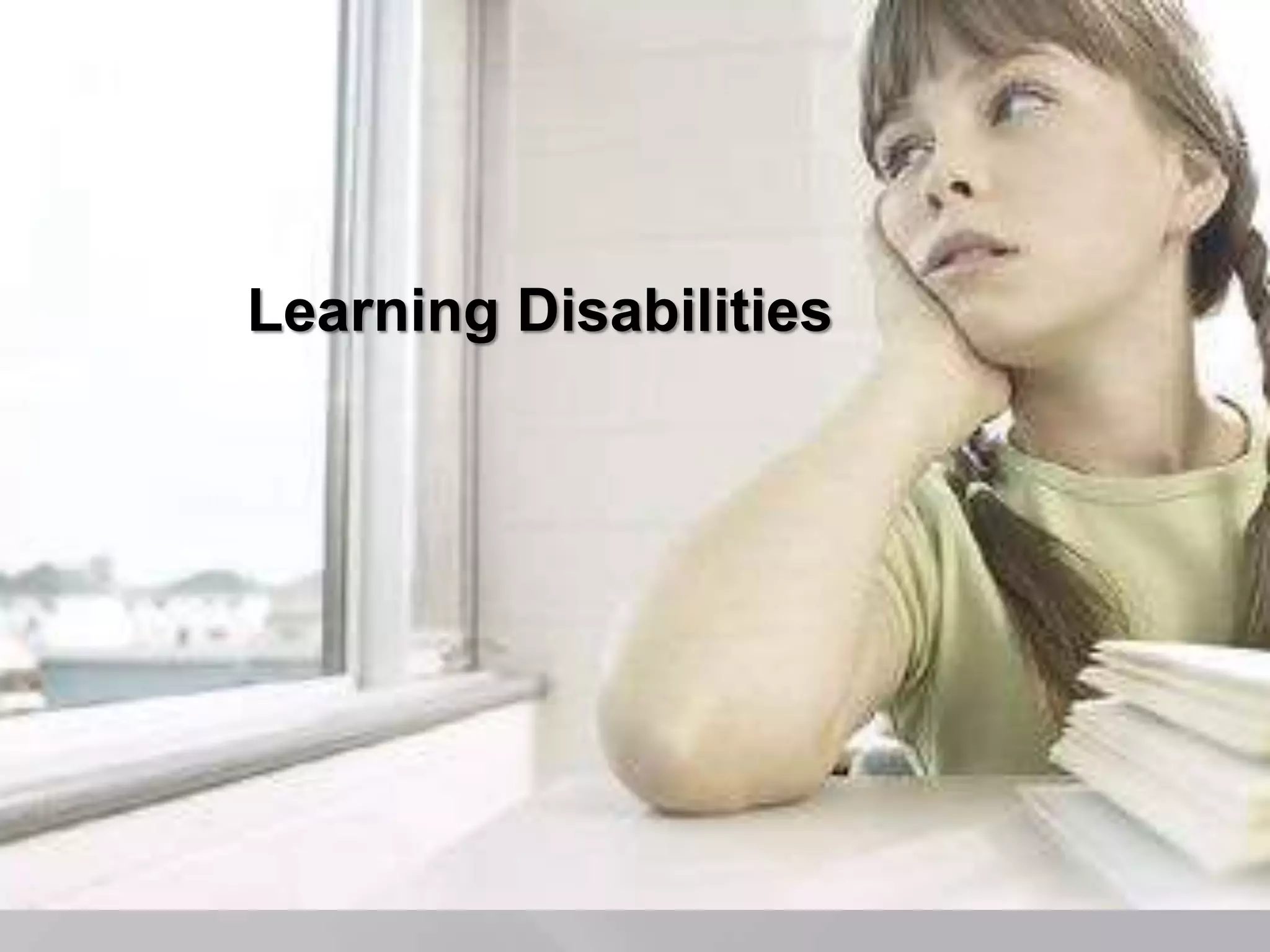
Learning Disabilities
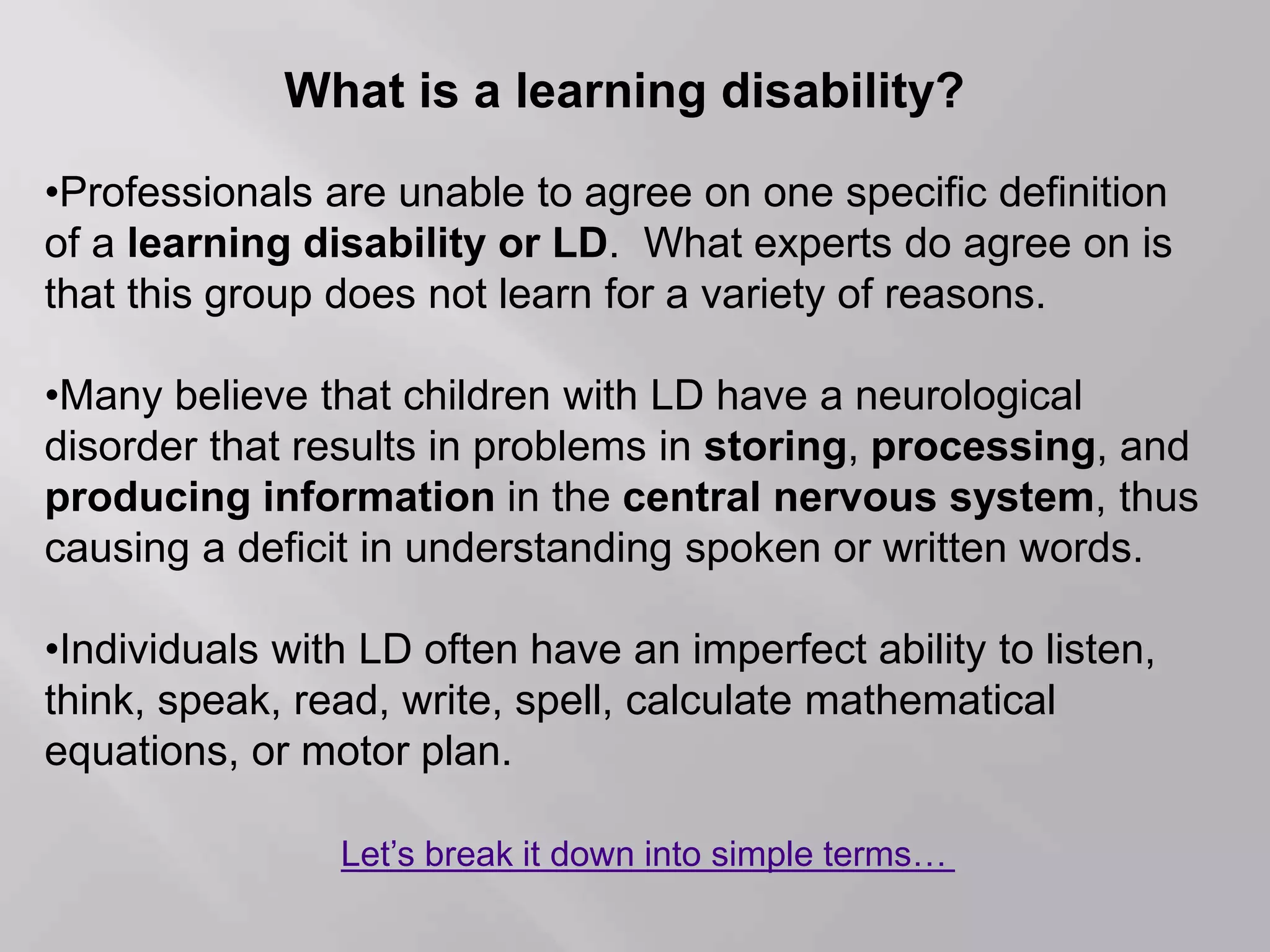
What is a learning disability?
•Professionals are unable to agree on one specific definition
of a learning disability or LD. What experts do agree on is
that this group does not learn for a variety of reasons.
•Many believe that children with LD have a neurological
disorder that results in problems in storing, processing, and
producing information in the central nervous system, thus
causing a deficit in understanding spoken or written words.
•Individuals with LD often have an imperfect ability to listen,
think, speak, read, write, spell, calculate mathematical
equations, or motor plan.
Let’s break it down into simple terms…
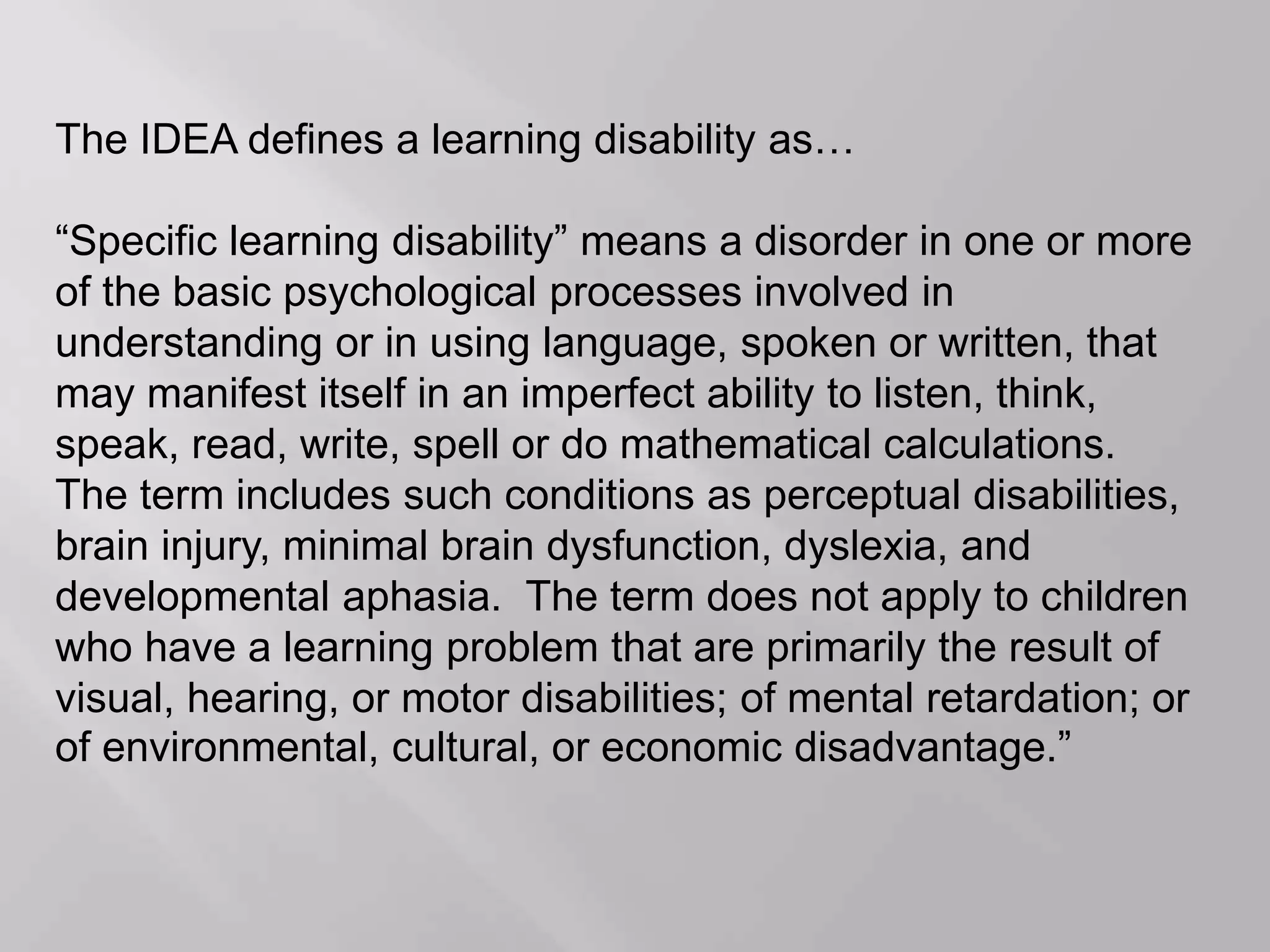
The IDEA defines a learning disability as…
“Specific learning disability” means a disorder in one or more
of the basic psychological processes involved in
understanding or in using language, spoken or written, that
may manifest itself in an imperfect ability to listen, think,
speak, read, write, spell or do mathematical calculations.
The term includes such conditions as perceptual disabilities,
brain injury, minimal brain dysfunction, dyslexia, and
developmental aphasia. The term does not apply to children
who have a learning problem that are primarily the result of
visual, hearing, or motor disabilities; of mental retardation; or
of environmental, cultural, or economic disadvantage.”
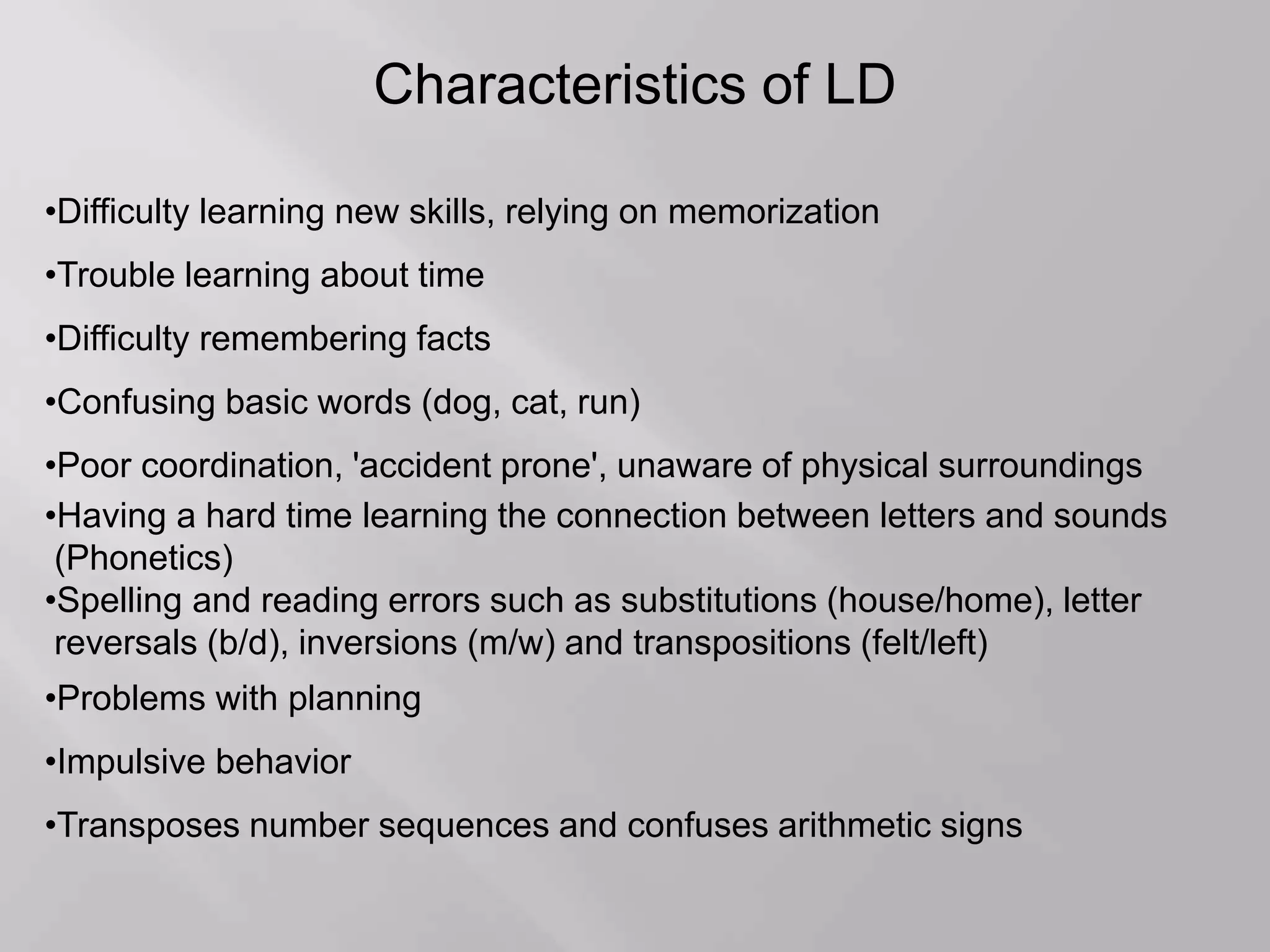
Characteristics of LD
•Difficulty learning new skills, relying on memorization
•Trouble learning about time
•Difficulty remembering facts
•Confusing basic words (dog, cat, run)
•Poor coordination, 'accident prone', unaware of physical surroundings
•Having a hard time learning the connection between letters and sounds
(Phonetics)
•Spelling and reading errors such as substitutions (house/home), letter
reversals (b/d), inversions (m/w) and transpositions (felt/left)
•Problems with planning
•Impulsive behavior
•Transposes number sequences and confuses arithmetic signs
Five common learning disabilities include…
•Dyslexia
•Dyscalculia
•Dysgraphia
•Visual Processing Disorders, and
•Non-verbal learning disabilities.
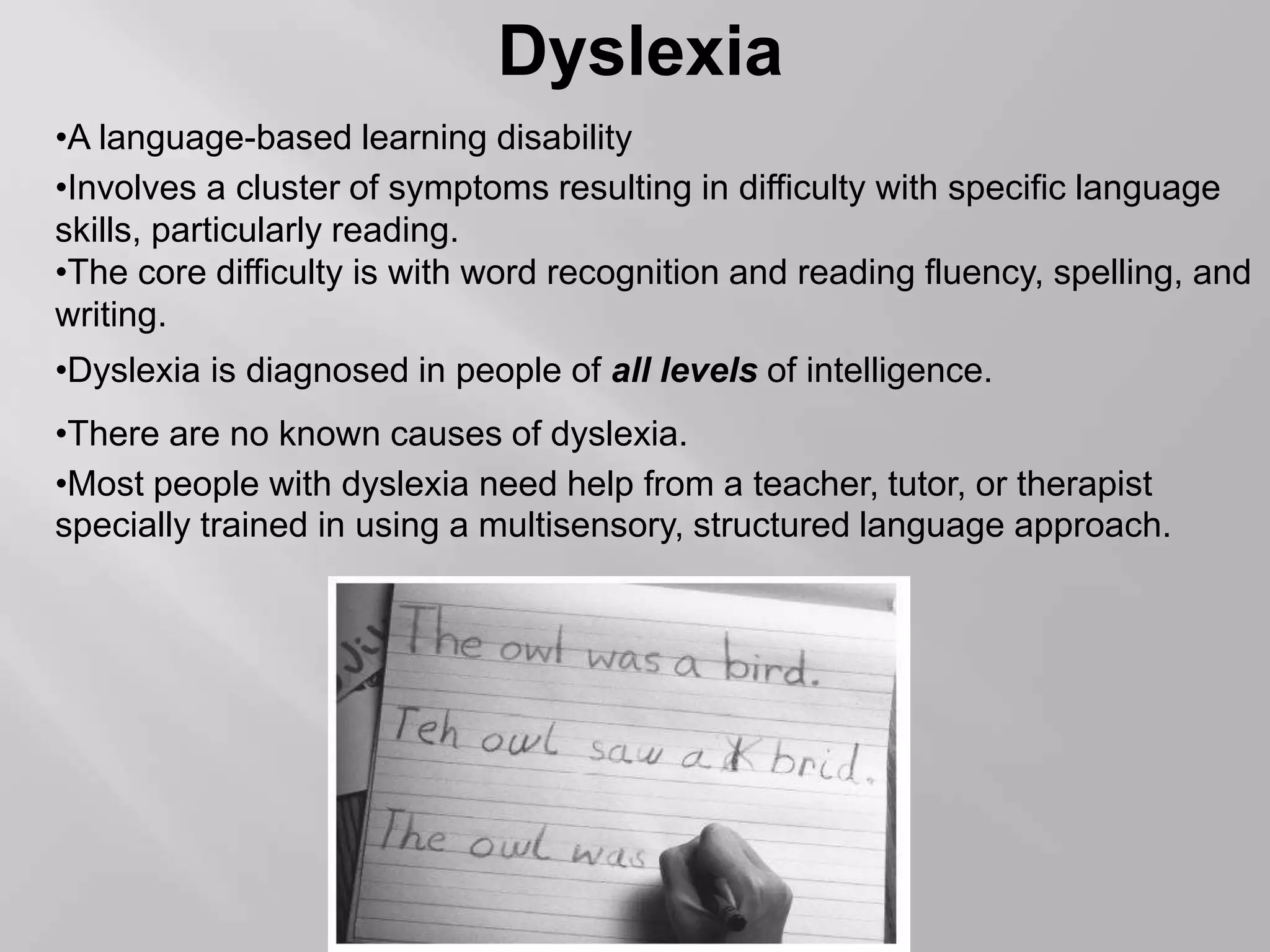
Dyslexia
•A language-based learning disability
•Involves a cluster of symptoms resulting in difficulty with specific language
skills, particularly reading.
•The core difficulty is with word recognition and reading fluency, spelling, and
writing.
•Dyslexia is diagnosed in people of all levels of intelligence.
•There are no known causes of dyslexia.
•Most people with dyslexia need help from a teacher, tutor, or therapist
specially trained in using a multisensory, structured language approach.
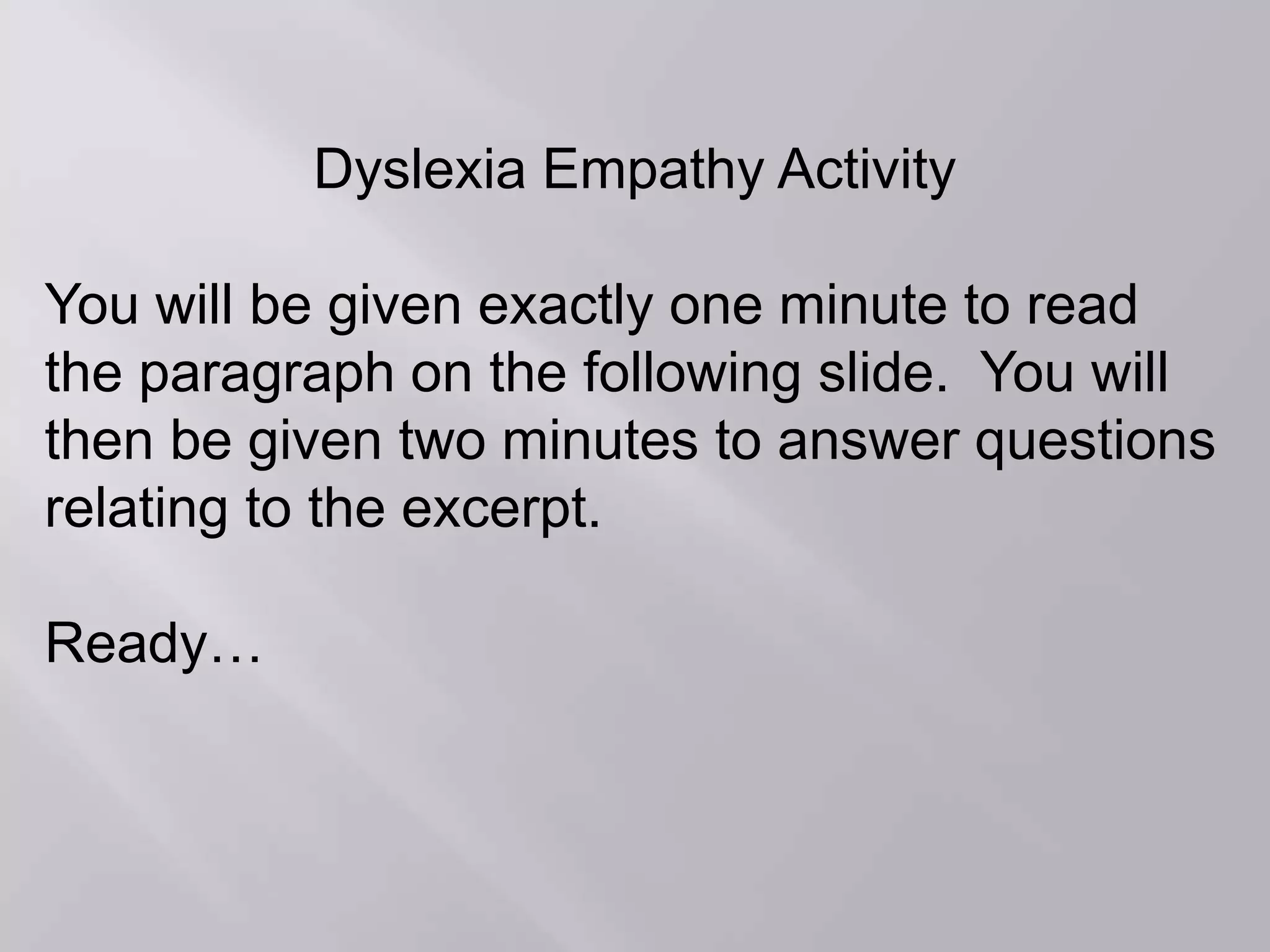
Dyslexia Empathy Activity
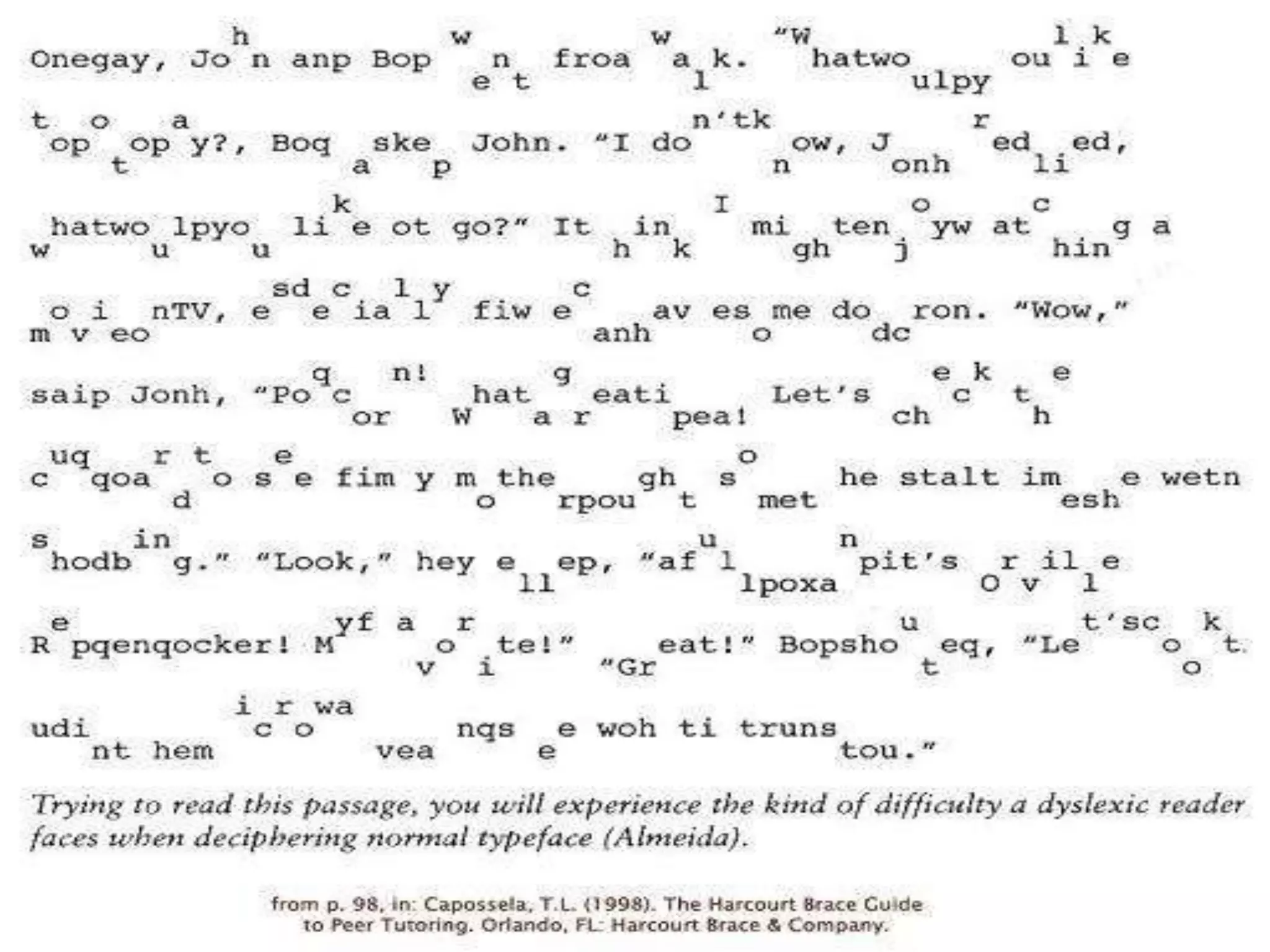
You will be given exactly one minute to read
the paragraph on the following slide. You will
then be given two minutes to answer questions
relating to the excerpt.
Ready…
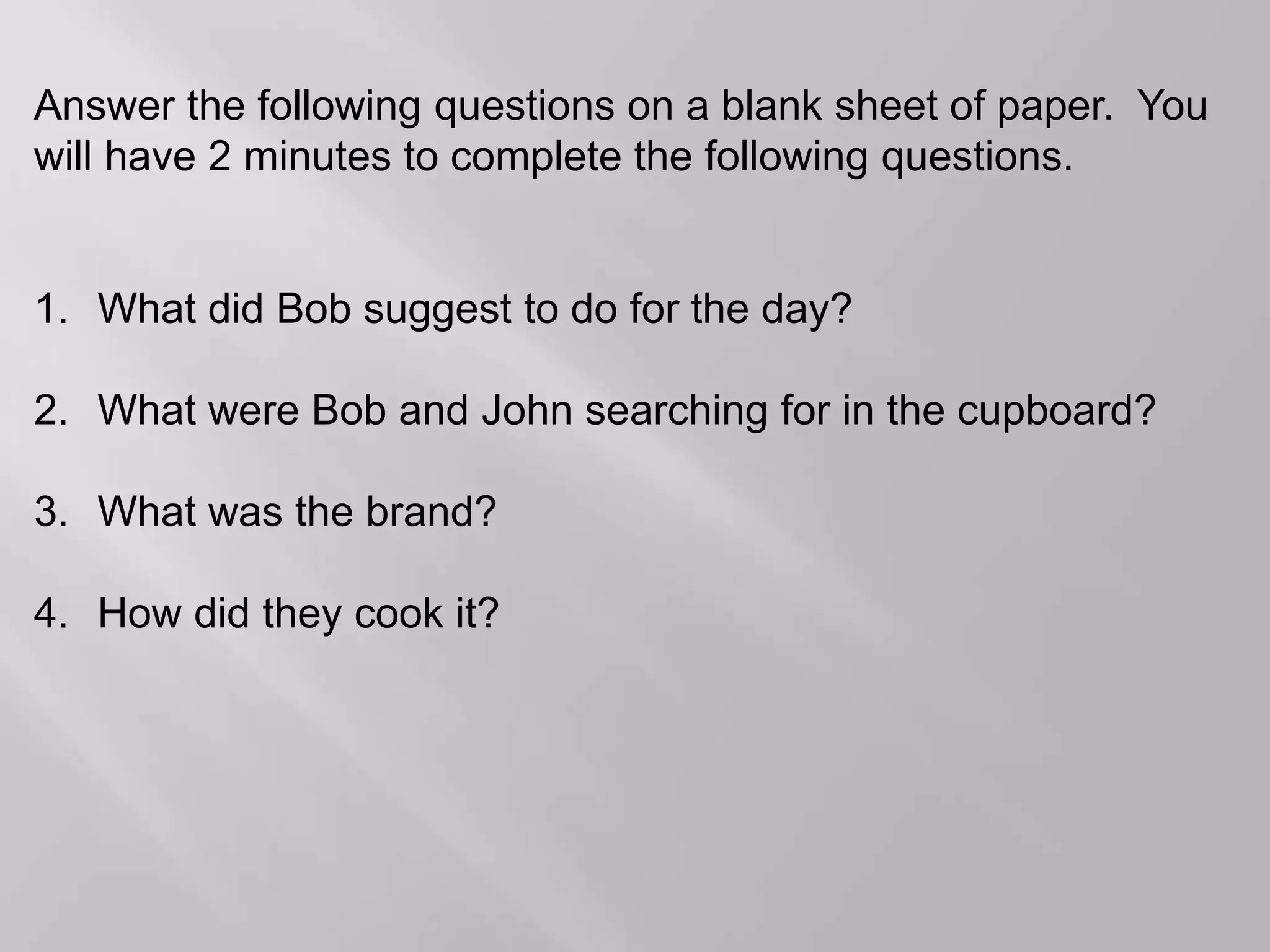
Answer the following questions on a blank sheet of paper. You
will have 2 minutes to complete the following questions.
1. What did Bob suggest to do for the day?
2. What were Bob and John searching for in the cupboard?
3. What was the brand?
4. How did they cook it?
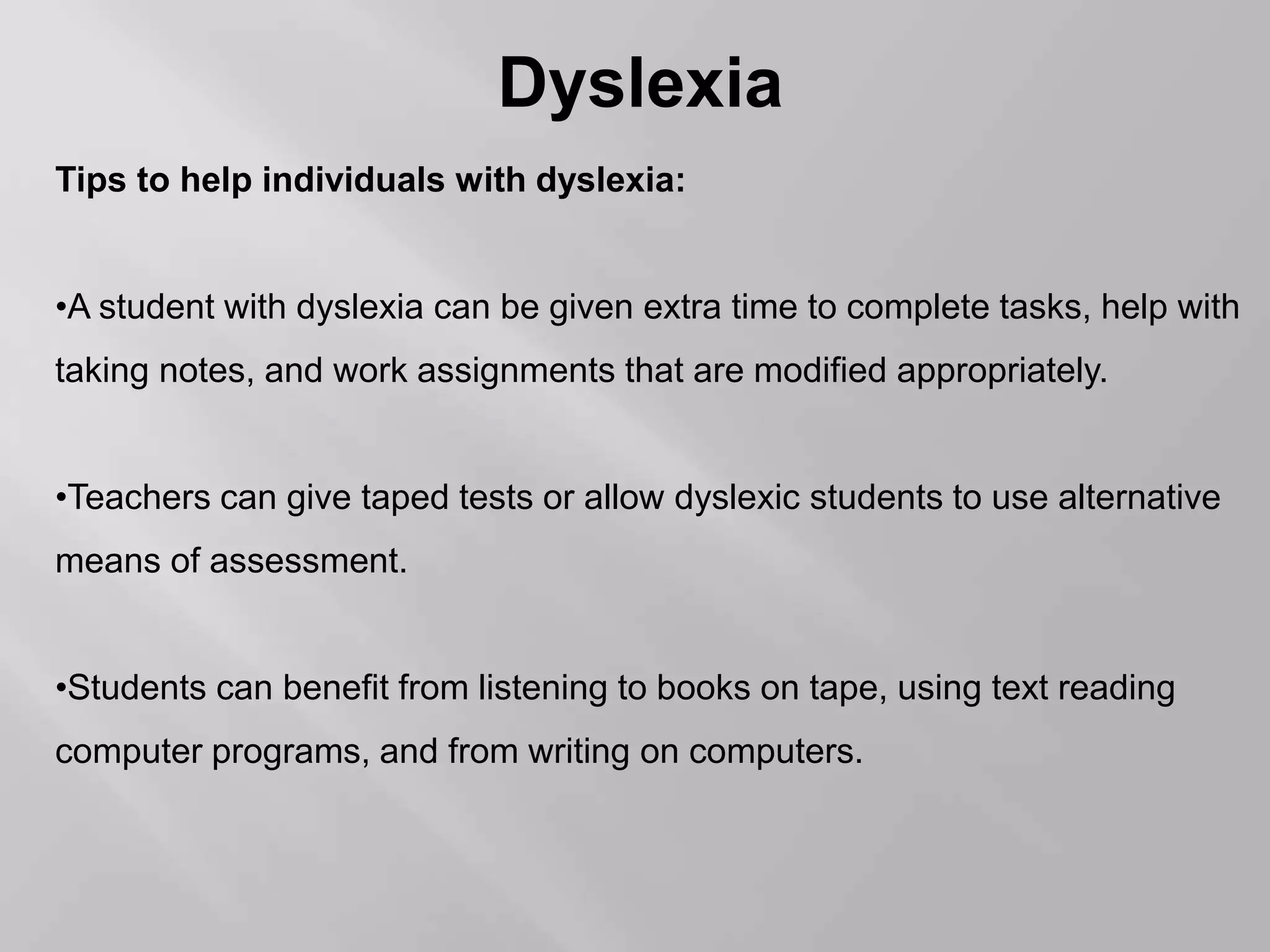
Dyslexia
Tips to help individuals with dyslexia:
•A student with dyslexia can be given extra time to complete tasks, help with
taking notes, and work assignments that are modified appropriately.
•Teachers can give taped tests or allow dyslexic students to use alternative
means of assessment.
•Students can benefit from listening to books on tape, using text reading
computer programs, and from writing on computers.
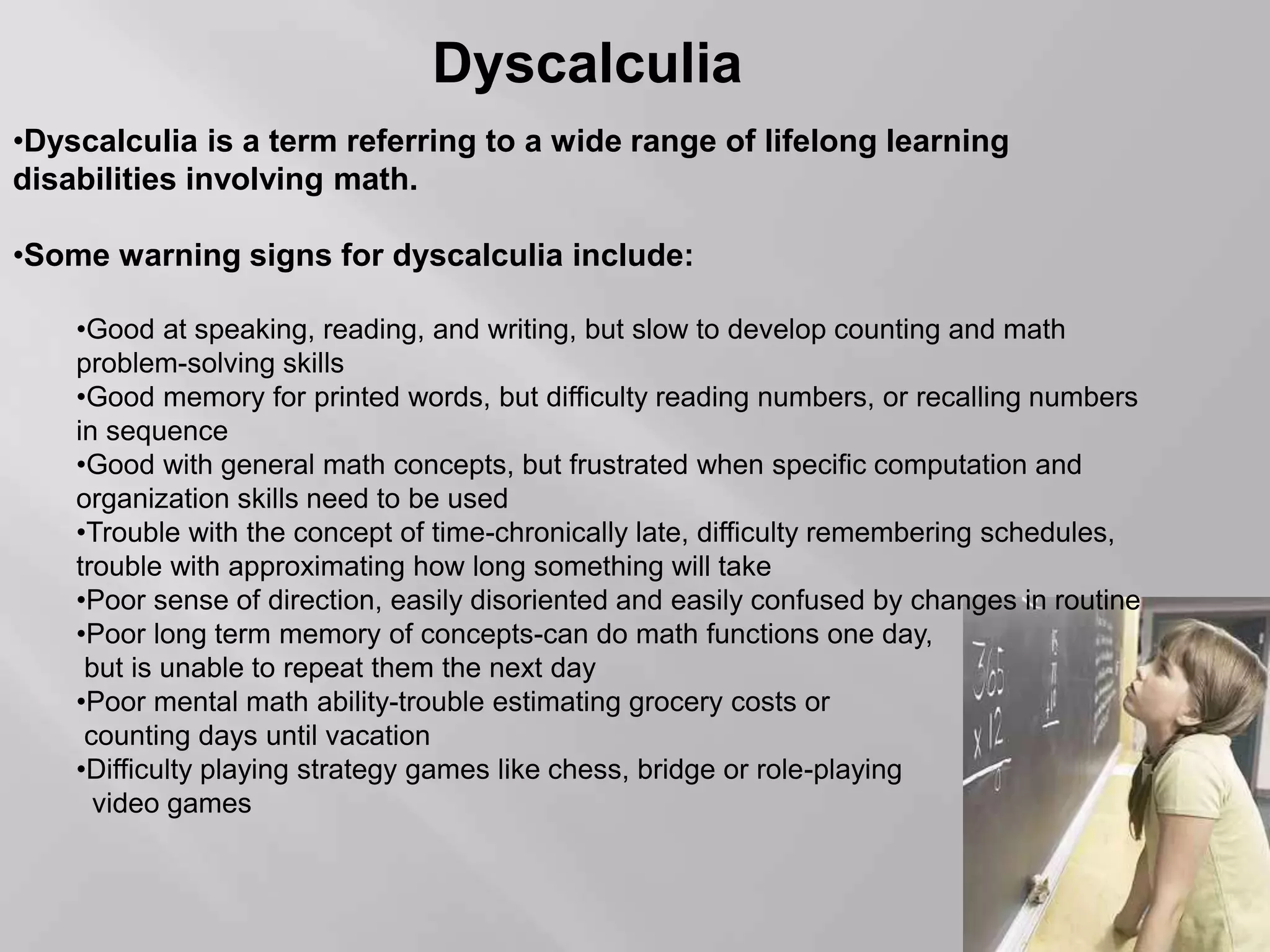
Dyscalculia
•Dyscalculia is a term referring to a wide range of lifelong learning
disabilities involving math.
•Some warning signs for dyscalculia include:
•Good at speaking, reading, and writing, but slow to develop counting and math
problem-solving skills
•Good memory for printed words, but difficulty reading numbers, or recalling numbers
in sequence
•Good with general math concepts, but frustrated when specific computation and
organization skills need to be used
•Trouble with the concept of time-chronically late, difficulty remembering schedules,
trouble with approximating how long something will take
•Poor sense of direction, easily disoriented and easily confused by changes in routine
•Poor long term memory of concepts-can do math functions one day,
but is unable to repeat them the next day
•Poor mental math ability-trouble estimating grocery costs or
counting days until vacation
•Difficulty playing strategy games like chess, bridge or role-playing
video games
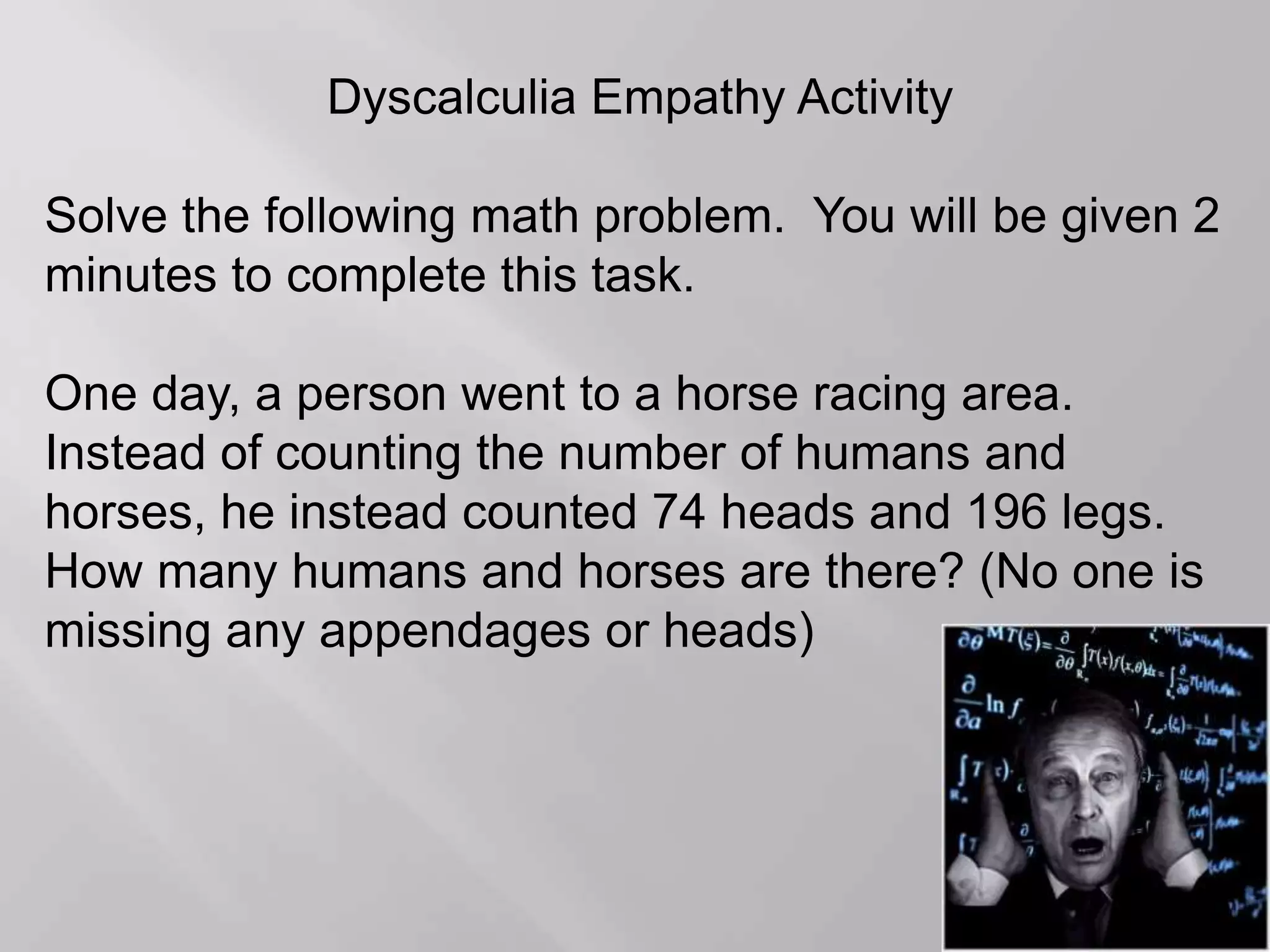
Dyscalculia Empathy Activity
Solve the following math problem. You will be given 2
minutes to complete this task.
One day, a person went to a horse racing area.
Instead of counting the number of humans and
horses, he instead counted 74 heads and 196 legs.
How many humans and horses are there? (No one is
missing any appendages or heads)
Dyscalculia
Tips to help individuals with dyscalculia:
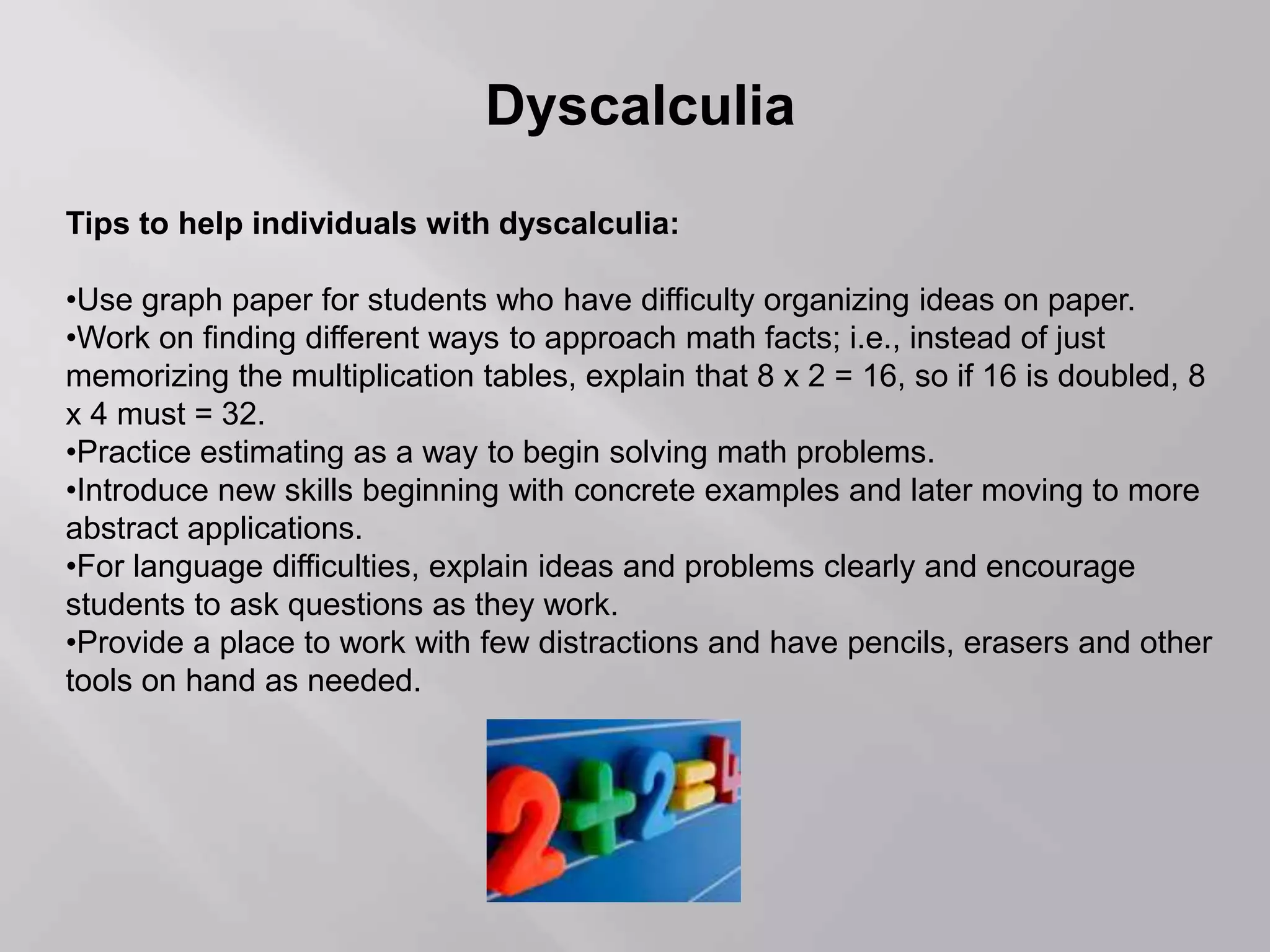
•Use graph paper for students who have difficulty organizing ideas on paper.
•Work on finding different ways to approach math facts; i.e., instead of just
memorizing the multiplication tables, explain that 8 x 2 = 16, so if 16 is doubled, 8
x 4 must = 32.
•Practice estimating as a way to begin solving math problems.
•Introduce new skills beginning with concrete examples and later moving to more
abstract applications.
•For language difficulties, explain ideas and problems clearly and encourage
students to ask questions as they work.
•Provide a place to work with few distractions and have pencils, erasers and other
tools on hand as needed.
Dysgraphia
Dysgraphia is a learning disability that affects writing abilities. It can manifest
itself as difficulties with spelling, poor handwriting, and trouble putting thoughts
on paper.
Common signs of dysgraphia include:
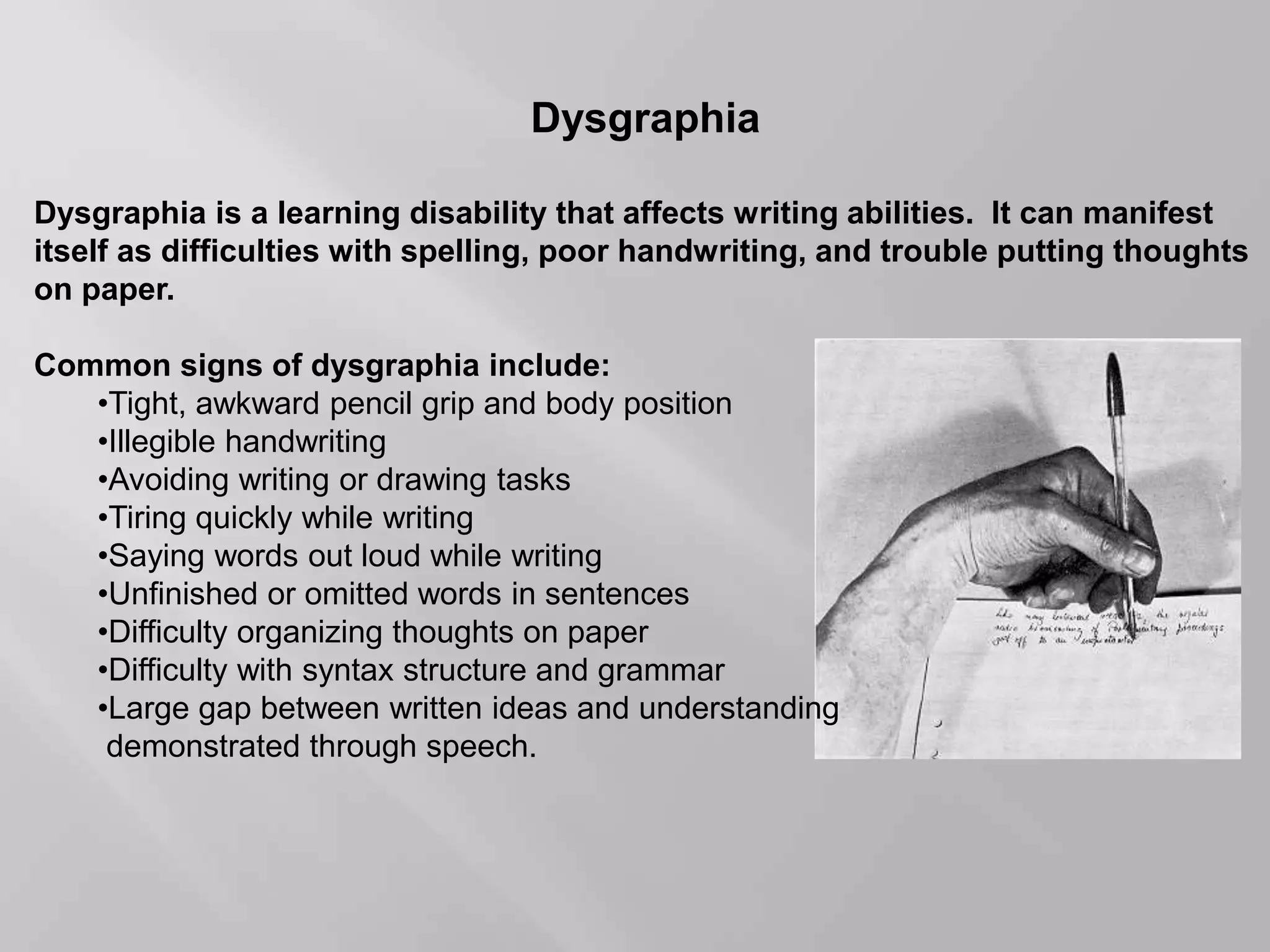
•Tight, awkward pencil grip and body position
•Illegible handwriting
•Avoiding writing or drawing tasks
•Tiring quickly while writing
•Saying words out loud while writing
•Unfinished or omitted words in sentences
•Difficulty organizing thoughts on paper
•Difficulty with syntax structure and grammar
•Large gap between written ideas and understanding
demonstrated through speech.
Dysgraphia Empathy Activity
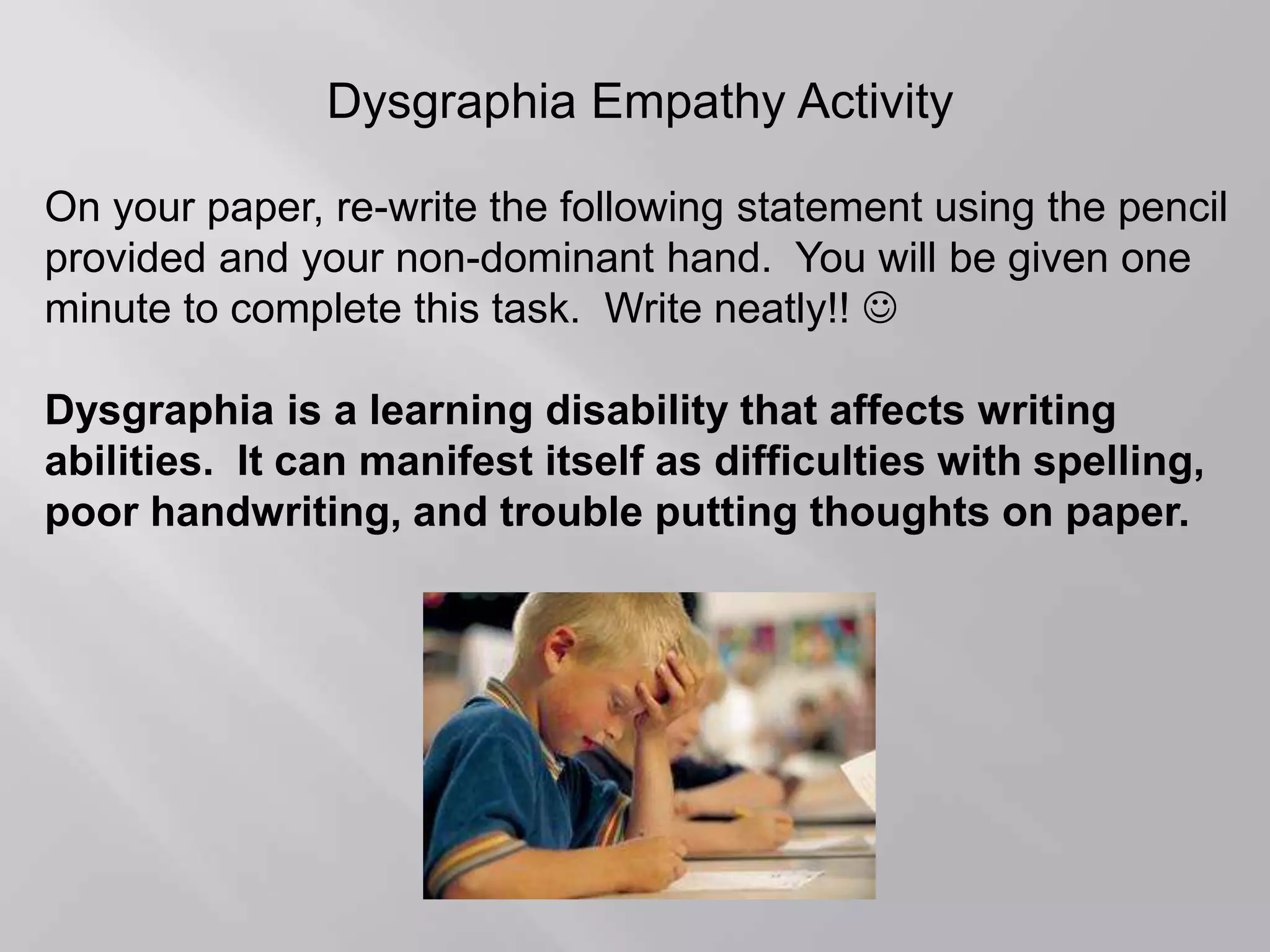
On your paper, re-write the following statement using the pencil
provided and your non-dominant hand. You will be given one
minute to complete this task. Write neatly!! 
Dysgraphia is a learning disability that affects writing
abilities. It can manifest itself as difficulties with spelling,
poor handwriting, and trouble putting thoughts on paper.
Dysgraphia
Tips to help individuals with dysgraphia:
•Use paper with raised lines for a sensory guide to staying within the lines.
•Try different pens and pencils to find one that's most comfortable.
•Practice writing letters and numbers in the air with big arm movements to
improve motor memory of these important shapes. Also practice letters and
numbers with smaller hand or finger motions.
•Encourage proper grip, posture and paper positioning for writing. It's important to
reinforce this early as it's difficult for students to unlearn bad habits later on.
•Be patient and positive, encourage practice and praise effort - becoming a good
writer takes time and practice.
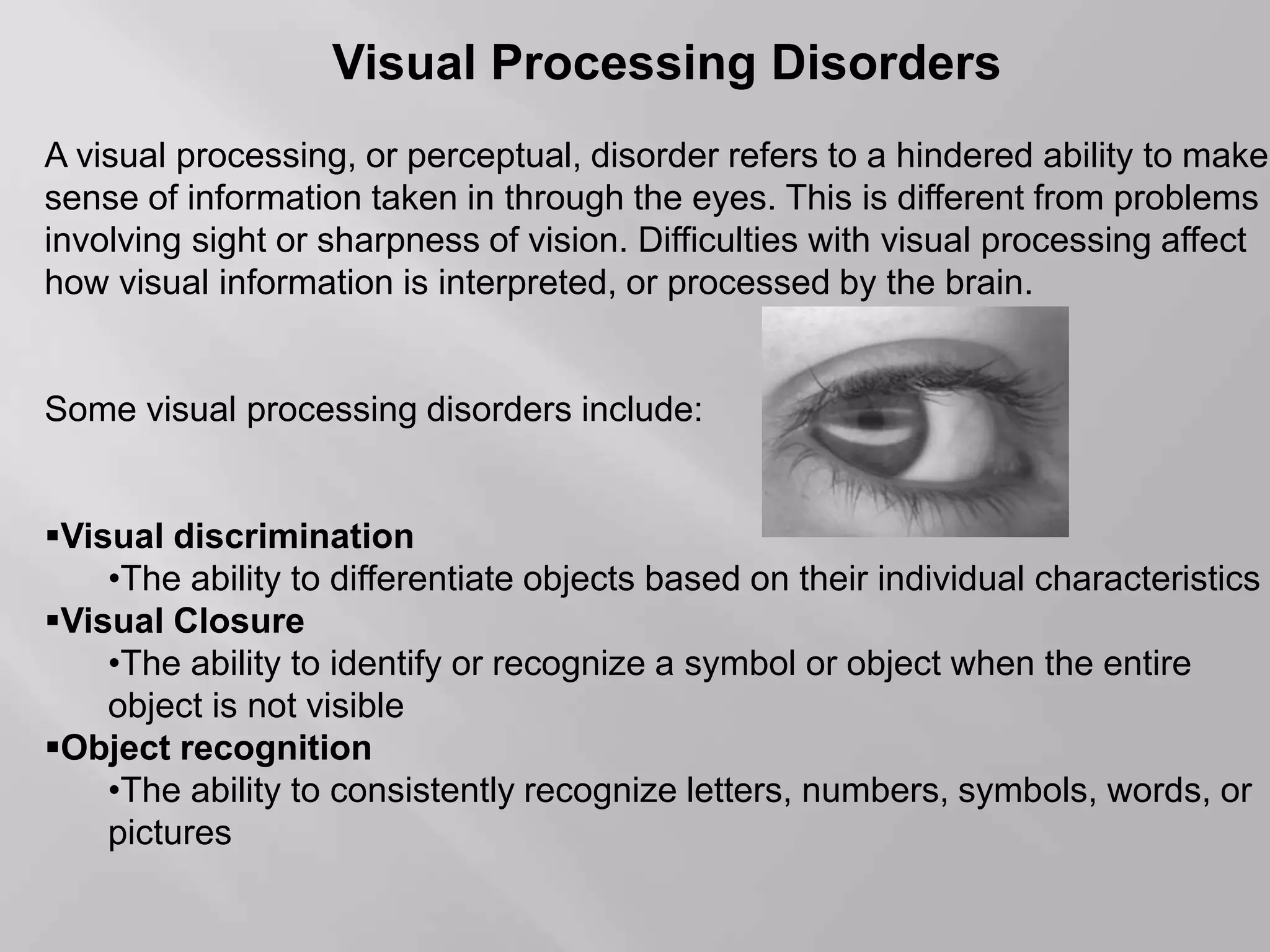
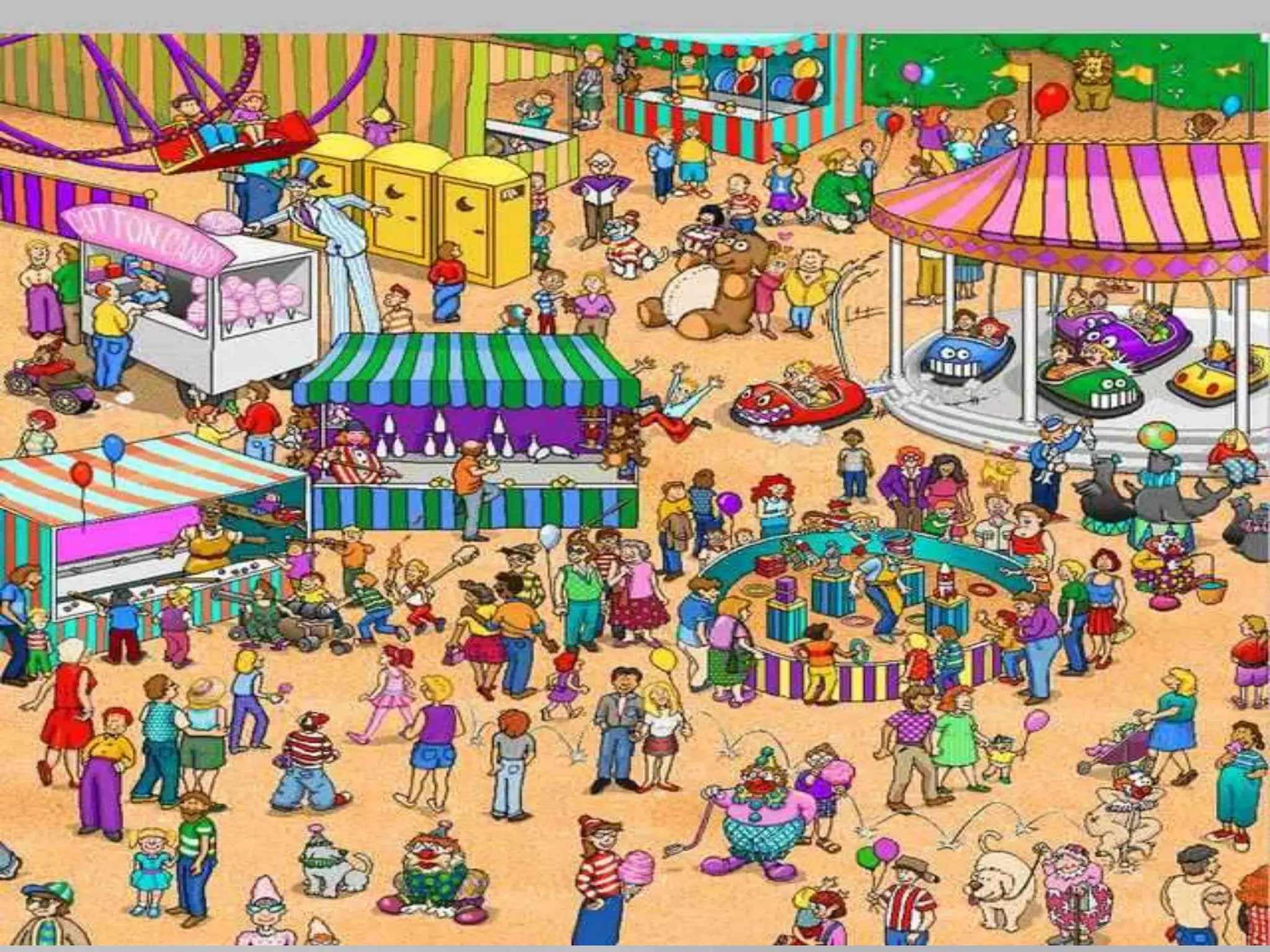
Visual Processing Disorders
A visual processing, or perceptual, disorder refers to a hindered ability to make
sense of information taken in through the eyes. This is different from problems
involving sight or sharpness of vision. Difficulties with visual processing affect
how visual information is interpreted, or processed by the brain.
Some visual processing disorders include:
Visual discrimination
•The ability to differentiate objects based on their individual characteristics
Visual Closure
•The ability to identify or recognize a symbol or object when the entire
object is not visible
Object recognition
•The ability to consistently recognize letters, numbers, symbols, words, or
pictures
Visual Processing Disorder
For reading:
•Enlarge print for books, paper, and worksheets.
•Create a “window” using an index card which can be used to block out
peripheral material which can be distracting while reading.
For writing:
•Use paper that structured (dark, bold lines)
•Paper that is divided into large sections can be used for writing math
problems
Teaching Style
•Try to avoid the student’s weakness
For example, if you write something on the board, verbalize what is being
written
Non-verbal Learning Disabilities
A non-verbal learning disorder (NLD) is a neurological syndrome
consisting of specific assets and deficits.
The assets include:
•Early speech and vocabulary development
•Remarkable rote memory skills
•Attention to detail
•Early reading skills development
•Excellent spelling skills
•Also, these individuals have the verbal ability to express
themselves eloquently.
There are four major categories of deficits and dysfunction that also
present themselves with NLD:
•motoric (lack of coordination, severe balance problems, and
difficulties with graphomotor skills).
•visual-spatial-organizational (lack of image, poor visual recall,
faulty spatial perceptions, and problems with spatial relations).
•social (lack of ability to comprehend nonverbal communication,
difficulties adjusting to transitions and novel situations, and deficits
in social judgment and social interaction).
•sensory (sensitivity in any of the sensory modes: visual, auditory,
tactile, taste or olfactory)
 Dyspraxia (Sensory Integration Disorder):
difficulties with motor coordination; fine
motor skills
 Central Auditory Processing Disorder
(CAP): difficulties interpreting auditory
information; a disorder where the
information is taken in through the ears but
is not accurately processed by the brain (the
brain does not process what is actually
heard/said)
- Dysnomia: Difficulty in using words;
problems between storage in the brain and
retrieval from the brain when words are
required
 Attention Deficit Hyperactivity Disorder:
difficulties with concentration and focus;
impulsivity
 Hyperactive
 Impulsive
 Fidgety
 Inattentive
 Disorganized
 Unreasonable
emotional negativity
 Emotional outbursts
 Frustration over minor
issues
 Bedwetting
 (All characteristics may vary with
age)
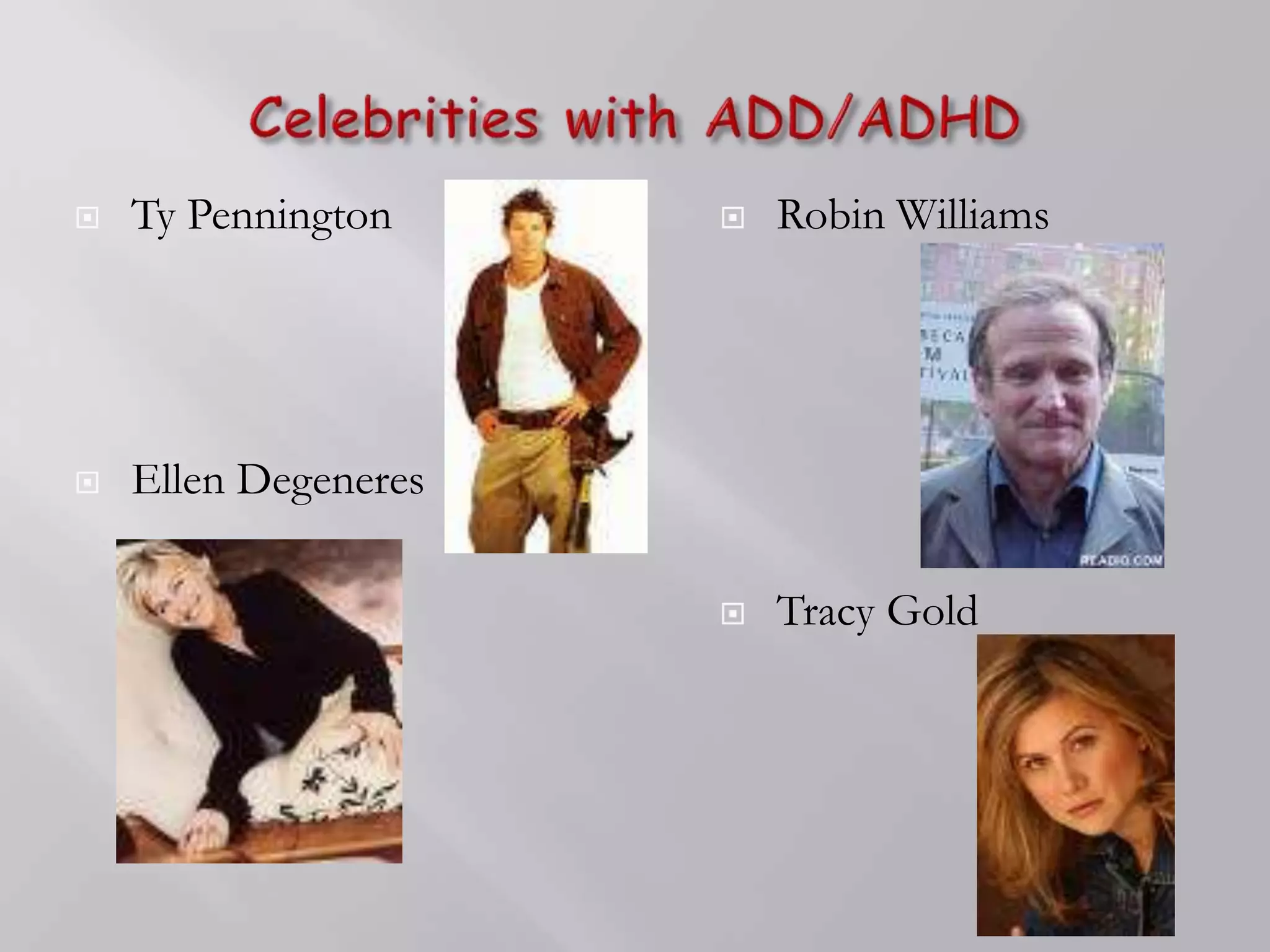
 Ty Pennington
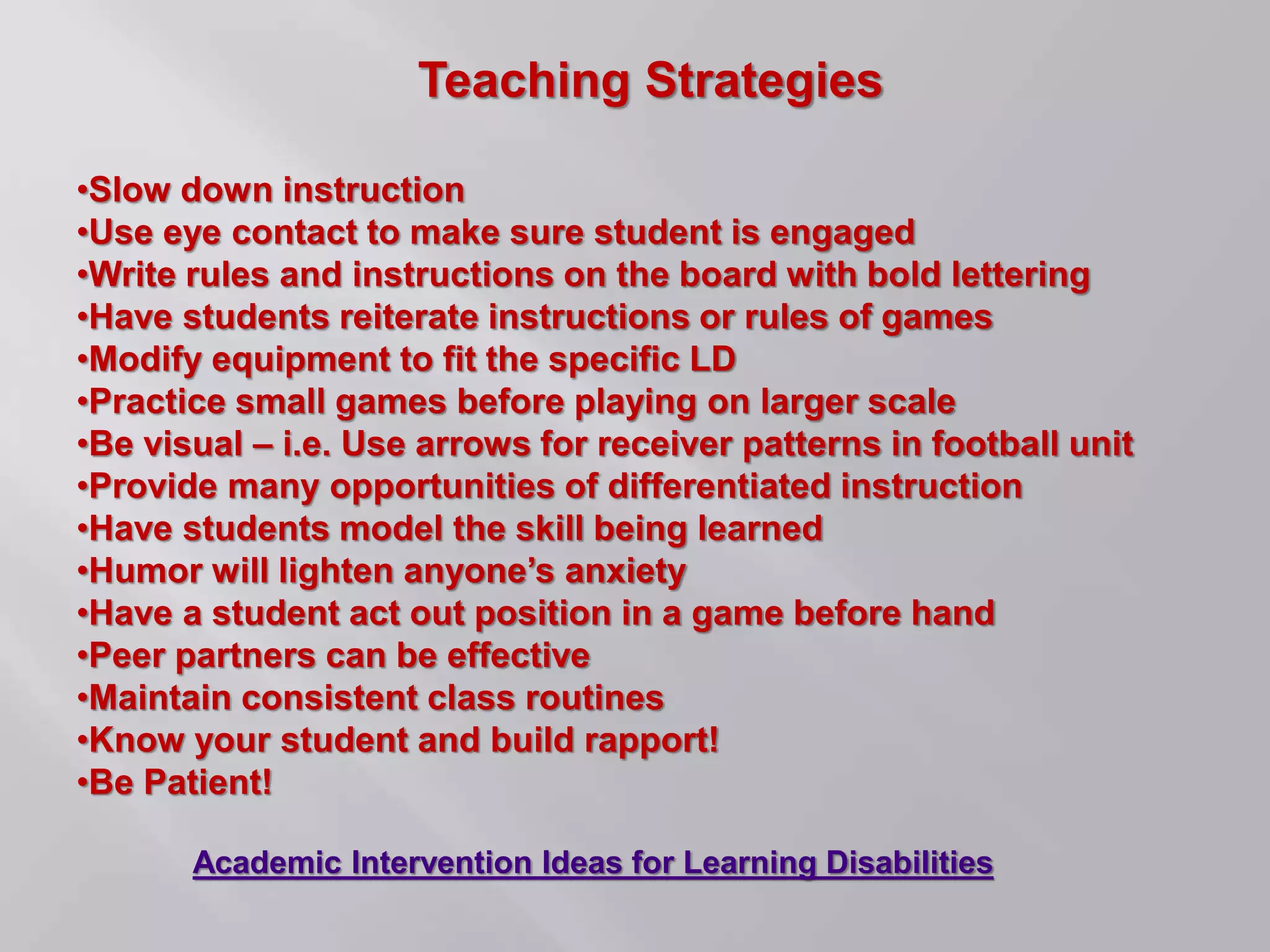
 Ellen Degeneres
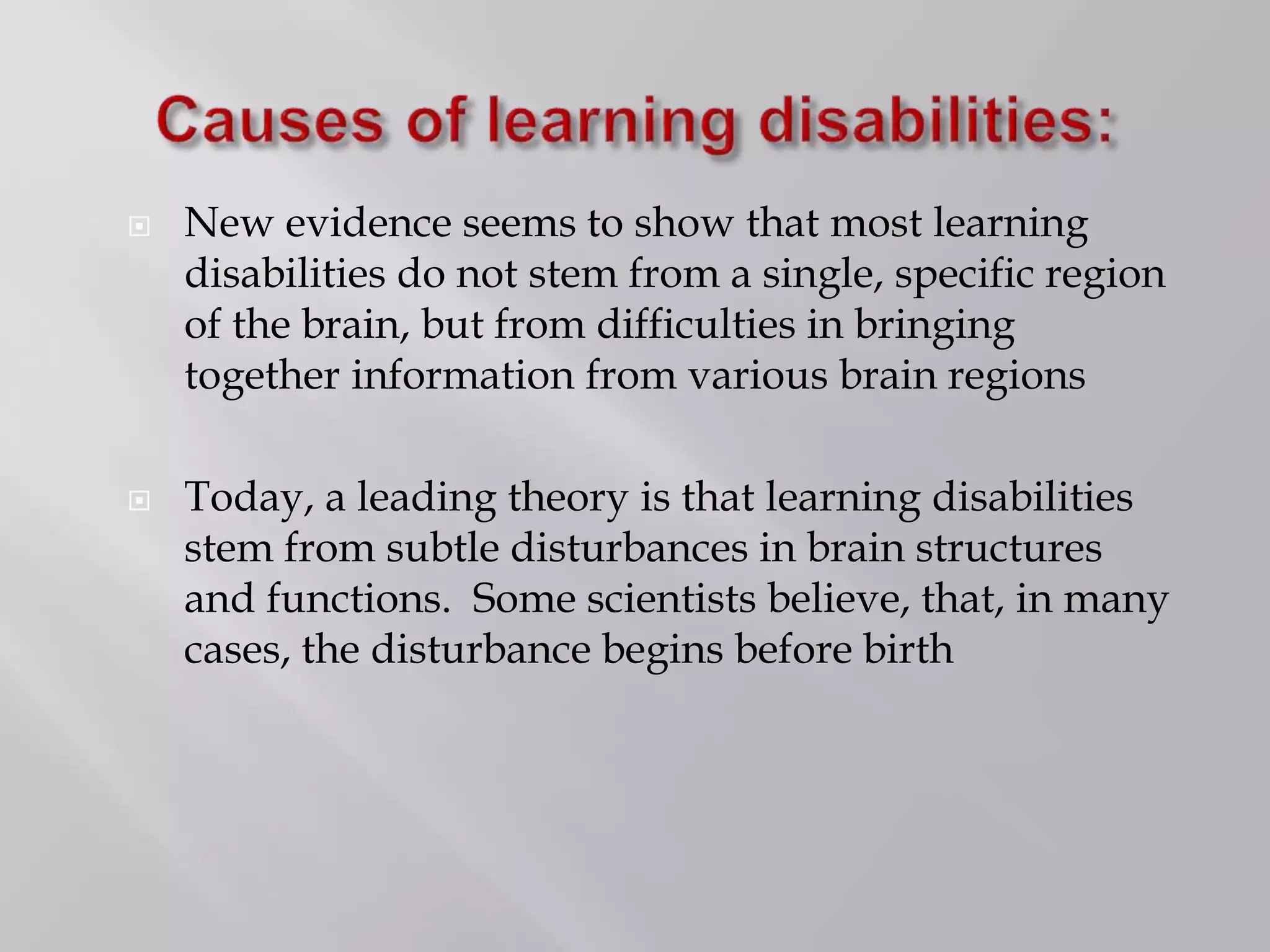
 Robin Williams
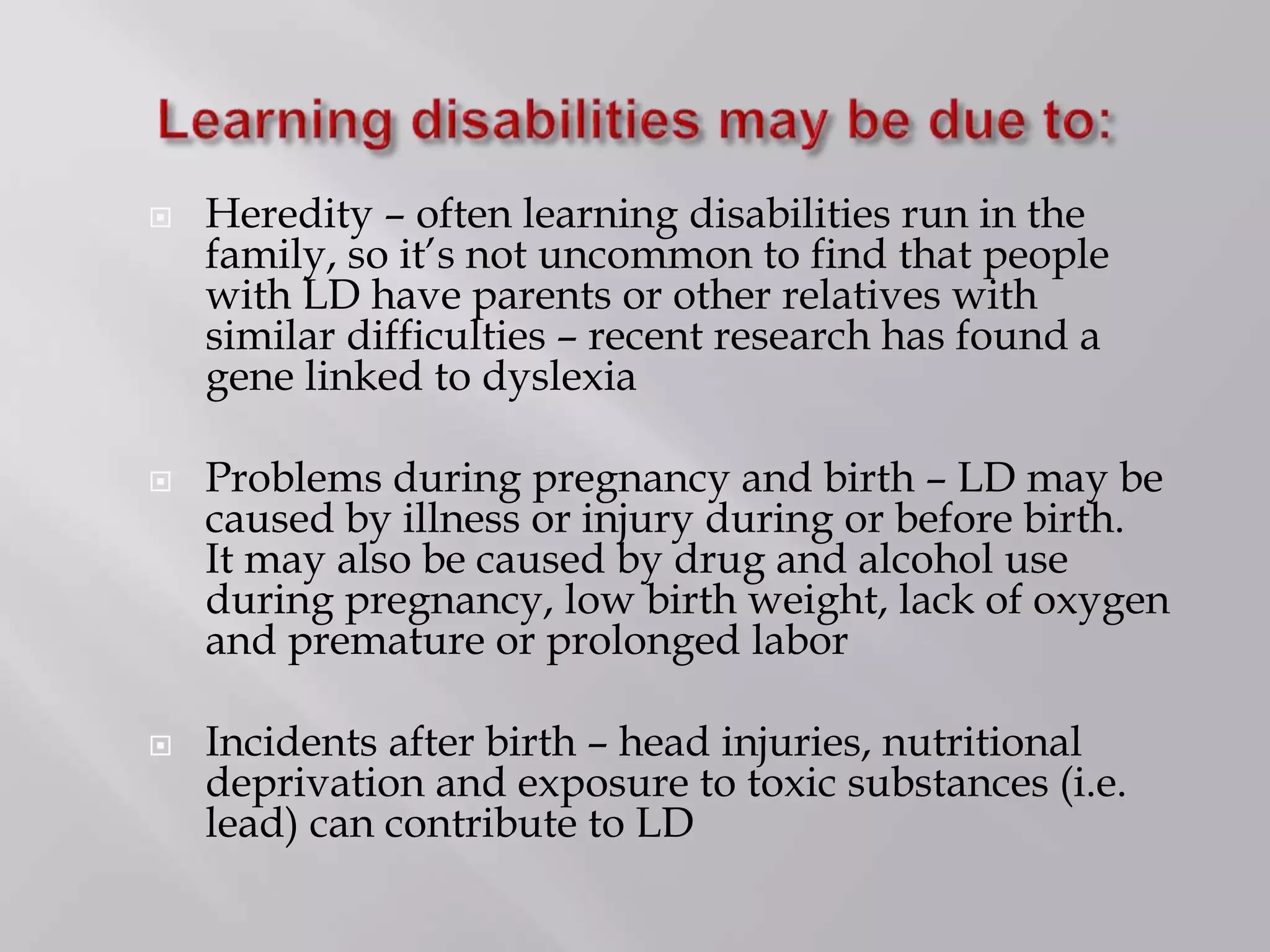
 Tracy Gold
Teaching Strategies
•Slow down instruction
•Use eye contact to make sure student is engaged
•Write rules and instructions on the board with bold lettering
•Have students reiterate instructions or rules of games
•Modify equipment to fit the specific LD
•Practice small games before playing on larger scale
•Be visual – i.e. Use arrows for receiver patterns in football unit
•Provide many opportunities of differentiated instruction
•Have students model the skill being learned
•Humor will lighten anyone’s anxiety
•Have a student act out position in a game before hand
•Peer partners can be effective
•Maintain consistent class routines
•Know your student and build rapport!
•Be Patient!
Academic Intervention Ideas for Learning Disabilities
 New evidence seems to show that most learning
disabilities do not stem from a single, specific region
of the brain, but from difficulties in bringing
together information from various brain regions
 Today, a leading theory is that learning disabilities
stem from subtle disturbances in brain structures
and functions. Some scientists believe, that, in many
cases, the disturbance begins before birth
 Heredity – often learning disabilities run in the
family, so it’s not uncommon to find that people
with LD have parents or other relatives with
similar difficulties – recent research has found a
gene linked to dyslexia
 Problems during pregnancy and birth – LD may be
caused by illness or injury during or before birth.
It may also be caused by drug and alcohol use
during pregnancy, low birth weight, lack of oxygen
and premature or prolonged labor
 Incidents after birth – head injuries, nutritional
deprivation and exposure to toxic substances (i.e.
lead) can contribute to LD
 Economic disadvantage
 Environmental factors
 Cultural or differences
 Poor parenting
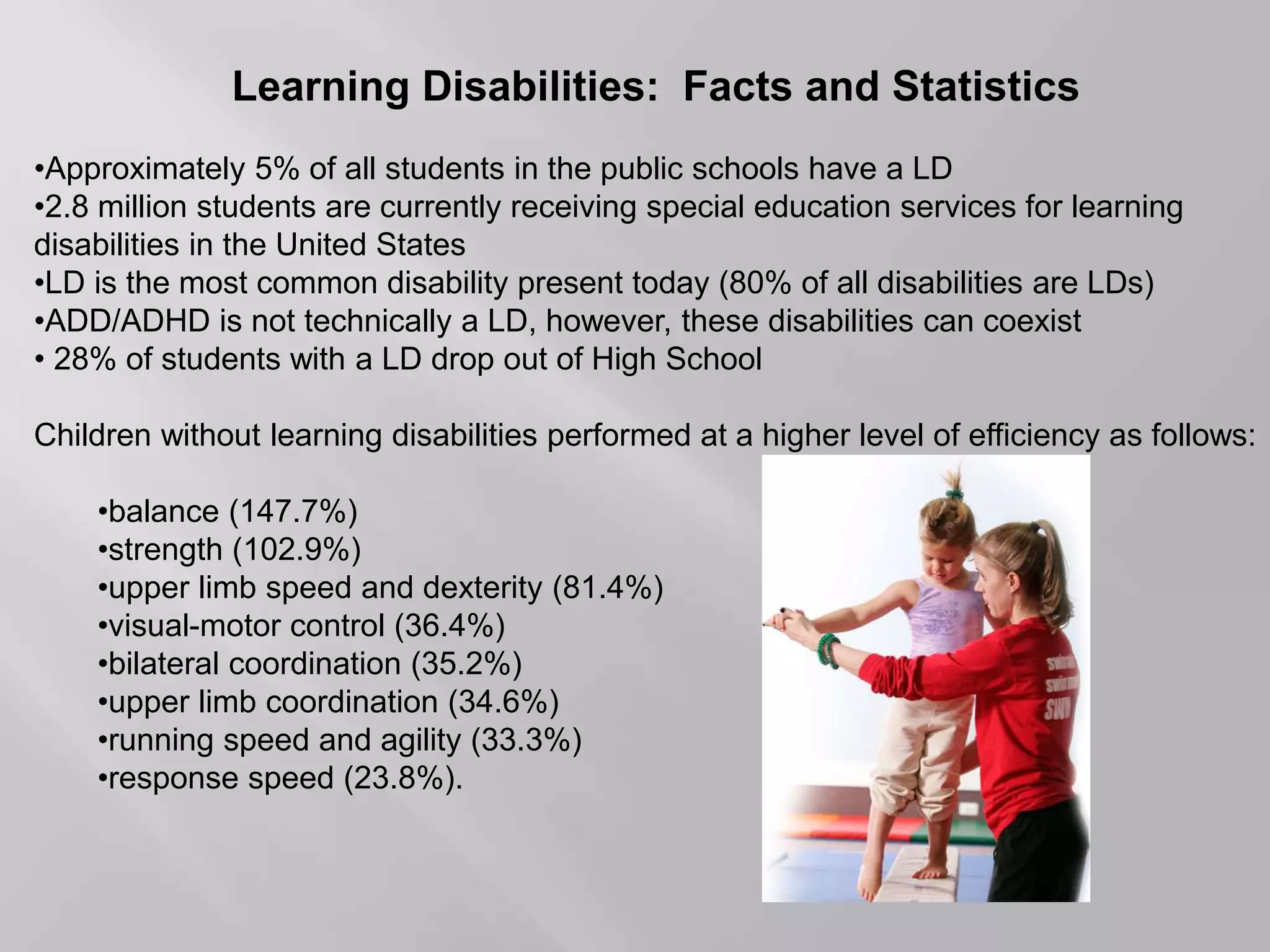
Learning Disabilities: Facts and Statistics
•Approximately 5% of all students in the public schools have a LD
•2.8 million students are currently receiving special education services for learning
disabilities in the United States
•LD is the most common disability present today (80% of all disabilities are LDs)
•ADD/ADHD is not technically a LD, however, these disabilities can coexist
• 28% of students with a LD drop out of High School
Children without learning disabilities performed at a higher level of efficiency as follows:
•balance (147.7%)
•strength (102.9%)
•upper limb speed and dexterity (81.4%)
•visual-motor control (36.4%)
•bilateral coordination (35.2%)
•upper limb coordination (34.6%)
•running speed and agility (33.3%)
•response speed (23.8%).
POTPOURRI
 Because many people with dyslexia are right-brained
thinkers, they may be more artistic and creative, becoming
poets, actors, inventors, and artists.
 Children with dyslexia use “almost five times as much brain
area as other children while doing a simple language task”
(Silverstein et al., 2001, p. 22).
 “In the past, doctors…tried to prevent [children with
disabilities] from being born; they…also…tried to stop
some [people with disabilities] from having children of their
own” (Flynn, 1998, p. 11).
EMOTIONAL ISSUES
 Students with learning disabilities may suffer from
emotional problems/depression, and/or low
self-esteem. This may cause students to withdraw
from social interaction.
 These same students may turn to drugs or alcohol for
relief from feelings of low self-worth.
 As many as 35% of students with learning disorders,
drop out of High School (Girod, 2001, p. 31).
 “Teenagers with dyslexia …[are] more likely to…think about
and to attempt suicide than other young people their age”
(Landau, 2004, pp. 48-9).
It is important to note the following…
•Most children have difficulty in some areas (i.e. reading, writing, speaking) at
one time or another. Only when these difficulties occur in more than one
setting, persist over an extended time, and interfere with learning do they
need special attention.
•A key feature of a learning disability is that an educationally significant
discrepancy exists between estimated intellectual potential and actual
academic achievement. This discrepancy is referred to as “Unexpected
underachievement”
•A learning disability cannot be caused by cultural differences, lack of
educational opportunities, poverty, or other such conditions.
•Learning disabilities can coexist with other conditions such as ADHD
•The majority of individuals with LD possess normal intelligence, however,
their academic performance lags behind their peers.
•Individuals with LD have difficulty learning in traditional ways.
Resources
Graham, G, Holt/Hale, S, & Parker, M (2007). Children Moving: A Reflective
Approach to Teaching Physical Education. New York, NY: McGraw Hill.
Grosshans, J, & Kiger, M (2004). Identifying and Teaching Students with Learning
DIsabilities in a Genaral Physical Education. JOPERD. 75, 18-21.
LD Basics. Retrieved April 3, 2009, from The World's Leading Website on
Learning Disabilities and ADHD Web site: http://ldonline.org/ldbasics
Ormond, Jeanne Ellis (2006). Educational Psychology: Developing Learners. Upper
Saddle River, NJ: Pearson Education.
Santrock, John W. (2007). A Topical Approach to Life-Span Development. New York,
NY: McGraw Hill.
Winnick, Joseph P. (2005). Adapted Physical Education and Sport. Champaign, IL:
Human Kinetics.
Wright, Jim Academic Intervention Ideas That Any Teacher Can Use. Retrieved
April 3, 2009, from Intervention Central Web site:
http://www.interventioncentral.org/
Learning Disabilities

Learning Disabilities

  • 1.
  • 2.
    What is alearning disability? •Professionals are unable to agree on one specific definition of a learning disability or LD. What experts do agree on is that this group does not learn for a variety of reasons. •Many believe that children with LD have a neurological disorder that results in problems in storing, processing, and producing information in the central nervous system, thus causing a deficit in understanding spoken or written words. •Individuals with LD often have an imperfect ability to listen, think, speak, read, write, spell, calculate mathematical equations, or motor plan. Let’s break it down into simple terms…
  • 3.
    The IDEA definesa learning disability as… “Specific learning disability” means a disorder in one or more of the basic psychological processes involved in understanding or in using language, spoken or written, that may manifest itself in an imperfect ability to listen, think, speak, read, write, spell or do mathematical calculations. The term includes such conditions as perceptual disabilities, brain injury, minimal brain dysfunction, dyslexia, and developmental aphasia. The term does not apply to children who have a learning problem that are primarily the result of visual, hearing, or motor disabilities; of mental retardation; or of environmental, cultural, or economic disadvantage.”
  • 4.
    Characteristics of LD •Difficultylearning new skills, relying on memorization •Trouble learning about time •Difficulty remembering facts •Confusing basic words (dog, cat, run) •Poor coordination, 'accident prone', unaware of physical surroundings •Having a hard time learning the connection between letters and sounds (Phonetics) •Spelling and reading errors such as substitutions (house/home), letter reversals (b/d), inversions (m/w) and transpositions (felt/left) •Problems with planning •Impulsive behavior •Transposes number sequences and confuses arithmetic signs
  • 5.
    Five common learningdisabilities include… •Dyslexia •Dyscalculia •Dysgraphia •Visual Processing Disorders, and •Non-verbal learning disabilities.
  • 6.
    Dyslexia •A language-based learningdisability •Involves a cluster of symptoms resulting in difficulty with specific language skills, particularly reading. •The core difficulty is with word recognition and reading fluency, spelling, and writing. •Dyslexia is diagnosed in people of all levels of intelligence. •There are no known causes of dyslexia. •Most people with dyslexia need help from a teacher, tutor, or therapist specially trained in using a multisensory, structured language approach.
  • 7.
    Dyslexia Empathy Activity Youwill be given exactly one minute to read the paragraph on the following slide. You will then be given two minutes to answer questions relating to the excerpt. Ready…
  • 9.
    Answer the followingquestions on a blank sheet of paper. You will have 2 minutes to complete the following questions. 1. What did Bob suggest to do for the day? 2. What were Bob and John searching for in the cupboard? 3. What was the brand? 4. How did they cook it?
  • 10.
    Dyslexia Tips to helpindividuals with dyslexia: •A student with dyslexia can be given extra time to complete tasks, help with taking notes, and work assignments that are modified appropriately. •Teachers can give taped tests or allow dyslexic students to use alternative means of assessment. •Students can benefit from listening to books on tape, using text reading computer programs, and from writing on computers.
  • 11.
    Dyscalculia •Dyscalculia is aterm referring to a wide range of lifelong learning disabilities involving math. •Some warning signs for dyscalculia include: •Good at speaking, reading, and writing, but slow to develop counting and math problem-solving skills •Good memory for printed words, but difficulty reading numbers, or recalling numbers in sequence •Good with general math concepts, but frustrated when specific computation and organization skills need to be used •Trouble with the concept of time-chronically late, difficulty remembering schedules, trouble with approximating how long something will take •Poor sense of direction, easily disoriented and easily confused by changes in routine •Poor long term memory of concepts-can do math functions one day, but is unable to repeat them the next day •Poor mental math ability-trouble estimating grocery costs or counting days until vacation •Difficulty playing strategy games like chess, bridge or role-playing video games
  • 12.
    Dyscalculia Empathy Activity Solvethe following math problem. You will be given 2 minutes to complete this task. One day, a person went to a horse racing area. Instead of counting the number of humans and horses, he instead counted 74 heads and 196 legs. How many humans and horses are there? (No one is missing any appendages or heads)
  • 13.
    Dyscalculia Tips to helpindividuals with dyscalculia: •Use graph paper for students who have difficulty organizing ideas on paper. •Work on finding different ways to approach math facts; i.e., instead of just memorizing the multiplication tables, explain that 8 x 2 = 16, so if 16 is doubled, 8 x 4 must = 32. •Practice estimating as a way to begin solving math problems. •Introduce new skills beginning with concrete examples and later moving to more abstract applications. •For language difficulties, explain ideas and problems clearly and encourage students to ask questions as they work. •Provide a place to work with few distractions and have pencils, erasers and other tools on hand as needed.
  • 14.
    Dysgraphia Dysgraphia is alearning disability that affects writing abilities. It can manifest itself as difficulties with spelling, poor handwriting, and trouble putting thoughts on paper. Common signs of dysgraphia include: •Tight, awkward pencil grip and body position •Illegible handwriting •Avoiding writing or drawing tasks •Tiring quickly while writing •Saying words out loud while writing •Unfinished or omitted words in sentences •Difficulty organizing thoughts on paper •Difficulty with syntax structure and grammar •Large gap between written ideas and understanding demonstrated through speech.
  • 15.
    Dysgraphia Empathy Activity Onyour paper, re-write the following statement using the pencil provided and your non-dominant hand. You will be given one minute to complete this task. Write neatly!!  Dysgraphia is a learning disability that affects writing abilities. It can manifest itself as difficulties with spelling, poor handwriting, and trouble putting thoughts on paper.
  • 16.
    Dysgraphia Tips to helpindividuals with dysgraphia: •Use paper with raised lines for a sensory guide to staying within the lines. •Try different pens and pencils to find one that's most comfortable. •Practice writing letters and numbers in the air with big arm movements to improve motor memory of these important shapes. Also practice letters and numbers with smaller hand or finger motions. •Encourage proper grip, posture and paper positioning for writing. It's important to reinforce this early as it's difficult for students to unlearn bad habits later on. •Be patient and positive, encourage practice and praise effort - becoming a good writer takes time and practice.
  • 17.
    Visual Processing Disorders Avisual processing, or perceptual, disorder refers to a hindered ability to make sense of information taken in through the eyes. This is different from problems involving sight or sharpness of vision. Difficulties with visual processing affect how visual information is interpreted, or processed by the brain. Some visual processing disorders include: Visual discrimination •The ability to differentiate objects based on their individual characteristics Visual Closure •The ability to identify or recognize a symbol or object when the entire object is not visible Object recognition •The ability to consistently recognize letters, numbers, symbols, words, or pictures
  • 19.
    Visual Processing Disorder Forreading: •Enlarge print for books, paper, and worksheets. •Create a “window” using an index card which can be used to block out peripheral material which can be distracting while reading. For writing: •Use paper that structured (dark, bold lines) •Paper that is divided into large sections can be used for writing math problems Teaching Style •Try to avoid the student’s weakness For example, if you write something on the board, verbalize what is being written
  • 20.
    Non-verbal Learning Disabilities Anon-verbal learning disorder (NLD) is a neurological syndrome consisting of specific assets and deficits. The assets include: •Early speech and vocabulary development •Remarkable rote memory skills •Attention to detail •Early reading skills development •Excellent spelling skills •Also, these individuals have the verbal ability to express themselves eloquently.
  • 21.
    There are fourmajor categories of deficits and dysfunction that also present themselves with NLD: •motoric (lack of coordination, severe balance problems, and difficulties with graphomotor skills). •visual-spatial-organizational (lack of image, poor visual recall, faulty spatial perceptions, and problems with spatial relations). •social (lack of ability to comprehend nonverbal communication, difficulties adjusting to transitions and novel situations, and deficits in social judgment and social interaction). •sensory (sensitivity in any of the sensory modes: visual, auditory, tactile, taste or olfactory)
  • 22.
     Dyspraxia (SensoryIntegration Disorder): difficulties with motor coordination; fine motor skills  Central Auditory Processing Disorder (CAP): difficulties interpreting auditory information; a disorder where the information is taken in through the ears but is not accurately processed by the brain (the brain does not process what is actually heard/said)
  • 23.
    - Dysnomia: Difficultyin using words; problems between storage in the brain and retrieval from the brain when words are required  Attention Deficit Hyperactivity Disorder: difficulties with concentration and focus; impulsivity
  • 24.
     Hyperactive  Impulsive Fidgety  Inattentive  Disorganized  Unreasonable emotional negativity  Emotional outbursts  Frustration over minor issues  Bedwetting  (All characteristics may vary with age)
  • 25.
     Ty Pennington Ellen Degeneres  Robin Williams  Tracy Gold
  • 26.
    Teaching Strategies •Slow downinstruction •Use eye contact to make sure student is engaged •Write rules and instructions on the board with bold lettering •Have students reiterate instructions or rules of games •Modify equipment to fit the specific LD •Practice small games before playing on larger scale •Be visual – i.e. Use arrows for receiver patterns in football unit •Provide many opportunities of differentiated instruction •Have students model the skill being learned •Humor will lighten anyone’s anxiety •Have a student act out position in a game before hand •Peer partners can be effective •Maintain consistent class routines •Know your student and build rapport! •Be Patient! Academic Intervention Ideas for Learning Disabilities
  • 27.
     New evidenceseems to show that most learning disabilities do not stem from a single, specific region of the brain, but from difficulties in bringing together information from various brain regions  Today, a leading theory is that learning disabilities stem from subtle disturbances in brain structures and functions. Some scientists believe, that, in many cases, the disturbance begins before birth
  • 28.
     Heredity –often learning disabilities run in the family, so it’s not uncommon to find that people with LD have parents or other relatives with similar difficulties – recent research has found a gene linked to dyslexia  Problems during pregnancy and birth – LD may be caused by illness or injury during or before birth. It may also be caused by drug and alcohol use during pregnancy, low birth weight, lack of oxygen and premature or prolonged labor  Incidents after birth – head injuries, nutritional deprivation and exposure to toxic substances (i.e. lead) can contribute to LD
  • 29.
     Economic disadvantage Environmental factors  Cultural or differences  Poor parenting
  • 30.
    Learning Disabilities: Factsand Statistics •Approximately 5% of all students in the public schools have a LD •2.8 million students are currently receiving special education services for learning disabilities in the United States •LD is the most common disability present today (80% of all disabilities are LDs) •ADD/ADHD is not technically a LD, however, these disabilities can coexist • 28% of students with a LD drop out of High School Children without learning disabilities performed at a higher level of efficiency as follows: •balance (147.7%) •strength (102.9%) •upper limb speed and dexterity (81.4%) •visual-motor control (36.4%) •bilateral coordination (35.2%) •upper limb coordination (34.6%) •running speed and agility (33.3%) •response speed (23.8%).
  • 31.
    POTPOURRI  Because manypeople with dyslexia are right-brained thinkers, they may be more artistic and creative, becoming poets, actors, inventors, and artists.  Children with dyslexia use “almost five times as much brain area as other children while doing a simple language task” (Silverstein et al., 2001, p. 22).  “In the past, doctors…tried to prevent [children with disabilities] from being born; they…also…tried to stop some [people with disabilities] from having children of their own” (Flynn, 1998, p. 11).
  • 32.
    EMOTIONAL ISSUES  Studentswith learning disabilities may suffer from emotional problems/depression, and/or low self-esteem. This may cause students to withdraw from social interaction.  These same students may turn to drugs or alcohol for relief from feelings of low self-worth.  As many as 35% of students with learning disorders, drop out of High School (Girod, 2001, p. 31).  “Teenagers with dyslexia …[are] more likely to…think about and to attempt suicide than other young people their age” (Landau, 2004, pp. 48-9).
  • 33.
    It is importantto note the following… •Most children have difficulty in some areas (i.e. reading, writing, speaking) at one time or another. Only when these difficulties occur in more than one setting, persist over an extended time, and interfere with learning do they need special attention. •A key feature of a learning disability is that an educationally significant discrepancy exists between estimated intellectual potential and actual academic achievement. This discrepancy is referred to as “Unexpected underachievement” •A learning disability cannot be caused by cultural differences, lack of educational opportunities, poverty, or other such conditions. •Learning disabilities can coexist with other conditions such as ADHD •The majority of individuals with LD possess normal intelligence, however, their academic performance lags behind their peers. •Individuals with LD have difficulty learning in traditional ways.
  • 34.
    Resources Graham, G, Holt/Hale,S, & Parker, M (2007). Children Moving: A Reflective Approach to Teaching Physical Education. New York, NY: McGraw Hill. Grosshans, J, & Kiger, M (2004). Identifying and Teaching Students with Learning DIsabilities in a Genaral Physical Education. JOPERD. 75, 18-21. LD Basics. Retrieved April 3, 2009, from The World's Leading Website on Learning Disabilities and ADHD Web site: http://ldonline.org/ldbasics Ormond, Jeanne Ellis (2006). Educational Psychology: Developing Learners. Upper Saddle River, NJ: Pearson Education. Santrock, John W. (2007). A Topical Approach to Life-Span Development. New York, NY: McGraw Hill. Winnick, Joseph P. (2005). Adapted Physical Education and Sport. Champaign, IL: Human Kinetics. Wright, Jim Academic Intervention Ideas That Any Teacher Can Use. Retrieved April 3, 2009, from Intervention Central Web site: http://www.interventioncentral.org/