

Curriculum Development
Planning and implementation
Our aim is to develop a strong working partnership with academic colleagues,
enabling students to access high quality, peer reviewed resources appropriate to
their level of study. We do this by attending planning meetings, supporting
validations, assisting in resource visits, periodic reviews, and support for collaborate
provision.
 What books, journals, and databases will students need?
 Are all my resources accessible to all students?
 How much will these cost?
 Will students require access to specific software?
 Where will the module /course be taught?
 How many students will be studying on the module?
 Will it be offered to collaborate partners?
 How will students develop their academic skills ?
Contacting your Liaison Librarian at the earliest point in the planning process will help you
manage a whole lot of issues including accessibility, sourcing new publications, potential
software requirements and licensing issues. This latter can be especially important when
planning course for collaborate provision as not all resources may be available due to
licensing issues.
Curriculum Development and Planning
Early Childhood Curriculum addresses current approaches to
curriculum for infants, toddlers and young children, ages birth to
eight. It provides a comprehensive introduction to the curriculum
issues that student teachers and emerging practitioners will face
and equips them with the decision-making tools that will
ultimately enhance and promote young children’s learning. The
text proposes a cultural historical framework to explore diverse
approaches to early years education, drawing on research and
examples of practice across a range of international contexts. It
offers a clear focus on domain areas of the curriculum - the arts,
health and wellbeing, literacy and language, science and math, and
information and communication technology - so that teachers are
able to gain a breadth of understanding and effectively plan, design
and implement curriculum strategy.
Early Intervention Implementation
developmental delay
Academic excellence of students with special needs
depends on many factors such as the level of
individual intelligence, slow development, the level of
hearing loss, vision problems and age at diagnosis.
Children who have been identified to undergo continued in
the preschool early intervention such as the use of hearing
aids, provide training in language and communication,
socialization, teaching them how to read and write using
Braille, improve motor skills, orientation and mobility to
increase student confidence..
Early intervention programs implemented to meet the educational
needs of students with special needs that have been identified
with visual, hearing, learning, impaired physical and multiple
disabilities in preschool. National Education Policy states that
students with special needs are given the opportunity to gain
access to appropriate educational and relevant to their ability to
become independent and lead a life of quality (Ministry of
Education 2012). Early intervention preschool program for special
education students is the process of supplying the service,
support, education of various stimulation techniques lessons,
activities and training to students with special needs who
suffer from physical or mental developmental delay, which will
affect the development and learning prevents them (the Ministry
of Education in 2013
introduction
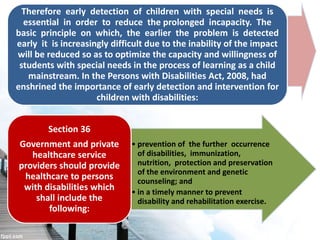
Therefore early detection of children with special needs is
essential in order to reduce the prolonged incapacity. The
basic principle on which, the earlier the problem is detected
early it is increasingly difficult due to the inability of the impact
will be reduced so as to optimize the capacity and willingness of
students with special needs in the process of learning as a child
mainstream. In the Persons with Disabilities Act, 2008, had
enshrined the importance of early detection and intervention for
children with disabilities:
• prevention of the further occurrence
of disabilities, immunization,
nutrition, protection and preservation
of the environment and genetic
counseling; and
• in a timely manner to prevent
disability and rehabilitation exercise.
Section 36
Government and private
healthcare service
providers should provide
healthcare to persons
with disabilities which
shall include the
following:
In accordance with the Act, teachers and parents
must play their part by taking early action. Among
the measures that should be taken is referred to a
specialist or medical practitioner who provides
services related to the inability to detect. Immediate
steps can help children deal with disability through a
planned intervention program implemented by the
information detection (Ministry of Education 2013).
The first five years of life are a critical period for the development of
children. Prior experience and a healthy environment is a step to prepare
for the future and success in school. Prior experience actually affect brain
development, to provide the basis for the development of language,
reasoning, problem solving, social skills, emotional and behavioral
problems. According to the research, the willingness of students to the
school measured by five different domains but are intertwined with each
other, namely physical and motor development, social development,
emotional, behavioral and language development (Papalia, Olds &
Feldman 2004). These domains interact with each other to strengthen all
aspects of development. The willingness of students with special
needs to develop five domains that require appropriate early
intervention to help them improve their development as well as
support from the kindergarten teachers and parents.
LITERATURE
Detection of early childhood special education is very important that early
intervention can be carried out timely and appropriate support services
can be provided. In this way children who are identified to be able to
continue learning and be able to follow the program of inclusive education
in mainstream classes. Early intervention is a system of structured services
that help enhance the growth and development of children. This is a way to
support families in the early years critical (0 to 6 years) for a child for
special education. The importance of early intervention program
among preschool special education students can not be denied since it
can help children grow into productive individuals and self-reliant (Special
Education, 2013), preventing them from developmental problems
become more serious (Odom, McConnell & McEvoy 2002), the train
children in school readiness skills, reduce the number of children who
need to be placed in special education (Bailey & Wolery 2007) and
reduce spending for special education funding (Guralnick 1991).
Practices on the implementation of the intervention program of early
childhood special education preschool towards preparation for primary
school. Analysis of data known of three special education preschool teacher
shows there are seven themes that affect the implementation of early
intervention preschool special education students, namely;
• an understanding of early intervention,
• early intervention program implementation practices,
• Curriculum Standard Preschool Special Education
• teacher recruitment
• Infrastructure
• collaboration
• monitoring.
These themes were found to play an important role in contributing to excellence
in student learning preschool special education to prepare them for school.
FINDINGS
DISCUSSION AND
RECOMMENDATIONS TO
OVERCOME
An understanding of early intervention
A comprehensive early intervention program is practical in
improving children's development in cognitive, language and
communication, social, emotional and gross motor skills and fine
motor to determine their excellence in teaching. These can also
be linked to the discovery that quality early intervention program
for special education students can help determine children's
social, behavioral, language and communication, gross motor,
fine motor, cognitive development and school readiness skill
The practice of implementation of early intervention programs
The implementation of early intervention practices are still not
widely used in the classroom for special education preschool. This
condition is associated with a lack of exposure to carry out early
intervention techniques, lack of knowledge and skills on early
intervention will have an impact in the performance of early
intervention programs, this phenomenon should be curbed to ensure
that preschool teachers have special education knowledge and skills
to carry out early intervention. These teachers should be given
adequate training in the form of in-service courses or workshops to
ensure they are competent to run early intervention.
Preschool Special Education Curriculum
While early intervention program to support early childhood
learning preschool special education but implementation of
early intervention practices still less emphasized. In Special
Education Preschool Curriculum Standard Immigration existing
no content specifically related aspects of early intervention.
Monitoring
the teachers described a very important aspect of monitoring
requirements to ensure the implementation of early
intervention programs run smoothly. Monitoring should see
the needs of teachers and students and the results that can
be achieved by planning to ensure early intervention
program implemented to help pupils with special educational
preschool guaranteed optimal quality of learning.
CONCLUSION
In conclusion, early intervention is crucial for the positive
development of students in preschool special education. The
collaboration between those with expertise to maximize the
potential of children with special needs and minimize their
disability so they get the chance to secure a proper education.
Readiness for school is an important element in helping
students with special needs to adapt to the new learning
environment. Willingness to school is an important aspect
in determining the success and failure of children in schools.
Indeed, the willingness to schools should be given special
attention by the parents and teachers of preschool at an early
stage.
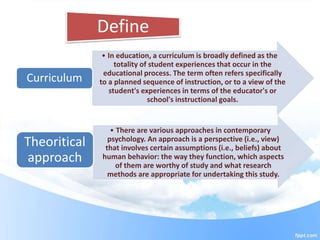
Define
• In education, a curriculum is broadly defined as the
totality of student experiences that occur in the
educational process. The term often refers specifically
to a planned sequence of instruction, or to a view of the
student's experiences in terms of the educator's or
school's instructional goals.
Curriculum
• There are various approaches in contemporary
psychology. An approach is a perspective (i.e., view)
that involves certain assumptions (i.e., beliefs) about
human behavior: the way they function, which aspects
of them are worthy of study and what research
methods are appropriate for undertaking this study.
Theoritical
approach
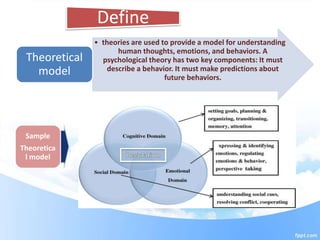
Define
• theories are used to provide a model for understanding
human thoughts, emotions, and behaviors. A
psychological theory has two key components: It must
describe a behavior. It must make predictions about
future behaviors.
Theoretical
model
Sample
Theoretica
l model
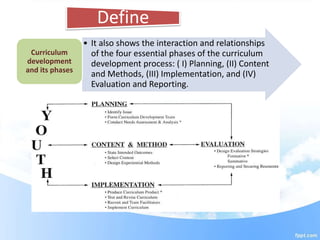
Define
• It also shows the interaction and relationships
of the four essential phases of the curriculum
development process: ( I) Planning, (II) Content
and Methods, (III) Implementation, and (IV)
Evaluation and Reporting.
Curriculum
development
and its phases
A Thematic unit is the organization of a
curriculum around a central theme. In other
words, it's a series of lessons that integrate
subjects across the curriculum, such as math,
reading, social studies, science, language arts,
etc. that all tie into the main theme of the unit.
Each activity should have a main
focus toward the thematic idea.
A thematic unit is much broader
than just choosing a topic.
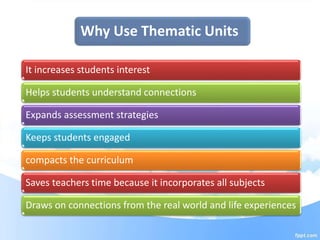
Why Use Thematic Units
It increases students interest
Helps students understand connections
Expands assessment strategies
Keeps students engaged
compacts the curriculum
Saves teachers time because it incorporates all subjects
Draws on connections from the real world and life experiences
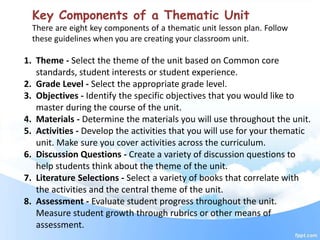
Key Components of a Thematic Unit
There are eight key components of a thematic unit lesson plan. Follow
these guidelines when you are creating your classroom unit.
1. Theme - Select the theme of the unit based on Common core
standards, student interests or student experience.
2. Grade Level - Select the appropriate grade level.
3. Objectives - Identify the specific objectives that you would like to
master during the course of the unit.
4. Materials - Determine the materials you will use throughout the unit.
5. Activities - Develop the activities that you will use for your thematic
unit. Make sure you cover activities across the curriculum.
6. Discussion Questions - Create a variety of discussion questions to
help students think about the theme of the unit.
7. Literature Selections - Select a variety of books that correlate with
the activities and the central theme of the unit.
8. Assessment - Evaluate student progress throughout the unit.
Measure student growth through rubrics or other means of
assessment.
Activity Based Intervention
Activity-based intervention (ABI) provides a
developmentally appropriate framework for
incorporating several effective instructional
strategies into a child’s daily activities. This
approach is a promising way to utilize
naturally occurring antecedents and
consequences to teach children with autism
target skills.
DESCRIPTION
Activity-based intervention (ABI) originated with Diane Bricker and her colleagues
at the University of Oregon. It is defined as a “child-directed, transactional
approach that embeds intervention on children’s individual goals and objectives in
routine, planned, or child-initiated activities, and uses logically occurring
antecedents and consequences to develop functional and generative skills”.
Novick (1993) described ABI as a “combination of selected strategies found in early
childhood and behavior analytic approaches and shares many theoretical and
philosophical underpinnings with developmentally appropriate practice”. It is
considered a naturalistic teaching approach and is commonly described in terms of
embedded instruction, routine-based intervention, or integrated therapy
• Administer comprehensive curriculum-
based assessment/evaluation tools.
• Summarize the results of the assessment in
terms of interests, strengths, and needs.
• Target skills that are (a) functional, (b)
usable across settings with different people
and materials, (c) observable and
measurable, and (d) part of the child’s
natural daily environment.
• Identify appropriate goals and objectives
through prioritizing skills.
• Develop written goals and objectives that
are observable, measurable, and clearly
understandable to team members.
A five-step
process of
selecting
appropriate
skills for
intervention:
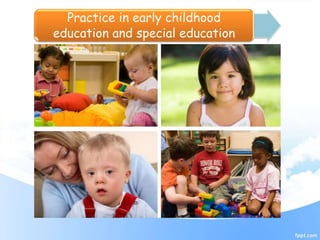
Practice in early childhood
education and special education
Historical, philosophical foundations, and legal basis of services for infants
and young children both with and without exceptional needs
Trends and issues in early childhood education, early childhood special
education, and early intervention
Legal, ethical, and policy issues related to educational, developmental, and
medical services for infants and young children, and their families
Advocacy for professional status and working conditions for those who
serve infants and young children, and their families
Recognize signs of emotional distress, neglect, and abuse, and follow
reporting procedures
Integrate family systems theories and principles into professional practice
Respect family choices and goals
Participate in activities of professional organizations relevant to early
childhood special education and early intervention
Apply evidence-based and recommended practices for infants and young
children, including those from diverse backgrounds
Advocate on behalf of infants and young children and their families
Implement family services consistent with due process safeguards
Practices were developed to provide guidance to
practitioners and families about the most effective
ways to improve the learning outcomes and promote
the development of young children, birth through
five years of age, who have or are at-risk for
developmental delays or disabilities. The purpose of
this document is to help bridge the gap between
research and practice by highlighting those
practices that have been shown to result in better
outcomes for young children with disabilities, their
families, and the personnel who serve them. The
DEC Recommended Practices support children’s
access and participation in inclusive settings and
natural environments and address cultural, linguistic,
and ability diversity. They also identify key
leadership responsibilities associated with the
implementation of these practices.
Thank you…

Curriculum Development Planning and implementation

  • 1.
  • 2.
    Our aim isto develop a strong working partnership with academic colleagues, enabling students to access high quality, peer reviewed resources appropriate to their level of study. We do this by attending planning meetings, supporting validations, assisting in resource visits, periodic reviews, and support for collaborate provision.  What books, journals, and databases will students need?  Are all my resources accessible to all students?  How much will these cost?  Will students require access to specific software?  Where will the module /course be taught?  How many students will be studying on the module?  Will it be offered to collaborate partners?  How will students develop their academic skills ? Contacting your Liaison Librarian at the earliest point in the planning process will help you manage a whole lot of issues including accessibility, sourcing new publications, potential software requirements and licensing issues. This latter can be especially important when planning course for collaborate provision as not all resources may be available due to licensing issues. Curriculum Development and Planning
  • 3.
    Early Childhood Curriculumaddresses current approaches to curriculum for infants, toddlers and young children, ages birth to eight. It provides a comprehensive introduction to the curriculum issues that student teachers and emerging practitioners will face and equips them with the decision-making tools that will ultimately enhance and promote young children’s learning. The text proposes a cultural historical framework to explore diverse approaches to early years education, drawing on research and examples of practice across a range of international contexts. It offers a clear focus on domain areas of the curriculum - the arts, health and wellbeing, literacy and language, science and math, and information and communication technology - so that teachers are able to gain a breadth of understanding and effectively plan, design and implement curriculum strategy.
  • 4.
    Early Intervention Implementation developmentaldelay Academic excellence of students with special needs depends on many factors such as the level of individual intelligence, slow development, the level of hearing loss, vision problems and age at diagnosis. Children who have been identified to undergo continued in the preschool early intervention such as the use of hearing aids, provide training in language and communication, socialization, teaching them how to read and write using Braille, improve motor skills, orientation and mobility to increase student confidence..
  • 5.
    Early intervention programsimplemented to meet the educational needs of students with special needs that have been identified with visual, hearing, learning, impaired physical and multiple disabilities in preschool. National Education Policy states that students with special needs are given the opportunity to gain access to appropriate educational and relevant to their ability to become independent and lead a life of quality (Ministry of Education 2012). Early intervention preschool program for special education students is the process of supplying the service, support, education of various stimulation techniques lessons, activities and training to students with special needs who suffer from physical or mental developmental delay, which will affect the development and learning prevents them (the Ministry of Education in 2013 introduction
  • 6.
    Therefore early detectionof children with special needs is essential in order to reduce the prolonged incapacity. The basic principle on which, the earlier the problem is detected early it is increasingly difficult due to the inability of the impact will be reduced so as to optimize the capacity and willingness of students with special needs in the process of learning as a child mainstream. In the Persons with Disabilities Act, 2008, had enshrined the importance of early detection and intervention for children with disabilities: • prevention of the further occurrence of disabilities, immunization, nutrition, protection and preservation of the environment and genetic counseling; and • in a timely manner to prevent disability and rehabilitation exercise. Section 36 Government and private healthcare service providers should provide healthcare to persons with disabilities which shall include the following:
  • 7.
    In accordance withthe Act, teachers and parents must play their part by taking early action. Among the measures that should be taken is referred to a specialist or medical practitioner who provides services related to the inability to detect. Immediate steps can help children deal with disability through a planned intervention program implemented by the information detection (Ministry of Education 2013).
  • 8.
    The first fiveyears of life are a critical period for the development of children. Prior experience and a healthy environment is a step to prepare for the future and success in school. Prior experience actually affect brain development, to provide the basis for the development of language, reasoning, problem solving, social skills, emotional and behavioral problems. According to the research, the willingness of students to the school measured by five different domains but are intertwined with each other, namely physical and motor development, social development, emotional, behavioral and language development (Papalia, Olds & Feldman 2004). These domains interact with each other to strengthen all aspects of development. The willingness of students with special needs to develop five domains that require appropriate early intervention to help them improve their development as well as support from the kindergarten teachers and parents. LITERATURE
  • 9.
    Detection of earlychildhood special education is very important that early intervention can be carried out timely and appropriate support services can be provided. In this way children who are identified to be able to continue learning and be able to follow the program of inclusive education in mainstream classes. Early intervention is a system of structured services that help enhance the growth and development of children. This is a way to support families in the early years critical (0 to 6 years) for a child for special education. The importance of early intervention program among preschool special education students can not be denied since it can help children grow into productive individuals and self-reliant (Special Education, 2013), preventing them from developmental problems become more serious (Odom, McConnell & McEvoy 2002), the train children in school readiness skills, reduce the number of children who need to be placed in special education (Bailey & Wolery 2007) and reduce spending for special education funding (Guralnick 1991).
  • 10.
    Practices on theimplementation of the intervention program of early childhood special education preschool towards preparation for primary school. Analysis of data known of three special education preschool teacher shows there are seven themes that affect the implementation of early intervention preschool special education students, namely; • an understanding of early intervention, • early intervention program implementation practices, • Curriculum Standard Preschool Special Education • teacher recruitment • Infrastructure • collaboration • monitoring. These themes were found to play an important role in contributing to excellence in student learning preschool special education to prepare them for school. FINDINGS
  • 11.
  • 12.
    An understanding ofearly intervention A comprehensive early intervention program is practical in improving children's development in cognitive, language and communication, social, emotional and gross motor skills and fine motor to determine their excellence in teaching. These can also be linked to the discovery that quality early intervention program for special education students can help determine children's social, behavioral, language and communication, gross motor, fine motor, cognitive development and school readiness skill
  • 13.
    The practice ofimplementation of early intervention programs The implementation of early intervention practices are still not widely used in the classroom for special education preschool. This condition is associated with a lack of exposure to carry out early intervention techniques, lack of knowledge and skills on early intervention will have an impact in the performance of early intervention programs, this phenomenon should be curbed to ensure that preschool teachers have special education knowledge and skills to carry out early intervention. These teachers should be given adequate training in the form of in-service courses or workshops to ensure they are competent to run early intervention.
  • 14.
    Preschool Special EducationCurriculum While early intervention program to support early childhood learning preschool special education but implementation of early intervention practices still less emphasized. In Special Education Preschool Curriculum Standard Immigration existing no content specifically related aspects of early intervention.
  • 15.
    Monitoring the teachers describeda very important aspect of monitoring requirements to ensure the implementation of early intervention programs run smoothly. Monitoring should see the needs of teachers and students and the results that can be achieved by planning to ensure early intervention program implemented to help pupils with special educational preschool guaranteed optimal quality of learning.
  • 16.
    CONCLUSION In conclusion, earlyintervention is crucial for the positive development of students in preschool special education. The collaboration between those with expertise to maximize the potential of children with special needs and minimize their disability so they get the chance to secure a proper education. Readiness for school is an important element in helping students with special needs to adapt to the new learning environment. Willingness to school is an important aspect in determining the success and failure of children in schools. Indeed, the willingness to schools should be given special attention by the parents and teachers of preschool at an early stage.
  • 17.
    Define • In education,a curriculum is broadly defined as the totality of student experiences that occur in the educational process. The term often refers specifically to a planned sequence of instruction, or to a view of the student's experiences in terms of the educator's or school's instructional goals. Curriculum • There are various approaches in contemporary psychology. An approach is a perspective (i.e., view) that involves certain assumptions (i.e., beliefs) about human behavior: the way they function, which aspects of them are worthy of study and what research methods are appropriate for undertaking this study. Theoritical approach
  • 18.
    Define • theories areused to provide a model for understanding human thoughts, emotions, and behaviors. A psychological theory has two key components: It must describe a behavior. It must make predictions about future behaviors. Theoretical model Sample Theoretica l model
  • 19.
    Define • It alsoshows the interaction and relationships of the four essential phases of the curriculum development process: ( I) Planning, (II) Content and Methods, (III) Implementation, and (IV) Evaluation and Reporting. Curriculum development and its phases
  • 20.
    A Thematic unitis the organization of a curriculum around a central theme. In other words, it's a series of lessons that integrate subjects across the curriculum, such as math, reading, social studies, science, language arts, etc. that all tie into the main theme of the unit. Each activity should have a main focus toward the thematic idea. A thematic unit is much broader than just choosing a topic.
  • 21.
    Why Use ThematicUnits It increases students interest Helps students understand connections Expands assessment strategies Keeps students engaged compacts the curriculum Saves teachers time because it incorporates all subjects Draws on connections from the real world and life experiences
  • 22.
    Key Components ofa Thematic Unit There are eight key components of a thematic unit lesson plan. Follow these guidelines when you are creating your classroom unit. 1. Theme - Select the theme of the unit based on Common core standards, student interests or student experience. 2. Grade Level - Select the appropriate grade level. 3. Objectives - Identify the specific objectives that you would like to master during the course of the unit. 4. Materials - Determine the materials you will use throughout the unit. 5. Activities - Develop the activities that you will use for your thematic unit. Make sure you cover activities across the curriculum. 6. Discussion Questions - Create a variety of discussion questions to help students think about the theme of the unit. 7. Literature Selections - Select a variety of books that correlate with the activities and the central theme of the unit. 8. Assessment - Evaluate student progress throughout the unit. Measure student growth through rubrics or other means of assessment.
  • 23.
    Activity Based Intervention Activity-basedintervention (ABI) provides a developmentally appropriate framework for incorporating several effective instructional strategies into a child’s daily activities. This approach is a promising way to utilize naturally occurring antecedents and consequences to teach children with autism target skills.
  • 24.
    DESCRIPTION Activity-based intervention (ABI)originated with Diane Bricker and her colleagues at the University of Oregon. It is defined as a “child-directed, transactional approach that embeds intervention on children’s individual goals and objectives in routine, planned, or child-initiated activities, and uses logically occurring antecedents and consequences to develop functional and generative skills”. Novick (1993) described ABI as a “combination of selected strategies found in early childhood and behavior analytic approaches and shares many theoretical and philosophical underpinnings with developmentally appropriate practice”. It is considered a naturalistic teaching approach and is commonly described in terms of embedded instruction, routine-based intervention, or integrated therapy
  • 25.
    • Administer comprehensivecurriculum- based assessment/evaluation tools. • Summarize the results of the assessment in terms of interests, strengths, and needs. • Target skills that are (a) functional, (b) usable across settings with different people and materials, (c) observable and measurable, and (d) part of the child’s natural daily environment. • Identify appropriate goals and objectives through prioritizing skills. • Develop written goals and objectives that are observable, measurable, and clearly understandable to team members. A five-step process of selecting appropriate skills for intervention:
  • 26.
    Practice in earlychildhood education and special education
  • 27.
    Historical, philosophical foundations,and legal basis of services for infants and young children both with and without exceptional needs Trends and issues in early childhood education, early childhood special education, and early intervention Legal, ethical, and policy issues related to educational, developmental, and medical services for infants and young children, and their families Advocacy for professional status and working conditions for those who serve infants and young children, and their families Recognize signs of emotional distress, neglect, and abuse, and follow reporting procedures Integrate family systems theories and principles into professional practice Respect family choices and goals Participate in activities of professional organizations relevant to early childhood special education and early intervention Apply evidence-based and recommended practices for infants and young children, including those from diverse backgrounds Advocate on behalf of infants and young children and their families Implement family services consistent with due process safeguards
  • 28.
    Practices were developedto provide guidance to practitioners and families about the most effective ways to improve the learning outcomes and promote the development of young children, birth through five years of age, who have or are at-risk for developmental delays or disabilities. The purpose of this document is to help bridge the gap between research and practice by highlighting those practices that have been shown to result in better outcomes for young children with disabilities, their families, and the personnel who serve them. The DEC Recommended Practices support children’s access and participation in inclusive settings and natural environments and address cultural, linguistic, and ability diversity. They also identify key leadership responsibilities associated with the implementation of these practices.
  • 29.