GCGMH DEPARTMENT
OF PEDIATRICS
PEDIATRICS NEUROLOGICAL
EXAMINATION
MANDAL, AJAY KUMAR
4th Year Medical Student
Gullas college of Medicine
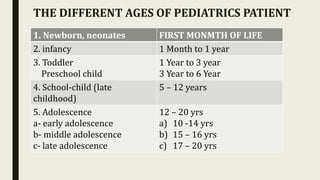
THE DIFFERENT AGES OF PEDIATRICS PATIENT
1. Newborn, neonates FIRST MONMTH OF LIFE
2. infancy 1 Month to 1 year
3. Toddler
Preschool child
1 Year to 3 year
3 Year to 6 Year
4. School-child (late
childhood)
5 – 12 years
5. Adolescence
a- early adolescence
b- middle adolescence
c- late adolescence
12 – 20 yrs
a) 10 -14 yrs
b) 15 – 16 yrs
c) 17 – 20 yrs
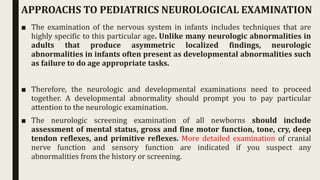
■ The examination of the nervous system in infants includes techniques that are
highly specific to this particular age. Unlike many neurologic abnormalities in
adults that produce asymmetric localized findings, neurologic
abnormalities in infants often present as developmental abnormalities such
as failure to do age appropriate tasks.
■ Therefore, the neurologic and developmental examinations need to proceed
together. A developmental abnormality should prompt you to pay particular
attention to the neurologic examination.
■ The neurologic screening examination of all newborns should include
assessment of mental status, gross and fine motor function, tone, cry, deep
tendon reflexes, and primitive reflexes. More detailed examination of cranial
nerve function and sensory function are indicated if you suspect any
abnormalities from the history or screening.
APPROACHS TO PEDIATRICS NEUROLOGICAL EXAMINATION
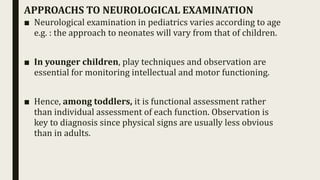
APPROACHS TO NEUROLOGICAL EXAMINATION
■ Neurological examination in pediatrics varies according to age
e.g. : the approach to neonates will vary from that of children.
■ In younger children, play techniques and observation are
essential for monitoring intellectual and motor functioning.
■ Hence, among toddlers, it is functional assessment rather
than individual assessment of each function. Observation is
key to diagnosis since physical signs are usually less obvious
than in adults.
■ The toddler is more difficult to examine. The toddler is best
approached by seating the child in the mother's or father's lap and
talking to the child.
■ Because toddlers are fearful of strangers, the physician must first
observe the child and defer touching him or her until some degree of
rapport has been established.
■ Offering a small, interesting toy may bridge the gap.
■ Once frightened, most toddlers are difficult to reassure and are lost for
the remainder of the examination.
APPROACHS TO NEUROLOGICAL EXAMINATION
General Outline(Subsets) of neurological examination
■ Mental status (appearance, behavior, communication, delusion/hallucination
and emotions) and higher mental function (consciousness, orientation, memory,
attention span, spatial perception, insight, abstract thinking, fund of information,
calculation, released reflexes)
■ Cranial nerve examination (I-XII)
■ Motor system examination (gait/posture, bulk, tone, muscle power, deep
tendon reflexes, superficial reflexes, abnormal movement)
■ Sensory system examination ( pain, temperature, fine touch, vibration, joint
position), cortical sensation (two-point discrimination, tactile localization)
■ Cerebellar system examination
■ Meningeal signs (neck rigidity, Kernig sign, Brudzinski sign)
APPROACHS TO NEUROLOGICAL EXAMINATION
Principles of Neurologic Examination of the Child
■ Use items such as a tennis ball, small toys (including a toy car), bell
■ Do not wear a white coat.
■ Postpone uncomfortable tasks until the end, such as head
circumference, fundoscopy, corneal and gag reflexes and sensory
testing.
■ Make the most of every opportunity to examine the child.
■ Examine the younger child in the parent's lap.
■ Always listen to the mother. It is okay to assess the child as sicker
than the mother feels.
The neurologic examination of an infant younger than 1 year of
age can be divided into three parts:
1. Evaluation of posture and tone
2.Evaluation of primitive reflexes
3. Age invariable tests.
Neurologic Examination of the Infant
1. Evaluation of posture and tone
Evaluation of posture and muscle tone is a
fundamental part of the neurologic examination of
infants. It involves examination of :
A. Resting Posture
B. Passive Tone
C. Active Tone
Neurologic Examination of the Infant
1.Evaluation of posture and tone:
A. Resting Posture: Posture is appreciated by inspecting the
undressed.
• During the first few months of life, normal hypertonia of the flexors of
the elbows, hips, and knees occurs.
• The hypertonia decreases markedly during the third month of life,
first in the upper extremities and later in the lower extremities.
Neurologic Examination of the Infant
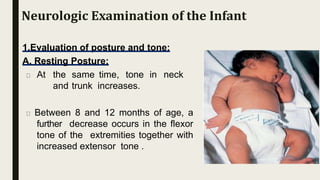
1.Evaluation of posture and tone:
A. Resting Posture:
At the same time, tone in neck
and trunk increases.
Between 8 and 12 months of age, a
further decrease occurs in the flexor
tone of the extremities together with
increased extensor tone .
Neurologic Examination of the Infant
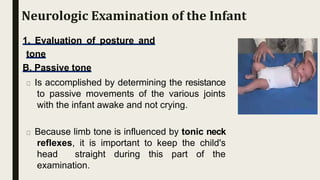
1. Evaluation of posture and
tone
B. Passive tone
Is accomplished by determining the resistance
to passive movements of the various joints
with the infant awake and not crying.
Because limb tone is influenced by tonic neck
reflexes, it is important to keep the child's
head straight during this part of the
examination.
Neurologic Examination of the Infant
1. Evaluation of posture and
tone
B. Passive tone
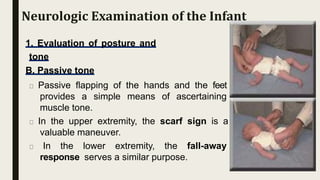
Passive flapping of the hands and the feet
provides a simple means of ascertaining
muscle tone.
In the upper extremity, the scarf sign is a
valuable maneuver.
In the lower extremity, the fall-away
response serves a similar purpose.
Neurologic Examination of the Infant
1. Evaluation of posture and tone:
C. Active tone:
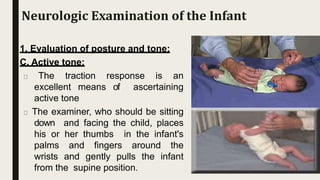
The traction response is an
excellent means of ascertaining
active tone
The examiner, who should be sitting
down and facing the child, places
his or her thumbs in the infant's
palms and fingers around the
wrists and gently pulls the infant
from the supine position.
Neurologic Examination of the Infant
1. Evaluation of posture and tone:
C. Active tone:
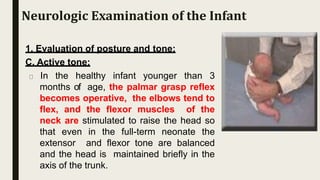
In the healthy infant younger than 3
months of age, the palmar grasp reflex
becomes operative, the elbows tend to
flex, and the flexor muscles of the
neck are stimulated to raise the head so
that even in the full-term neonate the
extensor and flexor tone are balanced
and the head is maintained briefly in the
axis of the trunk.
Neurologic Examination of the Infant
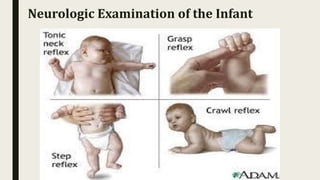
2. Evaluation of primitive reflexes:
-The evaluation of primitive reflexes is an integral part of
the neurologic examination of the infant.
-This disappearance should not be construed as
meaning that they are actually lost, for a reflex once
acquired in the course of development is retained
permanently.
- Rather, these reflexes, which develop during
intrauterine life, are gradually suppressed as the higher
cortical centers become functional.
Neurologic Examination of the Infant
2.Evaluation of primitive reflexes:
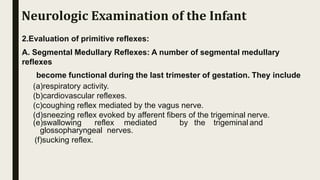
A. Segmental Medullary Reflexes: A number of segmental medullary
reflexes
become functional during the last trimester of gestation. They include
(a)respiratory activity.
(b)cardiovascular reflexes.
(c)coughing reflex mediated by the vagus nerve.
(d)sneezing reflex evoked by afferent fibers of the trigeminal nerve.
(e)swallowing reflex mediated by the trigeminal and
glossopharyngeal nerves.
(f)sucking reflex.
Neurologic Examination of the Infant
2. Evaluation of primitive reflexes:
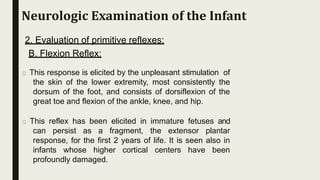
B. Flexion Reflex:
This response is elicited by the unpleasant stimulation of
the skin of the lower extremity, most consistently the
dorsum of the foot, and consists of dorsiflexion of the
great toe and flexion of the ankle, knee, and hip.
This reflex has been elicited in immature fetuses and
can persist as a fragment, the extensor plantar
response, for the first 2 years of life. It is seen also in
infants whose higher cortical centers have been
profoundly damaged.
Neurologic Examination of the Infant
2. Evaluation of primitive reflexes: C. Moro
Reflex
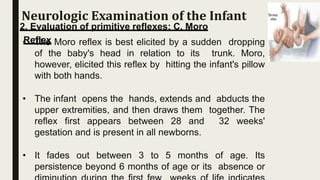
• The Moro reflex is best elicited by a sudden dropping
of the baby's head in relation to its trunk. Moro,
however, elicited this reflex by hitting the infant's pillow
with both hands.
• The infant opens the hands, extends and abducts the
upper extremities, and then draws them together. The
reflex first appears between 28 and 32 weeks'
gestation and is present in all newborns.
• It fades out between 3 to 5 months of age. Its
persistence beyond 6 months of age or its absence or
Neurologic Examination of the Infant
2. Evaluation of primitive reflexes: D. Tonic Neck
Response
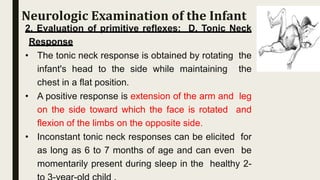
• The tonic neck response is obtained by rotating the
infant's head to the side while maintaining the
chest in a flat position.
• A positive response is extension of the arm and leg
on the side toward which the face is rotated and
flexion of the limbs on the opposite side.
• Inconstant tonic neck responses can be elicited for
as long as 6 to 7 months of age and can even be
momentarily present during sleep in the healthy 2-
Neurologic Examination of the Infant
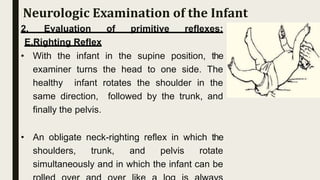
2. Evaluation of primitive reflexes:
E.Righting Reflex
• With the infant in the supine position, the
examiner turns the head to one side. The
healthy infant rotates the shoulder in the
same direction, followed by the trunk, and
finally the pelvis.
• An obligate neck-righting reflex in which the
shoulders, trunk, and pelvis rotate
simultaneously and in which the infant can be
Neurologic Examination of the Infant
2. Evaluation of primitive reflexes: F. Palmar and Plantar Grasp
Reflexes
• The palmar and plantar grasp reflexes are elicited
by pressure on the palm or sole.
• Generally, the plantar graspreflexis weaker
than the palmar reflex.
• The palmar grasp reflex appears at 28 weeks'
gestation, is well established by 32 weeks, and
becomes weak and inconsistent between 2 and 3
months of age, when it is covered up by voluntary
activity.
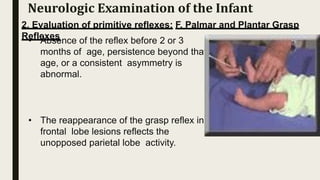
Neurologic Examination of the Infant
2. Evaluation of primitive reflexes: F. Palmar and Plantar Grasp
Reflexes
• Absence of the reflex before 2 or 3
months of age, persistence beyond that
age, or a consistent asymmetry is
abnormal.
• The reappearance of the grasp reflex in
frontal lobe lesions reflects the
unopposed parietal lobe activity.
Neurologic Examination of the Infant
2. Evaluation of primitive reflexes:
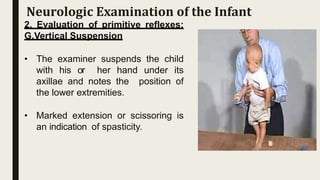
G.Vertical Suspension
• The examiner suspends the child
with his or her hand under its
axillae and notes the position of
the lower extremities.
• Marked extension or scissoring is
an indication of spasticity.
Neurologic Examination of the Infant
2. Evaluation of primitive reflexes:
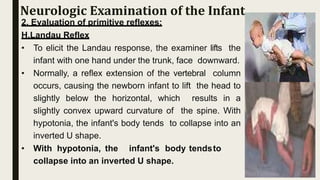
H.Landau Reflex
• To elicit the Landau response, the examiner lifts the
infant with one hand under the trunk, face downward.
• Normally, a reflex extension of the vertebral column
occurs, causing the newborn infant to lift the head to
slightly below the horizontal, which results in a
slightly convex upward curvature of the spine. With
hypotonia, the infant's body tends to collapse into an
inverted U shape.
• With hypotonia, the infant's body tendsto
collapse into an inverted U shape.
Neurologic Examination of the Infant
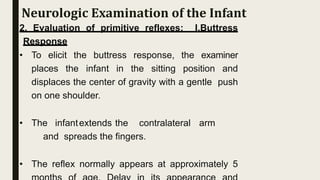
2. Evaluation of primitive reflexes: I.Buttress
Response
• To elicit the buttress response, the examiner
places the infant in the sitting position and
displaces the center of gravity with a gentle push
on one shoulder.
• The infantextends the contralateral arm
and spreads the fingers.
• The reflex normally appears at approximately 5
Neurologic Examination of the Infant
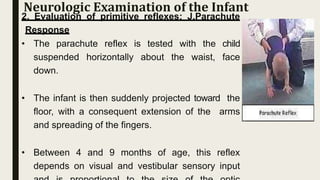
2. Evaluation of primitive reflexes: J.Parachute
Response
• The parachute reflex is tested with the child
suspended horizontally about the waist, face
down.
• The infant is then suddenly projected toward the
floor, with a consequent extension of the arms
and spreading of the fingers.
• Between 4 and 9 months of age, this reflex
depends on visual and vestibular sensory input
Neurologic Examination of the Infant
2. Evaluation of primitive reflexes: K.Reflex
Placing and Stepping Responses
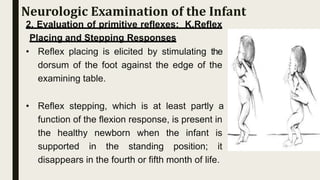
• Reflex placing is elicited by stimulating the
dorsum of the foot against the edge of the
examining table.
• Reflex stepping, which is at least partly a
function of the flexion response, is present in
the healthy newborn when the infant is
supported in the standing position; it
disappears in the fourth or fifth month of life.
Neurologic Examination of the Infant
2. Evaluation of primitive reflexes: L.Reflex Suck,
Root
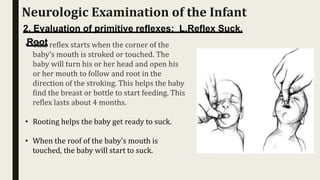
• This reflex starts when the corner of the
baby's mouth is stroked or touched. The
baby will turn his or her head and open his
or her mouth to follow and root in the
direction of the stroking. This helps the baby
find the breast or bottle to start feeding. This
reflex lasts about 4 months.
• Rooting helps the baby get ready to suck.
• When the roof of the baby's mouth is
touched, the baby will start to suck.
Neurologic Examination of the Infant
3.Age-Invariable
Tests
The last part of the neurologic examination involves tests
similar to those performed in older children or adults, such
as the funduscopic examination and the deep tendon
reflexes.
Neurologic Examination of the Infant
Neurologic Examination of the Child
■ The following can be useful in addition to the standard instruments
used:
– Tennis ball
– Few small toys (including a toy car)
– Bell
– Some object that attracts the child’s attention
(e.g., pinwheel)
■ Most pediatric neurologists do not wear white coats
■ In most intellectually healthy school-aged children, the general
physical and neurologic examinations can be performed in the
same manner as for adults.
Neurologic Examination of the Child
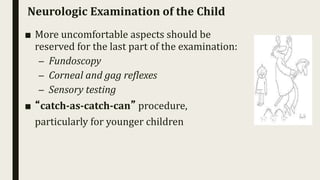
■ More uncomfortable aspects should be
reserved for the last part of the examination:
– Fundoscopy
– Corneal and gag reflexes
– Sensory testing
■ “catch-as-catch-can” procedure,
particularly for younger children
Neurologic Examination of the Child
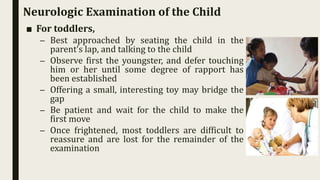
■ For toddlers,
– Best approached by seating the child in the
parent’s lap, and talking to the child
– Observe first the youngster, and defer touching
him or her until some degree of rapport has
been established
– Offering a small, interesting toy may bridge the
gap
– Be patient and wait for the child to make the
first move
– Once frightened, most toddlers are difficult to
reassure and are lost for the remainder of the
examination
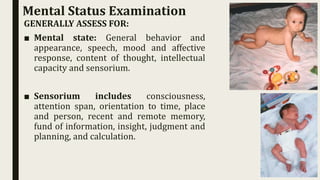
Mental Status Examination
GENERALLY ASSESS FOR:
■ Mental state: General behavior and
appearance, speech, mood and affective
response, content of thought, intellectual
capacity and sensorium.
■ Sensorium includes consciousness,
attention span, orientation to time, place
and person, recent and remote memory,
fund of information, insight, judgment and
planning, and calculation.
■ Observe the behavior, degree of awareness and alertness, eye contact,
ability to maintain attention/ concentration, ability to recall
immediate, recent and remote events, abstract reasoning.
■ Assess knowledge of general information (learned from school),
reading, spelling and arithmetic (based on the scholastic level or
chronologic age), personality and other emotional factors.
States of decreased consciousness
A. Lethargy: Difficulty to maintain the aroused state
B. Obtundation: Responsive to stimulation other than pain
C. Stupor: Responsive to pain
D. Coma:Unresponsive to pain
Mental Status Examination
Speech:
Listen to produced speech. Check articulation and comprehension. Ask
patient to repeat and name objects. Check for age appropriate receptive
and expressive language milestones, if there is dysphonia, dysarthria or
dysphasias.
■ Dysphonia- Disturbance in or lack of the production of sounds in the
larynx
■ Dysarthria- Disorder in articulating speech sounds
■ Dysphasia- Disturbance in understanding or expression of words as
symbols for communication
Mental Status Examination
Cranial Nerves Examinations
Olfactory Nerve (CN I)
■ Test for olfaction.
■ RARELY ASSESSED in child
■ With eyes closed, test each nostril separately occluding the
other side. Present coffee, chocolate or vanilla. Normal
young children may not identify the smell. Recognizing a
change of odor is sufficient.
■ Avoid noxious stimuli (e.g., ammonia, vinegar) as these
stimulate the trigeminal nerve
Anosmia - Inability to appreciate odor-(Seen in upper
respiratory infections, neoplasm, head trauma often
occipital)
Parosmia - Altered sense of smell
Optic Nerve (CN II)
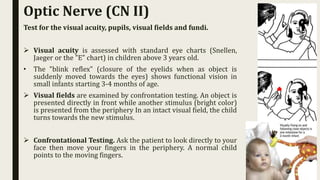
Test for the visual acuity, pupils, visual fields and fundi.
 Visual acuity is assessed with standard eye charts (Snellen,
Jaeger or the "E" chart) in children above 3 years old.
• The "blink reflex" (closure of the eyelids when as object is
suddenly moved towards the eyes) shows functional vision in
small infants starting 3-4 months of age.
 Visual fields are examined by confrontation testing. An object is
presented directly in front while another stimulus (bright color)
is presented from the periphery In an intact visual field, the child
turns towards the new stimulus.
 Confrontational Testing. Ask the patient to look directly to your
face then move your fingers in the periphery. A normal child
points to the moving fingers.
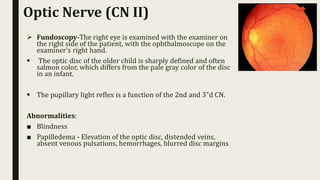
 Fundoscopy-The right eye is examined with the examiner on
the right side of the patient, with the ophthalmoscope on the
examiner's right hand.
 The optic disc of the older child is sharply defined and often
salmon color, which differs from the pale gray color of the disc
in an infant.
 The pupillary light reflex is a function of the 2nd and 3"d CN.
Abnormalities:
■ Blindness
■ Papilledema - Elevation of the optic disc, distended veins,
absent venous pulsations, hemorrhages, blurred disc margins
Optic Nerve (CN II)
Occulomotor, Trochlear and Abducens Nerve(CN III,
IV, VI)
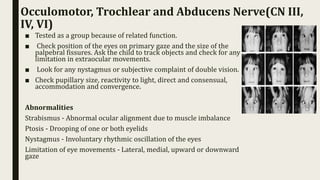
■ Tested as a group because of related function.
■ Check position of the eyes on primary gaze and the size of the
palpebral fissures. Ask the child to track objects and check for any
limitation in extraocular movements.
■ Look for any nystagmus or subjective complaint of double vision.
■ Check pupillary size, reactivity to light, direct and consensual,
accommodation and convergence.
Abnormalities
Strabismus - Abnormal ocular alignment due to muscle imbalance
Ptosis - Drooping of one or both eyelids
Nystagmus - Involuntary rhythmic oscillation of the eyes
Limitation of eye movements - Lateral, medial, upward or downward
gaze
Trigeminal Nerve (CNV)
Test for facial sensation and muscles of mastication.
■ Test for light touch, temperature (warm and cold), pain (pin prick), and the
corneal reflex. The corneal reflex is a function of the 5th (afferent) and 7th
(efferent) nerves.
■ Test sensation using cotton or touch areas from the vertex of the head to the
face and mandible (ophthalmic, maxillary and mandibular divisions).
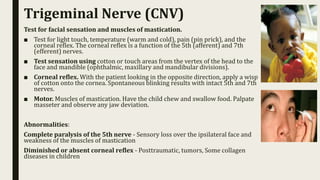
■ Corneal reflex. With the patient looking in the opposite direction, apply a wisp
of cotton onto the cornea. Spontaneous blinking results with intact 5th and 7th
nerves.
■ Motor. Muscles of mastication. Have the child chew and swallow food. Palpate
masseter and observe any jaw deviation.
Abnormalities:
Complete paralysis of the 5th nerve - Sensory loss over the ipsilateral face and
weakness of the muscles of mastication
Diminished or absent corneal reflex - Posttraumatic, tumors, Some collagen
diseases in children
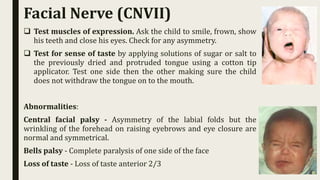
Facial Nerve (CNVII)
 Test muscles of expression. Ask the child to smile, frown, show
his teeth and close his eyes. Check for any asymmetry.
 Test for sense of taste by applying solutions of sugar or salt to
the previously dried and protruded tongue using a cotton tip
applicator. Test one side then the other making sure the child
does not withdraw the tongue on to the mouth.
Abnormalities:
Central facial palsy - Asymmetry of the labial folds but the
wrinkling of the forehead on raising eyebrows and eye closure are
normal and symmetrical.
Bells palsy - Complete paralysis of one side of the face
Loss of taste - Loss of taste anterior 2/3
Vestibulocochlear Nerve (CNVIII)
■ It subserves hearing and vestibular functions.
■ Hearing can be tested in the younger child by observing the
child's response to a bell, ticking of watch or rustling of fingers.
Older children may be asked to repeat whispered word or
number.
■ Weber Test - A vibrating tuning fork is placed on the vertex of
the patients head or over the forehead. A normal child
appreciates sound at the middleorequally on both sides.
■ Rinne Test -Differentiates conductive hearing loss from
sensorineural loss. Place the vibrating fork behind the ear over
the mastoid bone and just after the sound disappears, hold it
beside the ear over the external auditory canal. Normally, air
conduction is more efficient than bone conduction.
■ Caloric testing can be used for gross assessment of the vestibular function. Complaints of nausea,
ataxia, vertigo or unexplained vomiting, singly or in combination, may indicate labyrinthine and
vestibular pathologic origins
■ While the patient is in the supine position, the head is flexed at 30 degrees. Ice water (10ml) is
injected over 30 sec onto one external auditory canal at a time.
 The conscious patient develops coarse nystagmus toward the ipsilateral ear, no eye deviation
occurs.
 If the patient has some degree of obtundation, the eyes become tonically deviated ipsilaterally,
with nystagmus occurring contralaterally.
 If the patient is comatose, cold water stimulation usually causes tonic deviation ipsilaterally and
no nystagmus.
 If the coma is profound or the patient is brain dead, no eye changes occur.
Abnormalities:
Conductive hearing loss
Sensorineural hearing loss
Vestibulocochlear Nerve (CNVIII)
Glossopharyngeal and Vagus Nerves. (CN IX and X)
■ Test for palatal movements, uvular position and movement, gag reflex,
phonation, sucking and swallowing.
■ Have the child say "ahh" or stick the tongue out then observe symmetry in
movement of the uvula and soft palate.
■ Test for Gag reflex . Touch the back of the pharynx with a tongue depressor and
watch the elevation of the palate.
Abnormalities:
■ Loss of taste in then posterior 3rdof the tongue - In CN IX lesions
■ Loss or decreased gag reflex - In CN IX and X lesions
■ Deviation of the uvula to the normal side - In unilateral CN IX and X lesions
■ Hoarseness - In CN X impairment
Spinal Accessory Nerve (CN XI)
■ Test the function of the trapezius and
sternocleidomastoideocles.
■ Make the patient turn his head against resistance and
shrug shoulders while you apply resistance. Palpate for
symmetry of the muscle bulk, tone and contraction of the
muscles during the head turning and shoulder elevation.
Abnormalities:
1. Asymmetry in shoulder movement
2. Asymmetry in bulk (atrophy), and contraction of the
sternocleidomastoideocles
Hypoglossal Nerve (CNXII)
■ Test the tongue muscle.
■ Check the position of the tongue at rest
with the mouth open and during
protrusion.
Abnormalities:
Atrophy unilateral or bilateral
Grooving and fasciculations of the tongue
Deviation of the tongue to the side of paralysis
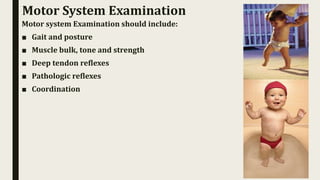
Motor System Examination
Motor system Examination should include:
■ Gait and posture
■ Muscle bulk, tone and strength
■ Deep tendon reflexes
■ Pathologic reflexes
■ Coordination
■ Observe gait and posture. Ask the child to walk normally, on toes, on heels
and do the tandem gait or walking along a straight line. Note any asymmetry,
weakness, clumsiness, undue tripping, abnormal involuntary movements.
■ Palpate and observe muscle bulk and presence of fasciculations
■ Check active and passive tone by passively flexing the extremities at major
joints and determining resistance and asymmetry.
■ Check for Gowers sign. Observe the child while arising from the floor to a
standing position. The child with Gowers sign would stand by pushing the
floor with all extremities then holding onto his thigh and pushing up to erect
position.
■ Look for any involuntary movements.
■ Assess muscle strength by noting any asymmetry and doing formal testing
of power for children who can follow instructions.
Motor System Examination
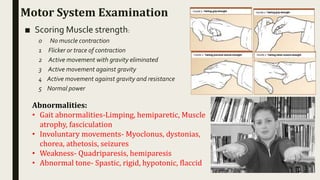
■ Scoring Muscle strength:
0 No muscle contraction
1 Flicker or trace of contraction
2 Active movement with gravity eliminated
3 Active movement against gravity
4 Active movement against gravity and resistance
5 Normal power
Abnormalities:
• Gait abnormalities-Limping, hemiparetic, Muscle
atrophy, fasciculation
• Involuntary movements- Myoclonus, dystonias,
chorea, athetosis, seizures
• Weakness- Quadriparesis, hemiparesis
• Abnormal tone- Spastic, rigid, hypotonic, flaccid
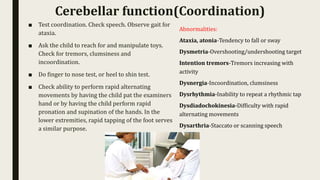
■ Test coordination. Check speech. Observe gait for
ataxia.
■ Ask the child to reach for and manipulate toys.
Check for tremors, clumsiness and
incoordination.
■ Do finger to nose test, or heel to shin test.
■ Check ability to perform rapid alternating
movements by having the child pat the examiners
hand or by having the child perform rapid
pronation and supination of the hands. In the
lower extremities, rapid tapping of the foot serves
a similar purpose.
Cerebellar function(Coordination)
Abnormalities:
Ataxia, atonia-Tendency to fall or sway
Dysmetria-Overshooting/undershooting target
Intention tremors-Tremors increasing with
activity
Dysnergia-Incoordination, clumsiness
Dysrhythmia-Inability to repeat a rhythmic tap
Dysdiadochokinesia-Difficulty with rapid
alternating movements
Dysarthria-Staccato or scanning speech
Sensory Examination
■ Difficult to do at any age
■ Almost impossible to do in an infant or toddler
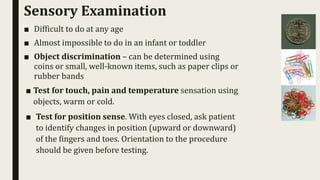
■ Object discrimination – can be determined using
coins or small, well-known items, such as paper clips or
rubber bands
■ Test for touch, pain and temperature sensation using
objects, warm or cold.
■ Test for position sense. With eyes closed, ask patient
to identify changes in position (upward or downward)
of the fingers and toes. Orientation to the procedure
should be given before testing.
■ Test for vibration sense by placing a vibrating tuning fork on the
joints.
■ Test for Romberg sign. With the eyes closed to remove visual clues to
spatial orientation and balance, have the child stand with both feet
together and both arms extended to sides. Observe balance or swaying.
■ Test for stereognosis, two-point discrimination, weight and size
discrimination, graphesthesia (finger-writing perception on palm)
which are finer sensations.
Abnormalities:
Astereognosis-Cannot recognize objects through touch
Agraphesthesia-Unable to recognize letters written on palms
Sensory Examination
REFLEXES
Test for deep tendon (DTR) Reflexes, Which test for ankle, knee,
brachioradialis, biceps, triceps, pectoralis reflexes.
A. Biceps jerk
 Ensure patient's arm is relaxed and slightly flexed. Palpate the
biceps tendon with the thumb and strike with examining
hammer. Look for elbow flexion and biceps contraction.
B. Brachioradialis(Supinator jerk)
– Strike the lower end of the radius with the hammer. Observe
elbow and finger flexion.
C. Triceps Jerk
– Strike the patient's elbow a few inches above the olecranon
process. Look for elbow extension and triceps contraction.
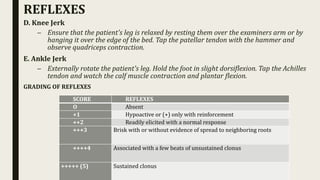
D. Knee Jerk
– Ensure that the patient's leg is relaxed by resting them over the examiners arm or by
hanging it over the edge of the bed. Tap the patellar tendon with the hammer and
observe quadriceps contraction.
E. Ankle Jerk
– Externally rotate the patient's leg. Hold the foot in slight dorsiflexion. Tap the Achilles
tendon and watch the calf muscle contraction and plantar flexion.
GRADING OF REFLEXES
REFLEXES
SCORE REFLEXES
O Absent
+1 Hypoactive or (+) only with reinforcement
++2 Readily elicited with a normal response
+++3 Brisk with or without evidence of spread to neighboring roots
++++4 Associated with a few beats of unsustained clonus
+++++ (5) Sustained clonus
Superficial reflexes:
Segmental reflex responses that indicate integrity of cutaneous innervations and the
corresponding motor outflow and include corneal, conjunctival, abdominal,
cremasteric, anal wink, plantar reflexes.
A. Abdominal reflexes can be elicited by drawing a line away from the umbilicus
along the diagnonals of the 4 quadrants of the abdomen. Normally, the umbilicus
is drawn toward the direction of the line that is drawn
B. Cremasteric reflex : Draw a line along the medial thigh and watch the
movement of the scrotum in males. Normally, elevation in the ipsilateral testes.
C. Plantar reflex : Stroking the lateral aspect of the sole of the foot normally
results in plantar flexion. Babinski reflex is dorsiflexion of the big toe with or
without fanning of the other toes. This may be normal till 2.5 years old
otherwise, it is seen in upper motor neuron lesions.
REFLEXES
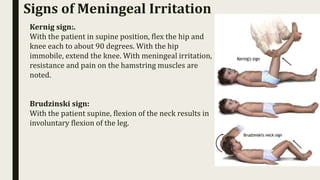
Signs of Meningeal Irritation
Kernig sign:.
With the patient in supine position, flex the hip and
knee each to about 90 degrees. With the hip
immobile, extend the knee. With meningeal irritation,
resistance and pain on the hamstring muscles are
noted.
Brudzinski sign:
With the patient supine, flexion of the neck results in
involuntary flexion of the leg.
Pediatrics Neurological Examination.pptx

Pediatrics Neurological Examination.pptx

  • 1.
    GCGMH DEPARTMENT OF PEDIATRICS PEDIATRICSNEUROLOGICAL EXAMINATION MANDAL, AJAY KUMAR 4th Year Medical Student Gullas college of Medicine
  • 2.
    THE DIFFERENT AGESOF PEDIATRICS PATIENT 1. Newborn, neonates FIRST MONMTH OF LIFE 2. infancy 1 Month to 1 year 3. Toddler Preschool child 1 Year to 3 year 3 Year to 6 Year 4. School-child (late childhood) 5 – 12 years 5. Adolescence a- early adolescence b- middle adolescence c- late adolescence 12 – 20 yrs a) 10 -14 yrs b) 15 – 16 yrs c) 17 – 20 yrs
  • 3.
    ■ The examinationof the nervous system in infants includes techniques that are highly specific to this particular age. Unlike many neurologic abnormalities in adults that produce asymmetric localized findings, neurologic abnormalities in infants often present as developmental abnormalities such as failure to do age appropriate tasks. ■ Therefore, the neurologic and developmental examinations need to proceed together. A developmental abnormality should prompt you to pay particular attention to the neurologic examination. ■ The neurologic screening examination of all newborns should include assessment of mental status, gross and fine motor function, tone, cry, deep tendon reflexes, and primitive reflexes. More detailed examination of cranial nerve function and sensory function are indicated if you suspect any abnormalities from the history or screening. APPROACHS TO PEDIATRICS NEUROLOGICAL EXAMINATION
  • 4.
    APPROACHS TO NEUROLOGICALEXAMINATION ■ Neurological examination in pediatrics varies according to age e.g. : the approach to neonates will vary from that of children. ■ In younger children, play techniques and observation are essential for monitoring intellectual and motor functioning. ■ Hence, among toddlers, it is functional assessment rather than individual assessment of each function. Observation is key to diagnosis since physical signs are usually less obvious than in adults.
  • 5.
    ■ The toddleris more difficult to examine. The toddler is best approached by seating the child in the mother's or father's lap and talking to the child. ■ Because toddlers are fearful of strangers, the physician must first observe the child and defer touching him or her until some degree of rapport has been established. ■ Offering a small, interesting toy may bridge the gap. ■ Once frightened, most toddlers are difficult to reassure and are lost for the remainder of the examination. APPROACHS TO NEUROLOGICAL EXAMINATION
  • 6.
    General Outline(Subsets) ofneurological examination ■ Mental status (appearance, behavior, communication, delusion/hallucination and emotions) and higher mental function (consciousness, orientation, memory, attention span, spatial perception, insight, abstract thinking, fund of information, calculation, released reflexes) ■ Cranial nerve examination (I-XII) ■ Motor system examination (gait/posture, bulk, tone, muscle power, deep tendon reflexes, superficial reflexes, abnormal movement) ■ Sensory system examination ( pain, temperature, fine touch, vibration, joint position), cortical sensation (two-point discrimination, tactile localization) ■ Cerebellar system examination ■ Meningeal signs (neck rigidity, Kernig sign, Brudzinski sign) APPROACHS TO NEUROLOGICAL EXAMINATION
  • 7.
    Principles of NeurologicExamination of the Child ■ Use items such as a tennis ball, small toys (including a toy car), bell ■ Do not wear a white coat. ■ Postpone uncomfortable tasks until the end, such as head circumference, fundoscopy, corneal and gag reflexes and sensory testing. ■ Make the most of every opportunity to examine the child. ■ Examine the younger child in the parent's lap. ■ Always listen to the mother. It is okay to assess the child as sicker than the mother feels.
  • 8.
    The neurologic examinationof an infant younger than 1 year of age can be divided into three parts: 1. Evaluation of posture and tone 2.Evaluation of primitive reflexes 3. Age invariable tests. Neurologic Examination of the Infant
  • 9.
    1. Evaluation ofposture and tone Evaluation of posture and muscle tone is a fundamental part of the neurologic examination of infants. It involves examination of : A. Resting Posture B. Passive Tone C. Active Tone Neurologic Examination of the Infant
  • 10.
    1.Evaluation of postureand tone: A. Resting Posture: Posture is appreciated by inspecting the undressed. • During the first few months of life, normal hypertonia of the flexors of the elbows, hips, and knees occurs. • The hypertonia decreases markedly during the third month of life, first in the upper extremities and later in the lower extremities. Neurologic Examination of the Infant
  • 11.
    1.Evaluation of postureand tone: A. Resting Posture: At the same time, tone in neck and trunk increases. Between 8 and 12 months of age, a further decrease occurs in the flexor tone of the extremities together with increased extensor tone . Neurologic Examination of the Infant
  • 12.
    1. Evaluation ofposture and tone B. Passive tone Is accomplished by determining the resistance to passive movements of the various joints with the infant awake and not crying. Because limb tone is influenced by tonic neck reflexes, it is important to keep the child's head straight during this part of the examination. Neurologic Examination of the Infant
  • 13.
    1. Evaluation ofposture and tone B. Passive tone Passive flapping of the hands and the feet provides a simple means of ascertaining muscle tone. In the upper extremity, the scarf sign is a valuable maneuver. In the lower extremity, the fall-away response serves a similar purpose. Neurologic Examination of the Infant
  • 14.
    1. Evaluation ofposture and tone: C. Active tone: The traction response is an excellent means of ascertaining active tone The examiner, who should be sitting down and facing the child, places his or her thumbs in the infant's palms and fingers around the wrists and gently pulls the infant from the supine position. Neurologic Examination of the Infant
  • 15.
    1. Evaluation ofposture and tone: C. Active tone: In the healthy infant younger than 3 months of age, the palmar grasp reflex becomes operative, the elbows tend to flex, and the flexor muscles of the neck are stimulated to raise the head so that even in the full-term neonate the extensor and flexor tone are balanced and the head is maintained briefly in the axis of the trunk. Neurologic Examination of the Infant
  • 16.
    2. Evaluation ofprimitive reflexes: -The evaluation of primitive reflexes is an integral part of the neurologic examination of the infant. -This disappearance should not be construed as meaning that they are actually lost, for a reflex once acquired in the course of development is retained permanently. - Rather, these reflexes, which develop during intrauterine life, are gradually suppressed as the higher cortical centers become functional. Neurologic Examination of the Infant
  • 17.
    2.Evaluation of primitivereflexes: A. Segmental Medullary Reflexes: A number of segmental medullary reflexes become functional during the last trimester of gestation. They include (a)respiratory activity. (b)cardiovascular reflexes. (c)coughing reflex mediated by the vagus nerve. (d)sneezing reflex evoked by afferent fibers of the trigeminal nerve. (e)swallowing reflex mediated by the trigeminal and glossopharyngeal nerves. (f)sucking reflex. Neurologic Examination of the Infant
  • 18.
    2. Evaluation ofprimitive reflexes: B. Flexion Reflex: This response is elicited by the unpleasant stimulation of the skin of the lower extremity, most consistently the dorsum of the foot, and consists of dorsiflexion of the great toe and flexion of the ankle, knee, and hip. This reflex has been elicited in immature fetuses and can persist as a fragment, the extensor plantar response, for the first 2 years of life. It is seen also in infants whose higher cortical centers have been profoundly damaged. Neurologic Examination of the Infant
  • 19.
    2. Evaluation ofprimitive reflexes: C. Moro Reflex • The Moro reflex is best elicited by a sudden dropping of the baby's head in relation to its trunk. Moro, however, elicited this reflex by hitting the infant's pillow with both hands. • The infant opens the hands, extends and abducts the upper extremities, and then draws them together. The reflex first appears between 28 and 32 weeks' gestation and is present in all newborns. • It fades out between 3 to 5 months of age. Its persistence beyond 6 months of age or its absence or Neurologic Examination of the Infant
  • 20.
    2. Evaluation ofprimitive reflexes: D. Tonic Neck Response • The tonic neck response is obtained by rotating the infant's head to the side while maintaining the chest in a flat position. • A positive response is extension of the arm and leg on the side toward which the face is rotated and flexion of the limbs on the opposite side. • Inconstant tonic neck responses can be elicited for as long as 6 to 7 months of age and can even be momentarily present during sleep in the healthy 2- Neurologic Examination of the Infant
  • 21.
  • 22.
    2. Evaluation ofprimitive reflexes: E.Righting Reflex • With the infant in the supine position, the examiner turns the head to one side. The healthy infant rotates the shoulder in the same direction, followed by the trunk, and finally the pelvis. • An obligate neck-righting reflex in which the shoulders, trunk, and pelvis rotate simultaneously and in which the infant can be Neurologic Examination of the Infant
  • 23.
    2. Evaluation ofprimitive reflexes: F. Palmar and Plantar Grasp Reflexes • The palmar and plantar grasp reflexes are elicited by pressure on the palm or sole. • Generally, the plantar graspreflexis weaker than the palmar reflex. • The palmar grasp reflex appears at 28 weeks' gestation, is well established by 32 weeks, and becomes weak and inconsistent between 2 and 3 months of age, when it is covered up by voluntary activity. Neurologic Examination of the Infant
  • 24.
    2. Evaluation ofprimitive reflexes: F. Palmar and Plantar Grasp Reflexes • Absence of the reflex before 2 or 3 months of age, persistence beyond that age, or a consistent asymmetry is abnormal. • The reappearance of the grasp reflex in frontal lobe lesions reflects the unopposed parietal lobe activity. Neurologic Examination of the Infant
  • 25.
    2. Evaluation ofprimitive reflexes: G.Vertical Suspension • The examiner suspends the child with his or her hand under its axillae and notes the position of the lower extremities. • Marked extension or scissoring is an indication of spasticity. Neurologic Examination of the Infant
  • 26.
    2. Evaluation ofprimitive reflexes: H.Landau Reflex • To elicit the Landau response, the examiner lifts the infant with one hand under the trunk, face downward. • Normally, a reflex extension of the vertebral column occurs, causing the newborn infant to lift the head to slightly below the horizontal, which results in a slightly convex upward curvature of the spine. With hypotonia, the infant's body tends to collapse into an inverted U shape. • With hypotonia, the infant's body tendsto collapse into an inverted U shape. Neurologic Examination of the Infant
  • 27.
    2. Evaluation ofprimitive reflexes: I.Buttress Response • To elicit the buttress response, the examiner places the infant in the sitting position and displaces the center of gravity with a gentle push on one shoulder. • The infantextends the contralateral arm and spreads the fingers. • The reflex normally appears at approximately 5 Neurologic Examination of the Infant
  • 28.
    2. Evaluation ofprimitive reflexes: J.Parachute Response • The parachute reflex is tested with the child suspended horizontally about the waist, face down. • The infant is then suddenly projected toward the floor, with a consequent extension of the arms and spreading of the fingers. • Between 4 and 9 months of age, this reflex depends on visual and vestibular sensory input Neurologic Examination of the Infant
  • 29.
    2. Evaluation ofprimitive reflexes: K.Reflex Placing and Stepping Responses • Reflex placing is elicited by stimulating the dorsum of the foot against the edge of the examining table. • Reflex stepping, which is at least partly a function of the flexion response, is present in the healthy newborn when the infant is supported in the standing position; it disappears in the fourth or fifth month of life. Neurologic Examination of the Infant
  • 30.
    2. Evaluation ofprimitive reflexes: L.Reflex Suck, Root • This reflex starts when the corner of the baby's mouth is stroked or touched. The baby will turn his or her head and open his or her mouth to follow and root in the direction of the stroking. This helps the baby find the breast or bottle to start feeding. This reflex lasts about 4 months. • Rooting helps the baby get ready to suck. • When the roof of the baby's mouth is touched, the baby will start to suck. Neurologic Examination of the Infant
  • 31.
    3.Age-Invariable Tests The last partof the neurologic examination involves tests similar to those performed in older children or adults, such as the funduscopic examination and the deep tendon reflexes. Neurologic Examination of the Infant
  • 32.
    Neurologic Examination ofthe Child ■ The following can be useful in addition to the standard instruments used: – Tennis ball – Few small toys (including a toy car) – Bell – Some object that attracts the child’s attention (e.g., pinwheel) ■ Most pediatric neurologists do not wear white coats ■ In most intellectually healthy school-aged children, the general physical and neurologic examinations can be performed in the same manner as for adults.
  • 33.
    Neurologic Examination ofthe Child ■ More uncomfortable aspects should be reserved for the last part of the examination: – Fundoscopy – Corneal and gag reflexes – Sensory testing ■ “catch-as-catch-can” procedure, particularly for younger children
  • 34.
    Neurologic Examination ofthe Child ■ For toddlers, – Best approached by seating the child in the parent’s lap, and talking to the child – Observe first the youngster, and defer touching him or her until some degree of rapport has been established – Offering a small, interesting toy may bridge the gap – Be patient and wait for the child to make the first move – Once frightened, most toddlers are difficult to reassure and are lost for the remainder of the examination
  • 35.
    Mental Status Examination GENERALLYASSESS FOR: ■ Mental state: General behavior and appearance, speech, mood and affective response, content of thought, intellectual capacity and sensorium. ■ Sensorium includes consciousness, attention span, orientation to time, place and person, recent and remote memory, fund of information, insight, judgment and planning, and calculation.
  • 36.
    ■ Observe thebehavior, degree of awareness and alertness, eye contact, ability to maintain attention/ concentration, ability to recall immediate, recent and remote events, abstract reasoning. ■ Assess knowledge of general information (learned from school), reading, spelling and arithmetic (based on the scholastic level or chronologic age), personality and other emotional factors. States of decreased consciousness A. Lethargy: Difficulty to maintain the aroused state B. Obtundation: Responsive to stimulation other than pain C. Stupor: Responsive to pain D. Coma:Unresponsive to pain Mental Status Examination
  • 37.
    Speech: Listen to producedspeech. Check articulation and comprehension. Ask patient to repeat and name objects. Check for age appropriate receptive and expressive language milestones, if there is dysphonia, dysarthria or dysphasias. ■ Dysphonia- Disturbance in or lack of the production of sounds in the larynx ■ Dysarthria- Disorder in articulating speech sounds ■ Dysphasia- Disturbance in understanding or expression of words as symbols for communication Mental Status Examination
  • 38.
  • 39.
    Olfactory Nerve (CNI) ■ Test for olfaction. ■ RARELY ASSESSED in child ■ With eyes closed, test each nostril separately occluding the other side. Present coffee, chocolate or vanilla. Normal young children may not identify the smell. Recognizing a change of odor is sufficient. ■ Avoid noxious stimuli (e.g., ammonia, vinegar) as these stimulate the trigeminal nerve Anosmia - Inability to appreciate odor-(Seen in upper respiratory infections, neoplasm, head trauma often occipital) Parosmia - Altered sense of smell
  • 40.
    Optic Nerve (CNII) Test for the visual acuity, pupils, visual fields and fundi.  Visual acuity is assessed with standard eye charts (Snellen, Jaeger or the "E" chart) in children above 3 years old. • The "blink reflex" (closure of the eyelids when as object is suddenly moved towards the eyes) shows functional vision in small infants starting 3-4 months of age.  Visual fields are examined by confrontation testing. An object is presented directly in front while another stimulus (bright color) is presented from the periphery In an intact visual field, the child turns towards the new stimulus.  Confrontational Testing. Ask the patient to look directly to your face then move your fingers in the periphery. A normal child points to the moving fingers.
  • 41.
     Fundoscopy-The righteye is examined with the examiner on the right side of the patient, with the ophthalmoscope on the examiner's right hand.  The optic disc of the older child is sharply defined and often salmon color, which differs from the pale gray color of the disc in an infant.  The pupillary light reflex is a function of the 2nd and 3"d CN. Abnormalities: ■ Blindness ■ Papilledema - Elevation of the optic disc, distended veins, absent venous pulsations, hemorrhages, blurred disc margins Optic Nerve (CN II)
  • 42.
    Occulomotor, Trochlear andAbducens Nerve(CN III, IV, VI) ■ Tested as a group because of related function. ■ Check position of the eyes on primary gaze and the size of the palpebral fissures. Ask the child to track objects and check for any limitation in extraocular movements. ■ Look for any nystagmus or subjective complaint of double vision. ■ Check pupillary size, reactivity to light, direct and consensual, accommodation and convergence. Abnormalities Strabismus - Abnormal ocular alignment due to muscle imbalance Ptosis - Drooping of one or both eyelids Nystagmus - Involuntary rhythmic oscillation of the eyes Limitation of eye movements - Lateral, medial, upward or downward gaze
  • 43.
    Trigeminal Nerve (CNV) Testfor facial sensation and muscles of mastication. ■ Test for light touch, temperature (warm and cold), pain (pin prick), and the corneal reflex. The corneal reflex is a function of the 5th (afferent) and 7th (efferent) nerves. ■ Test sensation using cotton or touch areas from the vertex of the head to the face and mandible (ophthalmic, maxillary and mandibular divisions). ■ Corneal reflex. With the patient looking in the opposite direction, apply a wisp of cotton onto the cornea. Spontaneous blinking results with intact 5th and 7th nerves. ■ Motor. Muscles of mastication. Have the child chew and swallow food. Palpate masseter and observe any jaw deviation. Abnormalities: Complete paralysis of the 5th nerve - Sensory loss over the ipsilateral face and weakness of the muscles of mastication Diminished or absent corneal reflex - Posttraumatic, tumors, Some collagen diseases in children
  • 44.
    Facial Nerve (CNVII) Test muscles of expression. Ask the child to smile, frown, show his teeth and close his eyes. Check for any asymmetry.  Test for sense of taste by applying solutions of sugar or salt to the previously dried and protruded tongue using a cotton tip applicator. Test one side then the other making sure the child does not withdraw the tongue on to the mouth. Abnormalities: Central facial palsy - Asymmetry of the labial folds but the wrinkling of the forehead on raising eyebrows and eye closure are normal and symmetrical. Bells palsy - Complete paralysis of one side of the face Loss of taste - Loss of taste anterior 2/3
  • 45.
    Vestibulocochlear Nerve (CNVIII) ■It subserves hearing and vestibular functions. ■ Hearing can be tested in the younger child by observing the child's response to a bell, ticking of watch or rustling of fingers. Older children may be asked to repeat whispered word or number. ■ Weber Test - A vibrating tuning fork is placed on the vertex of the patients head or over the forehead. A normal child appreciates sound at the middleorequally on both sides. ■ Rinne Test -Differentiates conductive hearing loss from sensorineural loss. Place the vibrating fork behind the ear over the mastoid bone and just after the sound disappears, hold it beside the ear over the external auditory canal. Normally, air conduction is more efficient than bone conduction.
  • 46.
    ■ Caloric testingcan be used for gross assessment of the vestibular function. Complaints of nausea, ataxia, vertigo or unexplained vomiting, singly or in combination, may indicate labyrinthine and vestibular pathologic origins ■ While the patient is in the supine position, the head is flexed at 30 degrees. Ice water (10ml) is injected over 30 sec onto one external auditory canal at a time.  The conscious patient develops coarse nystagmus toward the ipsilateral ear, no eye deviation occurs.  If the patient has some degree of obtundation, the eyes become tonically deviated ipsilaterally, with nystagmus occurring contralaterally.  If the patient is comatose, cold water stimulation usually causes tonic deviation ipsilaterally and no nystagmus.  If the coma is profound or the patient is brain dead, no eye changes occur. Abnormalities: Conductive hearing loss Sensorineural hearing loss Vestibulocochlear Nerve (CNVIII)
  • 47.
    Glossopharyngeal and VagusNerves. (CN IX and X) ■ Test for palatal movements, uvular position and movement, gag reflex, phonation, sucking and swallowing. ■ Have the child say "ahh" or stick the tongue out then observe symmetry in movement of the uvula and soft palate. ■ Test for Gag reflex . Touch the back of the pharynx with a tongue depressor and watch the elevation of the palate. Abnormalities: ■ Loss of taste in then posterior 3rdof the tongue - In CN IX lesions ■ Loss or decreased gag reflex - In CN IX and X lesions ■ Deviation of the uvula to the normal side - In unilateral CN IX and X lesions ■ Hoarseness - In CN X impairment
  • 48.
    Spinal Accessory Nerve(CN XI) ■ Test the function of the trapezius and sternocleidomastoideocles. ■ Make the patient turn his head against resistance and shrug shoulders while you apply resistance. Palpate for symmetry of the muscle bulk, tone and contraction of the muscles during the head turning and shoulder elevation. Abnormalities: 1. Asymmetry in shoulder movement 2. Asymmetry in bulk (atrophy), and contraction of the sternocleidomastoideocles
  • 49.
    Hypoglossal Nerve (CNXII) ■Test the tongue muscle. ■ Check the position of the tongue at rest with the mouth open and during protrusion. Abnormalities: Atrophy unilateral or bilateral Grooving and fasciculations of the tongue Deviation of the tongue to the side of paralysis
  • 50.
    Motor System Examination Motorsystem Examination should include: ■ Gait and posture ■ Muscle bulk, tone and strength ■ Deep tendon reflexes ■ Pathologic reflexes ■ Coordination
  • 51.
    ■ Observe gaitand posture. Ask the child to walk normally, on toes, on heels and do the tandem gait or walking along a straight line. Note any asymmetry, weakness, clumsiness, undue tripping, abnormal involuntary movements. ■ Palpate and observe muscle bulk and presence of fasciculations ■ Check active and passive tone by passively flexing the extremities at major joints and determining resistance and asymmetry. ■ Check for Gowers sign. Observe the child while arising from the floor to a standing position. The child with Gowers sign would stand by pushing the floor with all extremities then holding onto his thigh and pushing up to erect position. ■ Look for any involuntary movements. ■ Assess muscle strength by noting any asymmetry and doing formal testing of power for children who can follow instructions. Motor System Examination
  • 52.
    Motor System Examination ■Scoring Muscle strength: 0 No muscle contraction 1 Flicker or trace of contraction 2 Active movement with gravity eliminated 3 Active movement against gravity 4 Active movement against gravity and resistance 5 Normal power Abnormalities: • Gait abnormalities-Limping, hemiparetic, Muscle atrophy, fasciculation • Involuntary movements- Myoclonus, dystonias, chorea, athetosis, seizures • Weakness- Quadriparesis, hemiparesis • Abnormal tone- Spastic, rigid, hypotonic, flaccid
  • 53.
    ■ Test coordination.Check speech. Observe gait for ataxia. ■ Ask the child to reach for and manipulate toys. Check for tremors, clumsiness and incoordination. ■ Do finger to nose test, or heel to shin test. ■ Check ability to perform rapid alternating movements by having the child pat the examiners hand or by having the child perform rapid pronation and supination of the hands. In the lower extremities, rapid tapping of the foot serves a similar purpose. Cerebellar function(Coordination) Abnormalities: Ataxia, atonia-Tendency to fall or sway Dysmetria-Overshooting/undershooting target Intention tremors-Tremors increasing with activity Dysnergia-Incoordination, clumsiness Dysrhythmia-Inability to repeat a rhythmic tap Dysdiadochokinesia-Difficulty with rapid alternating movements Dysarthria-Staccato or scanning speech
  • 54.
    Sensory Examination ■ Difficultto do at any age ■ Almost impossible to do in an infant or toddler ■ Object discrimination – can be determined using coins or small, well-known items, such as paper clips or rubber bands ■ Test for touch, pain and temperature sensation using objects, warm or cold. ■ Test for position sense. With eyes closed, ask patient to identify changes in position (upward or downward) of the fingers and toes. Orientation to the procedure should be given before testing.
  • 55.
    ■ Test forvibration sense by placing a vibrating tuning fork on the joints. ■ Test for Romberg sign. With the eyes closed to remove visual clues to spatial orientation and balance, have the child stand with both feet together and both arms extended to sides. Observe balance or swaying. ■ Test for stereognosis, two-point discrimination, weight and size discrimination, graphesthesia (finger-writing perception on palm) which are finer sensations. Abnormalities: Astereognosis-Cannot recognize objects through touch Agraphesthesia-Unable to recognize letters written on palms Sensory Examination
  • 56.
    REFLEXES Test for deeptendon (DTR) Reflexes, Which test for ankle, knee, brachioradialis, biceps, triceps, pectoralis reflexes. A. Biceps jerk  Ensure patient's arm is relaxed and slightly flexed. Palpate the biceps tendon with the thumb and strike with examining hammer. Look for elbow flexion and biceps contraction. B. Brachioradialis(Supinator jerk) – Strike the lower end of the radius with the hammer. Observe elbow and finger flexion. C. Triceps Jerk – Strike the patient's elbow a few inches above the olecranon process. Look for elbow extension and triceps contraction.
  • 57.
    D. Knee Jerk –Ensure that the patient's leg is relaxed by resting them over the examiners arm or by hanging it over the edge of the bed. Tap the patellar tendon with the hammer and observe quadriceps contraction. E. Ankle Jerk – Externally rotate the patient's leg. Hold the foot in slight dorsiflexion. Tap the Achilles tendon and watch the calf muscle contraction and plantar flexion. GRADING OF REFLEXES REFLEXES SCORE REFLEXES O Absent +1 Hypoactive or (+) only with reinforcement ++2 Readily elicited with a normal response +++3 Brisk with or without evidence of spread to neighboring roots ++++4 Associated with a few beats of unsustained clonus +++++ (5) Sustained clonus
  • 58.
    Superficial reflexes: Segmental reflexresponses that indicate integrity of cutaneous innervations and the corresponding motor outflow and include corneal, conjunctival, abdominal, cremasteric, anal wink, plantar reflexes. A. Abdominal reflexes can be elicited by drawing a line away from the umbilicus along the diagnonals of the 4 quadrants of the abdomen. Normally, the umbilicus is drawn toward the direction of the line that is drawn B. Cremasteric reflex : Draw a line along the medial thigh and watch the movement of the scrotum in males. Normally, elevation in the ipsilateral testes. C. Plantar reflex : Stroking the lateral aspect of the sole of the foot normally results in plantar flexion. Babinski reflex is dorsiflexion of the big toe with or without fanning of the other toes. This may be normal till 2.5 years old otherwise, it is seen in upper motor neuron lesions. REFLEXES
  • 59.
    Signs of MeningealIrritation Kernig sign:. With the patient in supine position, flex the hip and knee each to about 90 degrees. With the hip immobile, extend the knee. With meningeal irritation, resistance and pain on the hamstring muscles are noted. Brudzinski sign: With the patient supine, flexion of the neck results in involuntary flexion of the leg.