Impact /
Influence of
Technology on
Cultural
Perspectives/
Practices
Marriage of
Development communication with
Technology: Unfair Alliance

Mira K Desai
Associate Professor
University Department of Extension Education
SNDT Women’s University
Juhu Campus, Mumbai
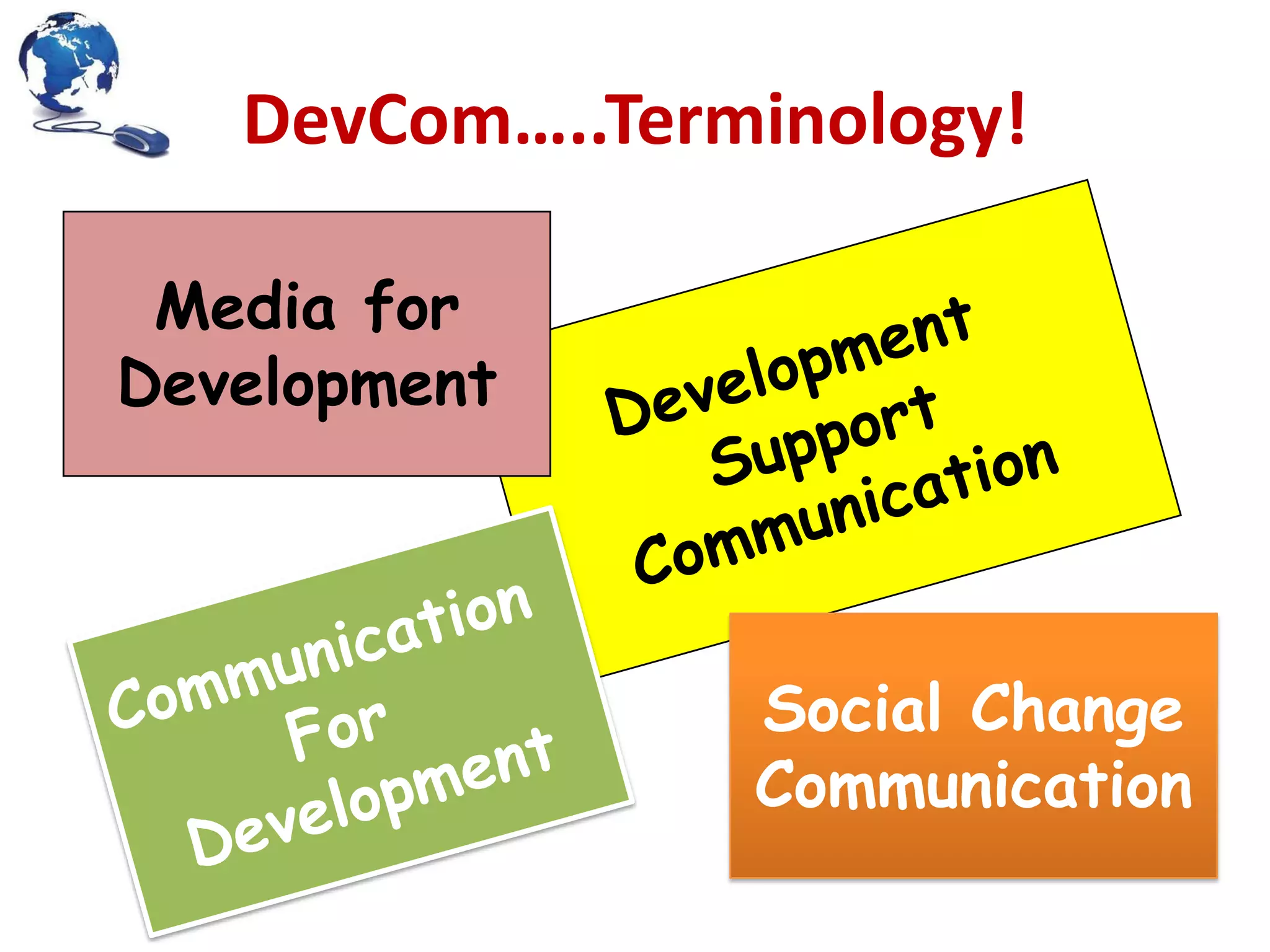
DevCom…..Terminology!
Media for
Development

Social Change
Communication
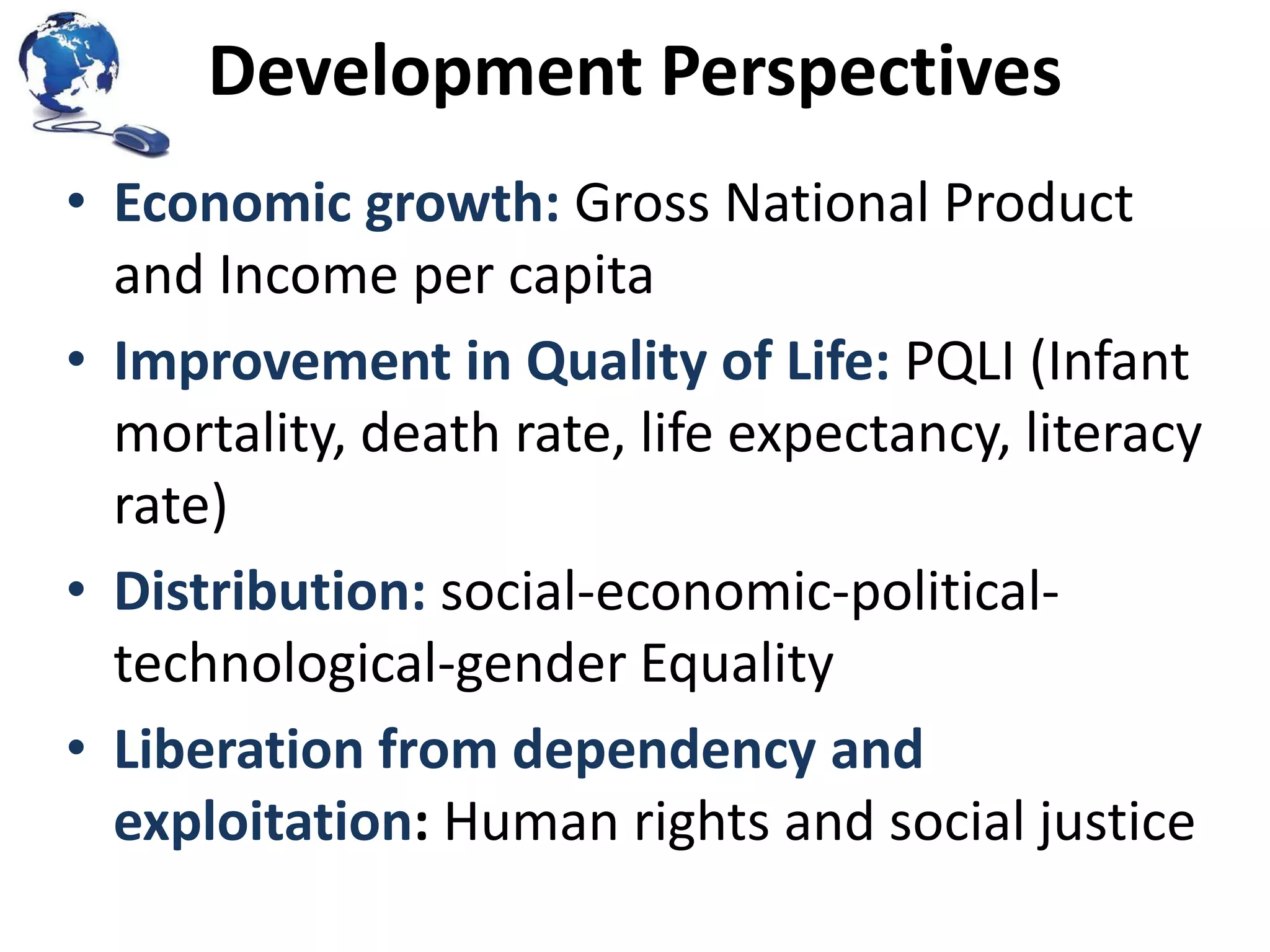
Development Perspectives
• Economic growth: Gross National Product
and Income per capita
• Improvement in Quality of Life: PQLI (Infant
mortality, death rate, life expectancy, literacy
rate)
• Distribution: social-economic-politicaltechnological-gender Equality
• Liberation from dependency and
exploitation: Human rights and social justice
DevCom….evolution
• It is widely accepted that development
communication is an art and science of human
communication for ‘speedy transformation of a
country’.
• The name Development Communication’ (DevCom)
in 1971 and formally in 1975 by Nora Quebral
• Her own modification of definition in 2008 by
adding words, ‘linked to planned intervention’,
• The objectives of any Devcom intervention are
‘greater economic and social equality and larger
fulfilment of human potential’.
Development Communication?
• Not only a nomenclature debate about DevCom,
C4D, M4D, ICT4D….!
• Not only about mere behaviour or practice change of
the people
• Not mere Monitoring and Evaluation of outcomes
BUT also
• Change in the quality of life of human societies
• Building up communities and helping them to help
themselves
• Making a world a better place to live not only for
present but also for future
7 Threads of DevCom
• UNDP (United Nations Development Programme)
and Erskine Childers
• Extension
• Community participation
• Population IEC (Information Education
Communication) and health communication,
• Social marketing
• Institution building
• finally the ICT (Information Communication
Technologies)
ICT4D…..as a term…is:
• conceptualised mostly as a monolithic and
homogeneous entity (http://www.ict4d.org.uk/)
• consists of hardware, software, networks, and
media for collection, storage, processing,
transmission, and presentation of information
(voice,
data,
text,
images)(http://info.worldbank.org)
• used to seek, receive, create and impart
information and ideas by anyone, at any time and
for any purpose. This makes it possible for users
to bypass traditional and official channels of
information
and
communication
(http://www.cprsouth.org)
ICT4D gets defined….by:
• e-Gov
(e-governance),
digital
LEARNING
(online/open learning) eHEALTH, mServe (Mobile
technologies), Tele-centre forum, e-Agriculture, and
municipal IT with multiple applications.
• Funded by Government, private corporations, multilateral agencies or philanthropic organizations and
Non-Government Organisations (NGO), most being
multi-party or multi-stakeholder projects.
• G2G, G2B, G2C, and B2C. G being Government, C
is Citizen and B being private player.
• Sectoral like education, health, agriculture,
governance, livelihood, employment generation,
and so on.
Secondary sources…….
• Bhatnagar and Schware (2000) (ed.) Information
and Communication Technology in DevelopmentCases from India, Sage Publications, New Delhi.
• Harris and Rajora (2006) Empowering poorInformation and Communication Technology for
governance and poverty reduction, A Study of rural
development projects in India, UNDP-APDIP
ICT4D series, Elservier, New Delhi.
• Agarwal (2007) (ed.) E Governance Case studies,
Universities Press India (Pvt.) Ltd., Hyderabad.
Bhatnagar and Schware (2000)
• 14 projects/programmes into 4 categorizations:
• projects for decision support to public
administrators in planning and monitoring of
development programmes
• improving services to citizens and bringing in
transparency
• empowering citizens through access to
information and knowledge
• use of ICT for training in rural areas
Harris and Rajora (2006)
• 18 development projects using ICTs in the form of
community tele-centre for poor
• Evaluating key constructs relating to their
potential for scaling up; these were Project
Design, Community Participation, Project
Outcomes, and their contextual Political Economy.
• 2,156 users of the tele-centre completed
questionnaires and interviews were conducted
with project stakeholders and personnel.
Agarwal (2007)
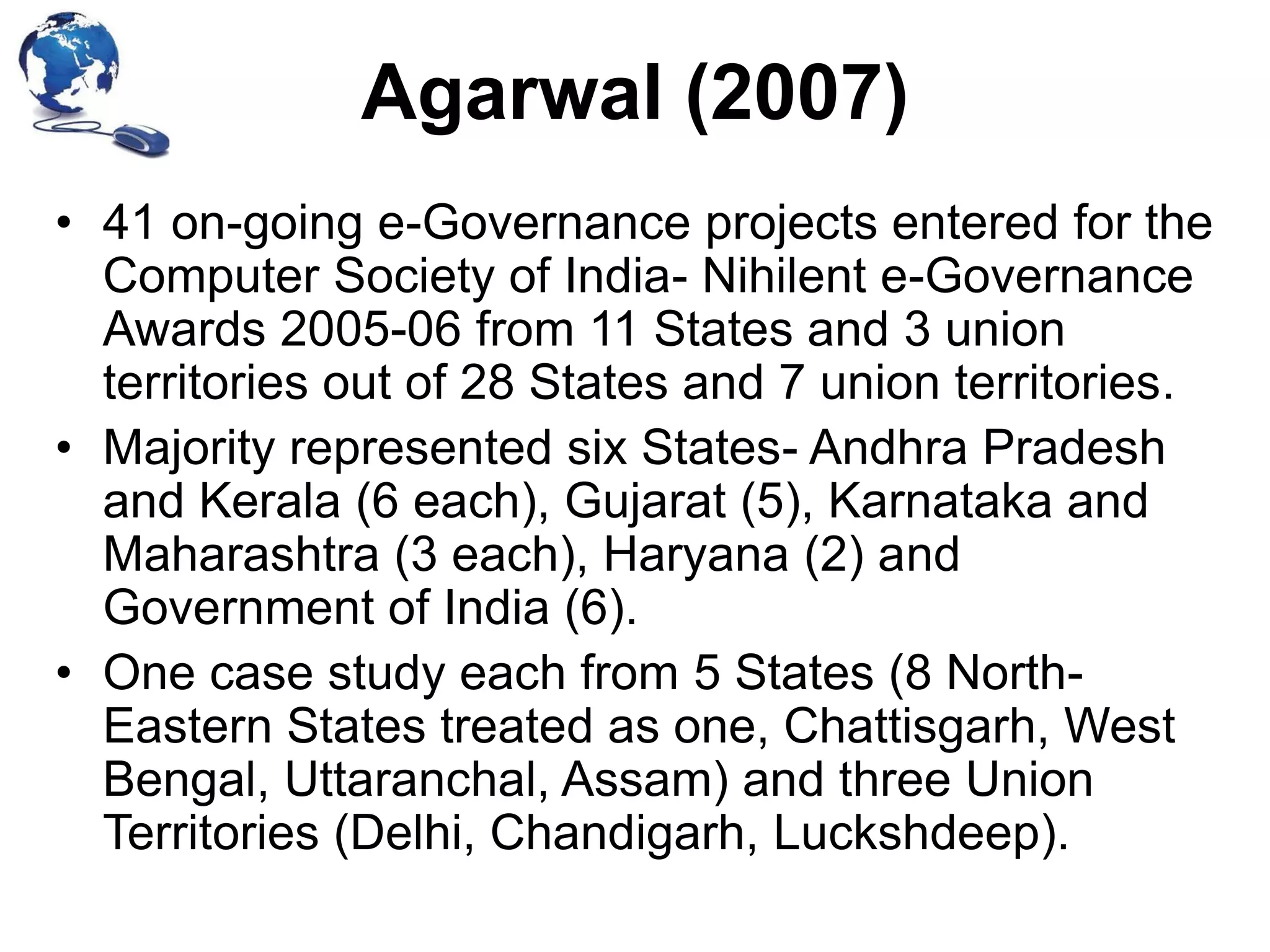
• 41 on-going e-Governance projects entered for the
Computer Society of India- Nihilent e-Governance
Awards 2005-06 from 11 States and 3 union
territories out of 28 States and 7 union territories.
• Majority represented six States- Andhra Pradesh
and Kerala (6 each), Gujarat (5), Karnataka and
Maharashtra (3 each), Haryana (2) and
Government of India (6).
• One case study each from 5 States (8 NorthEastern States treated as one, Chattisgarh, West
Bengal, Uttaranchal, Assam) and three Union
Territories (Delhi, Chandigarh, Luckshdeep).
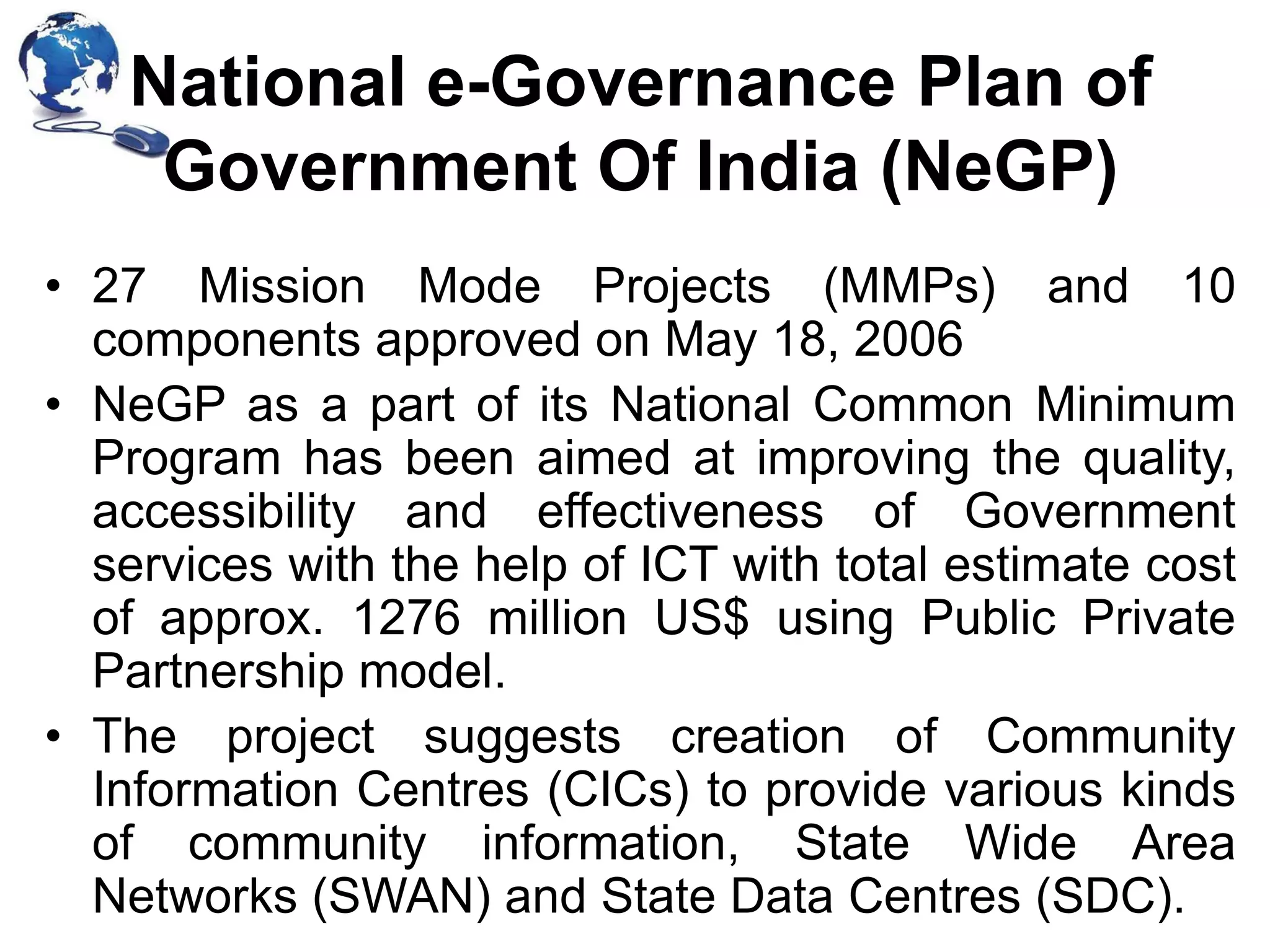
National e-Governance Plan of
Government Of India (NeGP)
• 27 Mission Mode Projects (MMPs) and 10
components approved on May 18, 2006
• NeGP as a part of its National Common Minimum
Program has been aimed at improving the quality,
accessibility and effectiveness of Government
services with the help of ICT with total estimate cost
of approx. 1276 million US$ using Public Private
Partnership model.
• The project suggests creation of Community
Information Centres (CICs) to provide various kinds
of community information, State Wide Area
Networks (SWAN) and State Data Centres (SDC).
Unfair Alliance……global
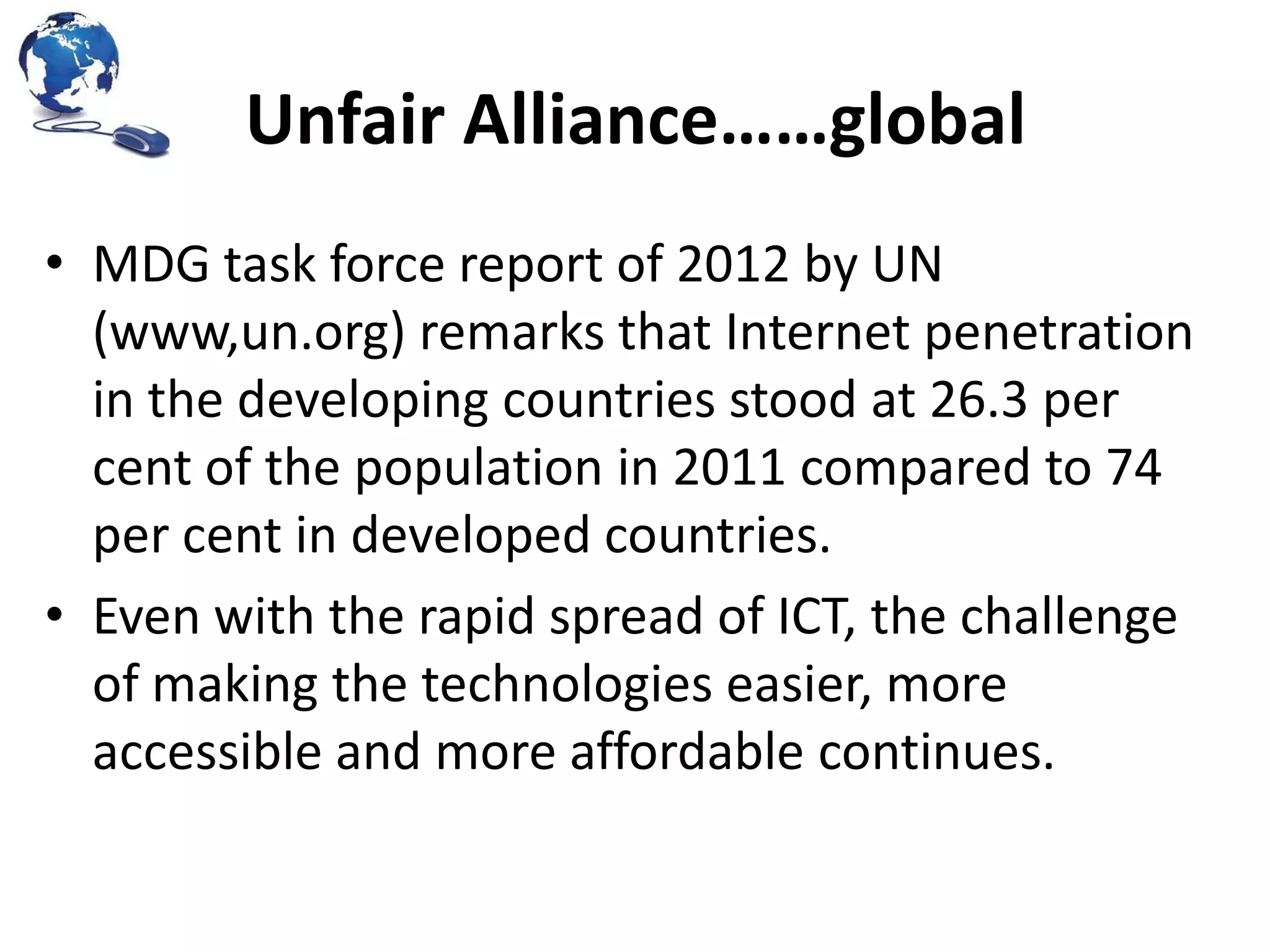
• MDG task force report of 2012 by UN
(www,un.org) remarks that Internet penetration
in the developing countries stood at 26.3 per
cent of the population in 2011 compared to 74
per cent in developed countries.
• Even with the rapid spread of ICT, the challenge
of making the technologies easier, more
accessible and more affordable continues.
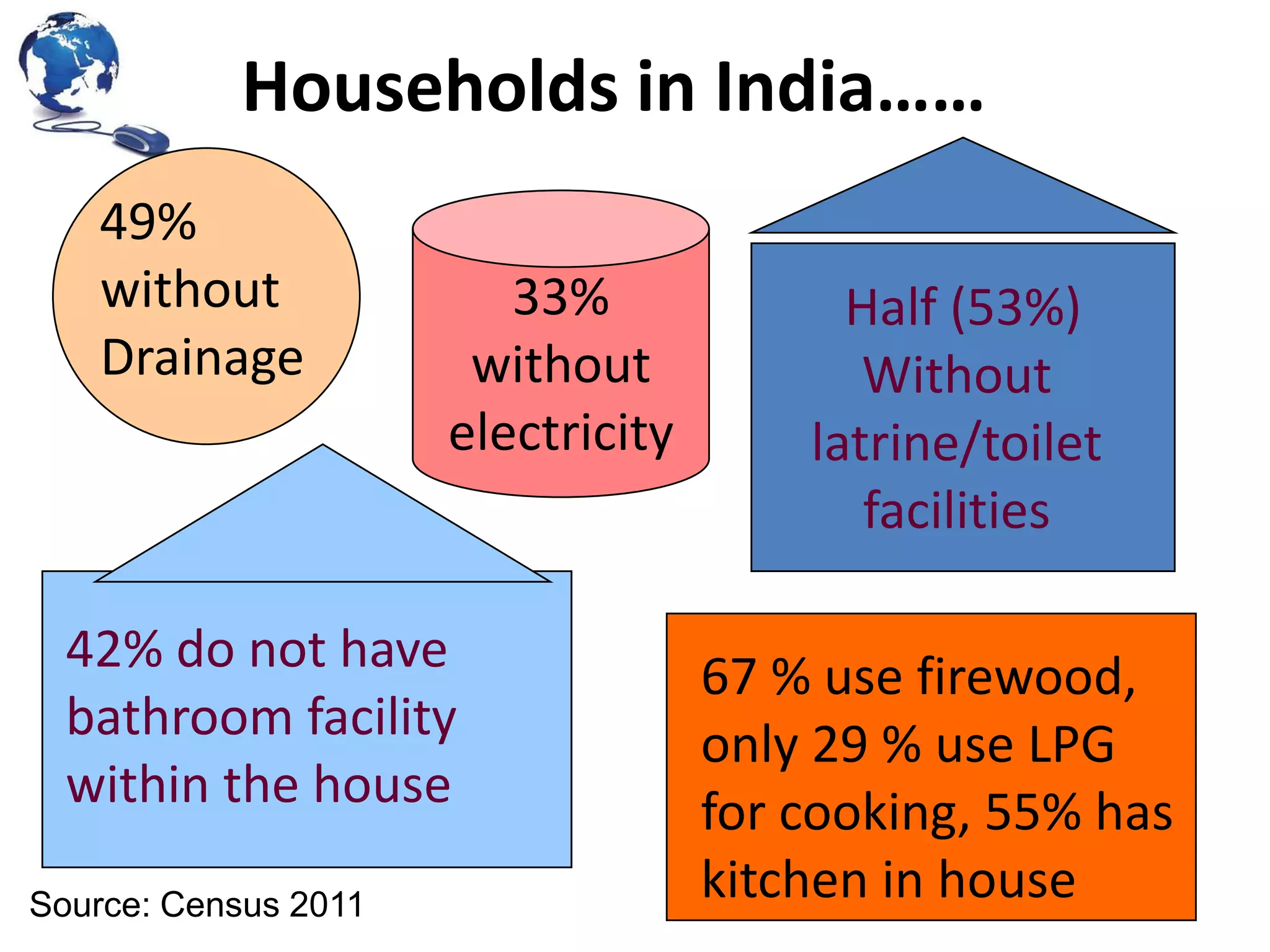
Households in India……
49%
without
Drainage

33%
without
electricity

42% do not have
bathroom facility
within the house
Source: Census 2011

Half (53%)
Without
latrine/toilet
facilities
67 % use firewood,
only 29 % use LPG
for cooking, 55% has
kitchen in house
Unfair Alliance……local
•
•
•
•

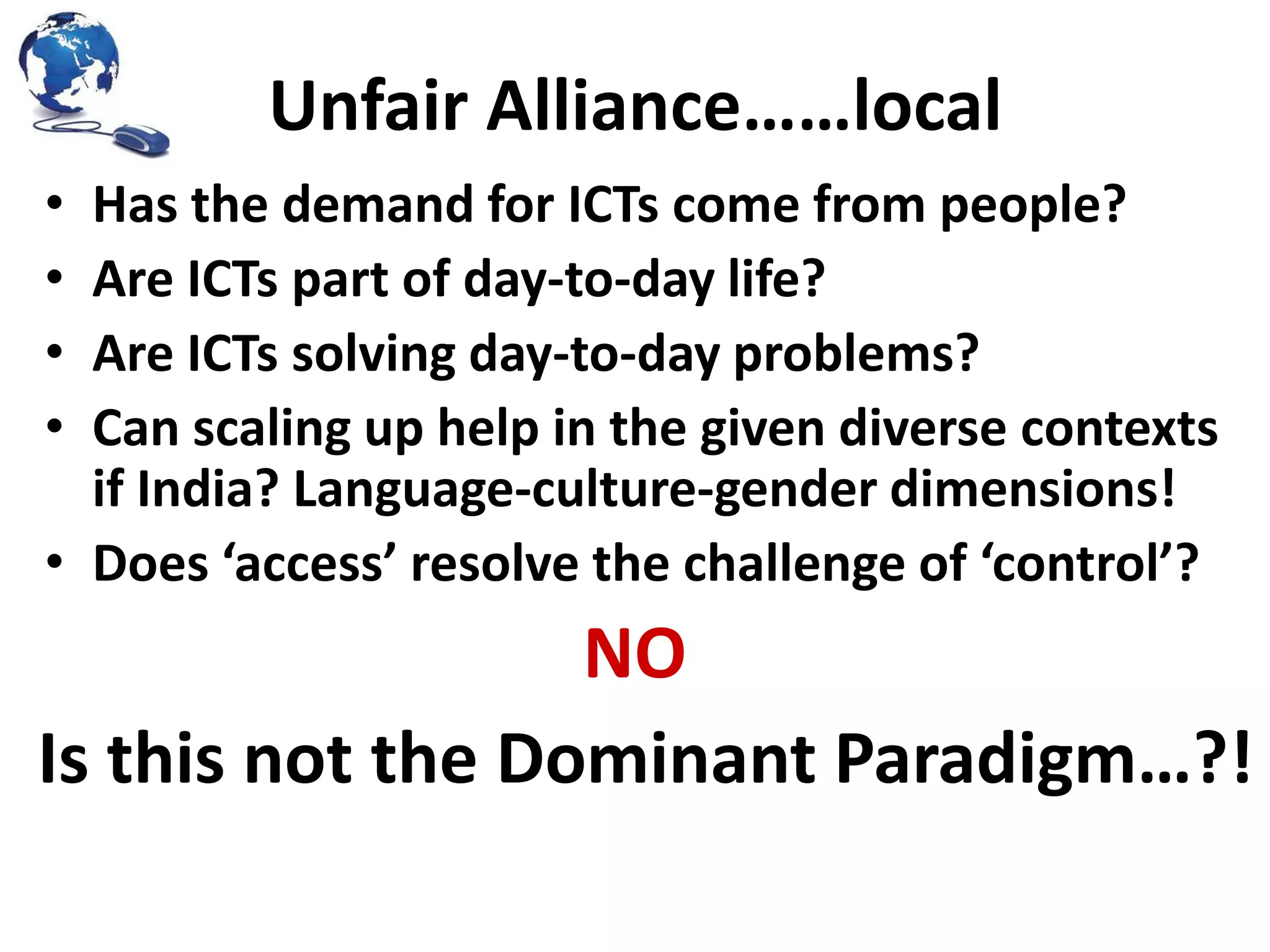
Has the demand for ICTs come from people?
Are ICTs part of day-to-day life?
Are ICTs solving day-to-day problems?
Can scaling up help in the given diverse contexts
if India? Language-culture-gender dimensions!
• Does ‘access’ resolve the challenge of ‘control’?

NO
Is this not the Dominant Paradigm…?!
DevCom allied with technology
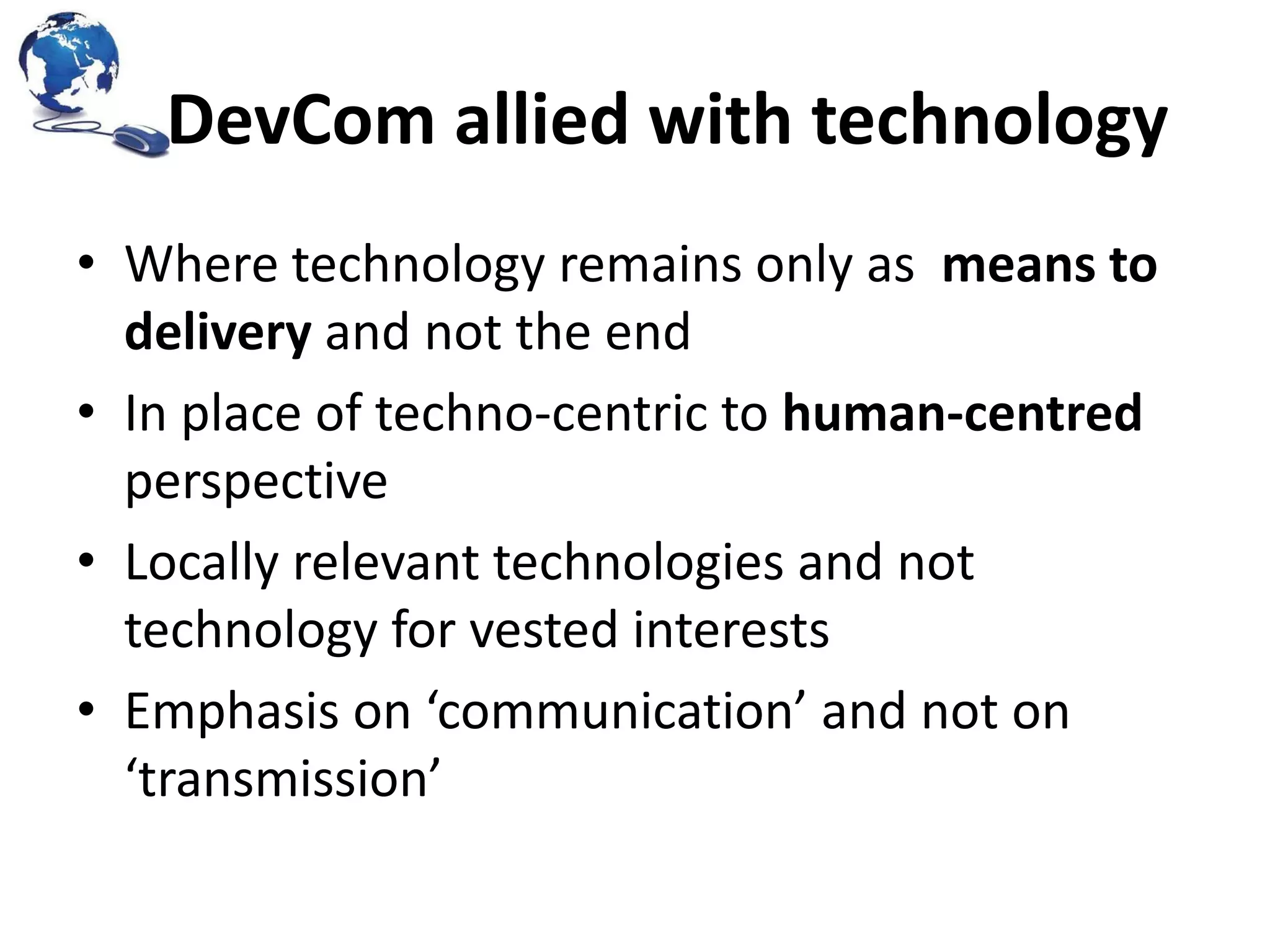
• Where technology remains only as means to
delivery and not the end
• In place of techno-centric to human-centred
perspective
• Locally relevant technologies and not
technology for vested interests
• Emphasis on ‘communication’ and not on
‘transmission’
What is Communication TODAY?
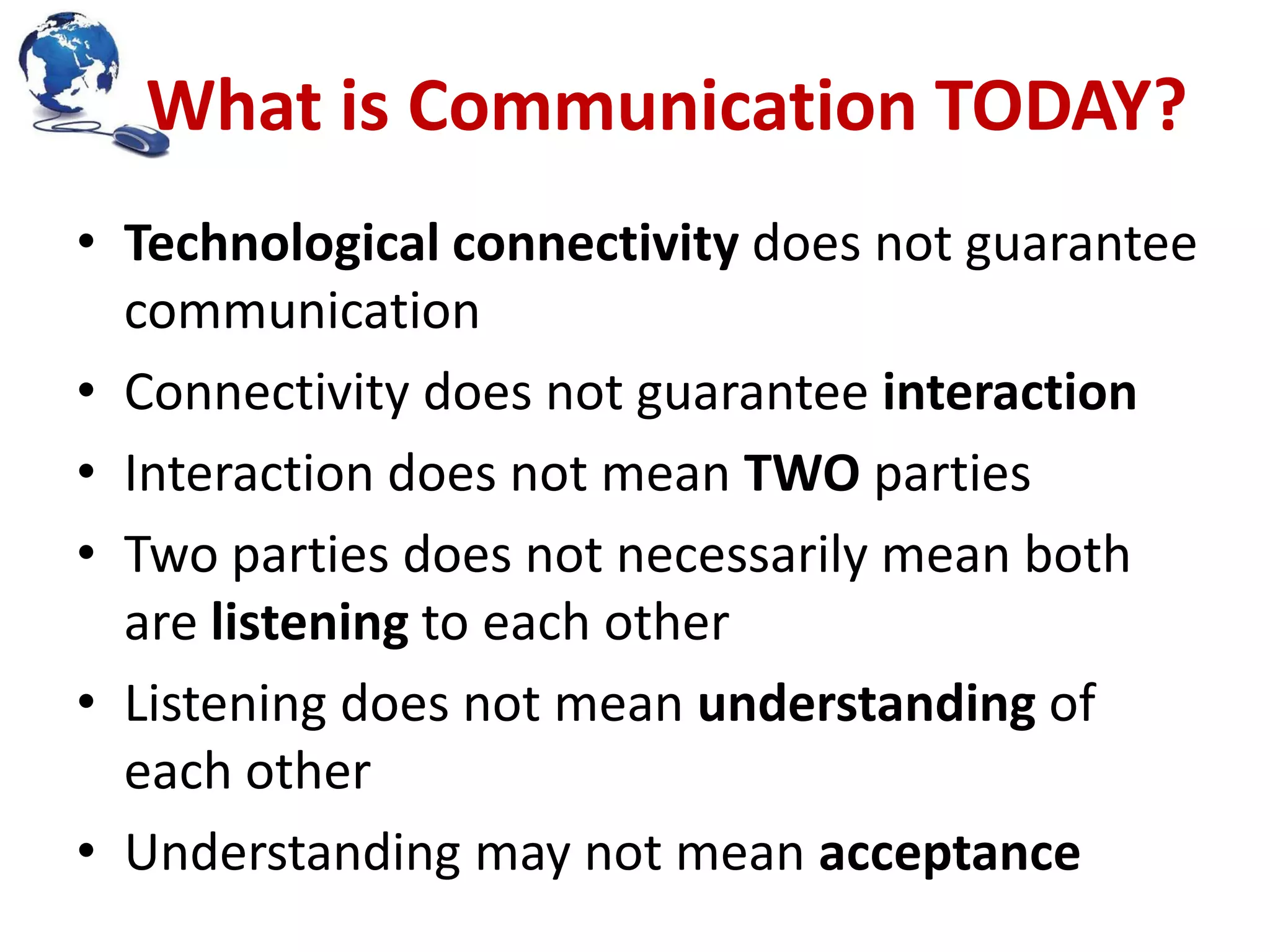
• Technological connectivity does not guarantee
communication
• Connectivity does not guarantee interaction
• Interaction does not mean TWO parties
• Two parties does not necessarily mean both
are listening to each other
• Listening does not mean understanding of
each other
• Understanding may not mean acceptance
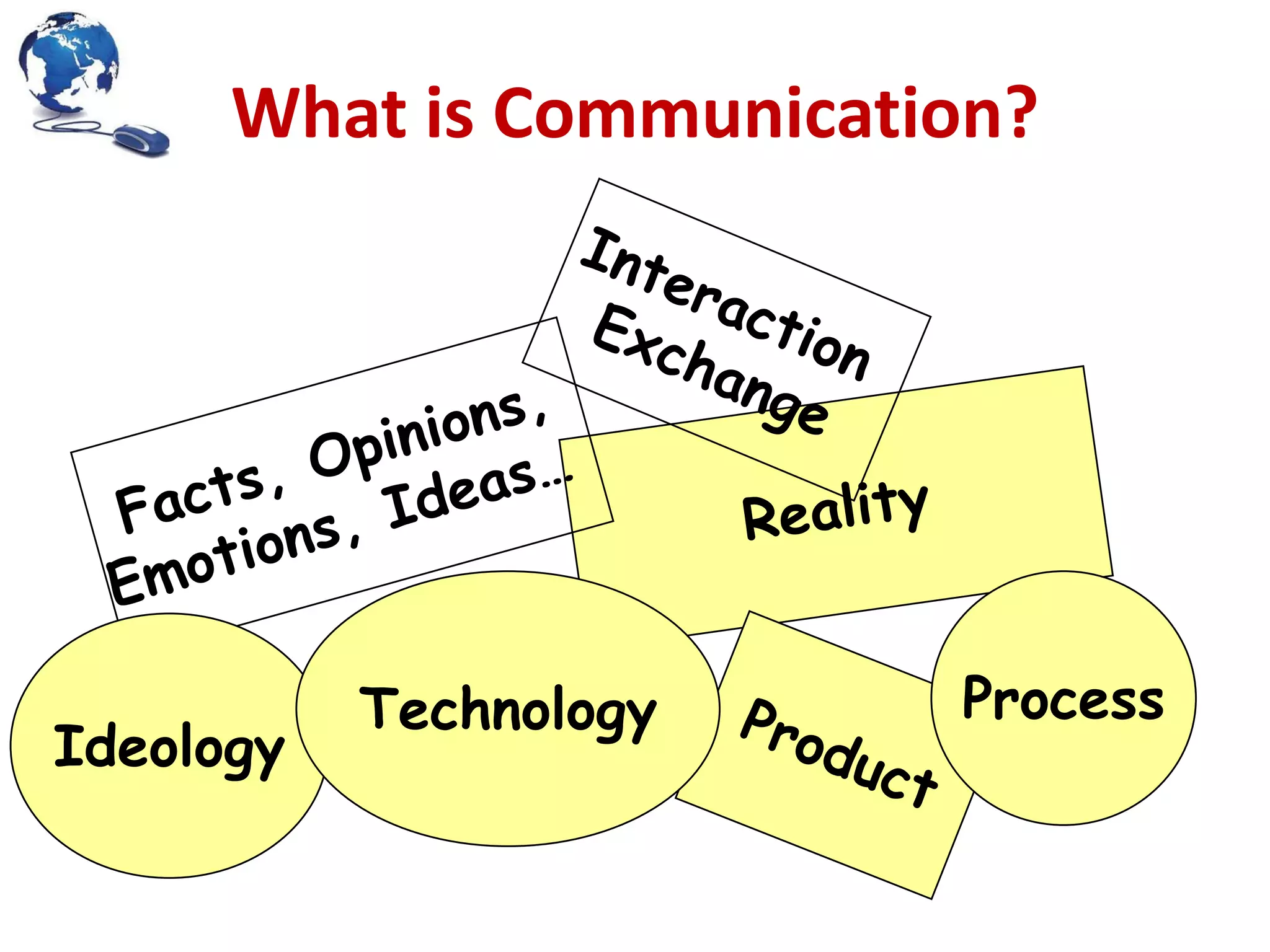
What is Communication?

Ideology

Technology

Process
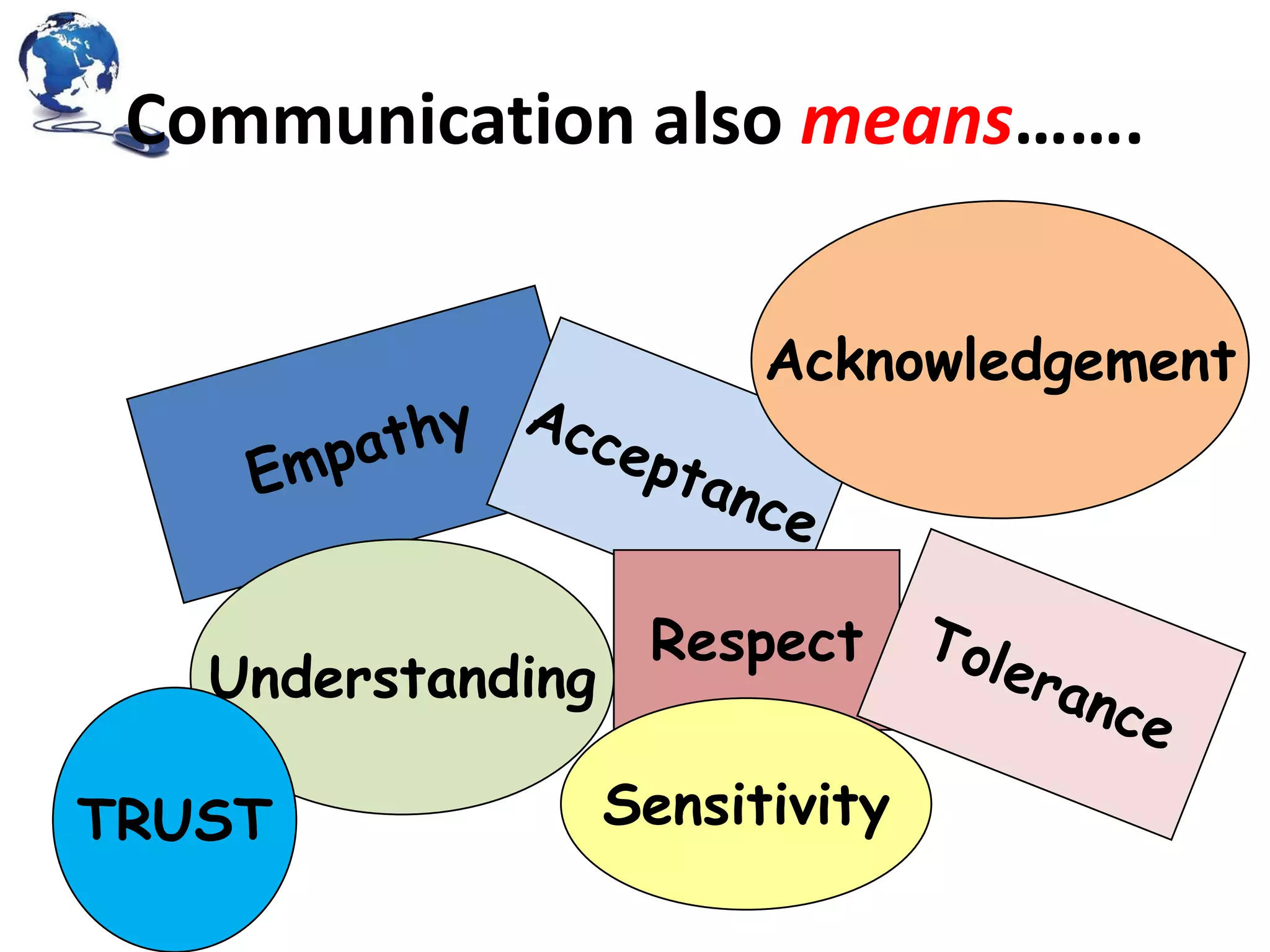
Communication also means…….
Acknowledgement

Understanding
TRUST

Respect
Sensitivity
Thank you for
YOUR
time and
patience

Feel free to connect
drmiradesai@gmail.com

Development Communication and Technology HSAI presentation Dec 2013

  • 1.
    Impact / Influence of Technologyon Cultural Perspectives/ Practices
  • 2.
    Marriage of Development communicationwith Technology: Unfair Alliance Mira K Desai Associate Professor University Department of Extension Education SNDT Women’s University Juhu Campus, Mumbai
  • 3.
  • 4.
    Development Perspectives • Economicgrowth: Gross National Product and Income per capita • Improvement in Quality of Life: PQLI (Infant mortality, death rate, life expectancy, literacy rate) • Distribution: social-economic-politicaltechnological-gender Equality • Liberation from dependency and exploitation: Human rights and social justice
  • 5.
    DevCom….evolution • It iswidely accepted that development communication is an art and science of human communication for ‘speedy transformation of a country’. • The name Development Communication’ (DevCom) in 1971 and formally in 1975 by Nora Quebral • Her own modification of definition in 2008 by adding words, ‘linked to planned intervention’, • The objectives of any Devcom intervention are ‘greater economic and social equality and larger fulfilment of human potential’.
  • 6.
    Development Communication? • Notonly a nomenclature debate about DevCom, C4D, M4D, ICT4D….! • Not only about mere behaviour or practice change of the people • Not mere Monitoring and Evaluation of outcomes BUT also • Change in the quality of life of human societies • Building up communities and helping them to help themselves • Making a world a better place to live not only for present but also for future
  • 7.
    7 Threads ofDevCom • UNDP (United Nations Development Programme) and Erskine Childers • Extension • Community participation • Population IEC (Information Education Communication) and health communication, • Social marketing • Institution building • finally the ICT (Information Communication Technologies)
  • 8.
    ICT4D…..as a term…is: •conceptualised mostly as a monolithic and homogeneous entity (http://www.ict4d.org.uk/) • consists of hardware, software, networks, and media for collection, storage, processing, transmission, and presentation of information (voice, data, text, images)(http://info.worldbank.org) • used to seek, receive, create and impart information and ideas by anyone, at any time and for any purpose. This makes it possible for users to bypass traditional and official channels of information and communication (http://www.cprsouth.org)
  • 9.
    ICT4D gets defined….by: •e-Gov (e-governance), digital LEARNING (online/open learning) eHEALTH, mServe (Mobile technologies), Tele-centre forum, e-Agriculture, and municipal IT with multiple applications. • Funded by Government, private corporations, multilateral agencies or philanthropic organizations and Non-Government Organisations (NGO), most being multi-party or multi-stakeholder projects. • G2G, G2B, G2C, and B2C. G being Government, C is Citizen and B being private player. • Sectoral like education, health, agriculture, governance, livelihood, employment generation, and so on.
  • 10.
    Secondary sources……. • Bhatnagarand Schware (2000) (ed.) Information and Communication Technology in DevelopmentCases from India, Sage Publications, New Delhi. • Harris and Rajora (2006) Empowering poorInformation and Communication Technology for governance and poverty reduction, A Study of rural development projects in India, UNDP-APDIP ICT4D series, Elservier, New Delhi. • Agarwal (2007) (ed.) E Governance Case studies, Universities Press India (Pvt.) Ltd., Hyderabad.
  • 11.
    Bhatnagar and Schware(2000) • 14 projects/programmes into 4 categorizations: • projects for decision support to public administrators in planning and monitoring of development programmes • improving services to citizens and bringing in transparency • empowering citizens through access to information and knowledge • use of ICT for training in rural areas
  • 12.
    Harris and Rajora(2006) • 18 development projects using ICTs in the form of community tele-centre for poor • Evaluating key constructs relating to their potential for scaling up; these were Project Design, Community Participation, Project Outcomes, and their contextual Political Economy. • 2,156 users of the tele-centre completed questionnaires and interviews were conducted with project stakeholders and personnel.
  • 13.
    Agarwal (2007) • 41on-going e-Governance projects entered for the Computer Society of India- Nihilent e-Governance Awards 2005-06 from 11 States and 3 union territories out of 28 States and 7 union territories. • Majority represented six States- Andhra Pradesh and Kerala (6 each), Gujarat (5), Karnataka and Maharashtra (3 each), Haryana (2) and Government of India (6). • One case study each from 5 States (8 NorthEastern States treated as one, Chattisgarh, West Bengal, Uttaranchal, Assam) and three Union Territories (Delhi, Chandigarh, Luckshdeep).
  • 14.
    National e-Governance Planof Government Of India (NeGP) • 27 Mission Mode Projects (MMPs) and 10 components approved on May 18, 2006 • NeGP as a part of its National Common Minimum Program has been aimed at improving the quality, accessibility and effectiveness of Government services with the help of ICT with total estimate cost of approx. 1276 million US$ using Public Private Partnership model. • The project suggests creation of Community Information Centres (CICs) to provide various kinds of community information, State Wide Area Networks (SWAN) and State Data Centres (SDC).
  • 15.
    Unfair Alliance……global • MDGtask force report of 2012 by UN (www,un.org) remarks that Internet penetration in the developing countries stood at 26.3 per cent of the population in 2011 compared to 74 per cent in developed countries. • Even with the rapid spread of ICT, the challenge of making the technologies easier, more accessible and more affordable continues.
  • 16.
    Households in India…… 49% without Drainage 33% without electricity 42%do not have bathroom facility within the house Source: Census 2011 Half (53%) Without latrine/toilet facilities 67 % use firewood, only 29 % use LPG for cooking, 55% has kitchen in house
  • 17.
    Unfair Alliance……local • • • • Has thedemand for ICTs come from people? Are ICTs part of day-to-day life? Are ICTs solving day-to-day problems? Can scaling up help in the given diverse contexts if India? Language-culture-gender dimensions! • Does ‘access’ resolve the challenge of ‘control’? NO Is this not the Dominant Paradigm…?!
  • 18.
    DevCom allied withtechnology • Where technology remains only as means to delivery and not the end • In place of techno-centric to human-centred perspective • Locally relevant technologies and not technology for vested interests • Emphasis on ‘communication’ and not on ‘transmission’
  • 19.
    What is CommunicationTODAY? • Technological connectivity does not guarantee communication • Connectivity does not guarantee interaction • Interaction does not mean TWO parties • Two parties does not necessarily mean both are listening to each other • Listening does not mean understanding of each other • Understanding may not mean acceptance
  • 20.
  • 21.
  • 22.
    Thank you for YOUR timeand patience Feel free to connect drmiradesai@gmail.com