Gerbner’s Model of 
Communication
• Mr. George Gerbner is one of the pioneers in the field 
of communication research. 
• His works are descriptive as well as very easy to 
understand any other before. 
• He is working as a professor and head of the 
Annenberg School of Communications in the University 
of Pennsylvania. 
• In 1956, Gerbner attempted the general purpose of 
communication models. 
• He stressed the dynamic nature of communication in 
his work and also the factor which affecting the 
reliability of communication.
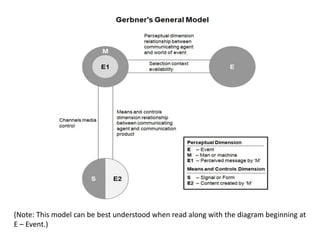
(Note: This model can be best understood when read along with the diagram beginning at 
E – Event.)
• (i) Perceptual Dimension: 
• An ‘E’ is an event happens in the real life and 
the event content or message is perceived by 
‘M’ (Man or a Machine). After Perceives the 
message from “E” by “M” is known as “E1”. E1 
is not same as like ‘E’. Because any man or 
machine can’t perceives the whole event and 
they perceives only the part of the event (E1). 
This is known as “Perceptual Dimension”.
• These 3 factors are involves between ‘E’ and 
‘M’ 
• Selection 
• Context 
• Availability
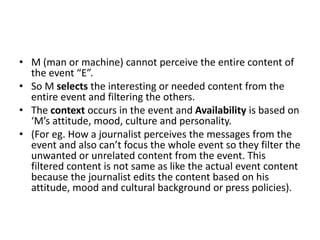
• M (man or machine) cannot perceive the entire content of 
the event “E”. 
• So M selects the interesting or needed content from the 
entire event and filtering the others. 
• The context occurs in the event and Availability is based on 
‘M’s attitude, mood, culture and personality. 
• (For eg. How a journalist perceives the messages from the 
event and also can’t focus the whole event so they filter the 
unwanted or unrelated content from the event. This 
filtered content is not same as like the actual event content 
because the journalist edits the content based on his 
attitude, mood and cultural background or press policies).
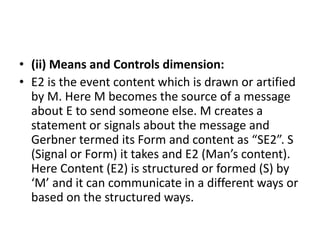
• (ii) Means and Controls dimension: 
• E2 is the event content which is drawn or artified 
by M. Here M becomes the source of a message 
about E to send someone else. M creates a 
statement or signals about the message and 
Gerbner termed its Form and content as “SE2”. S 
(Signal or Form) it takes and E2 (Man’s content). 
Here Content (E2) is structured or formed (S) by 
‘M’ and it can communicate in a different ways or 
based on the structured ways.
• M has to use channels (or media) over to send 
the message which he has a greater or lesser 
degree of control. The question of ‘control’ 
relates to M’s degree of skill in using 
communication channels. If using a verbal 
channel, how good is he using words? If using 
the Internet, how good is he at using new 
technology and words?
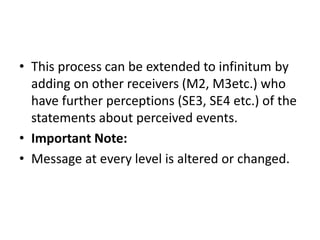
• This process can be extended to infinitum by 
adding on other receivers (M2, M3etc.) who 
have further perceptions (SE3, SE4 etc.) of the 
statements about perceived events. 
• Important Note: 
• Message at every level is altered or changed.
• Example: 
• In case of news reporting, E can be any event that 
has happened and the reporter (M) selects a 
particular part of event (E1) that may be provide 
his channel higher TRP ratings or the news may 
boost the particular party which his channel 
supports. This SE2 is sent through a medium to 
the mass audience. Then the audience 
distributed the message (SE2) and he (M1) sends 
to his friends with his interpretation and the 
process continues.
Gerbner’s General Model (1956) 
PERCEPTUAL DIMENSION 
Selection 
Context 
Availability 
E 
Event 
M 
E1 
Channels 
Media 
Control 
MEANS AND CONTROL 
DIMENSION 
S 
Form 
E 
Con-tent 
M2 
SE1 
(cf. Gerbner 1956, in: Corner; Hawthorn (eds.) 1989:18)
References 
• http://en.wikipedia.org/wiki/George_Gerbner 
• http://communicationtheory.org/gerbners-general- 
model/