HISTORY OF
DEVELOPMENT
COMMUNICATION
Introduction to Development
Communication
History of Development
Communication




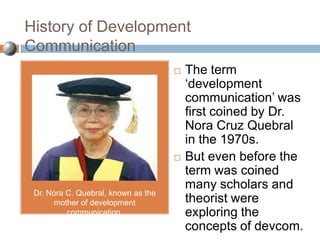
Dr. Nora C. Quebral, known as the
mother of development
communication.

The term
„development
communication‟ was
first coined by Dr.
Nora Cruz Quebral
in the 1970s.
But even before the
term was coined
many scholars and
theorist were
exploring the
concepts of devcom.
History of Development
Communication


The end of world war II was the point when
major aid, interventions, and beginning of
modernization planning and scheme
commenced.
“We must embark on a bold new
program for making the benefits of
our scientific advances and industrial
progress available for the
improvement and growth of
underdeveloped areas” – President
Henry Truman (1948)
History of Development
Communication
Technical Cooperation
Administration
 its goal was to improve the lives of
inhabitants of the peripheral regions
of the world but it remained
unchanged and some cases
become worse.
 The plans and hopes of northern
hemisphere elites of economic and
cultural growth failed to materialize
in the southern hemisphere.
 Scholars began to seek for new
theories and paradigms
History of Development
Communication
Schools of Development
Communication
 The

Latin America School (1940)
 The Bretton Woods School (1950)
 The Los Baños School (1950s)
 The African School (1960)
 The Indian School (1970)
 The Post Freire School: Participatory
Development Communication (1980)
History of Development
Communication


Bretton Woods School

Theorists: Daniel Lerner, Wilbur Schramm, Everett Rogers, and Jan
Servaes

A western-driven systematic and strategic
employment of linear communications in Third World
development experiments.
 The School‟s development paradigm propagated
production and planning of development in indigenous
and uncivilized societies.
 The failure of many development projects from 1960‟s
despite the increasing donor aid compelled the school
to re evaluate its top-down methods.

History of Development
Communication


Latin America School

Theorists: Luis Ramiro Beltrán, Juan Díaz Bordenave, Miguel Sabido,
and Paulo Freire

Radio Sutatenza for rural education and Miners’ Radio
Network in Colombia
 pioneered the employment of systematically designed
radio communications in empowering economically
and socially marginalized people, helping them to
lead decent and healthy lives.
 changed the approach in designing educational
broadcast dramas focusing on social development
issues.

History of Development
Communication


Los Baños School

Theorists: Felix Librero, Alexander Flor, Ely Gomez, Nora Quebral, Juan
Jamias

When Bretton School was still exploring the poverty
and its depths within the different parts of the world
(1950) and searching for appropriate communication
interventions, the Los Baños school was already
conducting ground breaking participatory
communication research experiments in and as
development interventions.
 Thus pioneered the design and implementation of
communication tools in promotion of sustainable
development that were based in the coherent method
and theory.

History of Development
Communication


African School (Anglophone Africa)

Theorists: Penina Mlama, Christopher Kamlongera, Zakes Mda,
Robert MacLaren, and Ngugi wa Thiong‟o


Rural radio and theatre for development

After the post colonial and
communists movements in
early 1970s African scholars
began to rethink concepts of
culture, communication, and
development began “taking
the theatre to the people”.
History of Development
Communication


Indian School

Theorists: Mehra Masani, George Verghese Keval Kumar, University of
Poona, Joseph Velacherry, Delhi University, University of Kerala

Central to this school are radio/television for rural
development and development journalism.
 Indonesia and Sri Lanka also used the academe to
experiment development communication.

History of Development
Communication


Post Freire School: Participatory Development
Communication

Theorists: UPLB College of Development Communication, IDRC, FAO
Communication Project, UNESCO, Rockefeller Foundation, Ford Foundation,
World Bank

collaboration between the first world and third world
devcom organizations.
 modern devcom is characterized by diverse
methodological and theoretical trajectories but still
centres around participatory production and utilization
of indigenous knowledge in local development
 Communication involving community participation
formulates a very important fact in the promotion of
sustainable development.

History of Development
Communication

Beginnings of DEVCOM in
UPLB
History of Development
Communication
The University of the Philippines was established in
1908 with four colleges: College of Fine Arts, College of
Medicine and Surgery, College of Liberal Arts, and
School of Agriculture in Los Baños.
In 1954 the Extension and Publications of the
College of Agriculture was established wherein some of
the staffs began to carry out research in how
communication could address problems of rural
development.
History of Development
Communication










1960- the first devcom courses were introduced in the
Agriculture curriculum.
1962- the extension and publications office was elevated
to Department of Information and Communication.
1968- the department was renamed as Department of
Agricultural Communication.
1974- it was renamed again as Department of
Development Communication
1987-1998- transition of the department to an institute
and later to a college.
History of Development
Communication
The pioneers of Development Communication in UPLB:
Nora Quebral, Felix Librero, Juan Jamias, and Ely
Gomez first defined devcom as:
“an organized and systematic art of human communication
applied to a speedy transformation of a country and a mass of its
people from poverty to a dynamic state of economic growth to
achieve greater social equity.”

Later on they would realize that Devcom „cannot really
change people‟ but can only help them change
themselves at their own enlightened pace, and there is
no „speedy transformation‟ of societies as development
is a protracted and long process.
History of Development
Communication




March 11, 1974- BS in degree curriculum in
Development Communication was approved and first
offered in S.Y. 1974-1975.
The course was comprised of:
Introduction to Devcom, Fundamentals of Devcom,
Community Broadcasting, Audio Visual Communications,
Communication and Society, Com Campaigns and Programs,
Testing and Evaluation of Com Materials, Com Research, Basic
Photography, Broadcast Speech and Performance for Community
Radio, Play Writing, Science Reporting, Publications Writing and
Editing, Management and Production of Community Newspaper,
Advanced Development Writing, Visual Aids Planning and
Production, Radio Drama and Documentary, and Educational
Broadcasting.
History of Development
Communication
3 cornerstones of Devcom UPLB


Agriculture



Since the department of development communication
emerged from the college of agriculture, its early
researches and experiments on development
communication have agricultural orientation. Such as
dairy farming, forestry management, agricultural
leasehold, livestock, etc.
History of Development
Communication


a)
b)
c)
d)



Rural development journalism
Quebral describes it as a kind of journalism which
circulates knowledge that will inform the people of the
significant events, opportunities, and changes
provide a forum where issues affecting national/community life
may be aired
teach ideas, skills and attitudes that people need to achieve
better life
create and maintain a base of consensus that is needed for the
stability of the state

Participatory development- indigenous people are
conceived as capable of taking an active part in
planning, implementing and evaluating interventions.
History of Development
Communication





Educational broadcasting
Community broadcasting and educational
programming
The role and nature of community radio in community
development
Localized programming and personalized
broadcasting can encourage audience involvement
and participation.

DZLB, also known as the Voice of the Village, was
established for the purpose of non formal education in
the rural setting. Farmers and villagers were able to
produce programs that are designed to help farmers
diagnose their problems and clarify their objectives.
Development Communication


Sustainable development
is the process of maximizing the use of
available resources in order to ensure the longterm well-being of present and future
beneficiaries. Sustainable Development is a
continuous progress which aims for and
maintains a constructive state of living in society
as preserved by social institutions and systems.
However, sustainable development entails
1.
2.
3.

Economic sustainability
Social sustainability
Cultural sustainability
Development Communication


Community/people participation
is a voluntary involvement of an informed
and motivated community while being
equipped with proper knowledge and training
in which they are equally gratified.
It is the active involvement of members of
a particular social unit in all aspects of
developmental procedures (planning, decisionmaking, evaluating, monitoring, etc.)
Development Communication
“an organized and systematic art of human communication
applied to a speedy transformation of a country and a mass of its
people from poverty to a dynamic state of economic growth to
achieve greater social equity.”


“ Is an art and science of human communication linked
to a society‟s planned transformation from a state of
poverty to one dynamic socio-economic growth that
makes for a greater equity and larger unfolding of
individual potential.” – Quebral (2002)
“ The science of human communication linked to the
transitioning of communities from poverty in all its
forms to a dynamic, overall growth that fosters equity
and unfolding of individual potential.” – Quebral (2012)
Thank you for
Listening!

The devcom manifesto

  • 1.
  • 2.
    History of Development Communication   Dr.Nora C. Quebral, known as the mother of development communication. The term „development communication‟ was first coined by Dr. Nora Cruz Quebral in the 1970s. But even before the term was coined many scholars and theorist were exploring the concepts of devcom.
  • 3.
    History of Development Communication  Theend of world war II was the point when major aid, interventions, and beginning of modernization planning and scheme commenced. “We must embark on a bold new program for making the benefits of our scientific advances and industrial progress available for the improvement and growth of underdeveloped areas” – President Henry Truman (1948)
  • 4.
    History of Development Communication TechnicalCooperation Administration  its goal was to improve the lives of inhabitants of the peripheral regions of the world but it remained unchanged and some cases become worse.  The plans and hopes of northern hemisphere elites of economic and cultural growth failed to materialize in the southern hemisphere.  Scholars began to seek for new theories and paradigms
  • 5.
    History of Development Communication Schoolsof Development Communication  The Latin America School (1940)  The Bretton Woods School (1950)  The Los Baños School (1950s)  The African School (1960)  The Indian School (1970)  The Post Freire School: Participatory Development Communication (1980)
  • 6.
    History of Development Communication  BrettonWoods School Theorists: Daniel Lerner, Wilbur Schramm, Everett Rogers, and Jan Servaes A western-driven systematic and strategic employment of linear communications in Third World development experiments.  The School‟s development paradigm propagated production and planning of development in indigenous and uncivilized societies.  The failure of many development projects from 1960‟s despite the increasing donor aid compelled the school to re evaluate its top-down methods. 
  • 7.
    History of Development Communication  LatinAmerica School Theorists: Luis Ramiro Beltrán, Juan Díaz Bordenave, Miguel Sabido, and Paulo Freire Radio Sutatenza for rural education and Miners’ Radio Network in Colombia  pioneered the employment of systematically designed radio communications in empowering economically and socially marginalized people, helping them to lead decent and healthy lives.  changed the approach in designing educational broadcast dramas focusing on social development issues. 
  • 8.
    History of Development Communication  LosBaños School Theorists: Felix Librero, Alexander Flor, Ely Gomez, Nora Quebral, Juan Jamias When Bretton School was still exploring the poverty and its depths within the different parts of the world (1950) and searching for appropriate communication interventions, the Los Baños school was already conducting ground breaking participatory communication research experiments in and as development interventions.  Thus pioneered the design and implementation of communication tools in promotion of sustainable development that were based in the coherent method and theory. 
  • 9.
    History of Development Communication  AfricanSchool (Anglophone Africa) Theorists: Penina Mlama, Christopher Kamlongera, Zakes Mda, Robert MacLaren, and Ngugi wa Thiong‟o  Rural radio and theatre for development After the post colonial and communists movements in early 1970s African scholars began to rethink concepts of culture, communication, and development began “taking the theatre to the people”.
  • 10.
    History of Development Communication  IndianSchool Theorists: Mehra Masani, George Verghese Keval Kumar, University of Poona, Joseph Velacherry, Delhi University, University of Kerala Central to this school are radio/television for rural development and development journalism.  Indonesia and Sri Lanka also used the academe to experiment development communication. 
  • 11.
    History of Development Communication  PostFreire School: Participatory Development Communication Theorists: UPLB College of Development Communication, IDRC, FAO Communication Project, UNESCO, Rockefeller Foundation, Ford Foundation, World Bank collaboration between the first world and third world devcom organizations.  modern devcom is characterized by diverse methodological and theoretical trajectories but still centres around participatory production and utilization of indigenous knowledge in local development  Communication involving community participation formulates a very important fact in the promotion of sustainable development. 
  • 12.
  • 13.
    History of Development Communication TheUniversity of the Philippines was established in 1908 with four colleges: College of Fine Arts, College of Medicine and Surgery, College of Liberal Arts, and School of Agriculture in Los Baños. In 1954 the Extension and Publications of the College of Agriculture was established wherein some of the staffs began to carry out research in how communication could address problems of rural development.
  • 14.
    History of Development Communication      1960-the first devcom courses were introduced in the Agriculture curriculum. 1962- the extension and publications office was elevated to Department of Information and Communication. 1968- the department was renamed as Department of Agricultural Communication. 1974- it was renamed again as Department of Development Communication 1987-1998- transition of the department to an institute and later to a college.
  • 15.
    History of Development Communication Thepioneers of Development Communication in UPLB: Nora Quebral, Felix Librero, Juan Jamias, and Ely Gomez first defined devcom as: “an organized and systematic art of human communication applied to a speedy transformation of a country and a mass of its people from poverty to a dynamic state of economic growth to achieve greater social equity.” Later on they would realize that Devcom „cannot really change people‟ but can only help them change themselves at their own enlightened pace, and there is no „speedy transformation‟ of societies as development is a protracted and long process.
  • 16.
    History of Development Communication   March11, 1974- BS in degree curriculum in Development Communication was approved and first offered in S.Y. 1974-1975. The course was comprised of: Introduction to Devcom, Fundamentals of Devcom, Community Broadcasting, Audio Visual Communications, Communication and Society, Com Campaigns and Programs, Testing and Evaluation of Com Materials, Com Research, Basic Photography, Broadcast Speech and Performance for Community Radio, Play Writing, Science Reporting, Publications Writing and Editing, Management and Production of Community Newspaper, Advanced Development Writing, Visual Aids Planning and Production, Radio Drama and Documentary, and Educational Broadcasting.
  • 17.
    History of Development Communication 3cornerstones of Devcom UPLB  Agriculture  Since the department of development communication emerged from the college of agriculture, its early researches and experiments on development communication have agricultural orientation. Such as dairy farming, forestry management, agricultural leasehold, livestock, etc.
  • 18.
    History of Development Communication   a) b) c) d)  Ruraldevelopment journalism Quebral describes it as a kind of journalism which circulates knowledge that will inform the people of the significant events, opportunities, and changes provide a forum where issues affecting national/community life may be aired teach ideas, skills and attitudes that people need to achieve better life create and maintain a base of consensus that is needed for the stability of the state Participatory development- indigenous people are conceived as capable of taking an active part in planning, implementing and evaluating interventions.
  • 19.
    History of Development Communication     Educationalbroadcasting Community broadcasting and educational programming The role and nature of community radio in community development Localized programming and personalized broadcasting can encourage audience involvement and participation. DZLB, also known as the Voice of the Village, was established for the purpose of non formal education in the rural setting. Farmers and villagers were able to produce programs that are designed to help farmers diagnose their problems and clarify their objectives.
  • 20.
    Development Communication  Sustainable development isthe process of maximizing the use of available resources in order to ensure the longterm well-being of present and future beneficiaries. Sustainable Development is a continuous progress which aims for and maintains a constructive state of living in society as preserved by social institutions and systems. However, sustainable development entails 1. 2. 3. Economic sustainability Social sustainability Cultural sustainability
  • 21.
    Development Communication  Community/people participation isa voluntary involvement of an informed and motivated community while being equipped with proper knowledge and training in which they are equally gratified. It is the active involvement of members of a particular social unit in all aspects of developmental procedures (planning, decisionmaking, evaluating, monitoring, etc.)
  • 22.
    Development Communication “an organizedand systematic art of human communication applied to a speedy transformation of a country and a mass of its people from poverty to a dynamic state of economic growth to achieve greater social equity.”  “ Is an art and science of human communication linked to a society‟s planned transformation from a state of poverty to one dynamic socio-economic growth that makes for a greater equity and larger unfolding of individual potential.” – Quebral (2002) “ The science of human communication linked to the transitioning of communities from poverty in all its forms to a dynamic, overall growth that fosters equity and unfolding of individual potential.” – Quebral (2012)
  • 23.