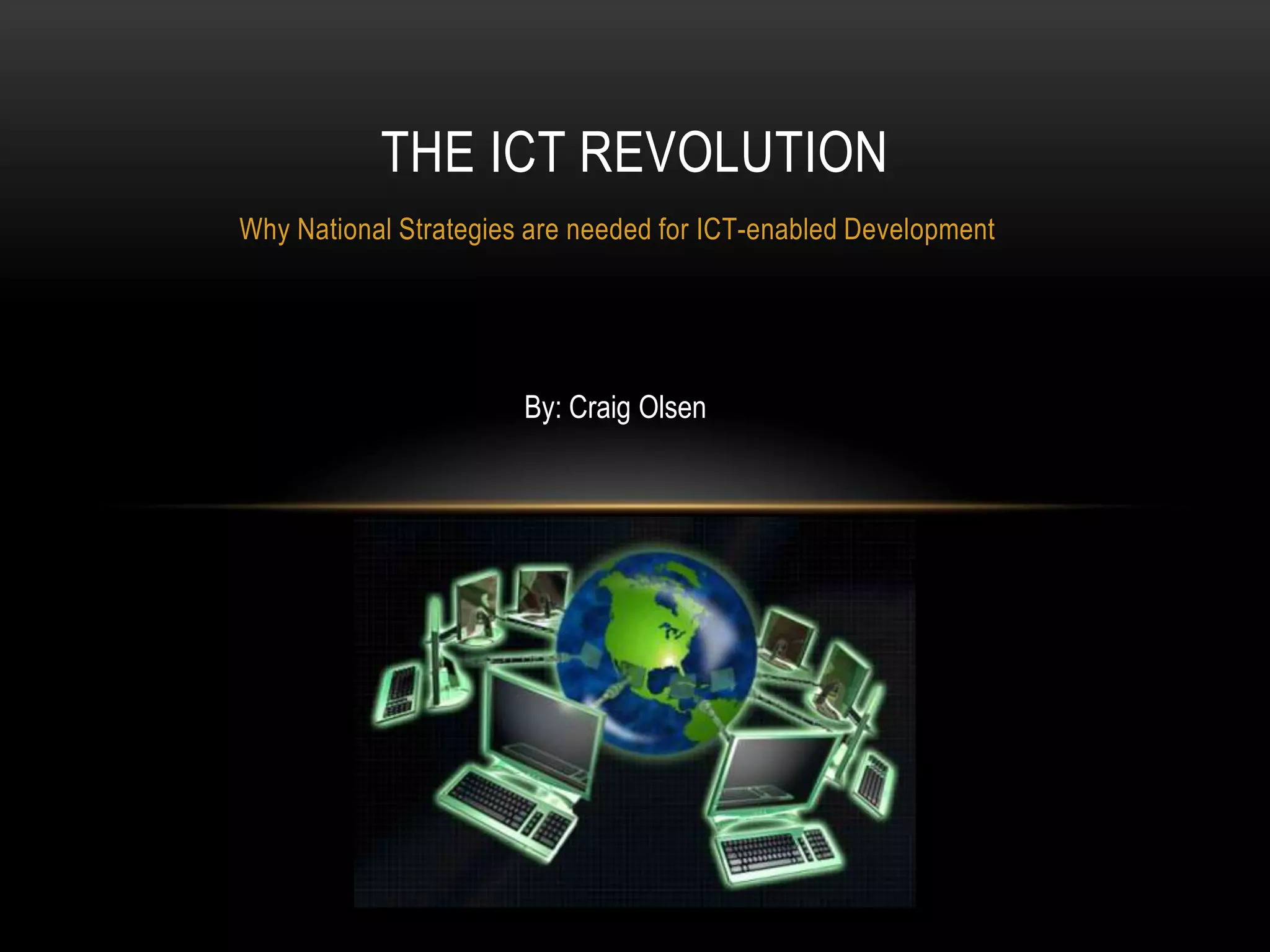
THE ICT REVOLUTION
Why National Strategies are needed for ICT-enabled Development


                       By: Craig Olsen
TOPICS THAT WILL BE ADDRESSED:

•   The effects ICT would have on rural development and the possibilities that can come from
    ICT integration.
•   Case studies of local-level projects in attempt to increase rural development.
•   A broad view of the promises and risks of the ICT revolution, and its potential impact on
    markets and education.
•   An examination of why developing countries should look ahead and try to adapt and
    harness ICT in support of economic and social development.
•   Policy Imperatives developing countries must follow.
INTERESTING QUOTES:
•   “Just as participation in the physical economy requires access to roads, bridges, and
    vehicles to transport goods, similar infrastructure is needed in the virtual and knowledge
    economy. However, here the highway is the Internet and other networks, bridges are
    interoperable data standards, and vehicles are computers and databases.”
           • Francis Gurry (Current Director General of WIPO)


•   “Some aid practitioners view ICT as a threat to established sectors and ways of doing
    business, and there is subtle but pervasive resistance to the required changes to
    mainstream ICT into development. Others view this fundamental technological change as
    an opportunity for developing countries to address old age development problems and
    innovate new means to achieve basic development goals in the context of new global
    realities.”
           • Nagy Hanna, (Senior Advisor on e-development at the World Bank)
ICT FOR RURAL DEVELOPMENT
•   Supporters of ICTs have advocated integrated rural development through
    telecommunications by highlighting many of their uses and applications in developing
    countries:
          • Finding markets for farm produce, fishery catches, and handicraft products; negotiating
            prices, and arranging for transportation.
          • Arranging for the delivery of inputs such as raw materials, supplies, and tools.
          • Obtaining and distributing information rapidly on markets, prices, consumption trends, and
            inventory.
          • Expanding educational opportunities such as distance learning.
          • Facilitating quick and easy ways to stay in touch with family members, relatives, and friends.
CASE STUDIES OF THE USE OF ICT IN RURAL
                DEVELOPMENT


•   Kotmale Project


•   Project in the rural areas of Warana and Baramati


•   Project in the state of Madhya Pradesh in Central India.
WORLD BANK PERSPECTIVE OF ICT INTEGRATION
•   Has continued to show strong support for the integration of ICTs in developing countries.
•   Acknowledge that there are threats and uncertainties that go along with the territory of
    ICT integration, but believe that the long-term benefits hold great promise and hope for
    developing countries.
•   They argue that if mainstream development practitioners continue to ignore the potential
    roles of ICT, it can pose serious risks to development effectiveness.
•   Attributes of ICT Revolution:
     •   Productivity revolution
     •   Knowledge revolution
     •   Learning revolution
     •   Innovation-driven economy
POTENTIAL IMPACTS OF ICT INTEGRATION
•   Impact on Markets:
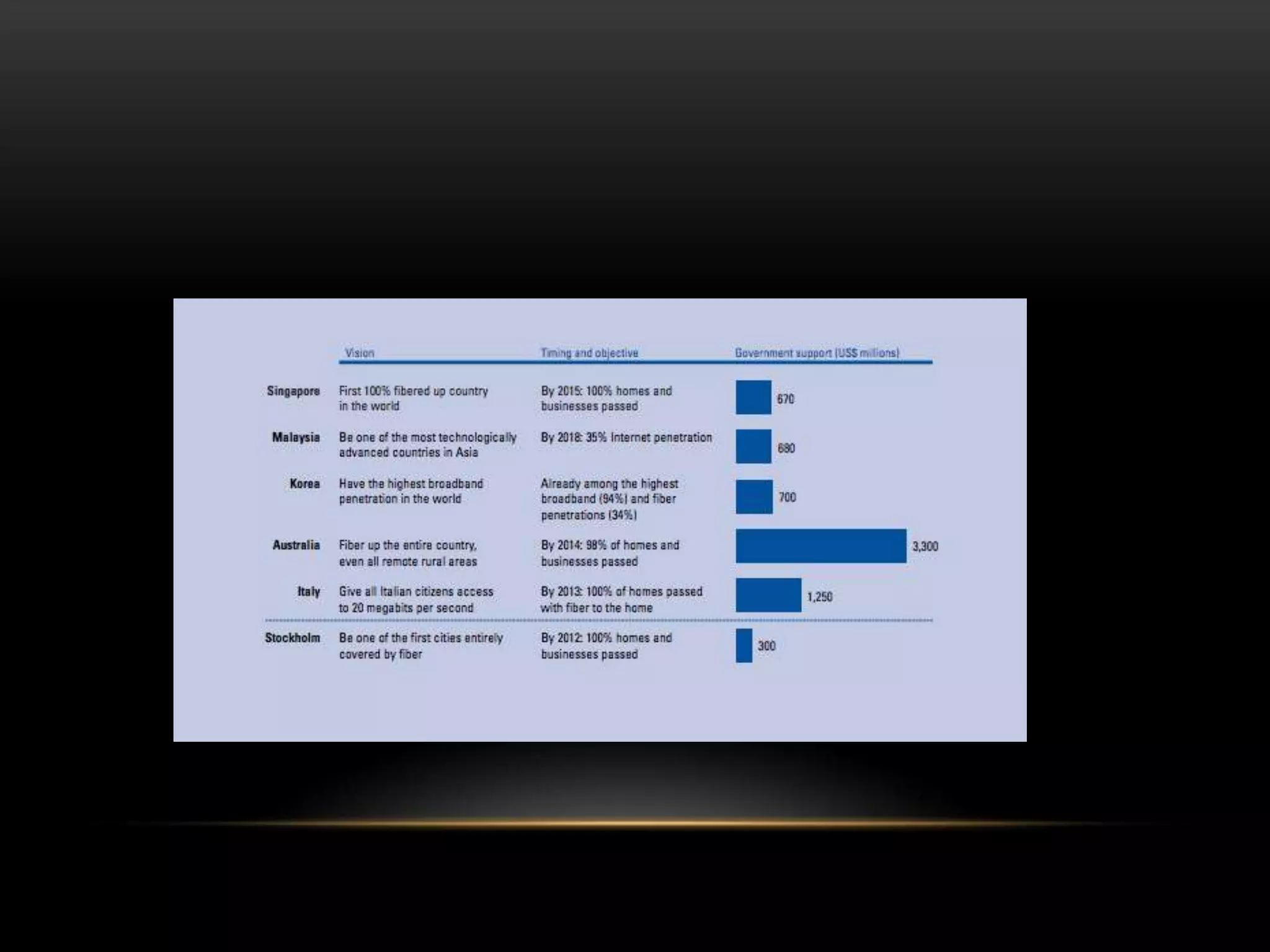
          • Great affect on cost, speed, and transparency of market based transactions
          • Ex) Singapore


•   Impact on Education:
     • Jordan Education Initiative
     • Reading Companion Education Program in South Africa
IMPORTANCE OF CREATING A NATIONAL
            E-DEVELOPMENT STRATEGY
•   Raise awareness and show commitment to action.
•   Build coalitions for policy and institutional reforms.
•   Clarify roles, build public-private partnerships, and facilitate participation by all
    stakeholders, including NGOs.
•   Help policy makers and other stakeholders focus, prioritize, sequence, and phase
    investments and complementary efforts.
CONCLUSION: POLICY IMPERATIVES
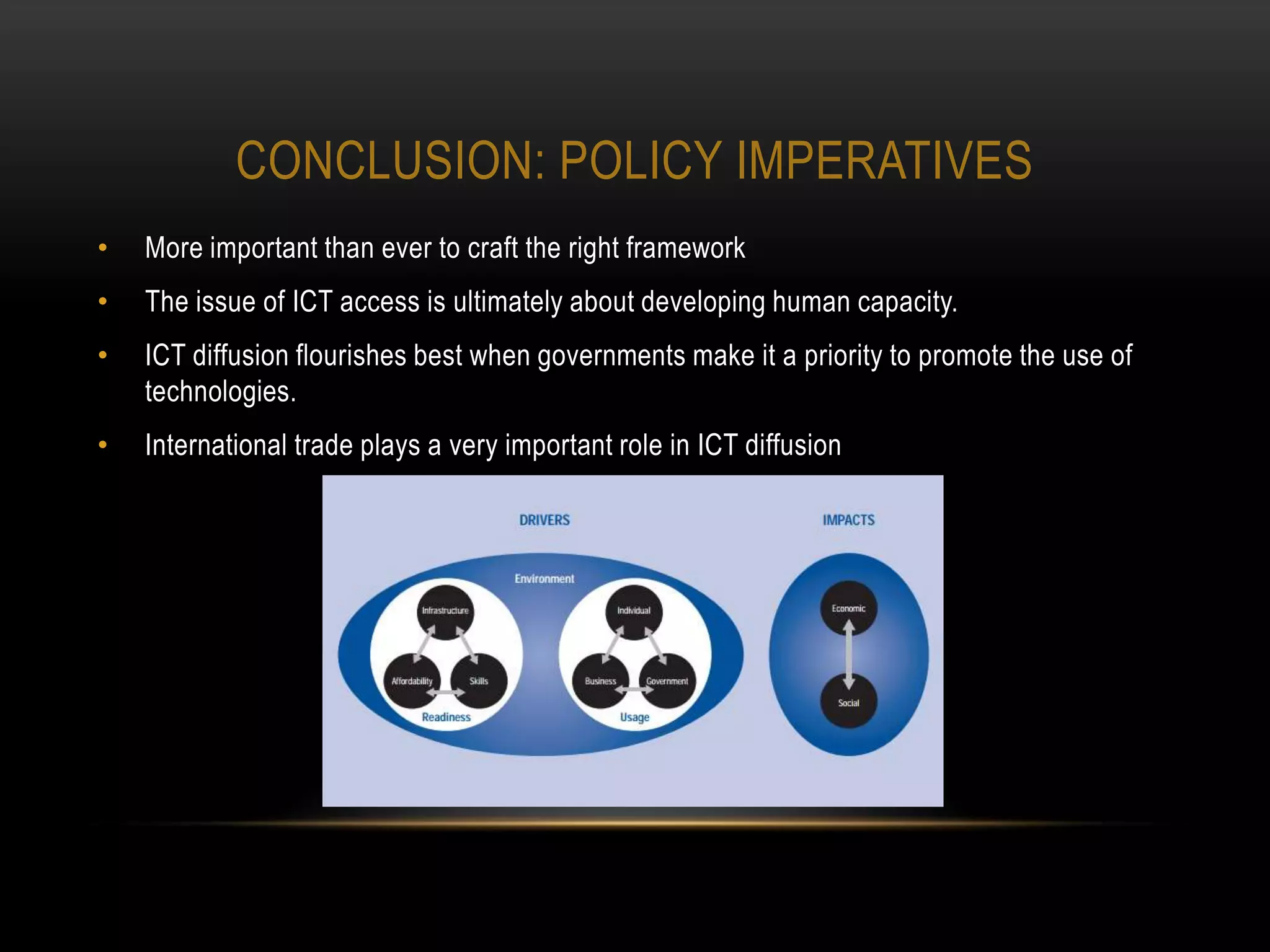
•   More important than ever to craft the right framework
•   The issue of ICT access is ultimately about developing human capacity.
•   ICT diffusion flourishes best when governments make it a priority to promote the use of
    technologies.
•   International trade plays a very important role in ICT diffusion
WORK CITED:
•   Barr, D.F. 1998. “Integrated Rural Development through Telecommunications.” In D. Richardson and L. Paisley (Eds.) The
    First Mile of Connectivity. Rome: FAO. Pp. 152-67
•   Clarke, G.R.G. (2001). Bridging the Digital Divide: How Enterprise Ownership and Foreign Competition Affect Internet Access
    in Eastern Europe and Central Asia. Washington, DC: Development Research Group, World Bank, July.
•   Eggleston, Jensen and Zekhauser (2002) “ Information and Communication Technologies, Markets and Economic
    Development”, The Global Information
•   GITR, 2003 Dutta, Soumitra; Lanvin, Bruno; Paua, Fiona. The Global Information Technology Report 2003-2004. New
    York, Oxford. Print.
•   GITR, 2009 Dutta, Soumitra, and Irene Mia. The Global Information Technology Report 2009-2010. Houndmills, Basingstoke:
    Palgrave MacMillan, Print.
•   Hanna, Nagy K. Why National Strategies Are Needed for ICT-enabled Development. Working paper no. No. 3. ISGIA. World
    Bank. Web.
•   Haqqani, A.B (ed.) (2005). The Role of Information and Communication Technologies in Global Development: Analyses and
    Policy Recommendations. United Nations ICT Task Force. New York: United Nations Press.
•   ILO (2001). World Employment Report
•   IMF (2001). World Economic Outlook, The Information Technology Revolution
•   Lloyd, M. May 24, 2000. “Magic Box – A Lifeline to India’s Poor Famers.” www.scmp.com/News/Comment/Article/FullText asp
    ArticleID-20000524052040288.asp.
•   Project Mass Communication. January 24, 2000. http://www.hindubusinessline.com.
•   Quebral, N.C (2006). Development Communication in the Agricultural Context. Asian Journal of Communication, 16(1) 100-7.
•   Richardson, D. 1998b. “The Internet and Rural Development.” In D. Richardson and L. Paisley (Eds.). The First Mile of
    Connectivity. Rome: FAO pp. 170-81
•
WORK CITED CONT.
•   Shea, Timothy, Godwin Ariguzo and D. Steven White (2006), “Putting the World in the World Wide Web: The
    Globalization of the Internet”, International Journal of Business Information Systems , Vol. 2, No. 1, pp. 75-98.
•   United Nations (2000b). Report of the Meeting of the High-Level Panel of Experts on Information and
    Communication Technology. New York: United Nations, April 17-20
•   United Nations Development Programme (2005). Human Development Report 2005: International Cooperation at a
    Crossroads. Aid, Trade and Security in an Unequal World. New York: United Nations.
•   Zhao, HongXin (2002), “Rapid Internet Development in China: A Discussion of Opportunities and Constraints on
    Future Growth”, Thunderbird International Business Review, Vol. 44, No. 1, pp.119 -138.

Capstone Presentation

  • 1.
    THE ICT REVOLUTION WhyNational Strategies are needed for ICT-enabled Development By: Craig Olsen
  • 2.
    TOPICS THAT WILLBE ADDRESSED: • The effects ICT would have on rural development and the possibilities that can come from ICT integration. • Case studies of local-level projects in attempt to increase rural development. • A broad view of the promises and risks of the ICT revolution, and its potential impact on markets and education. • An examination of why developing countries should look ahead and try to adapt and harness ICT in support of economic and social development. • Policy Imperatives developing countries must follow.
  • 3.
    INTERESTING QUOTES: • “Just as participation in the physical economy requires access to roads, bridges, and vehicles to transport goods, similar infrastructure is needed in the virtual and knowledge economy. However, here the highway is the Internet and other networks, bridges are interoperable data standards, and vehicles are computers and databases.” • Francis Gurry (Current Director General of WIPO) • “Some aid practitioners view ICT as a threat to established sectors and ways of doing business, and there is subtle but pervasive resistance to the required changes to mainstream ICT into development. Others view this fundamental technological change as an opportunity for developing countries to address old age development problems and innovate new means to achieve basic development goals in the context of new global realities.” • Nagy Hanna, (Senior Advisor on e-development at the World Bank)
  • 4.
    ICT FOR RURALDEVELOPMENT • Supporters of ICTs have advocated integrated rural development through telecommunications by highlighting many of their uses and applications in developing countries: • Finding markets for farm produce, fishery catches, and handicraft products; negotiating prices, and arranging for transportation. • Arranging for the delivery of inputs such as raw materials, supplies, and tools. • Obtaining and distributing information rapidly on markets, prices, consumption trends, and inventory. • Expanding educational opportunities such as distance learning. • Facilitating quick and easy ways to stay in touch with family members, relatives, and friends.
  • 5.
    CASE STUDIES OFTHE USE OF ICT IN RURAL DEVELOPMENT • Kotmale Project • Project in the rural areas of Warana and Baramati • Project in the state of Madhya Pradesh in Central India.
  • 6.
    WORLD BANK PERSPECTIVEOF ICT INTEGRATION • Has continued to show strong support for the integration of ICTs in developing countries. • Acknowledge that there are threats and uncertainties that go along with the territory of ICT integration, but believe that the long-term benefits hold great promise and hope for developing countries. • They argue that if mainstream development practitioners continue to ignore the potential roles of ICT, it can pose serious risks to development effectiveness. • Attributes of ICT Revolution: • Productivity revolution • Knowledge revolution • Learning revolution • Innovation-driven economy
  • 7.
    POTENTIAL IMPACTS OFICT INTEGRATION • Impact on Markets: • Great affect on cost, speed, and transparency of market based transactions • Ex) Singapore • Impact on Education: • Jordan Education Initiative • Reading Companion Education Program in South Africa
  • 8.
    IMPORTANCE OF CREATINGA NATIONAL E-DEVELOPMENT STRATEGY • Raise awareness and show commitment to action. • Build coalitions for policy and institutional reforms. • Clarify roles, build public-private partnerships, and facilitate participation by all stakeholders, including NGOs. • Help policy makers and other stakeholders focus, prioritize, sequence, and phase investments and complementary efforts.
  • 10.
    CONCLUSION: POLICY IMPERATIVES • More important than ever to craft the right framework • The issue of ICT access is ultimately about developing human capacity. • ICT diffusion flourishes best when governments make it a priority to promote the use of technologies. • International trade plays a very important role in ICT diffusion
  • 11.
    WORK CITED: • Barr, D.F. 1998. “Integrated Rural Development through Telecommunications.” In D. Richardson and L. Paisley (Eds.) The First Mile of Connectivity. Rome: FAO. Pp. 152-67 • Clarke, G.R.G. (2001). Bridging the Digital Divide: How Enterprise Ownership and Foreign Competition Affect Internet Access in Eastern Europe and Central Asia. Washington, DC: Development Research Group, World Bank, July. • Eggleston, Jensen and Zekhauser (2002) “ Information and Communication Technologies, Markets and Economic Development”, The Global Information • GITR, 2003 Dutta, Soumitra; Lanvin, Bruno; Paua, Fiona. The Global Information Technology Report 2003-2004. New York, Oxford. Print. • GITR, 2009 Dutta, Soumitra, and Irene Mia. The Global Information Technology Report 2009-2010. Houndmills, Basingstoke: Palgrave MacMillan, Print. • Hanna, Nagy K. Why National Strategies Are Needed for ICT-enabled Development. Working paper no. No. 3. ISGIA. World Bank. Web. • Haqqani, A.B (ed.) (2005). The Role of Information and Communication Technologies in Global Development: Analyses and Policy Recommendations. United Nations ICT Task Force. New York: United Nations Press. • ILO (2001). World Employment Report • IMF (2001). World Economic Outlook, The Information Technology Revolution • Lloyd, M. May 24, 2000. “Magic Box – A Lifeline to India’s Poor Famers.” www.scmp.com/News/Comment/Article/FullText asp ArticleID-20000524052040288.asp. • Project Mass Communication. January 24, 2000. http://www.hindubusinessline.com. • Quebral, N.C (2006). Development Communication in the Agricultural Context. Asian Journal of Communication, 16(1) 100-7. • Richardson, D. 1998b. “The Internet and Rural Development.” In D. Richardson and L. Paisley (Eds.). The First Mile of Connectivity. Rome: FAO pp. 170-81 •
  • 12.
    WORK CITED CONT. • Shea, Timothy, Godwin Ariguzo and D. Steven White (2006), “Putting the World in the World Wide Web: The Globalization of the Internet”, International Journal of Business Information Systems , Vol. 2, No. 1, pp. 75-98. • United Nations (2000b). Report of the Meeting of the High-Level Panel of Experts on Information and Communication Technology. New York: United Nations, April 17-20 • United Nations Development Programme (2005). Human Development Report 2005: International Cooperation at a Crossroads. Aid, Trade and Security in an Unequal World. New York: United Nations. • Zhao, HongXin (2002), “Rapid Internet Development in China: A Discussion of Opportunities and Constraints on Future Growth”, Thunderbird International Business Review, Vol. 44, No. 1, pp.119 -138.