Pratiksha Mishra
II semester
MS Communication
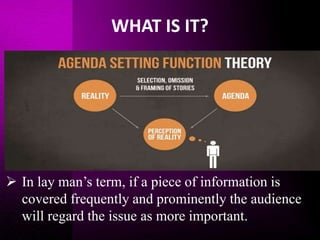
WHAT IS IT?
 In lay man’s term, if a piece of information is
covered frequently and prominently the audience
will regard the issue as more important.
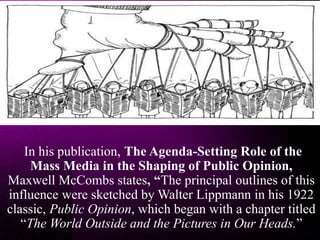
In his publication, The Agenda-Setting Role of the
Mass Media in the Shaping of Public Opinion,
Maxwell McCombs states, “The principal outlines of this
influence were sketched by Walter Lippmann in his 1922
classic, Public Opinion, which began with a chapter titled
“The World Outside and the Pictures in Our Heads.”
FOUNDING FATHERS
Developed and published in 1972 by:-
Dr. Max McCombs Dr. Donald Shaw
• Based on the 1968, US Elections, contested between
Richard Nixon(R)* and Hurbert Humphrey(D).
• Nixon had promised to restore the law and order of the
state.
CORE ASSUMPTIONS
It is the creation of public awareness and concern of
salient issues by the news media.
 The press and the media do not reflect reality; they
filter and shape it
 Media concentration on a few issues and subjects
leads the public to perceive those issues as more
important than other issues.
 The time frame for this phenomenon is very crucial.
 Different media have different agenda-setting
potential.
TYPES
1) Public agenda setting, in which the public's agenda
is the dependent variable.
- Influenced by opinion leaders
2) Media agenda setting, in which the media's agenda
is treated as the dependent
- Influenced by media
3) Policy agenda setting, in which elite policy
makers' agendas are treated as the dependent variable
- Influenced by the government.
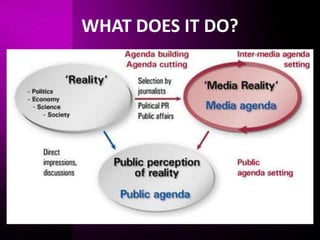
WHAT DOES IT DO?
IN THE INDIAN CONTEXT
 The 2014 Union Elections:-
 The NaMo Wave
 The Prince Vs The Pracharak
 The 2015 Delhi Elections:-
 Mufflerman vs Rs 10 lakh suit man
 Congress's loss is AAP's gain
ANOTHER HIGHLIGHT
Uses and Gratifications Research
There is another research tradition that denies that the
press has awesome power. The uses and gratifications
approach to the mass media, however, stresses
intrapersonal needs rather than interpersonal factors.
Instead of regarding mass media as principally
disseminators of news/information and wielders of
power/influence, this research tradition assumes they are
primarily sources of diversion, gratifiers of individual
needs, and entertaining outlets for personal escape.
With this assumption, researchers investigate how people
use a particular medium for their individual purposes.
THANK YOU
…..any questions?

Agenda setting- Communication Theory

  • 1.
  • 2.
    WHAT IS IT? In lay man’s term, if a piece of information is covered frequently and prominently the audience will regard the issue as more important.
  • 3.
    In his publication,The Agenda-Setting Role of the Mass Media in the Shaping of Public Opinion, Maxwell McCombs states, “The principal outlines of this influence were sketched by Walter Lippmann in his 1922 classic, Public Opinion, which began with a chapter titled “The World Outside and the Pictures in Our Heads.”
  • 4.
    FOUNDING FATHERS Developed andpublished in 1972 by:- Dr. Max McCombs Dr. Donald Shaw • Based on the 1968, US Elections, contested between Richard Nixon(R)* and Hurbert Humphrey(D). • Nixon had promised to restore the law and order of the state.
  • 5.
    CORE ASSUMPTIONS It isthe creation of public awareness and concern of salient issues by the news media.  The press and the media do not reflect reality; they filter and shape it  Media concentration on a few issues and subjects leads the public to perceive those issues as more important than other issues.  The time frame for this phenomenon is very crucial.  Different media have different agenda-setting potential.
  • 6.
    TYPES 1) Public agendasetting, in which the public's agenda is the dependent variable. - Influenced by opinion leaders 2) Media agenda setting, in which the media's agenda is treated as the dependent - Influenced by media 3) Policy agenda setting, in which elite policy makers' agendas are treated as the dependent variable - Influenced by the government.
  • 7.
  • 8.
    IN THE INDIANCONTEXT  The 2014 Union Elections:-  The NaMo Wave  The Prince Vs The Pracharak  The 2015 Delhi Elections:-  Mufflerman vs Rs 10 lakh suit man  Congress's loss is AAP's gain
  • 9.
    ANOTHER HIGHLIGHT Uses andGratifications Research There is another research tradition that denies that the press has awesome power. The uses and gratifications approach to the mass media, however, stresses intrapersonal needs rather than interpersonal factors. Instead of regarding mass media as principally disseminators of news/information and wielders of power/influence, this research tradition assumes they are primarily sources of diversion, gratifiers of individual needs, and entertaining outlets for personal escape. With this assumption, researchers investigate how people use a particular medium for their individual purposes.
  • 10.

Editor's Notes

  • #5 Additional Read:- http://en.wikipedia.org/wiki/United_States_presidential_election,_1968