
 Used as an extended synonym for information
technology (IT).
 Refers to the convergence of audio-visual and
telephone networks with computer networks.
 Term ICT became popular in 1997 and was First
used by academic researchers in 1980. (source)
 ICT and education today. (source)
ICT
• INTERNET (source)
• WIRELESS NETWORK
• CELLPHONES
• REALTIME COMMUNICATION
• INSTANT MESSAGING
• VOICE OVER INTERNET PROTOCOL (VOIP)
• VIDEO CONFERENCING
• SOCIAL NETWORKING ( Facebook, twitter,
whatsapp,etc)
• PROVIDING LEARNING OPPORTUNITIES FOR
INDIVISUALS IN CHALLENGED CIRCUMSTANCES
• CREATING OPEN AND VIRTUAL LEARNING
ENVIRONMENT
• IMPROVING THE QUALITY OF LEARNING
• PROFESSIONAL DEVELOPMENT OF TEACHERS
• RESOURCE SHARING
• DEMAND FOR MORE EDUCATION
• INFORMATION EXPLOSION
• SHORT SUPPLY OF TALENT
• REACHING LEARNERS IN REMOTE
COMMUNITIES
• TAKING EDUCATION TO GIRLS
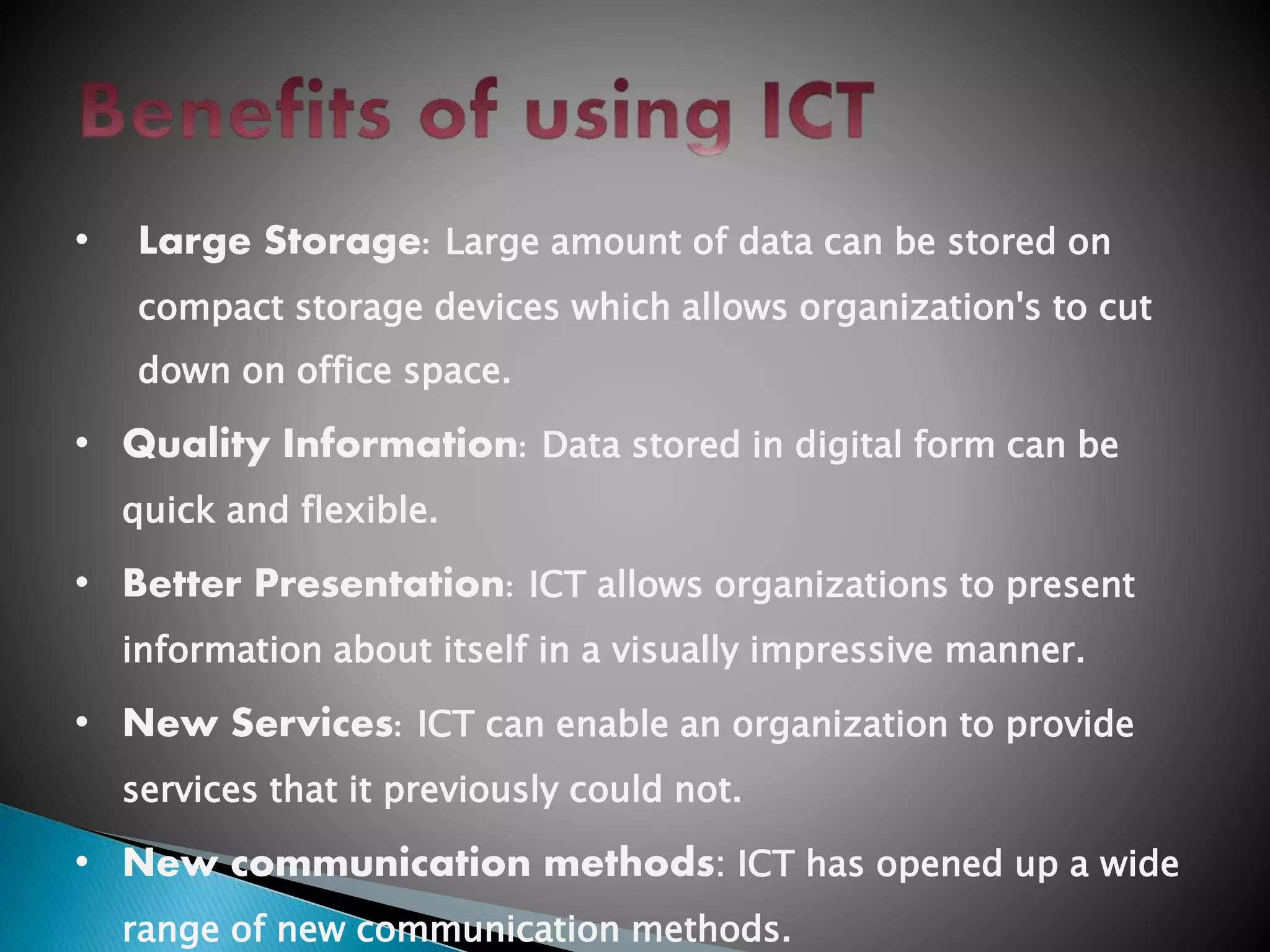
• Large Storage: Large amount of data can be stored on
compact storage devices which allows organization's to cut
down on office space.
• Quality Information: Data stored in digital form can be
quick and flexible.
• Better Presentation: ICT allows organizations to present
information about itself in a visually impressive manner.
• New Services: ICT can enable an organization to provide
services that it previously could not.
• New communication methods: ICT has opened up a wide
range of new communication methods.
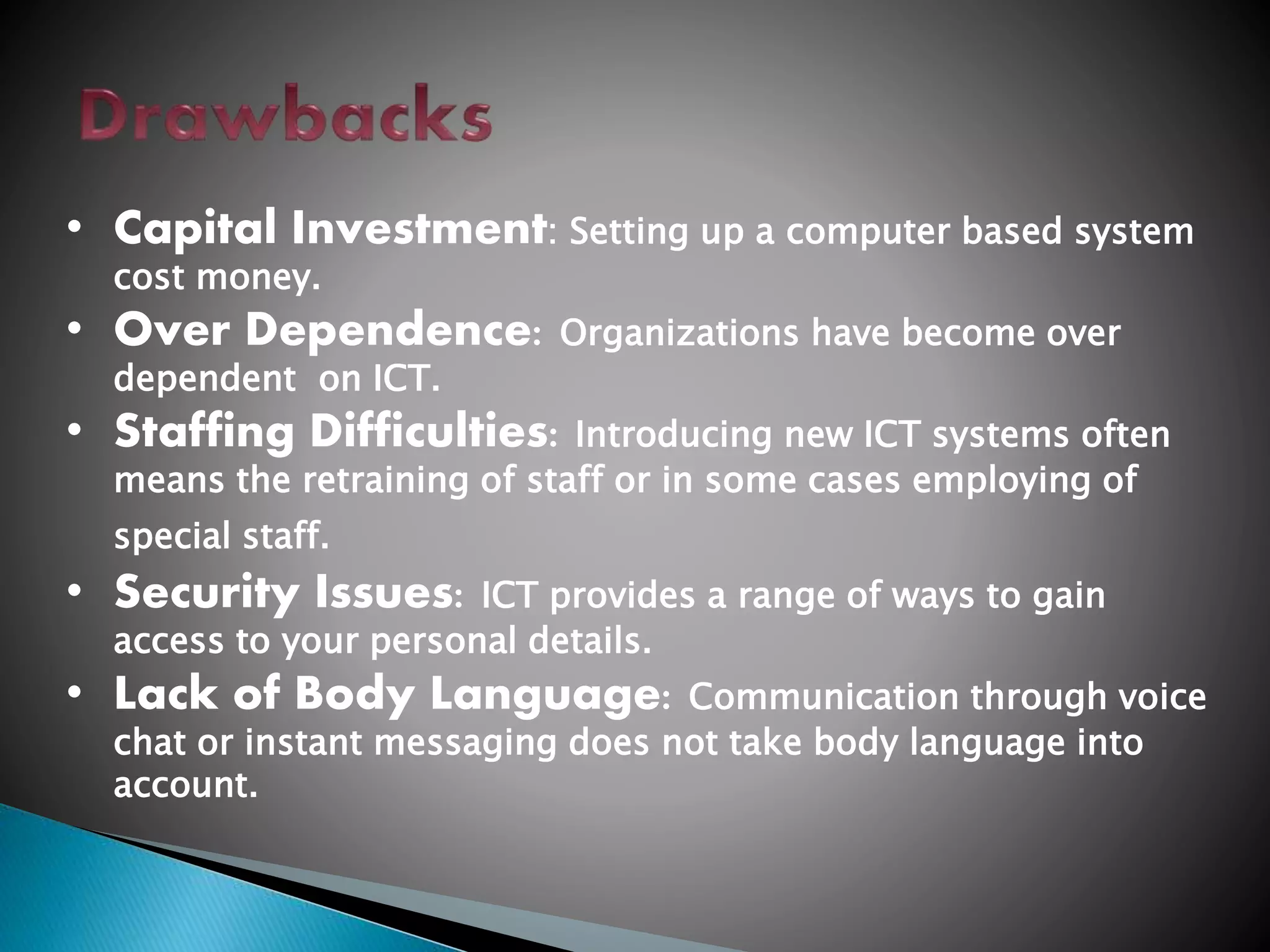
• Capital Investment: Setting up a computer based system
cost money.
• Over Dependence: Organizations have become over
dependent on ICT.
• Staffing Difficulties: Introducing new ICT systems often
means the retraining of staff or in some cases employing of
special staff.
• Security Issues: ICT provides a range of ways to gain
access to your personal details.
• Lack of Body Language: Communication through voice
chat or instant messaging does not take body language into
account.
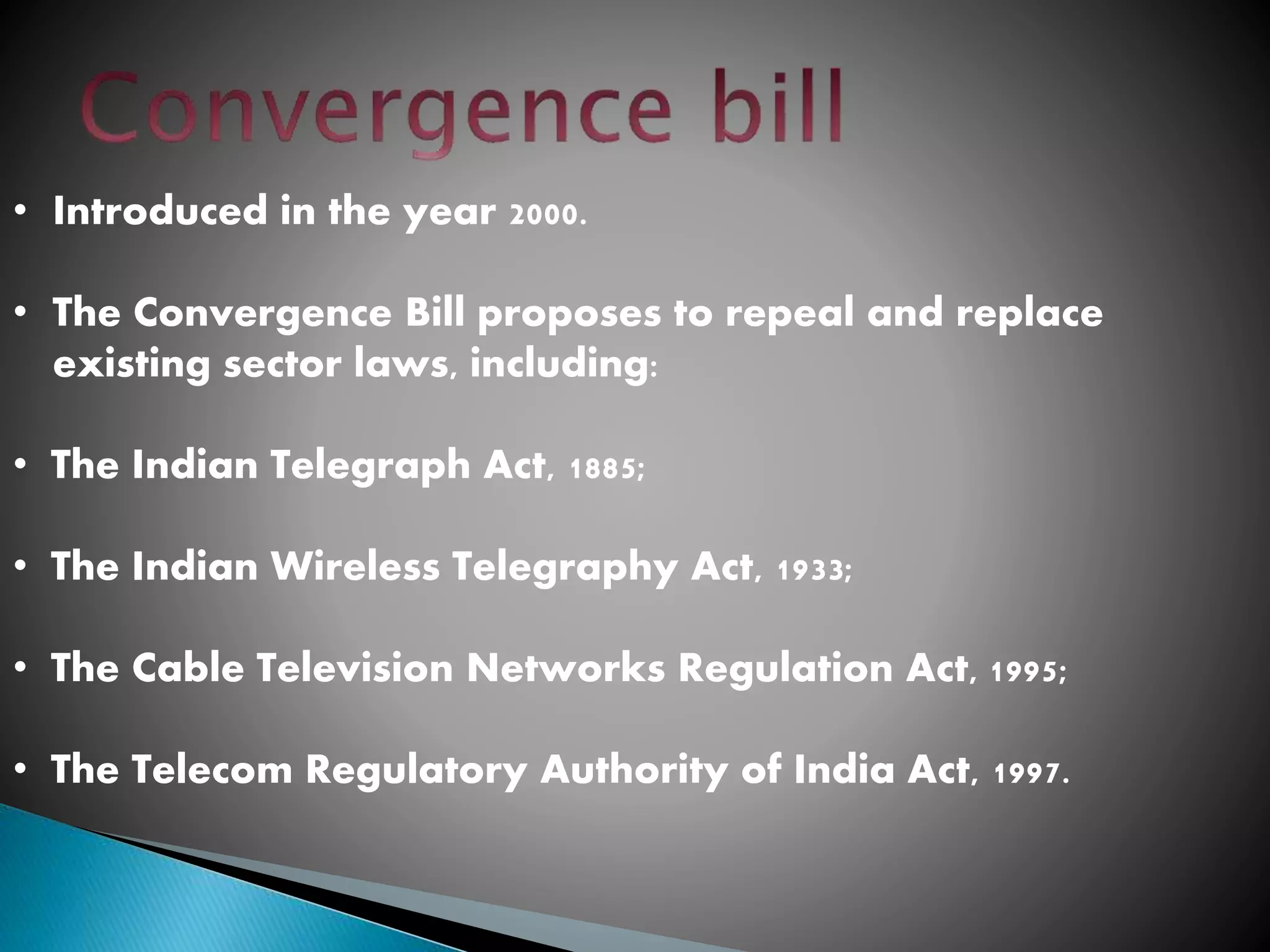
• Introduced in the year 2000.
• The Convergence Bill proposes to repeal and replace
existing sector laws, including:
• The Indian Telegraph Act, 1885;
• The Indian Wireless Telegraphy Act, 1933;
• The Cable Television Networks Regulation Act, 1995;
• The Telecom Regulatory Authority of India Act, 1997.
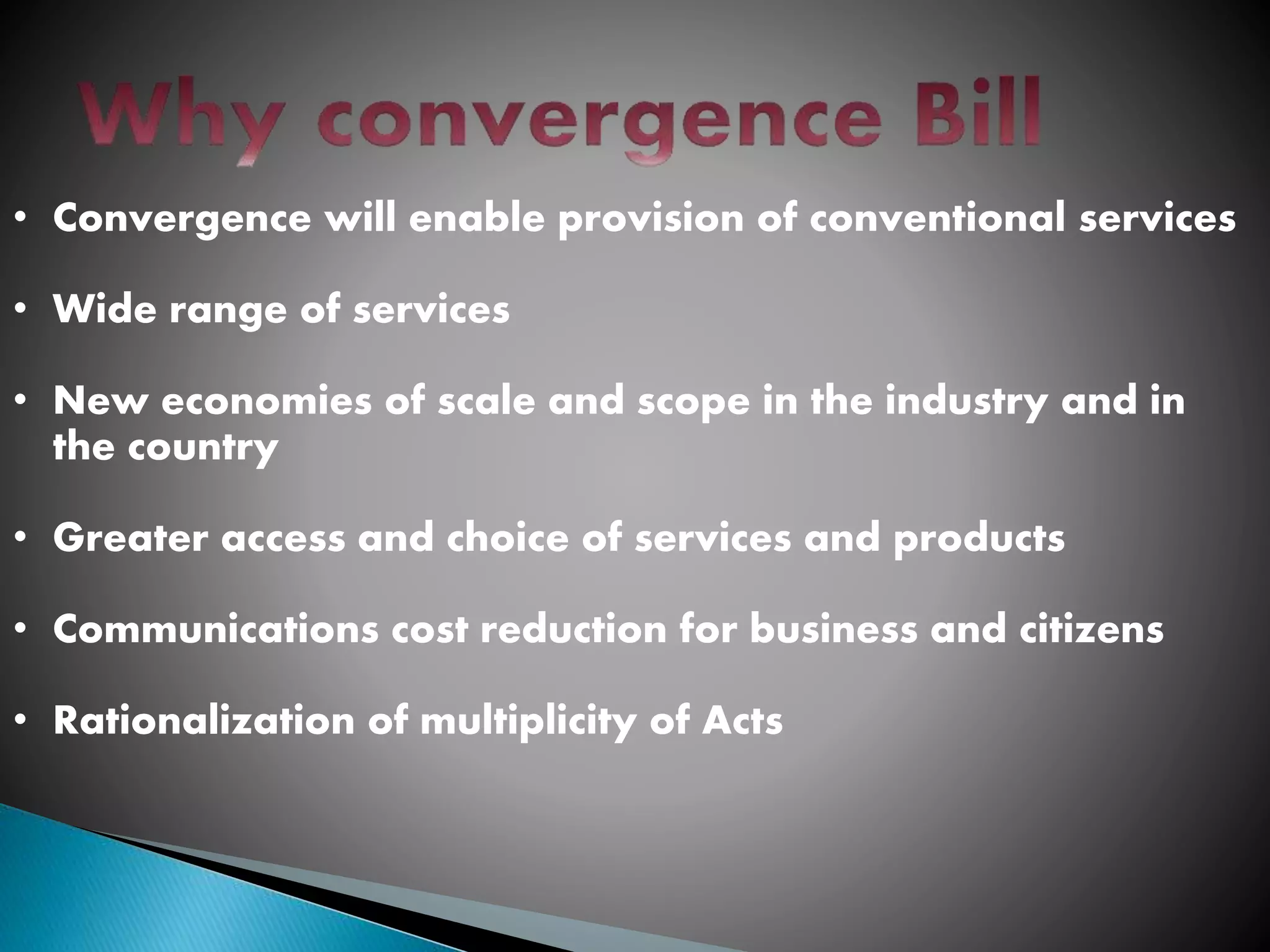
• Convergence will enable provision of conventional services
• Wide range of services
• New economies of scale and scope in the industry and in
the country
• Greater access and choice of services and products
• Communications cost reduction for business and citizens
• Rationalization of multiplicity of Acts
The main objectives of the Convergence Bill are:
• To facilitate development of a national communications
infrastructure, in order to provide a wide choice of
services to consumers.
• To establish a regulatory framework that addresses the
convergence of technologies, and defines the powers
and roles of a single regulatory and licensing authority
for broadcasting, telecommunications and multimedia.
• To establish a basis for codes and standards for
broadcasting content.
• The convergence Bill recognizes the Republic’s national
objective of universal service and access
• Convergence of electronic communications:
• Telecommunications
• Broadcasting
• Internet and data communications
The phrase information and communication technology
has been used by academic researchers since 1980s and the
abbreviation ICT became popular after it was used in a report to
the UK government by DENNIS STEVENSON in 1997 and in the
revised national curriculum for England, Wales and Northern
Ireland in 2000.But in 2012 the Royal society recommended that
ICT should no longer be used in British schools as it has attracted
too many negative connotations, and with this being in effect
since 2014 the national curriculum began to utilize the word
computing which reflects the addition of computer programming
into the curriculum. A leading group of universities consider ICT to
be a soft subject and thus advise students against studying A-level
ICT, preferring A-level computer science instead.
In modern society ict is omnipresent with over
3 billion people having access to the internet with
approximately 8 out of 10 internet users owning a smart
phone, information and data are increased leaps and
bounds. This rapid growth especially in developing
countries has led ICT to become a keystone of everyday life
in which life without some facet of technology renders
most of clerical work and routine tasks dysfunctional.
The most recent authoritative data released in 2014 shows that the internet use
continues to grow steadily at 6.6 percent globally in 2014 { 3.3% in developed
countries, 8.7% in the developing world} the number of internet users in developing
countries has doubled in 5 years 2009-2014 with 2/3 of all people online now living
in the developing world.
However hurdles are still at large of the 4.3 billion people not yet using the internet,
90% live in the developing countries. In the worlds 42 least connected countries
which are home to 2.5 billion people, Access to ICTs remain largely out of reach,
particularly for these countries large rural populations.ICT has yet to penetrate the
remote areas of some countries, it includes the availability of telephone lines,
cellular coverage and other forms of electronic transmission of data. And estimated
450 million people worldwide live in places which are still out of reach cellular
services.
Information and communication technology can contribute to
universal access to education, equity in education, the delivery of
quality learning and teaching, teacher’s professional development and
more efficient education management, governance and
administration. UNSCO takes a holistic and comprehensive approach
to promoting ICT in education.
Access, inclusion and quality are among the main challenges they can
address. The organizations intersectral platform for ICT in education
focuses on these issues through the joint work of three of its sectors:
communication and information, education and science

Information and Communication Technology (ICT)

  • 1.
     Used asan extended synonym for information technology (IT).  Refers to the convergence of audio-visual and telephone networks with computer networks.  Term ICT became popular in 1997 and was First used by academic researchers in 1980. (source)  ICT and education today. (source) ICT
  • 2.
    • INTERNET (source) •WIRELESS NETWORK • CELLPHONES • REALTIME COMMUNICATION • INSTANT MESSAGING • VOICE OVER INTERNET PROTOCOL (VOIP) • VIDEO CONFERENCING • SOCIAL NETWORKING ( Facebook, twitter, whatsapp,etc)
  • 3.
    • PROVIDING LEARNINGOPPORTUNITIES FOR INDIVISUALS IN CHALLENGED CIRCUMSTANCES • CREATING OPEN AND VIRTUAL LEARNING ENVIRONMENT • IMPROVING THE QUALITY OF LEARNING • PROFESSIONAL DEVELOPMENT OF TEACHERS • RESOURCE SHARING
  • 4.
    • DEMAND FORMORE EDUCATION • INFORMATION EXPLOSION • SHORT SUPPLY OF TALENT • REACHING LEARNERS IN REMOTE COMMUNITIES • TAKING EDUCATION TO GIRLS
  • 5.
    • Large Storage:Large amount of data can be stored on compact storage devices which allows organization's to cut down on office space. • Quality Information: Data stored in digital form can be quick and flexible. • Better Presentation: ICT allows organizations to present information about itself in a visually impressive manner. • New Services: ICT can enable an organization to provide services that it previously could not. • New communication methods: ICT has opened up a wide range of new communication methods.
  • 6.
    • Capital Investment:Setting up a computer based system cost money. • Over Dependence: Organizations have become over dependent on ICT. • Staffing Difficulties: Introducing new ICT systems often means the retraining of staff or in some cases employing of special staff. • Security Issues: ICT provides a range of ways to gain access to your personal details. • Lack of Body Language: Communication through voice chat or instant messaging does not take body language into account.
  • 7.
    • Introduced inthe year 2000. • The Convergence Bill proposes to repeal and replace existing sector laws, including: • The Indian Telegraph Act, 1885; • The Indian Wireless Telegraphy Act, 1933; • The Cable Television Networks Regulation Act, 1995; • The Telecom Regulatory Authority of India Act, 1997.
  • 8.
    • Convergence willenable provision of conventional services • Wide range of services • New economies of scale and scope in the industry and in the country • Greater access and choice of services and products • Communications cost reduction for business and citizens • Rationalization of multiplicity of Acts
  • 9.
    The main objectivesof the Convergence Bill are: • To facilitate development of a national communications infrastructure, in order to provide a wide choice of services to consumers. • To establish a regulatory framework that addresses the convergence of technologies, and defines the powers and roles of a single regulatory and licensing authority for broadcasting, telecommunications and multimedia. • To establish a basis for codes and standards for broadcasting content.
  • 10.
    • The convergenceBill recognizes the Republic’s national objective of universal service and access • Convergence of electronic communications: • Telecommunications • Broadcasting • Internet and data communications
  • 12.
    The phrase informationand communication technology has been used by academic researchers since 1980s and the abbreviation ICT became popular after it was used in a report to the UK government by DENNIS STEVENSON in 1997 and in the revised national curriculum for England, Wales and Northern Ireland in 2000.But in 2012 the Royal society recommended that ICT should no longer be used in British schools as it has attracted too many negative connotations, and with this being in effect since 2014 the national curriculum began to utilize the word computing which reflects the addition of computer programming into the curriculum. A leading group of universities consider ICT to be a soft subject and thus advise students against studying A-level ICT, preferring A-level computer science instead.
  • 13.
    In modern societyict is omnipresent with over 3 billion people having access to the internet with approximately 8 out of 10 internet users owning a smart phone, information and data are increased leaps and bounds. This rapid growth especially in developing countries has led ICT to become a keystone of everyday life in which life without some facet of technology renders most of clerical work and routine tasks dysfunctional.
  • 14.
    The most recentauthoritative data released in 2014 shows that the internet use continues to grow steadily at 6.6 percent globally in 2014 { 3.3% in developed countries, 8.7% in the developing world} the number of internet users in developing countries has doubled in 5 years 2009-2014 with 2/3 of all people online now living in the developing world. However hurdles are still at large of the 4.3 billion people not yet using the internet, 90% live in the developing countries. In the worlds 42 least connected countries which are home to 2.5 billion people, Access to ICTs remain largely out of reach, particularly for these countries large rural populations.ICT has yet to penetrate the remote areas of some countries, it includes the availability of telephone lines, cellular coverage and other forms of electronic transmission of data. And estimated 450 million people worldwide live in places which are still out of reach cellular services.
  • 15.
    Information and communicationtechnology can contribute to universal access to education, equity in education, the delivery of quality learning and teaching, teacher’s professional development and more efficient education management, governance and administration. UNSCO takes a holistic and comprehensive approach to promoting ICT in education. Access, inclusion and quality are among the main challenges they can address. The organizations intersectral platform for ICT in education focuses on these issues through the joint work of three of its sectors: communication and information, education and science