Interpretative
(Interpretive)
Reporting
What is interpretative reporting?
• . It is reporting news depth and with care, news refreshed with
  background materials to make it comprehensive and
  meaningful. - Lester Markel, editor, The Sunday New York
  Times
• It is objective judgment based on background knowledge of a
  situation or appraisal of an event which are essential parts of
  news. - Lester Markel
What is interpretative reporting?
• . It is about telling the reader everything he needs to know
  about a given development, and all the essential facts in a way
  that brings the story to the reader's environment. - Robert
  Bolorf, executive editor, The Wall Street Journal
• It is giving the reading public accurate information as fully as
  the importance of any story dictates. - Catledge, editor, The
  New York Times
Based on the following definitions,
interpretative reporting is more than
the recital of bare facts but reporting
news refreshed with background
materials to make it comprehensive
and meaningful. Interpretive
reporting uses skills in explanation,
analysis and description.
Interpretive (or interpretative)
journalism goes beyond the basic
facts of an event or topic to
provide context, analysis, and
possible consequences.
Interpretive journalists must have
unusual familiarity with and
understanding of a subject, and
their work involves looking for
patterns, motives, and influences
that explain what they are
reporting.
Interpretive journalism overlaps with
other forms of reporting
( Investigative Reporting ; Advocacy
Journalism ), in which journalists
themselves, after interviews and
reviews of documents and data, assert
who committed wrong or what
caused failure.
Here are the major phases that are
involved in interpretative
reporting:
 • Factual or fact-gathering phase - the first and, personally, the
   crucial stage, since, this stage will be the foundation of all the
   reports. With enough facts gathered, verified and rechecked,
   the reporter can then have more assurance of making a story
   stand.
 • Prophesy phase - the writer, like a scientist, makes an
   “educated guess” or like a hypothesis in science, where he can
   somehow predict, based on the FACTS, where his / her story is
   leading. Information from experts can verify if the “guess”
   may lead to something concrete.
 • Interpretation phase - this phase is the “fruit” of the two
   previous phases, where the reporter concludes on the
   MEANING, IMPORTANCE or EFFECT of all the reports. The
   reporter’s interpretation can be highlighted on this or an / the
   expert/s opinion on the matter.
In contrast to the opinion journalism,
which takes position to the topics
themselves, the interpretive
journalism tries to report objectively
and to quote therefore several points
of view. The journalist knows
however by selection and order of
these points of view under-smolder-
lies nevertheless a certain opinion to
represent.
As a result of adding extended
information from different
sources arises the interpretation
of the journalist, who is as
objective as possible and for who
readers arrange the background
of the event.
In interpretive journalism the
selection of the sources is
particularly important.
A high-quality interpretive article
contains sources of various kind and
particularly from various points of
view. Here the opinions of
Protagonist, in addition, of experts,
entangled into the message, who are
familiar with the respective topic, play
an important role.
what is the distinction between
objective journalism and
interpretive journalism?
Interpretive reporting takes the
facts from objective journalism
and adds context and analysis
Interpretive Writing should
Provoke, Relate, and Reveal!
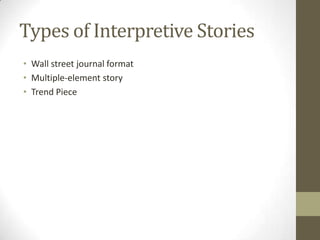
Types of Interpretive Stories
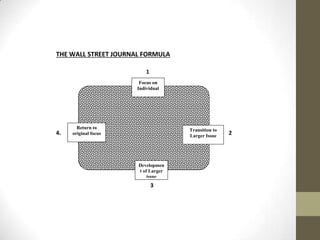
• Wall street journal format
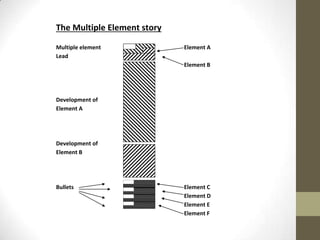
• Multiple-element story
• Trend Piece
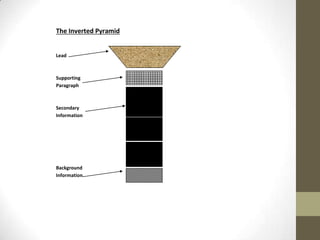
The Inverted Pyramid


Lead


Supporting
Paragraph


Secondary
Information


Background
Information
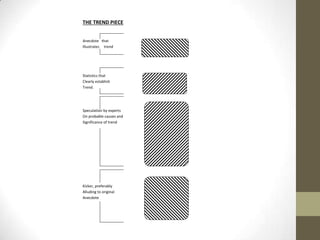
THE TREND PIECE


Anecdote that
Illustrates trend


Statistics that
Clearly establish
Trend.


Speculation by experts
On probable causes and
Significance of trend


Kicker, preferably
Alluding to original
Anecdote
THE WALL STREET JOURNAL FORMULA

                          1
                       Focus on
                      Individual


       Return to                    Transition to
4.   original focus                 Larger Issue
                                                    2


                      Developmen
                      t of Larger
                          issue
                              3
The Multiple Element story

Multiple element             Element A
Lead
                             Element B


Development of
Element A


Development of
Element B


Bullets                      Element C
                             Element D
                             Element E
                             Element F
The full flowering of interpretive
reporting, however, occurs in
stories that are not based on
events
These are enterprise stories:
trend stories, backgrounders,
analyses, “think” pieces,
investigative reports: that are
increasingly becoming the
hallmark of newspaper
journalism
They seek to identify the causes
of events rather than report on
their occurrence. Such stories
give the causes and
consequences of events.
Reporters are expected to keep
their personal opinions out of
print, although this often a
matter of form than of substance.
The control that reporters exert
over the content of interpretive
stories, both sources and facts,
makes it impossible to claim that
personal opinion is absent.
Professional acceptance of interpretive
reporting since the 1960s has brought
with it a number of variations in
journalistic style and method – the new
journalism, activism and advocacy,
adversary journalism, investigative
journalism, etc

Interpretative (interpretive) reporting

  • 1.
  • 2.
    What is interpretativereporting? • . It is reporting news depth and with care, news refreshed with background materials to make it comprehensive and meaningful. - Lester Markel, editor, The Sunday New York Times • It is objective judgment based on background knowledge of a situation or appraisal of an event which are essential parts of news. - Lester Markel
  • 3.
    What is interpretativereporting? • . It is about telling the reader everything he needs to know about a given development, and all the essential facts in a way that brings the story to the reader's environment. - Robert Bolorf, executive editor, The Wall Street Journal • It is giving the reading public accurate information as fully as the importance of any story dictates. - Catledge, editor, The New York Times
  • 4.
    Based on thefollowing definitions, interpretative reporting is more than the recital of bare facts but reporting news refreshed with background materials to make it comprehensive and meaningful. Interpretive reporting uses skills in explanation, analysis and description.
  • 5.
    Interpretive (or interpretative) journalismgoes beyond the basic facts of an event or topic to provide context, analysis, and possible consequences.
  • 6.
    Interpretive journalists musthave unusual familiarity with and understanding of a subject, and their work involves looking for patterns, motives, and influences that explain what they are reporting.
  • 7.
    Interpretive journalism overlapswith other forms of reporting ( Investigative Reporting ; Advocacy Journalism ), in which journalists themselves, after interviews and reviews of documents and data, assert who committed wrong or what caused failure.
  • 8.
    Here are themajor phases that are involved in interpretative reporting: • Factual or fact-gathering phase - the first and, personally, the crucial stage, since, this stage will be the foundation of all the reports. With enough facts gathered, verified and rechecked, the reporter can then have more assurance of making a story stand. • Prophesy phase - the writer, like a scientist, makes an “educated guess” or like a hypothesis in science, where he can somehow predict, based on the FACTS, where his / her story is leading. Information from experts can verify if the “guess” may lead to something concrete. • Interpretation phase - this phase is the “fruit” of the two previous phases, where the reporter concludes on the MEANING, IMPORTANCE or EFFECT of all the reports. The reporter’s interpretation can be highlighted on this or an / the expert/s opinion on the matter.
  • 9.
    In contrast tothe opinion journalism, which takes position to the topics themselves, the interpretive journalism tries to report objectively and to quote therefore several points of view. The journalist knows however by selection and order of these points of view under-smolder- lies nevertheless a certain opinion to represent.
  • 10.
    As a resultof adding extended information from different sources arises the interpretation of the journalist, who is as objective as possible and for who readers arrange the background of the event.
  • 11.
    In interpretive journalismthe selection of the sources is particularly important.
  • 12.
    A high-quality interpretivearticle contains sources of various kind and particularly from various points of view. Here the opinions of Protagonist, in addition, of experts, entangled into the message, who are familiar with the respective topic, play an important role.
  • 13.
    what is thedistinction between objective journalism and interpretive journalism?
  • 14.
    Interpretive reporting takesthe facts from objective journalism and adds context and analysis
  • 15.
  • 16.
    Types of InterpretiveStories • Wall street journal format • Multiple-element story • Trend Piece
  • 17.
  • 18.
    THE TREND PIECE Anecdotethat Illustrates trend Statistics that Clearly establish Trend. Speculation by experts On probable causes and Significance of trend Kicker, preferably Alluding to original Anecdote
  • 19.
    THE WALL STREETJOURNAL FORMULA 1 Focus on Individual Return to Transition to 4. original focus Larger Issue 2 Developmen t of Larger issue 3
  • 20.
    The Multiple Elementstory Multiple element Element A Lead Element B Development of Element A Development of Element B Bullets Element C Element D Element E Element F
  • 21.
    The full floweringof interpretive reporting, however, occurs in stories that are not based on events
  • 22.
    These are enterprisestories: trend stories, backgrounders, analyses, “think” pieces, investigative reports: that are increasingly becoming the hallmark of newspaper journalism
  • 23.
    They seek toidentify the causes of events rather than report on their occurrence. Such stories give the causes and consequences of events.
  • 24.
    Reporters are expectedto keep their personal opinions out of print, although this often a matter of form than of substance.
  • 25.
    The control thatreporters exert over the content of interpretive stories, both sources and facts, makes it impossible to claim that personal opinion is absent.
  • 26.
    Professional acceptance ofinterpretive reporting since the 1960s has brought with it a number of variations in journalistic style and method – the new journalism, activism and advocacy, adversary journalism, investigative journalism, etc