Community Radio
By
Dr. L.Muralikrishnan,
Scientist, Division of
Agricultural Extension,
ICAR-IARI,
New Delhi -12.
Community
Community is defined geographically, as well as in terms
of interest, language, cultural or ethnic groupings
What is Community Radio?
 Community radio stations are operated, owned, and
influenced by the communities they serve.
 They are generally non profit and provide a
mechanism for enabling individuals, groups, and
communities.
 Community radio stations serve geographic
communities' interest. They broadcast content that is
popular and relevant to a local, specific audience
Cont….
 It also helps in raising awareness and leads to the
development of a particular area.
 It plays an important role at the time of natural
disasters and calamities.
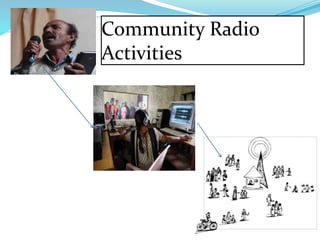
Community Radio
Activities
Characteristics of Community
Radio Station
 Small radio station
 Low power transmitter used
 Works on frequency modulation (FM) band
 Tower length is maximum 30 meters
Purpose of Community Radio
 Social welfare development
 Education
 Women empowerment
 Health and hygiene
 Natural resource conservation
 Agriculture
Basic Features of CR
 Not for profit making
 Community participation
 community radio is better at encouraging involvement
in the public sphere
Basic elements in CRS
 Hardware
Studio
Transmitters
Tower
Antenna and cable
 Soft ware
Training
Content
The medium of,
 An affordable technology (low cost)
 Easy to operate
 Portability (transistor radio)
 Accessibility
Everitt’s New Voices of Community Radio
• Reaching listeners who are underserved
• Facilitation of discussion and the expression of opinion
•Education or training for volunteers
•Better understanding of the community and the
strengthening of links
Cont…
• Delivery of services provided by local authorities
• Promotion of economic development and of social
enterprises
• The promotion of employment
• Gaining work experience
• Promotion of social inclusion
• Promotion of cultural and linguistic diversity
• Promotion of civic participation and volunteering
Role of Community Radio
Public sphere
 Community radio station a “common meeting
ground” for overlapping, even conflicting, local
public spheres
(Hochheimer 1993: 477)
Radical democracy
 Political action - an active striving in the socio-
political arena
 Appropriate “discursive conditions” must precede
political change
(Laclau & Mouffe 1985: 153)
Collective action
“Basis of the knowledge formation”
Implications for - participatory action
Conscientization
 The stages of ‘codification’ and ‘decodification’
aim to transform the social reality – to become
‘subjects’ of their own destiny
Hegemony
 ‘Community’ as an ‘articulation’ (Hall) of different social
actors and groups which is “neither necessary nor
inevitable [but] rather…contingent and volatile…a unity of
differences; a unity forged through symbol, ritual,
language and discursive practices”
(Howley 2005:6)
Identity
 “The contradictory movement of globalization and the
fragmentation of culture simultaneously involves the
revitalization and worldwide extension of the local” (ibid
p.636).
 Indigenous identities in the face of “their transformation
into ‘modern countries’ (ibid. p.635)
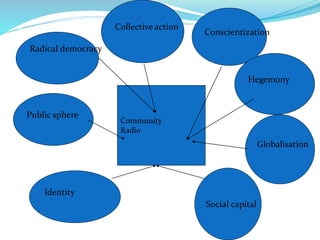
Community
Radio
Public sphere
Radical democracy
Collective action
Conscientization
Hegemony
Globalisation
Social capital
Identity
Issues
Access – providing individuals and communities with a
platform to express their views
Participation – non-professional media makers are
encouraged to be involved in the production process
Self-management - democratic structures;
involvement in policy and planning
Conclusion.
If we are to give CR with its proper attention,
there will have to be transformations of TOT
with effective socio-economic development.
references
Barlow, W. (1988) “Community Radio in the US: The Struggle for a Democratic Medium”, in Media,
Culture and Society, vol. 19, pp. 81-105.
Coyer, K., Dowmunt, T. and Fountain, A. (2007) The Alternative Media Handbook. London:
Routledge
Downing, J. (ed.) (2010) Encyclopedia of Social Movement Media. London: Sage
Downing, J. (2000) Radical Media: Rebellious Communication and Social Movements. CA:
Sage
Dunaway, David (1998) “Community radio at the beginning of the 21st century”, in The
Public/Javnost 5.2, 87-103.
Lewis, P. (1984) “Community Radio: The Montreal Conference and after”, in Media,
Culture and Society, vol. 6, pp. 137-150.
Prehn, O. (1992) “From Small Scale Utopianism to Large Scale Pragmatism. Trends and
Prospects for Community Orientated Local Radio and Television”, in Jankowski, N.,
Prehn, O. and Stappers, J. (eds.) The People’s Voice: Local Radio and Television in
Europe. London: John Libbey.
Rennie, E. (2006) Community Media: a Global Introduction. Oxford: Rowman &
Littlefield Publishers, Inc

Community radio

  • 1.
    Community Radio By Dr. L.Muralikrishnan, Scientist,Division of Agricultural Extension, ICAR-IARI, New Delhi -12.
  • 2.
    Community Community is definedgeographically, as well as in terms of interest, language, cultural or ethnic groupings
  • 3.
    What is CommunityRadio?  Community radio stations are operated, owned, and influenced by the communities they serve.  They are generally non profit and provide a mechanism for enabling individuals, groups, and communities.  Community radio stations serve geographic communities' interest. They broadcast content that is popular and relevant to a local, specific audience
  • 4.
    Cont….  It alsohelps in raising awareness and leads to the development of a particular area.  It plays an important role at the time of natural disasters and calamities.
  • 5.
  • 6.
    Characteristics of Community RadioStation  Small radio station  Low power transmitter used  Works on frequency modulation (FM) band  Tower length is maximum 30 meters
  • 7.
    Purpose of CommunityRadio  Social welfare development  Education  Women empowerment  Health and hygiene  Natural resource conservation  Agriculture
  • 8.
    Basic Features ofCR  Not for profit making  Community participation  community radio is better at encouraging involvement in the public sphere
  • 9.
    Basic elements inCRS  Hardware Studio Transmitters Tower Antenna and cable  Soft ware Training Content
  • 10.
    The medium of, An affordable technology (low cost)  Easy to operate  Portability (transistor radio)  Accessibility
  • 11.
    Everitt’s New Voicesof Community Radio • Reaching listeners who are underserved • Facilitation of discussion and the expression of opinion •Education or training for volunteers •Better understanding of the community and the strengthening of links
  • 12.
    Cont… • Delivery ofservices provided by local authorities • Promotion of economic development and of social enterprises • The promotion of employment • Gaining work experience • Promotion of social inclusion • Promotion of cultural and linguistic diversity • Promotion of civic participation and volunteering
  • 13.
  • 14.
    Public sphere  Communityradio station a “common meeting ground” for overlapping, even conflicting, local public spheres (Hochheimer 1993: 477)
  • 15.
    Radical democracy  Politicalaction - an active striving in the socio- political arena  Appropriate “discursive conditions” must precede political change (Laclau & Mouffe 1985: 153)
  • 16.
    Collective action “Basis ofthe knowledge formation” Implications for - participatory action
  • 17.
    Conscientization  The stagesof ‘codification’ and ‘decodification’ aim to transform the social reality – to become ‘subjects’ of their own destiny
  • 18.
    Hegemony  ‘Community’ asan ‘articulation’ (Hall) of different social actors and groups which is “neither necessary nor inevitable [but] rather…contingent and volatile…a unity of differences; a unity forged through symbol, ritual, language and discursive practices” (Howley 2005:6)
  • 19.
    Identity  “The contradictorymovement of globalization and the fragmentation of culture simultaneously involves the revitalization and worldwide extension of the local” (ibid p.636).  Indigenous identities in the face of “their transformation into ‘modern countries’ (ibid. p.635)
  • 20.
    Community Radio Public sphere Radical democracy Collectiveaction Conscientization Hegemony Globalisation Social capital Identity
  • 21.
    Issues Access – providingindividuals and communities with a platform to express their views Participation – non-professional media makers are encouraged to be involved in the production process Self-management - democratic structures; involvement in policy and planning
  • 22.
    Conclusion. If we areto give CR with its proper attention, there will have to be transformations of TOT with effective socio-economic development.
  • 23.
    references Barlow, W. (1988)“Community Radio in the US: The Struggle for a Democratic Medium”, in Media, Culture and Society, vol. 19, pp. 81-105. Coyer, K., Dowmunt, T. and Fountain, A. (2007) The Alternative Media Handbook. London: Routledge Downing, J. (ed.) (2010) Encyclopedia of Social Movement Media. London: Sage Downing, J. (2000) Radical Media: Rebellious Communication and Social Movements. CA: Sage Dunaway, David (1998) “Community radio at the beginning of the 21st century”, in The Public/Javnost 5.2, 87-103. Lewis, P. (1984) “Community Radio: The Montreal Conference and after”, in Media, Culture and Society, vol. 6, pp. 137-150. Prehn, O. (1992) “From Small Scale Utopianism to Large Scale Pragmatism. Trends and Prospects for Community Orientated Local Radio and Television”, in Jankowski, N., Prehn, O. and Stappers, J. (eds.) The People’s Voice: Local Radio and Television in Europe. London: John Libbey. Rennie, E. (2006) Community Media: a Global Introduction. Oxford: Rowman & Littlefield Publishers, Inc